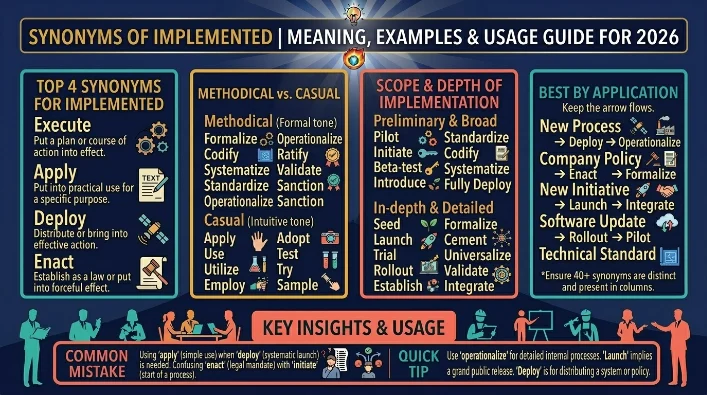
Implemented means putting a plan, idea, or system into action. The best synonyms include executed, applied, enforced, enacted, performed, actualized, realized, and carried out. The most common everyday synonym is carried out, while executed works best in professional contexts. Each synonym has a slightly different tone and fits different situations perfectly.
Top 10 Synonyms
- Executed
- Applied
- Enforced
- Enacted
- Performed
- Actualized
- Realized
- Carried out
- Put into practice
- Instituted
Every synonym has a slightly different meaning, tone, or context, so choose carefully based on your situation.
Do you find yourself using “implemented” again and again in emails, reports, and conversations? You’re not alone. It’s a useful word, but overusing it makes your writing sound repetitive and dull.
Learning synonyms for “implemented” helps you sound more professional and precise. Whether you’re writing a business report, describing a project, or explaining how something got done, having the right word makes your message clearer and more impressive.
In this guide, you’ll discover 35 powerful alternatives to “implemented.” You’ll learn their meanings, when to use them, and which ones native speakers prefer in different situations. Let’s get started!
What Does “Implemented” Mean?
Definition
Implemented means to put a decision, plan, agreement, or system into effect. It describes the action of making something happen—turning an idea from paper into reality.
In everyday terms, think of it like this: when you have a recipe, implementing it means actually cooking the meal. When a company has a new policy, implementing it means telling employees and making sure they follow it. It’s the bridge between planning and doing.
Implemented can describe:
- Putting a plan into action (“We implemented the new marketing strategy”)
- Enforcing rules or policies (“The school implemented stricter dress codes”)
- Starting new systems (“The hospital implemented a new patient records system”)
Pronunciation
| Feature | Value |
|---|---|
| US IPA | /ˈɪm.pləˌmɛn.tɪd/ |
| UK IPA | /ˈɪm.plɪ.mɛn.tɪd/ |
| Syllables | 4 (im-ple-ment-ed) |
| Tip | Stress the first syllable: IM-ple-men-ted |
Grammar
| Grammar Feature | Information |
|---|---|
| Part of Speech | Verb (past tense and past participle) |
| Common Position | After the subject, before the object |
| Typical Pattern | implement + something (plan/policy/system) |
Example Sentences:
- “The company implemented new safety procedures last month.”
- “We successfully implemented the software update across all departments.”
- “Teachers implemented the new curriculum in September.”
Grammar Note: “Implemented” is a regular verb. The base form is “implement,” and it follows standard past tense rules (add -ed).
Word Family
| Word | Part of Speech | Meaning |
|---|---|---|
| Implement | Verb | To put a plan or system into action |
| Implementation | Noun | The act of putting a plan into action |
| Implementable | Adjective | Possible to put into action |
| Implementer | Noun | A person who puts plans into action |
| Reimplement | Verb | To implement something again |
| Implemented | Verb (past) | Put into action (completed) |
| Implementing | Verb (continuous) | The process of putting into action |
35 Synonyms of “Implemented”
1. Executed
Meaning: Carried out a plan, order, or task completely and successfully.
Best Used For: Business reports, project management, professional communication.
Formality: Formal
Tone: Professional, Competent
Frequency: ⭐⭐⭐⭐⭐ Very Common
CEFR Level: B2
Example Sentence 1: “The team executed the marketing campaign flawlessly.”
Example Sentence 2: “She executed the CEO’s vision with remarkable precision.”
Usage Tip: “Executed” sounds professional and suggests skill and competence. Use it in business contexts when you want to emphasize successful completion. Don’t confuse it with the legal meaning (to kill someone).
2. Applied
Meaning: Put something into practical use; made something relevant to a situation.
Best Used For: Academic writing, technical contexts, practical situations.
Formality: Neutral to Formal
Tone: Practical, Logical
Frequency: ⭐⭐⭐⭐⭐ Very Common
CEFR Level: B1
Example Sentence 1: “The teacher applied new teaching methods in the classroom.”
Example Sentence 2: “We applied the theory to solve real-world problems.
Usage Tip: “Applied” suggests taking knowledge or theory and using it practically. It’s common in academic and professional contexts. Perfect for describing how ideas become reality.
3. Enforced
Meaning: Made sure rules or laws were followed; compelled compliance.
Best Used For: Legal contexts, policy discussions, describing authority.
Formality: Formal
Tone: Authoritative, Serious
Frequency: ⭐⭐⭐⭐ Common
CEFR Level: B2
Example Sentence 1: “The government enforced stricter traffic regulations.”
Example Sentence 2: “The school enforced the dress code from the first day.”
Usage Tip: “Enforced” is stronger than “implemented.” It implies power or authority. Use it when compliance is mandatory. It’s not appropriate for voluntary actions or suggestions.
4. Enacted
Meaning: Made a law, policy, or rule official by formal approval.
Best Used For: Government, law, formal policy changes.
Formality: Formal
Tone: Official, Serious
Frequency: ⭐⭐⭐ Moderate
CEFR Level: B2
Example Sentence 1: “Congress enacted new environmental protection laws.”
Example Sentence 2: “The board enacted changes to company policy.”
Usage Tip: “Enacted” is specific to official, formal processes. Use it for laws, regulations, and formal policy changes. It’s more official than “implemented” and suggests formal approval.
5. Performed
Meaning: Carried out a task, duty, or function.
Best Used For: Describing work, tasks, duties, or functions.
Formality: Neutral to Formal
Tone: Professional, Capable
Frequency: ⭐⭐⭐⭐⭐ Very Common
CEFR Level: B1
Example Sentence 1: “The surgeon performed the operation successfully.”
Example Sentence 2: “The team performed all the required tests.”
Usage Tip: “Performed” is a safe choice for describing the completion of tasks. It suggests competence and professionalism. Use it for specific duties rather than broad strategies.
6. Actualized
Meaning: Made something real; brought an idea or plan into existence.
Best Used For: Creative writing, motivational contexts, personal development.
Formality: Formal
Tone: Inspiring, Ambitious
Frequency: ⭐⭐ Rare
CEFR Level: C1
Example Sentence 1: “She finally actualized her dream of opening a bakery.”
Example Sentence 2: “The architect actualized the client’s vision in the design.”
Usage Tip: “Actualized” is a sophisticated word for making things real. It’s common in self-help and creative contexts. Use it for personal goals or creative visions, not for routine tasks.
7. Realized
Meaning: Made something real; achieved or fulfilled something.
Best Used For: Personal goals, business achievements, creative projects.
Formality: Neutral to Formal
Tone: Achieved, Fulfilled
Frequency: ⭐⭐⭐⭐⭐ Very Common
CEFR Level: B1
Example Sentence 1: “She realized her goal of becoming a manager.
Example Sentence 2: “The company realized significant profits from the new strategy.”
Usage Tip: “Realized” has two meanings: making something real AND becoming aware of something. In this context, it means achieving or fulfilling. Use it for goals and ambitions.
8. Carried out
Meaning: Completed a task or action; put a plan into practice.
Best Used For: Everyday conversation, informal writing, general use.
Formality: Neutral
Tone: Practical, Straightforward
Frequency: ⭐⭐⭐⭐⭐ Very Common
CEFR Level: B1
Example Sentence 1: “The team carried out the plan without any problems.”
Example Sentence 2: “We carried out all the necessary repairs.”
Usage Tip: “Carried out” is one of the most natural alternatives to “implemented.” It works in almost any context. Use it when “implemented” sounds too formal or stiff.
9. Put into practice
Meaning: Started using an idea or plan in real situations.
Best Used For: Educational contexts, practical applications, training.
Formality: Neutral
Tone: Practical, Educational
Frequency: ⭐⭐⭐⭐ Common
CEFR Level: B1
Example Sentence 1: “The students put their new skills into practice during the project.”
Example Sentence 2: “We need to put this theory into practice.”
Usage Tip: This phrase is perfect for describing how ideas become real actions. It’s more conversational than “implemented” and works well in educational and practical contexts.
10. Instituted
Meaning: Set up an organization, system, or rule for the first time.
Best Used For: Formal contexts, establishing new systems, organizational change.
Formality: Formal
Tone: Authoritative, Official
Frequency: ⭐⭐⭐ Moderate
CEFR Level: B2
Example Sentence 1: “The university instituted new admission requirements.”
Example Sentence 2: “We instituted a weekly team meeting to improve communication.”
Usage Tip: “Instituted” suggests establishing something new and permanent. It’s more formal than “implemented” and implies creating something that will last.
11. Established
Meaning: Set up, founded, or created something that continues.
Best Used For: Organizations, systems, rules, traditions.
Formality: Neutral to Formal
Tone: Permanent, Stable
Frequency: ⭐⭐⭐⭐⭐ Very Common
CEFR Level: B1
Example Sentence 1: “The company established new safety protocols.”
Example Sentence 2: “She established a scholarship fund for students.”
Usage Tip: “Established” suggests creating something permanent. Use it when the result is meant to continue. It’s more about creation than execution.
12. Deployed
Meaning: Moved resources or people into position for action.
Best Used For: Military, business (people/resources), technology.
Formality: Formal
Tone: Strategic, Professional
Frequency: ⭐⭐⭐⭐ Common
CEFR Level: B2
Example Sentence 1: “The company deployed additional staff to the new office.”
Example Sentence 2: “The IT team deployed the new software to all computers.”
Usage Tip: “Deployed” suggests strategic placement of resources. In technology, it means making software available to users. It’s more specific than “implemented.”
13. Operationalized
Meaning: Made a concept or idea ready for practical use.
Best Used For: Academic writing, research, strategic planning.
Formality: Formal
Tone: Academic, Technical
Frequency: ⭐⭐ Rare
CEFR Level: C1
Example Sentence 1: “The researcher operationalized the theory into measurable variables.”
Example Sentence 2: “We operationalized our strategy with clear action items.
Usage Tip: This is a technical term common in research and strategy. It means turning abstract ideas into concrete actions. Save it for academic or professional contexts.
14. Effected
Meaning: Caused something to happen or brought about change.
Best Used For: Formal writing, describing change, official contexts.
Formality: Formal
Tone: Serious, Formal
Frequency: ⭐⭐⭐ Moderate
CEFR Level: B2
Example Sentence 1: “The new policy effected positive changes in the workplace.
Example Sentence 2: “The treaty effected a lasting peace between the nations.”
Usage Tip: “Effected” (with an “e”) means to cause or bring about. Don’t confuse it with “affected” (with an “a”), which means to influence. This is a formal word for official contexts.
15. Accomplished
Meaning: Successfully completed a goal or task.
Best Used For: Resumes, achievements, describing success.
Formality: Neutral to Formal
Tone: Achieved, Proud
Frequency: ⭐⭐⭐⭐⭐ Very Common
CEFR Level: B1
Example Sentence 1: “The team accomplished their goal ahead of schedule.”
Example Sentence 2: “She accomplished more in one week than most people do in a month.”
Usage Tip: “Accomplished” emphasizes the result, not the process. Use it when you want to highlight the achievement. It’s an excellent word for resumes.
16. Fulfilled
Meaning: Satisfied a need, requirement, or expectation; completed something.
Best Used For: Meeting requirements, personal satisfaction, promises.
Formality: Neutral
Tone: Satisfied, Complete
Frequency: ⭐⭐⭐⭐ Common
CEFR Level: B1
Example Sentence 1: “The contractor fulfilled all the project requirements.”
Example Sentence 2: “She fulfilled her promise to help the community.”
Usage Tip: “Fulfilled” is about meeting expectations. It works well for promises, requirements, or needs. It’s slightly more personal than “implemented.”
17. Completed
Meaning: Finished something; brought to an end.
Best Used For: Tasks, projects, checklists, daily work.
Formality: Neutral
Tone: Productive, Done
Frequency: ⭐⭐⭐⭐⭐ Very Common
CEFR Level: A2
Example Sentence 1: “The team completed the project on time.”
Example Sentence 2: “She completed all the training modules.”
Usage Tip: “Completed” is simple and clear. It emphasizes finishing the task. Use it when you want to say something is done, without concern for how.
18. Delivered
Meaning: Provided or produced something as promised.
Best Used For: Business, customer service, promised results.
Formality: Neutral
Tone: Reliable, Professional
Frequency: ⭐⭐⭐⭐⭐ Very Common
CEFR Level: B1
Example Sentence 1: “The team delivered the project on budget.”
Example Sentence 2: “The sales department delivered record results.”
Usage Tip: “Delivered” suggests meeting a promise or expectation. It’s common in business and professional contexts. Use it to show reliability and success.
19. Actualized
Meaning: Made something real or concrete.
Best Used For: Creative writing, personal development, visionary contexts.
Formality: Formal
Tone: Inspiring, Ambitious
Frequency: ⭐⭐ Rare
CEFR Level: C1
Example Sentence 1: “The artist actualized her vision in the gallery exhibition.”
Example Sentence 2: “He actualized his dream of starting a nonprofit organization.”
Usage Tip: This is an inspiring word that suggests turning dreams into reality. It’s more creative and personal than “implemented.”
20. Enacted
Meaning: Made official through formal process.
Best Used For: Laws, policies, formal rules.
Formality: Formal
Tone: Official, Serious
Frequency: ⭐⭐⭐ Moderate
CEFR Level: B2
Example Sentence 1: “The government enacted new consumer protection laws.
Example Sentence 2: “The committee enacted changes to the bylaws.”
Usage Tip: “Enacted” is the right word for laws and formal policies. It implies official approval through a formal process.
21. Executed
Meaning: Carried out skillfully and completely.
Best Used For: Strategies, plans, operations.
Formality: Formal
Tone: Professional, Competent
Frequency: ⭐⭐⭐⭐⭐ Very Common
CEFR Level: B2
Example Sentence 1: “The general executed the battle plan perfectly.”
Example Sentence 2: “She executed the project with precision and skill.”
Usage Tip: “Executed” suggests skill, precision, and successful completion. It’s a powerful professional word. Use it when you want to show competence.
22. Activated
Meaning: Made something start working; turned on or triggered.
Best Used For: Systems, technology, processes.
Formality: Neutral
Tone: Action-oriented, Technical
Frequency: ⭐⭐⭐⭐ Common
CEFR Level: B1
Example Sentence 1: “The IT team activated the new security system.”
Example Sentence 2: “She activated the emergency response plan.”
Usage Tip: “Activated” suggests starting something that was inactive. It’s common in technology and processes. Use it for making systems operational.
23. Launched
Meaning: Started or introduced something new.
Best Used For: Products, campaigns, initiatives, new programs.
Formality: Neutral
Tone: Exciting, New
Frequency: ⭐⭐⭐⭐⭐ Very Common
CEFR Level: B1
Example Sentence 1: “The company launched a new marketing campaign.”
Example Sentence 2: “We launched the program with great enthusiasm.”
Usage Tip: “Launched” is exciting and suggests something new. Use it for new products, campaigns, or programs. It’s more engaging than “implemented.”
24. Initiated
Meaning: Started something for the first time.
Best Used For: New projects, programs, ideas.
Formality: Formal
Tone: New, Beginning
Frequency: ⭐⭐⭐⭐ Common
CEFR Level: B2
Example Sentence 1: “The school initiated a new arts program.”
Example Sentence 2: “She initiated changes to improve efficiency.”
Usage Tip: “Initiated” means starting, not necessarily completing. Use it for the beginning of something new. It’s formal and professional.
25. Legislated
Meaning: Made or passed a law.
Best Used For: Legal and governmental contexts.
Formality: Formal
Tone: Official, Serious
Frequency: ⭐⭐⭐ Moderate
CEFR Level: C1
Example Sentence 1: “The state legislated new safety standards.”
Example Sentence 2: “They legislated changes to the tax system.”
Usage Tip: “Legislated” is specifically for laws and government action. It’s more formal and official than “implemented.” Use it only for legal contexts.
26. Coordinated
Meaning: Organized and directed a process to achieve something.
Best Used For: Projects, events, teams.
Formality: Neutral to Formal
Tone: Organized, Collaborative
Frequency: ⭐⭐⭐⭐⭐ Very Common
CEFR Level: B1
Example Sentence 1: “The project manager coordinated the team’s efforts.”
Example Sentence 2: “We coordinated the response to the emergency.”
Usage Tip: “Coordinated” emphasizes organization and collaboration. Use it when multiple people or parts come together.
27. Integrated
Meaning: Combined things into a unified whole.
Best Used For: Systems, software, processes, ideas.
Formality: Formal
Tone: Unified, Complete
Frequency: ⭐⭐⭐⭐ Common
CEFR Level: B2
Example Sentence 1: “The company integrated new technology into its systems.”
Example Sentence 2: “We integrated feedback from all departments.”
Usage Tip: “Integrated” emphasizes combining different elements into one. Use it when things are brought together to work as one.
28. Operationalized
Meaning: Made a plan or concept ready for practical use.
Best Used For: Strategic planning, research, business.
Formality: Formal
Tone: Strategic, Professional
Frequency: ⭐⭐ Rare
CEFR Level: C1
Example Sentence 1: “The team operationalized the growth strategy in six months.”
Example Sentence 2: “We operationalized the new procedure across all offices.”
Usage Tip: This is a sophisticated word for making things work practically. It’s common in business strategy and academic research. Use it to sound precise and strategic.
29. Enforced
Meaning: Made sure people followed rules or laws.
Best Used For: Laws, policies, compliance.
Formality: Formal
Tone: Authoritative, Serious
Frequency: ⭐⭐⭐⭐ Common
CEFR Level: B2
Example Sentence 1: “Police enforced the new traffic regulations.”
Example Sentence 2: “Managers enforced the company’s attendance policy.”
Usage Tip: “Enforced” is about ensuring compliance. It suggests authority and consequences. Use it when following rules is mandatory.
30. Implemented
Meaning: Put a plan, system, or policy into effect.
Best Used For: General professional and academic contexts.
Formality: Neutral to Formal
Tone: Professional, Capable
Frequency: ⭐⭐⭐⭐⭐ Very Common
CEFR Level: B1
Example Sentence 1: “The school implemented a new behavior management plan.”
Example Sentence 2: “We implemented the changes recommended by the consultant.”
Usage Tip: This is the original word. It’s still useful, but vary your vocabulary with the alternatives in this guide.
31. Inaugurated
Meaning: Officially introduced or started something new.
Best Used For: Major new initiatives, official events.
Formality: Formal
Tone: Official, Significant
Frequency: ⭐⭐ Rare
CEFR Level: C1
Example Sentence 1: “The mayor inaugurated the new community center.”
Example Sentence 2: “They inaugurated a new era of cooperation.”
Usage Tip: “Inaugurated” is formal and suggests something significant. Use it for important new initiatives, not everyday tasks.
32. Carried through
Meaning: Completed something despite difficulties.
Best Used For: Describing perseverance, tough projects.
Formality: Neutral
Tone: Determined, Persistent
Frequency: ⭐⭐⭐ Moderate
CEFR Level: B2
Example Sentence 1: “She carried through with her plan despite the challenges.”
Example Sentence 2: “The team carried through the project to completion.”
Usage Tip: This phrase emphasizes perseverance. Use it when completing something was challenging.
33. Set in motion
Meaning: Started a process that will continue.
Best Used For: Describing initiation of long processes.
Formality: Neutral
Tone: Dynamic, Active
Frequency: ⭐⭐⭐⭐ Common
CEFR Level: B2
Example Sentence 1: “The CEO set the new strategy in motion.”
Example Sentence 2: “We set the review process in motion last week.”
Usage Tip: This phrase emphasizes starting a process, not necessarily completing it. Use it when things are just beginning.
34. Brought to fruition
Meaning: Made something happen successfully.
Best Used For: Dreams, plans, long-term projects.
Formality: Formal
Tone: Achieved, Fulfilled
Frequency: ⭐⭐⭐ Moderate
CEFR Level: B2
Example Sentence 1: “After years of work, she brought the project to fruition.”
Example Sentence 2: “The team brought the vision to fruition.”
Usage Tip: This phrase suggests successful completion of something that required time and effort. It’s elegant and formal.
35. Actualized
Meaning: Made something real or concrete.
Best Used For: Personal achievement, creative work.
Formality: Formal
Tone: Inspiring, Ambitious
Frequency: ⭐⭐ Rare
CEFR Level: C1
Example Sentence 1: “The architect actualized the client’s dreams in the building.”
Example Sentence 2: “She actualized her potential through dedication.
Usage Tip: “Actualized” is about making potential into reality. It’s a powerful word for personal and creative achievements.
Synonyms Comparison Table
| Synonym | Best Context | Formality | Tone | Frequency |
|---|---|---|---|---|
| Executed | Professional plans | Formal | Competent | ⭐⭐⭐⭐⭐ |
| Applied | Theory to practice | Neutral | Practical | ⭐⭐⭐⭐⭐ |
| Enforced | Rules and laws | Formal | Authoritative | ⭐⭐⭐⭐ |
| Enacted | Laws, policy | Formal | Official | ⭐⭐⭐ |
| Performed | Tasks, duties | Neutral | Professional | ⭐⭐⭐⭐⭐ |
| Realized | Goals, achievements | Neutral | Fulfilled | ⭐⭐⭐⭐⭐ |
| Carried out | General use | Neutral | Practical | ⭐⭐⭐⭐⭐ |
| Put into practice | Education, skills | Neutral | Practical | ⭐⭐⭐⭐ |
| Instituted | New systems | Formal | Official | ⭐⭐⭐ |
| Established | Organizations, rules | Neutral | Stable | ⭐⭐⭐⭐⭐ |
| Deployed | Resources, tech | Formal | Strategic | ⭐⭐⭐⭐ |
| Accomplished | Achievements | Neutral | Proud | ⭐⭐⭐⭐⭐ |
| Completed | Tasks, projects | Neutral | Done | ⭐⭐⭐⭐⭐ |
| Delivered | Promised results | Neutral | Reliable | ⭐⭐⭐⭐⭐ |
| Launched | New products | Neutral | Exciting | ⭐⭐⭐⭐⭐ |
Best Synonyms by Situation
| Situation | Best Synonym | Why It Works |
|---|---|---|
| Resume | Accomplished, Delivered | Shows results and reliability |
| Business Report | Executed, Operationalized | Sounds professional and precise |
| Academic Writing | Applied, Actualized | Shows practical application |
| Project Management | Coordinated, Carried out | Emphasizes organization and completion |
| Legal Context | Enacted, Legislated, Enforced | Accurate and official |
| Technology | Deployed, Integrated, Activated | Technical and precise |
| Personal Goals | Realized, Fulfilled, Actualized | Emphasizes personal achievement |
| Daily Conversation | Carried out, Put into practice | Natural and clear |
| Policy Discussion | Implemented, Instituted | Professional and appropriate |
| Government | Enacted, Legislated | Official and correct |
Formal vs Informal Synonyms
Formal Alternatives
| Synonym | Best Used For |
|---|---|
| Executed | Strategy, plans, operations |
| Enacted | Laws, formal policy |
| Operationalized | Strategy, research |
| Instituted | New systems, permanent changes |
| Deployed | Resources, technology |
| Legislated | Law-making |
Neutral Alternatives
| Synonym | Best Used For |
|---|---|
| Carried out | Most situations |
| Put into practice | Education, practical use |
| Performed | Tasks, duties |
| Completed | Projects, tasks |
| Established | Systems, rules |
| Applied | Theory to reality |
Informal Alternatives
| Synonym | Best Used For |
|---|---|
| Put in place | Everyday conversation |
| Rolled out | New systems, changes |
| Kicked off | New projects |
| Got done | Casual completion |
| Set up | Systems, organizations |
When to choose each level: Use formal synonyms for academic papers, business reports, and official documents. Use neutral synonyms for everyday writing and most professional contexts. Use informal synonyms with friends and in casual conversation.
Strong vs Mild Synonyms
Mild (Everyday Situations)
- Carried out
- Completed
- Performed
- Put into practice
- Applied
Moderate (More Expressive)
- Executed
- Delivered
- Established
- Launched
- Realized
Strong (High-Intensity)
- Enforced
- Actualized
- Operationalized
- Instituted
- Brought to fruition
Remember: Stronger doesn’t always mean better. Choose the intensity that fits your situation. In a formal report, “executed” works perfectly. In a casual conversation, “carried out” is more natural.
Real-Life Examples
- In the Office
- “The project team executed the marketing campaign with remarkable precision.”
- In a Business Email
- “We have implemented the changes you requested and will begin testing next week.”
- In Government
- “The city council enacted new zoning laws to control development.”
- In a Resume
- “Accomplished revenue growth of 45% through strategic planning and team leadership.”
- In Technology
- “The IT team deployed the security update across all company computers.”
Academic Context
“Researchers applied the theoretical framework to analyze real-world data.”
Daily Conversation
“We carried out all the repairs on the weekend.”
Common Collocations
| Common Phrase | Better Alternative |
|---|---|
| Implemented a plan | Executed a plan |
| Implemented changes | Enacted changes, Instituted changes |
| Implemented a policy | Enforced a policy |
| Implemented a system | Deployed a system |
| Implemented a strategy | Executed a strategy |
| Implemented a program | Launched a program |
| Implemented new rules | Enacted new rules |
| Implemented the decision | Carried out the decision |
Common Phrases
- “Carry out a plan” – Meaning: Complete a plan as intended. Instead of “implement a plan,” say “execute a plan” or “carry out a plan.”
- “Put a plan into action” – Meaning: Start doing something. Instead of “implement,” say “put into practice.”
- “Make something happen” – Meaning: Cause something to occur. Instead of “implement,” say “actualize” or “realize.”
- “Roll out a program” – Meaning: Introduce something new. Instead of “implement,” say “launch” or “introduce.”
Context Guide
| Situation | Best Synonym | Reason |
|---|---|---|
| Essay | Applied, Realized | Formal and clear |
| Speech | Enacted, Executed | Strong and engaging |
| Business Email | Implemented, Delivered | Professional and precise |
| Novel | Realized, Brought to fruition | Creative and descriptive |
| Presentation | Executed, Launched | Dynamic and confident |
| Conversation | Carried out, Put in place | Natural and clear |
| Academic Writing | Applied, Operationalized | Precise and academic |
| Marketing Copy | Launched, Delivered | Exciting and persuasive |
Related Words
Near Synonyms
- Execute: Carry out a plan skillfully.
- Apply: Make something practical.
- Enforce: Ensure compliance.
- Perform: Complete a task.
Antonyms
- Abandon: Give up or stop a plan.
- Cancel: Decide to stop or not proceed.
- Neglect: Fail to care for or carry out.
- Ignore: Pay no attention to.
- Related Adjectives
- Related Nouns
- Implementation: The act of putting into effect.
- Execution: The carrying out of a plan.
- Application: The practical use of something.
- Enforcement: The act of ensuring compliance.
- Related Verbs
- Execute: To carry out completely.
- Apply: To put into practical use.
- Enforce: To ensure compliance.
- Inaugurate: To start or introduce officially.
Frequently Asked Questions
What is another word for implemented?
The best alternatives are executed, applied, carried out, performed, enacted, enforced, actualized, and realized. The most common and natural alternative is carried out, which works in almost any context. For professional situations, executed and applied are excellent choices.
Which synonym sounds the most professional?
Executed, operationalized, and instituted sound the most professional. These words appear frequently in business reports and official documents. Executed suggests skillful completion, while operationalized suggests strategic implementation.
What is the strongest synonym for implemented?
Enforced and actualized are among the strongest alternatives. Enforced suggests authority and mandatory compliance, while actualized suggests turning dreams or visions into reality. Use them carefully as they carry strong connotations.
Which synonym is best for essays?
Applied, implemented, and realized work best in academic essays. They’re formal enough for academic writing while remaining clear and accessible. Avoid overly technical words like operationalized unless you’re writing for a specialized audience.
What’s the difference between implemented and executed?
Executed suggests skillful and precise completion, while implemented simply means putting into effect. Executed is often used for strategies, plans, and operations where skill matters. Implemented is broader and can describe any plan or policy being put into action.
Which synonym is most common in everyday English?
Carried out and put into practice are the most common everyday alternatives. Native speakers use these phrases frequently in conversation. They’re natural, clear, and work in almost any context.
What is the opposite of implemented?
The most common opposites are abandoned, canceled, neglected, ignored, and scrapped. These words describe plans or policies that were never put into action or were stopped before completion.
Is “operationalized” a real word?
Yes, operationalized is a real word commonly used in business, research, and academic contexts. It means to make a concept or plan ready for practical use. However, it’s quite formal and technical. Use it only in appropriate professional contexts.
Conclusion
Learning alternatives to “implemented” makes your English more natural and precise. The right word depends on your context, audience, and what you want to emphasize.
For everyday situations, carried out and put into practice are your safest choices. They’re natural, clear, and work in almost any context. For professional writing and resumes, executed, delivered, and accomplished will help you stand out.
Remember these key principles:
- Formal situations need formal words like enacted, instituted, or operationalized
- Neutral situations work well with performed, completed, or applied
- Informal situations let you use rolled out, put in place, or kicked off
Choose the word that fits your situation, and your writing will sound more natural and professional. The more you practice using these alternatives, the more natural they’ll become.
