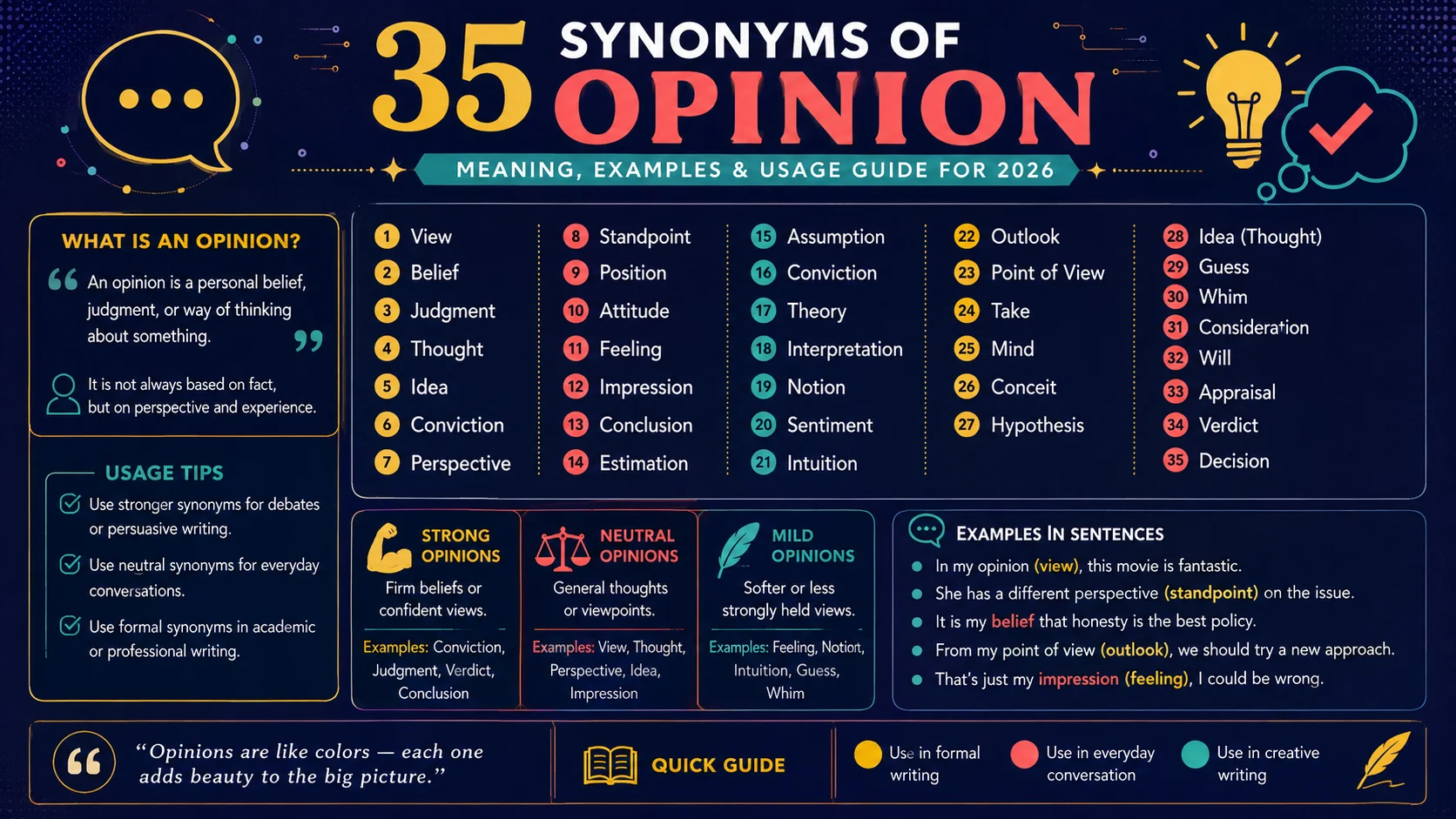
An opinion is what someone thinks or believes about something. It’s not a fact it’s a personal view. The best synonyms include view, belief, perspective, standpoint, stance, viewpoint, judgment, conviction, and point of view. The most common everyday synonym is view, while perspective works well in professional contexts. Each synonym has a slightly different meaning, tone, or context, so choose carefully based on your situation.
Top 10 Synonyms
- View
- Belief
- Perspective
- Standpoint
- Stance
- Viewpoint
- Judgment
- Conviction
- Point of view
- Sentiment
Do you ever feel like you keep saying “in my opinion” too often? Maybe you’re writing an essay, having a discussion, or expressing your thoughts at work. Using the same word repeatedly makes your English sound less natural.
Learning synonyms for “opinion” helps you express yourself more precisely. Different situations call for different words. A view is casual, a conviction is strong, and a perspective shows you understand different angles.
In this guide, you’ll discover 35 powerful alternatives to “opinion.” You’ll learn their meanings, when to use them, and which ones native speakers prefer in different situations. Let’s dive in!
What Does “Opinion” Mean?
Definition
An opinion is a belief, judgment, or way of thinking about something. It’s what you think about a topic, person, or situation. Unlike a fact, an opinion is personal and can vary from person to person.
In everyday terms, think of it this way: Facts are true for everyone. Water boils at 100 degrees Celsius—that’s a fact. “Chocolate ice cream is the best flavor”—that’s an opinion because someone else might disagree. Opinions come from your experiences, values, and feelings.
Opinion can describe:
- A personal belief (“In my opinion, the movie was amazing”)
- A professional judgment (“The expert gave his opinion on the matter”)
- A group sentiment (“Public opinion is divided on this issue”)
Pronunciation
| Feature | Value |
|---|---|
| US IPA | /əˈpɪn.jən/ |
| UK IPA | /əˈpɪn.jən/ |
| Syllables | 3 (o-pin-ion) |
| Tip | Stress the second syllable: o-PIN-ion |
Grammar
| Grammar Feature | Information |
|---|---|
| Part of Speech | Noun (countable and uncountable) |
| Common Position | Subject or object of a sentence |
| Typical Pattern | opinion + about/on/of + something |
Example Sentences:
- “What’s your opinion about the new policy?”
- “She has strong opinions on education.”
- “In my opinion, we should wait.”
Grammar Note: “Opinion” can be countable (“I have two opinions on this”) or uncountable (“He spoke with opinion”). It’s usually preceded by articles or possessive pronouns.
Word Family
| Word | Part of Speech | Meaning |
|---|---|---|
| Opinion | Noun | A belief or judgment about something |
| Opine | Verb | To express an opinion |
| Opinionated | Adjective | Holding strong opinions; stubborn |
| Opinionatedly | Adverb | In an opinionated manner |
| Opinionative | Adjective | Characterized by opinions |
| Misopinion | Noun | A mistaken opinion |
35 Synonyms of “Opinion”
1. View
Meaning: A particular way of thinking about something; your personal perspective.
Best Used For: Daily conversation, general writing, expressing personal thoughts.
Formality: Neutral
Tone: Personal, Direct
Frequency: ⭐⭐⭐⭐⭐ Very Common
CEFR Level: A2
Example Sentence 1: “What’s your view on the new building project?”
Example Sentence 2: “He has a very different view of the situation.”
Usage Tip: This is the most natural and common synonym for “opinion.” You can use it in almost any context, from casual conversations to professional meetings. It’s safe and always appropriate.
2. Belief
Meaning: Something you accept as true or real, often based on faith or conviction.
Best Used For: Religion, values, deeply held convictions, moral positions.
Formality: Neutral to Formal
Tone: Strong, Personal
Frequency: ⭐⭐⭐⭐⭐ Very Common
CEFR Level: B1
Example Sentence 1: “She holds the belief that everyone deserves a second chance.”
Example Sentence 2: “His political beliefs influence his decisions.”
Usage Tip: “Belief” is stronger than “opinion.” It suggests something you hold deeply, not just a casual thought. Use it for values, faith, or strong convictions rather than everyday preferences.
3. Perspective
Meaning: A particular way of considering or understanding something; your unique angle or viewpoint.
Best Used For: Academic writing, professional discussions, understanding different angles.
Formality: Formal
Tone: Analytical, Understanding
Frequency: ⭐⭐⭐⭐ Common
CEFR Level: B2
Example Sentence 1: “Her perspective on the problem helped us find a solution.”
Example Sentence 2: “We need to consider this from a different perspective.”
Usage Tip: “Perspective” suggests understanding the broader context. It’s more analytical than “opinion.” Use it when you want to sound thoughtful and open-minded.
4. Standpoint
Meaning: A position or point of view from which you consider something.
Best Used For: Formal discussions, debates, academic writing.
Formality: Formal
Tone: Objective, Analytical
Frequency: ⭐⭐⭐ Moderate
CEFR Level: B2
Example Sentence 1: “From a business standpoint, the decision makes perfect sense.”
Example Sentence 2: “Let’s look at this from the customer’s standpoint.
Usage Tip: “Standpoint” is useful when you want to specify whose perspective you’re considering. It’s more formal than “view” and works well in professional and academic contexts.
5. Stance
Meaning: A position or attitude about something, especially in a debate or argument.
Best Used For: Politics, debates, taking a position on issues.
Formality: Neutral to Formal
Tone: Decisive, Clear
Frequency: ⭐⭐⭐⭐ Common
CEFR Level: B2
Example Sentence 1: “The company took a clear stance on environmental issues.”
Example Sentence 2: “What’s your stance on the new policy?”
Usage Tip: “Stance” suggests a clear, firm position, often on a controversial issue. It’s less about personal preference and more about where you stand in a debate.
6. Viewpoint
Meaning: A specific position or angle from which you consider something.
Best Used For: Discussions, arguments, understanding others.
Formality: Neutral to Formal
Tone: Considered, Thoughtful
Frequency: ⭐⭐⭐⭐ Common
CEFR Level: B1
Example Sentence 1: “From my viewpoint, the project is moving too slowly.”
Example Sentence 2: “We need to hear everyone’s viewpoint before deciding.”
Usage Tip: “Viewpoint” is similar to “view” but suggests a more considered position. It’s slightly more formal and useful in group discussions.
7. Judgment
Meaning: An opinion formed by careful thought and consideration.
Best Used For: Professional contexts, decision-making, evaluating situations.
Formality: Formal
Tone: Analytical, Wise
Frequency: ⭐⭐⭐⭐ Common
CEFR Level: B2
Example Sentence 1: “I trust her judgment on this matter.”
Example Sentence 2: “His judgment was clouded by emotion.”
Usage Tip: “Judgment” suggests reasoned opinion, not just a feeling. It implies evaluation and decision-making. Use it in professional contexts where careful thought matters.
8. Conviction
Meaning: A very strong belief that is not likely to change.
Best Used For: Deeply held beliefs, moral positions, passionate causes.
Formality: Formal
Tone: Strong, Passionate
Frequency: ⭐⭐⭐ Moderate
CEFR Level: B2
Example Sentence 1: “She spoke with conviction about human rights.”
Example Sentence 2: “His political convictions guide his every decision.
Usage Tip: “Conviction” is much stronger than “opinion.” It suggests something you believe with your whole heart. Use it only for your most important and deeply held beliefs.
9. Point of view
Meaning: A specific way of thinking or considering a situation.
Best Used For: General use, discussions, explaining personal perspectives.
Formality: Neutral
Tone: Personal, Clear
Frequency: ⭐⭐⭐⭐⭐ Very Common
CEFR Level: B1
Example Sentence 1: “From my point of view, this is the best option.”
Example Sentence 2: “We need to consider the customer’s point of view.”
Usage Tip: This is a very common phrase in English. It’s slightly more formal than “view” but less formal than “perspective.” Use it when you want to be clear about your personal position.
10. Sentiment
Meaning: An opinion based on feelings rather than facts; public or general feeling.
Best Used For: Describing public opinion, marketing, customer feedback.
Formality: Neutral to Formal
Tone: Emotional, Reflective
Frequency: ⭐⭐⭐⭐ Common
CEFR Level: B2
Example Sentence 1: “Public sentiment has turned against the proposed law.”
Example Sentence 2: “The sentiment among employees is positive.”
Usage Tip: “Sentiment” often describes collective opinion, not just one person’s. It also emphasizes the emotional aspect of opinion. Use it for describing how groups of people feel.
11. Notion
Meaning: A general idea or belief about something.
Best Used For: Describing ideas, general concepts, informal thinking.
Formality: Neutral
Tone: Casual, Thoughtful
Frequency: ⭐⭐⭐⭐ Common
CEFR Level: B2
Example Sentence 1: “He rejected the notion that money brings happiness.”
Example Sentence 2: “She has some strange notions about health.”
Usage Tip: “Notion” is a bit more vague than “opinion.” It suggests a general idea rather than a well-formed opinion. Use it for casual thoughts and general beliefs.
12. Thought
Meaning: An idea or opinion produced by thinking.
Best Used For: General use, sharing ideas, creative contexts.
Formality: Neutral
Tone: Reflective, Personal
Frequency: ⭐⭐⭐⭐⭐ Very Common
CEFR Level: A2
Example Sentence 1: “I’d like to hear your thoughts on this proposal.”
Example Sentence 2: “She expressed some interesting thoughts at the meeting.”
Usage Tip: “Thought” is a very natural alternative to “opinion.” It’s slightly less formal and suggests a consideration rather than a firm position. Use it when you want to be inviting and open.
13. Perception
Meaning: How you understand, see, or interpret something.
Best Used For: Psychology, business, understanding different perspectives.
Formality: Formal
Tone: Analytical, Insightful
Frequency: ⭐⭐⭐⭐ Common
CEFR Level: B2
Example Sentence 1: “Public perception of the company has improved.”
Example Sentence 2: “Her perception of the problem was completely different.
Usage Tip: “Perception” is about how you see or understand something. It suggests that different people can see the same thing differently. Use it for analytical and psychological contexts.
14. Observation
Meaning: An opinion formed by noticing or watching something.
Best Used For: Scientific contexts, reporting, thoughtful analysis.
Formality: Formal
Tone: Analytical, Objective
Frequency: ⭐⭐⭐⭐ Common
CEFR Level: B2
Example Sentence 1: “She made an interesting observation about the data.”
Example Sentence 2: “One observation is that people work better in teams.”
Usage Tip: “Observation” suggests an opinion based on careful watching or study. It’s more objective than “opinion” and works well in scientific and professional contexts.
15. Assumption
Meaning: Something you believe to be true without proof.
Best Used For: Decision-making, planning, discussions.
Formality: Neutral to Formal
Tone: Cautious, Analytical
Frequency: ⭐⭐⭐⭐ Common
CEFR Level: B2
Example Sentence 1: “We need to examine our assumptions about the market.”
Example Sentence 2: “That assumption might not be correct.”
Usage Tip: “Assumption” is a belief without evidence. Use it when you want to question or examine a belief. It’s useful in discussions and planning.
16. Conjecture
Meaning: An opinion formed without enough evidence; a guess.
Best Used For: Formal writing, when evidence is limited.
Formality: Formal
Tone: Cautious, Scholarly
Frequency: ⭐⭐ Rare
CEFR Level: C1
Example Sentence 1: “The theory is based on conjecture rather than evidence.”
Example Sentence 2: “His conjecture about the results proved accurate.”
Usage Tip: “Conjecture” is a formal word for an educated guess. Use it when you want to acknowledge uncertainty in your opinion.
17. Estimation
Meaning: An opinion about the value, size, or quality of something.
Best Used For: Business, economics, evaluating situations.
Formality: Formal
Tone: Analytical, Professional
Frequency: ⭐⭐⭐ Moderate
CEFR Level: B2
Example Sentence 1: “My estimation is that we’ll finish the project by Friday.”
Example Sentence 2: “What’s your estimation of the situation?”
Usage Tip: “Estimation” is used for opinions that involve judgment of value, size, or quality. It’s common in business and professional contexts.
18. Impression
Meaning: An opinion or feeling about someone or something from limited experience.
Best Used For: First meetings, quick judgments, initial responses.
Formality: Neutral
Tone: Personal, Initial
Frequency: ⭐⭐⭐⭐ Common
CEFR Level: B1
Example Sentence 1: “I got the impression that she wasn’t interested.
Example Sentence 2: “My first impression of the restaurant was positive.”
Usage Tip: “Impression” suggests a feeling or opinion formed quickly, often from limited information. Use it for initial reactions rather than deeply considered opinions.
19. Prejudice
Meaning: A strong opinion formed without enough knowledge or reason.
Best Used For: Discussions about bias, discrimination, unfair judgments.
Formality: Formal
Tone: Negative, Critical
Frequency: ⭐⭐⭐ Moderate
CEFR Level: B2
Example Sentence 1: “Prejudice prevents people from seeing the truth.”
Example Sentence 2: “He has a prejudice against modern art.”
Usage Tip: “Prejudice” is a negative word for a biased opinion. Use it when you want to criticize unfair or uninformed judgments.
20. Bias
Meaning: A tendency to favor one side or view over another.
Best Used For: Journalism, research, discussions about fairness.
Formality: Neutral to Formal
Tone: Analytical, Critical
Frequency: ⭐⭐⭐⭐ Common
CEFR Level: B2
Example Sentence 1: “The news report showed a clear bias against the opposition.”
Example Sentence 2: “We need to avoid bias in our research.”
Usage Tip: “Bias” is a tendency that affects your opinion. It’s often used when fairness or objectivity is important. It can be positive or negative but is often seen as negative.
21. Attitude
Meaning: A settled way of thinking or feeling about something.
Best Used For: Describing behavior, psychology, personal reactions.
Formality: Neutral
Tone: Personal, Behavioral
Frequency: ⭐⭐⭐⭐⭐ Very Common
CEFR Level: B1
Example Sentence 1: “Her positive attitude makes her a great team member.”
Example Sentence 2: “He has a negative attitude toward change.”
Usage Tip: “Attitude” includes both opinion and feeling, often reflected in behavior. It’s about how you approach something, not just what you think.
22. Mindset
Meaning: The way you think about things; your mental attitude.
Best Used For: Personal development, business, psychology.
Formality: Neutral
Tone: Modern, Psychological
Frequency: ⭐⭐⭐⭐ Common
CEFR Level: B2
Example Sentence 1: “A growth mindset helps people learn from mistakes.”
Example Sentence 2: “Our team needs to adopt a customer-first mindset.”
Usage Tip: “Mindset” is a modern term for your general way of thinking. It’s popular in business and personal development. Use it to describe overall thinking patterns.
23. Ideology
Meaning: A set of beliefs or opinions held by a group or person.
Best Used For: Politics, philosophy, social movements.
Formality: Formal
Tone: Intellectual, Serious
Frequency: ⭐⭐⭐ Moderate
CEFR Level: C1
Example Sentence 1: “The party’s ideology is based on socialist principles.”
Example Sentence 2: “His personal ideology shaped his life choices.
Usage Tip: “Ideology” is a system of beliefs. It’s more comprehensive than “opinion.” Use it for political, religious, or philosophical belief systems.
24. Creed
Meaning: A system of beliefs or principles.
Best Used For: Religion, moral positions, personal principles.
Formality: Formal
Tone: Serious, Belief-focused
Frequency: ⭐⭐ Rare
CEFR Level: C1
Example Sentence 1: “The creed of the organization is to help others.
Example Sentence 2: “His creed centers on honesty and hard work.”
Usage Tip: “Creed” is like a personal or group belief system. It’s more formal than “opinion” and suggests strong principles.
25. Faith
Meaning: Strong belief in something, often without proof.
Best Used For: Religion, trust, confidence in people or systems.
Formality: Neutral to Formal
Tone: Trusting, Spiritual
Frequency: ⭐⭐⭐⭐⭐ Very Common
CEFR Level: B1
Example Sentence 1: “She has faith that things will improve.”
Example Sentence 2: “I have faith in my team’s abilities.”
Usage Tip: “Faith” is about trust and belief, often without evidence. It’s stronger than “opinion” and can be religious or secular.
26. Doctrine
Meaning: A set of principles or beliefs taught by a group.
Best Used For: Religion, politics, formal belief systems.
Formality: Formal
Tone: Official, Serious
Frequency: ⭐⭐⭐ Moderate
CEFR Level: C1
Example Sentence 1: “The church’s doctrine has remained unchanged.”
Example Sentence 2: “The company’s doctrine emphasizes innovation.”
Usage Tip: “Doctrine” is a formal set of beliefs. Use it for official beliefs of organizations, religions, or political groups.
27. Disposition
Meaning: Your general attitude or tendency to think in a certain way.
Best Used For: Describing personality, psychology.
Formality: Formal
Tone: Psychological, Descriptive
Frequency: ⭐⭐⭐ Moderate
CEFR Level: B2
Example Sentence 1: “She has a cheerful disposition that people love.”
Example Sentence 2: “His disposition makes him slow to trust others.”
Usage Tip: “Disposition” is about your natural way of thinking or feeling. It describes your general attitude, not just one opinion.
28. Consideration
Meaning: A view or thought formed after careful thought.
Best Used For: Formal discussions, professional contexts.
Formality: Formal
Tone: Thoughtful, Careful
Frequency: ⭐⭐⭐ Moderate
CEFR Level: B2
Example Sentence 1: “Several important considerations guided our decision.
Example Sentence 2: “This is an issue worthy of serious consideration.”
Usage Tip: “Consideration” suggests careful thought. It’s a more formal word for opinions formed after deliberation.
29. Understanding
Meaning: Your interpretation or comprehension of something.
Best Used For: Explaining how you see something, comprehension.
Formality: Neutral to Formal
Tone: Logical, Understanding
Frequency: ⭐⭐⭐⭐⭐ Very Common
CEFR Level: B1
Example Sentence 1: “My understanding is that we’re meeting next week.”
Example Sentence 2: “We need a better understanding of the problem.”
Usage Tip: “Understanding” is about how you comprehend something. It’s often used when clarifying what you think is true.
30. Interpretation
Meaning: Your personal way of explaining or understanding something.
Best Used For: Art, law, analyzing texts, diverse viewpoints.
Formality: Formal
Tone: Analytical, Creative
Frequency: ⭐⭐⭐⭐ Common
CEFR Level: B2
Example Sentence 1: “Her interpretation of the poem was fascinating.”
Example Sentence 2: “The law is subject to different interpretations.”
Usage Tip: “Interpretation” suggests that other interpretations are possible. Use it when discussing art, laws, texts, or any ambiguous subject.
31. Theory
Meaning: A set of ideas used to explain something.
Best Used For: Science, academic contexts, explanations.
Formality: Formal
Tone: Intellectual, Analytical
Frequency: ⭐⭐⭐⭐⭐ Very Common
CEFR Level: B2
Example Sentence 1: “He has a theory about why sales have dropped.”
Example Sentence 2: “The theory explains how dinosaurs became extinct.”
Usage Tip: “Theory” is used for explanatory opinions. In science, it’s more than a guess. In everyday use, it can mean a personal explanation.
32. Hypothesis
Meaning: A proposed explanation based on limited evidence.
Best Used For: Science, research, investigation.
Formality: Formal
Tone: Scientific, Analytical
Frequency: ⭐⭐⭐ Moderate
CEFR Level: B2
Example Sentence 1: “The researchers tested their hypothesis with experiments.”
Example Sentence 2: “My hypothesis is that the market will recover.”
Usage Tip: “Hypothesis” is a formal word for a testable idea. Use it in research and scientific contexts.
33. Tenet
Meaning: A principle or belief that is central to a group or system.
Best Used For: Philosophy, religion, formal belief systems.
Formality: Formal
Tone: Serious, Principle-focused
Frequency: ⭐⭐ Rare
CEFR Level: C1
Example Sentence 1: “One of the tenets of democracy is free speech.”
Example Sentence 2: “The company’s tenets include sustainability and ethics.”
Usage Tip: “Tenet” is a formal word for a core belief. Use it for fundamental principles, not casual opinions.
34. Conception
Meaning: A general idea or understanding of something.
Best Used For: Philosophy, abstract concepts, academic contexts.
Formality: Formal
Tone: Intellectual, Abstract
Frequency: ⭐⭐⭐ Moderate
CEFR Level: C1
Example Sentence 1: “The conception of equality has evolved over time.”
Example Sentence 2: “Her conception of the project was different from mine.”
Usage Tip: “Conception” is about how you understand abstract ideas. It’s more intellectual than “opinion.”
35. Outlook
Meaning: Your general attitude or way of seeing the world.
Best Used For: Describing overall attitude, future expectations.
Formality: Neutral
Tone: Personal, Broad
Frequency: ⭐⭐⭐⭐ Common
CEFR Level: B2
Example Sentence 1: “She has a positive outlook on life.”
Example Sentence 2: “The economic outlook for next year is encouraging.”
Usage Tip: “Outlook” is a broad view of life or the future. It’s less specific than “opinion” and describes general attitudes.
Synonyms Comparison Table
| Synonym | Best Context | Formality | Tone | Frequency |
|---|---|---|---|---|
| View | General use | Neutral | Personal | ⭐⭐⭐⭐⭐ |
| Belief | Deeply held | Neutral | Strong | ⭐⭐⭐⭐⭐ |
| Perspective | Different angles | Formal | Analytical | ⭐⭐⭐⭐ |
| Standpoint | Formal discussion | Formal | Objective | ⭐⭐⭐ |
| Stance | Debates, positions | Neutral | Decisive | ⭐⭐⭐⭐ |
| Viewpoint | Considered opinion | Neutral | Thoughtful | ⭐⭐⭐⭐ |
| Judgment | Professional evaluation | Formal | Wise | ⭐⭐⭐⭐ |
| Conviction | Deeply held | Formal | Passionate | ⭐⭐⭐ |
| Point of view | General use | Neutral | Personal | ⭐⭐⭐⭐⭐ |
| Sentiment | Collective feeling | Neutral | Emotional | ⭐⭐⭐⭐ |
Best Synonyms by Situation
| Situation | Best Synonym | Why It Works |
|---|---|---|
| Daily Conversation | View, Point of view | Natural and clear |
| Business Email | Perspective, Viewpoint | Professional and considered |
| Academic Writing | Standpoint, Interpretation | Formal and analytical |
| School Assignment | View, Judgment | Clear and appropriate |
| Professional Meeting | Stance, Judgment | Decisive and professional |
| Presentation | Perspective, Standpoint | Shows breadth of understanding |
| Creative Writing | Outlook, Sentiment | Adds depth and feeling |
| Social Media | Opinion, View | Casual and engaging |
| Politics | Stance, Ideology | Shows firm position |
| Philosophy | Conception, Tenet | Intellectual and precise |
Formal vs Informal Synonyms
Formal Alternatives
| Synonym | Best Used For |
|---|---|
| Standpoint | Academic writing, formal discussions |
| Conviction | Strong beliefs, moral positions |
| Judgment | Professional evaluation |
| Interpretation | Art, law, analysis |
| Ideology | Political, philosophical systems |
Neutral Alternatives
| Synonym | Best Used For |
|---|---|
| View | Most situations |
| Belief | Personal beliefs |
| Perspective | Understanding different angles |
| Point of view | General use |
| Outlook | Life attitudes |
Informal Alternatives
| Synonym | Best Used For |
|---|---|
| Take | Casual conversations |
| Two cents | Offering an opinion humbly |
| Gut feeling | Intuitive opinions |
| Vibe | General feeling about something |
When to choose each level: Use formal synonyms for academic papers, business reports, and professional speeches. Use neutral synonyms for everyday writing and most professional contexts. Use informal synonyms with friends and in casual settings.
Strong vs Mild Synonyms
Mild (Everyday Situations)
- View
- Thought
- Impression
- Notion
- Take
Moderate (More Expressive)
- Perspective
- Judgment
- Viewpoint
- Standpoint
- Outlook
Strong (High-Intensity)
- Conviction
- Ideology
- Creed
- Doctrine
- Prejudice
Remember: Stronger doesn’t always mean better. Choose the intensity that fits your situation. In a professional meeting, “perspective” sounds thoughtful. In a debate, “conviction” shows passion.
Real-Life Examples
- In a Business Meeting
- “From my perspective, we need to focus on customer retention rather than acquisition.”
- In an Email
- “I’d love to hear your thoughts on the proposal before we proceed.”
- In a Classroom
- “The students shared their viewpoints on climate change.”
- In a Debate
- “What’s your stance on the new immigration policy?”
- In a Review
- “In my opinion, the movie was disappointing compared to the book.”
On Social Media
“Just my two cents, but I think we should support local businesses.”
Academic Writing
“The author’s interpretation of the poem reveals deeper cultural tensions.”
Personal Conversation
“I have a feeling she’s going to say yes.”
Common Collocations
| Common Phrase | Better Alternative |
|---|---|
| Strong opinion | Conviction, Strong conviction |
| Different opinion | Different perspective, Different viewpoint |
| Public opinion | Public sentiment, Public perception |
| Expert opinion | Expert judgment, Professional assessment |
| Personal opinion | Personal view, Personal perspective |
| Popular opinion | Prevailing sentiment, Common belief |
| Political opinion | Political stance, Political ideology |
Common Phrases
- “In my opinion” – Meaning: The standard way to express your view. Instead of repeating it, try “From my perspective” or “I believe.”
- “To my mind” – Meaning: In my opinion. This sounds more formal and interesting.
- “I think” – Meaning: It’s my opinion. Very common, but try “I believe” or “I feel” for variety.
- “If you ask me” – Meaning: In my opinion (often casual). This is a common informal introduction.
- “I’m of the view that” – Meaning: I believe that. This is more formal and confident.
Context Guide
| Situation | Best Synonym | Reason |
|---|---|---|
| Essay | Standpoint, Interpretation | Formal and precise |
| Speech | Conviction, Belief | Powerful and persuasive |
| Business Email | Perspective, Viewpoint | Professional and thoughtful |
| Novel | Outlook, Sentiment | Evocative and descriptive |
| Presentation | Stance, Position | Decisive and clear |
| Conversation | View, Thought | Natural and friendly |
| Academic Writing | Hypothesis, Theory | Intellectual and precise |
| Marketing Copy | Sentiment, Perception | Insightful and persuasive |
Related Words
Near Synonyms
- Belief: Something accepted as true.
- Conviction: A strong, unwavering belief.
- Perspective: A way of understanding things.
- Viewpoint: A particular way of thinking.
Antonyms
- Fact: Something proven to be true.
- Certainty: Something known without doubt.
- Truth: Reality; what is actually true.
- Reality: The actual state of things.
- Related Adjectives
- Opinionated: Having strong opinions.
- Open-minded: Willing to consider other opinions.
- Objective: Based on facts, not opinions.
- Subjective: Based on personal feelings or opinions.
- Related Nouns
- Argument: Reasons given for an opinion.
- Debate: Discussion of different opinions.
- Discussion: Exchange of opinions.
- Controversy: Disagreement in opinions.
- Related Verbs
- Opine: To state your opinion.
- Believe: To think something is true.
- Think: To have a particular opinion.
- Consider: To think about something carefully.
Frequently Asked Questions
What is another word for opinion?
The best alternatives are view, belief, perspective, standpoint, viewpoint, judgment, conviction, and point of view. The most common everyday synonym is view, while perspective works well in professional contexts. Your choice depends on how formal you need to be and how strongly you feel.
Which synonym sounds the most professional?
Perspective, standpoint, and judgment sound the most professional. Perspective shows understanding of different angles, standpoint shows a considered position, and judgment suggests careful evaluation. These words are excellent for business and academic contexts.
What is the strongest synonym for opinion?
Conviction and ideology are among the strongest alternatives. Conviction suggests an unshakable belief, while ideology suggests a complete belief system. Use them carefully—they imply deep commitment and are not suitable for casual opinions.
Which synonym is best for essays?
Standpoint, interpretation, and perspective are best for academic essays. They sound formal and thoughtful. Argument is also useful when you’re making a case. Avoid informal words like take or two cents in academic writing.
What’s the difference between opinion and perspective?
An opinion is simply what you think or believe. A perspective is how you understand or consider something, often considering the broader context. Perspective is more analytical and shows you understand there may be other valid viewpoints.
Which synonym is most common in everyday English?
View and point of view are the most common everyday alternatives. Native speakers use these constantly in conversation. Thought is also very common, especially when inviting someone to share (“I’d like your thoughts on this”).
What is the opposite of opinion?
The direct opposite is fact. Other opposites include certainty, truth, and reality. While opinions can differ from person to person, facts are universally true. Fact is the most common and direct opposite.
Is “perspective” a synonym for opinion?
Yes, but with a slightly different meaning. Perspective emphasizes how you understand or consider something, often influenced by your background or experiences. It’s more analytical than opinion and suggests a broader view of a situation.
Conclusion
Learning alternatives to “opinion” makes your English more natural and precise. The right word depends on your context, audience, and the strength of what you want to express.
For everyday situations, view and point of view are your safest choices. They’re natural, clear, and work in almost any context. For professional writing, perspective, standpoint, and judgment will help you sound more thoughtful and analytical. For expressing deeply held beliefs, conviction and belief are powerful choices.
Remember these key principles:
- Formal situations need formal words like interpretation, standpoint, or ideology
- Neutral situations work well with view, viewpoint, or perspective
- Strong feelings call for strong words like conviction or creed
- Be careful with negative words like prejudice and bias
Choose the word that fits your situation, and your writing and speaking will sound more natural and professional. The more you practice using these alternatives, the more natural they’ll become.
