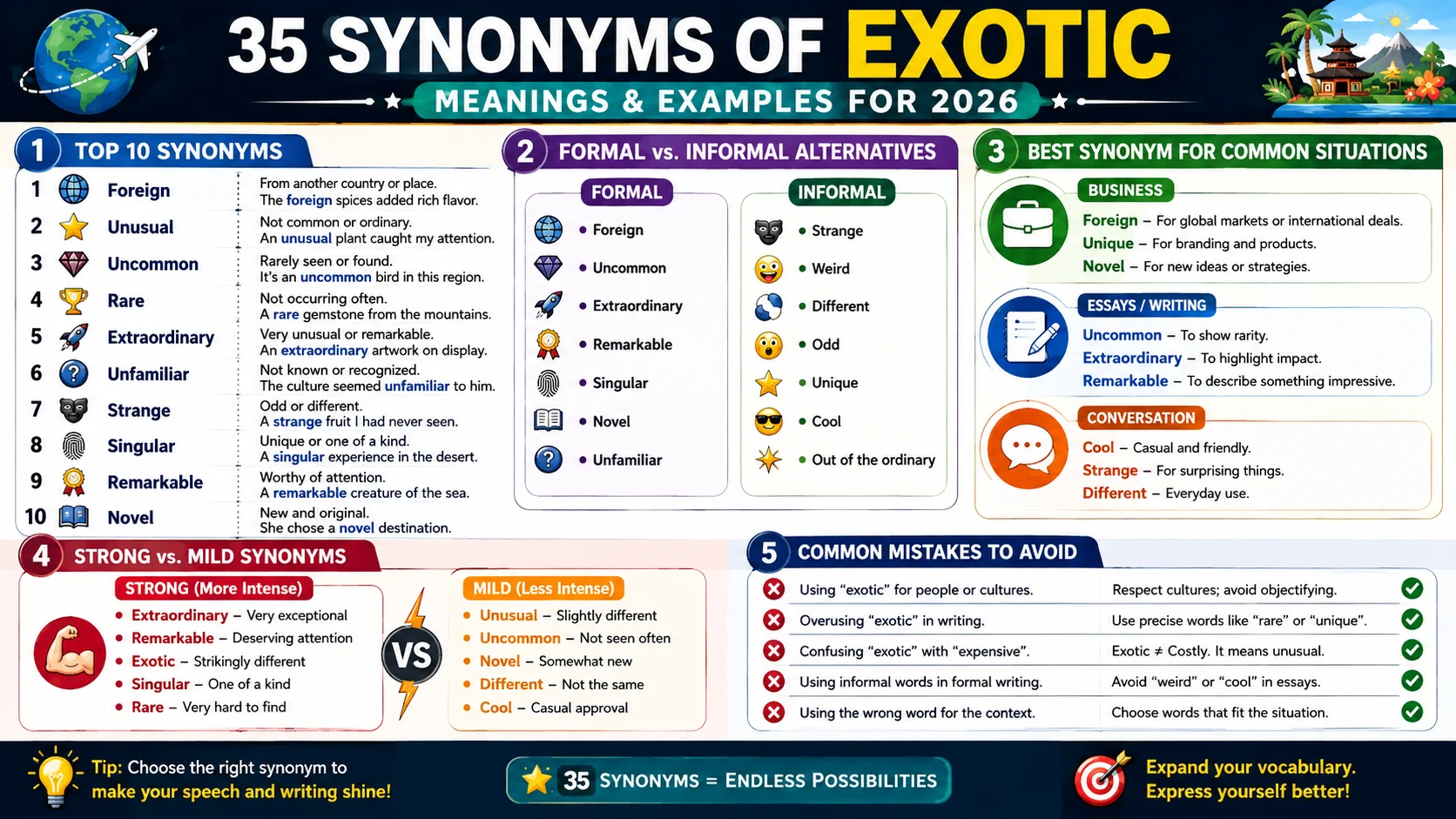
“Exotic” means something unusual, foreign, or strikingly different from what is familiar. The best synonyms are foreign, unusual, extraordinary, unique, and strange. “Foreign” is a common alternative. Each synonym has a slightly different meaning and context where it fits best.
Top 10 Synonyms
- Foreign
- Unusual
- Extraordinary
- Unique
- Strange
- Distinctive
- Intriguing
- Alien
- Unfamiliar
- Glamorous
“Exotic” is a fascinating word. It brings to mind faraway places, unusual things, and exciting experiences. But using it too often can make your English feel repetitive and predictable.
Think about it. You can describe exotic food, exotic animals, exotic travel, or exotic plants. Each situation might need a different word that captures the specific type of foreign beauty or difference.
In this guide, you’ll learn 35 powerful synonyms for “exotic.” You’ll discover exactly when to use each one, how formal they are, and what common mistakes to avoid. Let’s begin!
What Does “Exotic” Mean?
Definition
Exotic” means something that comes from a foreign country, is unusual, or is strikingly different from what is normal or familiar. It often has a sense of beauty, mystery, or excitement. When something is exotic, it stands out because it’s not ordinary.
Pronunciation
| Feature | Value |
|---|---|
| US IPA | /ɪɡˈzɑtɪk/ |
| UK IPA | /ɪɡˈzɒtɪk/ |
| Syllables | 3 (ex-ot-ic) |
| Tip | Stress the second syllable: “ig-ZAH-tik” |
Grammar
| Grammar Feature | Information |
|---|---|
| Part of Speech | Adjective |
| Common Position | Before a noun or after a linking verb |
| Typical Pattern | Exotic + noun / Subject + be + exotic |
Examples:
- “She brought back exotic souvenirs.” (before noun)
- “The flowers are so exotic.” (after verb)
- “We ate exotic food.” (before noun)
Grammar Note: “Exotic” is often used with words like “very,” “so,” and “truly” to emphasize how unusual something is.
Word Family
| Word | Part of Speech | Meaning |
|---|---|---|
| Exotic | Adjective | Unusual, foreign, different |
| Exotically | Adverb | In an exotic way |
| Exoticness | Noun | The quality of being exotic |
| Exoticism | Noun | The quality or style of being exotic |
15 Synonyms of “Exotic”
Foreign
Meaning: From another country; not native.
Best Used For: Countries, cultures, languages.
Formality: Neutral
Tone: Different, External
Frequency: ⭐⭐⭐⭐⭐ (Very Common)
CEFR Level: A2
Example Sentence 1: “He learned several foreign languages.”
Example Sentence 2: “The museum has a collection of foreign artifacts.”
Usage Tip: “Foreign” is the most direct synonym. Use it for anything from another country.
Common Confusion: Foreign vs Exotic. Foreign” simply means from another country. “Exotic” suggests unusual beauty or mystery as well.
Unusual
Meaning: Different from what is normal or expected.
Best Used For: Situations, objects, people.
Formality: Neutral
Tone: Different, Interesting
Frequency: ⭐⭐⭐⭐⭐ (Very Common)
CEFR Level: A2
Example Sentence 1: “She has a very unusual sense of style.”
Example Sentence 2: “It’s unusual to see snow in this region.”
Usage Tip: “Unusual” emphasizes being different from the ordinary. Use it for anything that stands out.
Extraordinary
Meaning: Very unusual, special, or remarkable.
Best Used For: Events, people, achievements.
Formality: Formal
Tone: Remarkable, Special
Frequency: ⭐⭐⭐⭐ (Common)
CEFR Level: B2
Example Sentence 1: “She has extraordinary talent.”
Example Sentence 2: “It was an extraordinary experience.”
Usage Tip: “Extraordinary” suggests something truly special or amazing. Use it for remarkable things.
Unique
Meaning: Being the only one of its kind.
Best Used For: People, items, experiences.
Formality: Neutral
Tone: One-of-a-kind, Special
Frequency: ⭐⭐⭐⭐⭐ (Very Common)
CEFR Level: B2
Example Sentence 1: “Each person’s fingerprint is unique.”
Example Sentence 2: “This is a unique opportunity.”
Usage Tip: “Unique” means one of a kind. Use it for truly special, irreplaceable things.
Strange
Meaning: Unusual or unexpected.
Best Used For: Situations, behavior, objects.
Formality: Neutral
Tone: Odd, Different
Frequency: ⭐⭐⭐⭐⭐ (Very Common)
CEFR Level: A2
Example Sentence 1: “She heard a strange noise.”
Example Sentence 2: “His behavior seemed strange.”
Usage Tip: “Strange” suggests something is odd or puzzling. Use it for things that seem out of place.
Distinctive
Meaning: Having a quality that makes something easy to recognize.
Best Used For: Appearance, style, features.
Formality: Formal
Tone: Memorable, Characteristic
Frequency: ⭐⭐⭐⭐ (Common)
CEFR Level: B2
Example Sentence 1: “She has a very distinctive voice.”
Example Sentence 2: “The building has a distinctive design.”
Usage Tip: “Distinctive” suggests something stands out and is easily recognized.
Intriguing
Meaning: Fascinating and making you want to learn more.
Best Used For: Ideas, stories, people.
Formality: Formal
Tone: Fascinating, Curious
Frequency: ⭐⭐⭐ (Moderate)
CEFR Level: C1
Example Sentence 1: “The novel has an intriguing plot.”
Example Sentence 2: “She gave an intriguing answer.”
Usage Tip: “Intriguing” suggests something captures your curiosity. Use it for fascinating things.
Alien
Meaning: Very different and unfamiliar.
Best Used For: Ideas, experiences, creatures.
Formality: Neutral
Tone: Foreign, Unknown
Frequency: ⭐⭐⭐ (Moderate)
CEFR Level: B2
Example Sentence 1: “The concept was alien to her.”
Example Sentence 2: “The environment felt alien.”
Usage Tip: “Alien” suggests something is completely unfamiliar. Use it for things that feel strange or foreign.
Unfamiliar
Meaning: Not known or recognized.
Best Used For: Places, people, situations.
Formality: Neutral
Tone: New, Unknown
Frequency: ⭐⭐⭐⭐ (Common)
CEFR Level: B1
Example Sentence 1: “She felt lost in the unfamiliar city.”
Example Sentence 2: “He encountered unfamiliar words.”
Usage Tip: “Unfamiliar” emphasizes lack of knowledge. Use it for things you don’t know.
Glamorous
Meaning: Exciting and attractive in a special way.
Best Used For: Fashion, travel, people.
Formality: Informal
Tone: Glamorous, Exciting
Frequency: ⭐⭐⭐ (Moderate)
CEFR Level: B2
Example Sentence 1: “She lives a glamorous life.”
Example Sentence 2: “The hotel was very glamorous.”
Usage Tip: “Glamorous” suggests exciting, attractive luxury. Use it for stylish, appealing things.
Outlandish
Meaning: Very strange or unusual.
Best Used For: Ideas, clothes, behavior.
Formality: Informal
Tone: Wild, Strange
Frequency: ⭐⭐ (Rare)
CEFR Level: C1
Example Sentence 1: “He wore an outlandish outfit.”
Example Sentence 2: “Her ideas seemed outlandish.”
Usage Tip: “Outlandish” suggests something is very strange, almost ridiculous.
Rare
Meaning: Not common or found often.
Best Used For: Objects, plants, animals.
Formality: Neutral
Tone: Scarce, Special
Frequency: ⭐⭐⭐⭐⭐ (Very Common)
CEFR Level: B2
Example Sentence 1: “It’s a rare species of bird.”
Example Sentence 2: “She collects rare books.”
Usage Tip: “Rare” emphasizes scarcity. Use it for things that are hard to find.
Mysterious
Meaning: Difficult to understand or explain.
Best Used For: People, places, events.
Formality: Neutral
Tone: Mysterious, Unknown
Frequency: ⭐⭐⭐⭐ (Common)
CEFR Level: B2
Example Sentence 1: “She had a mysterious smile.”
Example Sentence 2: “The island is mysterious.”
Usage Tip: “Mysterious” suggests there’s something hidden or unknown. Use it for intriguing puzzles.
Bizarre
Meaning: Very strange and unusual.
Best Used For: Situations, behavior, events.
Formality: Neutral
Tone: Odd, Weird
Frequency: ⭐⭐⭐ (Moderate)
CEFR Level: B2
Example Sentence 1: “The whole situation was bizarre.”
Example Sentence 2: “He has bizarre taste in music.”
Usage Tip: “Bizarre” suggests something is very odd and unexpected.
Picturesque
Meaning: Visually attractive, like a painting.
Best Used For: Scenery, towns, views.
Formality: Formal
Tone: Beautiful, Scenic
Frequency: ⭐⭐⭐ (Moderate)
CEFR Level: B2
Example Sentence 1: “The village is very picturesque.”
Example Sentence 2: “They visited a picturesque island.”
Usage Tip: “Picturesque” suggests something is very pretty, like a painting. Use it for beautiful scenes.
Synonyms Comparison Table
| Synonym | Best Context | Formality | Tone | Frequency |
|---|---|---|---|---|
| Foreign | Other countries | Neutral | Different | ⭐⭐⭐⭐⭐ |
| Unusual | Normal differences | Neutral | Different | ⭐⭐⭐⭐⭐ |
| Unique | One-of-a-kind | Neutral | Special | ⭐⭐⭐⭐⭐ |
| Extraordinary | Remarkable | Formal | Special | ⭐⭐⭐⭐ |
| Strange | Odd, puzzling | Neutral | Odd | ⭐⭐⭐⭐⭐ |
| Distinctive | Recognizable | Formal | Memorable | ⭐⭐⭐⭐ |
| Rare | Scarce | Neutral | Special | ⭐⭐⭐⭐⭐ |
| Mysterious | Unknown | Neutral | Intriguing | ⭐⭐⭐⭐ |
| Glamorous | Exciting, luxury | Informal | Exciting | ⭐⭐⭐ |
Best Synonyms by Situation
| Situation | Best Synonym | Why It Works |
|---|---|---|
| Daily Conversation | Foreign/Unusual | Natural and common |
| Business Email | Distinctive | Professional and clear |
| Academic Writing | Extraordinary | Formal and precise |
| School Assignment | Unique | Clear and simple |
| Professional Meeting | Distinctive | Sounds professional |
| Presentation | Extraordinary | Strong and impressive |
| Creative Writing | Exotic/Intriguing | Adds literary depth |
| Social Media | Exotic/Glamorous | Casual and engaging |
| Travel Writing | Picturesque | Beautiful and descriptive |
Formal vs Informal Synonyms
Formal Alternatives
| Synonym | Best Used For |
|---|---|
| Extraordinary | Remarkable events |
| Distinctive | Recognizable features |
| Intriguing | Fascinating ideas |
| Picturesque | Beautiful scenery |
| Outlandish | Very strange |
Neutral Alternatives
| Synonym | Best Used For |
|---|---|
| Foreign | Other countries |
| Unusual | Different things |
| Unique | One-of-a-kind |
| Strange | Odd things |
| Rare | Scarce things |
Informal Alternatives
| Synonym | Best Used For |
|---|---|
| Glamorous | Exciting, stylish |
| Bizarre | Very odd |
| Weird | Strange (casual) |
Choosing the Right Level: Use “extraordinary” and “distinctive” for formal writing. Use “foreign” and “unusual” for most situations.
Strong vs Mild Synonyms
Mild
Suitable for everyday situations with less intensity.
- Different
- Unusual
- Foreign
- Rare
Moderate
More noticeable or remarkable alternatives.
- Unique
- Strange
- Unfamiliar
- Distinctive
Strong
High-intensity alternatives suggesting great difference.
- Extraordinary (remarkable)
- Intriguing (fascinating)
- Outlandish (very strange)
- Exotic (foreign and exciting)
How Intensity Changes Meaning: “It’s different” is mild. “It’s extraordinary” is remarkable. Choose stronger words when you want to emphasize how special or unusual something is.
Real-Life Examples
School: “The students learned about exotic animals.”
Office: “The company has a distinctive brand identity.”
Business Email: “This is a unique opportunity for growth.”
Meetings: “The proposal is very intriguing.”
Presentations: “The research showed extraordinary results.”
Daily Conversations: “I love trying foreign food.”
Social Media: “My vacation was truly exotic!”
Academic Writing: “The study explores rare phenomena.”
Common Collocations
| Common Phrase | Better Alternative |
|---|---|
| Exotic location | Foreign location |
| Exotic food | Unusual food |
| Exotic animal | Rare animal |
| Exotic plant | Unique plant |
| Exotic beauty | Distinctive beauty |
Common Phrases
Like nothing else: Unique. (e.g., “The food was like nothing else.”)
Out of this world: Extraordinary. (e.g., “The view was out of this world.”)
Off the beaten path: Unusual and not common. (e.g., “We went off the beaten path.”)
A breath of fresh air: New and different. (e.g., “His ideas were a breath of fresh air.”)
Unlike anything: Very different. (e.g., “It was unlike anything I’d seen.”)
Context Guide
| Situation | Best Synonym | Reason |
|---|---|---|
| Essay | Extraordinary | Academic and formal |
| Speech | Unique | Inspiring and clear |
| Business Email | Distinctive | Professional and clear |
| Novel | Exotic/Intriguing | Adds literary depth |
| Presentation | Extraordinary | Strong and impressive |
| Conversation | Unusual | Natural and relatable |
| Academic Writing | Distinctive | Precise and formal |
| Marketing Copy | Unique | Engaging and persuasive |
Related Words
Near Synonyms
- Unconventional: Not following tradition.
- Uncommon: Not found often.
- Novel: New and different.
- Unorthodox: Different from usual.
- Quirky: Strange in an interesting way.
Antonyms
- Common: Found often.
- Familiar: Well-known.
- Ordinary: Normal.
- Conventional: Following tradition.
- Native: From the local area.
Related Adjectives
- Exotic: Unusual and foreign.
- Foreign: From another country.
- Unique: One-of-a-kind.
- Rare: Not common.
- Unusual: Different from normal.
Related Nouns
- Exoticism: The quality of being exotic.
- Uniqueness: The quality of being unique.
- Rarity: The quality of being rare.
- Distinction: A quality that stands out.
- Novelty: The quality of being new.
Related Verbs
- Intrigue: To make curious.
- Fascinate: To interest greatly.
- Distinguish: To stand out.
- Stand out: To be noticeable.
Frequently Asked Questions
What is another word for exotic?
Common synonyms include foreign, unusual, extraordinary, unique, and strange. “Foreign” is the most common alternative.
Which synonym sounds the most professional?
Extraordinary and distinctive sound very professional. “Unique” is also excellent for business contexts.
What is the strongest synonym for exotic?
Extraordinary and outlandish are among the strongest synonyms. “Extraordinary” suggests something truly remarkable.
Which synonym is best for essays?
Extraordinary is the best choice for academic essays. It’s formal and impressive.
What’s the difference between exotic and foreign?
Foreign” simply means from another country. “Exotic” suggests foreign plus unusual beauty or mystery.
Which synonym is most common in everyday English?
“Foreign,” “unusual,” and “strange” are very common in everyday speech. “Unique” is also frequently used.
What is the opposite of exotic?
Common opposites are common, familiar, ordinary, conventional, and native.
Conclusion
“Exotic” is a fascinating word, but now you have 35 fantastic alternatives. Each synonym adds a different shade of meaning to your language.
Remember, the key is understanding the context. Use “foreign” for things from other countries. Use “unique” for one-of-a-kind things. Use “extraordinary” for truly remarkable things. Use “intriguing” for things that make you curious.
The best way to improve is practice. Try using one or two new synonyms each day. Listen for these words in conversations and books. Your vocabulary will become richer and more impressive with time.
