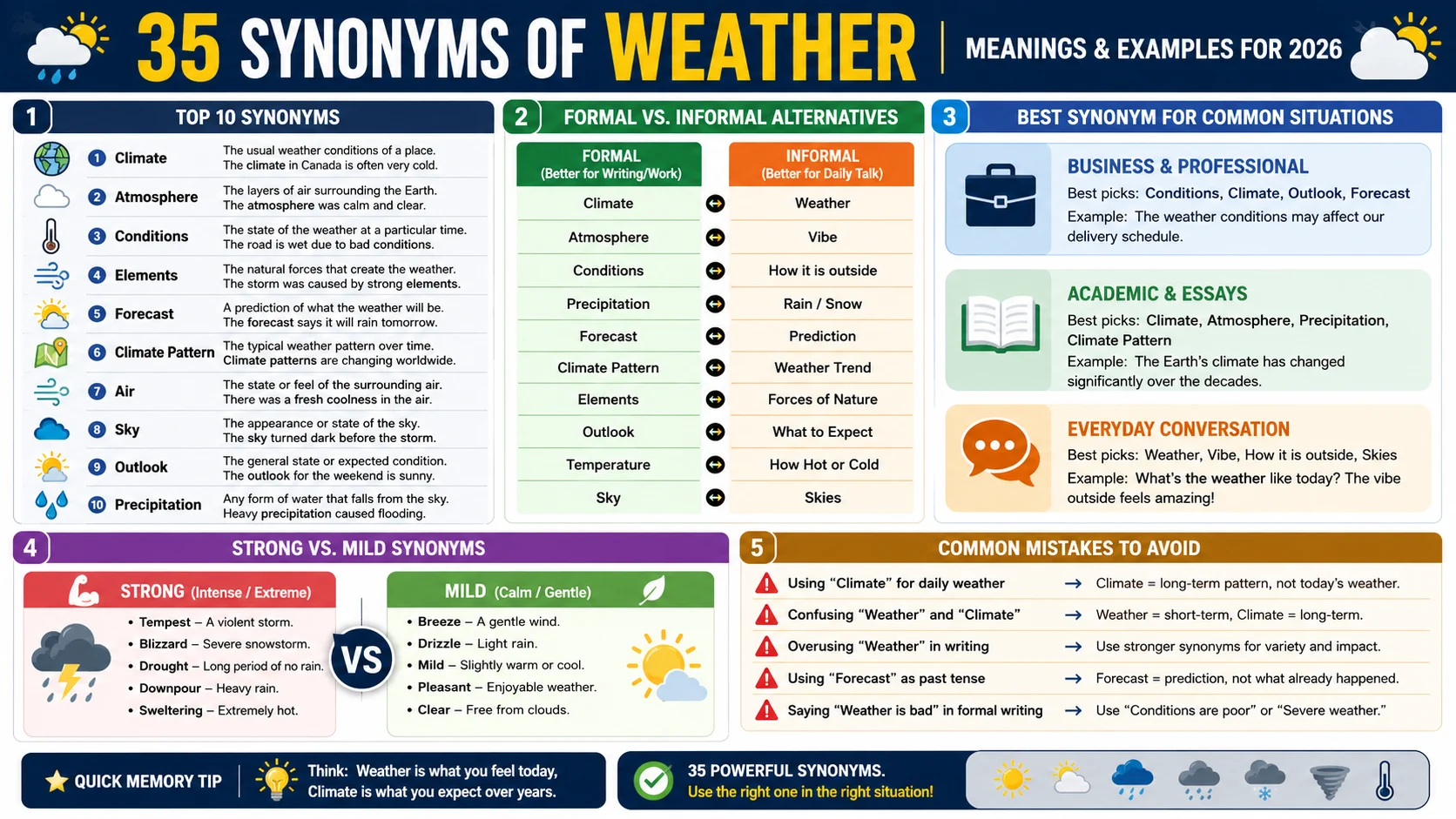
“Weather” means the conditions outside like temperature, rain, wind, and sunshine. The best synonyms are climate, atmosphere, conditions, elements, and forecast. “Climate” is the most common natural alternative. Each synonym has a slightly different meaning and context where it fits best.
Top 10 Synonyms
- Climate
- Atmosphere
- Conditions
- Elements
- Forecast
- Outlook
- Temperature
- Climate conditions
- Weather conditions
- The elements
“Weather” is something we talk about every day. We check the weather, complain about the weather, and plan our lives around the weather. But using it too often can make your English feel repetitive.
Think about it. You can talk about good weather, bad weather, extreme weather, or unpredictable weather. Each situation might need a different word that captures the specific type of weather.
In this guide, you’ll learn 35 powerful synonyms for “weather.” You’ll discover exactly when to use each one, how formal they are, and what common mistakes to avoid. Let’s begin!
What Does “Weather” Mean?
Definition
Weather” means the state of the atmosphere at a particular time and place. It includes temperature, precipitation (rain, snow), wind, humidity, and sunshine. Weather can change from day to day and hour to hour.
Pronunciation
| Feature | Value |
|---|---|
| US IPA | /ˈwɛðər/ |
| UK IPA | /ˈwɛðə/ |
| Syllables | 2 (weath-er) |
| Tip | Stress the first syllable: “WEH-ther” |
Grammar
| Grammar Feature | Information |
|---|---|
| Part of Speech | Noun (and Verb) |
| Common Position | Subject or object |
| Typical Pattern | Weather + is + adjective / Weather + of + place |
Examples:
- “The weather is beautiful today.” (noun)
- “We need to weather the storm.” (verb)
- “What’s the weather like in London?” (noun)
Grammar Note: “Weather” can also be a verb meaning to survive or withstand something.
Word Family
| Word | Part of Speech | Meaning |
|---|---|---|
| Weather | Noun/Verb | Atmospheric conditions or to survive |
| Weathering | Noun | The process of being affected by weather |
| Weatherproof | Adjective | Resistant to weather |
| Weatherman | Noun | A person who forecasts weather |
15 Synonyms of “Weather”
Climate
Meaning: The typical weather conditions in a place over a long period.
Best Used For: Long-term patterns, regions, geography.
Formality: Neutral
Tone: Scientific, Descriptive
Frequency: ⭐⭐⭐⭐⭐ (Very Common)
CEFR Level: B1
Example Sentence 1: “The climate in Florida is warm and humid.”
Example Sentence 2: “Climate change is affecting the planet.”
Usage Tip: “Climate” is about long-term patterns, not daily weather. Use it for regional descriptions.
Common Confusion: Climate vs Weather. “Climate” is long-term average. “Weather” is day-to-day conditions.
Atmosphere
Meaning: The layer of gases around the Earth, or the feeling of a place.
Best Used For: Scientific contexts, describing mood, air quality.
Formality: Formal
Tone: Scientific, Descriptive
Frequency: ⭐⭐⭐⭐ (Common)
CEFR Level: B2
Example Sentence 1: “The atmosphere contains oxygen and nitrogen.”
Example Sentence 2: “The atmosphere of the party was joyful.”
Usage Tip: “Atmosphere” can mean both the air around Earth and the mood of a place.
Conditions
Meaning: The state of the weather at a specific time.
Best Used For: Reports, descriptions of current weather.
Formality: Neutral
Tone: Factual, Descriptive
Frequency: ⭐⭐⭐⭐⭐ (Very Common)
CEFR Level: B1
Example Sentence 1: “Weather conditions are favorable for flying.”
Example Sentence 2: “The conditions on the mountain are dangerous.”
Usage Tip: “Conditions” is often used in weather reports and official contexts.
Elements
Meaning: The forces of nature, especially bad weather.
Best Used For: Poetic or dramatic descriptions.
Formality: Literary
Tone: Dramatic, Nature-focused
Frequency: ⭐⭐⭐ (Moderate)
CEFR Level: B2
Example Sentence 1: “The hikers braved the elements.”
Example Sentence 2: “The storm exposed them to the elements.”
Usage Tip: “Elements” is dramatic and often used to describe harsh weather.
Forecast
Meaning: A prediction of what the weather will be.
Best Used For: Weather predictions, planning.
Formality: Neutral
Tone: Predictive, Informative
Frequency: ⭐⭐⭐⭐ (Common)
CEFR Level: B2
Example Sentence 1: “The forecast predicts rain tomorrow.”
Example Sentence 2: “Let’s check the weather forecast.”
Usage Tip: “Forecast” is specifically about predicting future weather.
Outlook
Meaning: The expected weather for the future.
Best Used For: Future predictions, planning.
Formality: Neutral
Tone: Predictive, Informative
Frequency: ⭐⭐⭐ (Moderate)
CEFR Level: B2
Example Sentence 1: “The outlook for the weekend is sunny.”
Example Sentence 2: “The economic outlook is positive.”
Usage Tip: “Outlook” can be used for weather and also for future trends.
Temperature
Meaning: The degree of heat or cold in the air.
Best Used For: Describing how hot or cold it is.
Formality: Neutral
Tone: Scientific, Factual
Frequency: ⭐⭐⭐⭐⭐ (Very Common)
CEFR Level: A2
Example Sentence 1: “The temperature dropped to freezing.”
Example Sentence 2: “What’s the temperature outside?”
Usage Tip: “Temperature” focuses on how hot or cold it is, not the whole weather picture.
Weather conditions
Meaning: The state of the weather at a given time.
Best Used For: Official reports, detailed descriptions.
Formality: Neutral
Tone: Factual, Descriptive
Frequency: ⭐⭐⭐⭐ (Common)
CEFR Level: B1
Example Sentence 1: “The weather conditions are poor today.”
Example Sentence 2: “We should check the weather conditions before driving.”
Usage Tip: This is a more formal way to say “weather.”
Climate conditions
Meaning: The typical weather conditions in a region.
Best Used For: Geography, science, planning.
Formality: Formal
Tone: Scientific, Descriptive
Frequency: ⭐⭐⭐ (Moderate)
CEFR Level: B2
Example Sentence 1: “The climate conditions here are tropical.”
Example Sentence 2: “Climate conditions affect agriculture.”
Usage Tip: This is a formal term for typical weather in a region.
The elements
Meaning: The forces of nature.
Best Used For: Literary or dramatic contexts.
Formality: Literary
Tone: Dramatic, Nature-focused
Frequency: ⭐⭐⭐ (Moderate)
CEFR Level: B2
Example Sentence 1: “The sailors fought against the elements.”
Example Sentence 2: “The elements battered the coast.”
Usage Tip: A poetic way to describe harsh weather.
Precipitation
Meaning: Rain, snow, sleet, or hail that falls from the sky.
Best Used For: Scientific, weather reports.
Formality: Formal
Tone: Scientific, Factual
Frequency: ⭐⭐⭐ (Moderate)
CEFR Level: B2
Example Sentence 1: “The forecast predicts heavy precipitation.”
Example Sentence 2: “Precipitation amounts vary across the region.”
Usage Tip: “Precipitation” is a scientific term for rain and snow.
Humidity
Meaning: The amount of moisture in the air.
Best Used For: Describing how damp or dry the air feels.
Formality: Neutral
Tone: Scientific, Descriptive
Frequency: ⭐⭐⭐ (Moderate)
CEFR Level: B2
Example Sentence 1: “The humidity is high today.”
Example Sentence 2: “Humidity makes it feel hotter.”
Usage Tip: “Humidity” focuses on moisture in the air, not the whole weather picture.
Meteorology
Meaning: The study of weather.
Best Used For: Scientific contexts, studies.
Formality: Formal
Tone: Scientific, Academic
Frequency: ⭐⭐ (Rare)
CEFR Level: C1
Example Sentence 1: “She studies meteorology at university.”
Example Sentence 2: “Meteorology helps predict storms.”
Usage Tip: “Meteorology” is the science of weather, not the weather itself.
The sky
Meaning: The appearance of the sky as an indicator of weather.
Best Used For: Casual conversation, observation.
Formality: Informal
Tone: Observational, Casual
Frequency: ⭐⭐⭐⭐ (Common)
CEFR Level: A2
Example Sentence 1: “Look at the sky—it might rain.”
Example Sentence 2: “The sky is clear today.”
Usage Tip: “The sky” is used in casual conversation to talk about weather.
Nature
Meaning: The natural world, often including weather.
Best Used For: Philosophical, poetic contexts.
Formality: Neutral
Tone: Natural, Reflective
Frequency: ⭐⭐⭐⭐ (Common)
CEFR Level: B1
Example Sentence 1: “We’re at the mercy of nature.”
Example Sentence 2: “Nature can be harsh.”
Usage Tip: “Nature” is broader than weather but often includes it.
Synonyms Comparison Table
| Synonym | Best Context | Formality | Tone | Frequency |
|---|---|---|---|---|
| Climate | Long-term patterns | Neutral | Scientific | ⭐⭐⭐⭐⭐ |
| Conditions | Current state | Neutral | Factual | ⭐⭐⭐⭐⭐ |
| Temperature | Heat/cold | Neutral | Scientific | ⭐⭐⭐⭐⭐ |
| Forecast | Predictions | Neutral | Predictive | ⭐⭐⭐⭐ |
| Atmosphere | Air/mood | Formal | Scientific | ⭐⭐⭐⭐ |
| Precipitation | Rain/snow | Formal | Scientific | ⭐⭐⭐ |
| Elements | Nature’s forces | Literary | Dramatic | ⭐⭐⭐ |
| Outlook | Future predictions | Neutral | Predictive | ⭐⭐⭐ |
| Humidity | Moisture | Neutral | Scientific | ⭐⭐⭐ |
| Meteorology | Weather science | Formal | Academic | ⭐⭐ |
Best Synonyms by Situation
| Situation | Best Synonym | Why It Works |
|---|---|---|
| Daily Conversation | Weather | Natural and common |
| Business Email | Conditions | Professional and clear |
| Academic Writing | Climate | Formal and precise |
| School Assignment | Climate | Shows understanding |
| Professional Meeting | Conditions | Sounds professional |
| Presentation | Conditions | Clear and factual |
| Creative Writing | Elements | Adds literary depth |
| Social Media | Weather | Casual and relatable |
| Weather Report | Forecast | Accurate and clear |
Formal vs Informal Synonyms
Formal Alternatives
| Synonym | Best Used For |
|---|---|
| Climate | Long-term patterns |
| Precipitation | Rain, snow |
| Meteorology | Weather science |
| Humidity | Air moisture |
| Conditions | Current state |
Neutral Alternatives
| Synonym | Best Used For |
|---|---|
| Weather | Most general situations |
| Temperature | Heat/cold |
| Forecast | Predictions |
| Outlook | Future predictions |
Informal Alternatives
| Synonym | Best Used For |
|---|---|
| The sky | Casual observation |
| Elements | Dramatic descriptions |
| Nature | Broader natural world |
Choosing the Right Level: Use “climate” and “precipitation” for formal writing. Use “weather” and “conditions” for most situations.
Strong vs Mild Synonyms
Mild
Suitable for everyday situations with less intensity.
- Weather
- Temperature
- Forecast
Moderate
More specific or technical alternatives.
- Conditions
- Climate
- Outlook
- Precipitation
Strong
High-intensity alternatives suggesting dramatic or formal contexts.
- Elements (dramatic)
- Meteorology (academic)
- Atmosphere (scientific/literary)
How Intensity Changes Meaning: “Check the weather” is simple. “Check the meteorological conditions” is technical. Choose stronger words when you want to emphasize formality or drama.
Real-Life Examples
School: “The teacher explained how weather affects our daily lives.”
Office: “We need to check weather conditions before the trip.”
Business Email: “The conditions are favorable for the outdoor event.”
Meetings: “Climate change is affecting our industry.”
Presentations: “The forecast shows sunny weather for the weekend.”
Daily Conversations: “The weather is lovely today.”
Social Media: “Loving this beautiful weather!”
Academic Writing: “Climate patterns have changed significantly.”
Common Collocations
| Common Phrase | Better Alternative |
|---|---|
| Good weather | Favorable conditions |
| Bad weather | Severe weather |
| Weather forecast | Weather outlook |
| Weather patterns | Climate patterns |
| Extreme weather | Severe weather |
Common Phrases
Under the weather: Feeling ill. (e.g., “I’m feeling under the weather today.”)
Weather the storm: To survive a difficult situation. (e.g., “They weathered the storm.”)
The weather is on our side: The weather is helpful. (e.g., “The weather is on our side today.”)
Rain or shine: No matter what. (e.g., “We’ll go rain or shine.”)
Hot under the collar: Angry (related to temperature). (e.g., “He got hot under the collar.”)
Context Guide
| Situation | Best Synonym | Reason |
|---|---|---|
| Essay | Climate | Academic and formal |
| Speech | Weather | Clear and relatable |
| Business Email | Conditions | Professional and clear |
| Novel | Elements | Adds literary depth |
| Presentation | Conditions | Clear and factual |
| Conversation | Weather | Natural and relatable |
| Academic Writing | Climate | Precise and formal |
| Marketing Copy | Weather | Relatable and clear |
Related Words
Near Synonyms
- Climate: Typical weather patterns.
- Atmosphere: The air or mood.
- Conditions: Current state.
- Elements: Forces of nature.
- Meteorology: Weather science.
Antonyms
- Calm: Peaceful weather.
- Stillness: No wind.
- Stability: Consistent weather.
- Fairness: Good weather.
Related Adjectives
- Sunny: Having sunshine.
- Cloudy: Covered in clouds.
- Rainy: Having rain.
- Windy: Having wind.
- Snowy: Having snow.
Related Nouns
- Climate: Weather patterns.
- Temperature: Heat level.
- Precipitation: Rain/snow.
- Humidity: Moisture in air.
- Forecast: Weather prediction.
Related Verbs
- Forecast: To predict weather.
- Predict: To say what will happen.
- Rain: To fall as rain.
- Snow: To fall as snow.
- Storm: To be stormy.
Frequently Asked Questions
What is another word for weather?
Common synonyms include climate, atmosphere, conditions, elements, and forecast. “Climate” is the most common alternative for long-term patterns.
Which synonym sounds the most professional?
Conditions and climate sound very professional. “Meteorology” is excellent for academic contexts.
What is the strongest synonym for weather?
Elements is one of the strongest synonyms. It suggests the powerful forces of nature. “Meteorology” is also strong for academic contexts.
Which synonym is best for essays?
Climate is the best choice for academic essays. It’s formal and precise.
What’s the difference between weather and climate?
“Weather” is day-to-day conditions. “Climate” is long-term patterns over many years.
Which synonym is most common in everyday English?
“Weather” itself is most common. “Conditions” is also frequently used in weather reports.
What is the opposite of weather?
There is no direct opposite, but “calm” and “stillness” describe the absence of severe weather.
Conclusion
“Weather” is a word we use every day, but now you have 35 fantastic alternatives. Each synonym adds a different shade of meaning to your language.
Remember, the key is understanding the context. Use “climate” for long-term patterns. Use “conditions” for current weather. Use “forecast” for predictions. Use “elements” for dramatic descriptions.
The best way to improve is practice. Try using one or two new synonyms each day. Listen for these words in conversations and weather reports. Your vocabulary will become richer and more impressive with time.
