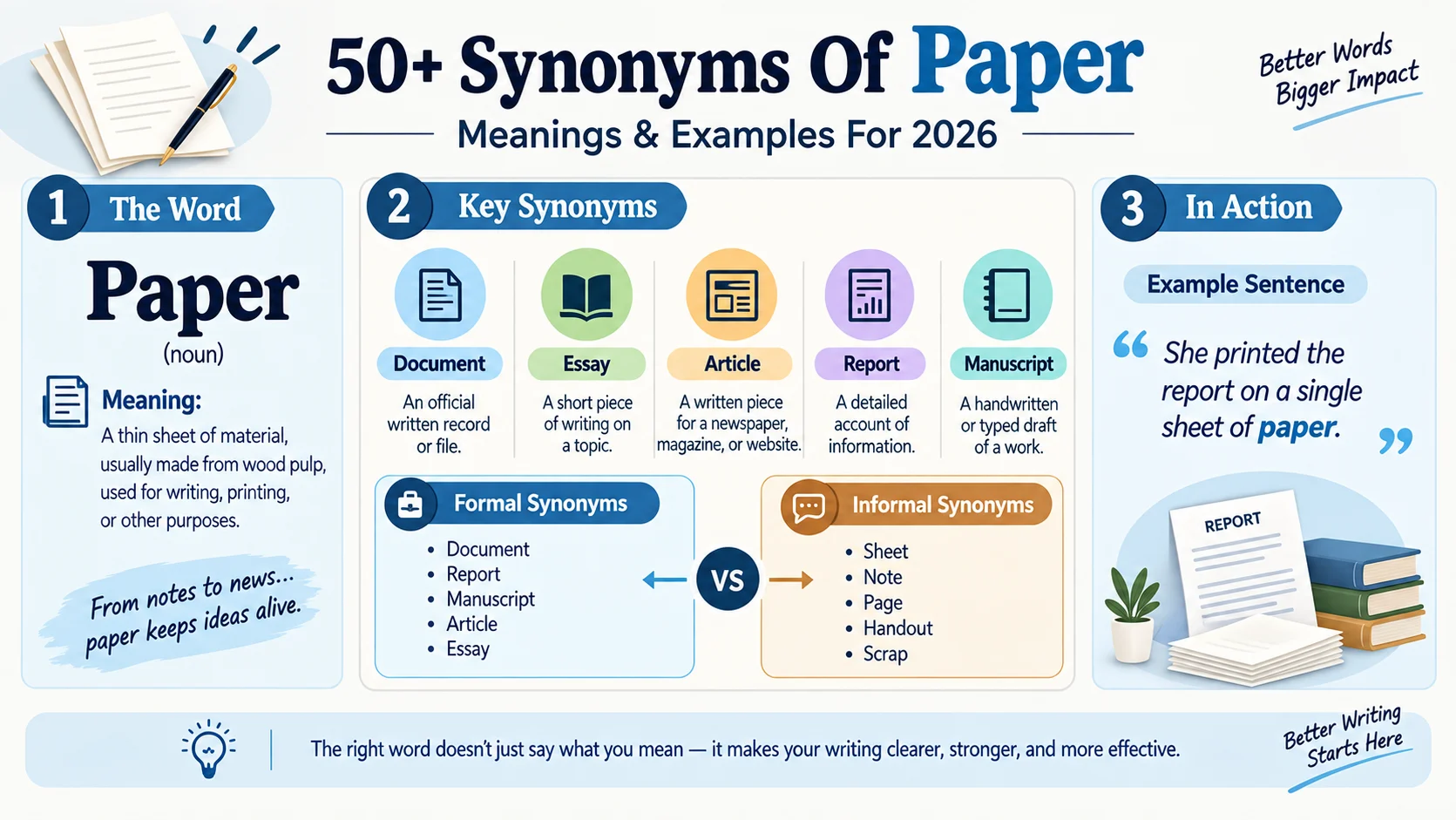
“Paper” can mean the material used for writing, an academic essay, an official document, or a newspaper. The best synonyms depend on context. For academic writing, use essay or thesis. For official documents, use document or form. For the material itself, use sheet or stationery.
Meaning, Tone and Context
The word “paper” is a versatile noun with several distinct meanings. Its core function is to refer to either a physical material or a written work. The tone is generally neutral, but it can shift depending on the specific meaning and the synonym you choose.
1. Simple Definition: Paper can mean the thin material used for writing and printing, an academic essay or article, an official document, or a newspaper.
2. Part of Speech: Paper is primarily a noun. It can also be used as an adjective.
- Noun: “I need a sheet of paper to write on.”
- Noun: “She published a paper on climate change.”
- Adjective: “The paper industry is a major economic sector.”
3. Tone: The tone is usually neutral. It can be formal when referring to academic papers or official documents. It can be casual when referring to a newspaper or a physical sheet.
4. Formality: “Paper” is a neutral word. It is appropriate for both casual conversation and professional writing. For very formal contexts, you might use “document” or “manuscript.”
5. Common Use Cases: You will encounter “paper” in many situations.
- Academic Writing: “I have to write a paper on American history.”
- Office and Business: “Please file these papers in the correct folder.”
- Everyday Conversation: “The paper boy delivers the news every morning.”
- Creative Writing: “She pulled out a piece of paper and began to sketch.”
6. Important Word Forms:
- Noun: paper, papers. “The papers were scattered across the desk.”
- Adjective: paper. We need to reduce our paper usage.”
- Verb: to paper. “They papered the walls with a floral design.”
When and How to Use “Paper”
Knowing when to use “paper” is about understanding its different meanings. It is a broad term that can refer to many things. Here are several scenarios where it is the perfect choice.
- Academic Context: To refer to a scholarly essay or research article.
Example: “The professor assigned a ten page paper on the French Revolution.” - Business Context: To refer to official documents or forms.
Example: “Please sign these papers before the end of the day.” - Casual Conversation: To refer to a newspaper.
Example: “I read an interesting article in the paper this morning.” - Creative Context: To refer to the material used for art or writing.
Example: “She bought a new sketchbook with high quality paper.” - School Context: To refer to a test or exam.
Example: “The final paper will cover everything we learned this semester.” - Email Context: To refer to a document that needs to be reviewed.
Example: “Please find the white paper attached to this email.” - Resume Context: To refer to published work or research.
Example: “I have published three papers in peer reviewed journals.” - Storytelling Context: To refer to something that exists only in theory.
Example: “The plan was good on paper, but it failed in practice.”
Another Word for “Paper”
Choosing the best replacement for “paper” depends entirely on the context. Here are the most effective alternatives categorized by use.
- Professional Writing: “Document” or “Report.” “The document outlines the new policy.”
- Academic Writing: “Essay” or “Thesis.” “Her thesis explored the effects of social media.”
- Casual Conversation: “Newspaper” or “Article.” “I read a great article about cooking.”
- Emotional Writing: “Manuscript” or “Work.” “The author’s manuscript was finally published.”
- Creative Writing: “Sheet” or “Page.” “He wrote his ideas on a single sheet of paper.”
- Resume or Workplace: “Publication” or “White paper.” “My publications include several articles on marketing.”
- Social Media Captions: “Post” or “Piece.” “Check out my latest piece on sustainable living.”
- Stronger Meaning: “Documentation” or “Manuscript.” “The manuscript was over 500 pages long.”
- Softer Meaning: “Note” or “Slip.” “He passed me a note during class.”
When Not to Use “Paper”
While “paper” is a versatile word, it can be too broad or vague in certain situations. Using a more precise synonym can improve clarity and impact.
- When You Need Specificity: If you are talking about a specific type of document, use a more precise word. “The paper was important” is vague. “The contract was important” is much clearer.
- When Discussing Digital Files: “Paper” implies something physical. “Send me the paper” is less clear than “Send me the PDF.”
- When Criticizing Directly: Using “paper” can sound neutral when you want to be critical. Instead of “The paper was full of errors,” try “The report was full of inaccuracies.”
Example of Precision: Compare these two sentences.
- Vague: “I need to write a paper.”
- Precise: “I need to write a research proposal.”
The second sentence is more specific and provides a clearer picture of the task.
Words Commonly Confused With “Paper”
Understanding the differences between these related words will significantly refine your English.
- Paper vs. Essay: A “paper” is a broad term for a written work, often academic. An “essay” is a specific type of paper that presents an argument or perspective. All essays are papers, but not all papers are essays.
- Paper vs. Article: An “article” is a piece of writing included in a publication like a newspaper, magazine, or journal. A “paper” can be a standalone document or an academic work. Articles are usually shorter and more focused.
- Paper vs. Document: A “document” is a broader term. It can be any written or printed matter that provides information or evidence. A “paper” is often a specific type of document, like an academic paper or an official form.
- Paper vs. Thesis: A “thesis” is a long, formal paper that presents original research, usually for a university degree. A “paper” can be much shorter and less formal.
- Paper vs. Report: A “report” is a document that presents information in an organized format for a specific audience. A “paper” can be a report, but it can also be an essay or an article.
- Paper vs. Newspaper: A “newspaper” is a specific type of publication. “Paper” is a casual, shortened way to refer to a newspaper. The context makes the meaning clear.
Best Synonym by Context for “Paper”
| Context | Best Synonym | Why It Works | Example |
|---|---|---|---|
| Formal Writing | Document | It is a broad, professional term. | “Please review the attached document.” |
| Academic Writing | Essay | It is precise and appropriate for school. | “The essay explores themes of identity.” |
| Professional/Business | Report | It is clear and focused on information. | “The quarterly report is due on Friday.” |
| Resume | Publication | It highlights your professional writing. | “My publications include several journal articles.” |
| Casual Conversation | Newspaper | It is simple and universally understood. | “I read about it in the newspaper.” |
| Creative Writing | Manuscript | It adds a literary and professional feel. | “The author submitted her manuscript to the publisher.” |
| Emotional Tone | Work | It suggests personal effort and creation. | “This is a work of great importance.” |
| Strong Intensity | Thesis | It implies deep, original research. | “His thesis changed the field of study.” |
| Soft/Moderate Tone | Note | It is casual and personal. | “She left a note on the kitchen table.” |
| Social Media Captions | Post | It is modern and perfect for online use. | “Check out my latest post on wellness.” |
| US/UK Usage | Paper (US) / Newspaper (UK) | Both are common, but context matters. | US: “The paper is on the table.” UK: “The newspaper is on the table.” |
Which Synonym Should You Choose?
Choosing the right word can seem difficult, but this simple guide will help you decide. It is all about matching the word to your goal, audience, and the message you want to send.
- Is your goal to inform or present research? Use “essay,” “thesis,” or “article.” These are the most precise terms for academic work.
- Is your goal to communicate in a professional setting? Use “document,” “report,” or “memo.” These are standard business terms.
- Is your goal to be casual and conversational? Use “newspaper,” “note,” or “sheet.” These are natural in everyday speech.
- Are you describing something creative or literary? Use “manuscript” or “work.” These add a sense of artistry.
- Are you writing for social media? Use “post” or “piece.” These are modern and engaging.
- Do you want to emphasize the physical material? Use “sheet,” “page,” or “stationery.” These are specific and clear.
Real Life Examples of “Paper” in Sentences
Here are examples of how “paper” and its stronger synonyms can be used in different real world scenarios.
- School: “I have to write a paper on the causes of World War II.” Stronger: “I have to write an essay on the causes of World War II.”
- Workplace: “Please file these papers in the cabinet.” Stronger: “Please file these documents in the cabinet.”
- Writing: “She published a paper in a prestigious journal.” Stronger: “She published an article in a prestigious journal.”
- Conversation: “I read the paper this morning.” Stronger: “I read the newspaper this morning.”
- Social Media: “Check out my new paper on digital marketing.” Stronger: “Check out my new post on digital marketing.”
- Resume: “I have written several papers on the subject.” Stronger: “I have authored several publications on the subject.”
- Email: “Attached is the paper you requested.” Stronger: “Attached is the document you requested.”
- Storytelling: “The old papers were yellowed with age.” Stronger: “The old manuscripts were yellowed with age.”
50 Synonyms for “Paper”
The following table lists 25 accurate and practical synonyms for “paper.
| Synonym | Simple Meaning | Best Used For | Example Sentence |
|---|---|---|---|
| Document | A formal written record. | Business, legal. | “The document must be signed by both parties.” |
| Essay | A short piece of writing on a subject. | Academic, school. | “The essay argues for stricter environmental laws.” |
| Article | A piece of writing in a publication. | Journalism, academic. | “The article was published in a major newspaper.” |
| Report | A detailed account of a situation. | Business, academic. | “The report highlights the company’s financial performance.” |
| Manuscript | An author’s unpublished work. | Publishing, creative. | “The manuscript was sent to the editor for review.” |
| Thesis | A long essay for a university degree. | Academic, research. | “She is writing her thesis on renewable energy.” |
| Publication | A published work. | Academic, professional. | “His publications include several books.” |
| Sheet | A single piece of paper. | Everyday, creative. | “He handed me a sheet with instructions.” |
| Page | One side of a sheet of paper. | Everyday, writing. | “Please turn to the next page.” |
| Note | A short informal written message. | Personal, casual. | “She left a note on the refrigerator.” |
| Memo | A short message in a business setting. | Business, office. | “The manager sent a memo about the meeting.” |
| Form | A document with blank spaces to fill. | Official, administrative. | “Please fill out the application form.” |
| Contract | A legal agreement. | Legal, business. | “The contract was signed by both parties.” |
| Newspaper | A daily publication with news. | Casual, media. | “He reads the newspaper every morning.” |
| Journal | A scholarly publication. | Academic, research. | “She published her findings in a medical journal.” |
| Draft | An early version of a written work. | Writing, academic. | “The first draft needs more work.” |
| Copy | Text for publication. | Journalism, publishing. | “The editor reviewed the copy before printing.” |
| Script | Written text for a play or movie. | Entertainment, creative. | “The actor memorized the script.” |
| Stationery | Writing materials, including paper. | Office, personal. | “She bought new stationery for her letters.” |
| Parchment | A historical writing material. | Historical, creative. | “The ancient parchment was fragile.” |
| Slip | A small piece of paper. | Casual, office. | “He wrote the address on a slip of paper.” |
| Card | A thick piece of paper. | Personal, greeting. | “She sent a birthday card to her friend.” |
| White paper | An authoritative report on a topic. | Business, government. | “The company released a white paper on data security.” |
| Term paper | A major academic assignment. | School, college. | “The term paper is due at the end of the semester.” |
| Working paper | A preliminary research document. | Academic, research. | “The working paper was circulated for feedback.” |
Synonym Groups and Usage Differences
Professional vs. Personal Synonyms
In a professional setting, like a business report or a resume, choose “document,” “report,” or “publication.” These words sound polished and appropriate. In a personal setting, “note,” “sheet,” or “card” are more natural and friendly. For example, you would tell a colleague “Please review the document,” but a friend “I left a note on your desk.”
Formal vs. Conversational Synonyms
Formal Synonyms: “Document,” “manuscript,” and “thesis” are perfect for academic papers, legal documents, or formal speeches.
Conversational Synonyms: “Newspaper,” “note,” and “sheet” are the best choices for everyday conversations and emails to friends.
Academic Synonyms
In essays and research papers, “essay,” “thesis,” and “journal article” are powerful and precise terms. “Working paper” is also useful for preliminary research. “Term paper” is common in school settings.
Professional and Business Synonyms
“Document” is a safe and professional choice for almost any workplace communication. “Report” is effective when discussing data or findings. “Memo” is great for short internal messages. “White paper” is excellent for authoritative reports.
Creative or Literary Synonyms
These words add a layer of artistry to your descriptions.
- Manuscript: Suggests a work in progress or an author’s original text.
- Script: Perfect for theater, film, or television.
- Parchment: Evokes a sense of history and antiquity.
Slang or Modern Synonyms
Post” is a modern synonym for an online article or piece of content. It is acceptable in social media captions and informal writing. “Copy” is a journalism term for text. These should be avoided in formal academic writing.
Strongest vs. Weaker Synonyms
Here is an intensity scale from mild to strongest:
- Slip, Note: Very mild, casual pieces of paper.
- Sheet, Page: Mild, referring to physical paper.
- Paper, Document: Moderate, general terms.
- Essay, Article, Report: Strong, formal written works.
- Thesis, Manuscript: Strongest, major scholarly or literary works.
Emotional vs. Neutral Synonyms
Emotional Synonyms: “Manuscript” and “work” can carry emotional weight, suggesting personal effort and creation.
Neutral Synonyms: “Document,” “form,” and “report” are factual and free of emotional charge.
Antonyms of “Paper”
Here are 15 clear antonyms for “paper,” which are words that mean the opposite: non physical, digital, or non written forms.
| Antonym | Meaning | Example Sentence |
|---|---|---|
| Digital file | A computer based document. | “Please send the digital file instead of a printed copy.” |
| Electronic document | A document stored on a computer. | “The electronic document is easier to edit.” |
| E book | A book in digital format. | “She prefers reading an e book on her tablet.” |
| Screen | A display for digital content. | “The information is on the screen.” |
| Speech | Spoken communication. | “His speech was powerful and moving.” |
| Conversation | An informal spoken exchange. | “We had a long conversation about the project.” |
| Video | A recording of moving images. | “The training video explains the process.” |
| Audio | Recorded sound. | “The audio recording captured the entire lecture.” |
| Artifact | A physical object. | “The museum displayed ancient artifacts.” |
| Object | A physical item. | “The object was too heavy to lift.” |
| Action | Something done rather than written. | “We need action, not just words on paper.” |
| Practice | Doing something rather than planning. | “The plan looks good on paper, but it fails in practice.” |
| Reality | The actual state of things. | “The theory works in reality, not just on paper.” |
| Memory | Something remembered. | “The story exists only in memory.” |
| Oral tradition | Stories passed down by speaking. | “The tribe preserved its history through oral tradition.” |
Comparison: “Paper” vs. Similar Words
Paper vs. Essay
Main Difference: A “paper” is a broad term for a written work, often academic. An “essay” is a specific type of paper that presents an argument or perspective.
Which One Is Stronger: “Essay” is more specific and focused.
Which One Is More Formal: Both are formal, but “essay” is more common in academic contexts.
Example Sentence with Paper: “I have to write a paper for my history class.”
Example Sentence with Essay: “The essay argues for stricter gun control laws.”
Paper vs. Article
Main Difference: An “article” is a piece of writing included in a publication like a newspaper, magazine, or journal. A “paper” can be a standalone document or an academic work.
Which One Is Stronger: “Article” is more specific to publications.
Which One Is More Formal: Both are formal, but “article” is more common in journalism.
Example Sentence with Paper: “She published a paper on climate change.”
Example Sentence with Article: “I read an interesting article about climate change.”
Paper vs. Document
Main Difference: A “document” is a broader term. It can be any written or printed matter that provides information or evidence. A “paper” is often a specific type of document, like an academic paper or an official form.
Which One Is Stronger: “Document” is broader and more inclusive.
Which One Is More Formal: Both are formal, but “document” is more general.
Example Sentence with Paper: “Please sign these papers.”
Example Sentence with Document: “Please review the attached document.”
Paper vs. Thesis
Main Difference: A “thesis” is a long, formal paper that presents original research, usually for a university degree. A “paper” can be much shorter and less formal.
Which One Is Stronger: “Thesis” is much stronger and more significant.
Which One Is More Formal: “Thesis” is more formal and academic.
Example Sentence with Paper: “I wrote a paper on Shakespeare.”
Example Sentence with Thesis: “She is writing her doctoral thesis on Shakespeare.”
Paper vs. Report
Main Difference: A “report” is a document that presents information in an organized format for a specific audience. A “paper” can be a report, but it can also be an essay or an article.
Which One Is Stronger: “Report” is more structured and informative.
Which One Is More Formal: Both are formal, but “report” is more common in business.
Example Sentence with Paper: “The paper was well researched.”
Example Sentence with Report: “The quarterly report shows strong growth.”
Paper vs. Newspaper
Main Difference: A “newspaper” is a specific type of publication. “Paper” is a casual, shortened way to refer to a newspaper. The context makes the meaning clear.
Which One Is Stronger: “Newspaper” is more specific.
Which One Is More Formal: “Newspaper” is more formal than the casual “paper.”
Example Sentence with Paper: “I read the paper this morning.”
Example Sentence with Newspaper: “The newspaper published a correction.”
Common Phrases and Expressions with “Paper”
1. On Paper
Meaning: In theory or in writing, but not necessarily in reality.
Example Sentence: “The plan looks good on paper, but it might not work in practice.”
2. Paper Trail
Meaning: A series of documents that provide evidence of someone’s actions.
Example Sentence: “The investigation followed the paper trail to find the truth.”
3. Paper Tiger
Meaning: Something that appears threatening but is actually weak.
Example Sentence: “The company was a paper tiger, with no real power.”
4. Put Pen to Paper
Meaning: To begin writing.
Example Sentence: “It is time to put pen to paper and start your essay.”
5. Paper Over the Cracks
Meaning: To hide problems instead of solving them.
Example Sentence: “The government tried to paper over the cracks in the economy.”
6. Dead Tree Edition
Meaning: A humorous term for a printed newspaper or book.
Example Sentence: “I still enjoy the dead tree edition of the newspaper.”
7. Walking Papers
Meaning: A notice of dismissal from a job.
Example Sentence: “After the mistake, he was given his walking papers.”
8. Paper Pusher
Meaning: A person with a routine administrative job.
Example Sentence: “He felt like a paper pusher in the large corporation.”
Common Mistakes to Avoid
1. Using “Paper” When a More Precise Synonym Is Better
Mistake: “I need to write a paper for work.”
Better: “I need to write a report for work.” This is more specific and professional.
2. Confusing “Paper” with “Essay”
Mistake: “I have to write an essay for my science lab.”
Better: “I have to write a lab report for my science lab.” A lab report is a specific type of paper, not an essay.
3. Using a Casual Synonym in Formal Writing
Mistake: “The newspaper article was informative.” (Using “newspaper” is fine, but in a formal report, “article” alone is better.)
Better: “The article was informative.” In a formal academic paper, “newspaper article” might be too specific. “Article” is more academic.
4. Using an Overly Dramatic Synonym for a Simple Situation
Mistake: “I wrote a manuscript for my grocery list.”
Better: “I wrote a note for my grocery list.” “Manuscript” is too grand for a simple list.
5. Repeating the Same Word Too Often
Mistake: “The paper was good. The paper was well written. The paper was interesting.”
Better: “The paper was good. The essay was well written. The document was interesting.” This variation makes the writing more engaging.
6. Choosing a Synonym with the Wrong Emotional Tone
Mistake: “I appreciated the manuscript for the meeting.”
Better: “I appreciated the document for the meeting.” “Manuscript” is for creative works, not business documents.
7. Using Slang in Academic or Professional Writing
Mistake: “The article is a piece for the new magazine.”
Better: “The article is a feature for the new magazine.” “Piece” is too casual for professional writing.
FAQs
1. What is the best synonym for paper?
- The best synonym depends on your context. For academic writing, “essay” is a safe choice. For business, use “document.” For the physical material, use “sheet.”
2. What is a formal synonym for paper?
A formal synonym for paper is “document” or “manuscript.” Both are appropriate for formal writing and professional communication.
3. What is an informal synonym for paper?
An informal synonym for paper is “newspaper” or “note.” “Slip” is also a good casual choice. These words are perfect for everyday conversation.
4. What is another word for paper in professional writing?
In professional writing, “document” is an excellent choice. “Report” is also effective when discussing data. “Memo” is useful for short internal messages.
5. What is the difference between paper and essay?
A “paper” is a broad term for a written work. An “essay” is a specific type of paper that presents an argument or perspective. All essays are papers, but not all papers are essays.
6. What is the opposite of paper?
The opposite of paper is “digital file,” “electronic document,” or “screen.” These words describe non physical or digital forms of information.
Conclusion
The word “paper” is a simple but versatile term. It can refer to the physical material we write on, an academic essay, an official document, or a newspaper. Choosing the right synonym depends entirely on your context, audience, and the tone you wish to convey.
For a professional setting, “document” or “report” work well. For a formal academic context, “essay” or “thesis” are excellent choices. In casual conversation, “newspaper” or “note” are natural and friendly. For creative writing, “manuscript” adds a literary touch.
The best advice is to think about your purpose and your audience before you choose a word. Do you want to be specific, professional, casual, or creative? Matching your word to your intention will make your communication more effective and your English more precise.
A practical vocabulary tip: Try replacing “paper” with a more specific synonym in your writing this week. If you are writing an academic essay, use “thesis.” If you are writing a business email, use “document.” This small change will significantly improve the clarity and sophistication of your English.
