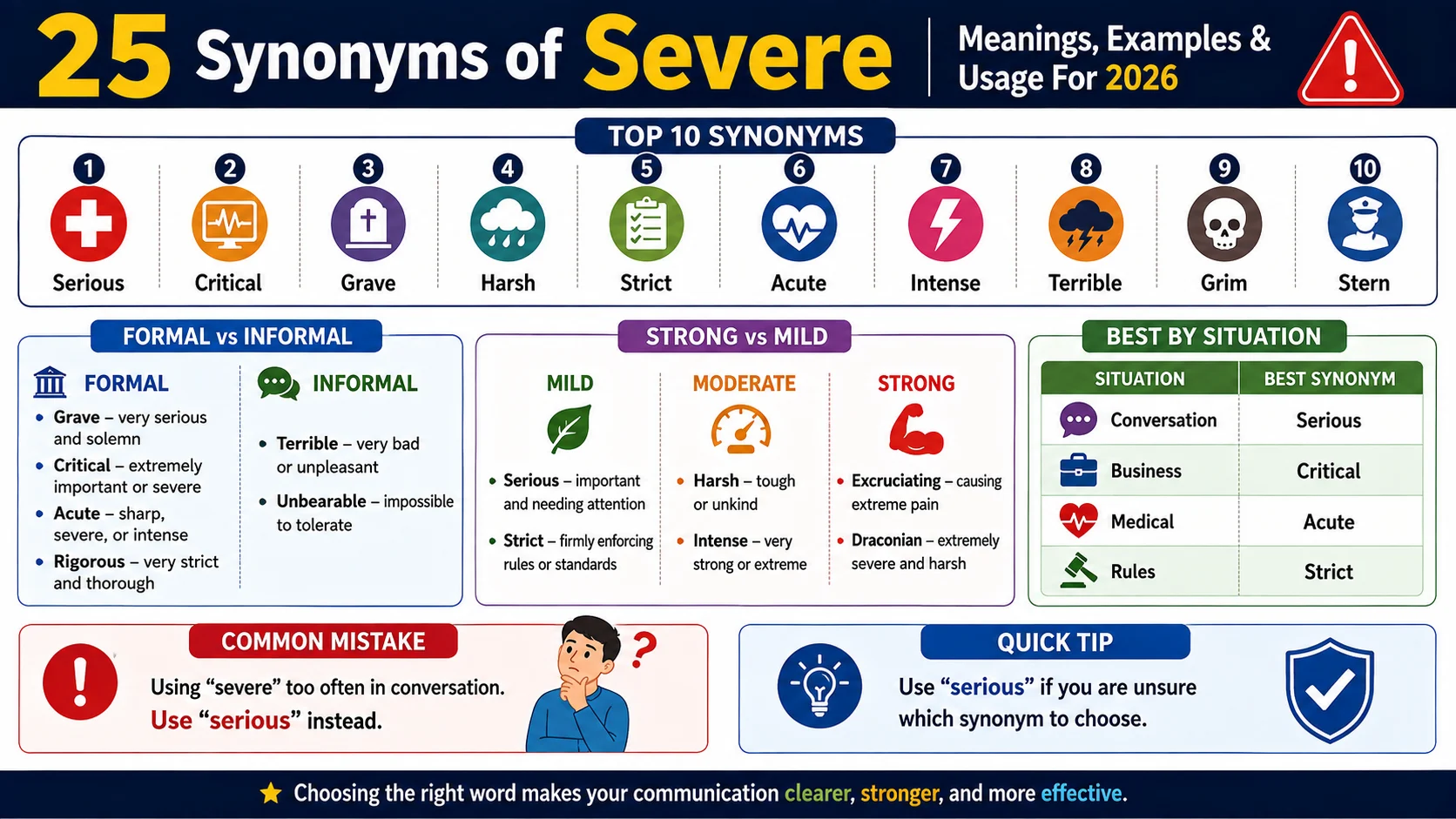
Severe means something very bad, intense, or strict. The best synonyms include serious, critical, grave, harsh, strict, acute, intense, grim, austere, and drastic. Serious is the most common everyday alternative. Each synonym has a slightly different meaning, so choose based on your context whether you are describing a situation, a person’s manner, or physical pain.
Have you ever described a situation as “severe” and felt the word didn’t quite capture what you meant? You are not alone. Severe” is a useful word, but English has many alternatives that express different shades of meaning. Whether you are writing a formal report, having a conversation, or describing a difficult experience, choosing the right synonym makes your English sound more natural and precise.
This guide will teach you the most common synonyms of “severe,” explain when to use each one, and help you avoid common mistakes. By the end, you will have a stronger vocabulary and greater confidence in your English.
What Does “Severe” Mean?
Definition
“Severe” describes something very unpleasant, intense, or serious. It can refer to pain, weather, punishment, criticism, or a person’s manner. Think of it as meaning “very bad” or “very strict.” It is stronger than just saying something is “bad” or “difficult.”
Pronunciation
| Feature | Value |
|---|---|
| US IPA | /səˈvɪr/ |
| UK IPA | /sɪˈvɪə/ |
| Syllables | 2 |
| Tip | Stress the second syllable: suh-VEER |
Grammar
| Feature | Information |
|---|---|
| Part of Speech | Adjective |
| Common Position | Before a noun (severe weather) or after a linking verb (The damage was severe) |
| Typical Pattern | severe + noun; verb to be + severe |
Example Sentences:
- The storm caused severe damage to the coastal town.
- Her father was a severe man who rarely smiled.
- The patient is in severe pain and needs immediate treatment.
Grammar Note: “Severe” is a gradable adjective, meaning you can use words like “very,” “extremely,” or “quite” before it (e.g., “very severe”). It also has comparative and superlative forms: “severer” and “severest,” though “more severe” and “most severe” are more common in modern English.
Word Family
| Word | Part of Speech | Meaning |
|---|---|---|
| Severe | Adjective | Very bad, intense, or strict |
| Severely | Adverb | In a severe manner |
| Severity | Noun | The quality of being severe |
| Severer | Adjective (comparative) | More severe |
| Severest | Adjective (superlative) | Most severe |
25 Synonyms of “Severe”
1. Serious
Meaning: Important, worrying, or dangerous; not minor.
Best Used For: Conversations, news reports, and general writing. It is the most natural everyday alternative to “severe.”
Formality: Neutral
Tone: Neutral, Professional
Frequency: ⭐⭐⭐⭐⭐ Very Common
CEFR Level: B1
Example Sentence 1: He has a serious health condition that requires regular check-ups.
Example Sentence 2: This is a serious problem that we need to address immediately.
Usage Tip: “Serious” is usually the best choice for everyday speech. Use it when you want to sound natural but still convey importance. Avoid “severe” in casual conversation it can sound too formal or dramatic. Native speakers often say “serious” instead of “severe” when talking about health or problems.
Common Confusion: “Serious” can also mean “not joking” (e.g., “Are you serious?”). Make sure the context makes your meaning clear.
2. Critical
Meaning: Extremely serious and dangerous; at a point where something could change for better or worse.
Best Used For: Medical situations, reviews, and formal writing when you mean “extremely serious.
Formality: Formal
Tone: Professional, Urgent
Frequency: ⭐⭐⭐⭐ Common
CEFR Level: B2
Example Sentence 1: Three of the injured are in a critical condition.
Example Sentence 2: The film received critical acclaim from reviewers.
Usage Tip: In medicine, “critical” means life-threatening. In reviews, it means “careful analysis.” Be careful “critical” has two different meanings depending on the context.
3. Grave
Meaning: Very serious and worrying; often used for situations with bad consequences.
Best Used For: News, formal reports, and describing serious situations where there is great concern.
Formality: Formal
Tone: Serious, Sober
Frequency: ⭐⭐⭐ Moderate
CEFR Level: B2
Example Sentence 1: The situation in the disaster zone is grave.
Example Sentence 2: She had a grave expression on her face when she delivered the news.
Usage Tip: “Grave” is more formal than “serious.” It suggests deep concern and often implies that the situation could get worse. It is a good choice for formal writing but might sound too serious for everyday conversation.
4. Terrible
Meaning: Very bad or unpleasant.
Best Used For: Conversation, complaints, and informal writing.
Formality: Informal
Tone: Negative, Emotional
Frequency: ⭐⭐⭐⭐⭐ Very Common
CEFR Level: A2
Example Sentence 1: I have a terrible headache.
Example Sentence 2: The service at that restaurant was terrible.
Usage Tip: “Terrible” is very common in everyday English. Use it when you want to express strong negative feelings but don’t need a formal tone. It can describe anything from pain to food to weather.
5. Harsh
Meaning: Strict, cruel, or unpleasant; often used for rules, punishments, or treatment of people.
Best Used For: Describing rules, criticism, weather, or how someone treats others.
Formality: Neutral
Tone: Negative, Critical
Frequency: ⭐⭐⭐⭐ Common
CEFR Level: B1
Example Sentence 1: The new teacher was harsh on students who talked in class.
Example Sentence 2: He received harsh criticism for his performance.
Usage Tip: Use “harsh” when you think someone is too strict or unkind. It focuses on the effect on people, not the intensity of a situation. It would be an odd choice for describing physical pain.
6. Strict
Meaning: Following rules very closely and not allowing any deviation.
Best Used For: Describing people, rules, schools, parents, or organizations that enforce rules firmly.
Formality: Neutral
Tone: Neutral, Professional
Frequency: ⭐⭐⭐⭐⭐ Very Common
CEFR Level: A2
Example Sentence 1: Her parents were very strict about curfew.
Example Sentence 2: The school has strict dress code policies.
Usage Tip: “Strict” focuses on rule-following rather than intensity. If you want to say a person is “severe” in manner, “strict” is often better. It carries less negative judgment than “harsh.”
7. Acute
Meaning: Very sharp, intense, or severe; often used for pain or medical conditions that come on suddenly.
Best Used For: Medical descriptions, scientific writing, and describing sharp sensations.
Formality: Formal
Tone: Professional, Technical
Frequency: ⭐⭐⭐ Moderate
CEFR Level: B2
Example Sentence 1: She felt an acute pain in her chest.
Example Sentence 2: The region is suffering from an acute shortage of water.
Usage Tip: “Acute” is a good choice when you need a more scientific or formal word for “severe.” It is often used in medical contexts to contrast with “chronic” (long-lasting). Avoid in casual conversation unless speaking about health.
8. Intense
Meaning: Very strong or extreme in degree.
Best Used For: Describing emotions, effort, weather, or experiences that are powerful.
Formality: Neutral
Tone: Positive or Negative (context-dependent)
Frequency: ⭐⭐⭐⭐ Common
CEFR Level: B1
Example Sentence 1: The debate became more intense as the evening went on.
Example Sentence 2: She has an intense fear of public speaking.
Usage Tip: “Intense” describes strength without necessarily implying something bad. It can be positive (intense passion) or negative (intense pain). This makes it more flexible than many “severe” synonyms.
9. Drastic
Meaning: Extreme and sudden; often used for actions or changes that have a big effect.
Best Used For: Describing significant changes, actions, or measures taken to solve problems.
Formality: Neutral
Tone: Urgent, Dramatic
Frequency: ⭐⭐⭐⭐ Common
CEFR Level: B1
Example Sentence 1: The company had to take drastic measures to survive.
Example Sentence 2: She made a drastic change to her appearance, cutting off all her hair.
Usage Tip: Use “drastic” when describing big actions or changes, not for describing inherent qualities. You would not say “drastic pain”; you would say “drastic measures to reduce pain.”
10. Austere
Meaning: Very plain and simple; or very strict and serious in manner.
Best Used For: Describing lifestyles, designs, or people who are very simple, plain, or strict.
Formality: Formal
Tone: Neutral, Literary
Frequency: ⭐⭐ Rare
CEFR Level: C1
Example Sentence 1: They lived an austere life in the mountains without electricity.
Example Sentence 2: The room was austere, with just a bed and a wooden chair.
Usage Tip: “Austere” is a more sophisticated word. It describes simplicity that is almost harsh. It can be a synonym for “severe” when “severe” means “plain” or “strict in manner.” This is a more advanced vocabulary choice.
11. Stern
Meaning: Serious, strict, and not friendly; often used for a person’s look or manner.
Best Used For: Describing people, expressions, or warnings that show authority or disapproval.
Formality: Neutral
Tone: Serious, Authoritative
Frequency: ⭐⭐⭐⭐ Common
CEFR Level: B2
Example Sentence 1: The principal gave him a stern warning.
Example Sentence 2: She had a stern expression that made the students quiet.
Usage Tip: “Stern” focuses on a person’s appearance or manner. Use it when describing how someone looks or speaks. It is good for describing authority figures like teachers, parents, or bosses.
12. Grim
Meaning: Very serious, worrying, or unpleasant; can also mean gloomy.
Best Used For: News reports, describing situations, or someone’s serious expression.
Formality: Neutral
Tone: Negative, Sober
Frequency: ⭐⭐⭐⭐ Common
CEFR Level: B2
Example Sentence 1: The outlook for the economy is grim.
Example Sentence 2: His face was grim as he told us the bad news.
Usage Tip: “Grim” often suggests hopelessness or that things look bad and may get worse. It is good for describing situations with no positive outcome. It can also describe a person’s serious, unhappy expression.
13. Appalling
Meaning: Very bad, shocking, or terrible.
Best Used For: Formal writing, news reports, and describing situations that cause shock or outrage.
Formality: Formal
Tone: Strongly Negative
Frequency: ⭐⭐⭐ Moderate
CEFR Level: B2
Example Sentence 1: The living conditions in the camp were appalling.
Example Sentence 2: They showed appalling behavior at the meeting.
Usage Tip: “Appalling” is stronger than “terrible” and suggests moral outrage or deep shock. Use it sparingly. It is a formal word that carries strong emotional weight.
14. Dire
Meaning: Extremely serious, urgent, and worrying; suggesting that disaster is likely.
Best Used For: News, warnings, and describing situations of great need or danger.
Formality: Formal
Tone: Urgent, Alarming
Frequency: ⭐⭐⭐ Moderate
CEFR Level: B2
Example Sentence 1: The country is in dire need of food and medicine.
Example Sentence 2: She gave us a dire warning about the dangers of the forest.
Usage Tip: “Dire” suggests a crisis. Use it when there is an urgent, severe problem that needs immediate action. It pairs naturally with words like “need” or “warning.”
15. Rigorous
Meaning: Very strict, precise, and thorough; involving careful attention to detail.
Best Used For: Academic writing, describing training, rules, or standards that require exactness.
Formality: Formal
Tone: Professional, Intellectual
Frequency: ⭐⭐⭐ Moderate
CEFR Level: B2
Example Sentence 1: All soldiers must pass rigorous physical tests.
Example Sentence 2: The research was conducted under rigorous conditions.
Usage Tip: “Rigorous” is positive when describing high standards. Unlike “harsh” or “oppressive,” it suggests thoroughness and precision rather than cruelty. Use it when you want to emphasize quality or difficulty.
16. Oppressive
Meaning: Unpleasantly harsh, heavy, or controlling; causing mental or physical discomfort.
Best Used For: Describing weather, governments, rules, or situations that feel heavy and restrictive.
Formality: Formal
Tone: Negative, Heavy
Frequency: ⭐⭐⭐ Moderate
CEFR Level: B2
Example Sentence 1: The heat was oppressive and made it hard to breathe.
Example Sentence 2: They lived under an oppressive regime for many years.
Usage Tip: “Oppressive” can describe physical conditions (like heat) or political situations. It always suggests something is weighing down on you. It would not be appropriate for describing a “severe headache” unless the headache felt crushing.
17. Draconian
Meaning: Extremely severe and harsh, especially laws or punishments; suggests unfairness.
Best Used For: Formal writing, political discussion, describing laws or penalties that seem too harsh.
Formality: Formal
Tone: Critical, Strongly Negative
Frequency: ⭐⭐ Rare
CEFR Level: C1
Example Sentence 1: The government introduced draconian punishments for minor crimes.
Example Sentence 2: Critics called the new regulations draconian and unreasonable.
Usage Tip: “Draconian” is a strong word. Use it when you want to criticize rules or punishments as being far too severe. It is a sophisticated word but should be used carefully. Save it for formal or argumentative writing.
18. Relentless
Meaning: Never stopping, continuing without giving up.
Best Used For: Describing someone’s effort, criticism, or something unpleasant that continues without pause.
Formality: Formal
Tone: Intense, Persistent
Frequency: ⭐⭐⭐⭐ Common
CEFR Level: B2
Example Sentence 1: He faced relentless criticism from the press.
Example Sentence 2: The team showed relentless determination to win.
Usage Tip: “Relentless” can be positive or negative. It works for both “relentless effort” (good) and “relentless pain” (bad). It focuses on continuity rather than intensity alone.
19. Punishing
Meaning: Extremely difficult and tiring; causing great physical or mental strain.
Best Used For: Describing schedules, exercise, work, or experiences that are exhausting.
Formality: Neutral
Tone: Exhausting, Difficult
Frequency: ⭐⭐⭐ Moderate
CEFR Level: B2
Example Sentence 1: She had a punishing work schedule.
Example Sentence 2: The training was punishing but rewarding.
Usage Tip: “Punishing” focuses on the effect something has on a person. It suggests that something is hard to endure. It fits well in business and sports contexts.
20. Bitter
Meaning: Very harsh, cold, or unpleasant; can refer to weather, feelings, or taste.
Best Used For: Describing cold weather, angry feelings, or a sharp, unpleasant taste.
Formality: Neutral
Tone: Negative, Sharp
Frequency: ⭐⭐⭐⭐ Common
CEFR Level: B1
Example Sentence 1: A bitter wind blew through the city streets.
Example Sentence 2: They had a bitter argument about money.
Usage Tip: “Bitter” is a common synonym for “severe” only in specific contexts: weather (bitter cold), emotions (bitter resentment), or taste. It would not describe “bitter damage” or “bitter punishment.”
21. Excruciating
Meaning: Extremely painful; unbearable.
Best Used For: Medical descriptions, writing about extreme physical or emotional pain.
Formality: Formal
Tone: Intense, Severe
Frequency: ⭐⭐ Rare
CEFR Level: C1
Example Sentence 1: He suffered excruciating pain from the injury.
Example Sentence 2: The wait for the test results was excruciating.
Usage Tip: “Excruciating” is one of the strongest words for pain. Use it only for the most extreme discomfort. It can be used figuratively for mental anguish, but it is most powerful when describing physical pain.
22. Agonizing
Meaning: Causing great physical or mental pain.
Best Used For: Writing about pain, difficult decisions, or long waits that are hard to endure.
Formality: Neutral
Tone: Painful, Difficult
Frequency: ⭐⭐⭐ Moderate
CEFR Level: B2
Example Sentence 1: The waiting was agonizing.
Example Sentence 2: She made the agonizing decision to move away from her family.
Usage Tip: “Agonizing” focuses on the experience of suffering. It is useful for describing both physical pain and emotional difficulty. It is slightly more literary than “excruciating.”
23. Unbearable
Meaning: So bad or painful that it cannot be tolerated.
Best Used For: Conversations, personal stories, and describing situations that feel impossible to continue.
Formality: Neutral
Tone: Emotional, Extreme
Frequency: ⭐⭐⭐⭐ Common
CEFR Level: B2
Example Sentence 1: The heat in the room was unbearable.
Example Sentence 2: The grief was unbearable after she lost her mother.
Usage Tip: “Unbearable” is a very common, strong word. Use it when you want to emphasize that something is too difficult to accept or endure. It is suitable for both formal and informal contexts.
24. Violent
Meaning: Very strong, forceful, or intense; can refer to physical force or strong sensations.
Best Used For: Medical descriptions, action writing, and describing strong physical reactions.
Formality: Neutral
Tone: Intense, Forceful
Frequency: ⭐⭐⭐⭐ Common
CEFR Level: B1
Example Sentence 1: He had a violent headache after the accident.
Example Sentence 2: The ship encountered a violent storm at sea.
Usage Tip: “Violent” usually implies physical force or sudden, uncontrollable intensity. Use it for pain, weather, or reactions, but avoid it for describing rules or punishments unless you mean literal physical force.
25. Sober
Meaning: Serious, calm, and not showing strong emotion; often used for colors or clothing that are not bright.
Best Used For: Describing people’s manner, clothing, or style that is plain and serious.
Formality: Neutral
Tone: Serious, Calm
Frequency: ⭐⭐⭐⭐ Common
CEFR Level: B2
Example Sentence 1: He wore a sober grey suit to the funeral.
Example Sentence 2: The judge’s sober expression calmed the courtroom.
Usage Tip: “Sober” means “severe” in the sense of plain and serious. It is a good choice for describing appearance (clothing, color) or serious mood. It does not mean “intense” or “harsh.”
Synonyms Comparison Table
| Synonym | Best Context | Formality | Tone | Frequency |
|---|---|---|---|---|
| Serious | General use, health, problems | Neutral | Neutral | ⭐⭐⭐⭐⭐ |
| Terrible | Everyday conversation, complaints | Informal | Negative | ⭐⭐⭐⭐⭐ |
| Strict | Rules, people, organizations | Neutral | Neutral | ⭐⭐⭐⭐⭐ |
| Harsh | Punishment, criticism, weather | Neutral | Negative | ⭐⭐⭐⭐ |
| Intense | Emotions, effort, experiences | Neutral | Variable | ⭐⭐⭐⭐ |
| Stern | People, expressions, warnings | Neutral | Serious | ⭐⭐⭐⭐ |
| Grim | Situations, news, expressions | Neutral | Negative | ⭐⭐⭐⭐ |
| Critical | Medical, formal situations | Formal | Urgent | ⭐⭐⭐⭐ |
| Drastic | Actions, changes, measures | Neutral | Dramatic | ⭐⭐⭐⭐ |
| Grave | News, formal reports | Formal | Serious | ⭐⭐⭐ |
| Acute | Medical, scientific | Formal | Professional | ⭐⭐⭐ |
| Appalling | Shocking situations, news | Formal | Strongly Negative | ⭐⭐⭐ |
| Dire | Needs, warnings, crises | Formal | Urgent | ⭐⭐⭐ |
| Rigorous | Standards, training, academic | Formal | Professional | ⭐⭐⭐ |
| Oppressive | Weather, governments, rules | Formal | Negative | ⭐⭐⭐ |
| Austere | Style, lifestyle, manner | Formal | Literary | ⭐⭐ |
| Relentless | Criticism, effort, persistence | Formal | Intense | ⭐⭐⭐⭐ |
| Punishing | Work, schedules, exercise | Neutral | Exhausting | ⭐⭐⭐ |
| Bitter | Weather, emotions, taste | Neutral | Negative | ⭐⭐⭐⭐ |
| Excruciating | Pain, extreme discomfort | Formal | Intense | ⭐⭐ |
| Agonizing | Pain, decisions, waits | Neutral | Painful | ⭐⭐⭐ |
| Unbearable | Extreme situations, sensations | Neutral | Emotional | ⭐⭐⭐⭐ |
| Violent | Pain, weather, force | Neutral | Forceful | ⭐⭐⭐⭐ |
| Sober | Manner, clothing, color | Neutral | Serious | ⭐⭐⭐⭐ |
| Draconian | Laws, punishments, policies | Formal | Critical | ⭐⭐ |
Best Synonyms by Situation
| Situation | Best Synonym | Why It Works |
|---|---|---|
| Daily Conversation | Serious | Sound natural and clear |
| Business Email | Serious, Critical | Professional and direct |
| Academic Writing | Grave, Rigorous, Acute | Precise and formal |
| School Assignment | Serious, Critical | Appropriate and clear |
| Professional Meeting | Critical, Serious | Shows urgency appropriately |
| Presentation | Grave, Intense | Engaging but professional |
| Creative Writing | Austere, Grim, Bitter | Literary and evocative |
| Social Media | Terrible, Unbearable | Casual and expressive |
| Medical Description | Acute, Excruciating, Violent | Specific and accurate |
| Describing a Person | Stern, Strict, Austere | Focuses on character |
Formal vs. Informal Synonyms
Formal Alternatives
| Synonym | Best Used For |
|---|---|
| Grave | Formal reports, news |
| Critical | Medical, professional situations |
| Acute | Scientific, medical writing |
| Rigorous | Academic, standards |
| Oppressive | Political, social commentary |
| Austere | Literary, descriptive writing |
| Draconian | Political, legal criticism |
| Appalling | Formal complaints, news |
| Dire | Urgent formal warnings |
Neutral Alternatives
| Synonym | Best Used For |
|---|---|
| Serious | Most everyday situations |
| Intense | Emotions, experiences |
| Stern | People, warnings |
| Grim | Situations, expressions |
| Strict | Rules, people |
| Harsh | Criticism, treatment |
| Relentless | Persistent effort or attack |
Informal Alternatives
| Synonym | Best Used For |
|---|---|
| Terrible | Complaints, conversation |
| Unbearable | Personal stories |
| Violent | Informal descriptions of pain |
| Bitter | Weather, feelings |
How to Choose Formality: Use formal synonyms for professional writing, academic work, and official communications. Choose neutral alternatives for most everyday writing and most conversations. Save informal words for talking with friends, social media, and personal stories.
Strong vs. Mild Synonyms
Mild
These are suitable for everyday situations:
- Serious
- Strict
- Sober
- Stern
Moderate
More expressive than “severe” in certain contexts:
- Harsh
- Intense
- Grim
- Bitter
Strong
High-intensity alternatives for extreme situations:
- Excruciating
- Appalling
- Draconian
- Oppressive
- Unbearable
- Dire
- Grave (in medical/urgent contexts)
- Critical (in medical/urgent contexts)
Intensity Changes Meaning: The intensity of your synonym changes the message. “Serious” suggests something important but manageable. “Critical” suggests immediate danger. “Excruciating” suggests the most extreme pain. Choose the level that matches the reality of what you are describing.
Real-Life Examples
In a Business Email:
“We are facing critical supply chain issues that need immediate attention.”
In a Medical Report:
“The patient experienced acute chest pain and was admitted to the emergency ward.”
In a Conversation:
“The traffic was terrible this morning. I was stuck for over an hour.”
In a News Report:
“The humanitarian situation in the region remains grave, with thousands in need of food and shelter.”
In a Teacher’s Comment:
“The principal gave a stern warning to students who were late.”
In a Weather Forecast:
“Bitter cold temperatures are expected to continue throughout the week.”
In a Book Description:
“He led an austere life, with few possessions and no luxuries.”
Common Collocations
| Common Phrase | Better Alternative |
|---|---|
| severe weather | severe weather (this is natural) |
| severe pain | acute pain, excruciating pain |
| severe punishment | harsh punishment, strict punishment |
| severe criticism | harsh criticism, scathing criticism |
| severe standards | rigorous standards, strict standards |
| severe person | stern person, strict person |
| severe expression | stern expression, grim expression |
| severe problem | serious problem, critical problem |
| severe condition | serious condition, critical condition |
| severe shortage | acute shortage, dire shortage |
Common Phrases
“In severe condition”
Meaning: Seriously ill or injured.
Better alternative: “In critical condition” (medical), “in serious condition” (general).
“Severe weather warning”
Meaning: Official alert about dangerous weather.
This phrase is natural. Keep it.
“Severe punishment”
Meaning: Harsh punishment.
Better alternative: “Harsh punishment,” “strict punishment,” or “heavy penalty.”
“Severe criticism”
Meaning: Strong negative comments.
Better alternative: “Harsh criticism,” “scathing criticism,” or “strong criticism.”
Context Guide
| Situation | Best Synonym | Reason |
|---|---|---|
| Essay | Grave, Rigorous, Austere | Academic tone |
| Speech | Serious, Critical, Grave | Engaging and clear |
| Business Email | Serious, Critical | Professional urgency |
| Novel | Grim, Austere, Bitter | Literary quality |
| Presentation | Critical, Grave | Emphasizes importance |
| Conversation | Serious, Terrible | Natural and clear |
| Academic Writing | Rigorous, Acute | Precision |
| Marketing Copy | Intense, Serious | Balanced credibility |
Related Words
Near Synonyms
Words that are close in meaning but have slightly different uses include intense (very strong), extreme (far beyond normal), fierce (aggressive or strong), and brutal (very harsh or cruel). Choose these when you need to describe high intensity but want a different shade of meaning.
Antonyms
The most useful opposites are:
- Mild – not severe (mild pain, mild weather)
- Lenient – not strict (lenient punishment)
- Gentle – kind and not harsh (gentle treatment)
- Minor – not serious (minor problem)
- Moderate – average, not extreme (moderate pain)
Related Adjectives
- Severe (very bad or strict) has related adjectives such as strict (following rules closely), serious (important or dangerous), harsh (cruel or unpleasant), stern (serious and strict in manner), and austere (very plain or strict). These adjectives share the core meaning of high intensity or strictness but apply to different contexts.
Related Nouns
- Severity – the quality of being severe
- Seriousness – the quality of being serious
- Strictness – the quality of being strict
- Intensity – the quality of being intense
- Harshness – the quality of being harsh
Frequently Asked Questions
What is another word for severe?
The most common alternative is “serious.” Other widely used synonyms include “critical,” “grave,” “harsh,” “strict,” “acute,” “intense,” and “terrible.” The best choice depends on what you are describing. “Serious” works in almost any situation, making it a safe default.
Which synonym sounds the most professional?
“Critical” and “grave” sound the most professional in formal writing. “Serious” is also professional and works in most business contexts. For technical or academic writing, “acute” and “rigorous” are excellent formal choices.
What is the strongest synonym for severe?
“Excruciating” is one of the strongest words for physical pain. “Draconian” is very strong for describing strict laws or punishments. “Appalling” and “oppressive” also express extreme severity, especially in social or political contexts.
Which synonym is best for essays?
For essays, choose “grave,” “rigorous,” “acute,” or “critical.” These sound academic and precise. Avoid informal choices like “terrible.” Use “grave” for serious situations, “rigorous” for strict standards, and “acute” for intense problems or pain.
What’s the difference between severe and serious?
“Severe” is stronger than “serious” but often sounds more dramatic or formal. “Serious” is more common in everyday conversation. Both mean “very bad,” but “severe” emphasizes intensity while “serious” emphasizes importance or danger.
Which synonym is most common in everyday English?
“Serious” and “terrible” are the most common choices in everyday conversation. “Serious” is more neutral and polite, while “terrible” expresses stronger negative emotion. “Strict” is very common when describing people and rules.
What is the opposite of severe?
The most useful antonyms are “mild,” “lenient,” “gentle,” “minor,” and “moderate.” “Mild” is the best opposite for describing pain, weather, or conditions. “Lenient” is the best opposite for describing rules or punishments.
Conclusion
“Severe” is a powerful word, but English offers many alternatives that help you express yourself more precisely. Whether you need a formal word for a report, a natural choice for conversation, or a strong word for extreme situations, you now have over 20 options to choose from.
Remember these key points:
- “Serious” is your safest choice for most situations.
- Formal contexts call for words like “grave,” “critical,” and “acute.”
- Conversations work best with “terrible” or “serious.”
- Describing people often works best with “strict,” “stern,” or “austere.”
- Intensity matters choose “excruciating” or “unbearable” only for extreme situations.
The best synonym depends on context, formality, and what you are describing. Practice using these words in your daily writing and speaking, and soon you will choose the perfect word without thinking about it.
Start with one or two new words each day. Use them in sentences. Before you know it, your vocabulary will feel richer and more natural.
