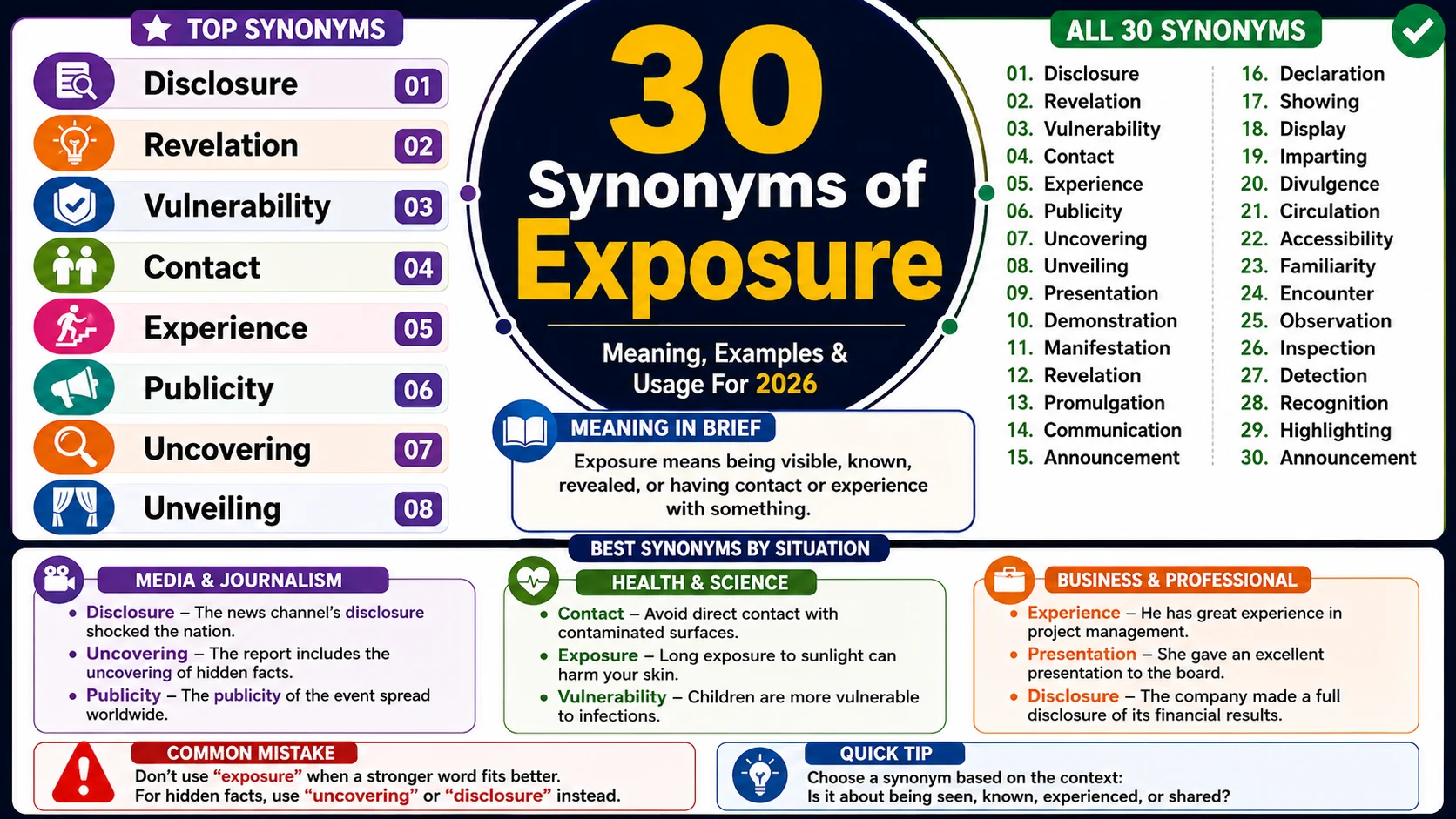
Exposure means being in contact with something or being revealed to others. The best synonyms include disclosure, revelation, vulnerability, contact, experience, publicity, and uncovering. The most common everyday synonym is experience when talking about learning, and publicity when discussing media attention. Each synonym has a slightly different meaning, tone, and context.
Let’s be honest: “exposure” is one of those words that keeps popping up everywhere. You hear it in weather reports (“dangerous cold exposure”), business meetings (“brand exposure”), and even in photography class (“film exposure”). But finding the right synonym for this versatile word can feel tricky.
That’s where this guide comes in. I’ve created this resource to help you choose the perfect synonym for any situation whether you’re writing a professional email, having a casual conversation, or working on a school assignment. We’ll explore 30 alternatives, complete with real examples and practical usage tips. By the end, you’ll never feel stuck searching for the right word again.
What Does “Exposure” Mean?
Definition
In simple terms, exposure has two main meanings. First, it describes the state of being put in contact with something like being exposed to cold weather, new ideas, or a foreign language. Second, it means revealing something to others, such as exposing a secret or showing something to the public . Think of it as either “experiencing something” or “making something known.”
Pronunciation
| Feature | Information |
|---|---|
| US IPA | /ɪkˈspoʊ.ʒɚ/ |
| UK IPA | /ɪkˈspəʊ.ʒə/ |
| Syllables | 3 (ex-po-sure) |
| Tip | Stress the second syllable: ex-PO-sure |
Grammar
| Feature | Information |
|---|---|
| Part of Speech | Noun |
| Common Position | Subject or object of a sentence |
| Typical Pattern | “exposure to [something]” or “exposure of [something]” |
Example Sentences:
- Prolonged exposure to the sun can damage your skin.
- The journalist’s exposure of the scandal shocked the nation.
- Children need exposure to different cultures.
Grammar Note: “Exposure” is usually uncountable when referring to contact with something, but can be countable when referring to individual instances (e.g., “He had several exposures to the chemical”).
Word Family
| Word | Part of Speech | Meaning |
|---|---|---|
| Expose | Verb | To reveal or uncover something |
| Exposure | Noun | The state of being exposed |
| Exposed | Adjective | Uncovered, unprotected, or revealed |
| Unexposed | Adjective | Not revealed or not protected |
| Exposé | Noun | A report that reveals hidden truths |
30 Synonyms of Exposure
1. Disclosure
Meaning: The act of revealing information that was previously hidden .
Best Used For: Formal writing, legal documents, journalism, business reports.
Formality: Formal
Tone: Professional, Serious
Frequency: ⭐⭐⭐⭐ Common
CEFR Level: B2
Example Sentence 1: The company required full disclosure of all financial transactions.
Example Sentence 2: Her disclosure about the project delay surprised everyone in the meeting.
Usage Tip: Use “disclosure” when you’re talking about releasing official or sensitive information. It sounds more professional than “revealing.”
2. Revelation
Meaning: A surprising or shocking piece of information that is made known .
Best Used For: Storytelling, news reporting, dramatic situations.
Formality: Neutral
Tone: Emotional, Dramatic
Frequency: ⭐⭐⭐⭐ Common
CEFR Level: B2
Example Sentence 1: The revelation that he was the real culprit changed everything.
Example Sentence 2: Her sudden revelation about the family secret left everyone speechless.
Usage Tip: “Revelation” implies that the information is surprising or unexpected. It’s stronger than “disclosure” and suggests an element of shock.
3. Vulnerability
Meaning: The state of being open to harm, danger, or attack .
Best Used For: Health and safety discussions, psychology, risk assessment.
Formality: Neutral
Tone: Serious, Concerned
Frequency: ⭐⭐⭐⭐ Common
CEFR Level: B2
Example Sentence 1: Children’s vulnerability to online predators is a serious concern.
Example Sentence 2: His vulnerability to criticism made him reluctant to share his ideas.
Usage Tip: “Vulnerability” focuses on the potential for harm. It often has a negative tone.
4. Contact
Meaning: The state of touching or meeting someone or something .
Best Used For: Daily conversation, health discussions, science.
Formality: Neutral
Tone: Neutral
Frequency: ⭐⭐⭐⭐⭐ Very Common
CEFR Level: A2
Example Sentence 1: Regular contact with the language is essential for learning it.
Example Sentence 2: Avoid contact with the chemical if possible.
Usage Tip: “Contact” is the most natural choice when discussing physical touch or communication. It’s very common in everyday English.
5. Experience
Meaning: The process of living through an event or situation .
Best Used For: Daily conversation, education, personal development.
Formality: Neutral
Tone: Neutral
Frequency: ⭐⭐⭐⭐⭐ Very Common
CEFR Level: A2
Example Sentence 1: Her early exposure to music led to a successful career as a pianist.
Example Sentence 2: Firsthand experience with the problem gave him valuable insight.
Usage Tip: “Experience” is often the most natural-sounding alternative in everyday conversation when you’re talking about learning or personal growth.
6. Publicity
Meaning: Public attention or notice gained through media coverage .
Best Used For: Marketing, business, entertainment.
Formality: Neutral
Tone: Professional
Frequency: ⭐⭐⭐⭐ Common
CEFR Level: B1
Example Sentence 1: The product launch generated huge publicity for the startup.
Example Sentence 2: She’s an actress who craves publicity.
Usage Tip: “Publicity” is the go-to word in marketing and advertising. It’s specifically about public attention, not personal experience.
7. Uncovering
Meaning: The act of discovering or revealing something hidden .
Best Used For: Journalism, investigations, historical research.
Formality: Neutral
Tone: Active, Dramatic
Frequency: ⭐⭐⭐ Moderate
CEFR Level: B2
Example Sentence 1: The uncovering of the ancient ruins attracted worldwide attention.
Example Sentence 2: Her investigative reporting led to the uncovering of a major scandal.
Usage Tip: “Uncovering” emphasizes the active process of discovery. Use it when you want to focus on the action of finding something.
8. Unveiling
Meaning: The act of showing or revealing something for the first time .
Best Used For: Events, product launches, ceremonies.
Formality: Neutral
Tone: Exciting, Positive
Frequency: ⭐⭐⭐ Moderate
CEFR Level: B2
Example Sentence 1: The unveiling of the new monument was a grand ceremony.
Example Sentence 2: The company’s unveiling of its new smartphone impressed the tech world.
Usage Tip: “Unveiling” suggests a planned, often ceremonial, revealing of something new or important.
9. Danger
Meaning: The possibility of harm or injury .
Best Used For: Health warnings, safety instructions, risk assessment.
Formality: Neutral
Tone: Serious, Warning
Frequency: ⭐⭐⭐⭐⭐ Very Common
CEFR Level: A2
Example Sentence 1: The soldiers were in danger of exposure to enemy fire.
Example Sentence 2: Long-term exposure to pollution poses a danger to public health.
Usage Tip: Use “danger” when you want to emphasize the risk or threat. It’s a clear, direct word.
10. Hazard
Meaning: A source of danger or risk .
Best Used For: Workplace safety, industrial settings, health warnings.
Formality: Formal
Tone: Serious, Technical
Frequency: ⭐⭐⭐⭐ Common
CEFR Level: B2
Example Sentence 1: Chemical exposure is a significant hazard for factory workers.
Example Sentence 2: The hazard of sun exposure is well-documented.
Usage Tip: “Hazard” is more technical than “danger.” It’s often used in professional or safety contexts.
11. Risk
Meaning: The possibility of something bad happening .
Best Used For: Business, finance, health, everyday decisions.
Formality: Neutral
Tone: Neutral, Serious
Frequency: ⭐⭐⭐⭐⭐ Very Common
CEFR Level: B1
Example Sentence 1: Smoking increases your risk of lung cancer.
Example Sentence 2: Prolonged exposure to stress poses a risk to mental health.
Usage Tip: “Risk” is very versatile and common. It’s the standard word for discussing potential negative outcomes.
12. Display
Meaning: The act of showing something to others .
Best Used For: Museums, retail, presentations.
Formality: Neutral
Tone: Neutral
Frequency: ⭐⭐⭐⭐ Common
CEFR Level: B1
Example Sentence 1: The museum’s display of ancient artifacts was impressive.
Example Sentence 2: Her display of anger shocked everyone in the room.
Usage Tip: “Display” is about showing something openly. It’s often used for physical objects but can also be used for emotions.
13. Exhibition
Meaning: A public display of something .
Best Used For: Art, museums, trade shows.
Formality: Neutral
Tone: Professional, Cultural
Frequency: ⭐⭐⭐ Moderate
CEFR Level: B2
Example Sentence 1: The exhibition of contemporary art attracted thousands of visitors.
Example Sentence 2: The media exposure gave the artist his first major exhibition.
Usage Tip: “Exhibition” is typically used for formal, planned public displays, especially in art and culture.
14. Exposé
Meaning: A report or article that reveals hidden truths, often about wrongdoing .
Best Used For: Journalism, documentaries, investigative reporting.
Formality: Neutral
Tone: Dramatic, Serious
Frequency: ⭐⭐⭐ Moderate
CEFR Level: B2
Example Sentence 1: The newspaper published a damning exposé about government corruption.
Example Sentence 2: The documentary was an exposé of the food industry’s practices.
Usage Tip: “Exposé” has a very specific meaning a report that uncovers something scandalous or hidden. Use it for investigative journalism, not everyday situations.
15. Presentation
Meaning: The act of showing or introducing something to an audience .
Best Used For: Business, education, professional settings.
Formality: Formal
Tone: Professional
Frequency: ⭐⭐⭐⭐ Common
CEFR Level: B1
Example Sentence 1: The students gave a presentation of their research findings.
Example Sentence 2: His exposure to the ideas came through a presentation by a visiting expert.
Usage Tip: “Presentation” is the standard word for formal talks and demonstrations. It’s more common in professional contexts.
16. Showing
Meaning: The act of making something visible or apparent .
Best Used For: Casual conversation, demonstrations.
Formality: Informal
Tone: Casual
Frequency: ⭐⭐⭐⭐ Common
CEFR Level: A2
Example Sentence 1: His showing of emotion surprised everyone.
Example Sentence 2: The agent arranged a showing of the house.
Usage Tip: “Showing” is a simple, informal alternative. Use it in casual conversation rather than formal writing.
17. Detection
Meaning: The act of discovering or identifying something .
Best Used For: Science, investigations, security.
Formality: Formal
Tone: Technical, Professional
Frequency: ⭐⭐⭐ Moderate
CEFR Level: B2
Example Sentence 1: Early detection of the disease is crucial for treatment.
Example Sentence 2: The detection of the chemical required specialized equipment.
Usage Tip: “Detection” focuses on the technical process of discovering something, often through scientific or forensic methods.
18. Divulgence
Meaning: The act of revealing secret or private information .
Best Used For: Legal contexts, formal writing, journalism.
Formality: Formal
Tone: Serious, Professional
Frequency: ⭐⭐ Rare
CEFR Level: C1
Example Sentence 1: The lawyer prevented the divulgence of classified information.
Example Sentence 2: His divulgence of company secrets led to his dismissal.
Usage Tip: “Divulgence” is quite formal and rarely used in everyday speech. Stick to “disclosure” or “revelation” unless you’re writing a formal document.
19. Discovery
Meaning: Finding something that was previously unknown .
Best Used For: Science, history, personal development.
Formality: Neutral
Tone: Positive, Exciting
Frequency: ⭐⭐⭐⭐⭐ Very Common
CEFR Level: A2
Example Sentence 1: Her early exposure to science led to the discovery of a new species.
Example Sentence 2: The discovery of the hidden documents changed the course of the investigation.
Usage Tip: “Discovery” emphasizes the act of finding something new. It has a positive, exciting tone.
20. Familiarity
Meaning: Good knowledge or close acquaintance with something .
Best Used For: Personal development, education, cultural exchange.
Formality: Neutral
Tone: Positive
Frequency: ⭐⭐⭐ Moderate
CEFR Level: B2
Example Sentence 1: His familiarity with the subject came from years of exposure.
Example Sentence 2: Exposure to different cultures increases familiarity with diverse perspectives.
Usage Tip: “Familiarity” focuses on the knowledge gained through exposure, not the exposure itself.
21. Knowledge
Meaning: Information and understanding gained through experience .
Best Used For: Education, professional contexts, personal growth.
Formality: Neutral
Tone: Neutral
Frequency: ⭐⭐⭐⭐⭐ Very Common
CEFR Level: A2
Example Sentence 1: Exposure to different ideas expanded his knowledge.
Example Sentence 2: Practical exposure to the job gave her knowledge that textbooks couldn’t provide.
Usage Tip: “Knowledge” is a broad word that describes the result of exposure rather than the process itself.
22. Introduction
Meaning: The act of making someone familiar with something for the first time .
Best Used For: Education, personal development, new experiences.
Formality: Neutral
Tone: Positive
Frequency: ⭐⭐⭐⭐ Common
CEFR Level: B1
Example Sentence 1: His introduction to jazz music happened at a young age.
Example Sentence 2: Her early exposure to different languages was an introduction to a lifelong passion.
Usage Tip: “Introduction” emphasizes the first time someone experiences something. Use it when highlighting a beginning.
23. Danger
Meaning: The possibility of something harmful happening .
Best Used For: Warning, health and safety discussions.
Formality: Neutral
Tone: Urgent, Serious
Frequency: ⭐⭐⭐⭐⭐ Very Common
CEFR Level: A2
Example Sentence 1: Exposure to the toxic substance posed a serious danger.
Example Sentence 2: Children are in danger from too much screen time.
Usage Tip: “Danger” is a very common, everyday word. It’s perfect for warnings and safety messages.
24. Airing
Meaning: The act of making opinions or complaints known to others .
Best Used For: Conversations, media, public discussions.
Formality: Informal
Tone: Casual
Frequency: ⭐⭐⭐ Moderate
CEFR Level: B2
Example Sentence 1: The public airing of their disagreement made things awkward.
Example Sentence 2: Her exposure of the problem led to a much-needed airing of grievances.
Usage Tip: “Airing” is often used for opinions, grievances, or concerns. It suggests talking about something openly.
25. Subjection
Meaning: The state of being under control or influence .
Best Used For: Academic writing, political discussion, philosophy.
Formality: Formal
Tone: Neutral
Frequency: ⭐⭐ Rare
CEFR Level: C1
Example Sentence 1: The subjection of the population to constant propaganda was effective.
Example Sentence 2: His exposure to religious teachings led to his subjection to the faith.
Usage Tip: “Subjection” is formal and has a specific meaning related to control or influence. It’s rarely used in casual conversation.
26. Outing
Meaning: The act of revealing someone’s identity or secret, especially in a negative way .
Best Used For: Celebrity gossip, personal drama, LGBTQ+ context.
Formality: Informal
Tone: Negative, Controversial
Frequency: ⭐⭐⭐ Moderate
CEFR Level: B2
Example Sentence 1: The magazine’s outing of the politician ended his career.
Example Sentence 2: The unauthorized outing of personal information led to a lawsuit.
Usage Tip: “Outing” often has a negative, controversial tone. It’s particularly sensitive when used for revealing someone’s LGBTQ+ identity without permission.
27. Denunciation
Meaning: Public criticism or condemnation of something .
Best Used For: Politics, public affairs, journalism.
Formality: Formal
Tone: Strong, Critical
Frequency: ⭐⭐ Rare
CEFR Level: C1
Example Sentence 1: The public denunciation of the company’s practices was swift.
Example Sentence 2: His exposure of the facts led to widespread denunciation of the policy.
Usage Tip: “Denunciation” is strong and formal. It suggests not just revealing something but criticizing it strongly.
28. Betrayal
Meaning: Revealing secrets or showing disloyalty .
Best Used For: Personal relationships, politics, thrillers.
Formality: Neutral
Tone: Emotional, Negative
Frequency: ⭐⭐⭐⭐ Common
CEFR Level: B2
Example Sentence 1: His exposure of their plan felt like a betrayal of trust.
Example Sentence 2: The betrayal of confidential information angered the board members.
Usage Tip: “Betrayal” is emotional and negative. Use it when the revealing of information also involves broken trust.
29. Leak
Meaning: The unauthorized release of confidential information .
Best Used For: News, government, business.
Formality: Neutral
Tone: Serious
Frequency: ⭐⭐⭐⭐ Common
CEFR Level: B2
Example Sentence 1: The leak of classified documents shook the government.
Example Sentence 2: The company is investigating the leak of sensitive data.
Usage Tip: “Leak” is common in news contexts, especially when referring to confidential information being shared without permission.
30. Unveiling
Meaning: The official showing of something new or important .
Best Used For: Events, product launches, ceremonies.
Formality: Neutral
Tone: Exciting, Positive
Frequency: ⭐⭐⭐ Moderate
CEFR Level: B2
Example Sentence 1: The company’s unveiling of its new brand identity was a major event.
Example Sentence 2: The unveiling of the statue was covered by all major news outlets.
Usage Tip: “Unveiling” is best for formal, planned reveals of something that’s been kept secret.
Synonyms Comparison Table
| Synonym | Best Context | Formality | Tone | Frequency |
|---|---|---|---|---|
| Disclosure | Legal, business | Formal | Professional | ⭐⭐⭐⭐ |
| Revelation | Stories, news | Neutral | Dramatic | ⭐⭐⭐⭐ |
| Vulnerability | Health, safety | Neutral | Serious | ⭐⭐⭐⭐ |
| Contact | Daily life | Neutral | Neutral | ⭐⭐⭐⭐⭐ |
| Experience | Daily life | Neutral | Neutral | ⭐⭐⭐⭐⭐ |
| Publicity | Marketing | Neutral | Professional | ⭐⭐⭐⭐ |
| Uncovering | Journalism | Neutral | Dramatic | ⭐⭐⭐ |
| Unveiling | Events, launches | Neutral | Positive | ⭐⭐⭐ |
| Danger | Safety warnings | Neutral | Serious | ⭐⭐⭐⭐⭐ |
| Hazard | Workplace safety | Formal | Serious | ⭐⭐⭐⭐ |
| Risk | Business, health | Neutral | Serious | ⭐⭐⭐⭐⭐ |
| Display | Museums, retail | Neutral | Neutral | ⭐⭐⭐⭐ |
| Exhibition | Art, culture | Neutral | Professional | ⭐⭐⭐ |
| Exposé | Investigative journalism | Neutral | Dramatic | ⭐⭐⭐ |
| Presentation | Business, education | Formal | Professional | ⭐⭐⭐⭐ |
Best Synonyms by Situation
| Situation | Best Synonym | Why It Works |
|---|---|---|
| Daily Conversation | Experience | Natural and commonly used |
| Business Email | Disclosure | Professional and clear |
| Academic Writing | Revelation | Precise and formal enough |
| School Assignment | Uncovering | Clear and active |
| Professional Meeting | Presentation | Professional and appropriate |
| Marketing Campaign | Publicity | Industry-standard term |
| Creative Writing | Unveiling | Evocative and interesting |
| Social Media | Exposure | Short and widely understood |
| News Report | Revelation | Dramatic and engaging |
| Health Warning | Risk | Clear and urgent |
Formal vs Informal Synonyms
Formal Alternatives
| Synonym | Best Used For |
|---|---|
| Disclosure | Legal documents, official statements |
| Denunciation | Political writing, strong criticism |
| Divulgence | Legal contexts, formal reports |
| Presentation | Business settings, academic talks |
| Subjection | Academic writing, philosophy |
Neutral Alternatives
| Synonym | Best Used For |
|---|---|
| Revelation | Journalism, storytelling |
| Uncovering | Research, investigation |
| Experience | Most everyday situations |
| Contact | General use |
| Familiarity | Personal knowledge |
Informal Alternatives
| Synonym | Best Used For |
|---|---|
| Showing | Casual conversation |
| Airing | Discussing opinions |
| Outing | Celebrity gossip |
Choosing the Right Level: Use formal synonyms for professional documents and legal matters. Choose neutral synonyms for most everyday situations. Save informal alternatives for conversations with friends and casual writing.
Strong vs Mild Synonyms
Mild
- Contact – simple physical touch or communication
- Showing – basic act of displaying
- Experience – general learning through exposure
Moderate
- Revelation – surprising news
- Uncovering – active discovery
- Publicity – public attention
Strong
- Denunciation – strong public criticism
- Exposé – shocking investigative report
- Vulnerability – serious risk of harm
Intensity Matters: Choosing a strong synonym can dramatically change your message. “The exposure of the documents” sounds neutral, while “The betrayal of the documents” sounds dramatic and personal. Always match the intensity to your situation.
Real-Life Examples
Workplace:
“My exposure to different departments during my internship gave me a well-rounded understanding of the company.”
Business Email:
“Please ensure full disclosure of any potential conflicts of interest in your report.”
Everyday Conversation:
“I had so much exposure to French growing up that I can speak it almost fluently.”
News Report:
“The revelation of the email scandal shocked the political world.”
Academic Writing:
“The study examined children’s vulnerability to online advertising.”
Common Collocations
| Common Phrase | Better Alternative |
|---|---|
| Media exposure | Media attention, publicity |
| Sun exposure | Sun contact, UV risk |
| Exposure therapy | Gradual approach, fear confrontation |
| Radiation exposure | Radiation risk, contact with radiation |
| Brand exposure | Brand visibility, brand awareness |
Common Phrases
| Phrase | Meaning | Better Alternative |
|---|---|---|
| Die of exposure | Die from extreme cold or heat | Die of cold/hypothermia |
| Exposure time | Time something is exposed | Contact time, duration |
| At risk of exposure | Likely to be revealed | Under threat of revelation |
Context Guide
| Situation | Best Synonym | Reason |
|---|---|---|
| Essay | Revelation | Academic and precise |
| Speech | Uncovering | Active and engaging |
| Business Email | Disclosure | Professional and clear |
| Novel | Unveiling | Creative and evocative |
| Presentation | Presentation | Standard and appropriate |
| Conversation | Experience | Natural and common |
| Academic Writing | Vulnerability | Precise and formal |
| Marketing Copy | Publicity | Industry-standard |
Related Words
Near Synonyms
- Exposure is sometimes used interchangeably with experience, but experience focuses on what you gain while exposure focuses on what you’re in contact with.
Antonyms
- Concealment – keeping something hidden
- Protection – keeping something safe
- Cover-up – hiding the truth
Related Adjectives
- Exposed – unprotected or revealed
- Unexposed – hidden or protected
- Vulnerable – open to harm
Related Nouns
- Experience – knowledge gained from exposure
- Familiarity – close knowledge of something
- Knowledge – understanding gained through exposure
Related Verbs
- Expose – to reveal or uncover
- Reveal – to make known
- Uncover – to find or reveal something
Frequently Asked Questions
What is another word for exposure?
The most common synonyms for exposure are disclosure, revelation, vulnerability, contact, experience, and publicity, depending on the context. Each one has a slightly different meaning and use.
Which synonym sounds the most professional?
Disclosure is the most professional synonym, especially in business and legal contexts. It sounds formal, clear, and appropriate for official documents.
Which synonym is best for everyday conversation?
Experience is the most natural choice in everyday conversation. It’s simple, widely understood, and doesn’t sound too formal.
What is the strongest synonym for exposure?
Vulnerability and denunciation are among the strongest synonyms. They emphasize serious risk and strong criticism, making them dramatic and impactful.
What’s the difference between revelation and disclosure?
Revelation suggests surprising or dramatic information, while disclosure is more neutral and professional. “Revelation” often implies shock, while “disclosure” just means making something known.
Which synonym is most common in everyday English?
Experience, contact, and risk are the most commonly used synonyms in everyday English. You’ll hear them frequently in daily conversation.
What is the opposite of exposure?
Concealment, protection, and cover-up are the main opposites of exposure. They all describe keeping something hidden or protected.
Is “exposure” a positive or negative word?
Exposure is neutral its tone depends on context. “Exposure to new ideas” is positive, while “exposure to toxic chemicals” is negative. Always consider the situation.
Conclusion
We’ve covered a lot, so let’s wrap it all up. Exposure is a versatile word with two core meanings: being in contact with something and revealing something to others. The best synonym depends entirely on your situation. Use disclosure for formal professional writing, experience for casual conversation, publicity for marketing, and revelation when you want to add dramatic effect.
Remember that context, tone, and formality matter. A word that sounds perfect in a news report might sound out of place in a business email. Choose your synonym carefully, and you’ll sound more natural and confident. Keep experimenting with these alternatives, and your English vocabulary will grow stronger every day.
