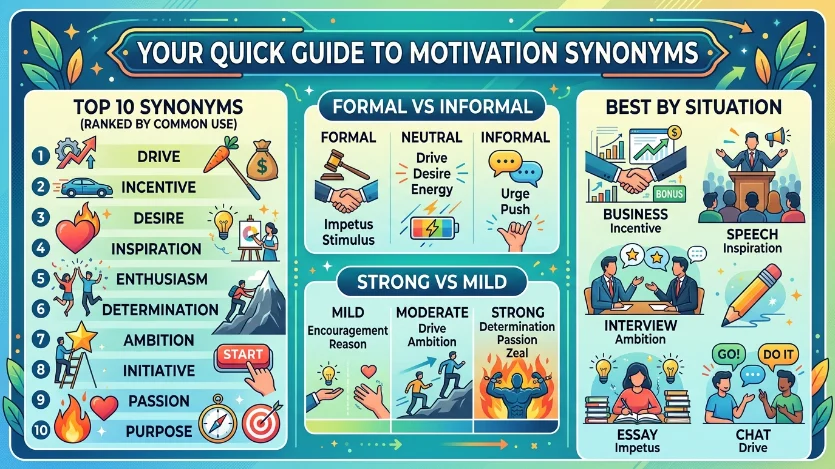
Motivation is the inner drive or reason that pushes you to take action and achieve goals. The most common synonyms are drive, incentive, desire, inspiration, and enthusiasm. Each synonym has a slightly different feel, so your choice depends on context, formality, and tone. The best one for daily conversation is “drive,” while “incentive” fits business settings perfectly.
Have you ever struggled to find the right word to describe what pushes you to act? Maybe you’re writing an essay, preparing a speech, or simply trying to express yourself more clearly.
Understanding synonyms for motivation can transform your English. It helps you avoid repetition, sound more natural, and choose words that perfectly match your situation. Whether you’re a student, professional, or English learner, having a rich vocabulary makes communication easier and more effective.
In this guide, you’ll discover 30 practical synonyms for motivation. Each one comes with a clear meaning, example sentences, formality level, and usage tips. By the end, you’ll know exactly which word to use in any situation.
What Does “Motivation” Mean?
Definition
In simple terms, motivation is what gets you moving. It’s the reason you do something whether it’s studying for an exam, going to work, or starting a new project. Think of it as the fuel that powers your actions.
Psychologically, motivation is the force that directs your behavior toward a goal. It can come from inside you (like wanting to learn) or from outside (like earning a reward). Without it, even simple tasks can feel difficult.
Pronunciation
| Feature | Information |
|---|---|
| US IPA | /ˌmoʊ.t̬əˈveɪ.ʃən/ |
| UK IPA | /ˌməʊ.tɪˈveɪ.ʃən/ |
| Syllables | 4 (mo-ti-va-tion) |
| Tip | Stress the third syllable: mo-ti-VA-tion |
Grammar
| Grammar Feature | Information |
|---|---|
| Part of Speech | Noun |
| Common Position | Subject or object of a sentence |
| Typical Pattern | “motivation + to + verb” or “motivation + for + noun” |
Example Sentences:
- “She has strong motivation to finish her degree.”
- “The promise of a bonus gave him motivation for the extra work.”
- “Finding motivation can be hard on Monday mornings.”
Grammar Note: “Motivation” is usually uncountable, but you can use “a motivation” when referring to a specific reason.
Word Family
| Word | Part of Speech | Meaning |
|---|---|---|
| Motivate | Verb | To give someone a reason to do something |
| Motivated | Adjective | Feeling eager and ready to act |
| Motivational | Adjective | Related to encouraging people |
| Motivator | Noun | A person or thing that motivates |
| Motive | Noun | The reason behind an action |
30 Synonyms of “Motivation”
1. Drive
Meaning
A strong inner force that pushes you to achieve things. It’s about energy and determination.
Best Used For
Daily conversation and personal development discussions
Formality
Neutral
Tone
Positive, energetic
Frequency
⭐⭐⭐⭐⭐ Very Common
CEFR Level
B1
Example Sentence 1
“Her drive to succeed helped her start her own business at just 22.”
Example Sentence 2
“I need more drive to exercise regularly I keep skipping my morning run.”
Usage Tip
“Drive” suggests inner energy rather than outside rewards. Native speakers often use it to describe ambitious people. It sounds natural in most contexts.
2. Incentive
Meaning
A reward or benefit that encourages you to act. Something external that motivates you.
Best Used For
Business writing, workplace discussions, and formal settings
Formality
Formal
Tone
Professional, neutral
Frequency
⭐⭐⭐⭐⭐ Very Common
CEFR Level
C1
Example Sentence 1
“The company offered cash incentives to employees who met their targets.”
Example Sentence 2
“Tax breaks are a strong incentive for people to buy electric cars.”
Usage Tip
“Incentive” implies an external reward. If you mean internal drive, choose “motivation” or “desire” instead. It’s very common in business English.
3. Desire
Meaning
A strong wish or craving for something. It’s about wanting something deeply.
Best Used For
Everyday conversation, storytelling, and emotional contexts
Formality
Neutral
Tone
Emotional, passionate
Frequency
⭐⭐⭐⭐⭐ Very Common
CEFR Level
B2
Example Sentence 1
“His desire to become a doctor comes from watching his grandmother struggle with illness.”
Example Sentence 2
“I have no desire to argue with you let’s find a solution instead.”
Usage Tip
“Desire” is more emotional than “motivation.” Use it when you want to express strong personal feelings. Be careful: in formal writing, “desire” can sound slightly intense.
4. Inspiration
Meaning
A sudden idea or feeling that makes you want to create, improve, or act. Often comes from someone or something else.
Best Used For
Creative contexts, speeches, and personal development
Formality
Neutral
Tone
Positive, uplifting
Frequency
⭐⭐⭐⭐⭐ Very Common
CEFR Level
B1
Example Sentence 1
“The teacher’s passion for science was an inspiration to her students.”
Example Sentence 2
“I find my inspiration for writing in nature and everyday conversations.”
Usage Tip
“Inspiration” often comes from outside a person, a story, or an experience. “Motivation” can be more internal. These words overlap but aren’t identical.
5. Enthusiasm
Meaning
Strong excitement and positive energy about doing something.
Best Used For
Team settings, presentations, and social situations
Formality
Neutral
Tone
Positive, energetic
Frequency
⭐⭐⭐⭐⭐ Very Common
CEFR Level
B1
Example Sentence 1
“She approached every new project with enthusiasm and a smile.”
Example Sentence 2
“His enthusiasm for football is contagious now all his friends want to play.”
Usage Tip
“Enthusiasm” is about showing excitement. It’s more visible than other synonyms. Use it when you want to describe someone’s energy and positive attitude.
6. Determination
Meaning
The quality of continuing even when things get difficult. It’s about not giving up.
Best Used For
Personal stories, motivational contexts, and character descriptions
Formality
Neutral
Tone
Strong, resolute
Frequency
⭐⭐⭐⭐⭐ Very Common
CEFR Level
B2
Example Sentence 1
“Her determination to learn English helped her pass the exam despite many obstacles.”
Example Sentence 2
“Determination matters more than talent in the long run.”
Usage Tip
“Determination” emphasizes persistence. If someone keeps trying despite failure, this is the word to use. It’s more specific than “motivation.”
7. Ambition
Meaning
A strong goal or aspiration that drives you to achieve something significant.
Best Used For
Career discussions, personal development, and interviews
Formality
Neutral to formal
Tone
Positive, forward-looking
Frequency
⭐⭐⭐⭐⭐ Very Common
CEFR Level
B2
Example Sentence 1
“Her ambition is to become a CEO before the age of 40.”
Example Sentence 2
“Healthy ambition can push you to improve, but too much can make you unhappy.”
Usage Tip
“Ambition” is goal-oriented. It often refers to long-term achievements. In job interviews, this word is highly valued.
8. Urge
Meaning
A strong sudden feeling that makes you want to do something right away.
Best Used For
Everyday conversation and emotional situations
Formality
Informal
Tone
Intense, spontaneous
Frequency
⭐⭐⭐⭐ Very Common
CEFR Level
B1
Example Sentence 1
“I had a sudden urge to call my old friend and catch up.”
Example Sentence 2
“Fighting the urge to check your phone during meetings takes practice.”
Usage Tip
“Urge” is about immediate impulses. It’s less about long-term goals and more about present feelings. It works well in casual speech.
9. Impulse
Meaning
A natural instinct or sudden desire to act, often without thinking carefully.
Best Used For
Psychology, storytelling, and casual conversation
Formality
Neutral
Tone
Neutral, spontaneous
Frequency
⭐⭐⭐⭐ Common
CEFR Level
B2
Example Sentence 1
“Buying things on impulse can ruin your budget.”
Example Sentence 2
“His first impulse was to argue, but he stopped himself.”
Usage Tip
“Impulse” suggests less control than “urge.” It often leads to actions you might regret. Not every impulse is positive, unlike “motivation.”
10. Zeal
Meaning
Great passion and energy for a cause, activity, or goal.
Best Used For
Professional and formal writing
Formality
Formal
Tone
Passionate, energetic
Frequency
⭐⭐⭐ Moderate
CEFR Level
C1
Example Sentence 1
“She approached the fundraising campaign with great zeal.”
Example Sentence 2
“His religious zeal made him a committed community leader.”
Usage Tip
“Zeal” sounds more formal and slightly old-fashioned. Native speakers use it in written English more than in speech. It suggests dedicated passion.
11. Passion
Meaning
A very strong feeling of love or enthusiasm for something.
Best Used For
Personal statements, interviews, and creative contexts
Formality
Neutral
Tone
Emotional, strong
Frequency
⭐⭐⭐⭐⭐ Very Common
CEFR Level
B1
Example Sentence 1
“Her passion for teaching is evident in every lesson.”
Example Sentence 2
“Find what you’re passionate about and turn it into a career.”
Usage Tip
Passion” is one of the strongest synonyms. Use it when you want to express deep emotional commitment. In job interviews, employers often ask about your passions.
12. Energy
Meaning
The mental or physical power to do things and stay active.
Best Used For
Everyday conversation and work settings
Formality
Neutral
Tone
Positive, active
Frequency
⭐⭐⭐⭐⭐ Very Common
CEFR Level
A2
Example Sentence 1
“The team had so much energy during the brainstorming session.”
Example Sentence 2
“I don’t have the energy to go out tonight I’m exhausted.”
Usage Tip
Energy” can mean either physical or mental drive. It’s a simple, natural word that works in almost any context. Use it when you want to describe active engagement.
13. Initiative
Meaning
The ability to take action without needing someone else to tell you what to do.
Best Used For
Professional settings, interviews, and performance reviews
Formality
Formal
Tone
Professional, independent
Frequency
⭐⭐⭐⭐⭐ Very Common
CEFR Level
B2
Example Sentence 1
“She showed great initiative by organizing the event without being asked.”
Example Sentence 2
“Employers value workers who take initiative and solve problems themselves.”
Usage Tip
“Initiative” is highly valued in the workplace. It’s not exactly the same as “motivation” it emphasizes acting without direction rather than just feeling driven.
14. Enterprise
Meaning
The willingness to start new projects and take risks to achieve something.
Best Used For
Business and entrepreneurship contexts
Formality
Formal
Tone
Professional, ambitious
Frequency
⭐⭐⭐ Moderate
CEFR Level
C1
Example Sentence 1
“His spirit of enterprise led him to start three successful companies.”
Example Sentence 2
“Enterprise is the driving force behind economic growth.”
Usage Tip
“Enterprise” often relates to business and risk-taking. It’s less common in everyday speech and sounds more academic or professional.
15. Spur
Meaning
Something that encourages you to do something faster or better. A push that makes you act.
Best Used For
Writing and formal contexts
Formality
Formal
Tone
Encouraging, pressing
Frequency
⭐⭐⭐ Moderate
CEFR Level
C1
Example Sentence 1
“The competition was a spur to improve their performance.”
Example Sentence 2
“Low grades spurred her to study harder for the next exam.”
Usage Tip
“Spur” often works as a verb too (“spurred me to act”). It suggests being pushed into action by something external. It sounds somewhat literary.
16. Stimulus
Meaning
Something that causes activity, growth, or development.
Best Used For
Academic writing, economics, and formal contexts
Formality
Formal
Tone
Neutral, analytical
Frequency
⭐⭐⭐ Moderate
CEFR Level
C1
Example Sentence 1
“Economic stimulus packages aim to encourage spending and investment.”
Example Sentence 2
“Positive feedback serves as a stimulus for learning.”
Usage Tip
Stimulus” is more technical than other synonyms. Use it in academic or professional writing. In speech, “incentive” or “motivation” sounds more natural.
17. Impetus
Meaning
The force or energy that makes something happen or develop.
Best Used For
Academic and formal writing
Formality
Formal
Tone
Neutral, analytical
Frequency
⭐⭐⭐ Moderate
CEFR Level
C1
Example Sentence 1
“The new funding gave impetus to the research project.”
Example Sentence 2
“Public concern provided the impetus for new safety regulations.”
Usage Tip
“Impetus” is a formal word that often describes the starting force behind projects or movements. It’s not used in everyday conversation.
18. Inducement
Meaning
A benefit or reward offered to persuade someone to do something.
Best Used For
Business, politics, and formal contexts
Formality
Formal
Tone
Neutral, persuasive
Frequency
⭐⭐⭐ Moderate
CEFR Level
C1
Example Sentence 1
“Financial inducements attracted investors to the project.”
Example Sentence 2
“The promise of promotion served as an inducement for hard work.”
Usage Tip
“Inducement” is similar to “incentive” but sounds more formal. It often implies a transaction you offer something to get someone to act.
19. Encouragement
Meaning
Words or actions that give someone confidence and courage to do something.
Best Used For
Everyday situations, education, and personal development
Formality
Neutral
Tone
Positive, supportive
Frequency
⭐⭐⭐⭐⭐ Very Common
CEFR Level
B1
Example Sentence 1
“Her teacher’s encouragement helped her pass the difficult exam.”
Example Sentence 2
“Children need encouragement to try new things without fear of failure.”
Usage Tip
“Encouragement” comes from others, not from inside you. If you mean internal drive, choose a different synonym. It works well in educational contexts.
20. Purpose
Meaning
A clear reason for doing something. Your goal or intention.
Best Used For
Personal development, business, and writing
Formality
Neutral
Tone
Meaningful, determined
Frequency
⭐⭐⭐⭐⭐ Very Common
CEFR Level
B1
Example Sentence 1
“Finding purpose in your work makes even hard days meaningful.”
Example Sentence 2
“My purpose for learning English is to study abroad.”
Usage Tip
“Purpose” emphasizes the goal more than the drive. Use it when you want to focus on the “why” rather than the energy behind it.
21. Desire
Meaning
A strong wish or craving for something.
Best Used For
Personal contexts, storytelling, and emotional situations
Formality
Neutral
Tone
Emotional, longing
Frequency
⭐⭐⭐⭐⭐ Very Common
CEFR Level
B2
Example Sentence 1
“His desire to travel the world started in childhood.”
Example Sentence 2
“I have no desire to watch that movie it looks boring.”
Usage Tip
Desire” is one of the most natural synonyms for “motivation.” It captures wanting something deeply. However, in formal business writing, “incentive” or “drive” might be better.
22. Aspiration
Meaning
A strong hope or ambition to achieve something great.
Best Used For
Formal writing, personal statements, and career contexts
Formality
Formal
Tone
Positive, future-focused
Frequency
⭐⭐⭐⭐ Common
CEFR Level
B2
Example Sentence 1
“Her aspiration to become a doctor was inspired by her sick grandmother.”
Example Sentence 2
“Higher education enables people to pursue their aspirations.”
Usage Tip
“Aspiration” is more formal than “dream” and more specific than “motivation.” It emphasizes future goals rather than present drive.
23. Inspiration
Meaning
A sudden creative idea or the influence of a person or thing that makes you want to act.
Best Used For
Creative contexts, personal development, and public speaking
Formality
Neutral
Tone
Positive, uplifting
Frequency
⭐⭐⭐⭐⭐ Very Common
CEFR Level
B1
Example Sentence 1
“Nature is the inspiration behind many of her paintings.”
Example Sentence 2
“Their success was an inspiration to everyone in the community.”
Usage Tip
“Inspiration” often comes from an external source a role model, an experience, or art. Unlike “motivation,” it’s not necessarily about taking action.
24. Reason
Meaning
The cause, explanation, or justification for why something happens or why you do it.
Best Used For
Everyday conversation and neutral contexts
Formality
Neutral
Tone
Neutral, logical
Frequency
⭐⭐⭐⭐⭐ Very Common
CEFR Level
A2
Example Sentence 1
“The reason I started running was to improve my health.”
Example Sentence 2
“Is there a reason for this sudden change in schedule?”
Usage Tip
“Reason” is a neutral, simple word. It’s less strong than “motivation” but works in almost every context. Use it when you need a clear cause or explanation.
25. Drive
Meaning
Strong inner energy that pushes you to work hard and achieve.
Best Used For
Business, sports, and achievement contexts
Formality
Neutral
Tone
Energetic, determined
Frequency
⭐⭐⭐⭐⭐ Very Common
CEFR Level
B1
Example Sentence 1
“Her drive to succeed impressed the hiring manager.”
Example Sentence 2
“You need drive to build a business from nothing.”
Usage Tip
“Drive” suggests natural energy rather than external rewards. It’s a strong, positive word that works in many professional and personal contexts.
26. Motive
Meaning
The specific reason or hidden purpose behind an action.
Best Used For
Legal contexts, psychology, and investigative situations
Formality
Neutral to formal
Tone
Neutral, analytical
Frequency
⭐⭐⭐⭐ Common
CEFR Level
B2
Example Sentence 1
“The police investigated the motive behind the crime.”
Example Sentence 2
“Understanding your motives helps you make better decisions.”
Usage Tip
“Motive” often has a slightly negative tone, especially when discussing crime or hidden intentions. In everyday contexts, “reason” or “motivation” is safer.
27. Incitement
Meaning
The act of encouraging or provoking someone to do something.
Best Used For
Legal and formal contexts
Formality
Formal
Tone
Neutral to negative
Frequency
⭐⭐ Rare
CEFR Level
C1
Example Sentence 1
“He was accused of incitement to violence.”
Example Sentence 2
“The speech was seen as incitement of political unrest.”
Usage Tip
“Incitement” often has a negative connotation. It’s used in legal contexts and implies encouraging someone to do something bad. Avoid it in positive situations.
28. Catalyst
Meaning
Something that makes a change happen more quickly.
Best Used For
Professional and academic writing
Formality
Formal
Tone
Neutral, analytical
Frequency
⭐⭐⭐ Moderate
CEFR Level
C1
Example Sentence 1
“The new policy acted as a catalyst for innovation in the company.”
Example Sentence 2
“His speech was the catalyst that inspired the protest.”
Usage Tip
“Catalyst” comes from chemistry and suggests something that triggers change. Use it when describing the spark that sets things in motion.
29. Willpower
Meaning
The self-control and inner strength to do what you should, even when you don’t want to.
Best Used For
Personal development, health, and habits
Formality
Neutral
Tone
Positive, determined
Frequency
⭐⭐⭐⭐ Common
CEFR Level
B2
Example Sentence 1
“Losing weight requires more willpower than most people realize.”
Example Sentence 2
“He used all his willpower to resist eating the chocolate cake.”
Usage Tip
“Willpower” focuses on self-control rather than general motivation. Use it when discussing resisting temptation or building good habits.
30. Push
Meaning
A strong effort or encouragement that helps someone do something.
Best Used For
Everyday conversation and informal contexts
Formality
Informal
Tone
Encouraging, supportive
Frequency
⭐⭐⭐⭐ Common
CEFR Level
B1
Example Sentence 1
“She gave me the push I needed to apply for the job.”
Example Sentence 2
“His friends gave him a gentle push to start dating again.”
Usage Tip
“Push” is more informal and often comes from another person. Use it when someone else encourages you to act. It’s a natural, conversational alternative.
Synonyms Comparison Table
| Synonym | Best Context | Formality | Tone | Frequency |
|---|---|---|---|---|
| Drive | Personal achievement | Neutral | Energetic | ⭐⭐⭐⭐⭐ |
| Incentive | Business, rewards | Formal | Professional | ⭐⭐⭐⭐⭐ |
| Desire | Emotional contexts | Neutral | Passionate | ⭐⭐⭐⭐⭐ |
| Inspiration | Creative work | Neutral | Uplifting | ⭐⭐⭐⭐⭐ |
| Enthusiasm | Team settings | Neutral | Excited | ⭐⭐⭐⭐⭐ |
| Determination | Overcoming obstacles | Neutral | Strong | ⭐⭐⭐⭐⭐ |
| Ambition | Career goals | Neutral | Forward-looking | ⭐⭐⭐⭐⭐ |
| Zeal | Formal writing | Formal | Passionate | ⭐⭐⭐ |
| Passion | Personal commitment | Neutral | Emotional | ⭐⭐⭐⭐⭐ |
| Initiative | Work situations | Formal | Professional | ⭐⭐⭐⭐⭐ |
| Urge | Spontaneous action | Informal | Intense | ⭐⭐⭐⭐ |
| Purpose | Personal growth | Neutral | Meaningful | ⭐⭐⭐⭐⭐ |
| Aspiration | Future goals | Formal | Ambitious | ⭐⭐⭐⭐ |
| Motive | Analysis, legal | Neutral | Analytical | ⭐⭐⭐⭐ |
Best Synonyms by Situation
| Situation | Best Synonym | Why It Works |
|---|---|---|
| Daily Conversation | Drive | Natural, common, and easy to understand |
| Business Email | Incentive | Professional and reward-focused |
| Academic Writing | Impetus | Formal and precise |
| School Assignment | Determination | Emphasizes effort and persistence |
| Professional Meeting | Initiative | Shows independence and leadership |
| Job Interview | Ambition | Impresses employers and shows goals |
| Creative Writing | Inspiration | Captures the creative spark |
| Social Media | Energy | Short, positive, and engaging |
| Personal Development | Purpose | Emphasizes meaning and direction |
Formal vs Informal Synonyms
Formal Alternatives
| Synonym | Best Used For |
|---|---|
| Incentive | Contracts, negotiations, employee motivation |
| Impetus | Research, policy documents, academic papers |
| Inducement | Legal contexts, formal offers |
| Zeal | Formal speeches, written praise |
| Stimulus | Economics, healthcare, academic writing |
Neutral Alternatives
| Synonym | Best Used For |
|---|---|
| Drive | Most everyday situations |
| Desire | Personal expression, storytelling |
| Ambition | Career and personal goal-setting |
| Energy | Describing active engagement |
| Purpose | Meaningful discussion about goals |
Informal Alternatives
| Synonym | Best Used For |
|---|---|
| Urge | Spontaneous feelings, casual chat |
| Push | Getting encouragement from friends |
| Drive | Social media, friendly conversation |
When you’re writing a formal document, choose words like “incentive” or “impetus.” For everyday conversation, “drive” and “desire” sound natural. For casual speech, “urge” and “push” work best.
Strong vs Mild Synonyms
Mild
These are suitable for everyday situations:
- Reason – simple and clear
- Encouragement – supportive
- Desire – personal but not extreme
Moderate
These are more expressive than the original word:
- Drive – strong and natural
- Ambition – focuses on goals
- Energy – active and positive
Strong
High-intensity alternatives that should be used carefully:
- Zeal – very passionate, formal
- Passion – deep commitment
- Determination – implies persistence
Choosing the right intensity matters. For a simple task, “encouragement” works. For a life-changing goal, “determination” is better. Don’t use strong words for small achievements it can sound exaggerated.
Real-Life Examples
In the Office:
“She showed real drive by completing the project ahead of schedule.”
In a Business Email:
“We’re offering a financial incentive to teams that exceed their targets.”
In an Interview:
“My ambition is to grow into a leadership role within the next five years.”
In a Conversation:
“I have no motivation to cook tonight let’s order pizza.”
In a Speech:
“It was her determination that led her to overcome every obstacle.”
In Academic Writing:
“The impetus for this research came from a need to understand climate change.”
On Social Media:
“Today’s workout was powered by pure energy and caffeine!”
In a Movie Review:
“The villain’s motive remained unclear until the final scene.”
Common Collocations
Here are common phrases with “motivation” and their stronger alternatives:
| Common Phrase | Better Alternative |
|---|---|
| Lack of motivation | Low drive or weak incentive |
| Strong motivation | Strong drive or deep desire |
| Personal motivation | Personal drive or inner ambition |
| Career motivation | Career ambition or professional drive |
| Student motivation | Academic drive or learning purpose |
| Employee motivation | Worker incentive or workplace initiative |
Using stronger alternatives makes your writing more precise and natural.
Common Phrases
| Phrase | Meaning | Better Alternative |
|---|---|---|
| “I’ve lost motivation.” | You no longer feel like acting | “I’ve lost my drive.” |
| “She’s full of motivation.” | She’s very enthusiastic | “She’s full of energy.” |
| “The motivation is there.” | The willingness exists | “The desire is there.” |
| “That gave me motivation.” | Something encouraged you | “That was my inspiration.” |
Context Guide
| Situation | Best Synonym | Reason |
|---|---|---|
| Academic Essay | Impetus or stimulus | Sounds formal and analytical |
| Business Presentation | Initiative or incentive | Professional and goal-oriented |
| Personal Story | Determination or passion | Feels emotional and authentic |
| Job Application | Ambition or drive | Impresses employers |
| Casual Chat | Urge or push | Natural and conversational |
| Formal Report | Inducement or catalyst | Precise and professional |
| Creative Writing | Inspiration or desire | Captures emotion and imagination |
Related Words
Near Synonyms
- Eagerness – excitement about doing something
- Hunger – strong desire, often for success
- Appetite – interest or desire for something
Antonyms
- Apathy – lack of interest
- Indifference – not caring
- Lethargy – lack of energy
Related Adjectives
- Motivated – eager to work hard
- Ambitious – wanting to achieve
- Driven – powerfully motivated
Related Nouns
- Ambition – strong desire to achieve
- Goal – something you aim for
- Inspiration – encouragement from outside
Related Verbs
- Motivate – give someone a reason to act
- Inspire – fill someone with creative energy
- Encourage – support someone’s confidence
Frequently Asked Questions
What is another word for motivation in everyday English?
The most common synonyms are drive, desire, and enthusiasm . “Drive” works best for casual conversation and describes inner energy. “Desire” expresses wanting something. “Enthusiasm” captures excitement. Choose based on what you want to emphasize.
Which synonym for motivation sounds most professional?
Incentive and initiative are the most professional choices . “Incentive” works best for rewards and business contexts. “Initiative” shows independence and leadership. Both sound natural in workplace communication and formal writing.
What is the strongest synonym for motivation?
Determination is one of the strongest, emphasizing persistence despite obstacles . Passion is also very strong, showing deep emotional commitment. Zeal is another strong formal option. Use these when you want to describe powerful, unwavering drive.
Which synonym is best for academic essays?
Impetus and stimulus work well in academic writing . They sound formal and precise. “Impetus” describes the force behind an action or change. “Stimulus” fits research and economics topics. Avoid informal words like “push” or “urge” in formal essays.
What is the opposite of motivation?
Common antonyms include apathy (lack of interest), indifference (not caring), and lethargy (lack of energy) . These words describe the opposite state when someone has no desire or drive to act.
How can I use “incentive” and “motivation” differently?
“Motivation” can be internal or external . “Incentive” is always external a reward or benefit offered to encourage action . For example, your motivation to work might be personal pride, while a bonus is an incentive.
Conclusion
Motivation is the inner drive that pushes you to act and achieve your goals. The most useful synonyms drive, incentive, desire, inspiration, and enthusiasm each have their own flavor.
Choosing the right word depends on your situation. For business, “incentive” or “initiative” sounds professional. For everyday conversation, “drive” or “desire” feels natural. For formal writing, “impetus” or “stimulus” works best.
Remember: context, tone, and formality matter. Strong words like “determination” and “passion” show deep commitment, while milder options like “encouragement” suit everyday support.
Improving your vocabulary takes practice. Try using one new synonym each day. Soon, these alternatives will become part of your natural English. The more you use them, the more confident you’ll become.
