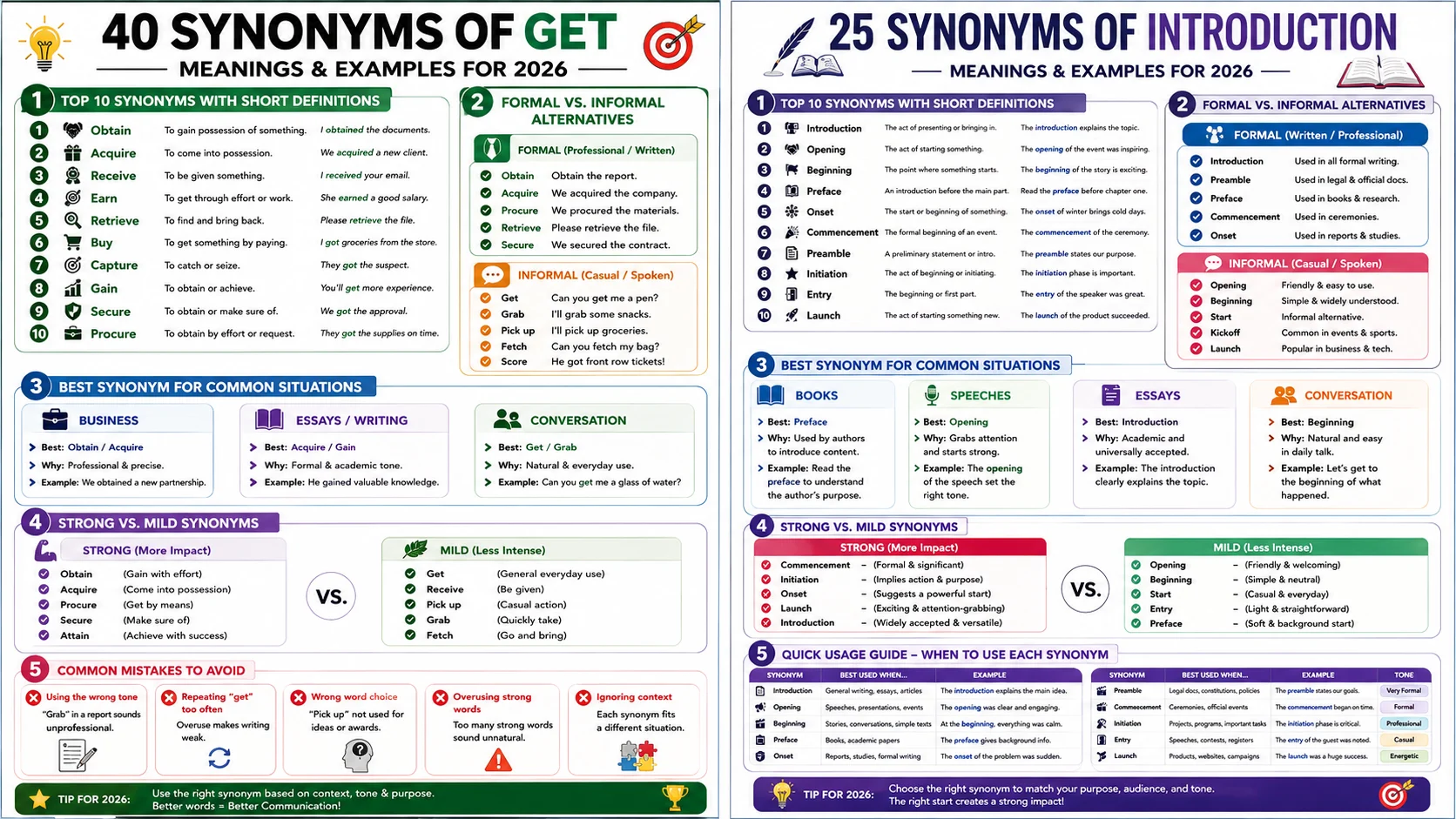
An introduction is the beginning part of something, like a speech, book, or meeting, where you present the main topic. The best synonyms are opening, preface, prologue, preamble, and foreword. “Opening” is the most common in everyday English, while “preface” works well for books.
Top 10 Synonyms
- Opening
- Preface
- Prologue
- Preamble
- Foreword
- Preliminary
- Lead-in
- Start
- Commencement
- Beginning
Have you ever struggled to find the right word for the beginning of something? Whether you’re writing an essay, giving a speech, or starting a meeting, the word “introduction” often feels too basic or repetitive.
The good news is that English offers many wonderful alternatives. Each synonym has a slightly different flavor and works best in specific contexts. Some are perfect for books, others for speeches, and some for everyday conversation.
In this guide, you’ll discover 25 powerful synonyms for “introduction.” You’ll learn exactly when to use each one, how formal they are, and what mistakes to avoid. Let’s make your vocabulary richer and more precise!
What Does “Introduction” Mean?
Definition
An introduction is the first part of something that explains what will follow. It can be the opening section of a book, the beginning of a speech, or a meeting where people meet for the first time. Introductions help set the stage and prepare the audience for what comes next.
Pronunciation
| Feature | Value |
|---|---|
| US IPA | /ˌɪntrəˈdʌkʃən/ |
| UK IPA | /ˌɪntrəˈdʌkʃən/ |
| Syllables | 4 (in-tro-duc-tion) |
| Tip | Stress the third syllable: “IN-truh-DUK-shun” |
Grammar
| Grammar Feature | Information |
|---|---|
| Part of Speech | Noun |
| Common Position | Subject or Object |
| Typical Pattern | Introduction + to + noun / Introduction + of + noun |
Examples:
- “The introduction to the book was very engaging.”
- “She gave a brief introduction of the new employee.”
- “His introduction to politics happened when he was young.”
Grammar Note: “Introduction” can be used with “to” (introduction to a topic) or “of” (introduction of a person). The meaning changes slightly depending on the preposition.
Word Family
| Word | Part of Speech | Meaning |
|---|---|---|
| Introduce | Verb | To present someone or something for the first time |
| Introduction | Noun | The act of introducing or the beginning part |
| Introductory | Adjective | Serving as an introduction |
| Introducer | Noun | A person who introduces |
| Introductorily | Adverb | In an introductory manner |
15 Synonyms of “Introduction”
Opening
Meaning: The first part or beginning of something, such as a speech, event, or performance.
Best Used For: Everyday conversation, speeches, events, general use.
Formality: Neutral
Tone: Natural, Direct
Frequency: ⭐⭐⭐⭐⭐ (Very Common)
CEFR Level: A2
Example Sentence 1: “The opening of her speech was very powerful and grabbed everyone’s attention.”
Example Sentence 2: “Let’s hear the opening remarks from our host before we begin.”
Usage Tip: “Opening” is the most common and versatile alternative. It works in almost any context and sounds completely natural.
Preface
Meaning: A short introduction at the beginning of a book, usually written by the author.
Best Used For: Books, academic writing, formal documents.
Formality: Formal
Tone: Literary, Professional
Frequency: ⭐⭐⭐ (Moderate)
CEFR Level: B2
Example Sentence 1: “The author explains her inspiration in the preface of the novel.
Example Sentence 2: “The preface provided valuable context for the research.
Usage Tip: “Preface” is specifically for books and longer written works. It’s written by the author and often explains why they wrote the book.
Common Confusion: Preface vs Foreword. A preface is written by the author. A foreword is written by someone else, often a famous person.
Prologue
Meaning: An opening section of a story or play that gives background information before the main action begins.
Best Used For: Literature, plays, movies, creative writing.
Formality: Formal
Tone: Literary, Artistic
Frequency: ⭐⭐⭐ (Moderate)
CEFR Level: B2
Example Sentence 1: “The prologue of the novel introduced the ancient prophecy.”
Example Sentence 2: “The play begins with a prologue that sets the scene.
Usage Tip: “Prologue” is perfect for creative writing, especially novels, plays, and films. It sets the scene before the main story begins.
Preamble
Meaning: An introductory statement, especially in official documents or laws.
Best Used For: Legal documents, constitutions, formal writing.
Formality: Formal
Tone: Official, Legal
Frequency: ⭐⭐ (Rare)
CEFR Level: C1
Example Sentence 1: “The preamble of the constitution explains the purpose of the law.”
Example Sentence 2: “The treaty included a preamble outlining the shared goals.
Usage Tip: “Preamble” is a formal word used in official contexts. You’ll often see it in legal documents, treaties, and official statements. It is not used in everyday conversation.
Foreword
Meaning: A short introduction to a book written by someone other than the author.
Best Used For: Books, especially when a famous person recommends the work.
Formality: Formal
Tone: Professional, Recommending
Frequency: ⭐⭐⭐ (Moderate)
CEFR Level: B2
Example Sentence 1: “The foreword was written by a well-known professor in the field.”
Example Sentence 2: “She was honored to write the foreword for her mentor’s book.”
Usage Tip: “Foreword” is like a celebrity endorsement for a book. It adds credibility to the work. Remember, it’s “foreword” not “foreword” (forward is about direction).
Preliminary
Meaning: An action or event that comes before the main one.
Best Used For: Formal events, academic writing, competition contexts.
Formality: Formal
Tone: Preparatory, Professional
Frequency: ⭐⭐⭐ (Moderate)
CEFR Level: B2
Example Sentence 1: “We need to complete the preliminaries before the conference begins.
Example Sentence 2: “The preliminary discussion helped us understand the main issues.”
Usage Tip: “Preliminary” is often used as an adjective, but as a noun, it means the preparation or early stage before the main event.
Lead-in
Meaning: An opening statement or section that introduces or prepares for the main content.
Best Used For: Journalistic writing, presentations, everyday use.
Formality: Neutral
Tone: Practical, Professional
Frequency: ⭐⭐⭐ (Moderate)
CEFR Level: B1
Example Sentence 1: “The lead-in to the news report explained the background of the story.
Example Sentence 2: “Use a strong lead-in to grab your audience’s attention.”
Usage Tip: “Lead-in” is a practical word for any situation where you need to prepare the audience for something. It’s common in journalism and presentations.
Start
Meaning: The point when something begins.
Best Used For: Everyday conversation, informal contexts.
Formality: Informal
Tone: Casual, Direct
Frequency: ⭐⭐⭐⭐⭐ (Very Common)
CEFR Level: A1
Example Sentence 1: “The start of the movie was really exciting.”
Example Sentence 2: “We missed the start of the concert.”
Usage Tip: “Start” is simple and informal. Use it when you want a basic, easy word that everyone understands. It works for almost anything.
Commencement
Meaning: The beginning or start of something, often a formal event like a graduation.
Best Used For: Formal events, academic ceremonies, official occasions.
Formality: Formal
Tone: Ceremonial, Official
Frequency: ⭐⭐ (Rare)
CEFR Level: C1
Example Sentence 1: “The commencement of the ceremony was marked by a trumpet fanfare.”
Example Sentence 2: “Graduates wore their caps and gowns for the commencement.”
Usage Tip: “Commencement” is very formal. It’s the word used for graduation ceremonies. Use it only for formal, official beginnings.
Beginning
Meaning: The first part or earliest stage of something.
Best Used For: Everyday conversation, writing, general use.
Formality: Neutral
Tone: Natural, Simple
Frequency: ⭐⭐⭐⭐⭐ (Very Common)
CEFR Level: A1
Example Sentence 1: “The beginning of the book was a bit slow, but it got better.”
Example Sentence 2: “We’ve been friends since the very beginning.”
Usage Tip: “Beginning” is a simple, safe word that works in almost all contexts. It’s a great alternative when you want to be clear and straightforward.
Overture
Meaning: A short opening piece of music played before a longer performance, or an approach to start something.
Best Used For: Music, theater, introducing an idea or relationship.
Formality: Formal
Tone: Artistic, Literary
Frequency: ⭐⭐ (Rare)
CEFR Level: C1
Example Sentence 1: “The orchestra played a beautiful overture before the opera.
Example Sentence 2: “His friendly overture was a good way to start the conversation.”
Usage Tip: “Overture” has two meanings. One is musical, and the other is a formal way to say “opening move” in a conversation or negotiation.
Exordium
Meaning: The beginning or introductory part of a speech or discourse.
Best Used For: Formal speeches, academic writing, rhetoric.
Formality: Very Formal
Tone: Academic, Classical
Frequency: ⭐ (Very Rare)
CEFR Level: C2
Example Sentence 1: “The exordium of his speech captured the audience’s attention immediately.”
Example Sentence 2: “In classical rhetoric, the exordium is the opening part of an oration.”
Usage Tip: “Exordium” is an extremely formal and rare word. Use it only if you’re writing about classical rhetoric or want to sound highly academic. For everyday use, stick to “opening” or “beginning.”
Prequel
Meaning: A story or film that tells about events that happened before an earlier story.
Best Used For: Movies, books, creative writing.
Formality: Neutral
Tone: Creative, Entertaining
Frequency: ⭐⭐⭐ (Moderate)
CEFR Level: B1
Example Sentence 1: “The new movie is a prequel to the original film.”
Example Sentence 2: “Fans were excited to learn the backstory in the prequel.”
Usage Tip: “Prequel” is a specific type of introduction to a story. It’s a story that comes before the main story and provides background.
Prelude
Meaning: An action or event that leads to and introduces something more important.
Best Used For: Music, literature, describing events leading to something.
Formality: Formal
Tone: Literary, Artistic
Frequency: ⭐⭐⭐ (Moderate)
CEFR Level: B2
Example Sentence 1: “The beautiful prelude set the mood for the wedding ceremony.”
Example Sentence 2: “The economic crisis was a prelude to the war.”
Usage Tip: “Prelude” suggests that something is a preparation or warning for something bigger. It has a slightly dramatic tone.
Portico
Meaning: A covered entrance to a building, often used metaphorically as an introduction.
Best Used For: Poetry, literary writing, architecture.
Formality: Formal
Tone: Literary, Architectural
Frequency: ⭐ (Very Rare)
CEFR Level: C1
Example Sentence 1: “The portico of the ancient temple welcomed visitors.”
Example Sentence 2: “The first chapter serves as a portico to the entire story.”
Usage Tip: “Portico” is a literal architectural term that can be used metaphorically to describe an introduction. It is very rare in everyday speech.
Synonyms Comparison Table
| Synonym | Best Context | Formality | Tone | Frequency |
|---|---|---|---|---|
| Opening | Speeches, events, general | Neutral | Natural | ⭐⭐⭐⭐⭐ |
| Beginning | Everyday use | Neutral | Simple | ⭐⭐⭐⭐⭐ |
| Start | Informal contexts | Informal | Casual | ⭐⭐⭐⭐⭐ |
| Preface | Books by the author | Formal | Literary | ⭐⭐⭐ |
| Foreword | Books by someone else | Formal | Professional | ⭐⭐⭐ |
| Prologue | Stories, plays, films | Formal | Artistic | ⭐⭐⭐ |
| Lead-in | Journalism, presentations | Neutral | Practical | ⭐⭐⭐ |
| Preliminary | Formal events | Formal | Preparatory | ⭐⭐⭐ |
| Commencement | Ceremonies, official events | Formal | Ceremonial | ⭐⭐ |
| Preamble | Legal documents | Formal | Official | ⭐⭐ |
Best Synonyms by Situation
| Situation | Best Synonym | Why It Works |
|---|---|---|
| Daily Conversation | Opening / Beginning | Natural and clear for everyday talk |
| Business Email | Opening | Professional and straightforward |
| Academic Writing | Preface | Suitable for scholarly work |
| School Assignment | Introduction | The expected academic term |
| Professional Meeting | Opening remarks | Sets the tone professionally |
| Presentation | Lead-in | Grabs attention and sets context |
| Creative Writing | Prologue | Perfect for setting a story’s scene |
| Social Media | Start | Casual and fits the platform |
| Movie Review | Opening | Describes the start of a film |
| Book Review | Preface / Foreword | Specific to book parts |
Formal vs Informal Synonyms
Formal Alternatives
| Synonym | Best Used For |
|---|---|
| Preface | Books and academic writing |
| Preamble | Legal and official documents |
| Foreword | Books written by a guest writer |
| Prologue | Creative writing and plays |
| Commencement | Ceremonies and official events |
Neutral Alternatives
| Synonym | Best Used For |
|---|---|
| Opening | Most professional and everyday situations |
| Beginning | General use in most contexts |
| Lead-in | Journalism, presentations, meetings |
Informal Alternatives
| Synonym | Best Used For |
|---|---|
| Start | Casual conversation |
| Kick-off | Informal meetings, events, sports |
| Intro | Short, casual situations |
Choosing the Right Level: For formal writing, choose “preface” or “preamble.” For everyday conversation, use “opening,” “beginning,” or “start.” For creative writing, “prologue” is perfect.
Strong vs Mild Synonyms
Mild
Suitable for everyday situations with a simple tone.
- Beginning
- Start
- Opening
Moderate
More specific and suitable for most professional or formal contexts.
- Preface
- Foreword
- Lead-in
- Preliminary
Strong
High-intensity alternatives that carry significant weight or formality.
- Prologue (important for storytelling)
- Preamble (important for legal contexts)
- Commencement (important for ceremonies)
- Exordium (very formal academic)
How Intensity Changes Meaning: A mild word like “start” is simple and straightforward. A strong word like “preamble” suggests importance and formality. Choose the level that matches your context.
Real-Life Examples
School: “The introduction to the biology textbook explains the basics of the subject.”
Office: “The manager gave an opening statement to start the meeting.”
Business Email: “Please find attached an introductory document about our services.”
Meetings: “Let’s begin with a brief lead-in before we dive into the details.”
Presentations: “Her opening presentation set the stage for the entire conference.”
Daily Conversations: “The beginning of the movie was really exciting.”
Social Media: “Here’s a quick intro to my new YouTube series.”
Academic Writing: “The preface of the research paper provided important context.”
Common Collocations
| Common Phrase | Better Alternative |
|---|---|
| Give an introduction | Give an opening / Give a lead-in |
| Introduction to the book | Preface to the book |
| Introduction to the topic | Opening to the topic |
| Short introduction | Brief opening |
| Introduction speech | Opening remarks |
Common Phrases
Breaking the ice: An introduction or activity to make people feel more comfortable. (e.g., “Let’s break the ice before the meeting begins.”)
Set the stage: To prepare or introduce something. (e.g., “The first chapter sets the stage for the entire book.”)
Get the ball rolling: To start something. (e.g., “Let’s get the ball rolling with introductions.”)
Opening gambit: An initial move or introduction in a negotiation. (e.g., “His opening gambit was to offer a discount.”)
Context Guide
| Situation | Best Synonym | Reason |
|---|---|---|
| Essay | Introduction / Preface | Standard academic terminology |
| Speech | Opening / Opening remarks | Clear and professional |
| Business Email | Introduction / Opening | Direct and professional |
| Novel | Prologue / Preface | Literary and appropriate |
| Presentation | Lead-in / Opening | Practical and engaging |
| Conversation | Start / Beginning | Natural and casual |
| Academic Writing | Preface / Foreword | Formal and scholarly |
| Legal Document | Preamble | Official and precise |
Related Words
Near Synonyms
- Kick-off: The start of an event, meeting, or game (informal).
- Opener: An introductory action, event, or joke.
- Onset: The beginning of something, especially something unpleasant.
Antonyms
- Conclusion: The end of something.
- Conclusion: The final part of a book, speech, or event.
- Epilogue: A final section after the main story.
- Closure: The act of ending or closing.
Related Adjectives
- Introductory: Serving as an introduction. (e.g., “introductory remarks”)
- Opening: First or beginning. (e.g., “opening chapter”)
- Preliminary: Before the main event. (e.g., “preliminary results”)
- Inaugural: First of its kind. (e.g., “inaugural speech”)
Related Nouns
- Exordium: The introduction to a speech.
- Prelim: Short for preliminary.
- Intro: Short, informal for introduction.
- Front matter: The introductory pages of a book.
Related Verbs
- Introduce: To present something for the first time.
- Commence: To begin or start.
- Launch: To start something new and important.
Frequently Asked Questions
What is another word for introduction?
Common synonyms for introduction include opening, preface, prologue, preamble, and foreword. The best choice depends on the context—books, speeches, or casual conversation.
Which synonym sounds the most professional?
Preface and foreword sound the most professional when talking about books. For general situations, “opening” or “opening remarks” sound professional and natural.
What is the strongest synonym for introduction?
Preamble is one of the strongest, used in legal and official documents. Prologue is also strong and important in literary contexts.
Which synonym is best for essays?
For academic essays, “introduction” is the standard term. For books or research papers, “preface” is more appropriate.
What’s the difference between a preface and a foreword?
A preface is written by the author and explains the book’s background. A foreword is written by someone else, often a famous person, to endorse or recommend the book.
Which synonym is most common in everyday English?
Opening and beginning are the most common synonyms in everyday conversation. They are simple, clear, and work in almost any situation.
What is the opposite of introduction?
The most common opposites are conclusion, ending, finish, and epilogue. A conclusion is the final part of a speech, book, or event.
Conclusion
An introduction is more than just a beginning it sets the tone for everything that follows. The word you choose can change how your audience feels and what they expect.
You now have 25 powerful alternatives to use. Remember, “opening” and “beginning” work in almost any situation. “Preface” and “foreword” are perfect for books. “Prologue” is for stories and plays. “Preamble” is for official documents.
The key to choosing the right word is understanding your context and audience. Use formal words for formal settings. Use casual words for everyday conversations. And when you’re writing creatively, try words like “prologue” or “prelude” to add a literary touch.
The best way to improve is to practice. Try using one new synonym each day. Read books and articles to see how native speakers use these words. Your vocabulary will become richer and more impressive with time.
