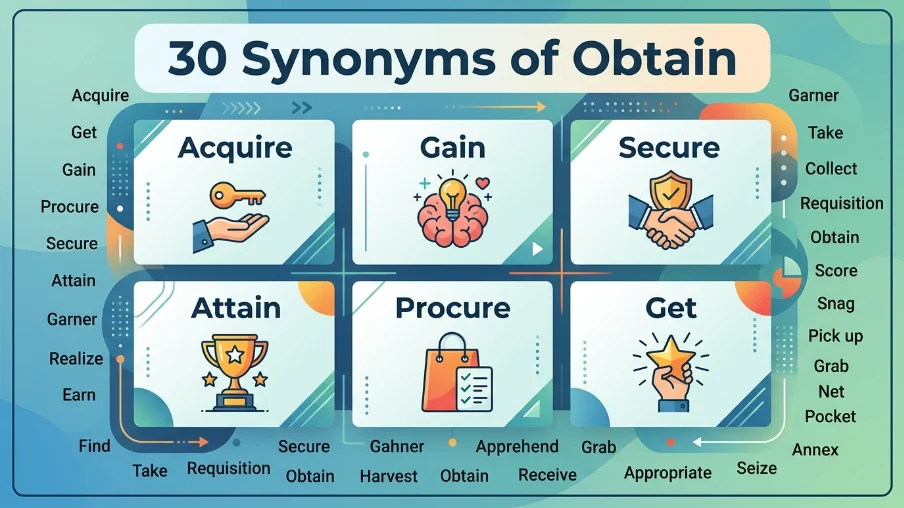
Obtain means to get something, usually through effort or planning. The best synonyms are acquire, get, gain, secure, and attain. “Get” is the most common, but “acquire” sounds more professional. Each synonym has a slightly different meaning, tone, or context.
Top 10 Synonyms
- Acquire
- Get
- Gain
- Secure
- Attain
- Earn
- Procure
- Retrieve
- Collect
- Receive
Do you feel like you always say “get” or “obtain” when you talk about receiving something? Many English learners struggle with this. While “obtain” is a perfectly good word, using it too often can make your English sound repetitive or overly formal.
Learning different ways to say “obtain” helps you express yourself more precisely. Each synonym has a unique feeling. Some suggest hard work, while others suggest receiving something without effort. The right word can make your writing and speaking much more impressive.
In this guide, you will learn 30 powerful alternatives. You will also discover when to use each one, how formal they are, and common mistakes to avoid. Let’s begin!
What Does “Obtain” Mean?
Definition
Obtain means to get possession of something, usually through effort, planning, or a specific process. It is a formal way of saying “get.” When you obtain something, you often have to work for it or follow steps to achieve it. For example, you obtain a driver’s license by passing a test.
Pronunciation
| Feature | Value |
|---|---|
| US IPA | /əbˈteɪn/ |
| UK IPA | /əbˈteɪn/ |
| Syllables | 2 (ob-tain) |
| Tip | Stress the second syllable: “ub-TAYN” |
Grammar
| Grammar Feature | Information |
|---|---|
| Part of Speech | Verb (transitive) |
| Common Position | After the subject, before an object |
| Typical Pattern | Subject + obtain + object |
Examples:
- “She obtained her degree after four years of study.”
- “We need to obtain permission before we start.”
- “He obtained the information from a reliable source.”
Grammar Note: “Obtain” is a transitive verb, which means it always needs an object. You can’t just say “I obtained.” You must say what you obtained.
Word Family
| Word | Part of Speech | Meaning |
|---|---|---|
| Obtain | Verb | To get something through effort |
| Obtainable | Adjective | Possible to get |
| Obtainment | Noun | The act of obtaining |
| Unobtainable | Adjective | Impossible to get |
15 Synonyms of “Obtain”
Acquire
Meaning: To get something, often over time or through effort. It often suggests building a collection or gaining a skill.
Best Used For: Business, academic writing, talking about skills or knowledge.
Formality: Formal
Tone: Professional, Neutral
Frequency: ⭐⭐⭐⭐ (Common)
CEFR Level: B2
Example Sentence 1: “She has acquired a lot of valuable experience in her new job.
Example Sentence 2: “The museum acquired a rare painting from the 18th century.”
Usage Tip: Use “acquire” when you want to sound more professional than “get.” It is often used for skills, knowledge, or valuable items. It suggests a process, not a one-time event.
Common Confusion: Acquire vs Obtain. “Acquire” suggests a longer process of building up, while “obtain” focuses on getting something specific at a certain time.
Get
Meaning: The most common word for receiving, buying, or obtaining something.
Best Used For: Daily conversation, informal writing, any situation where simple English is fine.
Formality: Informal
Tone: Casual, Direct
Frequency: ⭐⭐⭐⭐⭐ (Very Common)
CEFR Level: A1
Example Sentence 1: “Can you get some milk from the store?”
Example Sentence 2: “I got a letter from my sister this morning.”
Usage Tip: “Get” is the most natural word in everyday English. Use it for simple, informal situations. Avoid it in formal essays or business reports where a more precise word is better.
Gain
Meaning: To get something useful or valuable, often through effort, like knowledge, experience, or an advantage.
Best Used For: Professional writing, personal development, self-improvement contexts.
Formality: Neutral
Tone: Positive, Motivating
Frequency: ⭐⭐⭐⭐ (Common)
CEFR Level: B1
Example Sentence 1: “You will gain a lot of confidence by practicing daily.”
Example Sentence 2: “The company gained a competitive advantage through innovation.
Usage Tip: “Gain” is perfect when you get something positive that adds value. It is a great word for resumes, interviews, and personal growth topics.
Common Confusion: Gain vs Obtain. “Gain” focuses on acquiring something beneficial (confidence, experience). “Obtain” is more neutral.
Secure
Meaning: To get something that is difficult to obtain, often requiring extra effort, protection, or guarantees.
Best Used For: Business, formal writing, legal contexts, job hunting.
Formality: Formal
Tone: Professional, Strategic
Frequency: ⭐⭐⭐⭐ (Common)
CEFR Level: B2
Example Sentence 1: “She secured a position at a top law firm.”
Example Sentence 2: “We need to secure funding for our project.”
Usage Tip: “Secure” implies that obtaining something was a bit of a challenge. It also suggests you now have it safely. It is a very strong, professional choice.
Attain
Meaning: To successfully reach or achieve a goal, especially after a lot of effort and time.
Best Used For: Academic writing, formal speeches, personal goal setting.
Formality: Formal
Tone: Inspirational, Academic
Frequency: ⭐⭐⭐ (Moderate)
CEFR Level: B2
Example Sentence 1: “He attained the rank of captain after serving for 15 years.”
Example Sentence 2: “Her goal was to attain a perfect score on the exam.”
Usage Tip: “Attain” is used for achieving high-level goals or things that require years of work. It is not for everyday items like groceries.
Common Confusion: Attain vs Achieve. “Attain” is often used with specific goals or positions (attain a goal), while “achieve” is more general (achieve success).
Earn
Meaning: To get something as a result of your work, effort, or good behavior.
Best Used For: Work, finance, describing rewards for effort.
Formality: Neutral
Tone: Positive, Fair
Frequency: ⭐⭐⭐⭐⭐ (Very Common)
CEFR Level: A2
Example Sentence 1: “She earned a promotion because of her dedication.”
Example Sentence 2: “He earns a good salary at his new job.”
Usage Tip: “Earn” is perfect when you want to emphasize that you deserved what you got. It is a very common and natural word.
Procure
Meaning: To get something, especially with effort or care. It often implies arranging or providing something.
Best Used For: Business, formal procurement, official contexts.
Formality: Formal
Tone: Official, Business-like
Frequency: ⭐⭐ (Rare)
CEFR Level: C1
Example Sentence 1: “We need to procure new equipment for the factory.”
Example Sentence 2: “The diplomat procured a peace deal between the two nations.”
Usage Tip: “Procure” is a very formal word used in business and official contexts. It often suggests that the process was complex. It is rare in everyday speech.
Retrieve
Meaning: To find and bring something back, especially something that was lost or hard to reach.
Best Used For: Technology, when you’ve lost something, in stories.
Formality: Neutral
Tone: Practical, Action-oriented
Frequency: ⭐⭐⭐ (Moderate)
CEFR Level: B1
Example Sentence 1: “The dog retrieved the ball from the river.”
Example Sentence 2: “I need to retrieve my files from the backup drive.”
Usage Tip: Use “retrieve” when something has been misplaced, removed, or is out of reach and you need to bring it back.
Collect
Meaning: To gather things together from different places or over time.
Best Used For: Hobbies, business, talking about gathering information.
Formality: Neutral
Tone: Organized, Practical
Frequency: ⭐⭐⭐⭐ (Common)
CEFR Level: A2
Example Sentence 1: “She collects stamps from around the world.”
Example Sentence 2: “We collected data from over 500 participants.”
Usage Tip: “Collect” implies gathering from multiple sources. It’s great for hobbies, research, and organized tasks.
Receive
Meaning: To be given or presented with something; to accept something that is sent or offered.
Best Used For: Daily life, business, describing incoming mail or gifts.
Formality: Neutral
Tone: Passive, Neutral
Frequency: ⭐⭐⭐⭐⭐ (Very Common)
CEFR Level: A2
Example Sentence 1: “I received a beautiful gift for my birthday.”
Example Sentence 2: “She received a warm welcome from her new colleagues.”
Usage Tip: “Receive” focuses on being on the receiving end of something. You usually don’t have to work hard for it.
Common Confusion: Receive vs Obtain. “Receive” implies it was given to you, while “obtain” implies you actively sought it out.
Achieve
Meaning: To successfully complete something or reach a goal through effort, skill, or courage.
Best Used For: Personal development, career goals, academic success, formal settings.
Formality: Formal
Tone: Positive, Ambitious
Frequency: ⭐⭐⭐⭐⭐ (Very Common)
CEFR Level: B1
Example Sentence 1: “After years of practice, she achieved her dream of becoming a doctor.
Example Sentence 2: “Our team achieved all of its goals for the year.”
Usage Tip: “Achieve” focuses on the result or completion of a goal. It’s a powerful word for resumes and success stories.
Common Confusion: Achieve vs Obtain. “Achieve” is for completing goals; “obtain” is for getting objects or things.
Reap
Meaning: To receive something as a result of your own actions, often a benefit or reward.
Best Used For: Metaphors, describing the results of hard work, literary writing.
Formality: Informal/Literary
Tone: Metaphorical, Thoughtful
Frequency: ⭐⭐ (Rare)
CEFR Level: B2
Example Sentence 1: “You will reap the rewards of your hard work.”
Example Sentence 2: “She reaped the benefits of her healthy lifestyle.
Usage Tip: “Reap” is often used metaphorically with “rewards” or “benefits.” It comes from farming—you reap what you sow.
Derive
Meaning: To get something, especially a feeling or benefit, from a specific source.
Best Used For: Academic writing, talking about sources of satisfaction, formal contexts.
Formality: Formal
Tone: Analytical, Intellectual
Frequency: ⭐⭐⭐ (Moderate)
CEFR Level: B2
Example Sentence 1: “He derives great pleasure from reading novels.”
Example Sentence 2: “The word derives from Latin.
Usage Tip: “Derive” is often used in formal or academic writing. It suggests the thing you obtain comes directly from another source.
Come by
Meaning: To find or get something, often when it’s not easy to find.
Best Used For: Informal conversation, talking about rare items or opportunities.
Formality: Informal
Tone: Casual, Direct
Frequency: ⭐⭐⭐ (Moderate)
CEFR Level: B1
Example Sentence 1: “Good jobs are hard to come by in this area.”
Example Sentence 2: “How did you come by that antique vase?”
Usage Tip: “Come by” is a phrasal verb that is quite common in speech. It’s a great, natural alternative to “obtain” in conversation.
Pick up
Meaning: To get something, often by buying it or collecting it from a place.
Best Used For: Daily conversation, shopping, informal contexts.
Formality: Informal
Tone: Casual, Easy
Frequency: ⭐⭐⭐⭐⭐ (Very Common)
CEFR Level: A2
Example Sentence 1: “Can you pick up some bread on your way home?”
Example Sentence 2: “I picked up a few new skills during my internship.
Usage Tip: “Pick up” is extremely common in casual speech for buying small things or learning skills. Avoid it in formal essays.
Access
Meaning: To be able to get or use something, especially information or technology.
Best Used For: Technology, digital contexts, talking about rights.
Formality: Neutral
Tone: Practical, Modern
Frequency: ⭐⭐⭐⭐ (Common)
CEFR Level: B1
Example Sentence 1: “You need a password to access the website.”
Example Sentence 2: “Students have access to the library database.”
Usage Tip: “Access” is the go-to word for digital and technological contexts. It is becoming more and more common.
Synonyms Comparison Table
| Synonym | Best Context | Formality | Tone | Frequency |
|---|---|---|---|---|
| Get | Everyday speech | Informal | Casual | ⭐⭐⭐⭐⭐ |
| Receive | Being given something | Neutral | Passive | ⭐⭐⭐⭐⭐ |
| Acquire | Skills, business | Formal | Professional | ⭐⭐⭐⭐ |
| Gain | Benefits, experience | Neutral | Positive | ⭐⭐⭐⭐ |
| Secure | Jobs, funding | Formal | Professional | ⭐⭐⭐⭐ |
| Earn | Payment, rewards | Neutral | Fair | ⭐⭐⭐⭐ |
| Collect | Hobbies, data | Neutral | Organized | ⭐⭐⭐⭐ |
| Access | Technology | Neutral | Modern | ⭐⭐⭐⭐ |
| Attain | High-level goals | Formal | Inspiring | ⭐⭐⭐ |
| Retrieve | Finding lost items | Neutral | Practical | ⭐⭐⭐ |
| Derive | Sources, origins | Formal | Analytical | ⭐⭐⭐ |
| Procure | Official, business | Formal | Official | ⭐⭐ |
| Reap | Metaphors, rewards | Lit/Inf | Metaphorical | ⭐⭐ |
Best Synonyms by Situation
| Situation | Best Synonym | Why It Works |
|---|---|---|
| Daily Conversation | Get | It’s the most natural and common word . |
| Business Email | Secure | Sounds professional and confident . |
| Academic Writing | Acquire | Shows a formal, educated vocabulary . |
| School Assignment | Attain | Reflects the effort to reach a goal . |
| Professional Meeting | Procure | Perfect for official tasks and deals . |
| Presentation | Gain | Sounds positive and motivating . |
| Creative Writing | Reap | Adds a poetic or metaphorical quality . |
| Social Media | Get/Pick up | Casual and fits the platform’s tone . |
Formal vs Informal Synonyms
Formal Alternatives
| Synonym | Best Used For |
|---|---|
| Acquire | Skills, knowledge, property in a professional context . |
| Procure | Business supplies, official documents . |
| Attain | Achieving a rank or high-level goal . |
| Secure | Getting a job, funding, or a competitive advantage . |
Neutral Alternatives
| Synonym | Best Used For |
|---|---|
| Gain | Getting benefits or valuable experience . |
| Receive | Getting items or information . |
| Collect | Gathering things from different places . |
Informal Alternatives
| Synonym | Best Used For |
|---|---|
| Get | Almost any casual situation . |
| Pick up | Buying or fetching small items . |
| Come by | Finding something rare or unusual . |
Choosing the Right Level: In formal writing, always prefer “acquire,” “secure,” or “attain.” In everyday speech, “get,” “pick up,” or “come by” sound much more natural and friendly.
Strong vs Mild Synonyms
Mild
These are suitable for everyday situations and don’t imply a lot of effort.
- Get
- Receive
- Pick up
Moderate
These suggest some effort or a more professional process.
- Acquire
- Gain
- Collect
- Obtain
Strong
High-intensity alternatives that suggest a lot of effort, complexity, or formality.
- Secure (implies overcoming challenges)
- Attain (implies achieving a major goal)
- Procure (implies complex arrangements)
- Reap (implies reaping rewards from previous actions)
How Intensity Changes Meaning: Using a strong word like “procure” suggests a complex, official process. Using a mild word like “get” suggests a simple, everyday action. Think about how much effort or formality you want to convey.
Real-Life Examples
School: “The students were asked to acquire a copy of the textbook.”
Office: “We need to secure approval from the director before proceeding.”
Business Email: “Please procure the necessary supplies for the new office.”
Meetings: “Our main objective is to gain market share this quarter.”
Presentations: “If you work hard, you will attain your sales targets.”
Daily Conversations: “I need to get some coffee on my way to work.”
Social Media: “I picked up a new recipe from TikTok today!”
Academic Writing: “The researchers derived their conclusions from the data.”
Common Collocations
| Common Phrase | Better Alternative |
|---|---|
| Obtain a job | Secure a position |
| Obtain an award | Win/earn an award |
| Obtain information | Access information |
| Obtain permission | Get permission (less formal) |
| Obtain experience | Gain experience |
Common Phrases
Come by honestly: To get something in a fair way. (e.g., “His success was hard to come by.”)
Get a hold of: To obtain or contact something/someone. (e.g., “I need to get a hold of the manager.”)
Reap the benefits: To get rewards from past actions. (e.g., “You will reap the benefits of your hard work.”)
Pick up knowledge: To learn something informally. (e.g., “I picked up a lot of Italian just by living there.”)
Context Guide
| Situation | Best Synonym | Reason |
|---|---|---|
| Essay | Acquire / Attain | These are formal and academic . |
| Speech | Attain / Secure | They sound ambitious and inspiring . |
| Business Email | Procure / Secure | Professional and confident . |
| Novel | Reap / Gain | Adds variety and literary depth . |
| Presentation | Gain / Secure | Positive and action-oriented . |
| Conversation | Get / Pick up | Natural, casual, and easy . |
| Academic Writing | Derive / Acquire | Precise and intellectual . |
| Marketing Copy | Gain / Secure | Emphasizes customer benefits and results . |
Related Words
Near Synonyms
- Land: To get a job or opportunity informally. (e.g., “She landed a great job.”)
- Score: To get something good, especially unexpectedly. (e.g., “I scored free tickets!”)
- Wrangle: To get something through negotiation or effort. (e.g., “He wrangled a discount.”)
Antonyms
- Lose: To no longer have something.
- Give up: To stop trying to get something.
- Miss: To fail to get something.
- Forfeit: To lose something as a penalty.
Related Adjectives
- Obtainable: Something you can get. (e.g., “The product is easily obtainable online.”)
- Acquired: Gotten or developed. (e.g., “An acquired taste.”)
- Unattainable: Impossible to get. (e.g., “An unattainable dream.”)
Related Nouns
- Acquisition: The act of acquiring something.
- Procurement: The formal process of obtaining supplies.
- Gain: An increase in something, or an advantage.
Related Verbs
- Gather: To collect things from different places.
- Purchase: To buy something.
- Seize: To take hold of something suddenly.
Frequently Asked Questions
What is another word for obtain?
Common synonyms are acquire, get, gain, secure, and attain. “Get” is the most common and informal, while “acquire” and “secure” sound more professional.
Which synonym sounds the most professional?
Secure and procure sound the most professional. “Secure” suggests you successfully obtained something despite difficulty, and “procure” is a formal business term.
What is the strongest synonym for obtain?
Attain is one of the strongest synonyms. It implies overcoming challenges to reach a significant goal or rank. “Secure” is also strong, suggesting a successful effort against difficulty.
Which synonym is best for essays?
Acquire and attain are the best choices for essays. They sound formal, academic, and show a good vocabulary . “Derive” is also excellent for analytical writing.
What’s the difference between get and obtain?
“Get” is informal and used in everyday conversation. “Obtain” is more formal and often implies a specific effort or process. You would say “I got a coffee” but “The scientist obtained the data.”
Which synonym is most common in everyday English?
Get” is by far the most common synonym. Native speakers use it constantly. Other common ones are “pick up” and “receive.”
What is the opposite of obtain?
The most common opposites are lose, give up, and miss. In a formal context, “forfeit” is another opposite.
Conclusion
Obtaining new vocabulary is a fantastic way to improve your English. By learning these 30 synonyms, you now have a powerful toolkit to avoid using “obtain” and “get” repeatedly.
Remember, the key to choosing the right word is understanding the context and your audience. Use “get” and “pick up” for everyday chats. Use “acquire” and “gain” for professional development. Use “attain” and “secure” for your biggest goals. And use “procure” when you need to sound very official.
The more you practice, the more natural these words will feel. Start by picking just one or two new synonyms to use each day. Read articles and listen to native speakers to see how they use these words in the wild. Your English will become richer, more precise, and more impressive in no time.
