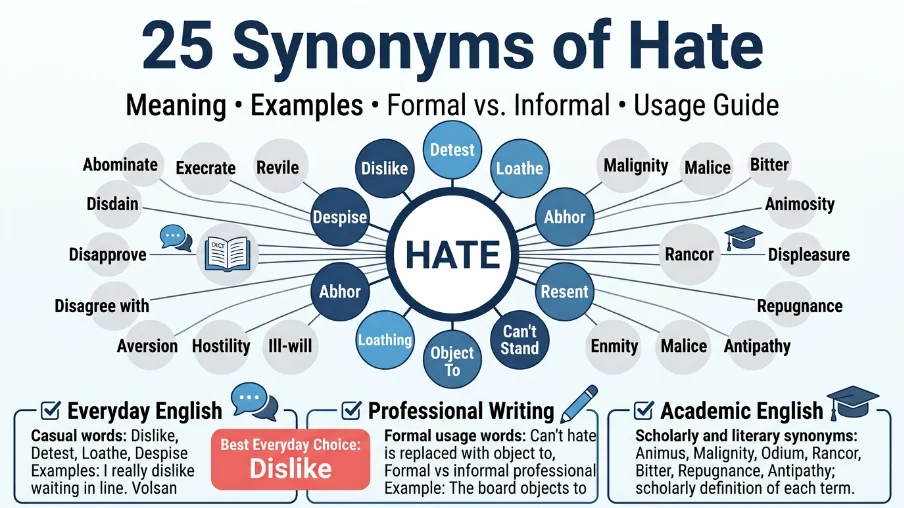
Hate means to feel an extremely strong dislike or intense negative emotion toward someone or something. The most common synonym is dislike, while stronger alternatives include despise, loathe, and detest. The best synonym depends on how strong, formal, or emotional you want your message to sound.
Top 10 Synonyms of Hate
- Dislike
- Detest
- Loathe
- Despise
- Abhor
- Resent
- Can’t stand
- Be disgusted by
- Be opposed to
- Have an aversion to
Every synonym expresses dislike differently, ranging from mild annoyance to intense emotional hatred.
Looking for the right hate synonym can help you express strong feelings with greater accuracy. The word hate describes one of the strongest negative emotions in English. But not every situation requires the same level of intensity. Sometimes dislike is enough. In other cases, you may need a word stronger than hate to communicate extreme hostility or deep resentment.
In this guide, you’ll discover useful hate synonyms, another word for hate, and the most natural synonyms for hate for different contexts. We’ll also explore the synonym for hate, the synonym of hate, pronunciation, grammar, and practical examples. If you’re wondering what is the strongest word for hate or searching for the strongest word for hate, you’ll find clear guidance here. Whether you’re writing an essay, professional email, or everyday English, these alternatives can make your vocabulary more precise.
What Does “Hate” Mean?
Definition
Hate means to feel an extremely strong dislike or negative feeling toward someone, something, or an activity. It can describe emotional hostility, personal preference, or strong opposition.
In everyday English, people often use hate to exaggerate mild dislikes, such as:
“I hate waking up early.”
In more serious situations, however, hate can describe deep hostility toward a person, group, or idea.
Unlike simply saying dislike, the word hate usually suggests a much stronger emotional reaction.
Pronunciation
hate (hayt)
| Feature | Value |
|---|---|
| US IPA | /heɪt/ |
| UK IPA | /heɪt/ |
| Syllables | 1 |
| Stress | The only syllable is stressed. |
| Pronunciation Tip | Pronounce it like “hayt,” rhyming with late, great, and wait. |
Grammar
| Grammar Feature | Information |
|---|---|
| Part of Speech | Verb and Noun |
| Verb Form | hate – hated – hated |
| Common Position | Before a noun or gerund (-ing form) |
| Typical Pattern | Hate + noun |
| Hate + verb (-ing) | |
| Hate + someone for + noun/verb |
Examples
- I hate noisy classrooms.
- She hates waiting in long lines.
- They hate being interrupted during meetings.
Grammar Notes
- Hate is commonly followed by a noun or an -ing verb.
- Both hate doing and hate to do are correct, but they can carry slightly different meanings depending on context.
- In conversation, native speakers often use hate for emphasis, even when they simply mean strongly dislike.
Word Family
| Word | Part of Speech | Meaning |
|---|---|---|
| hate | Verb | To feel intense dislike |
| hate | Noun | A feeling of strong dislike or hostility |
| hateful | Adjective | Full of hate or causing hate |
| hated | Adjective | Strongly disliked |
| hating | Verb (Present Participle) | Currently feeling hate |
| hatred | Noun | Deep and lasting hate |
| hatefully | Adverb | In a hateful way |
| hatefulness | Noun | The quality of being hateful |
25 Synonyms of “Hate”
1. Dislike
Meaning
Dislike means not enjoying or not approving of someone or something. It is much weaker than hate.
Best Used For
- Daily conversation
- Emails
- Professional communication
- School writing
Formality
Neutral
Tone
Neutral
Frequency
⭐⭐⭐⭐⭐ Very Common
CEFR Level
A2
Example Sentence 1
I dislike loud music when I’m working.
Example Sentence 2
Many students dislike taking difficult exams.
Usage Tip
Choose dislike when you want to sound polite or less emotional. Native speakers often prefer it in professional or formal conversations instead of saying hate.
2. Detest
Meaning
Detest means to strongly dislike someone or something because you find it unpleasant or unacceptable.
Best Used For
- Essays
- Professional writing
- Literature
Formality
Formal
Tone
Negative
Frequency
⭐⭐⭐⭐ Common
CEFR Level
B2
Example Sentence 1
She detests dishonesty in the workplace.
Example Sentence 2
Many people detest unfair treatment.
Usage Tip
Use detest when expressing a serious and strong feeling. It sounds more formal than hate and is common in writing.
3. Loathe
Meaning
Loathe expresses an extremely strong feeling of dislike or disgust.
Best Used For
- Books
- Essays
- Formal writing
Formality
Formal
Tone
Negative, Emotional
Frequency
⭐⭐⭐⭐ Common
CEFR Level
C1
Example Sentence 1
He loathes cruelty toward animals.
Example Sentence 2
She loathes wasting valuable time.
Usage Tip
Native speakers often use loathe when describing something they find morally or personally unbearable.
4. Despise
Meaning
Despise means to look down on someone while feeling strong dislike because you believe their actions or character are unacceptable.
Best Used For
- Academic writing
- Literature
- Serious discussions
Formality
Formal
Tone
Negative
Frequency
⭐⭐⭐⭐ Common
CEFR Level
B2
Example Sentence 1
He despises corruption in politics.
Example Sentence 2
She despised anyone who cheated others.
Usage Tip
Unlike hate, despise often includes a feeling of disrespect or contempt, not just dislike.
5. Abhor
Meaning
Abhor means to strongly reject something because it is morally wrong or deeply offensive.
Best Used For
- Academic English
- Opinion articles
- Formal speeches
Formality
Very Formal
Tone
Negative, Professional
Frequency
⭐⭐⭐ Moderate
CEFR Level
C1
Example Sentence 1
Most people abhor violence against children.
Example Sentence 2
She abhors discrimination in any form.
Usage Tip
Use abhor mainly when discussing ethical or moral issues. It sounds much more formal than everyday conversation.
6. Resent
Meaning
Resent means to feel bitterness or anger because you believe you have been treated unfairly.
Best Used For
- Personal discussions
- Psychology
- Workplace communication
Formality
Neutral
Tone
Negative, Emotional
Frequency
⭐⭐⭐⭐ Common
CEFR Level
B2
Example Sentence 1
He resented his colleague’s rude comments.
Example Sentence 2
She still resents being ignored during the meeting.
Usage Tip
Resent focuses on unfair treatment rather than general dislike. Don’t use it as a direct replacement for every use of hate.
7. Can’t Stand
Meaning
Can’t stand is an informal expression meaning you strongly dislike someone or something.
Best Used For
- Everyday conversation
- Friends
- Social media
Formality
Informal
Tone
Casual
Frequency
⭐⭐⭐⭐⭐ Very Common
CEFR Level
B1
Example Sentence 1
I can’t stand traffic during rush hour.
Example Sentence 2
She can’t stand people who interrupt others.
Usage Tip
Native speakers use this phrase very often in conversation because it sounds more natural and less harsh than hate.
8. Be Disgusted By
Meaning
This phrase means to feel strong disgust because something is offensive, unpleasant, or unacceptable.
Best Used For
- News
- Reviews
- Formal discussions
Formality
Neutral
Tone
Negative
Frequency
⭐⭐⭐ Moderate
CEFR Level
B2
Example Sentence 1
Many citizens were disgusted by the corruption scandal.
Example Sentence 2
She was disgusted by the condition of the building.
Usage Tip
Use this expression when the feeling comes from disgust rather than simple dislike.
9. Have an Aversion to
Meaning
Have an aversion to means to naturally avoid or strongly dislike something, often because it makes you uncomfortable rather than angry.
Best Used For
- Academic writing
- Professional communication
- Medical or psychological contexts
Formality
Formal
Tone
Neutral, Professional
Frequency
⭐⭐⭐ Moderate
CEFR Level
C1
Example Sentence 1
She has an aversion to public speaking.
Example Sentence 2
Many people have an aversion to bitter foods.
Usage Tip
Use this phrase when talking about long-term preferences or dislikes rather than emotional hatred. It sounds much more formal than hate.
10. Object To
Meaning
Object to means to express disagreement or opposition to something rather than emotional dislike.
Best Used For
- Business emails
- Meetings
- Legal writing
- Formal discussions
Formality
Formal
Tone
Professional
Frequency
⭐⭐⭐⭐ Common
CEFR Level
B2
Example Sentence 1
Several employees objected to the new policy.
Example Sentence 2
She objected to paying additional fees.
Usage Tip
Use object to when you disagree with an action or decision. It focuses on opposition, not personal emotion.
11. Be Against
Meaning
Be against means to disagree with an idea, proposal, or action.
Best Used For
- Conversations
- Meetings
- News articles
Formality
Neutral
Tone
Neutral
Frequency
⭐⭐⭐⭐⭐ Very Common
CEFR Level
A2
Example Sentence 1
I’m against wasting food.
Example Sentence 2
Many citizens are against raising taxes.
Usage Tip
Choose this phrase when discussing opinions or beliefs instead of personal dislike.
12. Scorn
Meaning
Scorn means to reject or look down on someone or something with contempt.
Best Used For
- Literature
- Opinion writing
- Academic essays
Formality
Formal
Tone
Negative
Frequency
⭐⭐⭐ Moderate
CEFR Level
C1
Example Sentence 1
He scorned anyone who lied.
Example Sentence 2
The proposal was met with public scorn.
Usage Tip
Scorn often includes disrespect as well as dislike.
13. Reject
Meaning
Reject means to refuse to accept or approve something.
Best Used For
- Business writing
- Academic writing
- Professional communication
Formality
Neutral
Tone
Professional
Frequency
⭐⭐⭐⭐⭐ Very Common
CEFR Level
B1
Example Sentence 1
The committee rejected the proposal.
Example Sentence 2
She rejected unfair criticism.
Usage Tip
Although reject is not always a synonym for hate, it works well when talking about refusing ideas or offers.
14. Look Down On
Meaning
Look down on means to think someone is less important or less worthy than you.
Best Used For
- Daily English
- Stories
- Essays
Formality
Neutral
Tone
Negative
Frequency
⭐⭐⭐⭐ Common
CEFR Level
B2
Example Sentence 1
Nobody should look down on others because of their background.
Example Sentence 2
He looked down on people who made honest mistakes.
Usage Tip
This phrase emphasizes disrespect rather than emotional hatred.
15. Be Repulsed By
Meaning
Be repulsed by means to feel extreme disgust because something is offensive or unpleasant.
Best Used For
- Reviews
- Journalism
- Formal writing
Formality
Formal
Tone
Negative, Emotional
Frequency
⭐⭐⭐ Moderate
CEFR Level
C1
Example Sentence 1
She was repulsed by the smell.
Example Sentence 2
Many readers were repulsed by the character’s actions.
Usage Tip
Use this expression when disgust is the main emotion rather than anger.
16. Disapprove Of
Meaning
Disapprove of means to believe something is wrong, inappropriate, or unacceptable.
Best Used For
- Parenting
- Education
- Professional discussions
Formality
Neutral
Tone
Professional
Frequency
⭐⭐⭐⭐ Common
CEFR Level
B2
Example Sentence 1
His parents disapproved of his decision.
Example Sentence 2
Most teachers disapprove of cheating.
Usage Tip
This phrase expresses judgment rather than personal hatred.
17. Feel Hostility Toward
Meaning
Feel hostility toward means to experience unfriendly or aggressive feelings toward someone.
Best Used For
- Psychology
- Academic writing
- News reports
Formality
Formal
Tone
Negative
Frequency
⭐⭐ Moderate
CEFR Level
C1
Example Sentence 1
He felt hostility toward his former employer.
Example Sentence 2
The conflict created hostility between the two groups.
Usage Tip
Use this phrase when discussing conflict or ongoing negative relationships instead of everyday dislikes.
Synonyms Comparison Table
| Synonym | Best Context | Formality | Tone | Frequency |
|---|---|---|---|---|
| Dislike | Everyday conversation | Neutral | Neutral | ⭐⭐⭐⭐⭐ |
| Can’t Stand | Casual speech | Informal | Casual | ⭐⭐⭐⭐⭐ |
| Detest | Essays | Formal | Strong | ⭐⭐⭐⭐ |
| Loathe | Literature | Formal | Emotional | ⭐⭐⭐⭐ |
| Despise | Serious discussions | Formal | Negative | ⭐⭐⭐⭐ |
| Resent | Personal feelings | Neutral | Emotional | ⭐⭐⭐⭐ |
| Object To | Business | Formal | Professional | ⭐⭐⭐⭐ |
| Be Against | Opinions | Neutral | Neutral | ⭐⭐⭐⭐⭐ |
| Disapprove Of | Professional discussions | Neutral | Professional | ⭐⭐⭐⭐ |
| Reject | Business & academics | Neutral | Professional | ⭐⭐⭐⭐⭐ |
| Abhor | Moral issues | Very Formal | Strong | ⭐⭐⭐ |
| Scorn | Literature | Formal | Contemptuous | ⭐⭐⭐ |
| Have an Aversion To | Academic writing | Formal | Neutral | ⭐⭐⭐ |
| Be Repulsed By | Reviews | Formal | Emotional | ⭐⭐⭐ |
| Feel Hostility Toward | Psychology | Formal | Negative | ⭐⭐ |
Best Synonyms by Situation
| Situation | Best Synonym | Why It Works |
|---|---|---|
| Daily Conversation | Dislike | Sounds natural without being too strong. |
| Business Email | Object to | Professional and respectful. |
| Academic Writing | Detest | Formal and precise. |
| School Assignment | Despise | Shows strong emotion with appropriate vocabulary. |
| Professional Meeting | Disapprove of | Expresses disagreement politely. |
| Presentation | Be against | Clear, neutral, and easy to understand. |
| Creative Writing | Loathe | Adds emotion and vividness. |
| Social Media | Can’t stand | Casual and commonly used. |
| Movie Review | Be repulsed by | Highlights disgust effectively. |
| Book Review | Abhor | Suitable for discussing moral themes. |
Formal vs. Informal Synonyms
Formal Alternatives
| Synonym | Best Used For |
|---|---|
| Abhor | Academic essays |
| Detest | Formal reports |
| Loathe | Literature |
| Despise | Opinion pieces |
| Object To | Business writing |
| Have an Aversion To | Research papers |
Formal alternatives sound more precise and are ideal for essays, reports, speeches, and professional communication.
Neutral Alternatives
| Synonym | Best Used For |
|---|---|
| Dislike | Everyday writing |
| Reject | Business communication |
| Resent | Personal discussions |
| Disapprove Of | Workplace communication |
| Be Against | General opinions |
Neutral words fit most situations because they are neither too emotional nor too casual.
Informal Alternatives
| Synonym | Best Used For |
|---|---|
| Can’t Stand | Friends |
| Sick Of | Casual conversation |
| Fed Up With | Social media |
| Not Into | Informal chats |
Informal alternatives are common in spoken English. Avoid them in academic or professional writing unless the tone is intentionally conversational.
Strong vs. Mild Synonyms
Mild
- Dislike
- Be Against
- Object To
- Disapprove Of
- Have an Aversion To
These words express disagreement or dislike without sounding overly emotional.
Moderate
- Resent
- Reject
- Can’t Stand
- Scorn
- Feel Hostility Toward
These alternatives communicate stronger feelings but still fit many everyday and professional situations.
Strong
- Hate
- Detest
- Loathe
- Despise
- Abhor
- Be Repulsed By
These words express intense dislike, disgust, or moral rejection. Use them carefully, as they can sound harsh or highly emotional.
Intensity Tip
As the intensity increases, the emotional impact also grows. Native English speakers often choose dislike or can’t stand in everyday conversation and reserve detest, loathe, or abhor for situations where they truly want to emphasize strong negative feelings.
Real-Life Examples
Native speakers choose different synonyms depending on the situation. Here are practical examples showing how these words are used naturally.
School
Original: I hate doing homework on weekends.
Better: I dislike doing homework on weekends.
Why? “Dislike” sounds less dramatic and more appropriate in most situations.
Office
Original: I hate unnecessary meetings.
Better: I can’t stand unnecessary meetings.
Professional: I object to unnecessary meetings that waste everyone’s time.
Business Email
❌ I hate the proposed schedule.
✅ I object to the proposed schedule because it conflicts with our deadline.
Team Meeting
Several employees disapproved of the new attendance policy.
This sounds respectful and professional while clearly expressing disagreement.
Academic Writing
Many researchers oppose policies that increase environmental pollution.
In formal writing, words like oppose or object to often sound more appropriate than hate.
Creative Writing
The old king despised betrayal above all else.
Novel
She loathed the thought of returning to that lonely house.
Movie Review
Critics were repulsed by the film’s unnecessary violence.
Social Media
I can’t stand slow internet.
This expression is extremely common among native speakers.
Daily Conversation
I dislike waking up early, but I’ve gotten used to it.
Common Collocations
| Common Collocation | Meaning | Better Alternative (When Appropriate) |
|---|---|---|
| hate doing homework | Strong dislike for homework | dislike doing homework |
| hate waiting | Strong dislike for delays | can’t stand waiting |
| hate traffic | Dislike traffic | dread traffic (if anticipating it) |
| hate Mondays | Dislike the start of the week | don’t enjoy Mondays |
| hate loud noises | Strong dislike | can’t stand loud noises |
| hate spicy food | Personal preference | dislike spicy food |
| hate dishonesty | Moral dislike | despise dishonesty |
| hate violence | Moral opposition | abhor violence |
| hate discrimination | Strong moral rejection | condemn discrimination |
| hate unfairness | Strong disagreement | resent unfairness |
Usage Note
Native speakers often replace hate with dislike in professional settings because it sounds more balanced and polite.
Common Phrases with “Hate”
Hate Someone’s Guts
Meaning: To dislike someone intensely.
Example:
He hates his boss’s guts.
Natural Alternative:
He despises his boss.
Love-Hate Relationship
Meaning: Having both positive and negative feelings toward something.
Example:
I have a love-hate relationship with social media.
Hate to Admit It
Meaning: To reluctantly accept something is true.
Example:
I hate to admit it, but you were right.
Hate the Idea Of
Meaning: Strongly dislike a suggestion or possibility.
Example:
She hated the idea of moving overseas.
Hate Seeing
Meaning: Feel sad or upset about witnessing something.
Example:
I hate seeing people treated unfairly.
Hate It When
Meaning: Used to complain about repeated situations.
Example:
I hate it when my phone battery dies during a meeting.
Context Guide
| Situation | Best Synonym | Reason |
|---|---|---|
| Essay | Detest | Formal and expressive |
| Speech | Object to | Professional and respectful |
| Business Email | Disapprove of | Polite disagreement |
| Novel | Loathe | Emotionally powerful |
| Presentation | Be against | Clear and neutral |
| Conversation | Can’t stand | Natural spoken English |
| Academic Writing | Abhor | Strong moral emphasis |
| Marketing Copy | Avoid “hate”; use dislike or oppose | More audience-friendly |
Related Words
Near Synonyms
| Word | Explanation |
|---|---|
| Dislike | A mild form of hate. |
| Detest | Very strong dislike. |
| Loathe | Deep emotional dislike. |
| Despise | Hate mixed with contempt. |
| Abhor | Strong moral hatred. |
| Resent | Anger caused by unfair treatment. |
| Reject | Refuse to accept something. |
| Oppose | Be against an idea or action. |
| Scorn | Show contempt toward someone. |
| Can’t stand | Informal expression of strong dislike. |
Antonyms
| Word | Meaning |
|---|---|
| Love | Feel deep affection. |
| Like | Enjoy something. |
| Enjoy | Take pleasure in something. |
| Appreciate | Recognize value. |
| Admire | Respect or look up to someone. |
| Respect | Hold someone in high regard. |
| Cherish | Love deeply. |
| Value | Consider something important. |
Related Adjectives
| Adjective | Relationship |
|---|---|
| Hateful | Full of hate or causing hate. |
| Disgusted | Feeling strong disgust. |
| Bitter | Showing resentment. |
| Angry | Feeling anger. |
| Hostile | Unfriendly or aggressive. |
| Furious | Extremely angry. |
| Resentful | Full of resentment. |
Related Nouns
| Noun | Meaning |
|---|---|
| Hatred | Deep feeling of hate. |
| Dislike | Mild negative feeling. |
| Contempt | Feeling someone is beneath respect. |
| Resentment | Lingering anger. |
| Hostility | Unfriendly behavior or feelings. |
| Disgust | Strong feeling of revulsion. |
Related Verbs
| Verb | Explanation |
|---|---|
| Oppose | Be against something. |
| Reject | Refuse to accept. |
| Condemn | Express strong disapproval. |
| Criticize | Point out faults. |
| Avoid | Stay away from something. |
| Ignore | Choose not to pay attention. |
| Resist | Fight against something. |
Frequently Asked Questions
What is another word for hate?
The best alternative depends on the context. For everyday English, dislike is the most common choice. For stronger feelings, consider detest, loathe, despise, or abhor. In professional settings, phrases like object to or disapprove of often sound more appropriate.
Which synonym sounds the most professional?
Object to, disapprove of, and oppose are the most professional choices. They express disagreement without sounding overly emotional, making them suitable for business emails, reports, presentations, and workplace discussions.
What is the strongest synonym for hate?
Among the strongest alternatives are abhor, loathe, despise, and detest. These words express intense dislike or moral rejection and should be reserved for situations where strong emotion is genuinely intended.
Which synonym is best for essays?
For academic writing, detest, despise, abhor, and oppose are excellent choices. Select the word that best matches your intended meaning and level of intensity rather than simply replacing hate.
What’s the difference between hate and despise?
Hate refers to a strong feeling of dislike. Despise goes a step further by adding contempt or a sense that someone or something is unworthy of respect. Because of this, despise is often used in more serious or moral contexts.
Which synonym is most common in everyday English?
Dislike is the most common and versatile synonym. Native speakers also frequently use can’t stand in casual conversation when they want to express stronger dislike without sounding as harsh as hate.
Is it rude to say “I hate”?
It can be. In casual conversation, people often exaggerate by saying they “hate” things like traffic or homework. However, in professional or formal settings, words such as dislike, prefer not to, or object to usually sound more polite and appropriate.
What is the opposite of hate?
The most direct antonym is love. Depending on the context, other opposites include like, enjoy, admire, appreciate, respect, and cherish, each expressing a different degree of positive feeling or approval.
Conclusion
The word hate expresses one of the strongest negative emotions in English, but it isn’t always the best choice. Depending on the situation, you may want a milder, more formal, or more precise alternative.
For everyday conversations, dislike and can’t stand sound natural and are widely used by native speakers. In professional or academic writing, object to, disapprove of, detest, and oppose often communicate your meaning more effectively. When describing deep emotional or moral rejection, stronger words such as loathe, despise, and abhor provide greater impact.
Remember that every synonym carries its own level of intensity, tone, and formality. Choosing the right word helps you communicate more clearly, sound more natural, and avoid misunderstandings.
The best way to improve your vocabulary is to notice how native speakers use these words in real-life situations. Practice replacing hate with different alternatives in your speaking and writing, and you’ll quickly develop a richer, more confident command of English.
