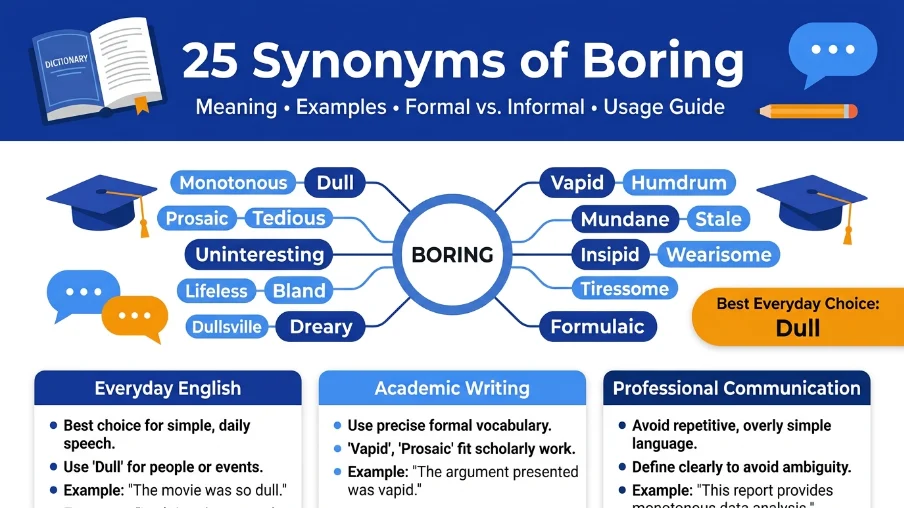
Boring describes something that is dull, uninteresting, or fails to hold your attention. The most common synonym is dull, while stronger alternatives include tedious, monotonous, dreary, and mind-numbing. The best synonym depends on whether you’re describing a person, activity, book, movie, speech, job, or situation.
Top 10 Synonyms of Boring
- Dull
- Tedious
- Monotonous
- Uninteresting
- Tiresome
- Dreary
- Mundane
- Mind-numbing
- Repetitive
- Bland
Every synonym carries a different level of intensity, tone, and context, so choosing the right one makes your writing and speech sound more natural.
The word boring is one of the most common adjectives in English. We use it to describe people, conversations, books, movies, classes, meetings, jobs, and activities that fail to capture our interest. While it’s useful, repeating the same word over and over can make your speaking and writing sound repetitive.
Learning synonyms of boring helps you describe situations more accurately. For example, a long lecture might be tedious, a repetitive task could be monotonous, and a plain design may seem bland. In this guide, you’ll learn the meaning, pronunciation, grammar, and the best alternatives to boring, along with practical examples and usage tips that native English speakers naturally use.
What Does “Boring” Mean?
Definition
Boring describes something that is not interesting, exciting, or enjoyable. It often causes people to lose attention, feel tired, or become mentally disengaged.
In everyday English, boring can describe almost anything from a slow movie or repetitive job to a dull conversation or an unexciting vacation.
Although the word is commonly used, choosing a more specific synonym often communicates your meaning more clearly. For instance, tedious emphasizes repetition, while dreary suggests sadness or gloom.
Pronunciation
| Feature | Value |
|---|---|
| US IPA | /ˈbɔːrɪŋ/ |
| UK IPA | /ˈbɔːrɪŋ/ |
| Syllables | 2 |
| Stress | First syllable |
| Pronunciation Tip | Say BOR-ing, with the stress on BOR. It rhymes closely with pouring and roaring. |
Grammar
| Grammar Feature | Information |
|---|---|
| Part of Speech | Adjective |
| Comparative | More boring |
| Superlative | Most boring |
| Common Position | Before a noun or after a linking verb |
| Typical Pattern | Boring + noun |
Examples
- The movie was boring.
- It was a boring lecture.
- His presentation became more boring as it continued.
Grammar Notes
- Boring describes the thing that causes boredom.
- Bored describes the person who feels boredom.
Correct:
- The lesson was boring.
- The students were bored.
This is one of the most common mistakes made by English learners.
Word Family
| Word | Part of Speech | Meaning |
|---|---|---|
| bore | Verb | To make someone lose interest |
| boring | Adjective | Not interesting |
| bored | Adjective | Feeling uninterested |
| boredom | Noun | The feeling of being bored |
| bore | Noun | A dull or uninteresting person |
| boringly | Adverb | In a boring way |
25 Synonyms of “Boring”
1. Dull
Meaning
Dull means lacking excitement, energy, or interest. It is the closest and most common synonym of boring.
Best Used For
- Everyday conversation
- School writing
- Reviews
- General descriptions
Formality
Neutral
Tone
Neutral
Frequency
⭐⭐⭐⭐⭐ Very Common
CEFR Level
A2
Example Sentence 1
The documentary was dull and difficult to finish.
Example Sentence 2
We had a dull afternoon with nothing to do.
Usage Tip
Use dull when something simply fails to keep your attention. Native speakers often use it interchangeably with boring.
2. Tedious
Meaning
Tedious describes something that feels long, repetitive, and mentally tiring.
Best Used For
- Academic writing
- Office work
- Essays
- Professional communication
Formality
Formal
Tone
Neutral
Frequency
⭐⭐⭐⭐ Common
CEFR Level
B2
Example Sentence 1
Completing the paperwork was tedious.
Example Sentence 2
The editing process became tedious after several hours.
Usage Tip
Choose tedious when repetition or length is the main reason something feels boring.
3. Monotonous
Meaning
Monotonous means lacking variety because the same thing happens repeatedly.
Best Used For
- Workplace
- Academic writing
- Describing routines
Formality
Formal
Tone
Neutral
Frequency
⭐⭐⭐⭐ Common
CEFR Level
B2
Example Sentence 1
Factory work became monotonous after a few months.
Example Sentence 2
The speaker’s monotonous voice made everyone sleepy.
Usage Tip
Use monotonous when describing repetitive tasks, sounds, routines, or speech rather than general boredom.
4. Uninteresting
Meaning
Uninteresting simply means not attracting attention or curiosity.
Best Used For
- Everyday English
- Reviews
- School assignments
Formality
Neutral
Tone
Neutral
Frequency
⭐⭐⭐⭐⭐ Very Common
CEFR Level
A2
Example Sentence 1
I found the article uninteresting.
Example Sentence 2
The museum tour was surprisingly uninteresting.
Usage Tip
This is a polite alternative to boring and works well in both speaking and writing.
5. Tiresome
Meaning
Tiresome describes something that becomes annoying because it lasts too long or happens too often.
Best Used For
- Conversations
- Professional writing
- Literature
Formality
Neutral
Tone
Negative
Frequency
⭐⭐⭐ Moderate
CEFR Level
B2
Example Sentence 1
His constant complaints became tiresome.
Example Sentence 2
The lengthy meeting felt tiresome.
Usage Tip
Unlike boring, tiresome often suggests irritation in addition to boredom.
6. Dreary
Meaning
Dreary describes something that feels boring because it is gloomy, depressing, or lifeless.
Best Used For
- Creative writing
- Books
- Movie reviews
- Describing weather
Formality
Neutral
Tone
Negative, Literary
Frequency
⭐⭐⭐ Moderate
CEFR Level
B2
Example Sentence 1
The town looked dreary on a rainy afternoon.
Example Sentence 2
The office felt dreary without any natural light.
Usage Tip
Use dreary when the atmosphere feels dull and depressing, not simply uninteresting.
7. Mundane
Meaning
Mundane means ordinary, routine, and lacking excitement because it is part of everyday life.
Best Used For
- Essays
- Professional writing
- Lifestyle articles
Formality
Formal
Tone
Neutral
Frequency
⭐⭐⭐ Moderate
CEFR Level
C1
Example Sentence 1
He wanted to escape his mundane routine.
Example Sentence 2
Even mundane tasks can become enjoyable with the right attitude.
Usage Tip
Mundane refers to ordinary daily activities rather than something that is simply boring.
8. Mind-Numbing
Meaning
Mind-numbing describes something so boring or repetitive that it feels mentally exhausting.
Best Used For
- Informal conversation
- Reviews
- Blogs
- Creative writing
Formality
Informal
Tone
Negative, Emotional
Frequency
⭐⭐⭐ Moderate
CEFR Level
C1
Example Sentence 1
The four-hour lecture was absolutely mind-numbing.
Example Sentence 2
Sorting thousands of files became mind-numbing after a while.
Usage Tip
Native speakers use mind-numbing to emphasize extreme boredom. It’s stronger than boring and works best in informal speech and expressive writing.
9. Repetitive
Meaning
Repetitive describes something that repeats the same actions, ideas, or patterns so often that it becomes boring.
Best Used For
- Workplace communication
- Reviews
- Academic writing
- Daily conversation
Formality
Neutral
Tone
Neutral
Frequency
⭐⭐⭐⭐ Common
CEFR Level
B2
Example Sentence 1
The training videos became repetitive after the first hour.
Example Sentence 2
The song sounded repetitive because it used the same chorus repeatedly.
Usage Tip
Use repetitive when repetition is the main reason something feels boring. It is more specific than simply saying boring.
10. Bland
Meaning
Bland means lacking excitement, originality, flavor, or personality.
Best Used For
- Food reviews
- Writing reviews
- Design discussions
- Everyday conversation
Formality
Neutral
Tone
Neutral
Frequency
⭐⭐⭐⭐ Common
CEFR Level
B2
Example Sentence 1
The presentation looked bland despite having useful information.
Example Sentence 2
The restaurant served bland food with very little seasoning.
Usage Tip
Although often used for food, bland also describes writing, designs, personalities, and experiences that lack interest.
11. Dry
Meaning
Dry describes something that is factual or serious but not entertaining.
Best Used For
- Book reviews
- Academic discussions
- Classroom situations
Formality
Neutral
Tone
Neutral
Frequency
⭐⭐⭐⭐ Common
CEFR Level
B2
Example Sentence 1
The professor gave a dry lecture on tax law.
Example Sentence 2
The documentary contained useful information but felt dry.
Usage Tip
Native speakers often describe textbooks, lectures, and technical writing as dry, not simply boring.
12. Lifeless
Meaning
Lifeless means lacking energy, excitement, emotion, or activity.
Best Used For
- Creative writing
- Movie reviews
- Storytelling
Formality
Neutral
Tone
Negative
Frequency
⭐⭐⭐ Moderate
CEFR Level
B2
Example Sentence 1
The performance felt lifeless from beginning to end.
Example Sentence 2
The room looked lifeless without decorations.
Usage Tip
Use lifeless when something lacks energy or emotion rather than simply failing to interest people.
13. Stale
Meaning
Stale means no longer fresh, exciting, or original because it has been repeated too often.
Best Used For
- Content writing
- Marketing
- Reviews
- Journalism
Formality
Neutral
Tone
Negative
Frequency
⭐⭐⭐ Moderate
CEFR Level
B2
Example Sentence 1
The jokes felt stale after hearing them many times.
Example Sentence 2
The advertising campaign had become stale and predictable.
Usage Tip
Use stale when ideas, jokes, or content have lost their appeal over time.
14. Wearisome
Meaning
Wearisome describes something that is exhausting because it lasts too long or becomes repetitive.
Best Used For
- Literature
- Essays
- Formal writing
Formality
Formal
Tone
Negative
Frequency
⭐⭐ Moderate
CEFR Level
C1
Example Sentence 1
The long negotiations became wearisome.
Example Sentence 2
His repeated excuses grew wearisome.
Usage Tip
Wearisome is more formal than tedious and appears more often in books than in everyday conversation.
15. Humdrum
Meaning
Humdrum means ordinary, predictable, and lacking excitement.
Best Used For
- Creative writing
- Lifestyle articles
- Storytelling
Formality
Neutral
Tone
Neutral
Frequency
⭐⭐ Moderate
CEFR Level
C1
Example Sentence 1
She wanted to escape her humdrum routine.
Example Sentence 2
The novel follows a man trying to break free from a humdrum life.
Usage Tip
Choose humdrum when describing everyday routines that have become predictable.
16. Predictable
Meaning
Predictable means something happens exactly as expected, making it less exciting or interesting.
Best Used For
- Movie reviews
- Book reviews
- Sports commentary
Formality
Neutral
Tone
Neutral
Frequency
⭐⭐⭐⭐ Common
CEFR Level
B1
Example Sentence 1
The ending of the movie was predictable.
Example Sentence 2
The story followed a predictable pattern.
Usage Tip
Something can be predictable without being completely boring, but the two ideas often overlap.
17. Sleep-Inducing
Meaning
Sleep-inducing describes something so dull that it makes you feel sleepy.
Best Used For
- Informal conversation
- Reviews
- Blogs
- Humorous writing
Formality
Informal
Tone
Negative, Humorous
Frequency
⭐⭐ Moderate
CEFR Level
C1
Example Sentence 1
The three-hour seminar was sleep-inducing.
Example Sentence 2
His slow delivery made the speech almost sleep-inducing.
Usage Tip
Native speakers use this expression humorously to exaggerate how boring something feels.
18. Ordinary
Meaning
Ordinary means common, average, or not especially interesting. It doesn’t always mean boring, but it can suggest a lack of excitement or originality.
Best Used For
- Everyday conversation
- Product reviews
- Lifestyle articles
Formality
Neutral
Tone
Neutral
Frequency
⭐⭐⭐⭐⭐ Very Common
CEFR Level
A2
Example Sentence 1
The restaurant was ordinary and didn’t stand out.
Example Sentence 2
His speech was ordinary compared to the others.
Usage Tip
Use ordinary when something is average rather than truly dull. Native speakers often use it as a softer alternative to boring.
19. Colorless
Meaning
Colorless describes something that lacks excitement, personality, emotion, or vivid qualities.
Best Used For
- Creative writing
- Character descriptions
- Book reviews
Formality
Formal
Tone
Negative, Literary
Frequency
⭐⭐⭐ Moderate
CEFR Level
C1
Example Sentence 1
The main character felt colorless and forgettable.
Example Sentence 2
The office had a colorless atmosphere.
Usage Tip
Although the word literally relates to color, it often describes people, writing, or places that feel dull and uninspiring.
20. Flat
Meaning
Flat means lacking emotion, energy, excitement, or impact.
Best Used For
- Movie reviews
- Presentations
- Performance reviews
Formality
Neutral
Tone
Negative
Frequency
⭐⭐⭐⭐ Common
CEFR Level
B2
Example Sentence 1
The comedian’s jokes fell flat.
Example Sentence 2
Her presentation sounded flat despite good research.
Usage Tip
Use flat when something lacks enthusiasm or emotional impact rather than simply being uninteresting.
21. Forgettable
Meaning
Forgettable describes something that leaves little or no lasting impression.
Best Used For
- Movie reviews
- Book reviews
- Product reviews
Formality
Neutral
Tone
Negative
Frequency
⭐⭐⭐ Moderate
CEFR Level
B2
Example Sentence 1
The film was entertaining for a while but ultimately forgettable.
Example Sentence 2
His performance was solid but forgettable.
Usage Tip
Native speakers use forgettable when something isn’t necessarily bad it just isn’t memorable.
22. Trivial
Meaning
Trivial means unimportant or lacking significance. In some contexts, this can make something seem boring.
Best Used For
- Academic writing
- Professional discussions
- Essays
Formality
Formal
Tone
Neutral
Frequency
⭐⭐⭐ Moderate
CEFR Level
B2
Example Sentence 1
The report focused on trivial details instead of major issues.
Example Sentence 2
They spent too much time discussing trivial matters.
Usage Tip
Trivial emphasizes importance rather than excitement. Use it carefully because it isn’t always a direct synonym for boring.
23. Formulaic
Meaning
Formulaic means following the same predictable pattern every time, making something feel repetitive and uninspired.
Best Used For
- Film reviews
- Book reviews
- Marketing
- Journalism
Formality
Formal
Tone
Negative
Frequency
⭐⭐⭐ Moderate
CEFR Level
C1
Example Sentence 1
The sequel felt formulaic and lacked originality.
Example Sentence 2
Many viewers criticized the show for its formulaic storytelling.
Usage Tip
Use formulaic when talking about creative work that follows an obvious pattern instead of offering fresh ideas.
24. Uninspiring
Meaning
Uninspiring describes something that fails to motivate, excite, or encourage interest.
Best Used For
- Business writing
- Performance reviews
- Education
- Creative work
Formality
Neutral
Tone
Professional
Frequency
⭐⭐⭐⭐ Common
CEFR Level
B2
Example Sentence 1
The campaign produced uninspiring results.
Example Sentence 2
His speech was informative but uninspiring.
Usage Tip
This word is excellent when you want to criticize politely without sounding overly harsh.
25. Soul-Crushing
Meaning
Soul-crushing describes something so repetitive, exhausting, or dull that it feels emotionally draining.
Best Used For
- Informal conversation
- Blogs
- Social media
- Humorous writing
Formality
Informal
Tone
Negative, Emotional, Humorous
Frequency
⭐⭐ Moderate
CEFR Level
C1
Example Sentence 1
Working the night shift every weekend became soul-crushing.
Example Sentence 2
The endless paperwork felt soul-crushing.
Usage Tip
This expression is intentionally dramatic. Native speakers often use it humorously to exaggerate extreme boredom or frustration.
Synonyms Comparison Table
| Synonym | Best Context | Formality | Tone | Frequency |
|---|---|---|---|---|
| Dull | Everyday conversation | Neutral | Neutral | ⭐⭐⭐⭐⭐ |
| Uninteresting | General writing | Neutral | Neutral | ⭐⭐⭐⭐⭐ |
| Tedious | Long tasks | Formal | Neutral | ⭐⭐⭐⭐ |
| Monotonous | Repetitive work | Formal | Neutral | ⭐⭐⭐⭐ |
| Repetitive | Routines & processes | Neutral | Neutral | ⭐⭐⭐⭐ |
| Bland | Food, writing, design | Neutral | Neutral | ⭐⭐⭐⭐ |
| Dry | Lectures & textbooks | Neutral | Neutral | ⭐⭐⭐⭐ |
| Tiresome | Meetings & conversations | Neutral | Negative | ⭐⭐⭐ |
| Dreary | Places & atmosphere | Neutral | Literary | ⭐⭐⭐ |
| Mundane | Daily routines | Formal | Neutral | ⭐⭐⭐ |
| Lifeless | Performances & rooms | Neutral | Negative | ⭐⭐⭐ |
| Stale | Ideas & jokes | Neutral | Negative | ⭐⭐⭐ |
| Wearisome | Formal writing | Formal | Negative | ⭐⭐ |
| Humdrum | Lifestyle & stories | Neutral | Neutral | ⭐⭐ |
| Sleep-Inducing | Informal reviews | Informal | Humorous | ⭐⭐ |
Best Synonyms by Situation
| Situation | Best Synonym | Why It Works |
|---|---|---|
| Daily Conversation | Dull | Natural and commonly used by native speakers. |
| Business Email | Uninteresting | Professional without sounding rude. |
| Academic Writing | Tedious | Precise and formal. |
| School Assignment | Monotonous | Describes repetition clearly. |
| Professional Meeting | Repetitive | Gives constructive feedback instead of sounding emotional. |
| Presentation | Dry | Commonly used for factual but less engaging talks. |
| Creative Writing | Dreary | Creates vivid imagery and mood. |
| Social Media | Mind-Numbing | Expressive and relatable. |
| Movie Review | Predictable | Highlights weak storytelling. |
| Book Review | Lifeless | Describes weak characters or narration effectively. |
Formal vs. Informal Synonyms
Formal Alternatives
| Synonym | Best Used For |
|---|---|
| Tedious | Reports and essays |
| Monotonous | Academic writing |
| Mundane | Professional articles |
| Wearisome | Literature and formal reviews |
| Uninteresting | Business communication |
Formal alternatives are ideal for essays, workplace communication, research papers, and professional reviews because they sound objective and precise.
Neutral Alternatives
| Synonym | Best Used For |
|---|---|
| Dull | Everyday English |
| Repetitive | Workplace feedback |
| Bland | Reviews and descriptions |
| Dry | Lectures and presentations |
| Predictable | Books and movies |
| Lifeless | Creative and review writing |
These words fit both spoken and written English and work in most situations.
Informal Alternatives
| Synonym | Best Used For |
|---|---|
| Mind-Numbing | Friends and blogs |
| Sleep-Inducing | Casual conversation |
| Boring | Everyday speech |
| Same Old | Informal chats |
| Nothing Special | Social media and conversations |
Informal expressions sound natural in conversations but should usually be avoided in academic or professional writing unless the tone is intentionally conversational.
Strong vs. Mild Synonyms
Mild
- Uninteresting
- Dull
- Bland
- Predictable
- Repetitive
These words suggest a lack of interest without sounding overly negative.
Moderate
- Tedious
- Monotonous
- Mundane
- Dry
- Tiresome
- Lifeless
These alternatives express a stronger sense of boredom or frustration and are suitable for reviews, essays, and workplace discussions.
Strong
- Mind-Numbing
- Sleep-Inducing
- Wearisome
- Dreary
- Excruciatingly Dull (informal expression)
- Painfully Boring (informal expression)
These expressions emphasize extreme boredom and are best used when you intentionally want to make a strong impression.
Intensity Tip
As the intensity increases, the emotional impact also grows. Native English speakers often choose dull or uninteresting in professional situations because they sound balanced and objective. Strong expressions like mind-numbing, painfully boring, or sleep-inducing are more common in casual conversations, entertainment reviews, and humorous writing where exaggeration feels natural.
Real-Life Examples
Native speakers choose different synonyms depending on the context. Here are practical examples of how these words are naturally used.
School
Original: The history class was boring.
Better: The history class became tedious because the lesson repeated the same points.
Alternative: The lecture was dry, but the information was valuable.
Office
Original: The meeting was boring.
Better: The meeting became repetitive after the first thirty minutes.
Professional Alternative: The presentation felt uninspiring and could have included more practical examples.
Business Email
❌ The report is boring.
✅ The report feels uninteresting and may benefit from more visuals and real-world examples.
Team Meeting
Several employees described the weekly updates as monotonous because the agenda rarely changed.
Academic Writing
The author’s repetitive arguments make several chapters tedious to read.
Creative Writing
The village seemed dreary, with empty streets and silent houses.
Novel
His humdrum routine slowly pushed him to seek a completely different life.
Movie Review
Although visually impressive, the storyline became predictable halfway through the film.
Social Media
Monday mornings feel absolutely mind-numbing without coffee.
Daily Conversation
I enjoyed the museum, but the guided tour was a little dry.
Common Collocations
| Common Collocation | Meaning | Better Alternative (When Appropriate) |
|---|---|---|
| boring lecture | A lecture that lacks interest | dry lecture |
| boring meeting | A meeting with little engagement | tedious meeting |
| boring speech | A speech that loses attention | uninspiring speech |
| boring movie | An uninteresting film | predictable movie |
| boring book | A book that’s hard to enjoy | dull book |
| boring conversation | A conversation with little interest | lifeless conversation |
| boring routine | A repetitive daily schedule | monotonous routine |
| boring task | A repetitive job | tedious task |
| boring job | A job lacking excitement | mundane job |
| boring presentation | A presentation with low engagement | flat presentation |
Usage Note
Many native speakers prefer more specific adjectives instead of repeating boring. Choosing the exact reason something lacks interest makes your English sound more natural and expressive.
Common Phrases with “Boring”
Boring to Death
Meaning: Extremely boring.
Example:
The seminar bored me to death.
Natural Alternative:
The seminar was mind-numbing.
Boring as Watching Paint Dry
Meaning: Exceptionally dull.
Example:
The meeting was as boring as watching paint dry.
Boring Me Stiff
Meaning: Making someone feel extremely bored.
Example:
This documentary is boring me stiff.
Nothing but the Same Old Thing
Meaning: Repeated without variety.
Example:
Every episode felt like the same old thing.
Alternative:
Every episode became formulaic.
Lose Interest
Meaning: Stop paying attention because something isn’t engaging.
Example:
I quickly lost interest in the discussion.
Put Someone to Sleep
Meaning: Informally describe something as so dull that it makes people sleepy.
Example:
That speech could put anyone to sleep.
Context Guide
| Situation | Best Synonym | Reason |
|---|---|---|
| Essay | Tedious | Formal and precise |
| Speech | Uninspiring | Professional and balanced |
| Business Email | Uninteresting | Polite criticism |
| Novel | Dreary | Creates atmosphere |
| Presentation | Flat | Describes weak delivery |
| Conversation | Dull | Natural everyday English |
| Academic Writing | Monotonous | Highlights repetition |
| Marketing Copy | Bland | Describes weak branding or messaging |
Related Words
Near Synonyms
| Word | Explanation |
|---|---|
| Dull | Lacking interest or excitement. |
| Tedious | Long and repetitive. |
| Monotonous | Repeating without variety. |
| Bland | Lacking personality or excitement. |
| Dry | Informative but not entertaining. |
| Lifeless | Without energy or emotion. |
| Dreary | Gloomy and dull. |
| Mundane | Ordinary and routine. |
| Formulaic | Predictably repetitive. |
| Uninspiring | Failing to motivate or excite. |
Antonyms
| Word | Meaning |
|---|---|
| Interesting | Holding attention. |
| Exciting | Full of energy and enthusiasm. |
| Engaging | Capturing interest effectively. |
| Fascinating | Extremely interesting. |
| Captivating | Holding attention completely. |
| Entertaining | Providing enjoyment. |
| Thrilling | Creating excitement. |
| Compelling | Difficult to ignore because it’s so interesting. |
Related Adjectives
| Adjective | Relationship |
|---|---|
| Interesting | Opposite of boring. |
| Exciting | Full of action or energy. |
| Engaging | Keeps people’s attention. |
| Predictable | Often contributes to boredom. |
| Repetitive | A common cause of boredom. |
| Ordinary | Average and unremarkable. |
| Creative | The opposite quality of dullness. |
Related Nouns
| Noun | Meaning |
|---|---|
| Boredom | The feeling of being bored. |
| Monotony | Repetition without variety. |
| Routine | Regular repeated activities. |
| Tedium | The quality of being tedious. |
| Sameness | Lack of variety. |
| Predictability | The state of being easy to anticipate. |
Related Verbs
| Verb | Explanation |
|---|---|
| Bore | Cause someone to lose interest. |
| Repeat | Do the same thing again. |
| Drag | Seem to pass very slowly. |
| Dull | Make something less interesting. |
| Tire | Cause mental or physical fatigue. |
| Engage | Capture someone’s attention (opposite idea). |
| Entertain | Keep someone interested or amused. |
Frequently Asked Questions
What is another word for boring?
The best synonym depends on the context. Dull is the closest everyday alternative, while tedious, monotonous, uninteresting, bland, and mind-numbing work better in specific situations. Choosing the right word makes your English more accurate and natural.
Which synonym sounds the most professional?
Uninteresting, tedious, monotonous, and uninspiring are excellent professional choices. They express criticism objectively without sounding overly emotional, making them suitable for business reports, presentations, emails, and academic writing.
What is the strongest synonym for boring?
Among the strongest alternatives are mind-numbing, soul-crushing, wearisome, and sleep-inducing. These expressions emphasize extreme boredom and are often used for dramatic effect in informal conversation, reviews, or creative writing.
Which synonym is best for essays?
For essays and formal writing, tedious, monotonous, dreary, uninspiring, and formulaic are strong choices. Each highlights a different reason why something lacks interest, allowing you to write with greater precision.
What’s the difference between boring and tedious?
Boring is a general word for something that fails to hold your interest. Tedious specifically describes something that feels long, repetitive, or mentally exhausting. A task can be tedious because of repetition, even if it isn’t completely boring at first.
Which synonym is most common in everyday English?
Dull is one of the most common alternatives to boring. Native speakers also frequently use uninteresting for polite descriptions and mind-numbing in casual conversations when they want to exaggerate how dull something feels.
Is it rude to call something boring?
It can be, depending on the situation. Describing someone’s work, presentation, or ideas as boring may sound blunt. In professional settings, words like uninteresting, uninspiring, or could be more engaging are usually more polite and constructive.
What is the opposite of boring?
The most direct antonym is interesting. Other useful opposites include exciting, engaging, captivating, fascinating, entertaining, and compelling, each expressing a different level of interest or excitement.
Conclusion
The word boring is useful, but it isn’t always the most precise way to describe something that lacks interest. English offers many alternatives, each with its own shade of meaning, level of formality, and emotional impact.
For everyday conversations, dull and uninteresting are the safest and most natural choices. If you’re describing repetitive work or long tasks, tedious and monotonous communicate your point more accurately. For reviews and creative writing, words like dreary, flat, lifeless, formulaic, or mind-numbing create stronger, more vivid descriptions.
Choosing the right synonym depends on why something feels boring. Is it repetitive? Predictable? Lacking emotion? Too ordinary? Answering that question will help you select the most accurate word.
As you continue learning English, try replacing boring with more specific alternatives in your conversations, essays, emails, and creative writing. Over time, you’ll develop a richer vocabulary, communicate with greater precision, and sound more like a confident native speaker.
