Connection means a relationship, link, or bond between people, things, or ideas. The best synonyms include link, bond, relationship, tie, association, union, relation, attachment, interconnection, and affiliation. But each synonym has a slightly different meaning, tone, or context, so choosing the right one depends on your situation.
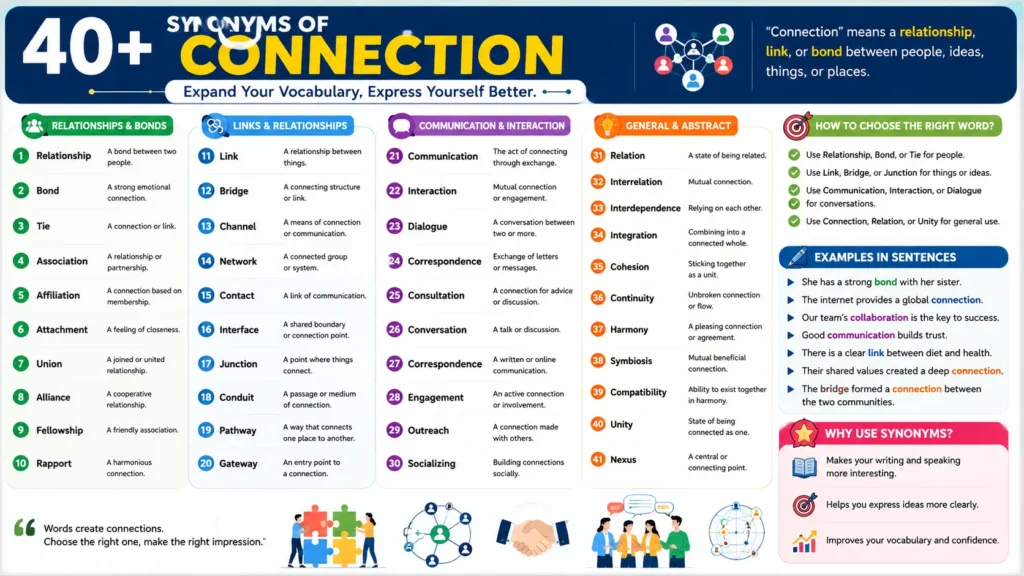
Have you ever struggled to find the right connection synonym while writing an email, school essay, business report, or everyday message? You’re not alone. The word connection can describe a relationship, link, association, bond, communication, or physical joining. So, choosing the right alternative depends on what you actually mean.
Learning the synonyms of connection can make your writing clearer, more precise, and more engaging. Common choices include relationship, link, association, bond, and tie, but each has a slightly different use. This matters for English learners, students, professionals, and writers who want their words to sound natural and accurate.
In this guide, you’ll discover 30 useful connection synonyms, including another word for connection, synonym for connection, and other words for connection, with simple meanings and examples. Whether you’re exploring connections synonym options, synonym connection choices, or another word for connections, you’ll learn how to select the best term based on meaning and context not just similarity.
What Does “Connection” Mean?
Definition
In simple terms, a connection is a link or relationship between two or more things. It can describe a physical link, like a train connection between cities, or an emotional bond, like the connection between close friends. It can also refer to a logical relationship, such as the connection between two ideas in an argument. Essentially, whenever things are related, joined, or associated in some way, there’s a connection.
Pronunciation
| Feature | Value |
|---|---|
| US IPA | /kəˈnɛkʃən/ |
| UK IPA | /kəˈnekʃən/ |
| Syllables | 3 |
| Tip | Stress the second syllable: kuh-NEK-shun |
Grammar
| Grammar Feature | Information |
|---|---|
| Part of Speech | Noun |
| Common Position | Subject or object of a sentence |
| Typical Pattern | connection between X and Y or connection to/with X |
Example Sentences:
- There is a strong connection between exercise and good health.
- She felt an instant connection with her new classmates.
- The Wi-Fi connection keeps dropping.
Grammar Note: Connection is a countable noun. You can have a connection or connections. It’s often used with prepositions like between, to, and with.
Word Family
| Word | Part of Speech | Meaning |
|---|---|---|
| Connect | Verb | To join or link things together |
| Connection | Noun | A link, bond, or relationship |
| Connected | Adjective | Joined or related to something |
| Connecting | Adjective | That joins or links |
| Connective | Adjective/Noun | Serving to connect; a word that connects |
| Connectivity | Noun | The state of being connected (often used for technology) |
| Disconnect | Verb/Noun | To break a connection; a lack of connection |
| Disconnected | Adjective | Not connected; lacking logical sequence |
30 Synonyms of “Connection”
1. Link
Meaning: A direct relationship or connection between two things.
Best Used For: Daily conversation, writing, and explaining relationships between ideas or things.
Formality: Neutral
Tone: Neutral, straightforward
Frequency: ⭐⭐⭐⭐⭐ Very Common
CEFR Level: B1
Example Sentence 1: Scientists have found a clear link between diet and heart disease.
Example Sentence 2: The new bridge will provide a vital link between the two cities.
Usage Tip: Link is one of the most versatile synonyms. Use it when you want to show that two things are directly related or joined. It works in almost any context from casual talk to academic writing. Avoid using it when you mean a deep emotional bond; bond is better for that.
2. Bond
Meaning: A strong emotional connection between people, or a force that joins things together.
Best Used For: Describing close relationships, friendships, family ties, and emotional connections.
Formality: Neutral
Tone: Emotional, warm
Frequency: ⭐⭐⭐⭐⭐ Very Common
CEFR Level: B1
Example Sentence 1: The shared experience created a lifelong bond between the teammates.
Example Sentence 2: There’s a special bond between a mother and her child.
Usage Tip: Use bond when you want to emphasize emotion and closeness. It’s much warmer than link or connection. Native speakers often use it for family, close friends, or any relationship that involves deep trust and affection. Don’t use it for technical or logical relationships.
3. Relationship
Meaning: The way two or more people or things are connected or behave toward each other.
Best Used For: Describing connections between people, countries, or organizations.
Formality: Neutral to formal
Tone: Neutral, professional
Frequency: ⭐⭐⭐⭐⭐ Very Common
CEFR Level: A2
Example Sentence 1: She has a good relationship with her colleagues.
Example Sentence 2: The relationship between the two countries has improved significantly.
Usage Tip: Relationship is a safe, all-purpose word. It works for personal connections (friendship, romance) and professional ones (business relationship). It can also describe connections between abstract things (the relationship between poverty and crime). It’s slightly more formal than connection in everyday speech.
4. Tie
Meaning: A connection or bond that links people or things together.
Best Used For: Describing family connections, obligations, or links between groups.
Formality: Neutral
Tone: Neutral, sometimes emotional
Frequency: ⭐⭐⭐⭐ Common
CEFR Level: B1
Example Sentence 1: Family ties are very important in many cultures.
Example Sentence 2: The two companies have strong business ties.
Usage Tip: Tie often suggests a connection that involves obligation or loyalty. It’s commonly used for family (family ties), diplomatic relations, or business partnerships. It can also be used figuratively, like emotional ties. Avoid using it for casual or temporary connections.
5. Association
Meaning: A connection or relationship between things, or an organized group of people with a common purpose.
Best Used For: Professional contexts, memberships, and describing mental connections.
Formality: Formal
Tone: Professional, neutral
Frequency: ⭐⭐⭐⭐ Common
CEFR Level: B2
Example Sentence 1: There is a strong association between smoking and lung cancer.
Example Sentence 2: She joined the teachers’ association.
Usage Tip: Association is more formal than connection. It works well in academic writing, professional reports, and when describing memberships or organizations. It can also describe a mental link (the association between the smell and childhood memories). Avoid using it in casual conversation it sounds too stiff.
6. Union
Meaning: The state of being joined together as a single unit.
Best Used For: Describing political, social, or marital unity, and organizations like labor unions.
Formality: Formal
Tone: Serious, unifying
Frequency: ⭐⭐⭐ Moderate
CEFR Level: B2
Example Sentence 1: The union of the two companies created a global powerhouse.
Example Sentence 2: Their marriage is a true union of hearts and minds.
Usage Tip: Union suggests a strong, formal joining. It’s often used for countries, organizations, or marriages. It implies that separate things have come together to form something new. It’s quite formal, so reserve it for serious or official contexts. Don’t use it for casual or temporary connections.
7. Relation
Meaning: A connection or similarity between things; also refers to family members.
Best Used For: Academic writing, formal reports, and discussing family.
Formality: Formal
Tone: Neutral, analytical
Frequency: ⭐⭐⭐⭐ Common
CEFR Level: B1
Example Sentence 1: The study examines the relation between income and education.
Example Sentence 2: She is a close relation of the famous author.
Usage Tip: Relation is very similar to relationship but is more formal and often used in academic or technical writing. It’s also used to mean “family member” (distant relation). In everyday conversation, relationship is usually more natural. Be careful not to confuse relation with relative both mean family member, but relative is more common.
8. Attachment
Meaning: A strong emotional bond or a physical connection.
Best Used For: Describing emotional bonds, especially in psychology, and physical connections.
Formality: Neutral to formal
Tone: Emotional, psychological
Frequency: ⭐⭐⭐ Moderate
CEFR Level: B2
Example Sentence 1: Children form a strong attachment to their primary caregivers.
Example Sentence 2: Please send the document as an email attachment.
Usage Tip: Attachment has two main meanings: emotional and physical. Emotionally, it refers to a deep bond, often used in psychology (attachment theory). Physically, it means something that’s joined or fastened. It’s more specialized than connection, so use it when you want to be precise about emotional or physical joining.
9. Interconnection
Meaning: A mutual connection between multiple things that affect each other.
Best Used For: Describing complex systems, networks, and global relationships.
Formality: Formal
Tone: Analytical, technical
Frequency: ⭐⭐ Rare
CEFR Level: C1
Example Sentence 1: The interconnection of global economies means that a crisis in one country affects others.
Example Sentence 2: The diagram shows the interconnection between different parts of the ecosystem.
Usage Tip: Interconnection emphasizes that things are connected to each other in a mutual or reciprocal way. It’s a great word for academic writing, technology, and systems thinking. It’s quite formal and a bit technical, so avoid it in casual conversation.
10. Affiliation
Meaning: A formal connection or membership with an organization.
Best Used For: Professional contexts, memberships, and official associations.
Formality: Formal
Tone: Professional, official
Frequency: ⭐⭐⭐ Moderate
CEFR Level: B2
Example Sentence 1: He has no political affiliation.
Example Sentence 2: The hospital has an affiliation with a major university.
Usage Tip: Affiliation is the right word when you’re talking about official membership or association with an organization. It’s common in politics, academia, and business. It suggests a formal, recognized connection. Don’t use it for personal relationships or emotional bonds.
11. Nexus
Meaning: A central or focal point where connections come together.
Best Used For: Academic writing, sophisticated prose, and describing central hubs.
Formality: Formal
Tone: Intellectual, sophisticated
Frequency: ⭐ Rare
CEFR Level: C1
Example Sentence 1: The city has become a nexus for technology startups.
Example Sentence 2: The research explores the nexus between climate change and poverty.
Usage Tip: Nexus is a powerful, sophisticated word. It describes a point where multiple connections meet or converge. It’s excellent for academic writing and formal speeches but sounds out of place in everyday conversation. Use it sparingly for maximum impact.
12. Correlation
Meaning: A mutual relationship or connection between two or more things, often statistical.
Best Used For: Academic writing, scientific reports, and data analysis.
Formality: Formal
Tone: Scientific, analytical
Frequency: ⭐⭐⭐ Moderate
CEFR Level: B2
Example Sentence 1: There is a strong correlation between study time and exam scores.
Example Sentence 2: The data shows a correlation between exercise and mental health.
Usage Tip: Correlation is a technical term used in statistics and science. It describes a connection where two things tend to change together. Remember: correlation does not imply causation just because two things are connected doesn’t mean one causes the other. Use it only in academic or analytical contexts.
13. Interdependence
Meaning: A mutual connection where things rely on each other.
Best Used For: Describing relationships in ecosystems, economics, and international relations.
Formality: Formal
Tone: Analytical, serious
Frequency: ⭐⭐ Rare
CEFR Level: C1
Example Sentence 1: The interdependence of species in an ecosystem is delicate.
Example Sentence 2: Global trade has created economic interdependence between nations.
Usage Tip: Interdependence goes beyond simple connection it emphasizes that connected things need each other. It’s a great word for academic essays about globalization, ecology, or complex systems. It’s quite formal and specific, so use it only when reliance is a key part of the connection.
14. Liaison
Meaning: A connection or communication between groups, often to coordinate activities.
Best Used For: Business, military, and diplomatic contexts.
Formality: Formal
Tone: Professional, coordinated
Frequency: ⭐⭐⭐ Moderate
CEFR Level: B2
Example Sentence 1: She works as a liaison between the marketing and design teams.
Example Sentence 2: The company appointed a liaison to improve communication with clients.
Usage Tip: Liaison is the perfect word for a connection that involves communication and coordination. It’s commonly used in business and government. It can also mean a secret romantic relationship, so be aware of context! In professional settings, it’s a respected, useful term.
15. Rapport
Meaning: A harmonious connection with mutual understanding and trust.
Best Used For: Describing positive relationships between people, especially in professional or therapeutic settings.
Formality: Neutral to formal
Tone: Warm, positive
Frequency: ⭐⭐⭐ Moderate
CEFR Level: B2
Example Sentence 1: The teacher quickly established a good rapport with her students.
Example Sentence 2: Building rapport with clients is essential for success in sales.
Usage Tip: Rapport is a wonderful word for a positive, trusting connection. It’s often used in professional contexts like teaching, therapy, sales, and management. It suggests mutual respect and understanding. It’s more specific than connection you wouldn’t use it for a negative or neutral relationship.
16. Alliance
Meaning: A formal agreement or connection between groups for mutual benefit.
Best Used For: Political, business, and military partnerships.
Formality: Formal
Tone: Strategic, cooperative
Frequency: ⭐⭐⭐ Moderate
CEFR Level: B2
Example Sentence 1: The two countries formed a military alliance.
Example Sentence 2: The company entered into an alliance with a technology partner.
Usage Tip: Alliance implies a strategic partnership with shared goals. It’s more formal and purposeful than connection. Use it when you’re talking about organizations, countries, or groups that have formally agreed to work together. It’s not appropriate for personal relationships.
17. Cohesion
Meaning: The connection that holds things together as a unified whole.
Best Used For: Describing group dynamics, writing, and social unity.
Formality: Formal
Tone: Analytical, structural
Frequency: ⭐⭐ Rare
CEFR Level: C1
Example Sentence 1: Team cohesion is essential for success in sports.
Example Sentence 2: The essay lacks cohesion the ideas don’t flow together.
Usage Tip: Cohesion emphasizes the force that holds a group or text together. It’s often used in sociology (social cohesion), writing (textual cohesion), and team dynamics. It’s a more specialized word than connection and works best in academic or professional analysis.
18. Continuity
Meaning: An unbroken connection or consistent sequence over time.
Best Used For: History, storytelling, and describing consistent relationships.
Formality: Formal
Tone: Analytical, chronological
Frequency: ⭐⭐ Rare
CEFR Level: B2
Example Sentence 1: The film maintains continuity by using the same actors throughout.
Example Sentence 2: There is a continuity of tradition in this community.
Usage Tip: Continuity is about connections over time. It suggests an unbroken sequence or consistent relationship. It’s commonly used in film, history, and business. Use it when you want to emphasize that a connection has lasted without interruption.
19. Interrelationship
Meaning: A mutual connection where things influence each other.
Best Used For: Academic writing and complex system analysis.
Formality: Formal
Tone: Analytical, academic
Frequency: ⭐ Rare
CEFR Level: C1
Example Sentence 1: The interrelationship between diet, exercise, and health is complex.
Example Sentence 2: The study examines the interrelationship of various social factors.
Usage Tip: Interrelationship is similar to interconnection but often emphasizes mutual influence rather than just connection. It’s a formal academic word. Use it when you want to highlight that connected things affect each other in complex ways.
20. Symbiosis
Meaning: A close, mutually beneficial connection between different organisms or groups.
Best Used For: Biology, ecology, and describing mutually beneficial relationships.
Formality: Formal
Tone: Scientific, metaphorical
Frequency: ⭐ Rare
CEFR Level: C1
Example Sentence 1: The relationship between bees and flowers is a classic example of symbiosis.
Example Sentence 2: The two companies have developed a symbiosis that benefits both.
Usage Tip: Symbiosis is a biological term that’s also used metaphorically. It describes a close connection where both parties benefit. It’s a powerful, sophisticated word for academic or creative writing. Use it sparingly and only when mutual benefit is central to the connection.
21. Communion
Meaning: A deep, spiritual, or intimate connection.
Best Used For: Spiritual, poetic, and deeply emotional contexts.
Formality: Formal to literary
Tone: Spiritual, intimate
Frequency: ⭐ Rare
CEFR Level: C1
Example Sentence 1: She felt a deep communion with nature during her walk in the forest.
Example Sentence 2: The ritual created a sense of communion among the participants.
Usage Tip: Communion is a beautiful, poetic word. It suggests a profound, almost spiritual connection. It’s often used in religious contexts but can also describe a deep connection with nature, art, or other people. It’s too formal and intense for everyday conversation.
22. Kinship
Meaning: A connection based on family, shared characteristics, or similar origins.
Best Used For: Describing family relationships and shared identity.
Formality: Neutral to formal
Tone: Warm, identity-focused
Frequency: ⭐⭐⭐ Moderate
CEFR Level: B2
Example Sentence 1: She felt a sense of kinship with the other immigrants.
Example Sentence 2: The two languages share a linguistic kinship.
Usage Tip: Kinship originally meant family connection, but it’s now used more broadly to describe any connection based on shared identity, experience, or origin. It’s warmer than relationship and suggests a sense of belonging. Use it when you want to emphasize shared identity.
23. Relevance
Meaning: A connection to the matter at hand; importance or significance.
Best Used For: Academic writing, presentations, and discussions.
Formality: Formal
Tone: Analytical, logical
Frequency: ⭐⭐⭐⭐ Common
CEFR Level: B2
Example Sentence 1: The article has no relevance to our research.
Example Sentence 2: She questioned the relevance of his comments.
Usage Tip: Relevance is a specific type of connection it means something is connected to the topic being discussed. It’s very common in academic and professional contexts. Use it when you want to talk about whether something is important or applicable to a particular situation.
24. Bearing
Meaning: A connection or relevance to something.
Best Used For: Formal discussions and academic writing.
Formality: Formal
Tone: Analytical, logical
Frequency: ⭐⭐ Rare
CEFR Level: B2
Example Sentence 1: His opinion has no bearing on the final decision.
Example Sentence 2: The evidence has a direct bearing on the case.
Usage Tip: Bearing is a formal way to say that something is connected or relevant. It’s almost always used in the phrase have a bearing on. It’s more sophisticated than relevance and works well in academic and professional writing. Avoid it in casual conversation.
25. Interplay
Meaning: The way two or more things affect each other.
Best Used For: Describing dynamic relationships in arts, sciences, and social contexts.
Formality: Formal
Tone: Dynamic, analytical
Frequency: ⭐⭐ Rare
CEFR Level: C1
Example Sentence 1: The interplay of light and shadow creates a dramatic effect.
Example Sentence 2: The interplay between government and business shapes economic policy.
Usage Tip: Interplay emphasizes a dynamic, active connection where things influence each other. It’s a great word for artistic, scientific, and social analysis. It suggests a connection that’s not static but constantly evolving. Use it in sophisticated writing.
26. Nexus
Meaning: A central point where connections meet.
Best Used For: Academic writing and sophisticated descriptions.
Formality: Formal
Tone: Intellectual
Frequency: ⭐ Rare
CEFR Level: C1
Example Sentence 1: The city is a nexus of culture, commerce, and politics.
Example Sentence 2: The research focuses on the nexus between technology and society.
Usage Tip: Nexus is a powerful word for a central connection point. It’s more sophisticated than link or connection. Use it when you want to emphasize that multiple connections come together at one place or point. It’s best reserved for formal, intellectual writing.
27. Connection Itself (as a versatile option)
Sometimes, the best word is the original one. Connection is perfectly fine in many contexts — you don’t always need a synonym. Use it when you want a neutral, clear, and universally understood word. Overusing synonyms can make your writing sound forced.
28. Thread
Meaning: A continuous connection or theme that runs through something.
Best Used For: Creative writing and describing themes.
Formality: Neutral to informal
Tone: Creative, narrative
Frequency: ⭐⭐⭐ Moderate
CEFR Level: B1
Example Sentence 1: A common thread runs through all his novels.
Example Sentence 2: The thread of friendship connects the stories.
Usage Tip: Thread is a metaphorical word for a connection that runs through a story, argument, or experience. It’s creative and imagery-rich. Use it in creative writing, book reviews, or when you want a more colorful alternative to connection.
29. Bridge
Meaning: Something that connects two things, especially when there’s a gap.
Best Used For: Metaphorical and creative contexts.
Formality: Neutral
Tone: Metaphorical, constructive
Frequency: ⭐⭐⭐ Moderate
CEFR Level: B1
Example Sentence 1: The program serves as a bridge between school and work.
Example Sentence 2: Music builds a bridge between different cultures.
Usage Tip: Bridge is a vivid metaphor for a connection that spans a gap. It’s perfect when you want to emphasize that something connects two separate or different things. It’s creative and easy to understand.
30. Network
Meaning: A complex system of connections between people or things.
Best Used For: Technology, business, and social contexts.
Formality: Neutral
Tone: Functional, modern
Frequency: ⭐⭐⭐⭐ Common
CEFR Level: B1
Example Sentence 1: She has a strong professional network.
Example Sentence 2: The internet is a global network of computers.
Usage Tip: Network suggests a system of many connections, not just one. It’s very common in technology and business. Use it when you’re talking about multiple connected people or things, like a social network or a computer network.
Synonyms Comparison Table
| Synonym | Best Context | Formality | Tone | Frequency |
|---|---|---|---|---|
| Link | General, ideas, physical | Neutral | Neutral | ⭐⭐⭐⭐⭐ |
| Bond | Emotional relationships | Neutral | Warm | ⭐⭐⭐⭐⭐ |
| Relationship | People, countries, ideas | Neutral | Neutral | ⭐⭐⭐⭐⭐ |
| Tie | Family, obligations | Neutral | Neutral | ⭐⭐⭐⭐ |
| Association | Organizations, mental links | Formal | Professional | ⭐⭐⭐⭐ |
| Union | Political, marital, organizational | Formal | Serious | ⭐⭐⭐ |
| Relation | Academic, formal writing | Formal | Analytical | ⭐⭐⭐⭐ |
| Attachment | Emotional, physical | Neutral | Emotional | ⭐⭐⭐ |
| Interconnection | Systems, global | Formal | Technical | ⭐⭐ |
| Affiliation | Membership, organizations | Formal | Official | ⭐⭐⭐ |
| Nexus | Central hub, academic | Formal | Intellectual | ⭐ |
| Correlation | Statistics, research | Formal | Scientific | ⭐⭐⭐ |
| Interdependence | Ecosystems, economics | Formal | Analytical | ⭐⭐ |
| Liaison | Business, coordination | Formal | Professional | ⭐⭐⭐ |
| Rapport | Positive relationships | Neutral | Warm | ⭐⭐⭐ |
| Alliance | Political, business | Formal | Strategic | ⭐⭐⭐ |
| Cohesion | Groups, writing | Formal | Structural | ⭐⭐ |
| Continuity | Time, tradition | Formal | Chronological | ⭐⭐ |
| Symbiosis | Biology, mutual benefit | Formal | Scientific | ⭐ |
| Kinship | Family, shared identity | Neutral | Warm | ⭐⭐⭐ |
Best Synonyms by Situation
| Situation | Best Synonym | Why It Works |
|---|---|---|
| Daily Conversation | Link or Bond | Natural, easy to understand |
| Business Email | Relationship or Liaison | Professional and clear |
| Academic Writing | Correlation or Interconnection | Precise and formal |
| School Assignment | Relationship or Link | Simple and appropriate |
| Professional Meeting | Alliance or Affiliation | Strategic and business-like |
| Presentation | Connection or Relationship | Clear and audience-friendly |
| Creative Writing | Thread or Bridge | Metaphorical and imagery-rich |
| Social Media | Connection or Network | Modern and relatable |
| Movie Review | Thread or Connection | Describes themes naturally |
| Book Review | Thread or Theme | Captures narrative links |
Formal vs Informal Synonyms
Formal Alternatives
| Synonym | Best Used For |
|---|---|
| Association | Organizational membership, mental links |
| Union | Political or marital joining |
| Correlation | Statistical or scientific relationships |
| Interdependence | Economic, ecological reliance |
| Affiliation | Official membership |
| Nexus | Central connection point |
| Symbiosis | Mutually beneficial relationships |
Neutral Alternatives
| Synonym | Best Used For |
|---|---|
| Link | General connections, ideas |
| Relationship | People, countries, concepts |
| Tie | Family, obligations |
| Connection | Almost any context |
| Network | Systems, technology |
Informal Alternatives
| Synonym | Best Used For |
|---|---|
| Bond | Emotional connections |
| Thread | Story themes, creative writing |
| Bridge | Connecting gaps metaphorically |
| Rapport | Positive relationships |
When to Choose Each Level of Formality: Use formal synonyms in academic papers, business reports, and professional presentations. Use neutral synonyms in everyday writing, emails, and most conversations. Use informal synonyms with friends, in creative writing, and on social media. The key is matching your word to your audience and situation.
Strong vs Mild Synonyms
Mild
- Link — A simple connection
- Tie — A basic bond
- Relation — A standard relationship
- Relevance — A connection to a topic
These words are suitable for everyday situations. They don’t carry strong emotional weight.
Moderate
- Relationship — A connection that involves interaction
- Association — A formal or mental link
- Attachment — An emotional or physical bond
- Affiliation — An official connection
These words are more expressive than mild synonyms. They suggest a connection that matters but isn’t overwhelming.
Strong
- Bond — A deep emotional connection
- Union — A complete joining
- Symbiosis — A mutually dependent connection
- Interdependence — A connection based on mutual need
- Communion — A spiritual or intimate connection
Use these words carefully. They convey intensity and should be reserved for situations where a strong connection truly exists. Overusing them can make your writing sound exaggerated.
Real-Life Examples
In the Workplace:
- “We need to strengthen the connection between our sales and marketing teams.”
- “She has excellent rapport with her clients.”
In Academic Writing:
- “The study found a significant correlation between sleep and academic performance.”
- “This chapter explores the interconnection between language and identity.”
In Everyday Conversation:
- “I felt an instant connection with her when we met.”
- “We have a strong family tie that keeps us close.”
In Creative Writing:
- “A thread of hope runs through the entire story.”
- “Music creates a bridge between the past and the present.”
In Business Emails:
- “Please establish a liaison with the client’s team.”
- “We value our long-standing relationship with your company.”
In Social Media:
- “Looking forward to making new connections at the conference!”
- “The network of support in this community is amazing.”
Common Collocations
| Common Phrase | Better Alternative |
|---|---|
| Strong connection | Powerful bond, deep relationship |
| Close connection | Close bond, close relationship |
| Direct connection | Direct link, direct relation |
| Emotional connection | Emotional bond, deep attachment |
| Personal connection | Personal bond, personal rapport |
| Business connection | Business relationship, business alliance |
| Family connection | Family tie, kinship |
| Causal connection | Causal link, causal relationship |
| Logical connection | Logical link, logical relation |
| Network connection | Network link, network tie |
Common Phrases
| Phrase | Meaning | Stronger Alternative |
|---|---|---|
| Make a connection | To establish a link or relationship | Forge a bond |
| Lose connection | To lose a link or relationship | Drift apart |
| Connection to the past | A link with history | Anchored in tradition |
| Human connection | Emotional links between people | Human bond |
| Connection between ideas | A logical link | Logical thread |
| Internet connection | Access to the internet | (No alternative needed) |
| Connection with nature | Feeling linked to nature | Communion with nature |
Context Guide
| Situation | Best Synonym | Reason |
|---|---|---|
| Essay | Relationship or Correlation | Academic and precise |
| Speech | Connection or Bond | Clear and impactful |
| Business Email | Liaison or Relationship | Professional and clear |
| Novel | Thread or Bond | Imagery-rich and emotional |
| Presentation | Connection or Link | Audience-friendly |
| Conversation | Link or Bond | Natural and easy |
| Academic Writing | Interconnection or Correlation | Formal and precise |
| Marketing Copy | Connection or Network | Modern and engaging |
Related Words
Near Synonyms
- Link — A direct connection
- Bond — An emotional connection
- Relationship — A connection between people or things
- Tie — A connection involving obligation
Antonyms
- Disconnection — A lack of connection
- Separation — Being apart
- Division — A split between things
- Isolation — Being alone or cut off
- Detachment — A lack of emotional connection
Related Adjectives
- Connected — Joined or related
- Related — Having a connection
- Interconnected — Mutually connected
- Attached — Emotionally or physically connected
- Bonded — Closely connected emotionally
Related Nouns
- Connectivity — The state of being connected (technology)
- Network — A system of connections
- Relationship — A connection between people
- Affiliation — An official connection
Related Verbs
- Connect — To join or link
- Relate — To show a connection
- Bond — To form an emotional connection
- Associate — To connect in the mind
- Link — To join or connect
Frequently Asked Questions
What is another word for connection?
The most common synonyms for connection are link, bond, relationship, and tie. The best choice depends on your context. For emotional connections, use bond. For logical or physical connections, use link. For general use, relationship works in most situations.
Which synonym sounds the most professional?
Association, affiliation, and liaison sound the most professional. Use association for organizational connections, affiliation for official memberships, and liaison for coordinating between groups. These words are common in business and academic writing.
What is the strongest synonym for connection?
Bond is the strongest emotional synonym. For formal connections, union and symbiosis are very strong. Bond implies deep emotional attachment, while union suggests complete joining. Choose based on whether you want emotional or structural intensity.
Which synonym is best for essays?
Relationship, correlation, and interconnection work best in essays. Relationship is versatile, correlation is great for data analysis, and interconnection works for complex systems. They’re all formal enough for academic writing.
What’s the difference between connection and link?
Connection is broader it can describe emotional, physical, or logical relationships. Link is more direct and often implies a physical or logical connection. You can have an emotional connection but not an emotional link in the same way. Link is more specific.
Which synonym is most common in everyday English?
Connection itself is most common, followed by link and relationship. Native speakers use these words daily. Bond is also common but specifically for emotional connections. For everyday use, stick with connection, link, or relationship.
What is the opposite of connection?
The main opposites are disconnection, separation, and isolation. Disconnection means a lack of connection, separation means being apart, and isolation means being alone. Choose based on whether you mean technical, physical, or emotional disconnection.
Is connection countable or uncountable?
Connection is a countable noun. You can say a connection or connections. For example: “I have three connections in that company.” It’s rarely used as an uncountable noun, except in technical contexts like “connection is lost”.
Conclusion
Connection is one of the most useful words in English. It describes everything from emotional bonds to logical links to physical joins. But using the same word over and over can make your writing dull.
Now you have 30 powerful synonyms to choose from. Remember:
- Use link for direct, logical, or physical connections
- Use bond for deep emotional connections
- Use relationship for connections between people or things
- Use association or affiliation for formal, official connections
- Use correlation or interconnection for academic writing
The key to choosing the right synonym is understanding your context, tone, and audience. A word that works perfectly in a business email might sound odd in a creative story. Practice using these synonyms in your daily writing and speaking, and soon they’ll feel completely natural.
Start small try replacing connection with link or relationship in your next conversation. Then experiment with more advanced words like rapport or symbiosis when the situation is right. Your vocabulary will grow, and your English will sound more fluent and natural.
