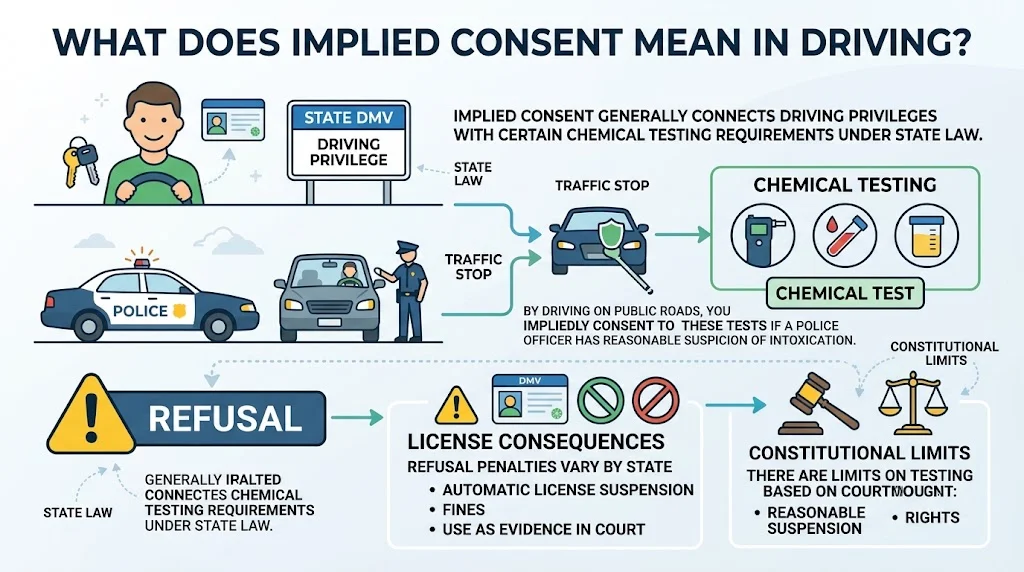
In the United States, implied consent means that drivers generally agree to certain chemical tests for alcohol or drugs when they lawfully drive under state law. Refusing a required test can trigger license suspension, revocation, or other penalties.
What does implied consent mean in driving is a question about a legal rule, not internet slang. In the United States, implied consent laws generally connect the privilege of driving with a driver’s agreement to submit to certain chemical testing under legally defined circumstances. These tests can involve breath, blood, urine, saliva, or other approved methods, depending on state law.
The key point is simple. Driving does not usually mean that police can test you whenever they want. Instead, an implied consent statute creates specific conditions for chemical testing. Those conditions vary by state.
Furthermore, a refusal can create consequences separate from the underlying DUI, DWI, or impaired driving charge. NHTSA reports that all states have implied consent laws involving BAC testing, although the exact rules and penalties differ.
This distinction matters because many people confuse a roadside breath screening with a later evidentiary chemical test. They can have different legal rules. A driver may also face administrative licensing consequences even when a criminal impaired driving case develops differently.
This guide explains the phrase in plain American English. It also covers refusal, constitutional limits, social media confusion, conversational examples, and common questions.
Quick Answer Box
| Meaning | Context | Primary Platforms | Example | Tone |
| A legal rule connecting driving with consent to certain chemical testing | DUI, DWI, impaired driving investigations | State DMV systems, courts, law enforcement materials | “The officer requested a chemical test under the state’s implied consent law.” | Formal and legal |
| Consent created by statute rather than an ordinary conversation | Traffic and licensing law | DMV websites, driver manuals, legal documents | “Your state may impose consequences for refusing the test.” | Serious and factual |
| Not ordinary slang | Everyday communication | Snapchat, TikTok, Instagram, texting | “What does implied consent mean in driving?” | Informational |
What does implied consent mean in driving?
The phrase refers to the legal concept of implied consent in motor vehicle law.
The basic idea is that a person who drives under a state’s licensing system may be considered to have agreed to certain chemical testing requirements. The agreement comes from the law itself rather than from a person signing a separate consent form at the traffic stop.
However, that explanation needs an important qualification. Implied consent does not mean unlimited consent.
State statutes establish when testing can occur. They can also specify which tests qualify, what officers must do, and what happens after a refusal.
The legal meaning of implied consent
In practical terms, the doctrine usually operates like this:
- A person drives a motor vehicle.
- State law creates an implied-consent obligation.
- Law enforcement develops the legally required basis for a chemical test.
- An officer requests the applicable test.
- The driver can face statutory consequences for refusing.
The exact sequence varies.
For example, New York’s DMV explains that its implied-consent law treats people who drive in the state as having consented to certain chemical testing after an alcohol or drug-related arrest. Refusal can produce license consequences and can also become relevant in the criminal case.
Therefore, the phrase should not be interpreted as “police automatically have permission to take any sample.”
Where did the concept come from?
The concept developed through state motor vehicle and impaired-driving laws. States use these laws to establish rules for collecting chemical evidence in suspected impaired-driving cases.
Over time, courts have also addressed constitutional questions involving breath, blood, and other bodily samples.
One important U.S. Supreme Court decision is Birchfield v. North Dakota. The Court distinguished between warrantless breath tests and warrantless blood tests in the context of drunk-driving arrests. The decision held that a warrantless breath test may be permissible as a search incident to a lawful drunk-driving arrest, while a warrantless blood test generally raises greater Fourth Amendment concerns.
Consequently, implied consent statutes operate alongside constitutional protections. One does not simply replace the other.
Implied consent versus express consent
These concepts sound similar, but they work differently.
| Type | Basic idea | Typical source |
| Implied consent | Consent is established by law or circumstances | State statute |
| Express consent | A person directly agrees | Spoken or written agreement |
| Refusal | Person declines a requested test | State-specific rules |
| Warrant | Judicial authorization for a search | Court process |
The distinction becomes especially important when police request a blood sample.
A state’s implied-consent statute may authorize certain procedures, but constitutional law can impose additional limits. The precise answer depends on the circumstances and the jurisdiction.
Contextual Dynamics & Nuances of the Term
Understanding the phrase requires more than memorizing one definition. Several legal and conversational nuances change its meaning.
It usually concerns chemical testing
People often hear “consent” and assume the phrase covers every form of roadside investigation.
That is too broad.
Implied consent laws primarily concern chemical testing connected with impaired-driving enforcement. Depending on state law, testing may involve breath, blood, urine, saliva, or another bodily substance.
NHTSA notes that state laws vary considerably in how they handle testing and refusal.
A roadside test may not be the same as an evidentiary test
This distinction causes frequent confusion.
An officer may use a preliminary breath device during an investigation. Later, the officer may request an evidentiary chemical test.
The two procedures can have different legal purposes.
For example, a preliminary device may help an officer investigate suspected impairment. An evidentiary test may later provide chemical evidence for administrative or criminal proceedings.
Therefore, someone asking about implied consent should identify which test they mean.
Refusal does not necessarily end the investigation
Another common misconception is that refusing a test automatically prevents an impaired-driving case.
That is not necessarily true.
NHTSA states that all states impose some form of separate consequence for BAC test refusal, with administrative license sanctions common across the country.
Furthermore, legal systems can use other evidence.
That evidence might include observations of driving, statements, field sobriety evidence, video, witness accounts, or other investigative information. The availability and admissibility of evidence depend on the circumstances and applicable law.
Refusal and guilt are separate questions
A refusal does not automatically establish that someone was driving while impaired.
Instead, refusal can create a separate legal issue.
For instance, New York’s DMV explains that a chemical-test refusal can result in license consequences even when the person is later found not guilty of the underlying alcohol or drug-related driving offense.
This illustrates why administrative licensing proceedings and criminal proceedings should not be treated as identical.
State law controls many details
There is no single nationwide penalty schedule.
State statutes can differ on:
| Issue | Why it matters |
| When testing may be requested | Determines whether the statutory requirement applies |
| Type of test | Breath, blood, urine, saliva, or another method |
| Refusal penalty | May involve suspension, revocation, fines, or other consequences |
| Prior refusals | Repeat conduct can trigger different consequences |
| Evidentiary use | State rules determine how refusal may be treated |
| Administrative hearing | Some states provide separate licensing procedures |
| Criminal consequences | Some states impose additional penalties |
NHTSA specifically cautions that refusal penalties cannot be reduced to one simple nationwide rule because state impaired-driving laws differ.
Real-Life Conversation Examples Using what does implied consent mean in driving
The phrase most commonly appears when someone is trying to understand a traffic stop, a driver’s manual, a court document, or a legal discussion.
Scenario 1: Asking a friend
Alex: I keep seeing “implied consent” in the driver’s handbook.
Jordan: It generally means drivers are considered to have agreed to certain chemical testing under state law.
Alex: So refusing can have consequences?
Jordan: Yes. The exact consequences depend on the state.
This is a natural explanation because it avoids claiming that every state uses identical rules.
Scenario 2: Discussing a traffic stop
Maya: The officer mentioned implied consent during the stop.
Chris: Was the officer asking for a chemical test?
Maya: Yes.
Chris: Then the rule probably relates to the state’s requirements for chemical testing and refusal.
Here, “implied consent” functions as a legal term.
Scenario 3: Looking at a DMV page
Sam: My DMV page says something about implied consent.
Taylor: Check the section about chemical testing and refusal.
Sam: Why?
Taylor: Because the exact consequences can depend on the state and the type of test.
This conversation demonstrates why context matters.
Scenario 4: Talking about a refusal
Chris: If someone refuses a chemical test, does that mean the DUI case disappears?
Morgan: No. Refusal can create separate consequences, and the case can involve other evidence.
Chris: So refusal and guilt are separate issues?
Morgan: Exactly.
That distinction is important for accurate legal communication.
Scenario 5: Explaining it online
User: What does implied consent mean in driving?
Reply: It generally means state law treats drivers as having consented to certain chemical testing in specified impaired-driving circumstances. Refusing can lead to license or other penalties, depending on the state.
This short answer works well for a forum, text message, or social-media comment.
Platform-Specific Breakdown
The phrase appears differently across digital platforms. However, its underlying meaning does not change simply because someone posts it on social media.
How It Is Used on Snapchat
On Snapchat, people may use the phrase while discussing a traffic stop, DUI arrest, driver’s license issue, or school assignment.
A Snapchat message might say:
“What does implied consent mean in driving?”
The sender is usually asking for a definition.
It is not normally a Snapchat-specific expression. It also does not carry a hidden slang meaning merely because it appears in a disappearing message.
For example:
Friend 1: What does this DMV question mean?
Friend 2: It is asking about implied consent.
Friend 1: Is that about a breath test?
Friend 2: Usually, yes, but the exact law depends on the state.
That response keeps the conversation accurate without turning a legal term into casual slang.
The Role of what does implied consent mean in driving on TikTok
TikTok can create confusion because legal terms often appear in short videos.
A creator might explain implied consent in a 30-second video. Another creator might discuss refusing a breath test. A third might discuss a particular state’s law.
Those videos can simplify complicated rules.
Therefore, viewers should check the jurisdiction.
A statement that is accurate in one state may be incomplete or inaccurate in another. NHTSA confirms that refusal rules and penalties vary significantly between states.
TikTok also encourages short answers. Legal rules rarely fit neatly into one sentence.
For that reason, a reliable explanation should identify:
- The state involved.
- The type of test.
- Whether an arrest occurred.
- The statutory requirements.
- The possible administrative consequences.
- Any relevant constitutional issue.
Instagram and Texting Dynamics
Instagram captions and text messages usually need a simpler explanation.
For example:
“Implied consent means drivers may be legally considered to have agreed to certain chemical testing under state law.”
That sentence works because it communicates the central concept without claiming that every traffic stop creates unlimited testing authority.
Another natural text might be:
“It is a DUI law concept. Refusing a required chemical test can cause separate license penalties.”
That wording is concise while preserving the important distinction.
Alternative Meanings & NLP Variations of the Phrase
Search engines and AI systems may encounter several variations of the same question.
Common variants include:
- What is implied consent when driving?
- What does implied consent mean for drivers?
- What is an implied consent law?
- What happens if you refuse a chemical test?
- Does driving mean you consent to a breath test?
- What does implied consent mean for a DUI?
- What happens if I refuse a breathalyzer?
- Does implied consent apply to blood tests?
- Is implied consent the same as actual consent?
- Can you refuse a chemical test?
- What are implied consent laws?
- What does refusal mean under implied consent laws?
These variations share the same semantic neighborhood.
Core NLP entities
The primary concepts include:
| Entity | Relationship |
| Driver | Person subject to the licensing rules |
| Driver’s license | Legal authorization to operate a vehicle |
| State law | Establishes many implied-consent requirements |
| DUI | Common impaired-driving offense terminology |
| DWI | Another impaired-driving terminology variant |
| BAC | Blood alcohol concentration |
| Chemical test | Test used to measure alcohol or drugs |
| Breath test | Common form of chemical testing |
| Blood test | More invasive chemical testing method |
| DMV | State agency handling driver licensing |
| Law enforcement | May request testing under applicable law |
| Court | Handles relevant criminal proceedings |
| Administrative hearing | May address license consequences |
| Fourth Amendment | Constitutional framework affecting searches |
Related terminology
Search intent often overlaps with phrases such as “chemical test refusal,” “license suspension,” “DUI breath test,” and “implied consent violation.”
However, these terms are not perfect synonyms.
For example, a refusal is an event. Implied consent is the legal framework that can make refusal consequential.
Similarly, BAC is a measurement. A chemical test is the method used to obtain that measurement.
Clear content should preserve those differences.
Misinterpretations:
The phrase is useful when discussing U.S. driving law. It becomes misleading when someone applies it to unrelated forms of consent.
Do not treat it as general permission
Implied consent does not mean that a person permanently gives up all privacy rights after receiving a driver’s license.
Constitutional protections still matter.
The Supreme Court’s decision in Birchfield v. North Dakota demonstrates this distinction. The Court treated breath and blood testing differently under the Fourth Amendment.
Do not assume every test follows the same rule
Breath, blood, and other chemical tests can raise different legal questions.
Blood testing is particularly important because it involves a more intrusive physical search.
The Supreme Court has addressed situations involving warrantless blood testing, including the circumstances surrounding unconscious drivers. In Mitchell v. Wisconsin, the Court addressed exigent circumstances involving an unconscious suspected impaired driver.
The case does not mean every blood draw is automatically lawful.
Instead, the circumstances matter.
Do not assume refusal has one national penalty
A person might say:
“Refusing always means a one-year suspension.”
That statement can be too broad.
The actual penalty depends on the state, the driver’s history, the type of test, and other circumstances.
NHTSA specifically notes substantial differences among state refusal laws.
Do not confuse implied consent with a confession
Consent to chemical testing is not the same thing as admitting guilt.
A driver can dispute an impaired-driving allegation while still facing an independent chemical-test issue.
The two questions can proceed through different legal channels.
Do not use the term as internet slang
The phrase may appear on Snapchat, TikTok, Instagram, Reddit, or messaging apps. That does not turn it into slang.
Its ordinary meaning remains legal.
This distinction matters for AI-generated content because a system may incorrectly infer a slang meaning from social-media frequency.
How to Respond in Chat Comfortably
If someone asks the phrase in a casual conversation, the best response depends on how much detail they need.
One-sentence response
“It means state law can treat drivers as having agreed to certain chemical tests in specified impaired-driving situations.”
Short casual response
“It’s a DUI law concept. It generally means drivers are considered to have consented to certain chemical testing, and refusing can have separate consequences.”
More detailed response
“Implied consent means that, under state law, driving can create an obligation to submit to certain chemical testing when the legal requirements are met. Refusing may affect your license or create other consequences, but the rules vary by state.”
If someone asks whether they can refuse
Avoid giving a blanket yes or no.
A safer and more accurate response is:
“That depends on your state’s law and the type of test. Refusal can carry separate consequences, so check the applicable state rules or speak with a qualified attorney.”
This wording provides useful information without pretending that one national rule controls every situation.
If someone asks about a breathalyzer
Clarify which test they mean.
A preliminary roadside breath test and an evidentiary breath test can have different legal treatment. The distinction depends on state law and the circumstances of the stop.
Therefore, asking for the state and test type can materially improve the answer.
If someone asks about a blood draw
Use greater caution.
Blood testing raises distinct constitutional questions because it is more physically intrusive than a breath test. Birchfield and later cases help explain why the distinction matters.
For a real case, state-specific legal advice may be necessary.
FAQs
1. What does implied consent mean in driving?
It generally means that state law treats a driver as having consented to certain chemical testing in legally specified impaired-driving circumstances. The exact requirements and consequences vary by state.
2. Is implied consent the same as actual consent?
No. Implied consent is created by law. Express consent involves an explicit agreement. The legal consequences of refusing a test can depend on the applicable statute.
3. Does every state have implied consent laws?
Yes, NHTSA states that all states have implied consent laws involving BAC testing. However, the details differ considerably between jurisdictions.
4. What happens if a driver refuses a chemical test?
Possible consequences include administrative license suspension or revocation. Some jurisdictions may impose additional penalties. NHTSA reports that refusal consequences vary substantially by state.
5. Can refusal affect a DUI case?
It can. The legal treatment of refusal varies by state. In some jurisdictions, evidence of refusal can be introduced in a criminal case. Other consequences may arise through a separate licensing process.
6. Is a breath test the same as a blood test?
No. Both can provide chemical evidence, but they involve different procedures and constitutional considerations.
The Supreme Court’s Birchfield decision specifically distinguished warrantless breath testing from warrantless blood testing in drunk-driving cases.
7. Does implied consent mean police can take blood without a warrant?
Not automatically.
The legality of a blood draw depends on the circumstances, state law, and constitutional rules. Courts have recognized particular exceptions to the warrant requirement, but those exceptions do not create unlimited authority.
8. Can someone face license penalties without being convicted of DUI?
Yes, depending on state law.
New York, for example, explains that a confirmed chemical-test refusal can result in license revocation even if the driver is ultimately found not guilty of the related alcohol or drug offense.
9. Is implied consent a type of driving slang?
No. It is primarily a legal term.
People may discuss it casually on social media, but the underlying phrase refers to motor vehicle and impaired-driving law.
10. Where should I check the rules for my state?
Start with the official state DMV or transportation agency. For a specific arrest or pending case, a licensed attorney in the relevant jurisdiction can explain how the statute applies to the facts.
Conclusion:
What does implied consent mean in driving is fundamentally a legal question, not a modern slang phrase.
The answer centers on state implied-consent laws. These laws generally connect the privilege of driving with specific chemical testing requirements in impaired-driving situations.
However, the details matter.
A driver’s obligations can depend on the state, the type of test, the circumstances of the stop, whether an arrest occurred, and the applicable statutory requirements.
Refusal can also create consequences separate from the underlying DUI or DWI allegation. NHTSA identifies administrative license sanctions as a common feature of state refusal laws, while noting that state systems differ.
Constitutional law adds another layer.
The Supreme Court’s decisions concerning breath and blood testing show why “implied consent” should never be treated as unlimited permission. Birchfield v. North Dakota addressed the different constitutional treatment of breath and blood tests. Meanwhile, Mitchell v. Wisconsin addressed warrantless blood testing in the specific context of an unconscious suspected impaired driver.
Therefore, the most accurate plain-English definition is straightforward:
Implied consent is a legal rule under which driving can create consent to certain chemical testing when the requirements of the applicable state law are satisfied. Refusing the test can create separate legal or licensing consequences.
The phrase may appear in texts, search queries, TikTok videos, Snapchat conversations, Instagram posts, and online forums. Its platform does not change its legal meaning.
For general education, the definition above provides the foundation. For an actual traffic stop, chemical-test refusal, license suspension, or DUI case, the relevant state’s current law and the specific facts control.
