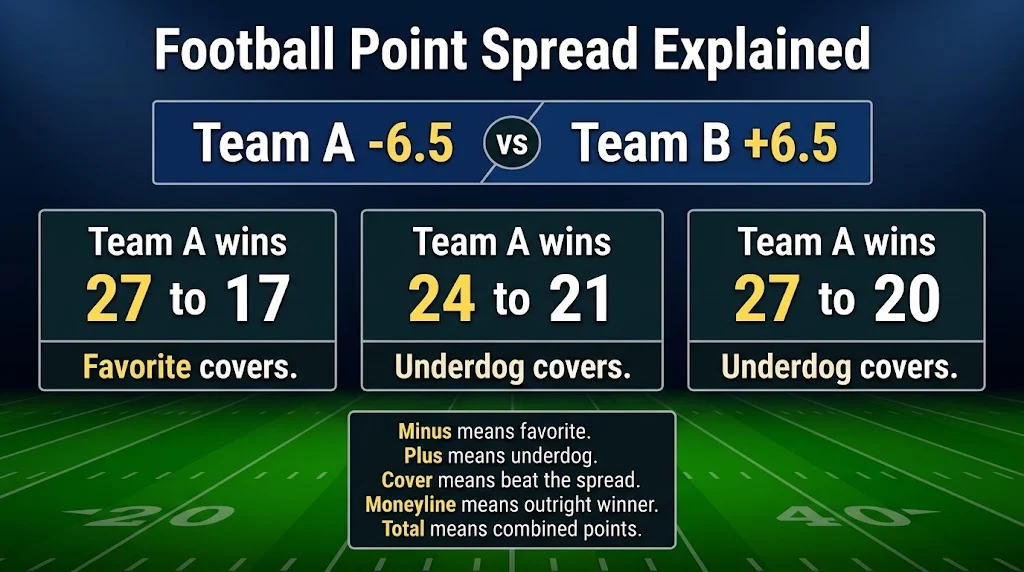
In football betting, the spread is a disability that gives the favorite a negative point margin and the underdog a positive one. A spread bet wins when your selected team covers that adjusted margin.
What does the spread mean in football is a question many new football fans ask when they first see betting lines. The answer is simple once you understand the basic idea. A spread creates a disability between two teams. It makes the betting question about the margin of victory rather than simply identifying the winner.
For example, imagine Team A is listed at −7.5 and Team B at +7.5. Team A is the favorite. Team B is the underdog. A wager on Team A requires the favorite to win by at least eight points. A wager on Team B can win if the underdog wins outright or loses by seven points or fewer.
Therefore, the spread changes how you interpret the final score. A team can win the football game but still lose a spread bet. Conversely, an underdog can lose the game while still cover the spread.
This distinction matters across NFL and college football betting. It also appears frequently in sports discussions, social posts, betting previews, and live game conversations. Major U.S. sportsbooks describe the point spread as a disability applied to both sides of a football matchup.
The rest of this guide explains the terminology, mathematics, examples, online usage, and common misunderstandings in plain American English.
QUICK ANSWER BOX
| Meaning | Context | Primary Platforms | Example | Tone |
| A point disability between two football teams | Sports betting | Sportsbooks, sports apps, social media, texting | Chiefs −6.5 vs. Bills +6.5 | Informal, analytical, sports focused |
What Does the Spread Mean in Football?
The phrase refers to the point spread, a betting line that gives one team a statistical disability against another.
The favorite receives a negative number. The underdog receives a positive number. The two numbers normally represent the same margin from opposite sides.
For example:
| Team | Spread | What it means |
| Team A | −6.5 | Team A must win by 7 or more |
| Team B | +6.5 | Team B can win outright or lose by 6 or fewer |
The spread does not change the actual score on the field. Instead, it changes the score used to determine the result of the wager.
Suppose Team A beats Team B 28 to 24.
The actual margin is four points.
If Team A had a −6.5 spread, Team A would not cover. Team B +6.5 would cover.
The arithmetic looks like this:
| Actual result | Adjusted result | Spread outcome |
| Team A 28, Team B 24 | Team A 21.5, Team B 24 | Team B covers |
| Team A 31, Team B 20 | Team A 24.5, Team B 20 | Team A covers |
Consequently, the spread focuses on margin, not merely victory.
This concept is common in American football betting. Sportsbooks use the point spread to create a market around the expected difference between teams. DraftKings describes the spread as a disability and explains that the favorite carries the negative number while the underdog carries the positive number.
Favorite Versus Underdog
The favorite is the team expected by the betting market to perform better.
The underdog receives points.
Consider this example:
49ers −4.5 vs. Seahawks +4.5
If you choose the 49ers, they must win by at least five points.
If you choose the Seahawks, they can win the game outright or lose by four points or fewer.
The terms therefore work as a pair:
| Term | Typical symbol | Basic meaning |
| Favorite | − | Expected to win by the listed margin |
| Underdog | + | Receives the listed points |
| Spread | Point number | disability separating both sides |
| Cover | Win against the line | Selected side beats the adjusted result |
| Push | Exact line result | Stake is generally returned |
Why Half Points Matter
You may see spreads such as −3.5, +6.5, or −10.5.
Half points prevent an exact tie against the betting line.
For example, a team listed at −3.5 must win by four or more points. It cannot finish exactly three and a half points ahead on the actual scoreboard.
By contrast, a −3 spread can produce a push if the favorite wins by exactly three points. A push generally returns the wager rather than producing a win or loss, although rules can vary by market and sportsbook.
Spread Versus Actual Score
A common beginner mistake is to think the spread changes the official football score.
It does not.
The referee does not add points because of the betting line. The scoreboard remains unchanged.
Instead, the sportsbook applies the disability when settling the wager.
That difference becomes especially important when discussing games after they finish.
A fan might say:
“They won 24 to 21, but they didn’t cover.”
That statement can be completely correct.
If the favorite was −4.5, a three point victory was not enough.
Contextual Dynamics & Nuances of the Term
The word spread can mean different things depending on the football conversation.
In a betting discussion, it usually means the point spread. However, football fans sometimes use the word in tactical or statistical contexts.
For example, “spread offense” describes an offensive formation and philosophy. That meaning has nothing to do with gambling.
Therefore, context matters.
Betting Context
When you see a number with a plus or minus sign, betting is usually the intended meaning.
Examples include:
“Dallas −3.5”
“Miami +7”
“Take the points”
“They covered”
“ATS record”
Here, the conversation concerns betting or betting analysis.
Tactical Football Context
Football coaches and analysts also use spread in phrases such as “spread offense.”
That phrase describes an offensive system designed to distribute players across the field.
The purpose can include creating space, isolating defenders, and opening running or passing opportunities.
Consequently, someone saying “They run a spread offense” is not discussing a betting line.
Media Context
Sports media often uses the term in headlines and previews.
You may see phrases such as:
“Can the underdog cover?”
“Line moves to −5.5.”
“Public money is backing the favorite.”
“Which side of the spread should bettors consider?”
These statements usually belong to sports betting coverage.
Live Betting Context
The number can also change during a game.
Suppose a favorite begins at −4.5.
After scoring two early touchdowns, the live spread might move significantly.
That new number reflects the current game state and market pricing. It does not replace the original number for a wager that was already placed.
Therefore, always check whether someone means the pre game spread or live spread.
Spread, Line, and Odds Are Not Identical
People often use “line” and “spread” casually.
However, the terms can have different meanings.
| Term | Meaning |
| Spread | disability applied to each team |
| Line | Broad term for a betting price or market |
| Odds | Price associated with a wager |
| Moneyline | Bet on the outright winner |
| Total | Wager on combined points |
| ATS | Against the spread |
DraftKings distinguishes the spread from the accompanying odds. The spread determines which side covers, while the odds determine the risk and potential return associated with the wager.
Real Life Conversation Examples Using What Does the Spread Mean in Football?
The phrase often appears in educational conversations rather than ordinary football commentary. Here are five realistic examples.
Conversation 1: A Beginner Asks
Alex: I keep seeing −7.5 next to the team. What does that mean?
Jordan: That’s the point spread. The team at −7.5 has to win by at least eight points for that side to cover.
Alex: So if they win by five, they still lose the spread bet?
Jordan: Exactly. They won the game, but they didn’t cover.
Conversation 2: Talking About an Underdog
Maya: Why would someone take the underdog if they don’t think it will win?
Chris: Because of the points. If the underdog is +6.5, it can lose by six or fewer and still cover.
Maya: So covering isn’t the same as winning?
Chris: Right. That’s the important distinction.
Conversation 3: Comparing Two Bets
Sam: Should I look at the spread or moneyline?
Taylor: They answer different questions. The moneyline focuses on who wins. The spread focuses on who performs better relative to the disability.
Sam: So a favorite could win the game but lose my spread bet?
Taylor: Yes. If the favorite doesn’t win by enough points, the spread bet loses.
Conversation 4: Discussing a Finished Game
Mike: The Eagles won 27 to 24.
Dan: They were −5.5, though.
Mike: So they didn’t cover?
Dan: Correct. They won outright, but the margin was only three points.
Conversation 5: Explaining a Push
Chris: What happens if the spread is exactly three?
Jamie: If the favorite wins by exactly three, that’s usually a push.
Chris: Meaning I get my stake back?
Jamie: Generally, yes. The exact settlement depends on the sportsbook and wager rules.
These conversations demonstrate an important language pattern. People often shorten the full concept.
Instead of saying “The favorite covered the point spread,” someone may simply say:
“They covered.”
“I’m taking the dog.”
“I like the points.”
“The line moved.”
“That’s a bad number.”
The surrounding conversation supplies the missing meaning.
Platform Specific Breakdown
Online sports conversations use the term differently depending on the platform. The underlying betting concept stays the same, but the language becomes shorter and more informal.
How It Is Used on Snapchat
Snapchat conversations tend to be brief and conversational.
A football fan might post a screenshot of a betting line and write:
“Taking +7.5 tonight.”
Another person might reply:
“Need them to keep it close.”
The meaning depends heavily on the attached image or game context.
Snapchat users may also use emojis, abbreviations, and shorthand.
Common examples include:
“ATS”
“Lock?”
“Taking the dog”
“Favorite −3.5”
“Need the cover”
These expressions can confuse beginners because experienced bettors often omit the explanation.
The important point is that a positive number usually identifies the underdog’s disability, while a negative number usually identifies the favorite’s disability.
The Role of What Does the Spread Mean in Football on TikTok
TikTok often turns complicated sports concepts into short educational clips.
A creator might explain a matchup in less than a minute:
“Here’s how the spread works. If the Bills are −6.5, they need to win by seven or more.”
That format works because the concept has a simple numerical core.
Creators may also compare three markets:
| Market | Basic question |
| Moneyline | Who wins? |
| Spread | Who wins relative to the disability? |
| Total | Will combined points go over or under the listed number? |
TikTok captions may shorten the terminology.
For example:
“Spread explained in 30 seconds.”
“Why −3.5 matters.”
“Moneyline vs spread.”
“Underdog + points explained.”
However, short videos can leave out important details. Always check the actual sportsbook rules when settlement conditions matter.
Instagram and Texting Dynamics
Instagram captions and direct messages often use compact sports language.
A post might say:
“Sunday slate. Who are you taking the ATS?”
Someone familiar with betting understands that ATS means against the spread.
A beginner may not.
Texting creates the same issue.
One friend might send:
“I’m on +4.5.”
Without the earlier context, that message can seem incomplete.
In a football group chat, however, everyone may already know which game they are discussing.
Therefore, social platforms reward shorthand, while educational content should define the terminology first.
Alternative Meanings & NLP Variations of the Phrase
Search engines and language models may encounter several versions of the same question.
These variations generally point toward the same underlying concept:
“football spread meaning”
“what is a point spread in football”
“what does −3.5 mean in football”
“how does the football spread work”
“football betting spread explained”
“what does taking the points mean”
“what does covering the spread mean”
“what does ATS mean in football betting”
“favorite and underdog spread explained”
“how to read football betting lines”
From an NLP perspective, these phrases belong to the same semantic cluster.
The central entities include:
| Entity | Relationship |
| Football | Sport |
| Point spread | Betting disability |
| Favorite | Team assigned negative spread |
| Underdog | Team assigned positive spread |
| Cover | Beat the adjusted line |
| Push | Exact result against a whole number |
| Moneyline | Outright winner market |
| Total | Combined score market |
| ATS | Against the spread |
| Odds | Price attached to the wager |
“Take the Points”
This expression usually means choosing the underdog.
For example:
“I’m taking the Bears +5.5.”
The bettor is taking the points.
They are not necessarily predicting that the Bears will win. They are predicting that the Bears will perform within the listed margin.
“Lay the Points”
This expression usually refers to taking the favorite.
For example:
“I’m playing 6.5 with the Chiefs.”
The bettor accepts the −6.5 disability.
The favorite must therefore win by at least seven points.
“Cover the Spread”
To cover means the selected side beats the betting line.
For a −6.5 favorite:
Win by 7 or more = cover
Win by 6 or fewer = no cover
Lose outright = no cover
For a +6.5 underdog:
Win outright = cover
Lose by 6 or fewer = cover
Lose by 7 or more = no cover
This is why the final score alone does not always tell you whether a spread wager won.
Misinterpretations:
The phrase can become misleading when someone uses it outside a betting context.
Do Not Confuse It With Spread Offense
A spread offense is a football strategy.
A point spread is a betting concept.
They share the word “spread,” but they describe different things.
Do Not Assume the Spread Predicts the Exact Score
A −7 spread does not mean the sportsbook predicts a final score with exactly seven points between the teams.
It represents the disability used for that betting market.
Actual scores can differ dramatically.
Do Not Treat the Spread as a Guaranteed Outcome
A betting line represents market pricing and expectations.
It does not guarantee what will happen during the game.
In fact, unexpected results are part of sports.
Do Not Confuse Spread With Moneyline
A moneyline bet generally asks whether a team will win outright.
A spread bet adds the disability.
Suppose Team A is −7.
If Team A wins 24 to 20, the moneyline side may win, but the −7 spread side loses.
That difference is fundamental.
Do Not Assume Every “Spread” Means Betting
Context should determine interpretation.
Consider these two sentences:
“The spread is −4.5.”
“They switched to a spread formation.”
The first concerns betting.
The second concerns tactics.
Therefore, never interpret the word in isolation.
How to Respond in Chat Comfortably
If someone asks you about the term, you do not need a complicated explanation.
A natural response can be:
“It means the favorite has to win by a certain number of points, while the underdog gets those points added for the bet.”
If they ask about a specific line, use the actual number.
For example:
“−3.5 means the favorite needs to win by four or more.”
For an underdog:
“+3.5 means they can win or lose by three or fewer.”
Short Reply Templates
| Situation | Natural response |
| Beginner question | “It’s basically a points disability.” |
| Favorite −7.5 | “They need to win by eight or more.” |
| Underdog +7.5 | “They can win or lose by seven or fewer.” |
| Asked about covering | “Covering means beating the spread.” |
| Asked about ATS | “ATS means against the spread.” |
| Asked about moneyline | “Moneyline is about the outright winner.” |
A More Detailed Explanation
If someone wants more detail, explain the process in three steps.
First, identify the favorite.
Second, identify the point disability.
Third, compare the final margin with that disability.
For example:
“Team A is −5.5. Team B is +5.5. If Team A wins by six or more, Team A covers. If Team A wins by five or fewer, Team B covers.”
That explanation is short, accurate, and easy to remember.
FAQs
1. What does the spread mean in football?
It means a point disability between two teams. The favorite receives a negative number, while the underdog receives a positive number. The final margin determines which side covers.
2. What does the spread mean in football betting?
It means your wager depends on the final score after accounting for the listed disability. The favorite usually needs to win by more than the spread, while the underdog can cover by staying within the margin or winning outright.
3. What does the spread mean in football when a team is −7?
A −7 line means the favorite needs to win by more than seven points to avoid a push. If it wins by exactly seven, the wager may push. If it wins by eight or more, the favorite covers.
4. What does the spread mean in football when a team is +7?
A +7 line gives the underdog seven points for settlement purposes. The underdog can win outright or lose by fewer than seven points and cover. If it loses by exactly seven, the wager can push.
5. What does “cover” mean?
Cover means a team or selected side beats the point spread.
For example, a −4.5 favorite covers winning by five or more.
6. What does ATS mean?
ATS means against the spread.
An ATS record measures results relative to point spreads rather than simple wins and losses.
For example, a team can have a strong overall record but a different ATS record.
7. Can a team win the game and lose the spread?
Yes.
Suppose a favorite is −8.5 and wins by five.
The team won the game.
However, it did not win by enough to cover the spread.
The underdog therefore covers.
8. What is a push?
A push occurs when the final result lands exactly on a whole number spread.
For example, a −3 favorite that wins by exactly three can produce a push.
The stake is generally returned, subject to the applicable sportsbook rules.
9. Is the spread the same as the moneyline?
No.
The moneyline focuses on the outright winner.
The spread adds a disability.
Therefore, a favorite can win the moneyline while failing to cover the spread.
10. Why do sportsbooks use half point spreads?
Half points reduce the possibility of an exact tie against the line.
For example, a −6.5 spread cannot finish exactly six and a half points apart.
As a result, the wager normally settles as either a win or a loss rather than a push.
Conclusion:
Understanding football betting language becomes much easier when you separate the actual game from the betting market.
The point spread is a disability. It changes the question from “Who wins?” to “Who performs better relative to the listed margin?”
That distinction explains why a favorite can win the game but fail to cover. It also explains why an underdog can lose while still producing a winning spread result.
The language becomes even shorter on social media. Fans may say “take the dog,” “lay the points,” “cover,” or “ATS.” These expressions can sound confusing at first. However, each one connects to the same basic vocabulary.
The most useful concepts to remember are simple.
A negative number usually identifies the favorite.
A positive number usually identifies the underdog.
The spread represents the disability.
Covering means beating that disability.
A push can occur when the final margin lands exactly on a whole number line.
Moneyline and spread are different markets.
Furthermore, context always matters. A “spread” in a betting conversation is different from a “spread offense” in a coaching discussion.
Once you understand those distinctions, football betting conversations become far easier to follow. You can read a betting line, interpret a postgame comment, understand common social media shorthand, and explain the concept clearly to someone else.
For anyone searching for what does the spread mean in football, the essential answer is this: the spread is a point disability that determines how much a favorite must win by, or how closely an underdog must keep the game, for a spread wager to cover.
