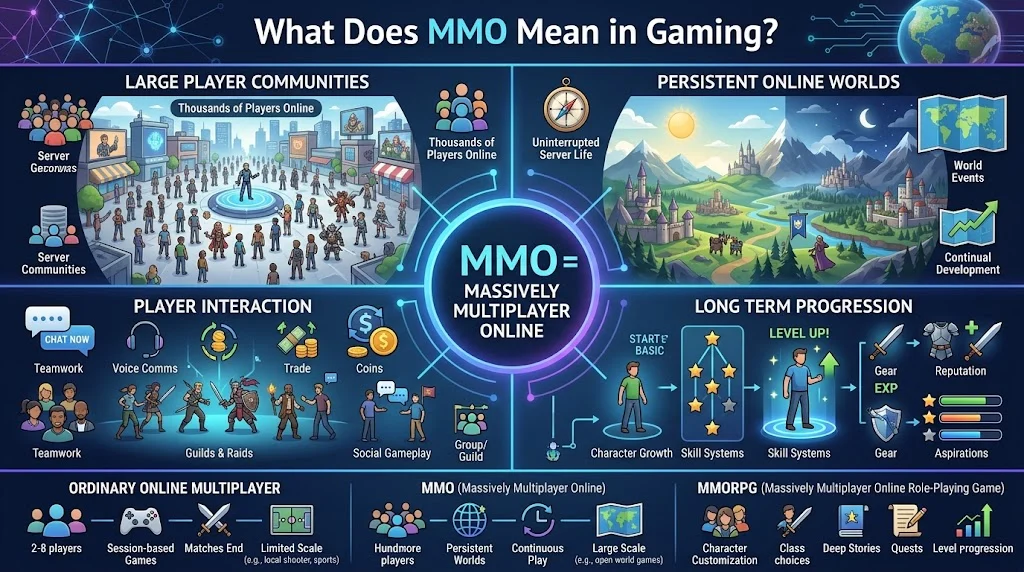
An MMO, or massively multiplayer online game, is a video game that lets many players interact in a shared online world. Players can explore, complete quests, fight enemies, socialize, trade items, and progress alongside other players.
What does MMO mean in gaming? It means massively multiplayer online, a genre built around persistent online worlds where large numbers of players can interact. Unlike a typical single player game, an MMO creates a shared environment that continues to exist when you log out.
The term can describe a broad range of games. Some focus on fantasy role playing. Others center on space exploration, survival, strategy, combat, or social interaction. Therefore, MMO describe the multiplayer structure in more than one specific gameplay style.
For example, a player might spend an evening completing quests with friends. Another player might trade rare items in a virtual marketplace. Meanwhile, someone else might join a large battle involving dozens or hundreds of participants.
This variety explains why the label appears across gaming communities, social media, forums, and casual conversations. Furthermore, modern games often combine MMO features with mechanics from other genres.
The result is a flexible gaming category with a long history and a vocabulary of its own.
Quick Answer Box
| Meaning | Context | Primary Platforms | Example | Tone |
| Massively Multiplayer Online | Online games with persistent shared worlds | PC, PlayStation, Xbox, sometimes mobile | World of Warcraft | Gaming and informal |
| MMO | Common shortened form | Gaming communities | “I play an MMO after work.” | Casual |
| MMORPG | MMO role playing game | PC and consoles | Final Fantasy XIV | More specific |
| MMOFPS | MMO first person shooter | PC and consoles | Large scale online shooters | Genre specific |
| MMORTS | MMO real time strategy | PC and browser platforms | Persistent strategy worlds | Strategy focused |
What Does MMO Mean in Gaming?
The simplest answer to what MMO means in gaming is massively multiplayer online. Each word explains an important part of the concept.
Massively refers to a large player population. It does not always mean that thousands of people appear on the same screen simultaneously. Instead, it usually indicates a game designed to support a substantial online community.
Multiplayer means players share the experience with other people. Those players may cooperate, compete, communicate, trade, or simply occupy the same virtual world.
Online means the game relies on an internet connection for its core shared experience.
Together, these terms describe games designed around large scale online participation.
Where the MMO Term Came From
The concept developed from earlier multiplayer computer games and online virtual worlds. Early networked experiences demonstrated that players could interact inside persistent digital spaces.
Text based multiplayer worlds played an important historical role. These environments allowed users to explore locations, fight enemies, communicate, and develop characters through text commands.
As computer networks improved, graphical online worlds became increasingly practical. Games could then support persistent characters, economies, guilds, quests, and social systems.
The MMO label became especially associated with large online role playing games during the late 1990s and early 2000s.
One major milestone was Ultima Online, released in 1997. Another was EverQuest, released in 1999. Later, World of Warcraft, released in 2004, brought the MMO role playing format to an enormous mainstream audience.
The category has continued evolving since then.
MMO Does Not Mean One Specific Genre
A common misunderstanding is treating MMO as a synonym for MMORPG.
That is not technically correct.
An MMORPG is a massively multiplayer online role playing game. Therefore, MMORPGs belong to the wider MMO family.
Other formats exist too. For example:
| Type | Meaning | Typical Focus |
| MMORPG | Massively multiplayer online role playing game | Characters, quests, combat |
| MMOFPS | Massively multiplayer online first person shooter | Shooting and large scale combat |
| MMORTS | Massively multiplayer online real time strategy | Strategy and resource management |
| MMO Survival | Large online survival experience | Crafting, exploration, survival |
| MMO Sandbox | Persistent player driven world | Freedom, economy, construction |
Consequently, saying a game is an MMO does not automatically tell you exactly how it plays.
What Does MMO Mean in Gaming Communities?
Within gaming communities, the word often carries a broader practical meaning.
Players may use MMO to describe games where online community interaction forms a major part of the experience. The term can therefore refer to progression systems, guilds, raids, virtual economies, social hubs, and persistent worlds.
For example, someone might say:
“I have been playing an MMO for years.”
They may be talking about an MMORPG. However, the speaker may simply prefer the shorter category label.
Gaming communities also use MMO as a noun, adjective, or genre descriptor.
Examples include:
- “That MMO has a huge player base.”
- “I want an MMO with better crafting.”
- “She is an MMO player.”
- “The new MMO launches next month.”
- “This feels more like an MMO than a traditional RPG.”
The surrounding words usually make the intended meaning clear.
Persistent Worlds and Shared Progress
Persistence is one of the defining ideas behind many MMO experiences.
A persistent world continues to operate even when an individual player leaves. Other players may remain active. Markets may change. Guilds may organize events. Characters may gain levels. Developers may introduce new content.
Therefore, the game world can feel more like an ongoing digital environment than a series of isolated matches.
This structure also creates long term relationships between players and games.
A player may return to the same character for months or years. They may join a guild, develop friendships, collect equipment, and participate in recurring community events.
Large Player Communities
The word “massively” does not establish one universal player count.
Different games use different server structures. Some divide players into separate realms or regions. Others use instances, shards, channels, or matchmaking systems.
As a result, you should not interpret “massively multiplayer” as meaning every player exists in one physical game space at once.
Instead, think of MMO as a model designed to support a large connected community.
Contextual Dynamics and Nuances of the Term
Understanding what MMO means in gaming also requires understanding how players use the term in different situations.
The same word can communicate slightly different ideas depending on the conversation.
Genre Classification
In a game discussion, MMO usually functions as a genre label.
For example:
“I mostly play MMOs.”
Here, the speaker is identifying a broad preference.
They might enjoy character progression, cooperative content, social systems, persistent worlds, or online communities.
Game Recommendation
Players also use MMO when describing what they want from a new game.
For example:
“Can you recommend a casual MMO?”
The speaker may want a persistent online world without requiring intensive daily play.
Similarly:
“I want an MMO with good PvP.”
This statement narrows the preference toward player versus player content.
Community Identity
The word can also describe a player’s gaming identity.
Someone might call themselves an MMO player because they enjoy long term progression and online communities.
However, this does not necessarily mean they play only one type of game.
Gamers often move between MMOs, competitive games, single player RPGs, strategy games, and other genres.
MMO Versus Multiplayer
Not every online multiplayer game qualifies as an MMO.
A four player cooperative game is multiplayer. A five versus five competitive match is multiplayer. A battle royale with dozens of players is also multiplayer.
However, those games do not automatically become MMOs.
The distinction usually involves scale, persistence, community structure, and the design of the shared online environment.
| Feature | Typical Multiplayer Game | Typical MMO |
| Online play | Often | Usually |
| Shared world | Not always | Common |
| Persistent character | Sometimes | Common |
| Large community | Not required | Central concept |
| Guilds or clans | Sometimes | Common |
| Long term progression | Sometimes | Common |
| Persistent economy | Rare | Common in many examples |
Real Life Conversation Examples Using What Does MMO Mean in Gaming
Natural conversations show how the phrase works outside formal definitions.
Scenario 1: A New Gamer Asks
Alex: I keep seeing people say MMO. What does MMO mean in gaming?
Jordan: It means massively multiplayer online. Basically, it usually refers to a game with a large online community and a persistent world.
Alex: So is every online game an MMO?
Jordan: No. A small co-op game can be multiplayer without being an MMO.
Scenario 2: Choosing a New Game
Mia: I want to try an MMO, but I do not know where to start.
Chris: What kind do you like?
Mia: Fantasy and character progression.
Chris: Then you might want to look at MMORPGs. They combine MMO features with role playing mechanics.
Mia: That makes sense. I was using MMO and MMORPG interchangeably.
Scenario 3: Talking About Friends
Sam: Why do you spend so much time in that game?
Taylor: My guild plays together most nights.
Sam: Is it an MMO?
Taylor: Yeah. We have a shared world, raids, trading, and a whole community.
Sam: So the social side is a big part of it?
Taylor: Exactly.
Scenario 4: Comparing Games
Chris: Is this new game an MMO?
Jordan: It has online multiplayer, but I would check its actual structure before calling it an MMO.
Chris: What would you look for?
Jordan: Things like persistent worlds, large communities, long term progression, and player interaction.
Scenario 5: Casual Gaming Chat
Ava: What are you playing tonight?
Noah: Probably my MMO.
Ava: Which one?
Noah: The fantasy one I told you about.
Ava: Oh, right. The one with the huge guild?
Noah: Yep. We have a raid tonight.
These examples show why context matters. The abbreviation usually feels natural among gamers because the audience already understands the terminology.
Platform Specific Breakdown
Online gaming language changes across platforms. However, the basic meaning remains consistent.
How It Is Used on Snapchat
Snapchat conversations tend to be short and informal. Therefore, gamers may simply write “MMO” without explaining the abbreviation.
Examples include:
- “Are you playing an MMO tonight?”
- “Our MMO update dropped.”
- “I need a new MMO.”
- “That MMO is taking over my weekend.”
A Snapchat user might also send a screenshot of a character, raid, inventory, or game world and mention the title as an MMO.
The term does not acquire a special Snapchat definition. Instead, the platform changes the communication style.
Short messages, abbreviations, emojis, and inside jokes are common in casual chats.
The Role of What Does MMO Mean in Gaming on TikTok
TikTok often introduces gaming terminology to people who do not belong to a specific gaming community.
Creators may use terms such as MMO, MMORPG, raid, guild, DPS, tank, healer, PvE, and PvP in videos.
For example, a creator might say:
“If you have never played an MMO, here is what you need to know.”
The audience can then learn the terminology through gameplay footage.
TikTok also encourages short explanations. As a result, creators may use MMO as a quick label rather than providing a technical genre definition.
Comments can create another layer of meaning.
A viewer might ask:
“What does MMO mean?”
Another viewer may answer:
“Massively multiplayer online. Think of a huge shared game world.”
This type of interaction helps gaming vocabulary spread beyond traditional gaming forums.
Instagram and Texting Dynamics
Instagram captions and direct messages often use MMO in a similarly casual way.
A gamer might post:
“New MMO grind begins.”
Another might write:
“Looking for an MMO to play with friends.”
In texting, the abbreviation saves space. It also assumes that the recipient understands gaming terminology.
However, context remains important.
If you send “I found a great MMO” to someone who rarely plays games, they may not understand the abbreviation.
In that situation, writing “massively multiplayer online game” once can make the conversation clearer.
Alternative Meanings and NLP Variations of the Phrase
The phrase can generate several closely related search queries and natural language variations.
Common variations include:
- what does MMO stand for
- MMO meaning in games
- MMO definition
- MMO gaming meaning
- what is an MMO
- MMO abbreviation gaming
- massively multiplayer online meaning
- MMO game definition
- difference between MMO and MMORPG
- what does MMORPG mean
- types of MMO games
- MMO versus multiplayer
- online MMO meaning
These phrases represent different search intentions.
Someone searching “what does MMO stand for” wants a direct definition.
Someone searching “MMO versus MMORPG” wants a comparison.
Someone searching “best MMO” has a discovery intent.
Someone searching “how do MMO games work” wants a deeper explanation.
Good content should address these related questions without forcing the exact primary phrase into every paragraph.
MMO and MMORPG
This distinction deserves special attention.
MMO describes the broader category.
MMORPG describes a role playing focused subtype.
An MMORPG commonly includes character levels, equipment, abilities, quests, classes, and progression systems.
However, an MMO does not have to use those mechanics.
Therefore:
MMORPG = MMO + role playing game structure
That shorthand is useful for understanding the relationship.
MMO and Online Multiplayer
These terms overlap, but they are not interchangeable.
Online multiplayer describes games where people play together over the internet.
MMO describes a more specific design approach centered around large scale online communities and persistent shared environments.
Consequently, MMO is a subset of online multiplayer rather than a universal synonym.
Misinterpretations: When Not to Use What Does MMO Mean in Gaming
The phrase is useful for identifying the concept, but several misunderstandings appear frequently.
Mistaking Every Online Game for an MMO
An online connection does not automatically make a game an MMO.
For example, a small cooperative game may support only a handful of players at a time.
That makes it multiplayer and online. It does not necessarily make it an MMO.
Assuming MMO Means MMORPG
This is another common mistake.
MMORPGs are a major type of MMO. However, the terms are not identical.
Using MMO for a role playing game is often perfectly understandable. Yet using MMORPG gives more specific information.
Assuming All MMOs Have the Same Structure
MMOs can differ dramatically.
One might emphasize quests and raids. Another might focus on trading and exploration. Another might emphasize competitive combat.
Therefore, the MMO label alone cannot tell you exactly how a game works.
Treating MMO as a Specific Game Title
MMO is a category, not a particular game.
If someone says:
“I play an MMO.”
They have not necessarily identified the game.
They have identified its general format.
Confusing MMO With Massive Player Counts on One Screen
An MMO does not require every player to appear together simultaneously.
Servers, instances, zones, matchmaking systems, and other technical structures can distribute players across different spaces.
The important concept is the broader persistent online ecosystem.
How to Respond in Chat Comfortably
If someone asks what MMO means in gaming, the simplest response is usually best.
You could say:
“MMO means massively multiplayer online. It usually refers to games with large online communities and persistent shared worlds.”
For a shorter response:
“It stands for massively multiplayer online.”
For someone unfamiliar with gaming:
“It means a game designed for a large online community, often with a persistent world where players interact.”
For a gaming friend:
“MMO means massively multiplayer online. MMORPGs are the role playing version.”
The best response depends on how much context the other person needs.
If Someone Uses MMO Incorrectly
You do not need to correct them aggressively.
Instead, clarify naturally.
For example:
“Yeah, that is an online multiplayer game. If you mean a persistent large-scale world, that is closer to the MMO definition.”
This keeps the conversation informative without turning terminology into an argument.
If You Are Unsure Whether a Game Is an MMO
Ask what features the speaker means.
You could say:
“Do you mean a persistent shared world, or just online multiplayer?”
That question separates two concepts that people frequently combine.
FAQs
What does MMO mean in gaming?
MMO means massively multiplayer online. It generally describes games built around large online communities and shared persistent environments.
What does MMO stand for?
MMO stands for massively multiplayer online.
Is MMO the same as MMORPG?
No. MMORPG is a massively multiplayer online role playing game. It is a specific type of MMO focused on role playing mechanics.
Is every online multiplayer game an MMO?
No. A game can support online multiplayer without providing the large scale, persistent, community oriented structure associated with MMOs.
Why are MMOs called massively multiplayer?
The term highlights their ability to support large online communities. It does not necessarily mean every player appears together in one location at the same time.
What makes a game an MMO?
Common characteristics include a persistent online world, large player communities, long term progression, social systems, and ongoing interaction between players.
Are MMO games only RPGs?
No. MMORPGs are common, but MMO design can appear in other genres, including shooters, strategy games, survival games, and sandbox experiences.
Can you play an MMO alone?
Often, yes. Many MMOs offer solo quests, exploration, crafting, or other activities. However, social interaction and multiplayer systems remain important parts of the overall design.
What is the difference between MMO and multiplayer?
Multiplayer simply means multiple people can participate in the same game experience. MMO usually refers to a larger persistent online environment designed around an extensive player community.
Why do gamers say MMO instead of the full phrase?
The abbreviation is faster and widely understood within gaming communities. It also works naturally in text messages, forums, voice chat, and social media.
Conclusion
What does MMO mean in gaming? It means massively multiplayer online, a broad term for games designed around large online communities and persistent online interaction.
The abbreviation began as gaming terminology, but it has become common across social platforms, forums, streaming communities, and everyday conversations.
Its meaning is straightforward. However, the games represented by the term can be extremely diverse.
An MMO might emphasize role playing, combat, exploration, crafting, strategy, survival, trading, or social interaction. Some games combine several of these systems.
The most important distinction is that MMO does not simply mean “any game played online.” The concept generally involves a large connected community and an ongoing shared environment.
It is also useful to distinguish MMO from MMORPG. An MMORPG is a role playing focused form of MMO, while the broader MMO category can include other genres.
Modern gaming continues to blur traditional genre boundaries. Games increasingly combine multiplayer systems, persistent progression, social features, seasonal content, and live service models.
As a result, the term MMO remains useful because it describes an underlying style of online game design rather than one rigid formula.
For anyone encountering the abbreviation for the first time, the core definition is enough to start:
MMO means massively multiplayer online. It refers to games built around large online communities, persistent worlds, and ongoing player interaction.
