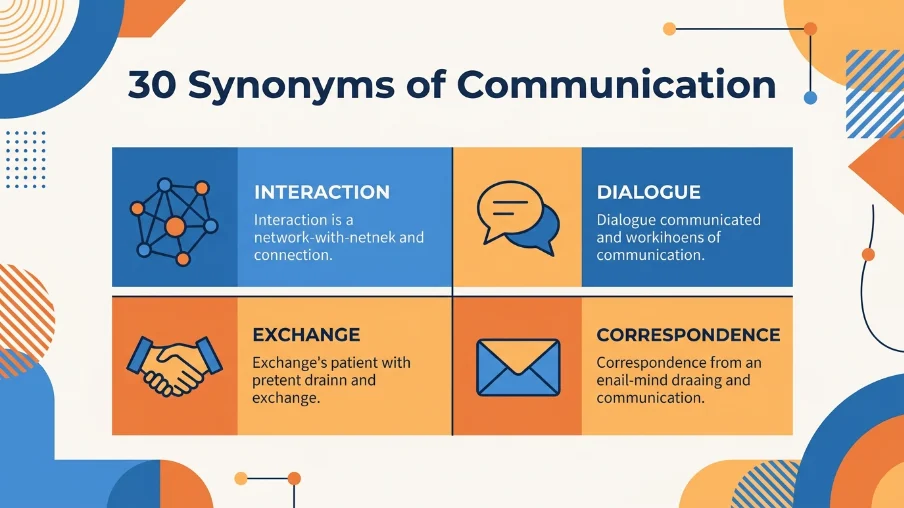
Communication is the act of sharing information, ideas, or feelings between people. The best synonyms are interaction, dialogue, exchange, contact, and correspondence. “Interaction” is the most common and natural in everyday English. Each synonym has a slightly different tone and context where it fits best.
Top 10 Synonyms
- Interaction
- Dialogue
- Exchange
- Contact
- Correspondence
- Conversation
- Discourse
- Transmission
- Connection
- Discussion
Have you ever felt like you keep using the same word over and over? Many English learners struggle with this. The word “communication” is useful, but using it too often can make your speaking and writing feel repetitive.
Learning different ways to say “communication” helps you express yourself more clearly. It also makes your English sound more natural and impressive. Whether you are writing an email, having a conversation, or giving a presentation, having the right word can make all the difference.
In this guide, you will learn 30 powerful synonyms. You will also discover when to use each one, how formal they are, and common mistakes to avoid. Let’s get started!
What Does “Communication” Mean?
Definition
Communication is the process of sharing or exchanging information, ideas, thoughts, or feelings between people. This can happen through speaking, writing, body language, or even technology. Whenever you talk to a friend, send an email, or wave hello, you are communicating. It is one of the most important human activities.
Pronunciation
| Feature | Value |
|---|---|
| US IPA | /kəˌmjuːnɪˈkeɪʃən/ |
| UK IPA | /kəˌmjuːnɪˈkeɪʃən/ |
| Syllables | 5 (com-mu-ni-ca-tion) |
| Tip | Stress the fourth syllable: “kuh-MYOO-nih-KAY-shun” |
Grammar
| Grammar Feature | Information |
|---|---|
| Part of Speech | Noun |
| Common Position | Subject or Object |
| Typical Pattern | Communication + between + people / communication + of + information |
Examples:
- “Good communication between team members is essential.”
- “The communication of important news was handled well.”
- “She has excellent communication skills.”
Note: “Communication” is usually uncountable. We rarely say “communications” except in specific contexts like telecommunications or military messages.
Word Family
| Word | Part of Speech | Meaning |
|---|---|---|
| Communicate | Verb | To share or exchange information |
| Communicator | Noun | A person who communicates well |
| Communicative | Adjective | Willing to talk and share information |
| Communicably | Adverb | In a way that can be communicated |
| Communication | Noun | The act of sharing information |
10–15 Synonyms of “Communication”
Interaction
Meaning: The act of people talking, working, or connecting with each other. It suggests a two-way flow.
Best Used For: Everyday conversation, describing how people connect in groups.
Formality: Neutral
Tone: Natural, Social
Frequency: ⭐⭐⭐⭐⭐ (Very Common)
CEFR Level: B1
Example Sentence 1: “Positive interaction between teachers and students creates a better learning environment.
Example Sentence 2: “Social interaction is important for mental health.
Usage Tip: Use “interaction” when you want to highlight the mutual or two-way nature of communication. It is a very common and safe choice.
Dialogue
Meaning: A conversation between two or more people, especially one that is thoughtful or focused on understanding.
Best Used For: Academic writing, serious discussions, conflict resolution.
Formality: Formal
Tone: Intellectual, Serious
Frequency: ⭐⭐⭐⭐ (Common)
CEFR Level: B2
Example Sentence 1: “The leaders engaged in a constructive dialogue about climate change.”
Example Sentence 2: “The movie has some brilliant dialogue between the two main characters.”
Usage Tip: “Dialogue” suggests a thoughtful exchange, not just casual chatting. Use it for important conversations. It also refers to the words spoken by characters in a story.
Exchange
Meaning: The act of giving and receiving something. It can be information, ideas, or even objects.
Best Used For: Professional settings, describing the giving and receiving of information.
Formality: Neutral
Tone: Practical, Professional
Frequency: ⭐⭐⭐⭐ (Common)
CEFR Level: B1
Example Sentence 1: “There was a lively exchange of ideas during the meeting.”
Example Sentence 2: “A quick exchange of emails confirmed our plans.
Usage Tip: Use “exchange” when you want to emphasize the giving and receiving aspect of communication. It works well for professional contexts .
Contact
Meaning: The state of being in communication with someone, or a person you know who can provide help or information.
Best Used For: Business, networking, informal conversation.
Formality: Neutral
Tone: Practical, Direct
Frequency: ⭐⭐⭐⭐⭐ (Very Common)
CEFR Level: B1
Example Sentence 1: “We keep in contact with our old neighbors.”
Example Sentence 2: “I have a good contact at the agency who can help us.”
Usage Tip: “Contact” is often used to mean getting in touch. It can also refer to a person you know through work or business . Be careful: it’s “keep in contact,” not “keep on contact.”
Correspondence
Meaning: Communication by exchanging letters, emails, or written messages.
Best Used For: Formal writing, business, academic contexts.
Formality: Formal
Tone: Professional, Traditional
Frequency: ⭐⭐⭐ (Moderate)
CEFR Level: B2
Example Sentence 1: “All official correspondence should be sent to the head office.”
Example Sentence 2: “We have maintained a friendly correspondence for many years.”
Usage Tip: “Correspondence” specifically refers to written communication. It sounds quite formal and is perfect for business or official contexts .
Conversation
Meaning: An informal, spoken exchange of thoughts, feelings, and ideas between two or more people.
Best Used For: Daily life, casual settings, describing any spoken communication.
Formality: Informal
Tone: Friendly, Natural
Frequency: ⭐⭐⭐⭐⭐ (Very Common)
CEFR Level: A2
Example Sentence 1: “We had a wonderful conversation about our travel plans.”
Example Sentence 2: “I overheard an interesting conversation on the bus.
Usage Tip: This is the most common word for spoken communication. It’s less formal than “dialogue” and is a perfect choice for everyday situations .
Discourse
Meaning: Serious or formal communication on a particular subject, often in writing or extended speech.
Best Used For: Academic writing, formal speeches, complex topics.
Formality: Formal
Tone: Intellectual, Analytical
Frequency: ⭐⭐⭐ (Moderate)
CEFR Level: C1
Example Sentence 1: “The professor’s discourse on ancient history was fascinating.”
Example Sentence 2: “Political discourse has become more polarized in recent years.”
Usage Tip: “Discourse” is a high-level word for formal, extended discussion or writing. Avoid it in everyday conversation unless you want to sound very academic.
Transmission
Meaning: The process of sending or passing something on, like information, signals, or a disease.
Best Used For: Technical, scientific, or formal contexts.
Formality: Formal
Tone: Technical, Scientific
Frequency: ⭐⭐⭐ (Moderate)
CEFR Level: B2
Example Sentence 1: “The transmission of data over the internet happens in milliseconds.”
Example Sentence 2: “The radio station is responsible for the transmission of news.”
Usage Tip: Use “transmission” when the focus is on the act of sending information from one place to another, especially through technology .
Connection
Meaning: A relationship or link between people or things. It can mean having a shared understanding or feeling.
Best Used For: Describing relationships, emotional bonds, or professional links.
Formality: Neutral
Tone: Emotional, Social
Frequency: ⭐⭐⭐⭐ (Common)
CEFR Level: B1
Example Sentence 1: “There was an instant connection between them.
Example Sentence 2: “I have a good connection at the marketing firm.”
Usage Tip: “Connection” focuses on the relationship or link itself, not necessarily the act of communicating . It is also used informally to mean a useful contact.
Discussion
Meaning: A conversation where people exchange views on a particular topic. It often implies looking at a subject in depth.
Best Used For: Formal and informal contexts, academic, business, and social settings.
Formality: Neutral
Tone: Analytical, Open
Frequency: ⭐⭐⭐⭐⭐ (Very Common)
CEFR Level: B1
Example Sentence 1: “The discussion about the new policy lasted for hours.
Example Sentence 2: “We need to have a serious discussion about your grades.
Usage Tip: Use “discussion” when people are talking about a specific topic or issue. It sounds more purposeful than “conversation.”
Interaction
Meaning: The act of people communicating, working, or connecting with each other. It is mutual and two-way.
Best Used For: Everyday speech, describing how people connect in social and work settings.
Formality: Neutral
Tone: Social, Modern
Frequency: ⭐⭐⭐⭐⭐ (Very Common)
CEFR Level: B1
Example Sentence 1: “Positive interaction between teachers and students creates a better learning environment.”
Example Sentence 2: “Social interaction is important for mental health.”
Usage Tip: “Interaction” is a great all-purpose substitute for “communication.” It highlights the back-and-forth nature of sharing.
Presentation
Meaning: The act of showing, explaining, or giving information to an audience.
Best Used For: Business, academic, or formal contexts where you are giving information to a group.
Formality: Formal
Tone: Professional, Informative
Frequency: ⭐⭐⭐⭐ (Common)
CEFR Level: B1
Example Sentence 1: “She gave a powerful presentation on climate change.
Example Sentence 2: “The presentation of the new product went smoothly.”
Usage Tip: “Presentation” is specifically for formal situations where someone is sharing information with an audience, often using slides or visuals.
Synonyms Comparison Table
| Synonym | Best Context | Formality | Tone | Frequency |
|---|---|---|---|---|
| Interaction | Social, Work | Neutral | Social | ⭐⭐⭐⭐⭐ |
| Dialogue | Formal Talks | Formal | Intellectual | ⭐⭐⭐⭐ |
| Exchange | Professional | Neutral | Practical | ⭐⭐⭐⭐ |
| Contact | Networking | Neutral | Direct | ⭐⭐⭐⭐⭐ |
| Correspondence | Writing | Formal | Professional | ⭐⭐⭐ |
| Conversation | Daily Life | Informal | Friendly | ⭐⭐⭐⭐⭐ |
| Discourse | Academic | Formal | Analytical | ⭐⭐⭐ |
| Transmission | Technical | Formal | Technical | ⭐⭐⭐ |
| Connection | Relationships | Neutral | Emotional | ⭐⭐⭐⭐ |
| Discussion | Meetings | Neutral | Analytical | ⭐⭐⭐⭐⭐ |
Best Synonyms by Situation
Formal vs Informal Synonyms
Formal Alternatives
| Synonym | Best Used For |
|---|---|
| Correspondence | Formal letters and emails . |
| Discourse | Extended academic writing . |
| Transmission | Technical or scientific communication . |
Neutral Alternatives
| Synonym | Best Used For |
|---|---|
| Interaction | Most everyday situations. |
| Exchange | Describing give-and-take. |
| Discussion | Talking about specific topics. |
Informal Alternatives
| Synonym | Best Used For |
|---|---|
| Conversation | Talking with friends or family. |
| Talk | An informal chat. |
| Chat | A very informal and friendly talk. |
Choosing the Right Level: The more formal the setting, the more you should avoid “conversation” and use words like “dialogue” or “correspondence.” In everyday life, “interaction” or “conversation” are almost always the best choices.
Strong vs Mild Synonyms
Mild
These are suitable for everyday situations. They aren’t too strong or too weak.
- Contact
- Connection
- Correspondence
Moderate
These are more expressive than the word “communication” and good for most contexts.
- Interaction
- Exchange
- Dialogue
- Discussion
Strong
High-intensity alternatives that should be used carefully.
- Discourse (strongly suggests a complex, academic topic)
- Dialogue (strongly suggests a serious, formal exchange to find a solution)
How Intensity Changes Meaning: Choosing a stronger word like “discourse” signals that the communication is very serious, formal, and complex. A milder word like “contact” just means getting in touch. Pick the word that fits the weight of the topic.
Real-Life Examples
School: “The teacher encouraged open interaction in the classroom.”
Office: “The manager asked for a dialogue with the team to improve morale.”
Business Email: “Please direct all correspondence regarding the project to me.”
Meetings: “The discussion on the new budget was very productive.”
Presentations: “Her presentation on sustainability was the highlight of the conference.”
Daily Conversations: “I had a great conversation with my neighbor yesterday.”
Social Media: “The brand’s interaction with its followers on TikTok is very engaging.”
Academic Writing: “Academic discourse on the subject has evolved over the last decade.”
Common Collocations
| Common Phrase | Better Alternative |
|---|---|
| Communication problem | Miscommunication |
| Have a communication | Have a conversation / talk |
| Open communication | Transparent dialogue |
| Better communication | Improved interaction |
Common Phrases
Keep in contact: Means to stay in touch with someone. (e.g., “Let’s keep in contact after you move.”)
Open communication: Means honest and direct sharing. Try “transparent dialogue” for a more formal alternative.
Line of communication: The way people share information. Try “channel of communication” as an alternative.
Communication breakdown: A failure to understand each other. Try “miscommunication” for a simpler version.
Context Guide
Related Words
Near Synonyms
- Interchange: The act of exchanging ideas, similar to “exchange.”
- Intercourse: An older word for communication, often used for “social intercourse” .
Antonyms
- Miscommunication: Failure to communicate clearly.
- Silence: Complete absence of communication.
- Concealment: Hiding information.
Related Adjectives
- Communicative: Willing to share information.
- Expressive: Showing thoughts or feelings effectively.
- Eloquent: Clear and persuasive speech or writing.
Related Verbs
- Communicate: The act of sharing information.
- Convey: To effectively express a message.
- Relay: To pass on a message from one person to another.
Frequently Asked Questions
What is another word for communication?
Common synonyms are interaction, dialogue, exchange, contact, and correspondence. The best choice depends on your context .
Which synonym sounds the most professional?
Correspondence and dialogue sound very professional. Correspondence is best for formal writing, while dialogue is great for serious, formal meetings.
What is the strongest synonym?
Discourse is one of the strongest synonyms. It is used for very formal, serious, and often academic communication. It implies deep and complex discussion .
Which synonym is best for essays?
Discourse is the best choice for essays. It signals to the reader that you are engaging with a topic at a high academic level .
What’s the difference between conversation and dialogue?
A conversation is an informal, everyday spoken exchange. A dialogue is a more purposeful, thoughtful, and often formal discussion .
Which synonym is most common in everyday English?
Conversation and interaction are the most common. Conversation is the standard word for two people talking, and interaction is great for describing any mutual exchange.
What is the opposite of communication?
Miscommunication is a common opposite. Other opposites include silence, which is a complete lack of communication, and concealment, which is hiding information.
Conclusion
Communication is at the heart of everything we do. Learning different synonyms helps you avoid repetition and sound more natural. The most important takeaway is that no two synonyms are exactly the same.
As you have learned, each word carries a slightly different tone, formality, and best use case. “Conversation” is for your friends, “correspondence” is for your boss, “discourse” is for your university essay, and “interaction” is for almost everything in between.
The best way to improve is to practice. Try using one new synonym each day in a different context. Pay attention to how native speakers use these words in movies, on TV, and in real life. This active learning will help you build a richer and more powerful vocabulary.
