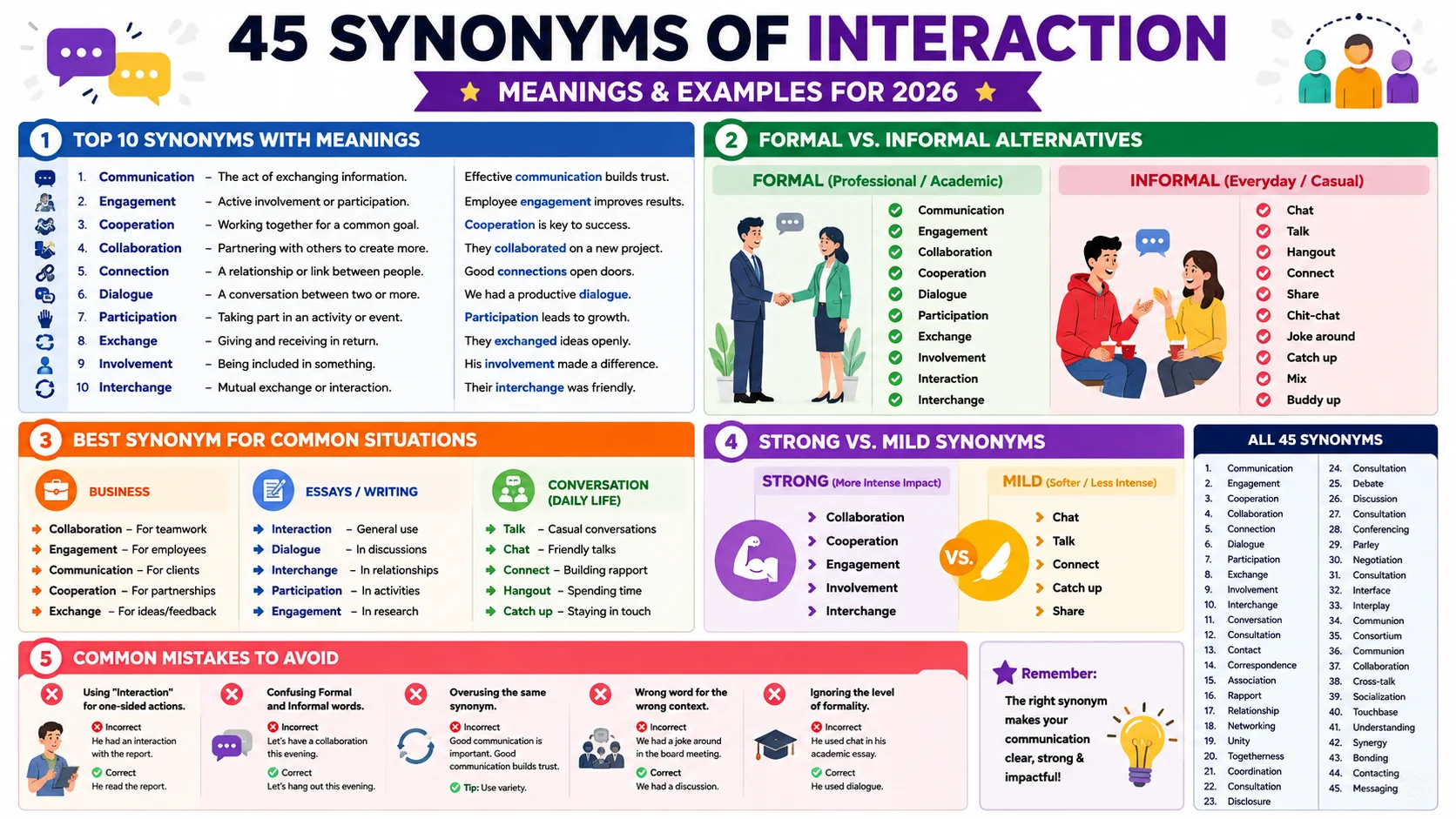
“Interaction” means people communicating, working, or connecting with each other. The best synonyms are communication, interchange, connection, collaboration, and engagement. “Communication” is the most common alternative. Each synonym has a slightly different meaning and context.
Top 10 Synonyms
- Communication
- Interchange
- Connection
- Collaboration
- Engagement
- Cooperation
- Contact
- Relations
- Interplay
- Reciprocity
Interaction is everywhere in modern life. We interact with people, technology, businesses, and our surroundings every day. But repeating the same word can make your writing sound dull or robotic.
So, what is the best interaction synonym for your sentence? The answer depends on the context. You may need a word that describes communication, cooperation, contact, engagement, or a social connection.
In this guide, you’ll discover 35 synonyms of interaction with clear meanings and practical examples. We’ll explore common interactions synonym choices, another word for interaction, and useful alternatives from an interaction thesaurus. You’ll also learn when to use each synonym for interaction, how formal it sounds, and which other words for interaction fit professional, academic, and everyday English. Let’s find the right word for every situation.
What Does “Interaction” Mean?
Definition
Interaction” means two or more people or things affecting or communicating with each other. It can be face-to-face conversation, online communication, or even how two chemicals react together. When you interact, you exchange something words, actions, or energy.
Pronunciation
| Feature | Value |
|---|---|
| US IPA | /ˌɪntərˈækʃən/ |
| UK IPA | /ˌɪntərˈækʃən/ |
| Syllables | 4 (in-ter-ac-tion) |
| Tip | Stress the third syllable: “in-ter-AK-shun” |
Grammar
| Grammar Feature | Information |
|---|---|
| Part of Speech | Noun |
| Common Position | Subject or object |
| Typical Pattern | Interaction + between/with + people/things |
Examples:
- “Positive interaction between teachers and students is important.”
- “His interaction with customers was always friendly.”
- “Social interaction is essential for mental health.”
Grammar Note: “Interaction” can be countable or uncountable. You can talk about “interactions” (multiple) or “interaction” (general).
Word Family
| Word | Part of Speech | Meaning |
|---|---|---|
| Interact | Verb | To communicate or work together |
| Interaction | Noun | The act of interacting |
| Interactive | Adjective | Allowing communication or exchange |
| Interactively | Adverb | In an interactive way |
| Interactivity | Noun | The quality of being interactive |
15 Synonyms of “Interaction”
Communication
Meaning: The exchange of information, ideas, or feelings between people.
Best Used For: All contexts, from conversation to written communication.
Formality: Neutral
Tone: Direct, Informative
Frequency: ⭐⭐⭐⭐⭐ (Very Common)
CEFR Level: A2
Example Sentence 1: “Good communication is the key to a healthy relationship.”
Example Sentence 2: “Communication between departments needs improvement.
Usage Tip: “Communication” is the most common and versatile synonym. Use it for almost any kind of interaction.
Common Confusion: Communication vs Interaction. “Communication” focuses on exchange of messages. “Interaction” is broader and includes any connection or exchange.
Interchange
Meaning: The exchange of things, ideas, or information between people.
Best Used For: Formal contexts, business, academic writing.
Formality: Formal
Tone: Exchange, Mutual
Frequency: ⭐⭐⭐ (Moderate)
CEFR Level: B2
Example Sentence 1: “The interchange of ideas between the teams was productive.”
Example Sentence 2: “There was a lively interchange of opinions during the debate.
Usage Tip: “Interchange” emphasizes a two-way exchange. It’s a formal word for mutual give-and-take.
Connection
Meaning: A relationship or link between people or things.
Best Used For: Relationships, emotional bonds, professional networks.
Formality: Neutral
Tone: Emotional, Social
Frequency: ⭐⭐⭐⭐⭐ (Very Common)
CEFR Level: B1
Example Sentence 1: “There was an instant connection between them.”
Example Sentence 2: “Social media helps people maintain connections.”
Usage Tip: “Connection” focuses on the relationship or link itself, not just the act of interacting.
Collaboration
Meaning: Working together with others to create or achieve something.
Best Used For: Professional settings, creative projects, teamwork.
Formality: Formal
Tone: Cooperative, Productive
Frequency: ⭐⭐⭐⭐⭐ (Very Common)
CEFR Level: B2
Example Sentence 1: “Collaboration between departments led to innovation.”
Example Sentence 2: “The project was a collaboration between two universities.”
Usage Tip: “Collaboration” implies joint work toward a shared goal. It’s very common in business and creative contexts.
Engagement
Meaning: Active involvement or participation in something.
Best Used For: Marketing, education, social media, relationships.
Formality: Formal
Tone: Active, Involved
Frequency: ⭐⭐⭐⭐ (Common)
CEFR Level: B2
Example Sentence 1: “High engagement on social media is important for brands.
Example Sentence 2: “Teacher engagement with students improves learning.
Usage Tip: “Engagement” emphasizes active participation and interest. It’s a modern, professional word.
Cooperation
Meaning: Working together and helping each other.
Best Used For: General teamwork, community projects.
Formality: Neutral
Tone: Helpful, Collaborative
Frequency: ⭐⭐⭐⭐⭐ (Very Common)
CEFR Level: A2
Example Sentence 1: “Cooperation between team members made the task easier.”
Example Sentence 2: “International cooperation is needed to solve global problems.”
Usage Tip: “Cooperation” emphasizes helpfulness and working together willingly.
Contact
Meaning: Communication or connection between people.
Best Used For: Business, networking, staying in touch.
Formality: Neutral
Tone: Practical, Direct
Frequency: ⭐⭐⭐⭐⭐ (Very Common)
CEFR Level: B1
Example Sentence 1: “We stay in contact with our former employees.”
Example Sentence 2: “She has good contacts in the industry.”
Usage Tip: “Contact” is often used for communication and networking. It can also refer to a useful person you know.
Relations
Meaning: The way in which people or groups behave toward each other.
Best Used For: Countries, organizations, professional relationships.
Formality: Formal
Tone: Diplomatic, Professional
Frequency: ⭐⭐⭐⭐ (Common)
CEFR Level: B2
Example Sentence 1: “International relations are crucial for peace.”
Example Sentence 2: “Labor relations have improved this year.”
Usage Tip: “Relations” is used for broader, more formal relationships, often between organizations or countries.
Interplay
Meaning: The way two or more things interact and affect each other.
Best Used For: Scientific, artistic, and complex systems.
Formality: Formal
Tone: Complex, Dynamic
Frequency: ⭐⭐⭐ (Moderate)
CEFR Level: C1
Example Sentence 1: “The interplay of light and shadow created a beautiful effect.”
Example Sentence 2: “The interplay between genetics and environment is complex.
Usage Tip: “Interplay” suggests a dynamic, mutual influence. Use it for complex systems and creative contexts.
Reciprocity
Meaning: A situation where people give and receive equally.
Best Used For: Relationships, business, social psychology.
Formality: Formal
Tone: Mutual, Balanced
Frequency: ⭐⭐ (Rare)
CEFR Level: C1
Example Sentence 1: “Reciprocity is important in healthy relationships.”
Example Sentence 2: “The business was built on reciprocity and trust.”
Usage Tip: “Reciprocity” emphasizes equal give-and-take. It’s a formal, sophisticated word.
Association
Meaning: A connection or relationship between people or things.
Best Used For: Groups, organizations, professional networks.
Formality: Formal
Tone: Official, Connected
Frequency: ⭐⭐⭐ (Moderate)
CEFR Level: B2
Example Sentence 1: “His association with the company lasted many years.”
Example Sentence 2: “She has a close association with the arts community.”
Usage Tip: “Association” suggests a formal or long-term connection.
Liaison
Meaning: Communication and cooperation between groups.
Best Used For: Business, military, diplomatic contexts.
Formality: Formal
Tone: Professional, Coordinating
Frequency: ⭐⭐ (Rare)
CEFR Level: C1
Example Sentence 1: “She acts as a liaison between the two departments.”
Example Sentence 2: “Liaison with local authorities is essential.
Usage Tip: “Liaison” is a formal word for coordination between groups. It’s often used for official connections.
Discourse
Meaning: Serious or formal conversation on a particular subject.
Best Used For: Academic writing, political discussions, formal debates.
Formality: Formal
Tone: Intellectual, Serious
Frequency: ⭐⭐⭐ (Moderate)
CEFR Level: B2
Example Sentence 1: “Academic discourse on the topic has evolved.”
Example Sentence 2: “Political discourse has become more polarized.”
Usage Tip: “Discourse” is formal and intellectual. Use it for serious academic or political discussions.
Exchange
Meaning: The giving and receiving of information, ideas, or things.
Best Used For: Business, education, cultural contexts.
Formality: Neutral
Tone: Practical, Mutual
Frequency: ⭐⭐⭐⭐ (Common)
CEFR Level: B1
Example Sentence 1: “There was a free exchange of ideas at the conference.”
Example Sentence 2: “The cultural exchange program was successful.”
Usage Tip: “Exchange” emphasizes the giving and receiving aspect. It’s a very useful and natural word.
Communion
Meaning: A feeling of connection and sharing with others.
Best Used For: Spiritual, emotional, deep personal contexts.
Formality: Formal
Tone: Spiritual, Deep
Frequency: ⭐⭐ (Rare)
CEFR Level: C1
Example Sentence 1: “She felt a deep communion with nature.”
Example Sentence 2: “There was a sense of communion among the group.”
Usage Tip: “Communion” is a deep, often spiritual word. Use it for profound connections.
Synonyms Comparison Table
| Synonym | Best Context | Formality | Tone | Frequency |
|---|---|---|---|---|
| Communication | General exchange | Neutral | Informative | ⭐⭐⭐⭐⭐ |
| Connection | Relationships | Neutral | Emotional | ⭐⭐⭐⭐⭐ |
| Cooperation | Teamwork | Neutral | Helpful | ⭐⭐⭐⭐⭐ |
| Contact | Networking | Neutral | Practical | ⭐⭐⭐⭐⭐ |
| Collaboration | Professional work | Formal | Productive | ⭐⭐⭐⭐⭐ |
| Engagement | Active involvement | Formal | Active | ⭐⭐⭐⭐ |
| Exchange | Giving and receiving | Neutral | Mutual | ⭐⭐⭐⭐ |
| Relations | Formal relationships | Formal | Diplomatic | ⭐⭐⭐⭐ |
| Interplay | Complex systems | Formal | Dynamic | ⭐⭐⭐ |
| Reciprocity | Equal give-and-take | Formal | Balanced | ⭐⭐ |
Best Synonyms by Situation
| Situation | Best Synonym | Why It Works |
|---|---|---|
| Daily Conversation | Communication | Natural and common |
| Business Email | Collaboration | Professional and productive |
| Academic Writing | Discourse | Formal and intellectual |
| School Assignment | Cooperation | Shows teamwork |
| Professional Meeting | Engagement | Active and involved |
| Presentation | Interaction | Clear and direct |
| Creative Writing | Interplay | Adds depth and nuance |
| Social Media | Engagement | Modern and relevant |
| Networking | Contact | Practical and direct |
Formal vs Informal Synonyms
Formal Alternatives
| Synonym | Best Used For |
|---|---|
| Collaboration | Professional, creative work |
| Engagement | Marketing, education, participation |
| Discourse | Academic, political discussions |
| Liaison | Official coordination |
| Reciprocity | Balanced relationships |
Neutral Alternatives
| Synonym | Best Used For |
|---|---|
| Communication | Most general situations |
| Connection | Relationships, links |
| Cooperation | Working together |
| Contact | Staying in touch |
| Exchange | Giving and receiving |
Informal Alternatives
| Synonym | Best Used For |
|---|---|
| Interaction | General use |
| Chat | Casual conversation |
| Dealings | Professional interactions |
Choosing the Right Level: Use “collaboration” and “engagement” for professional contexts. Use “discourse” for academic writing. Use “communication” and “connection” for everyday situations.
Strong vs Mild Synonyms
Mild
Suitable for everyday situations with less intensity.
- Contact
- Connection
- Association
Moderate
More active or engaged alternatives.
- Communication
- Cooperation
- Exchange
- Relations
Strong
High-intensity alternatives suggesting deep or complex interaction.
- Collaboration (working together actively)
- Engagement (deep involvement)
- Discourse (serious intellectual exchange)
- Reciprocity (equal mutual exchange)
How Intensity Changes Meaning: “We have contact” is simple. “We have deep engagement” sounds much more involved. Choose stronger words when you want to emphasize the depth of connection.
Real-Life Examples
School: “Positive interaction between teachers and students improves learning.”
Office: “Collaboration across departments leads to innovation.”
Business Email: “We value strong communication with our clients.”
Meetings: “Active engagement from all participants is encouraged.”
Presentations: “The interplay of different factors affects the outcome.”
Daily Conversations: “I enjoy social interaction with my friends.”
Social Media: “High engagement with followers is key to success.”
Academic Writing: “Academic discourse on the topic is extensive.”
Common Collocations
| Common Phrase | Better Alternative |
|---|---|
| Social interaction | Social engagement |
| Human interaction | Human connection |
| Positive interaction | Positive collaboration |
| Customer interaction | Customer engagement |
| Team interaction | Team collaboration |
Common Phrases
Touch base: To make contact. (e.g., “Let’s touch base next week.”)
Lend a hand: To help someone. (e.g., “Everyone lent a hand to finish the project.”)
Keep in touch: To stay in contact. (e.g., “Let’s keep in touch after graduation.”)
Rub shoulders: To interact with important people. (e.g., “She rubs shoulders with celebrities.”)
Be in sync: To agree or work well together. (e.g., “The team is totally in sync.”)
Context Guide
| Situation | Best Synonym | Reason |
|---|---|---|
| Essay | Discourse | Academic and formal |
| Speech | Engagement | Inspiring and active |
| Business Email | Collaboration | Professional and productive |
| Novel | Interplay | Adds literary depth |
| Presentation | Engagement | Modern and professional |
| Conversation | Communication | Natural and relatable |
| Academic Writing | Discourse | Precise and formal |
| Marketing Copy | Engagement | Modern and compelling |
Related Words
Near Synonyms
- Dialogue: A conversation between people.
- Intercourse: Communication or dealings (often used in “social intercourse”).
- Interface: The point of interaction between systems or people.
- Cross-pollination: Sharing of ideas between different fields.
Antonyms
- Isolation: Being alone.
- Separation: Being apart.
- Independence: Not depending on others.
- Alienation: Feeling disconnected.
- Detachment: Lack of emotional connection.
Related Adjectives
- Interactive: Allowing for interaction.
- Collaborative: Working together.
- Cooperative: Helpful and willing to work together.
- Engaging: Capturing attention and involvement.
- Communicative: Willing to communicate.
Related Nouns
- Communication: Exchange of information.
- Collaboration: Joint work.
- Cooperation: Working together helpfully.
- Engagement: Active involvement.
- Connection: Relationship or link.
Related Verbs
- Interact: To communicate or work together.
- Communicate: To share information.
- Collaborate: To work together.
- Cooperate: To work together helpfully.
- Engage: To become involved.
Frequently Asked Questions
What is another word for interaction?
Common synonyms include communication, interchange, connection, collaboration, engagement, and cooperation. “Communication” is the most common and versatile alternative.
Which synonym sounds the most professional?
Collaboration and engagement sound very professional. “Discourse” is excellent for academic contexts.
What is the strongest synonym for interaction?
Collaboration and engagement are among the strongest. “Discourse” is strong for intellectual interaction. “Reciprocity” is strong for balanced exchange.
Which synonym is best for essays?
Discourse is the best choice for academic essays. “Interchange” is also excellent for formal writing.
What’s the difference between interaction and communication?
“Interaction” is broader and includes any connection or exchange. “Communication” specifically involves the exchange of messages or information.
Which synonym is most common in everyday English?
“Communication” and “connection” are very common in everyday speech. “Cooperation” and “contact” are also frequently used.
What is the opposite of interaction?
Common opposites are isolation, separation, and detachment. These words describe being alone or disconnected.
Conclusion
“Interaction” is a wonderful word, but now you have 35 fantastic alternatives. Each synonym adds a different shade of meaning to your language.
Remember, the key is understanding the context. Use “communication” for general exchange of information. Use “collaboration” for professional teamwork. Use “engagement” for active involvement. Use “discourse” for serious intellectual exchange.
The best way to improve is practice. Try using one or two new synonyms each day. Listen for these words in conversations and books. Your vocabulary will become richer and more expressive with time.
