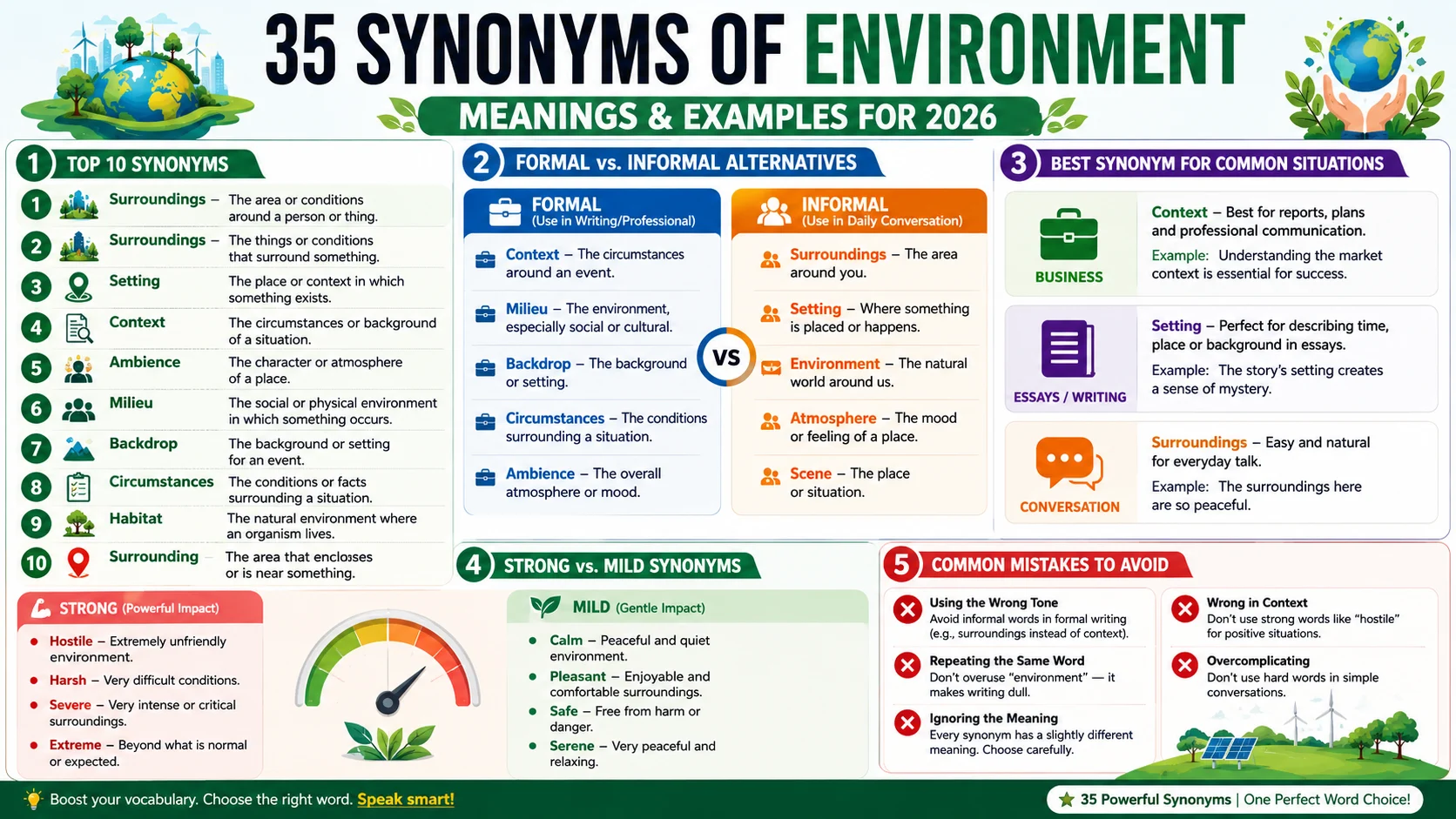
“Environment” means the surroundings or conditions in which something lives or operates. The best synonyms are surroundings, setting, atmosphere, conditions, and context. “Surroundings” is the most common natural alternative. Each synonym has a slightly different meaning and context.
Top 10 Synonyms
- Surroundings
- Setting
- Atmosphere
- Conditions
- Context
- Habitat
- Climate
- Milieu
- Background
- Scene
“Environment” is a word we use constantly. It’s useful, but using it too often can make your writing feel repetitive and boring.
Think about it. You talk about your work environment, your home environment, the natural environment, and the social environment. Each situation might need a different word that captures the exact meaning.
In this guide, you’ll learn 35 powerful synonyms for “environment.” You’ll discover exactly when to use each one, how formal they are, and what common mistakes to avoid. Let’s begin!
What Does “Environment” Mean?
Definition
Environment” means the surroundings, conditions, or circumstances in which someone or something exists. It includes physical surroundings like buildings and nature. It also includes social conditions, cultural influences, and the general atmosphere. Your environment affects how you feel and act.
Pronunciation
| Feature | Value |
|---|---|
| US IPA | /ɪnˈvaɪrənmənt/ |
| UK IPA | /ɪnˈvaɪrənmənt/ |
| Syllables | 4 (en-vi-ron-ment) |
| Tip | Stress the second syllable: “in-VYE-run-ment” |
Grammar
| Grammar Feature | Information |
|---|---|
| Part of Speech | Noun (countable and uncountable) |
| Common Position | Subject or object |
| Typical Pattern | Environment + of + something |
Examples:
- “The environment is important to protect.” (subject)
- “We need to improve the work environment.” (object)
- “The environment of the city is crowded.” (singular)
Grammar Note: “Environment” is usually countable when referring to specific places or types.
Word Family
| Word | Part of Speech | Meaning |
|---|---|---|
| Environment | Noun | The surroundings or conditions |
| Environmental | Adjective | Relating to the environment |
| Environmentalist | Noun | Someone who protects the environment |
| Environ | Verb | To surround or enclose |
15 Synonyms of “Environment”
Surroundings
Meaning: The things and conditions around you.
Best Used For: Physical surroundings, general contexts.
Formality: Neutral
Tone: Descriptive, Practical
Frequency: ⭐⭐⭐⭐⭐ (Very Common)
CEFR Level: A2
Example Sentence 1: “She enjoyed the peaceful surroundings of the countryside.”
Example Sentence 2: “The hotel is in beautiful natural surroundings.
Usage Tip: “Surroundings” is the most direct synonym for physical environment. Use it for what’s around you.
Common Confusion: Surroundings vs Environment. “Surroundings” is usually physical. “Environment” is broader.
Setting
Meaning: The place and time where something happens.
Best Used For: Stories, events, locations, scenes.
Formality: Neutral
Tone: Descriptive, Scene-setting
Frequency: ⭐⭐⭐⭐⭐ (Very Common)
CEFR Level: B1
Example Sentence 1: “The setting of the novel is 19th-century London.”
Example Sentence 2: “The restaurant had a romantic setting.”
Usage Tip: “Setting” is perfect for describing the place and time of events, especially in stories.
Atmosphere
Meaning: The mood, feeling, or quality of a place.
Best Used For: Mood, feelings, emotional quality of places.
Formality: Neutral
Tone: Emotional, Descriptive
Frequency: ⭐⭐⭐⭐ (Common)
CEFR Level: B1
Example Sentence 1: “There was a tense atmosphere in the meeting room.”
Example Sentence 2: “The restaurant has a very relaxing atmosphere.”
Usage Tip: “Atmosphere” focuses on the feeling or mood of a place, not the physical surroundings.
Conditions
Meaning: The state of things or the environment in which something happens.
Best Used For: Weather, work, living situations.
Formality: Neutral
Tone: Practical, Objective
Frequency: ⭐⭐⭐⭐⭐ (Very Common)
CEFR Level: A2
Example Sentence 1: “Working conditions have improved significantly.
Example Sentence 2: “The weather conditions were perfect for the event.
Usage Tip: “Conditions” is a practical word for the state of things. Use it for weather, work, and living situations.
Context
Meaning: The situation or background in which something exists.
Best Used For: Communication, learning, understanding.
Formality: Formal
Tone: Analytical, Intellectual
Frequency: ⭐⭐⭐⭐ (Common)
CEFR Level: B2
Example Sentence 1: “You need to understand the context of his words.
Example Sentence 2: “The context of the conversation was important.”
Usage Tip: “Context” is about the background that helps you understand something. Use it in academic and professional settings.
Habitat
Meaning: The natural home of a plant or animal.
Best Used For: Nature, animals, biology.
Formality: Formal
Tone: Scientific, Natural
Frequency: ⭐⭐⭐ (Moderate)
CEFR Level: B2
Example Sentence 1: “The rainforest is the natural habitat of many species.
Example Sentence 2: “Protecting animal habitats is crucial.”
Usage Tip: “Habitat” is specific to nature and living things. Use it in environmental and scientific contexts.
Climate
Meaning: The general weather conditions of a place, or the general feeling.
Best Used For: Weather, culture, political atmosphere.
Formality: Neutral
Tone: Descriptive, General
Frequency: ⭐⭐⭐⭐ (Common)
CEFR Level: B1
Example Sentence 1: “The climate in this region is warm and dry.”
Example Sentence 2: “The political climate is tense right now.”
Usage Tip: “Climate” can mean weather or the general feeling. Use it for both physical and metaphorical contexts.
Milieu
Meaning: The social or cultural environment in which someone lives.
Best Used For: Social context, culture, society.
Formality: Very Formal
Tone: Sophisticated, Intellectual
Frequency: ⭐ (Very Rare)
CEFR Level: C1
Example Sentence 1: “He grew up in a privileged social milieu.”
Example Sentence 2: “The artistic milieu of Paris was influential.”
Usage Tip: “Milieu” is very formal and intellectual. Use it in academic writing about society and culture.
Background
Meaning: The circumstances or environment in which someone grew up or lives.
Best Used For: Family, education, personal history.
Formality: Neutral
Tone: Personal, Descriptive
Frequency: ⭐⭐⭐⭐⭐ (Very Common)
CEFR Level: A2
Example Sentence 1: “He came from a working-class background.”
Example Sentence 2: “Her family background shaped her values.
Usage Tip: “Background” is personal. Use it for someone’s history and upbringing.
Scene
Meaning: The place where something happens.
Best Used For: Events, locations, visual descriptions.
Formality: Neutral
Tone: Descriptive, Vivid
Frequency: ⭐⭐⭐⭐ (Common)
CEFR Level: B1
Example Sentence 1: “The scene of the accident was being investigated.”
Example Sentence 2: “He described the scene in vivid detail.”
Usage Tip: “Scene” is great for describing a specific place where action happens.
Locale
Meaning: A particular place or location.
Best Used For: Events, travel, geographical locations.
Formality: Formal
Tone: Geographical, Specific
Frequency: ⭐⭐ (Rare)
CEFR Level: B2
Example Sentence 1: “The film was shot in various exotic locales.
Example Sentence 2: “The company chose a beautiful locale for the conference.”
Usage Tip: “Locale” is a formal word for a specific place. Use it in travel and event contexts.
Environs
Meaning: The surrounding area or neighborhood.
Best Used For: Geography, cities, local areas.
Formality: Formal
Tone: Geographical, Descriptive
Frequency: ⭐ (Very Rare)
CEFR Level: C1
Example Sentence 1: “The environs of the city are very beautiful.”
Example Sentence 2: “He explored the environs of the old town.”
Usage Tip: “Environs” is formal and means the surrounding areas. Use it in geographical descriptions.
Ecosystem
Meaning: A community of living things and their environment.
Best Used For: Nature, biology, systems.
Formality: Formal
Tone: Scientific, Systemic
Frequency: ⭐⭐⭐ (Moderate)
CEFR Level: B2
Example Sentence 1: “The ecosystem of the ocean is very delicate.”
Example Sentence 2: “Businesses have their own ecosystem.”
Usage Tip: “Ecosystem” is scientific but can be used metaphorically for systems.
Realm
Meaning: A particular area or field of activity.
Best Used For: Abstract, metaphorical contexts.
Formality: Formal
Tone: Literary, Metaphorical
Frequency: ⭐⭐⭐ (Moderate)
CEFR Level: B2
Example Sentence 1: “She entered the realm of politics.”
Example Sentence 2: “The realm of imagination is limitless.”
Usage Tip: “Realm” is often metaphorical. Use it for abstract areas like politics or art.
Territory
Meaning: An area of land or a field of activity.
Best Used For: Geography, business, animals.
Formality: Neutral
Tone: Territorial, Specific
Frequency: ⭐⭐⭐ (Moderate)
CEFR Level: B1
Example Sentence 1: “The animal defended its territory.”
Example Sentence 2: “This is our company’s core territory.”
Usage Tip: “Territory” can be physical land or a field of activity. Use it for both.
Synonyms Comparison Table
| Synonym | Best Context | Formality | Tone | Frequency |
|---|---|---|---|---|
| Surroundings | Physical area | Neutral | Descriptive | ⭐⭐⭐⭐⭐ |
| Setting | Stories, events | Neutral | Descriptive | ⭐⭐⭐⭐⭐ |
| Conditions | Weather, work | Neutral | Practical | ⭐⭐⭐⭐⭐ |
| Context | Understanding | Formal | Analytical | ⭐⭐⭐⭐ |
| Atmosphere | Mood, feeling | Neutral | Emotional | ⭐⭐⭐⭐ |
| Climate | Weather, feeling | Neutral | General | ⭐⭐⭐⭐ |
| Scene | Events, locations | Neutral | Vivid | ⭐⭐⭐⭐ |
| Habitat | Nature, animals | Formal | Scientific | ⭐⭐⭐ |
| Background | Personal history | Neutral | Personal | ⭐⭐⭐⭐⭐ |
| Milieu | Social context | Very Formal | Sophisticated | ⭐ |
Best Synonyms by Situation
| Situation | Best Synonym | Why It Works |
|---|---|---|
| Daily Conversation | Surroundings | Natural and clear |
| Business Email | Setting | Professional and clear |
| Academic Writing | Context | Formal and precise |
| School Assignment | Conditions | Practical and specific |
| Professional Meeting | Atmosphere | Captures the feeling |
| Presentation | Environment | Direct and clear |
| Creative Writing | Setting | Adds literary depth |
| Social Media | Surroundings | Casual and relatable |
| Nature Writing | Habitat | Scientific and accurate |
Formal vs Informal Synonyms
Formal Alternatives
| Synonym | Best Used For |
|---|---|
| Context | Academic, understanding |
| Milieu | Social and cultural contexts |
| Ecosystem | Scientific, natural systems |
| Habitat | Nature, animals |
| Environs | Geographical descriptions |
Neutral Alternatives
| Synonym | Best Used For |
|---|---|
| Surroundings | Physical area |
| Setting | Stories, events |
| Conditions | Weather, work |
| Atmosphere | Mood, feeling |
Informal Alternatives
| Synonym | Best Used For |
|---|---|
| Surroundings | Everyday use |
| Scene | Visual descriptions |
| Area | General use |
Choosing the Right Level: Use “context” and “milieu” for academic writing. Use “atmosphere” and “setting” for descriptive writing. Use “surroundings” for most everyday conversation.
Strong vs Mild Synonyms
Mild
Suitable for everyday situations with less specificity.
- Surroundings
- Area
- Scene
Moderate
More specific or professional alternatives.
- Setting
- Conditions
- Atmosphere
- Background
Strong
High-intensity or very specific alternatives.
- Ecosystem (complex system)
- Milieu (sophisticated social context)
- Context (understanding)
- Habitat (specific natural home)
How Intensity Changes Meaning: “The surroundings were nice” is simple. “The ecosystem was carefully balanced” is much more specific. Choose stronger words when you want to emphasize complexity or specificity.
Real-Life Examples
School: “Students learn better in a supportive classroom environment.”
Office: “The work atmosphere is very positive.”
Business Email: “We need to consider the economic context.”
Meetings: “The current climate in the industry is challenging.”
Presentations: “This product works in any setting.”
Daily Conversations: “I love the peaceful surroundings here.”
Social Media: “The scene at the festival was amazing!”
Academic Writing: “The social milieu influenced his writing.”
Common Collocations
| Common Phrase | Better Alternative |
|---|---|
| Work environment | Work atmosphere |
| Natural environment | Natural habitat |
| Learning environment | Learning setting |
| Social environment | Social context |
| Safe environment | Safe surroundings |
| Positive environment | Positive atmosphere |
Common Phrases
Set the scene: To describe the environment. (e.g., “Let me set the scene for you.”)
Read the room: To understand the social environment. (e.g., “He knew how to read the room.”)
In this context: In this environment. (e.g., “In this context, we need to adapt.”)
Weather the climate: To survive in difficult conditions. (e.g., “The company weathered the economic climate.”)
Out of one’s element: Not in a comfortable environment. (e.g., “He was out of his element at the party.”)
Context Guide
| Situation | Best Synonym | Reason |
|---|---|---|
| Essay | Context | Academic and analytical |
| Speech | Atmosphere | Emotional and descriptive |
| Business Email | Climate | Professional and broad |
| Novel | Setting | Literary and descriptive |
| Presentation | Context | Clear and professional |
| Conversation | Surroundings | Natural and relatable |
| Academic Writing | Milieu | Sophisticated and precise |
| Nature Writing | Habitat | Scientific and accurate |
Related Words
Near Synonyms
- Ambiance: The character and atmosphere of a place. (e.g., “The restaurant had a cozy ambiance.”)
- Locale: A specific place. (e.g., “The film was shot in a beautiful locale.”)
- Domain: A field of activity. (e.g., “This is his area of expertise.”)
- Realm: A particular area. (e.g., “The realm of science.”)
Antonyms
- Void: Empty space.
- Emptiness: Lack of surroundings.
- Barrenness: Empty and unproductive environment.
- Desolation: Empty and depressing environment.
Related Adjectives
- Environmental: Relating to the environment.
- Surrounding: Around something.
- Ambient: Surrounding and influencing.
- Contextual: Relating to context.
- Ecological: Relating to ecosystems.
Related Nouns
- Ecology: The study of environments.
- Ecosystem: A community and its environment.
- Habitat: The natural home of something.
- Atmosphere: The air or mood.
- Surroundings: The things around you.
Related Verbs
- Surround: To be all around.
- Encompass: To include or surround.
- Encircle: To surround completely.
- Contain: To have within.
Frequently Asked Questions
What is another word for environment?
Common synonyms include surroundings, setting, atmosphere, conditions, and context. “Surroundings” is the most common natural alternative.
Which synonym sounds the most professional?
Context and milieu sound the most professional and sophisticated. “Setting” is also excellent for professional contexts.
What is the strongest synonym for environment?
Ecosystem is one of the strongest and most specific synonyms. It implies a complete, balanced system. “Milieu” is also strong for social contexts.
Which synonym is best for essays?
Context and milieu are excellent for academic essays. “Ecosystem” is perfect for environmental essays.
What’s the difference between environment and surroundings?
“Surroundings” usually refers to physical things around you. “Environment” is broader and includes social, cultural, and natural factors.
Which synonym is most common in everyday English?
“Surroundings,” “setting,” and “conditions” are very common in everyday speech. “Atmosphere” is also frequently used.
What is the opposite of environment?
Common opposites include void, emptiness, and barrenness. These describe a lack of surroundings or conditions.
Conclusion
“Environment” is a versatile word, but now you have 35 fantastic alternatives. Each synonym adds a different shade of meaning to your language.
Remember, the key is understanding the context. Use “surroundings” for physical things around you. Use “atmosphere” for mood and feeling. Use “context” for understanding. Use “habitat” for nature. Use “setting” for stories and events.
The best way to improve is practice. Try using one or two new synonyms each day. Listen for these words in conversations, books, and movies. Your vocabulary will become richer and more impressive with time.
