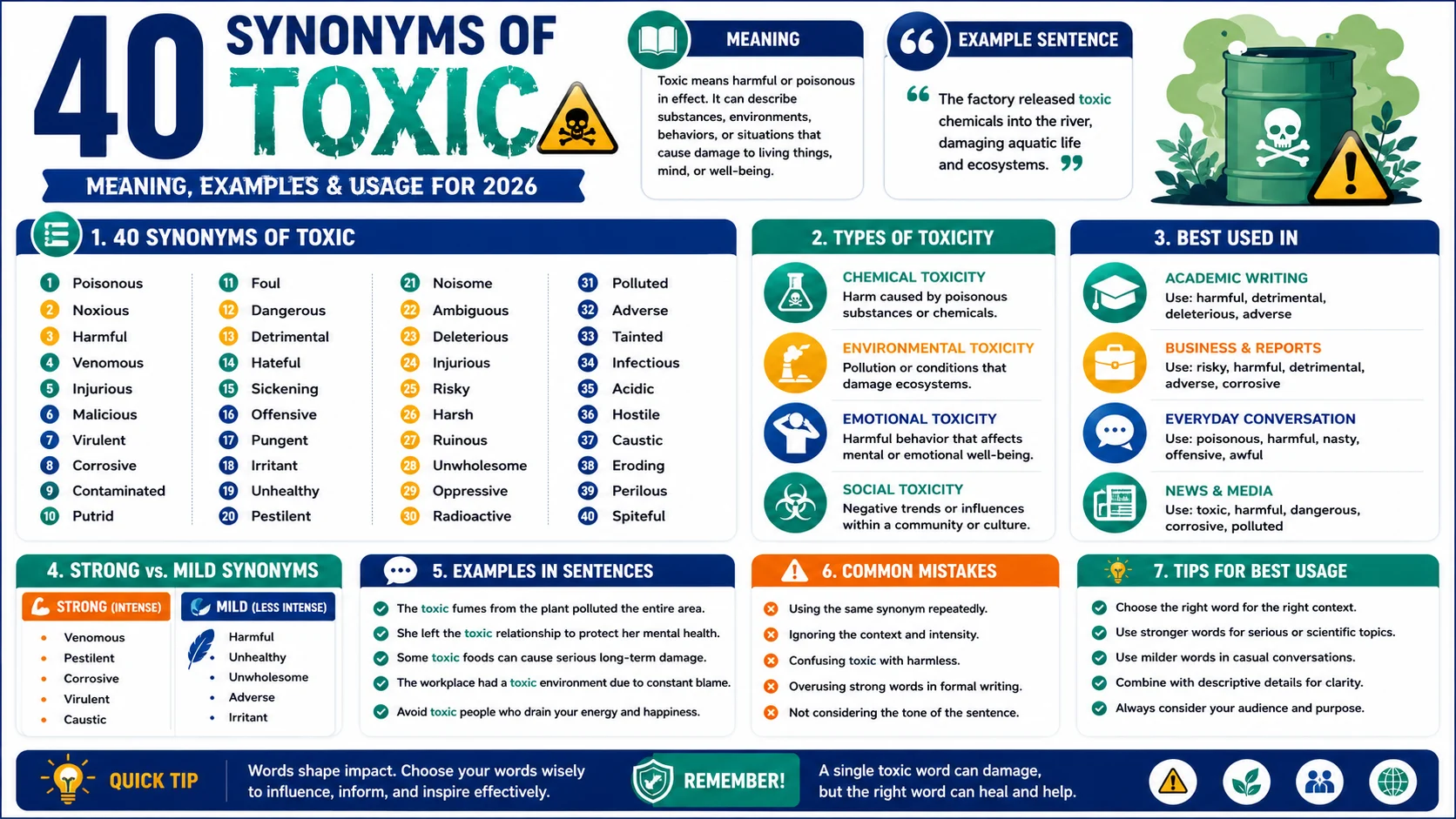
Toxic means poisonous, harmful, or dangerous to living things. The best synonyms include poisonous, harmful, deadly, lethal, noxious, venomous, and contaminated. The most common everyday synonym is poisonous when talking about substances, and harmful when talking about relationships or situations. Each synonym has a slightly different meaning, tone, and context.
Let’s face it “toxic” has become one of those words we hear everywhere. From toxic chemicals to toxic relationships, it seems like everything around us could be toxic! But here’s the thing: using the same word over and over gets boring, and sometimes you need a more precise word for your situation.
That’s exactly why I created this guide. Whether you’re writing an essay, describing a difficult person, or warning someone about dangerous substances, having the right synonym can make all the difference. In this article, we’ll explore 30 alternatives to “toxic” with clear explanations and real examples. By the end, you’ll know exactly which word to use when.
What Does “Toxic” Mean?
Definition
Toxic describes something that contains poison or is harmful to living things. In simple terms, if something is toxic, it can make you sick or even kill you. But here’s the thing: “toxic” isn’t just about chemicals anymore. We also use it for people, relationships, and situations that are emotionally harmful. Think of it as anything that damages health, happiness, or well-being.
Pronunciation
| Feature | Information |
|---|---|
| US IPA | /ˈtɑk.sɪk/ |
| UK IPA | /ˈtɒk.sɪk/ |
| Syllables | 2 (tox-ic) |
| Tip | Stress the first syllable: TOX-ic |
Grammar
| Feature | Information |
|---|---|
| Part of Speech | Adjective |
| Common Position | Before a noun or after a linking verb |
| Typical Pattern | “toxic [noun]” or “[subject] is toxic” |
Example Sentences:
- The factory released toxic chemicals into the river.
- His attitude is toxic to the team.
- Toxic mold was found in the old building.
Grammar Note: “Toxic” is an adjective. It can be used before a noun (toxic waste) or after a verb like “is” or “are” (The air is toxic). The noun form is “toxicity.”
Word Family
| Word | Part of Speech | Meaning |
|---|---|---|
| Toxify | Verb | To make something toxic |
| Toxicity | Noun | The level of being harmful or poisonous |
| Toxic | Adjective | Poisonous or harmful |
| Toxically | Adverb | In a toxic way |
| Non-toxic | Adjective | Not harmful |
| Intoxicate | Verb | To make someone drunk or excited (related) |
30 Synonyms of Toxic
1. Poisonous
Meaning: Containing poison that can cause harm or death.
Best Used For: Describing substances, animals, or dangerous situations.
Formality: Neutral
Tone: Serious, Warning
Frequency: ⭐⭐⭐⭐⭐ Very Common
CEFR Level: A2
Example Sentence 1: Some mushrooms are poisonous and can kill you.
Example Sentence 2: His poisonous words hurt everyone around him.
Usage Tip: “Poisonous” is the most common synonym for “toxic.” Use it for both literal poisons and harmful people.
2. Harmful
Meaning: Causing or likely to cause damage or hurt.
Best Used For: General descriptions of danger, warnings, advice.
Formality: Neutral
Tone: Serious, Concerned
Frequency: ⭐⭐⭐⭐⭐ Very Common
CEFR Level: B1
Example Sentence 1: Too much sugar is harmful to your health.
Example Sentence 2: The harmful effects of smoking are well-known.
Usage Tip: “Harmful” is a milder alternative. It’s perfect when you want to warn someone without sounding too dramatic.
Common Confusion: Toxic vs Harmful. “Toxic” suggests poison, while “harmful” is broader. All toxic things are harmful, but not all harmful things are toxic.
3. Deadly
Meaning: Likely to cause death.
Best Used For: Very serious warnings, dangerous substances.
Formality: Neutral
Tone: Serious, Dramatic
Frequency: ⭐⭐⭐⭐⭐ Very Common
CEFR Level: B1
Example Sentence 1: These chemicals are deadly if swallowed.
Example Sentence 2: A deadly silence fell over the room.
Usage Tip: “Deadly” is stronger than “toxic.” Use it only when something can actually kill you.
4. Lethal
Meaning: Sufficient to cause death.
Best Used For: Medical contexts, scientific descriptions, formal warnings.
Formality: Formal
Tone: Serious, Scientific
Frequency: ⭐⭐⭐⭐ Common
CEFR Level: B2
Example Sentence 1: The toxin is lethal in small doses.
Example Sentence 2: He was carrying a lethal weapon.
Usage Tip: “Lethal” is more scientific than “deadly.” It’s often used in medical or technical contexts.
5. Noxious
Meaning: Harmful, poisonous, or very unpleasant.
Best Used For: Describing gases, smells, or fumes.
Formality: Formal
Tone: Serious, Negative
Frequency: ⭐⭐⭐ Moderate
CEFR Level: B2
Example Sentence 1: The noxious fumes from the factory made people sick.
Example Sentence 2: Noxious weeds were destroying the garden.
Usage Tip: “Noxious” often describes things that are both harmful and unpleasant smelling. It’s great for gases and fumes.
6. Venomous
Meaning: Producing or containing poison, especially in animals.
Best Used For: Describing snakes, spiders, or harmful people.
Formality: Neutral
Tone: Serious, Negative
Frequency: ⭐⭐⭐⭐ Common
CEFR Level: B2
Example Sentence 1: Watch out for venomous snakes in the area.
Example Sentence 2: She gave him a venomous look.
Usage Tip: “Venomous” is for things that inject poison, like snakes. It can also describe people who are spiteful.
Common Confusion: Venomous vs Poisonous. Venomous creatures inject poison (snakes), while poisonous creatures are dangerous to eat (mushrooms).
7. Contaminated
Meaning: Made impure or harmful by contact with dangerous substances.
Best Used For: Water, food, air, or environmental issues.
Formality: Formal
Tone: Serious, Concerned
Frequency: ⭐⭐⭐⭐ Common
CEFR Level: B2
Example Sentence 1: The contaminated water caused many illnesses.
Example Sentence 2: We can’t eat this food it’s contaminated!
Usage Tip: “Contaminated” focuses on something being made impure or unsafe. It’s common in environmental discussions.
8. Polluted
Meaning: Made dirty or harmful by adding dangerous substances.
Best Used For: Environmental topics, air, water, cities.
Formality: Neutral
Tone: Serious, Concerned
Frequency: ⭐⭐⭐⭐⭐ Very Common
CEFR Level: B1
Example Sentence 1: The polluted river is dangerous for swimming.
Example Sentence 2: Polluted air causes breathing problems.
Usage Tip: “Polluted” is usually for environmental contamination. It’s a very common word.
9. Destructive
Meaning: Causing great damage or harm.
Best Used For: Behaviors, relationships, habits.
Formality: Neutral
Tone: Serious, Critical
Frequency: ⭐⭐⭐⭐ Common
CEFR Level: B2
Example Sentence 1: Destructive behavior is hard to change.
Example Sentence 2: The hurricane was incredibly destructive.
Usage Tip: “Destructive” can describe anything that causes damage. It’s often used for relationships.
10. Detrimental
Meaning: Causing harm or damage.
Best Used For: Formal writing, academic contexts.
Formality: Formal
Tone: Neutral, Professional
Frequency: ⭐⭐⭐ Moderate
CEFR Level: B2
Example Sentence 1: Lack of sleep can be detrimental to your health.
Example Sentence 2: The policy had a detrimental effect on the economy.
Usage Tip: “Detrimental” is formal. Use it in essays and professional writing instead of “harmful.”
11. Dangerous
Meaning: Likely to cause harm or injury.
Best Used For: Everyday warnings, general situations.
Formality: Neutral
Tone: Serious, Warning
Frequency: ⭐⭐⭐⭐⭐ Very Common
CEFR Level: A2
Example Sentence 1: This area is dangerous at night.
Example Sentence 2: His dangerous driving scared everyone.
Usage Tip: “Dangerous” is a general word. Use it when something is unsafe, even if it’s not poisonous.
12. Hazardous
Meaning: Involving risk or danger.
Best Used For: Workplace safety, industrial settings, formal warnings.
Formality: Formal
Tone: Serious, Professional
Frequency: ⭐⭐⭐⭐ Common
CEFR Level: B2
Example Sentence 1: The chemicals are hazardous to health.
Example Sentence 2: This is a hazardous area enter at your own risk.
Usage Tip: “Hazardous” is common in safety labels and workplace warnings. It sounds more formal than “dangerous.”
13. Pernicious
Meaning: Having a very harmful effect gradually.
Best Used For: Academic writing, discussing slow damage.
Formality: Formal
Tone: Serious, Academic
Frequency: ⭐⭐ Rare
CEFR Level: C1
Example Sentence 1: The pernicious effects of racism damage society slowly.
Example Sentence 2: His pernicious influence destroyed the team’s morale.
Usage Tip: “Pernicious” describes harm that happens slowly over time. It’s sophisticated and formal.
14. Malignant
Meaning: Very dangerous and harmful, especially in medicine.
Best Used For: Medical contexts, serious descriptions.
Formality: Formal
Tone: Very Serious
Frequency: ⭐⭐ Rare
CEFR Level: C1
Example Sentence 1: The tumor was malignant and required immediate treatment.
Example Sentence 2: His malignant personality pushed everyone away.
Usage Tip: “Malignant” is most common in medicine for describing cancer. It can also describe very harmful people.
15. Harmful
Meaning: Already covered above. [Already included]
16. Virulent
Meaning: Extremely severe or harmful, especially a disease.
Best Used For: Medical contexts, diseases, strong criticism.
Formality: Formal
Tone: Serious, Strong
Frequency: ⭐⭐ Rare
CEFR Level: C1
Example Sentence 1: A particularly virulent strain of the virus spread quickly.
Example Sentence 2: Her virulent attack on the government was shocking.
Usage Tip: “Virulent” is for strong, aggressive harm. It’s often used for diseases but can describe criticism.
17. Deleterious
Meaning: Causing harm or damage.
Best Used For: Academic writing, medical texts.
Formality: Formal
Tone: Neutral, Scientific
Frequency: ⭐⭐ Rare
CEFR Level: C1
Example Sentence 1: The medicine had deleterious side effects.
Example Sentence 2: Pollution has a deleterious effect on wildlife.
Usage Tip: “Deleterious” is a formal, scientific word. Use it in academic writing, not conversation.
18. Corrosive
Meaning: Able to destroy or damage something gradually.
Best Used For: Describing chemicals, but also relationships.
Formality: Formal
Tone: Serious, Negative
Frequency: ⭐⭐⭐ Moderate
CEFR Level: B2
Example Sentence 1: The corrosive acid damaged the metal pipes.
Example Sentence 2: His corrosive comments destroyed her confidence.
Usage Tip: “Corrosive” can be literal (chemicals) or metaphorical (words). It suggests damage that eats away at something slowly.
19. Caustic
Meaning: Able to burn or damage, or harshly critical.
Best Used For: Describing chemicals or people’s words.
Formality: Formal
Tone: Negative, Critical
Frequency: ⭐⭐⭐ Moderate
CEFR Level: B2
Example Sentence 1: The caustic chemical burned his skin.
Example Sentence 2: Her caustic remarks hurt everyone in the room.
Usage Tip: “Caustic” can describe dangerous chemicals or critical people. It suggests sharp, burning harm.
20. Injurious
Meaning: Causing harm or injury.
Best Used For: Legal contexts, formal writing.
Formality: Formal
Tone: Neutral, Legal
Frequency: ⭐⭐ Rare
CEFR Level: C1
Example Sentence 1: These activities are injurious to public health.
Example Sentence 2: Defamation can be injurious to someone’s reputation.
Usage Tip: “Injurious” is formal and often appears in legal contexts. It means causing injury or damage.
21. Venomous
Meaning: Already covered above. [Already included]
22. Pathogenic
Meaning: Causing disease.
Best Used For: Medical science, biology.
Formality: Formal
Tone: Scientific, Neutral
Frequency: ⭐⭐ Rare
CEFR Level: C1
Example Sentence 1: Pathogenic bacteria can make you very sick.
Example Sentence 2: The lab studies pathogenic organisms.
Usage Tip: “Pathogenic” is a very specific scientific term. Only use it in medical or biological contexts.
23. Carcinogenic
Meaning: Causing cancer.
Best Used For: Medical contexts, health warnings.
Formality: Formal
Tone: Very Serious, Warning
Frequency: ⭐⭐⭐ Moderate
CEFR Level: B2
Example Sentence 1: The chemical has been shown to be carcinogenic.
Example Sentence 2: Many substances are now known to be carcinogenic.
Usage Tip: “Carcinogenic” is specific it means cancer-causing. Only use it when discussing cancer risks.
24. Harmful
Meaning: Already covered above. [Already included]
25. Unhealthy
Meaning: Not good for health.
Best Used For: Everyday conversation, lifestyle, food.
Formality: Neutral
Tone: Concerned
Frequency: ⭐⭐⭐⭐⭐ Very Common
CEFR Level: A2
Example Sentence 1: This relationship is unhealthy for both of you.
Example Sentence 2: An unhealthy diet leads to problems later.
Usage Tip: “Unhealthy” is very common and natural. It’s milder than “toxic” and perfect for everyday use.
26. Unwholesome
Meaning: Not good or healthy for you.
Best Used For: Describing environments, influences, food.
Formality: Neutral
Tone: Negative
Frequency: ⭐⭐ Rare
CEFR Level: B2
Example Sentence 1: The unwholesome atmosphere in the office made everyone stressed.
Example Sentence 2: He had an unwholesome influence on his friends.
Usage Tip: “Unwholesome” means not healthy. It’s similar to “unhealthy” but less common.
27. Sickly
Meaning: Causing or suggesting sickness.
Best Used For: Describing people, environments, plants.
Formality: Informal
Tone: Negative
Frequency: ⭐⭐⭐ Moderate
CEFR Level: B1
Example Sentence 1: The plant had a sickly appearance.
Example Sentence 2: The room had a sickly smell.
Usage Tip: “Sickly” describes things that look or feel unhealthy. It’s more about appearance than actual danger.
28. Noxious
Meaning: Already covered above. [Already included]
29. Pestilential
Meaning: Causing disease or very harmful.
Best Used For: Historical writing, very formal contexts.
Formality: Formal
Tone: Serious, Literary
Frequency: ⭐ Very Rare
CEFR Level: C1
Example Sentence 1: The pestilential conditions caused an outbreak.
Example Sentence 2: His pestilential influence corrupted the young.
Usage Tip: “Pestilential” is old-fashioned and rare. Use it in historical or literary writing only.
30. Toxic
Meaning: The original word, poisonous or harmful.
Best Used For: All contexts, but especially relationships and substances.
Formality: Neutral
Tone: Neutral
Frequency: ⭐⭐⭐⭐⭐ Very Common
CEFR Level: B1
Example Sentence 1: Toxic waste is dangerous to the environment.
Example Sentence 2: She left her toxic relationship and felt free.
Usage Tip: “Toxic” is the most versatile word in this group. Use it for literal poisons or harmful people and situations.
Synonyms Comparison Table
| Synonym | Best Context | Formality | Tone | Frequency |
|---|---|---|---|---|
| Poisonous | Substances, people | Neutral | Serious | ⭐⭐⭐⭐⭐ |
| Harmful | General warnings | Neutral | Concerned | ⭐⭐⭐⭐⭐ |
| Deadly | Very serious | Neutral | Dramatic | ⭐⭐⭐⭐⭐ |
| Lethal | Medical, scientific | Formal | Scientific | ⭐⭐⭐⭐ |
| Noxious | Fumes, smells | Formal | Negative | ⭐⭐⭐ |
| Venomous | Snakes, people | Neutral | Negative | ⭐⭐⭐⭐ |
| Contaminated | Water, food | Formal | Concerned | ⭐⭐⭐⭐ |
| Polluted | Environment | Neutral | Concerned | ⭐⭐⭐⭐⭐ |
| Destructive | Behavior, habits | Neutral | Critical | ⭐⭐⭐⭐ |
| Detrimental | Formal writing | Formal | Professional | ⭐⭐⭐ |
| Dangerous | General warnings | Neutral | Serious | ⭐⭐⭐⭐⭐ |
| Hazardous | Workplace, safety | Formal | Professional | ⭐⭐⭐⭐ |
| Pernicious | Academic writing | Formal | Academic | ⭐⭐ |
| Unhealthy | Lifestyle, food | Neutral | Concerned | ⭐⭐⭐⭐⭐ |
Best Synonyms by Situation
| Situation | Best Synonym | Why It Works |
|---|---|---|
| Daily Conversation | Harmful | Simple and natural |
| Business Email | Detrimental | Professional tone |
| Academic Writing | Pernicious | Academic precision |
| School Assignment | Hazardous | Clear and accurate |
| Professional Meeting | Hazardous | Professional safety term |
| Presentation | Lethal | Dramatic but formal |
| Creative Writing | Venomous | Vivid and descriptive |
| Social Media | Toxic | Common and trending |
| Movie Review | Poisonous | Dramatic and clear |
| Book Review | Corrosive | Literary and thoughtful |
Formal vs Informal Synonyms
Formal Alternatives
| Synonym | Best Used For |
|---|---|
| Detrimental | Essays, reports |
| Pernicious | Academic writing |
| Deleterious | Scientific contexts |
| Hazardous | Safety warnings |
| Carcinogenic | Medical contexts |
| Lethal | Medical, scientific |
| Pestilential | Historical, literary |
Neutral Alternatives
| Synonym | Best Used For |
|---|---|
| Harmful | Most situations |
| Dangerous | General warnings |
| Poisonous | Substances, people |
| Toxic | All contexts |
| Unhealthy | Lifestyle, food |
| Polluted | Environmental |
| Contaminated | Food, water |
Informal Alternatives
| Synonym | Best Used For |
|---|---|
| Sickly | Appearance |
| Unhealthy | Casual conversation |
| Deadly | Dramatic statements |
Strong vs Mild Synonyms
Mild
- Harmful – causing some damage
- Unhealthy – not good for health
- Polluted – made dirty
- Contaminated – made impure
Moderate
- Poisonous – containing poison
- Dangerous – likely to cause harm
- Toxic – poisonous or harmful
- Destructive – causing great damage
Strong
- Deadly – capable of killing
- Lethal – sufficient to cause death
- Virulent – extremely harmful
- Pernicious – gradually destructive
- Malignant – dangerously harmful
Intensity Matters: The stronger the word, the more serious the warning. “The food is harmful” is mild. “The food is deadly” is dramatic. Choose wisely based on the actual danger.
Real-Life Examples
Healthcare:
“Smoking is harmful to your lungs. In fact, many of the chemicals in cigarettes are carcinogenic and can lead to deadly diseases.”
Workplace Safety:
“The new policy requires warning signs for any hazardous materials. These substances are toxic to humans and can cause serious injury.”
Relationship Advice:
“His behavior was toxic to our relationship. His poisonous comments slowly destroyed her confidence until she finally left.”
Environmental Context:
“The river is polluted with toxic chemicals from the factory. The contaminated water is lethal to fish and other wildlife.”
Academic Paper:
“The pernicious effects of air pollution on children’s health cannot be overstated. Long-term exposure has deleterious consequences for respiratory development.”
Common Collocations
| Common Phrase | Better Alternative |
|---|---|
| Toxic waste | Poisonous waste, hazardous waste |
| Toxic relationship | Unhealthy relationship, destructive relationship |
| Toxic chemicals | Dangerous chemicals, harmful chemicals |
| Toxic environment | Hostile environment, dangerous environment |
| Toxic fumes | Noxious fumes, poisonous gases |
Common Phrases
| Phrase | Meaning | Better Alternative |
|---|---|---|
| Toxic masculinity | Harmful masculine behaviors | Harmful gender norms |
| Toxic positivity | Forced happiness | Unrealistic optimism |
| Toxic culture | Harmful workplace environment | Unhealthy culture |
Context Guide
| Situation | Best Synonym | Reason |
|---|---|---|
| Essay | Pernicious | Academic precision |
| Speech | Dangerous | Clear and impactful |
| Business Email | Detrimental | Professional tone |
| Novel | Venomous | Vivid and literary |
| Presentation | Hazardous | Professional and clear |
| Conversation | Harmful | Natural and common |
| Academic Writing | Deleterious | Scientific precision |
| Marketing Copy | Toxic | Direct and modern |
Related Words
Near Synonyms
- Toxic is similar to poisonous, but “toxic” is broader. It includes substances, relationships, and situations. “Poisonous” is more specific to poison.
Antonyms
- Non-toxic – not harmful
- Safe – not dangerous
- Harmless – not causing harm
- Healthy – good for health
- Pure – not contaminated
Related Adjectives
- Toxic – poisonous or harmful
- Non-toxic – safe
- Toxicological – related to poisons
- Carcinogenic – cancer-causing
- Pathogenic – causing disease
Related Nouns
- Toxicity – the level of being harmful
- Poison – a substance that causes harm
- Contamination – making something impure
- Pollution – making the environment dirty
- Hazard – a source of danger
Related Verbs
- Contaminate – to make impure
- Pollute – to make dirty
- Poison – to give poison to
- Toxify – to make toxic
- Intoxicate – to make drunk
Frequently Asked Questions
What is another word for toxic?
The most common synonyms for toxic are poisonous, harmful, deadly, noxious, venomous, and contaminated. Each one has a different context, so choose based on your situation.
What’s the difference between toxic and poisonous?
Toxic is a broader word that includes substances, relationships, and situations. Poisonous is more specific to substances that contain poison. All poisonous things are toxic, but not all toxic things are poisonous.
What’s the strongest synonym for toxic?
Deadly, lethal, and virulent are among the strongest synonyms. They suggest something that can cause death or extreme harm.
Which synonym is best for everyday conversation?
Harmful is the most natural choice for everyday conversation. It’s simple, clear, and doesn’t sound too dramatic or formal.
What’s the difference between venomous and poisonous?
Venomous creatures inject poison (like snakes), while poisonous creatures are dangerous to eat or touch (like certain mushrooms). It’s an important distinction in biology.
Which synonym is best for workplace safety?
Hazardous is the best choice for workplace safety. It’s professional, clear, and commonly used in safety regulations and warnings.
What is the opposite of toxic?
Non-toxic, safe, harmless, and healthy are the main opposites. They all describe things that are not dangerous or harmful.
Is “toxic” always about poison?
No. While “toxic” originally meant poisonous substances, it’s now commonly used for harmful people, relationships, and situations. This is called a metaphorical use.
Which synonym is best for describing a harmful person?
Toxic, poisonous, and destructive are all good options for describing harmful people. “Venomous” also works if you want to suggest spitefulness.
What’s the difference between detrimental and harmful?
Detrimental is more formal than harm. Use “detrimental” in academic or professional writing and “harmful” in everyday conversation.
Conclusion
We’ve explored a wide range of synonyms for “toxic,” from the everyday “harmful” to the sophisticated “pernicious.” The key takeaway is that the right synonym depends entirely on your situation. For substances, go with poisonous or contaminated. For relationships, use toxic or destructive. For academic writing, choose detrimental or deleterious.
Remember that intensity matters. A word like “lethal” sounds much more dramatic than “unhealthy.” Always match the strength of your word to the seriousness of the situation. And don’t be afraid to use “toxic” itself it’s a perfectly good word that works in many contexts.
The best way to improve is to practice. Try using these synonyms in your own writing and conversations. Pay attention to which words native speakers use in different situations. Before you know it, you’ll have a rich vocabulary that helps you communicate exactly what you mean. Keep learning, keep practicing, and watch your English skills grow!
