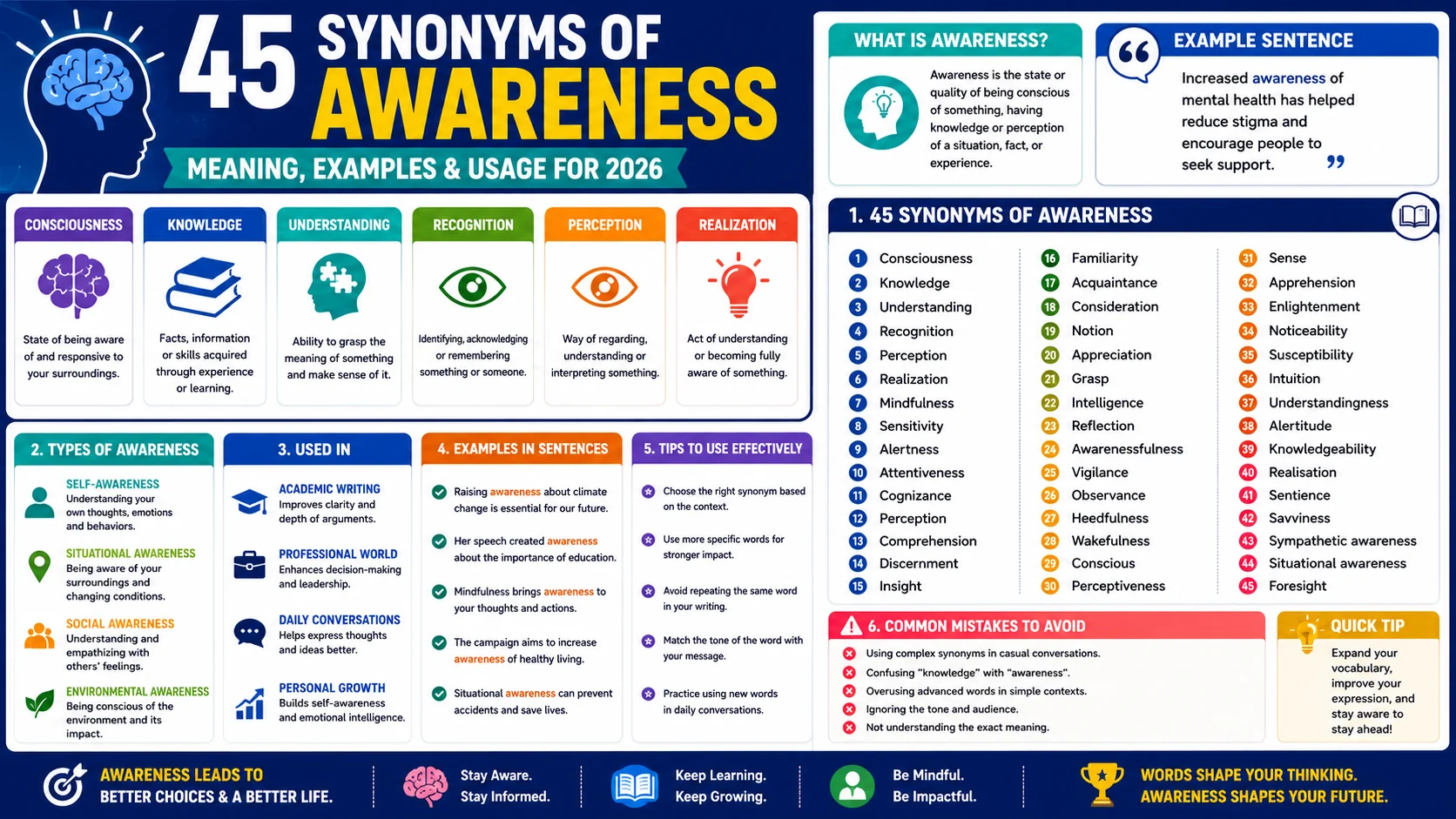
Awareness means knowing about or noticing something. The best synonyms include consciousness, knowledge, understanding, recognition, perception, realization, and mindfulness. The most common everyday synonym is knowledge when talking about facts, and consciousness when discussing being awake or alert. Each synonym has a slightly different meaning, tone, and context.
Have you ever had a moment when everything suddenly clicks? That’s awareness in action. Whether you’re becoming aware of a problem, your surroundings, or a new idea, this word shows up everywhere in English. But here’s the thing “awareness” isn’t your only option. There’s a rich variety of synonyms that can make your English sound more precise and natural.
In this guide, we’ll explore 30 powerful alternatives for “awareness.” I’ll explain each one with clear examples and practical tips. By the time you finish reading, you’ll know exactly which word fits every situation from casual conversations to formal business emails.
What Does “Awareness” Mean?
Definition
Awareness means having knowledge or understanding of something. It’s the state of knowing about a fact, a situation, or your surroundings. Think of it as having your eyes open to what’s happening around you or inside your mind. It can be as simple as knowing it’s raining outside or as deep as understanding your own emotions.
Pronunciation
| Feature | Information |
|---|---|
| US IPA | /əˈwer.nəs/ |
| UK IPA | /əˈweə.nəs/ |
| Syllables | 3 (a-ware-ness) |
| Tip | Stress the second syllable: a-WARE-ness |
Grammar
| Feature | Information |
|---|---|
| Part of Speech | Noun (uncountable) |
| Common Position | Subject or object of a sentence |
| Typical Pattern | “awareness of [something]” or “awareness that [clause]” |
Example Sentences:
- The campaign raised awareness about climate change.
- Her awareness of the problem grew over time.
- He has no awareness that he’s being followed.
Grammar Note: “Awareness” is usually uncountable. We don’t say “awarenesses.” Use it with “of” when mentioning the subject (“awareness of the issue”) or with “that” for a full clause (“awareness that it matters”).
Word Family
| Word | Part of Speech | Meaning |
|---|---|---|
| Aware | Adjective | Having knowledge or understanding |
| Awareness | Noun | The state of knowing or understanding |
| Unaware | Adjective | Not knowing or noticing |
| Unawareness | Noun | Lack of knowledge or understanding |
| Knowingly | Adverb | With awareness |
30 Synonyms of Awareness
1. Consciousness
Meaning: The state of being awake and aware of your surroundings.
Best Used For: Psychology, philosophy, medical contexts, serious discussions.
Formality: Formal
Tone: Neutral
Frequency: ⭐⭐⭐⭐ Common
CEFR Level: B2
Example Sentence 1: He regained consciousness after the accident.
Example Sentence 2: Environmental consciousness has grown in recent years.
Usage Tip: “Consciousness” has a broader meaning than “awareness.” It can mean being awake or alert, not just knowing something. Use it for deeper, more significant forms of awareness.
Common Confusion: Consciousness vs Awareness. “Consciousness” includes being awake, while “awareness” is more about knowing or noticing something.
2. Knowledge
Meaning: Facts, information, and understanding gained through experience.
Best Used For: Daily conversation, education, business, personal development.
Formality: Neutral
Tone: Neutral
Frequency: ⭐⭐⭐⭐⭐ Very Common
CEFR Level: A2
Example Sentence 1: Her knowledge of history is impressive.
Example Sentence 2: Awareness of the rules is essential for safety.
Usage Tip: “Knowledge” focuses on facts and information, while “awareness” focuses on noticing or knowing about something. Use “knowledge” when talking about learning facts.
3. Understanding
Meaning: The ability to know or comprehend something.
Best Used For: Teaching, explaining, personal relationships.
Formality: Neutral
Tone: Neutral
Frequency: ⭐⭐⭐⭐⭐ Very Common
CEFR Level: B1
Example Sentence 1: We have a better understanding of the problem now.
Example Sentence 2: Her understanding of human behavior amazed us.
Usage Tip: “Understanding” suggests a deeper grasp than simple awareness. Use it when you want to show you really get something.
4. Recognition
Meaning: The act of knowing or identifying something.
Best Used For: Facial recognition, achievements, official contexts.
Formality: Formal
Tone: Professional
Frequency: ⭐⭐⭐⭐ Common
CEFR Level: B2
Example Sentence 1: He gave a nod of recognition to his old friend.
Example Sentence 2: Awareness of the issue finally led to official recognition.
Usage Tip: “Recognition” often involves identifying something you’ve seen before or acknowledging its importance.
5. Perception
Meaning: The ability to see, hear, or notice things.
Best Used For: Psychology, everyday observation, personal insight.
Formality: Formal
Tone: Neutral
Frequency: ⭐⭐⭐ Moderate
CEFR Level: B2
Example Sentence 1: Her perception of color is better than average.
Example Sentence 2: His perception of the situation was completely wrong.
Usage Tip: “Perception” is about how we process information through our senses. It’s more about how we see or experience things.
6. Realization
Meaning: The moment when you suddenly understand something.
Best Used For: Personal growth, dramatic moments, storytelling.
Formality: Neutral
Tone: Emotional, Personal
Frequency: ⭐⭐⭐⭐ Common
CEFR Level: B2
Example Sentence 1: The realization that she was right hit him suddenly.
Example Sentence 2: His awareness grew into a full realization of the problem.
Usage Tip: “Realization” is about the sudden “aha!” moment when you first understand or become aware of something important.
7. Mindfulness
Meaning: The state of being aware of the present moment.
Best Used For: Meditation, mental health, daily life, well-being.
Formality: Neutral
Tone: Positive, Calming
Frequency: ⭐⭐⭐⭐ Common
CEFR Level: B2
Example Sentence 1: Practicing mindfulness helps reduce stress.
Example Sentence 2: She ate her lunch with complete mindfulness.
Usage Tip: “Mindfulness” is specifically about being fully present in the moment. It’s not just awareness it’s focused, intentional attention to the now.
8. Acumen
Meaning: The ability to make good judgments and quick decisions.
Best Used For: Business, leadership, professional contexts.
Formality: Formal
Tone: Professional
Frequency: ⭐⭐⭐ Moderate
CEFR Level: C1
Example Sentence 1: His business acumen helped the company succeed.
Example Sentence 2: Awareness of market trends requires sharp financial acumen.
Usage Tip: “Acumen” is a more sophisticated word. Use it when discussing skill in making decisions, not just knowing things.
9. Appreciation
Meaning: Full understanding of the value or importance of something.
Best Used For: Professional contexts, expressing thanks, critical thinking.
Formality: Formal
Tone: Positive, Respectful
Frequency: ⭐⭐⭐⭐ Common
CEFR Level: B2
Example Sentence 1: We have a deep appreciation for the challenges they face.
Example Sentence 2: His awareness became true appreciation over time.
Usage Tip: “Appreciation” goes beyond simple awareness. It involves understanding the worth or significance of something.
10. Sensitivity
Meaning: The ability to notice or understand subtle things.
Best Used For: Emotional intelligence, art, cultural contexts.
Formality: Neutral
Tone: Empathetic
Frequency: ⭐⭐⭐⭐ Common
CEFR Level: B2
Example Sentence 1: Cultural sensitivity is crucial in international business.
Example Sentence 2: Her sensitivity to others’ feelings made her a great teacher.
Usage Tip: “Sensitivity” is about noticing subtle details especially in emotions, art, or culture. It’s more nuanced than general awareness.
11. Discernment
Meaning: The ability to see or understand things clearly.
Best Used For: Making judgments, evaluating quality, formal contexts.
Formality: Formal
Tone: Analytical
Frequency: ⭐⭐ Rare
CEFR Level: C1
Example Sentence 1: She used her discernment to choose the best candidate.
Example Sentence 2: Awareness becomes discernment when you learn to judge wisely.
Usage Tip: “Discernment” suggests you’re not just aware but also able to judge and distinguish what’s important.
12. Cognizance
Meaning: Formal knowledge or awareness of something.
Best Used For: Legal documents, formal writing, official statements.
Formality: Very Formal
Tone: Professional
Frequency: ⭐⭐ Rare
CEFR Level: C1
Example Sentence 1: He had no cognizance of the rules.
Example Sentence 2: The court took cognizance of the evidence.
Usage Tip: “Cognizance” is extremely formal. You’ll see it in legal or very official writing. Avoid it in everyday conversation.
13. Insight
Meaning: A deep understanding of a complex issue.
Best Used For: Analysis, problem-solving, personal growth.
Formality: Neutral
Tone: Thoughtful
Frequency: ⭐⭐⭐⭐ Common
CEFR Level: B2
Example Sentence 1: Her insights into the problem helped us solve it quickly.
Example Sentence 2: Awareness of the situation gave him valuable insight.
Usage Tip: “Insight” means you’re aware of something in a deep, meaningful way. It’s not just seeing it’s understanding the deeper meaning.
14. Noticing
Meaning: Paying attention to or observing something.
Best Used For: Casual conversation, everyday observations.
Formality: Informal
Tone: Casual
Frequency: ⭐⭐⭐⭐ Common
CEFR Level: A2
Example Sentence 1: I couldn’t help noticing the beautiful painting.
Example Sentence 2: Noticing small details makes you a better writer.
Usage Tip: “Noticing” is about using your eyes or attention to observe things. It’s the most casual, everyday synonym for awareness.
15. Observation
Meaning: Watching or noticing something carefully.
Best Used For: Science, detective work, reporting.
Formality: Neutral
Tone: Analytical
Frequency: ⭐⭐⭐⭐ Common
CEFR Level: B2
Example Sentence 1: Careful observation of the scene revealed clues.
Example Sentence 2: His awareness came from years of observation.
Usage Tip: “Observation” implies careful, methodical watching. It’s more deliberate than just “noticing.”
16. Familiarity
Meaning: Knowing something well because you’ve experienced it.
Best Used For: Personal experience, relationships, common knowledge.
Formality: Neutral
Tone: Neutral
Frequency: ⭐⭐⭐⭐ Common
CEFR Level: B2
Example Sentence 1: Her familiarity with the city made her a good guide.
Example Sentence 2: Awareness came through familiarity with the subject.
Usage Tip: “Familiarity” is about knowing something from repeated experience. It’s more personal than just knowledge.
17. Recognition
Meaning: The act of identifying something as known.
Best Used For: Identity, achievements, official contexts.
Formality: Formal
Tone: Neutral
Frequency: ⭐⭐⭐⭐ Common
CEFR Level: B2
Example Sentence 1: The recognition of his face surprised me.
Example Sentence 2: Their awareness of the problem led to official recognition.
Usage Tip: “Recognition” specifically involves identifying something you’ve seen or known before. It can be physical (facial recognition) or abstract (recognition of an issue).
18. Alertness
Meaning: The state of being fully awake and aware.
Best Used For: Safety, health, situations requiring attention.
Formality: Neutral
Tone: Serious
Frequency: ⭐⭐⭐ Moderate
CEFR Level: B2
Example Sentence 1: Drivers need constant alertness on the highway.
Example Sentence 2: His alertness prevented a serious accident.
Usage Tip: “Alertness” suggests you’re ready to notice or respond to something. It’s about being awake and vigilant.
19. Wakefulness
Meaning: The state of being awake and aware.
Best Used For: Medical contexts, sleep disorders, biology.
Formality: Formal
Tone: Clinical
Frequency: ⭐⭐ Rare
CEFR Level: B2
Example Sentence 1: The medication caused increased wakefulness at night.
Example Sentence 2: Awareness requires wakefulness to perceive changes.
Usage Tip: “Wakefulness” is very specific it’s literally about being awake, not asleep. It’s medical in tone.
20. Enlightenment
Meaning: A state of deep awareness and understanding.
Best Used For: Philosophy, spirituality, personal growth.
Formality: Formal
Tone: Spiritual, Inspirational
Frequency: ⭐⭐⭐ Moderate
CEFR Level: C1
Example Sentence 1: He achieved enlightenment through years of meditation.
Example Sentence 2: The awareness she gained was true enlightenment.
Usage Tip: “Enlightenment” suggests you’ve reached a high level of understanding. It’s often used in spiritual or philosophical contexts.
21. Consciousness
Meaning: The state of being aware of thoughts, feelings, and surroundings.
Best Used For: Psychology, philosophy, health.
Formality: Formal
Tone: Academic
Frequency: ⭐⭐⭐⭐ Common
CEFR Level: B2
Example Sentence 1: Self-consciousness made him feel awkward.
Example Sentence 2: She lost consciousness briefly but recovered quickly.
Usage Tip: “Consciousness” is broader than “awareness.” It includes being awake and your mind being active.
22. Apprehension
Meaning: The act of understanding or perceiving.
Best Used For: Formal writing, philosophy, criminal justice.
Formality: Formal
Tone: Neutral
Frequency: ⭐⭐ Rare
CEFR Level: C1
Example Sentence 1: The apprehension of the concept took time.
Example Sentence 2: Her awareness was more like apprehension than full understanding.
Usage Tip: “Apprehension” is often confused with fear or anxiety. But in this context, it means understanding or grasping. Use it carefully.
23. Knowing
Meaning: The state of having awareness or understanding.
Best Used For: Casual conversation, personal statements.
Formality: Informal
Tone: Personal
Frequency: ⭐⭐⭐⭐⭐ Very Common
CEFR Level: A2
Example Sentence 1: There’s a knowing in her eyes that says everything.
Example Sentence 2: His awareness was like a deep knowing.
Usage Tip: “Knowing” is very casual. It’s often used as an adjective too, as in “a knowing smile.”
24. Realization
Meaning: Understanding or becoming aware of something.
Best Used For: Personal growth, storytelling, insights.
Formality: Neutral
Tone: Emotional
Frequency: ⭐⭐⭐⭐ Common
CEFR Level: B2
Example Sentence 1: The realization came slowly over time.
Example Sentence 2: She had the sudden realization she was wrong.
Usage Tip: “Realization” is about the moment you become aware when the light bulb turns on in your head.
25. Comprehension
Meaning: The ability to understand fully.
Best Used For: Reading, learning, formal contexts.
Formality: Formal
Tone: Academic
Frequency: ⭐⭐⭐ Moderate
CEFR Level: B2
Example Sentence 1: Reading comprehension is a key skill for students.
Example Sentence 2: His awareness grew into full comprehension of the subject.
Usage Tip: “Comprehension” suggests you understand something completely, not just have surface awareness.
26. Insightfulness
Meaning: Having deep, clear understanding.
Best Used For: Leadership, analysis, personal development.
Formality: Formal
Tone: Thoughtful
Frequency: ⭐⭐ Rare
CEFR Level: C1
Example Sentence 1: Her insightful approach solved the mystery.
Example Sentence 2: Awareness leads to insightfulness over time.
Usage Tip: “Insightfulness” is more about your ability to understand deeply than simple awareness.
27. Grasp
Meaning: Understanding or control of something.
Best Used For: Learning, teaching, explaining.
Formality: Neutral
Tone: Direct
Frequency: ⭐⭐⭐⭐ Common
CEFR Level: B1
Example Sentence 1: She has a good grasp of the subject.
Example Sentence 2: His awareness gave him a firm grasp of the situation.
Usage Tip: “Grasp” suggests not just awareness but also some control or ability to use what you know.
28. Intuition
Meaning: The ability to understand something without thinking.
Best Used For: Personal decisions, art, relationships.
Formality: Neutral
Tone: Personal
Frequency: ⭐⭐⭐ Moderate
CEFR Level: B2
Example Sentence 1: Her intuition told her something was wrong.
Example Sentence 2: Awareness of the situation made his intuition stronger.
Usage Tip: “Intuition” is about understanding without logic it’s your gut feeling. It goes beyond just being aware.
29. Observation
Meaning: Careful watching or noticing.
Best Used For: Research, reporting, law enforcement.
Formality: Neutral
Tone: Professional
Frequency: ⭐⭐⭐⭐ Common
CEFR Level: B2
Example Sentence 1: Scientific observation requires great patience.
Example Sentence 2: His awareness was the result of careful observation.
Usage Tip: “Observation” emphasizes the act of watching or noticing something carefully.
30. Apperception
Meaning: The ability to understand new ideas based on past experience.
Best Used For: Psychology, philosophy, academic writing.
Formality: Very Formal
Tone: Academic
Frequency: ⭐ Very Rare
CEFR Level: C2
Example Sentence 1: Apperception is key to lifelong learning.
Example Sentence 2: Her awareness grew through apperception of the material.
Usage Tip: “Apperception” is extremely rare and academic. Most native speakers haven’t heard it. Only use it in very specialized contexts.
Synonyms Comparison Table
| Synonym | Best Context | Formality | Tone | Frequency |
|---|---|---|---|---|
| Consciousness | Psychology, health | Formal | Neutral | ⭐⭐⭐⭐ |
| Knowledge | Everyday, education | Neutral | Neutral | ⭐⭐⭐⭐⭐ |
| Understanding | Teaching, relationships | Neutral | Neutral | ⭐⭐⭐⭐⭐ |
| Recognition | Official, identity | Formal | Professional | ⭐⭐⭐⭐ |
| Perception | Psychology | Formal | Neutral | ⭐⭐⭐ |
| Realization | Personal growth | Neutral | Emotional | ⭐⭐⭐⭐ |
| Mindfulness | Meditation, wellness | Neutral | Positive | ⭐⭐⭐⭐ |
| Acumen | Business | Formal | Professional | ⭐⭐⭐ |
| Appreciation | Professional | Formal | Positive | ⭐⭐⭐⭐ |
| Sensitivity | Emotional, cultural | Neutral | Empathetic | ⭐⭐⭐⭐ |
| Discernment | Judgment, quality | Formal | Analytical | ⭐⭐ |
| Cognizance | Legal, formal | Very Formal | Professional | ⭐⭐ |
| Insight | Analysis, growth | Neutral | Thoughtful | ⭐⭐⭐⭐ |
| Noticing | Everyday life | Informal | Casual | ⭐⭐⭐⭐ |
Best Synonyms by Situation
| Situation | Best Synonym | Why It Works |
|---|---|---|
| Daily Conversation | Knowledge | Simple and widely understood |
| Business Email | Understanding | Professional and clear |
| Academic Writing | Consciousness | Precise and formal |
| School Assignment | Recognition | Appropriate for papers |
| Professional Meeting | Awareness | Perfect for formal contexts |
| Presentation | Appreciation | Shows deeper comprehension |
| Creative Writing | Perception | Artistic and thoughtful |
| Social Media | Realization | Emotional and relatable |
| Personal Development | Mindfulness | Positive and motivating |
| Legal Context | Cognizance | Required in legal writing |
Formal vs Informal Synonyms
Formal Alternatives
| Synonym | Best Used For |
|---|---|
| Cognizance | Legal documents, official statements |
| Apperception | Academic, psychology |
| Discernment | Making judgments, formal analysis |
| Consciousness | Medical, philosophical contexts |
| Acumen | Business, professional contexts |
Neutral Alternatives
| Synonym | Best Used For |
|---|---|
| Understanding | Most situations |
| Knowledge | General use |
| Recognition | Official contexts |
| Realization | Personal insights |
| Insight | Deep understanding |
Informal Alternatives
| Synonym | Best Used For |
|---|---|
| Noticing | Casual observations |
| Knowing | Personal, casual contexts |
| Grasp | Learning, teaching |
| Realization | Personal stories |
Strong vs Mild Synonyms
Mild
- Noticing – simply observing
- Knowing – basic understanding
- Familiarity – knowing from experience
Moderate
- Awareness – general knowledge
- Understanding – deeper comprehension
- Recognition – identifying something
Strong
- Enlightenment – profound understanding
- Discernment – clear, wise judgment
- Cognizance – formal, complete awareness
- Apprehension – intellectual grasp
Real-Life Examples
Classroom:
“The teacher raised students’ awareness of environmental issues. She helped them develop a deeper understanding of climate change.”
Workplace:
“The training improved employees’ awareness of safety protocols. Everyone showed better recognition of potential hazards.”
Business Email:
“I want to raise awareness of our new policy. Please review the document to ensure full understanding of the changes.”
Everyday Conversation:
“I had a sudden realization that I’d been wrong about her. My awareness of the situation completely changed after that conversation.”
Academic Paper:
“The study explored awareness and consciousness in patients with brain injuries. Researchers examined their perception of their surroundings.”
Common Collocations
| Common Phrase | Better Alternative |
|---|---|
| Raise awareness | Increase understanding |
| Have awareness | Possess knowledge |
| Show awareness | Demonstrate understanding |
| Lack awareness | Show ignorance |
| Increase awareness | Boost consciousness |
| Develop awareness | Build understanding |
Common Phrases
| Phrase | Meaning | Better Alternative |
|---|---|---|
| Awareness campaign | Effort to educate | Public education effort |
| Self-awareness | Knowing yourself | Self-understanding |
| Situational awareness | Knowing your surroundings | Spatial consciousness |
| Cultural awareness | Understanding cultures | Cultural sensitivity |
Context Guide
| Situation | Best Synonym | Reason |
|---|---|---|
| Essay | Consciousness | Academic precision |
| Speech | Awareness | Clear and direct |
| Business Email | Understanding | Professional clarity |
| Novel | Perception | Literary depth |
| Presentation | Appreciation | Shows value |
| Conversation | Knowledge | Natural and common |
| Academic Writing | Cognizance | Formal analysis |
| Marketing Copy | Awareness | Standard terminology |
Related Words
Near Synonyms
- Awareness is similar to knowledge, but “awareness” focuses on noticing and knowing, while “knowledge” focuses on having information. You can be aware of a problem without knowing all the details.
Antonyms
- Ignorance – lack of knowledge or awareness
- Unawareness – not knowing or noticing
- Obliviousness – completely unaware
- Inattention – not paying attention
Related Adjectives
- Aware – having knowledge or perception
- Unaware – not knowing or noticing
- Conscious – awake and aware
- Alert – watching and aware
Related Nouns
- Consciousness – state of being aware
- Knowledge – facts and information
- Understanding – comprehension
- Insight – deep understanding
Related Verbs
- Notice – to become aware of something
- Realize – to become aware of something suddenly
- Understand – to know the meaning
- Recognize – to know what something is
- Perceive – to become aware through the senses
Frequently Asked Questions
What is another word for awareness?
The most common synonyms for awareness are consciousness, knowledge, understanding, recognition, and perception. Each has a slightly different meaning, so choose based on your situation.
Which synonym sounds the most professional?
Cognizance and awareness sound the most professional in formal contexts. “Cognizance” is especially common in legal and official documents.
What’s the difference between awareness and consciousness?
Awareness means knowing or noticing something, while consciousness includes being awake and alert. You can be conscious without being aware of something specific, but you can’t be aware without being conscious.
Which synonym is best for everyday conversation?
Knowledge and understanding are the most natural choices for everyday conversation. They’re simple, widely understood, and work in almost any situation.
What is the strongest synonym for awareness?
Cognizance, discernment, and enlightenment are among the strongest synonyms. They suggest complete, profound understanding.
What’s the difference between perception and awareness?
Perception is how you interpret things through your senses, while awareness is more general knowing. You can be aware of something without perceiving it clearly.
Which synonym is most common in everyday English?
Knowledge and understanding are the most common synonyms in everyday English. You’ll hear them in conversations, at work, and in school.
What is the opposite of awareness?
Ignorance, unawareness, and obliviousness are the main opposites. They all describe a lack of knowledge or understanding.
Is mindfulness the same as awareness?
Mindfulness is a specific type of awareness focused on the present moment. All mindfulness involves awareness, but not all awareness is mindfulness.
Conclusion
We’ve covered a lot of ground today. Awareness is such a versatile word with many wonderful synonyms. From the everyday knowledge and understanding to the formal cognizance and discernment, you have plenty of options to choose from.
The key to using these synonyms well is understanding your context. For casual conversations, stick with knowledge and understanding. For professional settings, awareness and recognition work beautifully. For academic writing, consider consciousness or perception. And for personal growth and wellness, mindfulness is your best friend.
Remember, the best word is the one that fits your situation perfectly. Don’t just grab the first synonym you see think about what you’re trying to say and who you’re saying it to. With practice, choosing the right synonym becomes second nature.
So go ahead and start using these alternatives. Your English will sound more natural, your writing will be more precise, and you’ll communicate with greater confidence. Keep learning, keep practicing, and watch your vocabulary bloom!
