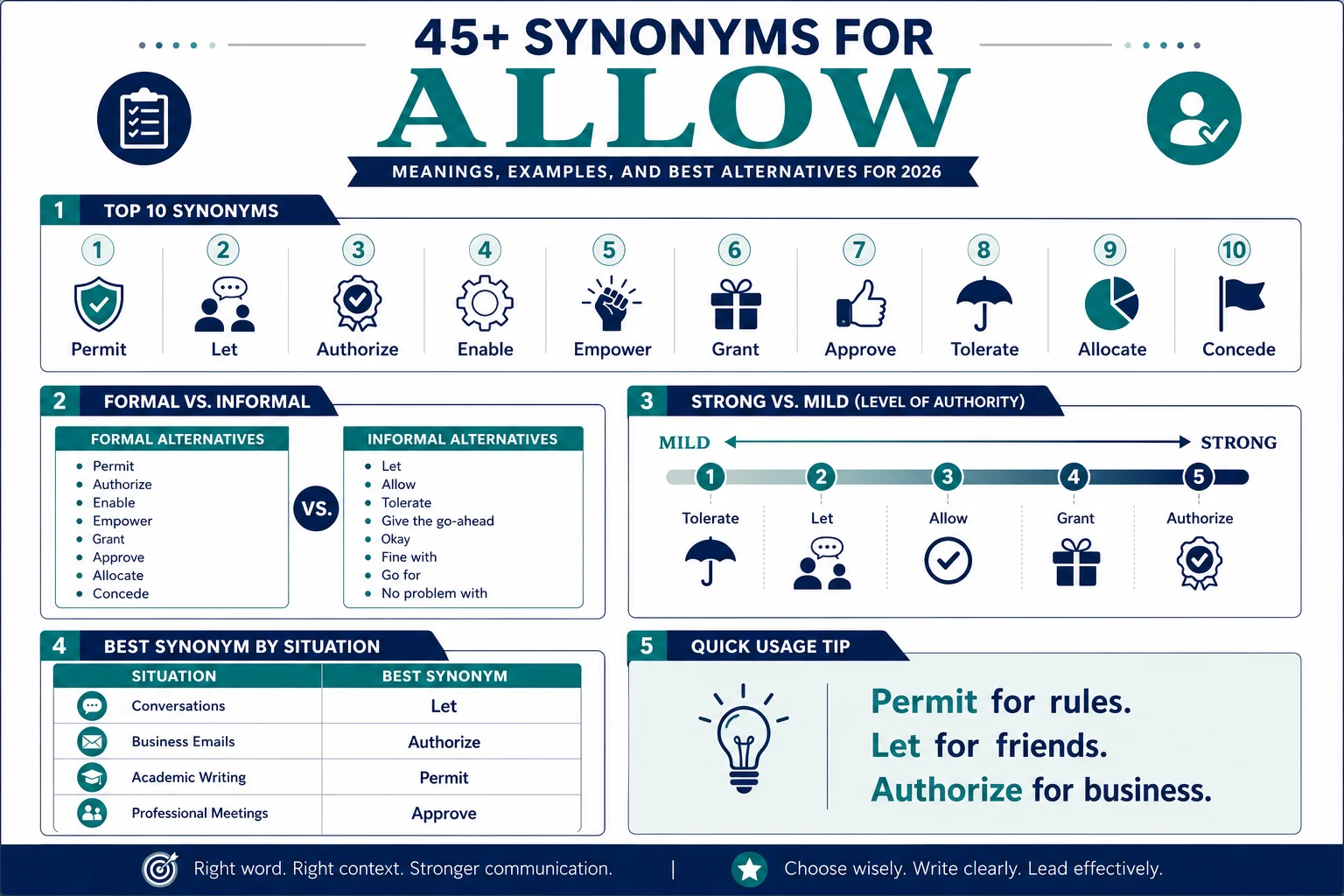
Allow means to give permission, make something possible, or set aside for a specific purpose. The best synonyms depend on your context. Use permit for formal permission, let for casual situations, authorize for official approval, enable for making things possible, empower for giving authority, and allocate for setting aside resources. Each synonym has a slightly different meaning, tone, or formality level.
Top 10 Synonyms for Allow:
- Permit
- Let
- Authorize
- Enable
- Empower
- Grant
- Sanction
- Approve
- Tolerate
- Allocate
Finding the right words can make your writing clearer, more natural, and more persuasive. If you are looking for synonyms for allow, the best choice depends on the context. You might mean giving someone permission, making something possible, accepting a situation, or letting an action happen. Words such as permit, authorize, enable, approve, and grant can work, but they are not always interchangeable.
In professional writing, choosing the precise synonym matters because each word can carry a slightly different tone or meaning. For example, “authorize” often suggests official permission, while “enable” focuses on making something possible. This guide explains the most useful synonyms for allow, with clear meanings, examples, and practical usage tips. Whether you are writing an email, report, academic assignment, or everyday message, you will find options that fit your context and sound natural.
What Does “Allow” Mean?
Definition
Allow is a verb that has three primary meanings. The first and most common meaning is to give permission for something to happen. The second meaning is to make something possible or to provide the opportunity for something. The third meaning is to set aside or reserve something for a specific purpose, such as time, money, or resources.
Think of allow as creating space for something to exist, happen, or be done. When you allow something, you are removing obstacles, granting permission, or enabling an action.
Pronunciation
| Feature | Detail |
|---|---|
| US IPA | /əˈlaʊ/ |
| UK IPA | /əˈlaʊ/ |
| Syllables | 2 |
| Tip | Stress the second syllable. The first syllable sounds like “uh” and the second rhymes with “cow.” |
Grammar
| Grammar Feature | Information |
|---|---|
| Part of Speech | Verb (transitive) |
| Common Position | Subject + allow + object + infinitive |
| Typical Pattern | Allow someone to do something |
| Other Patterns | Allow something, allow for something |
Example Sentences:
- “The school allows students to use the library until 9 PM.”
- “Her parents do not allow junk food in the house.”
- “The new software allows for faster data processing.”
Grammar Note: Allow is typically followed by an object plus a “to” infinitive. The passive form, “be allowed to,” is also common. Remember that “allow for” has a slightly different meaning: it means to take something into consideration or make provision for something.
Word Family
| Word | Part of Speech | Meaning |
|---|---|---|
| Allow | Verb | To give permission, make possible, or set aside |
| Allowed | Adjective | Permitted or accepted |
| Allowing | Verb | The act of giving permission or making possible |
| Allowable | Adjective | Permissible or acceptable according to rules |
| Allowance | Noun | An amount of money given regularly, or the act of allowing |
| Allowably | Adverb | In a permissible manner |
15 Synonyms of “Allow”
1. Permit
Meaning: To give official or formal permission for something to happen. Permit is slightly more formal than allow and often implies official authorization.
Best Used For: Official contexts, legal documents, workplace policies, formal writing, and situations where permission comes from an authority figure.
Formality: Formal
Tone: Professional, official
Frequency: ⭐⭐⭐⭐⭐ Very Common
CEFR Level: B1
Example Sentence 1: “The city council has decided to permit outdoor dining on the main street until October.”
Example Sentence 2: “This visa does not permit you to work in the country for more than twenty hours per week.”
Usage Tip: Use permit when you want to sound more professional or official. It is the standard choice for signs, policies, and formal documents. Avoid using permit in casual conversations unless you want to sound overly formal. Native speakers often use “permit” instead of “allow” on official forms and in written regulations.
2. Let
Meaning: To give permission or allow someone to do something. Let is the most casual and conversational synonym for allow.
Best Used For: Daily conversation, casual writing, texts, friendly emails, and informal situations.
Formality: Informal
Tone: Casual, friendly, conversational
Frequency: ⭐⭐⭐⭐⭐ Very Common
CEFR Level: A2
Example Sentence 1: “My mom lets me borrow her car whenever I need it.”
Example Sentence 2: “Please let me know if you need any help with the project.”
Usage Tip: Let is the most common word native speakers use in everyday conversation. However, it cannot be used in the passive voice. You can say “They let me in,” but you cannot say “I was let in” in formal writing. Let is also used in common phrases like “let me know” and “let it be.” Avoid using let in formal or academic writing.
Common Confusion: Permit vs. Let
Permit sounds formal and official. Let sounds casual and friendly. Use “Smoking is not permitted” for a sign, but “I won’t let you do that” in conversation.
3. Authorize
Meaning: To give official approval or power to do something. Authorize implies that someone in a position of authority has formally granted permission.
Best Used For: Business contexts, legal documents, official approvals, banking, government procedures, and situations requiring formal authority.
Formality: Very Formal
Tone: Official, authoritative, professional
Frequency: ⭐⭐⭐⭐ Common
CEFR Level: B2
Example Sentence 1: “Only the department manager can authorize expenses over one thousand dollars.”
Example Sentence 2: “The bank authorized the transaction after verifying my identity.”
Usage Tip: Use authorize when you need to emphasize that formal permission comes from a position of authority. This word is common in business and legal contexts. It carries more weight than permit or allow. Native speakers typically reserve this word for official situations. Do not use it in casual conversation unless you are being intentionally formal.
4. Enable
Meaning: To make something possible or to give someone the ability or means to do something. Enable focuses on providing the necessary conditions or tools.
Best Used For: Technology contexts, business writing, professional communication, explaining how something works, and situations where you are providing the means for something to happen.
Formality: Neutral to Formal
Tone: Professional, explanatory, positive
Frequency: ⭐⭐⭐⭐⭐ Very Common
CEFR Level: B1
Example Sentence 1: “The new software will enable our team to work more efficiently from home.”
Example Sentence 2: “This scholarship enabled her to attend the university she always dreamed of.”
Usage Tip: Enable emphasizes providing the means or opportunity, not just permission. When you enable someone, you are giving them the tools or conditions they need to succeed. In technology, enable often means to turn on a feature. This word has a positive, empowering tone. Avoid using enable when you simply mean to give permission.
5. Empower
Meaning: To give someone the authority, power, or confidence to do something. Empower emphasizes giving control and autonomy to another person.
Best Used For: Leadership contexts, motivational writing, professional development, personal growth, social causes, and situations where you want to emphasize giving power to others.
Formality: Neutral to Formal
Tone: Empowering, inspirational, supportive
Frequency: ⭐⭐⭐⭐ Common
CEFR Level: B2
Example Sentence 1: “Good managers empower their employees by trusting them to make important decisions.”
Example Sentence 2: “The program empowers women to start their own businesses in underserved communities.”
Usage Tip: Empower goes beyond simple permission. It implies giving someone the authority and confidence to act independently. This is a powerful word in business and leadership contexts. It is also common in social justice and development conversations. Avoid overusing empower or using it in situations where simple permission is what you mean.
6. Grant
Meaning: To give or allow something formally, especially in response to a request. Grant often implies that something is being given generously or officially.
Best Used For: Formal writing, legal documents, requests, official decisions, scholarships, and situations where someone is giving permission after being asked.
Formality: Formal
Tone: Official, generous, courteous
Frequency: ⭐⭐⭐⭐ Common
CEFR Level: B1
Example Sentence 1: “The university granted her request for an extension on her thesis deadline.”
Example Sentence 2: “The judge granted the motion for a new trial based on new evidence.”
Usage Tip: Grant is often used when someone has formally asked for something. It implies a positive response to a request. Grant also means to give something valuable, like a scholarship or funding. In academic contexts, a “grant” is also a noun meaning money given for research. Use grant when you want to sound courteous and official.
7. Sanction
Meaning: To give official permission or approval for something. Sanction can also mean to impose a penalty, so be careful with the context.
Best Used For: Government contexts, international relations, official bodies, legal contexts, and formal approval processes.
Formality: Very Formal
Tone: Official, authoritative, sometimes negative
Frequency: ⭐⭐⭐ Moderate
CEFR Level: C1
Example Sentence 1: “The government has sanctioned the use of the new medical treatment for patients.”
Example Sentence 2: “The international body refused to sanction the military intervention.”
Usage Tip: Sanction is one of the few English words with opposite meanings. It can mean to approve or to punish. For this reason, always pay attention to the context. In formal writing, sanction is a strong and authoritative word. Use it only in official or legal contexts. Most native speakers understand sanction primarily as a formal approval or an official penalty.
8. Approve
Meaning: To officially agree to or accept something as satisfactory. Approve focuses on giving consent after evaluation.
Best Used For: Business decisions, budget approvals, project proposals, official reviews, and situations where someone must evaluate before giving permission.
Formality: Formal
Tone: Official, evaluative, professional
Frequency: ⭐⭐⭐⭐⭐ Very Common
CEFR Level: B1
Example Sentence 1: “The committee approved the new marketing budget for the next fiscal year.”
Example Sentence 2: “Her supervisor approved her request to attend the conference in Chicago.”
Usage Tip: Approve implies that someone has considered something and found it acceptable. Unlike permit or allow, approve suggests a judgment was made. It often follows a request or proposal. Native speakers commonly use approve in workplace settings. Use “approve of” when you mean to have a favorable opinion rather than to give official permission.
9. Tolerate
Meaning: To allow something to happen or exist even if you do not like it or approve of it. Tolerate implies putting up with something.
Best Used For: Situations where you are allowing something despite personal objections, social contexts, and discussions about acceptance.
Formality: Neutral
Tone: Negative, reluctant, patient
Frequency: ⭐⭐⭐⭐ Common
CEFR Level: B2
Example Sentence 1: “The teacher tolerates late submissions but deducts points for every day they are late.”
Example Sentence 2: “I cannot tolerate the noise from the construction site next door anymore.”
Usage Tip: Tolerate is the right word when you want to express that you are allowing something but not happy about it. It has a reluctant, grudging tone. This word often describes endurance or patience. In medical contexts, “tolerate” means to withstand a treatment. Native speakers often use “can’t tolerate” to express strong dislike. Do not use tolerate when you genuinely approve or are happy about something.
10. Allocate
Meaning: To set aside or distribute resources, time, or money for a specific purpose. Allocate focuses on reserving things rather than giving permission.
Best Used For: Business planning, budgets, time management, project management, resource distribution, and academic writing about funding.
Formality: Formal
Tone: Professional, organizational, practical
Frequency: ⭐⭐⭐⭐ Common
CEFR Level: B2
Example Sentence 1: “The company will allocate five thousand dollars to the new employee training program.”
Example Sentence 2: “You should allocate at least two hours each day for studying if you want to pass the exam.”
Usage Tip: Allocate does not mean to give permission. It means to designate or reserve something for a specific use. This is a business and organizational term. Use allocate when you are talking about budgets, time, or resources. It is a professional and precise word. Do not use allocate to mean permit or let.
11. Leave
Meaning: To let something remain or to allow something to be done without interference. Leave often implies not preventing something or letting it stay as it is.
Best Used For: Informal situations, personal decisions, and contexts where you are choosing not to interfere with something.
Formality: Informal
Tone: Casual, relaxed, unconcerned
Frequency: ⭐⭐⭐⭐ Common
CEFR Level: A2
Example Sentence 1: “Please leave the door open so the cat can come inside.”
Example Sentence 2: “I will leave the decision to you since you know more about this topic.”
Usage Tip: Leave is often used in the sense of “leave it to me” or “leave it alone.” It can imply not interfering. This word is more common in British English than American English for certain usages. It sounds casual and conversational. Use it in everyday speech but avoid it in formal writing.
12. Afford
Meaning: To have enough money, time, or resources to do something. Afford implies having the means to allow something to happen.
Best Used For: Financial contexts, time management, resource availability, and situations where you are discussing whether something is possible given your resources.
Formality: Neutral
Tone: Practical, financial, realistic
Frequency: ⭐⭐⭐⭐ Common
CEFR Level: B1
Example Sentence 1: “We cannot afford to ignore the environmental impact of our business decisions.”
Example Sentence 2: “Can you afford the time to manage this project alongside your other responsibilities?”
Usage Tip: Afford is about having the resources to do something, not about giving permission. It is most commonly used with money, but it can also refer to time or energy. Native speakers often use afford in negative statements, like “I cannot afford to wait.” Do not confuse afford with allow. They are not synonyms in the sense of permission.
13. Admit
Meaning: To allow someone to enter a place or to accept someone into an organization. Admit can also mean to confess to something.
Best Used For: Entry to buildings, acceptance into schools or organizations, hospital contexts, and formal entries.
Formality: Formal
Tone: Official, selective, welcoming
Frequency: ⭐⭐⭐⭐ Common
CEFR Level: B1
Example Sentence 1: “The museum admits visitors until 5 PM every day except Monday.”
Example Sentence 2: “The university admits approximately thirty percent of all applicants each year.”
Usage Tip: Admit specifically relates to allowing entry or acceptance. In medical contexts, “admit to hospital” means to allow someone to stay for treatment. Admit also has a secondary meaning of confessing to something, which is completely different. Be careful to use the correct sense. In formal contexts, admit is the standard word for allowing entry to an institution or venue.
14. Concede
Meaning: To allow or grant something reluctantly, especially after disagreement. Concede implies giving in after opposition.
Best Used For: Debates, arguments, negotiations, political discussions, and situations where you are allowing something even though you argued against it.
Formality: Formal
Tone: Reluctant, defeatist, diplomatic
Frequency: ⭐⭐⭐ Moderate
CEFR Level: C1
Example Sentence 1: “After hours of debate, the committee finally conceded the point to the opposition.”
Example Sentence 2: “The politician conceded defeat and congratulated his opponent on the victory.”
Usage Tip: Concede is about allowing something after resistance. It has a defeated or reluctant tone. Use it when you want to express that someone has given in to an argument or request. This is a sophisticated word suitable for formal writing, debates, and diplomatic contexts. Avoid using it in casual conversation unless you are discussing formal negotiations.
15. Remit
Meaning: To send money as payment or to refer a matter to someone for consideration. Remit can also mean to cancel or forgive a debt.
Best Used For: Financial transactions, legal contexts, business communications, and formal referrals.
Formality: Very Formal
Tone: Official, businesslike, financial
Frequency: ⭐⭐ Rare
CEFR Level: C1
Example Sentence 1: “Please remit the payment within thirty days of receiving the invoice.”
Example Sentence 2: “The judge remitted the case to a lower court for further review.”
Usage Tip: Remit is a specialist word used primarily in business and legal contexts. As a synonym for allow, it is limited to specific formal uses. In everyday English, most native speakers use remit to mean sending payment. Use remit only if you are writing in a very formal business or legal context. In most situations, allow or permit are better and more common choices.
Synonyms Comparison Table
| Synonym | Best Context | Formality | Tone | Frequency |
|---|---|---|---|---|
| Permit | Official permission, rules, policies | Formal | Official | ⭐⭐⭐⭐⭐ |
| Let | Daily conversation, casual situations | Informal | Casual | ⭐⭐⭐⭐⭐ |
| Authorize | Business, legal, official approval | Very Formal | Authoritative | ⭐⭐⭐⭐ |
| Enable | Technology, making things possible | Neutral | Professional | ⭐⭐⭐⭐⭐ |
| Empower | Leadership, personal development | Neutral | Inspirational | ⭐⭐⭐⭐ |
| Grant | Formal requests, scholarships | Formal | Generous | ⭐⭐⭐⭐ |
| Sanction | Government, legal, international | Very Formal | Authoritative | ⭐⭐⭐ |
| Approve | Business decisions, proposals | Formal | Evaluative | ⭐⭐⭐⭐⭐ |
| Tolerate | Putting up with something | Neutral | Reluctant | ⭐⭐⭐⭐ |
| Allocate | Budgets, time, resources | Formal | Organizational | ⭐⭐⭐⭐ |
| Leave | Informal decisions | Informal | Relaxed | ⭐⭐⭐⭐ |
| Afford | Financial or resource availability | Neutral | Practical | ⭐⭐⭐⭐ |
| Admit | Entry, acceptance into institutions | Formal | Selective | ⭐⭐⭐⭐ |
| Concede | Debate, reluctant acceptance | Formal | Reluctant | ⭐⭐⭐ |
| Remit | Financial payments, legal referrals | Very Formal | Official | ⭐⭐ |
Best Synonyms by Situation
| Situation | Best Synonym | Why It Works |
|---|---|---|
| Daily Conversation | Let | Natural and friendly for everyday speech |
| Business Email | Authorize or Approve | Professional and clear for workplace communication |
| Academic Writing | Permit or Enable | Formal and precise for scholarly work |
| School Assignment | Allow or Permit | Standard and appropriate for student writing |
| Professional Meeting | Empower or Authorize | Shows confidence and professional language |
| Presentation | Enable or Empower | Inspiring and action-oriented |
| Creative Writing | Grant or Concede | Adds emotional and narrative depth |
| Social Media | Let or Allow | Simple and easy for casual posts |
| Movie Review | Tolerate or Grant | Expresses judgment or reluctant acceptance |
| Book Review | Permit or Enable | Discusses what the author allows readers to understand |
Formal vs. Informal Synonyms
Formal Alternatives
| Synonym | Best Used For |
|---|---|
| Authorize | Official approvals, legal documents |
| Sanction | Government and international contexts |
| Grant | Formal requests and official giving |
| Approve | Business decisions and proposals |
| Permit | Rules, policies, and official permission |
| Concede | Debates and diplomatic situations |
Formal Note: Use these synonyms in academic essays, business reports, legal documents, professional emails to clients, and official communications. They project professionalism and authority.
Neutral Alternatives
| Synonym | Best Used For |
|---|---|
| Enable | Making things possible |
| Allocate | Resourcing and planning |
| Afford | Financial and resource discussions |
| Admit | Entry and acceptance |
| Tolerate | Enduring or putting up with something |
Neutral Note: These synonyms work across most professional and academic contexts without being too formal. They are safe choices when you are unsure about the appropriate formality level.
Informal Alternatives
| Synonym | Best Used For |
|---|---|
| Let | Friends, family, and casual conversations |
| Leave | Relaxed decisions and everyday situations |
Informal Note: Reserve these words for text messages, social media, friendly emails, and spoken conversations. They sound natural and approachable in informal settings but would seem out of place in official documents.
Strong vs. Mild Synonyms
Mild
These synonyms express allowance or permission without strong emotional weight. They are safe, neutral choices for everyday situations.
- Let
- Leave
- Allow
- Permit
- Enable
Moderate
These synonyms add more meaning and expressiveness than the original word. They convey specific types of permission or allowance.
- Grant
- Approve
- Admit
- Allocate
- Afford
Strong
These high-intensity synonyms should be used carefully. They carry additional connotations of authority, resistance, or reluctance.
- Authorize
- Empower
- Sanction
- Concede
- Tolerate
Strong Note: Choose strong synonyms only when the situation genuinely calls for them. Overusing them makes your writing sound exaggerated or overly dramatic. The strongest synonyms often imply power dynamics, reluctance, or formal authority.
Real-Life Examples
School Context
“The school does not allow students to use their phones during class. However, teachers do permit their use during lunch break. The principal authorizes exceptions for students who need to contact their parents about emergencies.”
Workplace Context
“Our company policy allows remote work two days per week. Managers approve specific schedules based on team needs. This arrangement enables employees to maintain better work-life balance while meeting all their deadlines.”
Business Email
“Please be advised that I have authorized the purchase of new equipment for your department. This decision will empower your team to complete projects more efficiently. I have also allocated additional budget for training on the new systems.”
Meetings and Presentations
“We are implementing new software that will enable real-time collaboration across all departments. By empowering our teams with these tools, we will achieve faster project completion times and better communication.”
Daily Conversation
“Will your parents let you come to the movie tonight? I can pick you up if they leave the decision to you. My parents allow me to stay out until ten as long as I let them know where I am going.”
Social Media
“Instagram allows users to share stories that disappear after twenty-four hours. The platform permits accounts with over ten thousand followers to include swipe-up links. This feature enables creators to share content more interactively.”
Professional Writing
“The contract permits the client to terminate the agreement with thirty days’ notice. Both parties must authorize any modifications to the original terms. This provision allows for flexibility while maintaining clear expectations.”
Academic Writing
“The study’s design enables researchers to draw meaningful conclusions from the data. The funding body granted permission for the research team to extend the project timeline. This allowed the collection of a more comprehensive dataset.”
Common Collocations
| Common Phrase | Better Alternative |
|---|---|
| Allow time | Allocate time or Set aside time |
| Allow money | Allocate funds or Budget for |
| Allow access | Grant access or Authorize entry |
| Allow use | Permit use or Authorize use |
| Allow room | Leave room or Make space |
| Allow for | Account for or Consider |
Explanation: English speakers often pair allow with nouns like “time,” “money,” and “access.” While these phrases are grammatically correct, they can sound weak. Using more precise alternatives like “allocate time” or “grant access” makes your writing sound stronger and more professional.
Common Phrases
1. Allow me
Meaning: A polite way to offer help or to ask for permission to do something.
Example: “Allow me to introduce myself. I am the new marketing director.”
2. Allow for
Meaning: To take something into consideration or make provision for it.
Example: “When planning the trip, we must allow for unexpected delays and changes in weather.”
3. Allow yourself
Meaning: To give yourself permission or the opportunity to do something.
Example: “You should allow yourself a few minutes each day to relax and clear your mind.”
4. Be allowed to
Meaning: To have permission to do something.
Example: “Employees are not allowed to use company computers for personal shopping during work hours.”
5. Allow of
Meaning: To make possible or admit of (less common, more formal).
Example: “The situation does not allow of any other interpretation.”
Context Guide
| Situation | Best Synonym | Reason |
|---|---|---|
| Essay | Permit or Enable | Formal and academic in tone |
| Speech | Empower or Enable | Inspiring and action-focused |
| Business Email | Authorize or Approve | Professional and clear |
| Novel | Grant or Concede | Literary and narrative |
| Presentation | Enable or Empower | Engaging and motivational |
| Conversation | Let or Allow | Natural and friendly |
| Academic Writing | Permit or Enable | Scholarly and precise |
| Marketing Copy | Empower or Grant | Persuasive and positive |
Related Words
Near Synonyms
Near synonyms are words that are very similar in meaning but not exact substitutes. They often work in similar contexts to allow.
- Oblige: To make someone legally or morally bound to do something.
- Condone: To overlook or forgive something that is usually considered wrong.
- Yield: To give way to someone or something.
Antonyms
| Antonym | Meaning |
|---|---|
| Forbid | To order someone not to do something |
| Prohibit | To formally forbid something by law or rule |
| Prevent | To stop something from happening |
| Deny | To refuse to give or allow something |
| Disallow | To refuse to permit |
| Block | To obstruct or prevent passage or progress |
| Restrict | To limit or control something |
Related Verbs
Authorize: To give official permission. This is a direct professional alternative to allow.
Approve: To formally agree to or accept. This implies evaluation before permission.
Entitle: To give someone the right to do or have something. This focuses on rights.
Related Nouns
Permission: The action of allowing someone to do something.
Authorization: The official permission or approval for something.
Approval: The official agreement or acceptance of something.
Allowance: An amount of something, especially money, that is allowed or given regularly.
Frequently Asked Questions
What is another word for allow?
The most common synonyms for allow are permit, let, authorize, enable, empower, grant, approve, and tolerate. The best choice depends on your context and formality level. Permit is more formal, while let is casual.
Which synonym for allow sounds the most professional?
Authorize sounds the most professional and official. It is commonly used in business, legal, and government contexts. Approve and grant are also professional choices for workplace and formal writing.
What is the strongest synonym for allow?
Empower is the strongest synonym when you want to express giving authority and confidence. Sanction is also strong but can have negative connotations. Concede is strong in the sense of allowing reluctantly after resistance.
Which synonym for allow is best for academic writing?
Permit and enable are the best choices for academic writing. They are formal, precise, and widely accepted in scholarly contexts. Avoid using let or leave in academic papers.
What is the difference between allow and permit?
Allow is more general and slightly less formal than permit. Permit implies official or formal permission, while allow can be used in both formal and casual contexts. A sign might say “Smoking is not permitted” but a parent might say “I allow my child to stay up late.”
What is the difference between allow and let?
Let is informal and casual, while allow is more neutral and can be used in formal contexts. Let cannot be used in the passive voice. You can say “They let me in” but formal writing prefers “I was allowed to enter.”
What is the opposite of allow?
The main opposites of allow are forbid, prohibit, prevent, deny, and disallow. Forbid is the most direct opposite in casual contexts, while prohibit is more formal.
Conclusion
Allow is one of the most versatile verbs in English, but using the same word repeatedly makes your writing and speaking sound repetitive and weak. Now you have a powerful toolkit of precise alternatives.
Remember these key takeaways. Use permit for official rules and formal situations. Let is your go-to for casual conversations. Authorize and approve are professional choices for the workplace. Enable and empower focus on making things possible. Grant and allocate are perfect for formal requests and resources.
The key to choosing the right synonym is understanding your context. Ask yourself: Am I giving permission? Am I making something possible? Am I setting aside resources? Am I reluctantly allowing something?
Your audience also matters. A formal report needs authorize or permit. A text to a friend needs let or allow. Academic writing requires permit or enable. Social media works well with allow or let.
Start incorporating these synonyms into your daily vocabulary. The more you practice, the more natural they will feel. Your writing will become more precise, professional, and engaging.
