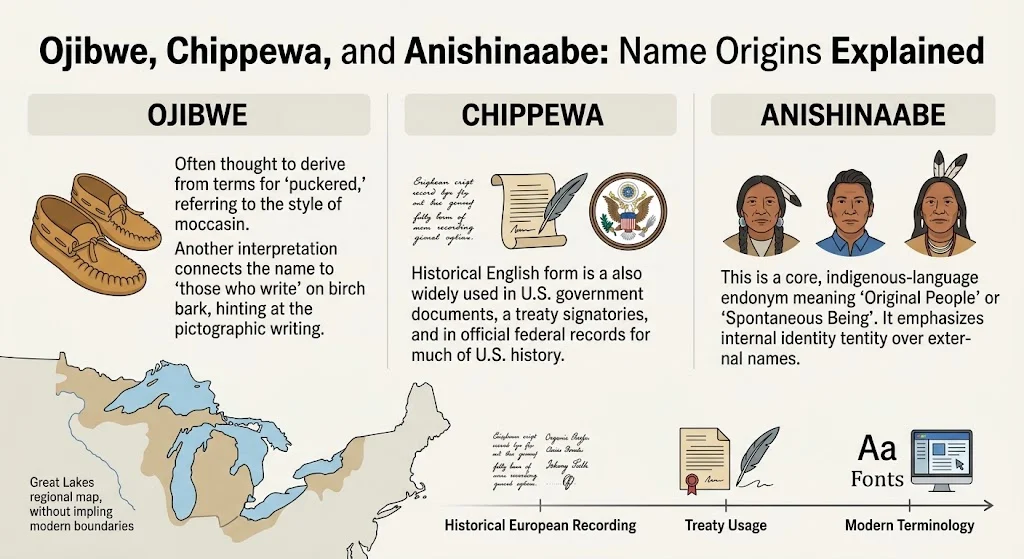
ojibwe chippewa name origin meaning refers to the history and interpretation of the names Ojibwe, Chippewa, and Anishinaabe. Ojibwe is linked to traditional cultural references, while Chippewa became an English form used widely in U.S. treaties and records.
ojibwe chippewa name origin meaning is best understood as a question about Indigenous identity, language, history, and changing English spellings. The terms Ojibwe, Chippewa, and Anishinaabe overlap, but they are not simply interchangeable in every context.
The Ojibwe are an Indigenous people of the Great Lakes region and surrounding areas of the United States and Canada. They belong to the Algonquian language family. Their communities have historically lived across areas that now include Minnesota, Wisconsin, Michigan, North Dakota, Ontario, and nearby regions.
The name Ojibwe has more than one proposed explanation. Minnesota Historical Society sources connect it either with the puckered construction of traditional moccasins or with the Ojibwe practice of writing on birch bark. Another Minnesota Historical Society source specifically connects the term with the puckered seam of the moccasin.
Meanwhile, Chippewa became a common English form. The Smithsonian’s National Museum of the American Indian explains that Chippewa is believed to have developed from a mispronunciation of Ojibwe. It also notes that Chippewa appeared in official U.S. agreements.
The term Anishinaabe is especially important because many Ojibwe people use it as a self designation. The Smithsonian describes Anishinaabe as a name used by Ojibwe people when referring to themselves. It gives the literal translation as “original people.”
Therefore, this topic is not really about internet slang. The search phrase describes a historical and linguistic question. Modern social platforms may surface the query, but the underlying subject is Native American history and language.
Quick Answer Box
| Meaning | Context | Primary Platforms | Example | Tone |
| The history of the names Ojibwe and Chippewa | Indigenous identity and language | Google, TikTok, Instagram, Snapchat, YouTube | “Why are Ojibwe people also called Chippewa?” | Educational |
| Ojibwe | A widely used modern English name for the people and language | Search and educational content | “Ojibwe language resources” | Neutral |
| Chippewa | Historical and official English form used extensively in U.S. records | Government, historical records, search | “Chippewa treaty” | Historical |
| Anishinaabe | A self designation used by many Ojibwe people | Cultural and educational contexts | “Anishinaabe language and culture” | Respectful |
| Ojibwemowin / Anishinaabemowin | Names used for the Ojibwe language | Language learning platforms | “Learn Anishinaabemowin” | Linguistic |
What does ojibwe chippewa name origin mean?
The phrase ojibwe chippewa name origin meaning does not represent a traditional Ojibwe expression. It is an English search query. It combines several concepts that people often want to understand together.
Those concepts include:
- What does Ojibwe mean?
- Where did the word Ojibwe come from?
- Why is Chippewa another name for the Ojibwe?
- What does Anishinaabe mean?
- Why do historical sources use different spellings?
- Which terminology is appropriate today?
These questions have historical answers, but some details remain debated.
What Does “Ojibwe” Mean?
The meaning of Ojibwe has multiple proposed explanations.
The Minnesota Historical Society states that the word may be connected to the puckered seam of traditional Ojibwe moccasins. It also presents another possibility involving the Ojibwe practice of writing on birch bark.
A separate Ojibwe educational resource emphasizes that there is no consensus on the exact meaning. It identifies two commonly repeated explanations: a reference to puckered moccasins and a reference to the storyteller role within the Three Fires Confederacy.
That distinction matters. Online articles sometimes present one explanation as absolute fact. The evidence does not support that level of certainty.
Consequently, a careful explanation should say that the origin has proposed interpretations rather than claiming one universally accepted translation.
What Does “Chippewa” Mean?
Chippewa is another English name historically used for the Ojibwe.
The Smithsonian explains that the term is believed to come from a mispronunciation of Ojibwe. It also notes that Chippewa was used in official agreements with the U.S. government.
This historical usage is significant.
Treaties, government records, newspapers, maps, and other documents may therefore use Chippewa even when modern sources use Ojibwe or Anishinaabe.
For example, a historical document can contain “Chippewa” without indicating that it refers to a completely different Indigenous nation. Context is essential.
What Does “Anishinaabe” Mean?
Anishinaabe is an important self designation associated with the Ojibwe.
The Smithsonian’s National Museum of the American Indian describes Anishinaabe as a name Ojibwe people use when talking about themselves. It translates the term as “original people.”
Some educational sources give slightly different English renderings. For example, another Smithsonian educational publication translates the term as “first men.”
This variation illustrates an important linguistic principle.
A word in an Indigenous language does not always map neatly onto one fixed English phrase. Translation can depend on grammatical analysis, dialect, context, and the source being consulted.
Are Ojibwe and Chippewa the Same People?
In broad historical usage, Ojibwe and Chippewa refer to the same Indigenous people.
The Smithsonian identifies the Ojibwe as also being called Chippewa or Anishinaabe.
However, terminology can vary by community, institution, historical period, and legal context.
That is why a historical treaty may use “Chippewa,” while a contemporary cultural organization may use “Ojibwe,” “Anishinaabe,” or a more specific community name.
The Minnesota Historical Society similarly explains that the Ojibwe have multiple names and notes that Chippewa became common through an English pronunciation of Ojibwe.
Contextual Dynamics & Nuances of the Term
Understanding ojibwe chippewa name origin meaning requires more than translating individual words. The names developed within a long history of Indigenous languages, European contact, colonial documentation, government policy, and community self identification.
European Spelling Changed Indigenous Names
Early European visitors recorded Indigenous words using European spelling systems.
They did not necessarily hear every sound accurately. Their writing systems also lacked some distinctions found in Indigenous languages.
As a result, one Indigenous name could appear in several written forms.
The Minnesota Historical Society advises researchers to search for variations such as Ojibwa, Ojibway, and Ojibwe. It also notes historical forms such as Chippewa, Chippeway, Anishinabe, and Anishinaabe.
Therefore, spelling variation is not automatically evidence of different peoples.
Ojibwe, Ojibwa, and Ojibway
These forms appear throughout historical and modern sources.
Ojibwe is now a common English spelling.
Ojibwa and Ojibway also occur frequently, particularly in older publications.
For historical research, it can be useful to search all three.
For modern writing, however, the terminology preferred by the specific community or organization should take priority.
The Minnesota Historical Society notes that “Ojibwe” is used consistently in its museum records to improve consistency and searchability.
Chippewa in Historical Documents
The word Chippewa has a particularly strong historical presence in U.S. government records.
The Smithsonian notes that it was the name used in official agreements with the U.S. government.
That history explains why the word remains visible today.
It appears in the names of some tribal governments, historical treaties, geographic features, institutions, and archival collections.
A searcher should therefore avoid assuming that the continued appearance of “Chippewa” means the term has the same social context everywhere.
Modern Community Names Matter
Terminology can differ between nations and organizations.
For example, the Smithsonian identifies the Minnesota Chippewa Tribe and describes individual Ojibwe bands across the region.
The Wisconsin Historical Society also documents Lake Superior Chippewa communities and historical use of the term Chippewa.
Consequently, the most respectful approach is simple: use the name that a particular community or organization uses for itself.
The Language Has Its Own Names
The Ojibwe language is commonly called Anishinaabemowin or Ojibwemowin.
Omniglot lists Anishinaabemowin as the name of the Ojibwe language in its own language.
Ojibwe also has multiple dialects and regional varieties.
This matters because language is not frozen.
Pronunciation, vocabulary, spelling systems, and preferred terminology can differ across communities.
Real Life Conversation Examples Using ojibwe chippewa name origin meaning
The phrase itself is not established everyday slang. A natural conversation would usually use simpler wording.
The following examples show how someone might discuss the topic accurately.
Example 1: Asking About the Two Names
Alex: Why do some books say Chippewa while others say Ojibwe?
Jordan: They generally refer to the same Indigenous people. Chippewa became a common English form and appears heavily in historical U.S. records.
Alex: So they are not two unrelated tribes?
Jordan: Correct. Context still matters because individual communities may use different names today.
Example 2: Discussing Anishinaabe
Maya: I keep seeing the word Anishinaabe.
Chris: It is an important self designation used by Ojibwe people.
Maya: Does it mean the same thing as Ojibwe?
Chris: They can overlap in reference, but the terms have different histories and uses. Anishinaabe is especially important in discussions of self identification.
Example 3: Correcting an Oversimplification
Sam: I read that Ojibwe definitely means “puckered moccasins.”
Taylor: That explanation is common, but it should not be presented as completely settled.
Sam: Why?
Taylor: Some sources connect the word to puckered moccasins. Other explanations exist too. Ojibwe educational material notes that there is no consensus on the exact origin.
Example 4: Researching a Family Record
Nina: My ancestor’s document says “Chippewa.”
Evan: That can be historically normal.
Nina: Should I search only for Chippewa?
Evan: No. Try Ojibwe, Ojibwa, Ojibway, Anishinaabe, and Anishinabe too. Historical records use many spellings.
Example 5: Choosing Modern Terminology
Liam: Which word should I use in my article?
Riley: Check the terminology used by the specific community you’re discussing.
Liam: So there isn’t one universal rule?
Riley: Exactly. Historical documents may require “Chippewa,” while a contemporary organization may identify itself as Ojibwe or Anishinaabe.
Platform Specific Breakdown
Social media can increase searches about Indigenous names and terminology. However, the phrase itself should not be treated as established Snapchat, TikTok, or Instagram slang.
The platforms below are better understood as places where people encounter explanations, historical discussions, educational videos, and search driven content.
How It Is Used on Snapchat
Snapchat content tends to be short and conversational.
A user might encounter a story explaining why someone says “Ojibwe” while another source says “Chippewa.” A creator might also discuss Indigenous identity, language, geography, or cultural history.
However, there is no reliable basis for claiming that ojibwe chippewa name origin meaning is a standardized Snapchat expression.
A better interpretation is that Snapchat can be a distribution channel for the topic.
For educational content, creators should avoid reducing the history to one catchy claim. Short formats can remove important context.
A responsible Snapchat explanation might say:
“Ojibwe and Chippewa are historical names associated with the same Indigenous people. Chippewa became common in U.S. records, while Ojibwe is widely used today.”
That statement provides context without turning a complex history into slang.
The Role of ojibwe chippewa name origin meaning on TikTok
TikTok can introduce historical language questions to audiences that may never encounter academic sources.
For example, a short video might explain:
- Why “Chippewa” appears in treaties.
- Why “Ojibwe” is common in contemporary educational sources.
- What Anishinaabe means.
- Why does Ojibwe have several historical spellings?
- Why the exact etymology remains debated.
However, TikTok videos can also oversimplify etymology.
A viral claim does not automatically become a reliable linguistic explanation.
For that reason, viewers should compare educational videos with authoritative sources such as museums, historical societies, tribal organizations, and language resources.
The Smithsonian specifically explains the relationship among Ojibwe, Chippewa, and Anishinaabe.
Instagram and Texting Dynamics
Instagram discussions usually work best when terminology is explained in a compact caption.
For example, a caption might distinguish:
| Term | General context |
| Ojibwe | Common contemporary English name |
| Chippewa | Historical English name with major use in U.S. records |
| Anishinaabe | Important self designation |
| Ojibwa | Historical spelling variant |
| Ojibway | Another historical spelling variant |
| Anishinaabemowin | Name associated with the language |
Texting requires even less explanation.
Someone might simply ask:
“Are Chippewa and Ojibwe the same?”
A useful response would be:
“Generally, yes. Chippewa is a historical English name for the Ojibwe, and it appears extensively in U.S. records.”
That is clearer than sending an unsupported one word definition.
Linguistic Entity Map
| Entity | Relationship |
| Ojibwe | Indigenous people and language name |
| Chippewa | Historical English name associated with the Ojibwe |
| Anishinaabe | Self designation used by many Ojibwe people |
| Ojibwemowin | Ojibwe language terminology |
| Anishinaabemowin | Language name |
| Algonquian | Larger language family |
| Great Lakes | Major historical geographic region |
| Minnesota | Major contemporary and historical Ojibwe location |
| Wisconsin | Major Ojibwe region |
| Michigan | Major Ojibwe region |
| Ontario | Major Ojibwe region |
Why Search Intent Can Be Misleading
A query containing “meaning” does not always ask for a dictionary definition.
It may ask for:
- Historical identity.
- Cultural context.
- Linguistic etymology.
- Treaty terminology.
- Modern preferred usage.
- Genealogical research help.
- Pronunciation.
- Differences between names.
Therefore, a high quality answer should cover both the literal terminology and the historical context.
Misinterpretations:
The biggest mistake is treating the phrase as slang.
It is not a documented slang expression with a special social meaning.
It is a modern English search phrase that combines several historical terms.
Do Not Claim One Definitive Etymology Without Qualification
Some sources connect Ojibwe with puckered moccasins.
Other explanations exist.
Ojibwe.net explicitly says there is no consensus on the meaning of the word and mentions more than one explanation.
Therefore, avoid statements such as:
“Ojibwe definitely means X.”
A better formulation is:
“One widely cited explanation connects Ojibwe with the puckered construction of traditional moccasins.”
That distinction improves factual accuracy.
Do Not Treat Chippewa as a Separate Unrelated People
In broad historical usage, Chippewa refers to the Ojibwe.
The Smithsonian explicitly describes Ojibwe people as also called Chippewa or Anishinaabe.
Still, modern institutional names can preserve the word Chippewa.
Consequently, the safest approach is contextual rather than absolute.
Do Not Assume Every Community Uses the Same Preferred Name
Modern terminology can vary.
A particular nation, band, organization, museum, or cultural program may have its own preferred terminology.
The Minnesota Historical Society notes that different names have been used historically and that terminology varies across sources.
Therefore, when discussing a specific community, use that community’s own current terminology whenever possible.
Do Not Translate Indigenous Terms Too Literally
A one word English translation can hide grammatical and cultural meaning.
For example, different sources translate Anishinaabe somewhat differently. The Smithsonian uses “original people,” while another Smithsonian educational publication gives “first men.”
That does not automatically mean one source is wrong.
Instead, it shows why translation requires context.
How to Respond in Chat Comfortably
If someone asks about the meaning of the ojibwe chippewa name, the best response depends on what they actually want.
If They Want a Short Answer
Say:
“Ojibwe and Chippewa are names historically used for the same Indigenous people. Chippewa became a common English form and was widely used in U.S. treaties. Ojibwe is a common modern term, while Anishinaabe is an important self designation.”
If They Ask About the Word Ojibwe
Say:
“The exact etymology is debated. One widely cited explanation connects Ojibwe with puckered moccasins, while other explanations have also been proposed.”
If They Ask Why Old Documents Say Chippewa
Say:
“Chippewa became a common English form and was used extensively in official U.S. agreements, so you’ll see it frequently in historical records.”
If They Ask Which Term Is More Respectful
Avoid declaring one universal answer.
Instead, say:
“For a specific modern community, follow the name that community uses for itself. Historical documents may use Chippewa, while contemporary organizations may use Ojibwe or Anishinaabe.”
This answer recognizes both historical terminology and modern self identification.
If They Ask About Pronunciation
Pronunciation can vary by dialect and speaker.
Therefore, a written English approximation should not be treated as a perfect representation of Ojibwe pronunciation.
For serious language learning, audio from a reliable Ojibwe language program or community source is preferable to an English pronunciation guide.
FAQs
1. What is the basic Ojibwe chippewa name’s origin meaning?
The phrase refers to the history and meaning of the names Ojibwe and Chippewa. Ojibwe is a widely used name for the people and language, while Chippewa is a historical English form used extensively in U.S. records.
2. Is Ojibwe the same as Chippewa?
In broad historical usage, yes. Chippewa is a name historically used for the Ojibwe people. However, terminology varies across historical records, communities, and institutions.
3. What does Ojibwe mean?
The exact etymology is not universally settled. One commonly cited explanation connects the term with puckered moccasins. Other explanations have also been proposed.
4. Why are Ojibwe people called Chippewa?
Chippewa is generally understood as an English form that developed from Ojibwe pronunciation. The Smithsonian notes that it is believed to have come from a mispronunciation and became common in official U.S. agreements.
5. What does Anishinaabe mean?
The Smithsonian describes Anishinaabe as a name used by Ojibwe people when referring to themselves and translates it as “original people.”
6. Is Chippewa an offensive word?
The answer depends on context. Chippewa has a long historical record and remains part of the official names of some organizations and governments. However, modern terminology should follow the preferences of the specific community being discussed.
7. Is Ojibwa different from Ojibwe?
Usually, Ojibwa is a spelling variant rather than a completely different language. Historical sources contain several forms, including Ojibwa, Ojibway, and Ojibwe.
8. What is the Ojibwe language called?
The language is commonly called Anishinaabemowin or Ojibwemowin. The language has multiple regional varieties and dialects.
9. Why do historical records use different names?
European and American writers recorded Indigenous names through different languages and spelling systems. Government records also preserved terminology that became standardized in treaties and official documents.
10. Is ojibwe chippewa name origin meaning internet slang?
No. The phrase is best understood as a modern search query rather than established slang. It describes a historical and linguistic topic involving Indigenous names, identity, and terminology.
Conclusion:
The phrase ojibwe chippewa name origin meaning is best treated as an informational search query, not as modern slang.
Its subject is much older and more significant than internet vocabulary.
The key distinction is between Ojibwe, Chippewa, and Anishinaabe.
Ojibwe is a widely used English name for the people and language. Its exact etymology remains subject to competing explanations. The puckered moccasin explanation is widely cited, but it should not be presented as an uncontested fact.
Chippewa developed as a common English form and became deeply established in U.S. historical and treaty records. The Smithsonian identifies it as a name used in official agreements with the U.S. government.
Anishinaabe adds another important layer. It is a self designation used by Ojibwe people, and the Smithsonian translates it as “original people.”
Historical spelling also matters.
Researchers may encounter Ojibwe, Ojibwa, Ojibway, Chippewa, Chippeway, Anishinabe, and Anishinaabe in different sources. The Minnesota Historical Society specifically recommends searching multiple variants when conducting family history research.
Therefore, the most accurate approach is contextual.
- When reading an old treaty, preserve its historical terminology. When discussing a contemporary nation or organization, follow its current self identification. When explaining etymology, distinguish established evidence from proposed interpretations.
Most importantly, avoid reducing a complex Indigenous history to a single viral definition.
The names carry linguistic, historical, political, geographic, and cultural context. Understanding that context produces a far more accurate explanation than treating the terms as simple synonyms or internet slang.
