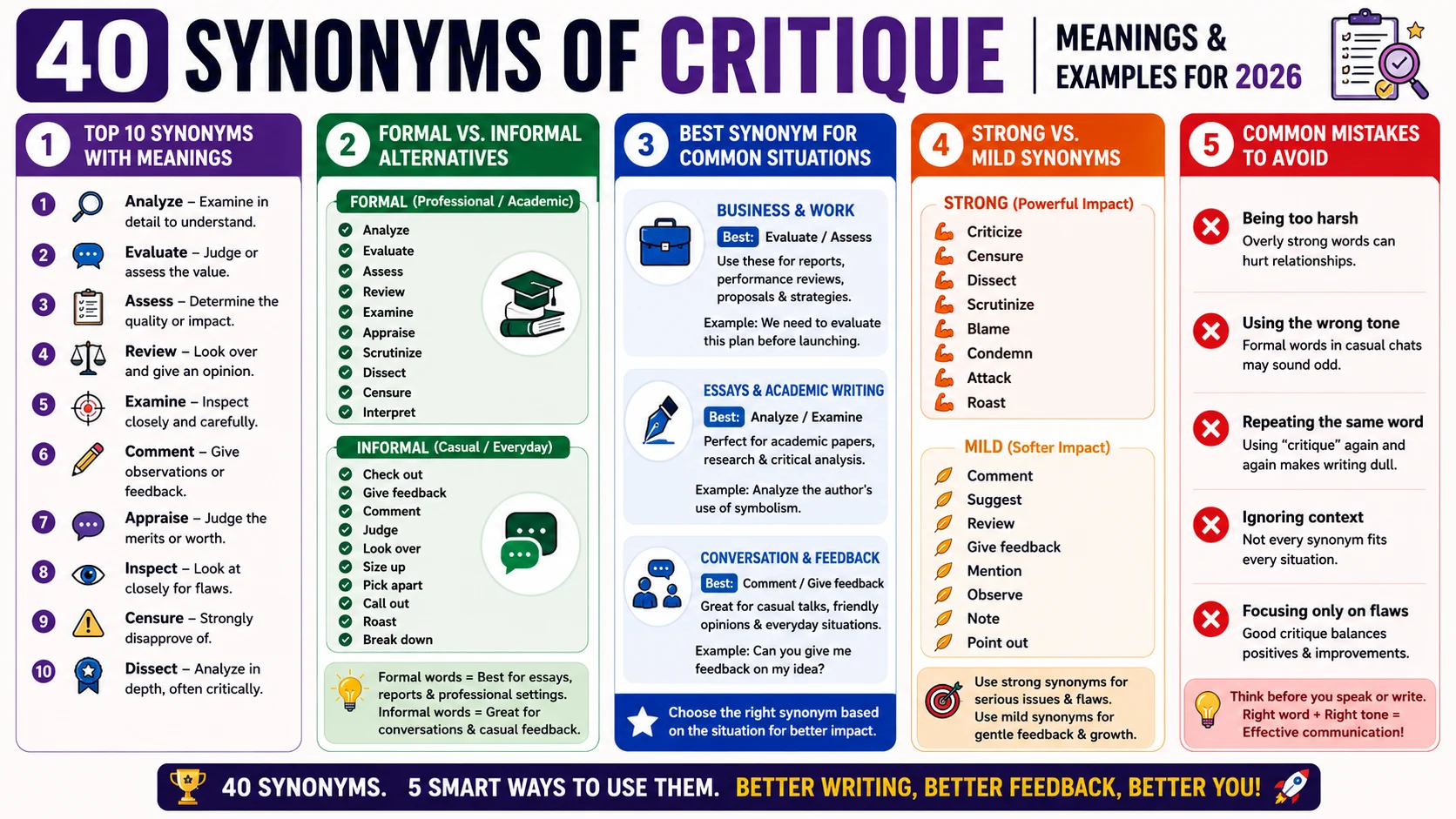
“Critique” means to evaluate or analyze something carefully, often pointing out both strengths and weaknesses. The best synonyms are review, evaluate, assess, analyze, and judge. “Review” is the most common and versatile alternative. Each synonym fits different contexts and tones.
Top 10 Synonyms
- Review
- Evaluate
- Assess
- Analyze
- Judge
- Appraise
- Examine
- Scrutinize
- Rate
- Comment on
“Critique” is a word that many English learners find tricky. It sounds similar to “criticize,” but they’re actually quite different. A critique is a balanced evaluation, while criticism is often negative.
When you critique something, you’re looking at it carefully. You’re thinking about what works and what doesn’t. It’s an important skill in school, at work, and in everyday life.
But using “critique” too often can make your language feel repetitive. English has many wonderful alternatives that can help you express yourself more precisely. In this guide, you’ll learn 35 powerful synonyms. You’ll discover when to use each one, how formal they are, and what mistakes to avoid. Let’s dive in!
What Does “Critique” Mean?
Definition
A “critique” is a careful evaluation or analysis of something. It’s not just about finding faults. A good critique looks at both strengths and weaknesses. It’s a balanced and thoughtful examination. You might critique a book, a movie, a piece of writing, or even someone’s performance.
Pronunciation
| Feature | Value |
|---|---|
| US IPA | /krɪˈtik/ |
| UK IPA | /krɪˈtiːk/ |
| Syllables | 2 (cri-tique) |
| Tip | Stress the second syllable: “kri-TEEK” |
Grammar
| Grammar Feature | Information |
|---|---|
| Part of Speech | Noun and Verb |
| Common Position | After subject (verb) or subject (noun) |
| Typical Pattern | Subject + critique + object |
Examples:
- “The professor asked us to critique the article.” (verb)
- “Her critique of the film was very fair.” (noun)
- “He wrote a detailed critique of the research.” (noun)
Grammar Note: “Critique” can be used as both a noun and a verb. As a verb, it means to evaluate. As a noun, it means the evaluation itself.
Word Family
| Word | Part of Speech | Meaning |
|---|---|---|
| Critique | Verb / Noun | To evaluate or the evaluation itself |
| Critic | Noun | A person who evaluates |
| Critical | Adjective | Involving careful judgment |
| Criticism | Noun | The act of finding faults |
| Criticize | Verb | To point out faults |
15 Synonyms of “Critique”
Review
Meaning: To examine and give an opinion about something, especially a book, movie, or product.
Best Used For: Books, movies, products, performance evaluations.
Formality: Neutral
Tone: Professional, Informative
Frequency: ⭐⭐⭐⭐⭐ (Very Common)
CEFR Level: B1
Example Sentence 1: “The teacher asked us to review the documentary.”
Example Sentence 2: “I need to review the proposal before the meeting.
Usage Tip: “Review” is the most common and versatile alternative. Use it for almost any type of evaluation. It’s slightly less formal than “critique” and works in most situations.
Evaluate
Meaning: To carefully judge the quality, importance, or value of something.
Best Used For: Work performance, products, academic work, research.
Formality: Formal
Tone: Analytical, Objective
Frequency: ⭐⭐⭐⭐ (Common)
CEFR Level: B2
Example Sentence 1: “We need to evaluate the performance of the new system.”
Example Sentence 2: “The teacher evaluated the students’ projects.”
Usage Tip: “Evaluate” is formal and objective. It’s the perfect word for business, academic, and professional contexts.
Common Confusion: Evaluate vs Critique. “Evaluate” is more about measuring value or quality. “Critique” emphasizes detailed analysis.
Assess
Meaning: To carefully consider and judge the quality or importance of something.
Best Used For: Risks, situations, progress, abilities.
Formality: Formal
Tone: Practical, Objective
Frequency: ⭐⭐⭐⭐ (Common)
CEFR Level: B2
Example Sentence 1: “The doctor assessed the patient’s condition.
Example Sentence 2: “We need to assess the risks before making a decision.”
Usage Tip: “Assess” is a formal word for judging a situation. It’s often used in professional and medical contexts.
Analyze
Meaning: To examine something in detail to understand it better.
Best Used For: Data, texts, arguments, scientific work.
Formality: Formal
Tone: Logical, Thorough
Frequency: ⭐⭐⭐⭐⭐ (Very Common)
CEFR Level: B2
Example Sentence 1: “The scientists analyzed the data carefully.”
Example Sentence 2: “We need to analyze the competition before launching.”
Usage Tip: “Analyze” emphasizes breaking things down to understand them. It’s more about understanding than judging.
Judge
Meaning: To form an opinion about something after thinking carefully.
Best Used For: Competitions, situations, people’s work.
Formality: Neutral
Tone: Decisive, Critical
Frequency: ⭐⭐⭐⭐⭐ (Very Common)
CEFR Level: B1
Example Sentence 1: “She judged the art competition fairly.”
Example Sentence 2: “Don’t judge a book by its cover.”
Usage Tip: “Judge” is very common. It can mean evaluating in a formal way (as a judge) or forming a personal opinion.
Appraise
Meaning: To assess the value, quality, or worth of something.
Best Used For: Property, art, employees, professional contexts.
Formality: Formal
Tone: Professional, Analytical
Frequency: ⭐⭐⭐ (Moderate)
CEFR Level: B2
Example Sentence 1: “The expert appraised the value of the painting.”
Example Sentence 2: “Managers should appraise their staff regularly.”
Usage Tip: “Appraise” is a formal word often used in professional settings. It’s frequently used for valuing property and art.
Examine
Meaning: To inspect or look at something very carefully.
Best Used For: Physical objects, evidence, medical checks, ideas.
Formality: Formal
Tone: Thorough, Careful
Frequency: ⭐⭐⭐⭐⭐ (Very Common)
CEFR Level: B1
Example Sentence 1: “The doctor examined the patient thoroughly.”
Example Sentence 2: “We need to examine all the evidence carefully.”
Usage Tip: “Examine” emphasizes careful looking and is often used for physical inspection. It can also be used for ideas and arguments.
Scrutinize
Meaning: To examine something very thoroughly and critically.
Best Used For: Documents, details, evidence, careful analysis.
Formality: Formal
Tone: Intense, Critical
Frequency: ⭐⭐⭐ (Moderate)
CEFR Level: C1
Example Sentence 1: “The lawyer scrutinized every word of the contract.
Example Sentence 2: “She scrutinized his face for any sign of emotion.
Usage Tip: “Scrutinize” means to look very, very carefully. It suggests paying attention to even the smallest details.
Rate
Meaning: To judge the quality or value of something on a scale.
Best Used For: Products, performance, movies, experiences.
Formality: Neutral
Tone: Quantitative, Practical
Frequency: ⭐⭐⭐⭐⭐ (Very Common)
CEFR Level: B1
Example Sentence 1: “The customers rated the service highly.
Example Sentence 2: “I would rate this movie as one of the best.”
Usage Tip: “Rate” is perfect for giving a score or ranking. It’s very common in everyday situations and online reviews.
Comment on
Meaning: To give your thoughts or opinion about something.
Best Used For: Giving feedback, sharing opinions.
Formality: Neutral
Tone: Expressive, Sharing
Frequency: ⭐⭐⭐⭐⭐ (Very Common)
CEFR Level: B1
Example Sentence 1: “The expert commented on the quality of the work.”
Example Sentence 2: “Can you comment on this proposal?”
Usage Tip: “Comment on” is a very natural way to give feedback. It’s less formal than “critique” and works well in conversation.
Inspect
Meaning: To look at something carefully to check its condition or quality.
Best Used For: Physical objects, buildings, products.
Formality: Formal
Tone: Practical, Thorough
Frequency: ⭐⭐⭐⭐ (Common)
CEFR Level: B1
Example Sentence 1: “The building inspector inspected the house.”
Example Sentence 2: “Please inspect the goods before signing.”
Usage Tip: “Inspect” focuses on checking for problems or defects. It’s often used for physical things like buildings and products.
Weigh up
Meaning: To carefully consider the advantages and disadvantages.
Best Used For: Decisions, options, comparing alternatives.
Formality: Neutral
Tone: Thoughtful, Considerate
Frequency: ⭐⭐⭐ (Moderate)
CEFR Level: B2
Example Sentence 1: “We need to weigh up the pros and cons.”
Example Sentence 2: “She weighed up her options before deciding.”
Usage Tip: “Weigh up” is about considering both sides of something. It’s useful when making decisions.
Critique
Meaning: The act of evaluating something in detail.
Best Used For: Academic writing, professional feedback, formal evaluations.
Formality: Formal
Tone: Balanced, Analytical
Frequency: ⭐⭐⭐⭐ (Common)
CEFR Level: B2
Example Sentence 1: “The professor gave a thoughtful critique of my essay.”
Example Sentence 2: “Please critique my presentation honestly.”
Usage Tip: “Critique” itself is a great word. Use it when you want to be precise about evaluation that looks at both strengths and weaknesses.
Review
Meaning: A formal evaluation or assessment.
Best Used For: Books, movies, performances, products.
Formality: Neutral
Tone: Professional, Informative
Frequency: ⭐⭐⭐⭐⭐ (Very Common)
CEFR Level: B1
Example Sentence 1: “I read a great review of that new restaurant.”
Example Sentence 2: “The manager wrote a positive review of the employee.
Usage Tip: “Review” works as both a noun and verb. It’s the most practical alternative to “critique” in most situations.
Tear apart
Meaning: To criticize something very harshly.
Best Used For: Bad performances, weak arguments, poor quality work.
Formality: Informal
Tone: Intense, Negative
Frequency: ⭐⭐ (Rare)
CEFR Level: B2
Example Sentence 1: “The critics tore the movie apart.”
Example Sentence 2: “He tore apart her argument with logic.
Usage Tip: This is an informal, strong phrase. Use it when something deserves very harsh criticism. It’s not a balanced critique.
Synonyms Comparison Table
| Synonym | Best Context | Formality | Tone | Frequency |
|---|---|---|---|---|
| Review | Books, movies, products | Neutral | Informative | ⭐⭐⭐⭐⭐ |
| Evaluate | Performance, systems | Formal | Analytical | ⭐⭐⭐⭐ |
| Assess | Risks, situations | Formal | Practical | ⭐⭐⭐⭐ |
| Analyze | Data, arguments | Formal | Logical | ⭐⭐⭐⭐⭐ |
| Judge | Competitions, decisions | Neutral | Decisive | ⭐⭐⭐⭐⭐ |
| Appraise | Property, value | Formal | Professional | ⭐⭐⭐ |
| Examine | Evidence, patients | Formal | Thorough | ⭐⭐⭐⭐⭐ |
| Scrutinize | Details, contracts | Formal | Intense | ⭐⭐⭐ |
| Rate | Products, experiences | Neutral | Quantitative | ⭐⭐⭐⭐⭐ |
| Inspect | Buildings, products | Formal | Practical | ⭐⭐⭐⭐ |
Best Synonyms by Situation
| Situation | Best Synonym | Why It Works |
|---|---|---|
| Daily Conversation | Review | Natural and common |
| Business Email | Evaluate / Assess | Professional and clear |
| Academic Writing | Analyze / Appraise | Formal and precise |
| School Assignment | Examine / Analyze | Shows careful thinking |
| Professional Meeting | Assess / Review | Practical and focused |
| Presentation | Analyze / Review | Clear and professional |
| Creative Writing | Scrutinize | Adds depth and detail |
| Social Media | Rate / Comment on | Casual and interactive |
| Book Review | Review / Critique | Standard and appropriate |
Formal vs Informal Synonyms
Formal Alternatives
| Synonym | Best Used For |
|---|---|
| Evaluate | Professional assessments |
| Assess | Judging quality or value |
| Appraise | Valuing property or work |
| Analyze | Breaking down complex things |
| Scrutinize | Very careful examination |
Neutral Alternatives
| Synonym | Best Used For |
|---|---|
| Review | Most everyday evaluations |
| Examine | Looking at things carefully |
| Judge | Forming an opinion |
| Rate | Giving a score or ranking |
Informal Alternatives
| Synonym | Best Used For |
|---|---|
| Comment on | Sharing simple opinions |
| Weigh up | Considering options |
| Tear apart | Harsh criticism |
| Look at | Quick evaluation |
Choosing the Right Level: In academic writing, use “analyze” or “evaluate.” In business, use “assess” or “review.” In casual conversation, “comment on” or “rate” sound much more natural.
Strong vs Mild Synonyms
Mild
Suitable for everyday situations with less intensity.
- Review
- Rate
- Look at
- Comment on
Moderate
More analytical or formal alternatives.
- Evaluate
- Assess
- Examine
- Analyze
Strong
High-intensity alternatives suggesting great detail or harshness.
- Scrutinize (very detailed)
- Tear apart (very harsh)
- Appraise (formal and professional)
- Critique (detailed analysis)
How Intensity Changes Meaning: “I reviewed the report” is simple. “I scrutinized the report” suggests very careful, detailed examination. Choose stronger words when you want to emphasize the thoroughness of the evaluation.
Real-Life Examples
School: “The teacher asked us to analyze the poem in detail.”
Office: “We need to evaluate the project’s performance.”
Business Email: “Please review the attached document carefully.”
Meetings: “Let’s assess the risks before proceeding.”
Presentations: “We should examine all the evidence available.”
Daily Conversations: “What did you think of the movie? I need to rate it.”
Social Media: “I’m going to comment on this post.”
Academic Writing: “The researchers scrutinized the data thoroughly.”
Common Collocations
| Common Phrase | Better Alternative |
|---|---|
| Critique a book | Review a book |
| Critique a paper | Analyze a paper |
| Give a critique | Provide feedback |
| Harsh critique | Strong criticism |
| Write a critique | Write a review |
Common Phrases
Critical review: A detailed evaluation. (e.g., “She wrote a critical review of the book.”)
Peer review: Evaluation by colleagues. (e.g., “The article went through peer review.”)
Balanced critique: Fair evaluation of both strengths and weaknesses. (e.g., “He gave a balanced critique of the proposal.”)
Constructive criticism: Helpful feedback that’s meant to improve. (e.g., “The feedback was constructive criticism.”)
Tear to pieces: To criticize very harshly. (e.g., “The critics tore the performance to pieces.”)
Context Guide
| Situation | Best Synonym | Reason |
|---|---|---|
| Essay | Analyze / Scrutinize | Academic and detailed |
| Speech | Evaluate / Assess | Clear and professional |
| Business Email | Review / Assess | Professional and focused |
| Novel | Critique / Analyze | Adds literary depth |
| Presentation | Examine / Review | Clear and structured |
| Conversation | Rate / Comment on | Natural and casual |
| Academic Writing | Scrutinize / Analyze | Formal and precise |
| Marketing Copy | Review / Rate | Customer-focused and practical |
Related Words
Near Synonyms
- Feedback: Comments about performance or work.
- Evaluation: The act of judging quality.
- Assessment: An evaluation of a situation.
- Opinion: A personal view.
- Judgment: An opinion formed after thinking.
Antonyms
- Ignore: To pay no attention to.
- Overlook: To fail to notice.
- Praise: To express approval.
- Applaud: To express strong approval.
- Celebrate: To praise enthusiastically.
Related Adjectives
- Critical: Involving careful judgment.
- Analytical: Using analysis to understand.
- Objective: Based on facts, not feelings.
- Subjective: Based on personal feelings.
- Judgmental: Tending to make judgments.
Related Nouns
- Evaluation: The act of evaluating.
- Assessment: An evaluation of quality.
- Analysis: Detailed examination.
- Appraisal: A formal assessment.
- Criticism: Pointing out faults.
Related Verbs
- Assess: To evaluate.
- Examine: To look at carefully.
- Judge: To form an opinion.
- Review: To examine and evaluate.
- Rate: To give a score.
Frequently Asked Questions
What is another word for critique?
Common synonyms are review, evaluate, assess, analyze, and judge. “Review” is the most common and versatile alternative.
Which synonym sounds the most professional?
Evaluate and assess sound very professional. “Appraise” is also excellent for formal professional contexts.
What is the strongest synonym for critique?
Scrutinize is one of the strongest synonyms. It suggests very careful, thorough, critical examination. “Tear apart” is also strong but very informal.
Which synonym is best for essays?
Analyze and scrutinize are excellent for academic essays. “Evaluate” and “appraise” also work well in formal writing.
What’s the difference between critique and criticize?
A critique is a balanced evaluation that looks at both strengths and weaknesses. “Criticize” usually means pointing out faults in a negative way.
Which synonym is most common in everyday English?
Review is the most common synonym in everyday speech. “Rate” and “comment on” are also frequently used in casual contexts.
What is the opposite of critique?
Common opposites include ignore, overlook, and praise. These words mean to pay no attention or to express approval instead of evaluation.
Conclusion
Critique” is a valuable word, but now you have 35 powerful alternatives to choose from. Each synonym adds its own special meaning and tone to your language.
The key is understanding the context. Use “review” and “rate” for everyday situations. Use “evaluate” and “assess” for professional contexts. Use “analyze” and “scrutinize” for academic and detailed work.
Remember, a good critique or evaluation is balanced. It looks at both what works and what needs improvement. This is true whether you’re reviewing a book, assessing performance, or analyzing data.
The best way to improve is practice. Try using one or two new synonyms each day. Listen for these words in conversations, movies, and books. Your vocabulary will become richer and more impressive with time.
