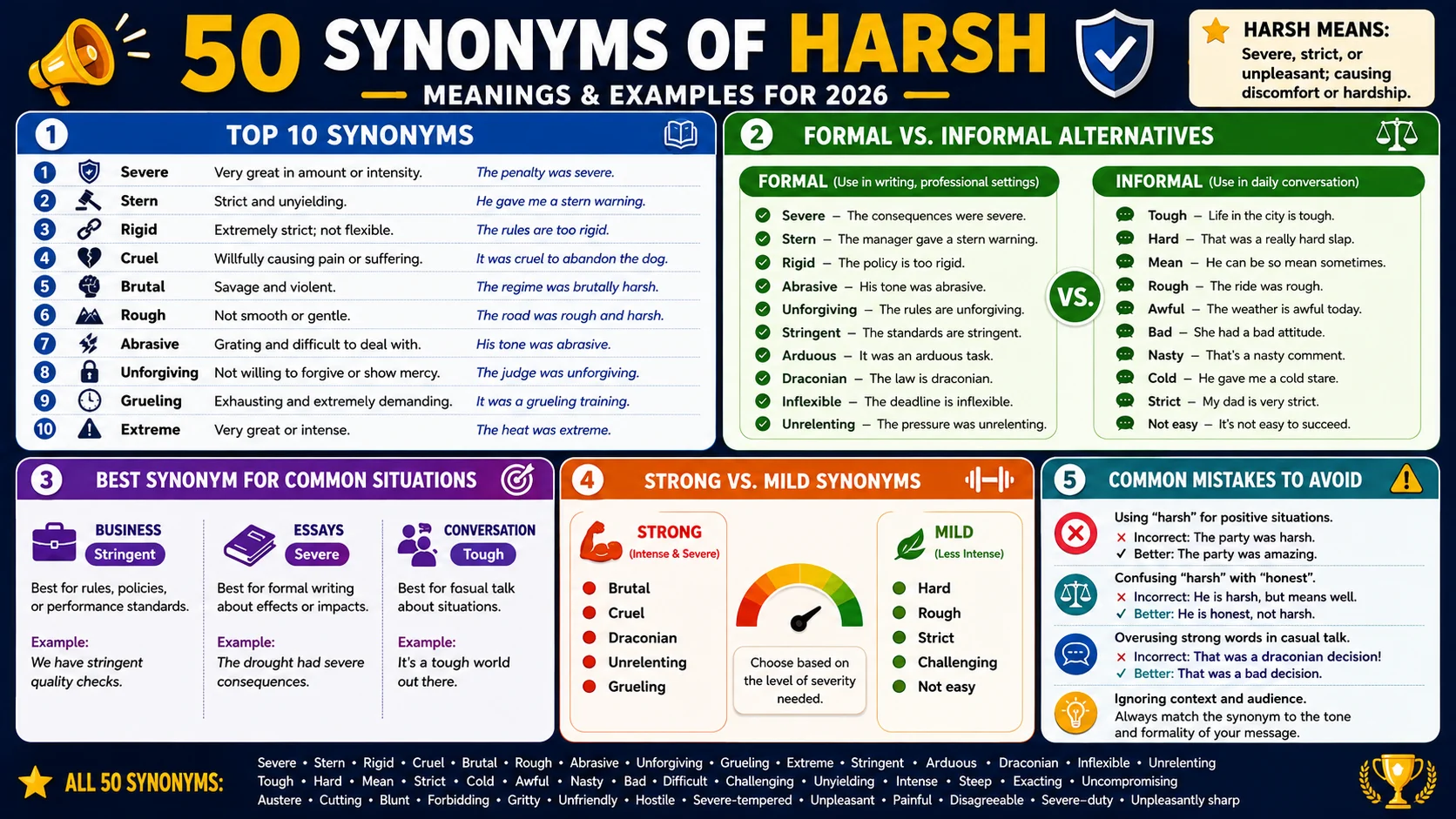
“Harsh” means severe, rough, or unpleasant in a way that causes discomfort. The best synonyms are severe, rough, harsh, cruel, and stern. “Severe” is the most common natural alternative. Each synonym has a slightly different meaning and context where it fits best.
Top 10 Synonyms
- Severe
- Rough
- Cruel
- Stern
- Hard
- Brutal
- Unkind
- Coarse
- Austere
- Relentless
Looking for the perfect word to describe something unpleasant, severe, or rough? The right harsh synonym can make your English clearer, more precise, and less repetitive. “Harsh” is a strong word that describes things that are unpleasant, severe, or rough. It can describe weather, words, treatment, punishment, or conditions. But when you need an another word for harsh, choosing the right alternative matters because each synonym can express a slightly different level or type of unpleasantness.
In this guide, you’ll find 35 powerful harsh synonyms, including extremely harsh or severe harsh synonym options, a harsh synonym formal for professional writing, and a useful harshness synonym for describing severity. We’ll also cover strict or harsh, synonyms like weather or punishment, the harsh meaning synonyms, and a harsher synonym when stronger language is needed. Let’s begin!
What Does “Harsh” Mean?
Definition
Harsh” means something is severe, rough, or unpleasant. It can be about weather that’s extreme, words that are mean, or conditions that are difficult. When something is harsh, it’s not gentle or pleasant—it causes discomfort or pain.
Pronunciation
| Feature | Value |
|---|---|
| US IPA | /hɑrʃ/ |
| UK IPA | /hɑːʃ/ |
| Syllables | 1 |
| Tip | Rhymes with “marsh” and “barsh” |
Grammar
| Grammar Feature | Information |
|---|---|
| Part of Speech | Adjective |
| Common Position | Before a noun or after a linking verb |
| Typical Pattern | Harsh + noun / Subject + be + harsh |
Examples:
- “The winter weather was harsh.” (after verb)
- “She said some harsh words.” (before noun)
- “The conditions were harsh.” (after verb)
Grammar Note: “Harsh” can be used with words like “very,” “extremely,” and “rather” to emphasize the severity.
Word Family
| Word | Part of Speech | Meaning |
|---|---|---|
| Harsh | Adjective | Severe or unpleasant |
| Harshly | Adverb | In a harsh way |
| Harshness | Noun | The quality of being harsh |
15 Synonyms of “Harsh”
Severe
Meaning: Very strict or extreme; not gentle.
Best Used For: Weather, punishment, criticism.
Formality: Neutral
Tone: Serious, Strong
Frequency: ⭐⭐⭐⭐⭐ (Very Common)
CEFR Level: B1
Example Sentence 1: “The storm brought severe weather to the region.
Example Sentence 2: “She received severe criticism for her mistake.”
Usage Tip: “Severe” is the most common and natural synonym. Use it for extreme situations that are serious.
Common Confusion: Severe vs Harsh. “Severe” often suggests seriousness and strictness. “Harsh” suggests roughness and unpleasantness.
Rough
Meaning: Not smooth; coarse and unpleasant.
Best Used For: Surfaces, conditions, treatment.
Formality: Neutral
Tone: Unpleasant, Coarse
Frequency: ⭐⭐⭐⭐⭐ (Very Common)
CEFR Level: A2
Example Sentence 1: “The sea was rough during the storm.”
Example Sentence 2: “He had a rough upbringing.”
Usage Tip: “Rough” suggests lack of smoothness or gentleness. It’s very common and versatile.
Cruel
Meaning: Causing pain or suffering deliberately.
Best Used For: People, treatment, words.
Formality: Neutral
Tone: Mean, Unkind
Frequency: ⭐⭐⭐⭐ (Common)
CEFR Level: B1
Example Sentence 1: “His cruel words hurt her deeply.
Example Sentence 2: “The king was known for his cruel treatment of prisoners.”
Usage Tip: “Cruel” suggests intentional unkindness. Use it for people and actions that cause suffering.
Stern
Meaning: Serious, strict, and not showing approval.
Best Used For: Teachers, parents, looks, warnings.
Formality: Neutral
Tone: Strict, Serious
Frequency: ⭐⭐⭐ (Moderate)
CEFR Level: B2
Example Sentence 1: “The teacher gave him a stern look.”
Example Sentence 2: “She is a stern but fair boss.”
Usage Tip: “Stern” suggests seriousness and strictness. It’s often used for authority figures.
Hard
Meaning: Difficult or severe; not soft or gentle.
Best Used For: Conditions, work, times.
Formality: Neutral
Tone: Difficult, Tough
Frequency: ⭐⭐⭐⭐⭐ (Very Common)
CEFR Level: A2
Example Sentence 1: “They lived through hard times.”
Example Sentence 2: “The work was hard but rewarding.”
Usage Tip: “Hard” is a very common word for difficult or severe situations.
Brutal
Meaning: Extremely cruel or severe.
Best Used For: Treatment, attacks, honesty.
Formality: Neutral
Tone: Extreme, Cruel
Frequency: ⭐⭐⭐⭐ (Common)
CEFR Level: B2
Example Sentence 1: “He was brutally honest with his opinion.”
Example Sentence 2: “The conditions were brutal.”
Usage Tip: “Brutal” suggests extreme harshness. It’s stronger than “harsh.”
Unkind
Meaning: Not kind; lacking kindness.
Best Used For: Words, actions, people.
Formality: Neutral
Tone: Mean, Unpleasant
Frequency: ⭐⭐⭐⭐ (Common)
CEFR Level: A2
Example Sentence 1: “She made an unkind comment about his appearance.”
Example Sentence 2: “His unkind behavior hurt many people.”
Usage Tip: “Unkind” is a milder way to say “cruel.” Use it for mean words or actions.
Coarse
Meaning: Rough in texture or rude in manner.
Best Used For: Fabric, texture, speech.
Formality: Neutral
Tone: Rough, Unrefined
Frequency: ⭐⭐⭐ (Moderate)
CEFR Level: B2
Example Sentence 1: “The coarse fabric irritated her skin.”
Example Sentence 2: “His coarse language offended everyone.”
Usage Tip: “Coarse” can describe physical roughness or rude language.
Austere
Meaning: Severe and simple in appearance or manner.
Best Used For: Style, lifestyle, places.
Formality: Formal
Tone: Simple, Strict
Frequency: ⭐⭐ (Rare)
CEFR Level: C1
Example Sentence 1: “The room had an austere design.”
Example Sentence 2: “She lived an austere life.”
Usage Tip: “Austere” suggests simplicity combined with harshness. It’s a formal word.
Relentless
Meaning: Never stopping; persistent and harsh.
Best Used For: Attacks, criticism, pursuit.
Formality: Formal
Tone: Persistent, Unstoppable
Frequency: ⭐⭐⭐ (Moderate)
CEFR Level: B2
Example Sentence 1: “The relentless rain flooded the streets.”
Example Sentence 2: “He faced relentless criticism.”
Usage Tip: “Relentless” suggests harshness that never stops or gives up.
Stern
Meaning: Very strict and serious.
Best Used For: Parents, teachers, looks.
Formality: Neutral
Tone: Strict, Serious
Frequency: ⭐⭐⭐ (Moderate)
CEFR Level: B2
Example Sentence 1: “The principal gave us a stern warning.”
Example Sentence 2: “She is a stern disciplinarian.”
Usage Tip: “Stern” is often used for people in authority who are strict.
Grim
Meaning: Very serious and unpleasant.
Best Used For: Situations, future, news.
Formality: Neutral
Tone: Serious, Negative
Frequency: ⭐⭐⭐ (Moderate)
CEFR Level: B2
Example Sentence 1: “The news was grim.”
Example Sentence 2: “They faced a grim future.”
Usage Tip: “Grim” suggests something is so bad it’s frightening.
Oppressive
Meaning: Unpleasantly harsh and difficult to bear.
Best Used For: Weather, regimes, conditions.
Formality: Formal
Tone: Overwhelming, Heavy
Frequency: ⭐⭐ (Rare)
CEFR Level: C1
Example Sentence 1: “The oppressive heat made everyone tired.”
Example Sentence 2: “The oppressive regime controlled everything.”
Usage Tip: “Oppressive” suggests harshness that feels overwhelming and crushing.
Callous
Meaning: Showing no concern for others’ feelings.
Best Used For: People, words, actions.
Formality: Formal
Tone: Cold, Unfeeling
Frequency: ⭐⭐ (Rare)
CEFR Level: C1
Example Sentence 1: “His callous remarks hurt everyone.”
Example Sentence 2: “She showed callous disregard for their feelings.”
Usage Tip: “Callous” suggests a cold lack of concern for others.
Tart
Meaning: Sharp and unpleasant in taste or manner.
Best Used For: Food, comments, responses.
Formality: Neutral
Tone: Sharp, Bitter
Frequency: ⭐⭐ (Rare)
CEFR Level: B2
Example Sentence 1: “The lemon had a tart taste.”
Example Sentence 2: “She gave him a tart reply.”
Usage Tip: “Tart” can describe both sour taste and sharp speech.
Synonyms Comparison Table
| Synonym | Best Context | Formality | Tone | Frequency |
|---|---|---|---|---|
| Severe | Extreme situations | Neutral | Serious | ⭐⭐⭐⭐⭐ |
| Rough | Physical harshness | Neutral | Unpleasant | ⭐⭐⭐⭐⭐ |
| Hard | Difficult conditions | Neutral | Tough | ⭐⭐⭐⭐⭐ |
| Cruel | Intentional unkindness | Neutral | Mean | ⭐⭐⭐⭐ |
| Brutal | Extreme harshness | Neutral | Cruel | ⭐⭐⭐⭐ |
| Unkind | Mild harshness | Neutral | Mean | ⭐⭐⭐⭐ |
| Stern | Strict authority | Neutral | Serious | ⭐⭐⭐ |
| Relentless | Persistent harshness | Formal | Unstoppable | ⭐⭐⭐ |
| Austere | Simple harshness | Formal | Strict | ⭐⭐ |
| Oppressive | Overwhelming harshness | Formal | Heavy | ⭐⭐ |
Best Synonyms by Situation
| Situation | Best Synonym | Why It Works |
|---|---|---|
| Daily Conversation | Rough | Natural and common |
| Business Email | Severe | Professional and clear |
| Academic Writing | Austere | Formal and precise |
| School Assignment | Hard | Clear and simple |
| Professional Meeting | Severe | Sounds professional |
| Presentation | Harsh | Clear and direct |
| Creative Writing | Brutal | Adds literary depth |
| Social Media | Rough | Casual and relatable |
| Weather Report | Severe | Accurate and clear |
Formal vs Informal Synonyms
Formal Alternatives
| Synonym | Best Used For |
|---|---|
| Austere | Style, life, design |
| Oppressive | Weather, regimes |
| Callous | People, remarks |
| Relentless | Attacks, criticism |
Neutral Alternatives
| Synonym | Best Used For |
|---|---|
| Severe | Most general situations |
| Rough | Physical harshness |
| Hard | Conditions, work |
| Stern | Authority figures |
Informal Alternatives
| Synonym | Best Used For |
|---|---|
| Tough | Everyday situations |
| Mean | People, words |
| Coarse | Language, texture |
Choosing the Right Level: Use “austere” and “oppressive” for formal writing. Use “severe” and “rough” for most situations. Use “tough” and “mean” with friends.
Strong vs Mild Synonyms
Mild
Suitable for everyday situations with less intensity.
- Rough
- Hard
- Unkind
Moderate
More serious or severe alternatives.
- Severe
- Stern
- Coarse
- Tart
Strong
High-intensity alternatives suggesting extreme harshness.
- Brutal (extremely harsh)
- Cruel (intentional harshness)
- Relentless (never-ending harshness)
- Oppressive (overwhelming harshness)
How Intensity Changes Meaning: “The weather is harsh” is descriptive. “The weather is brutal” is much stronger. Choose stronger words when you want to emphasize extreme severity.
Real-Life Examples
School: “The teacher gave a harsh punishment.”
Office: “The boss was harsh with his criticism.”
Business Email: “The new policy is too harsh.”
Meetings: “They faced harsh conditions in the market.”
Presentations: “The data shows harsh realities.”
Daily Conversations: “Winter here can be really rough.”
Social Media: “Don’t be so harsh on yourself!”
Academic Writing: “The regime was oppressive to its people.”
Common Collocations
| Common Phrase | Better Alternative |
|---|---|
| Harsh weather | Severe weather |
| Harsh words | Cruel words |
| Harsh criticism | Severe criticism |
| Harsh conditions | Hard conditions |
| Harsh punishment | Severe punishment |
Common Phrases
Hard as nails: Very tough. (e.g., “He’s hard as nails.”)
Straight out: Very direct and harsh. (e.g., “She told it straight out.”)
Grim reality: A harsh truth. (e.g., “We face the grim reality.”)
Bitter pill to swallow: A harsh truth. (e.g., “It was a bitter pill to swallow.”)
Cold hard truth: A harsh fact. (e.g., “The cold hard truth is difficult.”)
Context Guide
| Situation | Best Synonym | Reason |
|---|---|---|
| Essay | Austere | Academic and formal |
| Speech | Harsh | Clear and direct |
| Business Email | Severe | Professional and clear |
| Novel | Brutal | Adds literary depth |
| Presentation | Harsh | Clear and effective |
| Conversation | Rough | Natural and relatable |
| Academic Writing | Oppressive | Precise and formal |
| Marketing Copy | Harsh | Direct and honest |
Related Words
Near Synonyms
- Rigorous: Strict and demanding. (e.g., “Rigorous training.”)
- Grueling: Extremely demanding. (e.g., “A grueling schedule.”)
- Stringent: Very strict. (e.g., “Stringent rules.”)
- dreadful: Extremely cruel.
- Draconian: Extremely harsh (laws).
Antonyms
- Gentle: Kind and soft.
- Kind: Nice and caring.
- Mild: Not severe.
- Soft: Not harsh.
- Lenient: Not strict.
Related Adjectives
- Severe: Very strict.
- Cruel: Mean and unkind.
- Rough: Not smooth.
- Stern: Strict and serious.
- Brutal: Extremely harsh.
Related Nouns
- Harshness: The quality of being harsh.
- Severity: The quality of being severe.
- Roughness: The quality of being rough.
- Cruelty: The quality of being cruel.
- Oppression: Unjust treatment.
Related Verbs
- Criticize: To express disapproval.
- Punish: To impose a penalty.
- Scold: To criticize angrily.
- Condemn: To express strong disapproval.
Frequently Asked Questions
What is another word for harsh?
Common synonyms include severe, rough, cruel, stern, and hard. “Severe” is the most common and direct alternative.
Which synonym sounds the most professional?
Severe and austere sound very professional. “Oppressive” is also excellent for formal contexts.
What is the strongest synonym for harsh?
Brutal and relentless are among the strongest synonyms. They suggest extreme, unstoppable harshness.
Which synonym is best for essays?
Austere or oppressive is the best choice for academic essays. They are formal and precise.
What’s the difference between harsh and severe?
“Harsh” suggests roughness and unpleasantness. “Severe” suggests seriousness and strictness. Both are similar but “severe” is often more official.
Which synonym is most common in everyday English?
“Rough” and “hard” are the most common in everyday speech. “Severe” is also frequently used.
What is the opposite of harsh?
Common opposites are gentle, kind, mild, soft, and lenient. These words describe softness and kindness.
Conclusion
“Harsh” is a powerful word, but now you have 35 fantastic alternatives. Each synonym adds a different shade of meaning to your language.
Remember, the key is understanding the context. Use “severe” for serious situations. Use “rough” for physical harshness. Use “cruel” for intentional unkindness. Use “stern” for strict authority.
The best way to improve is practice. Try using one or two new synonyms each day. Listen for these words in conversations and books. Your vocabulary will become richer and more expressive with time.
