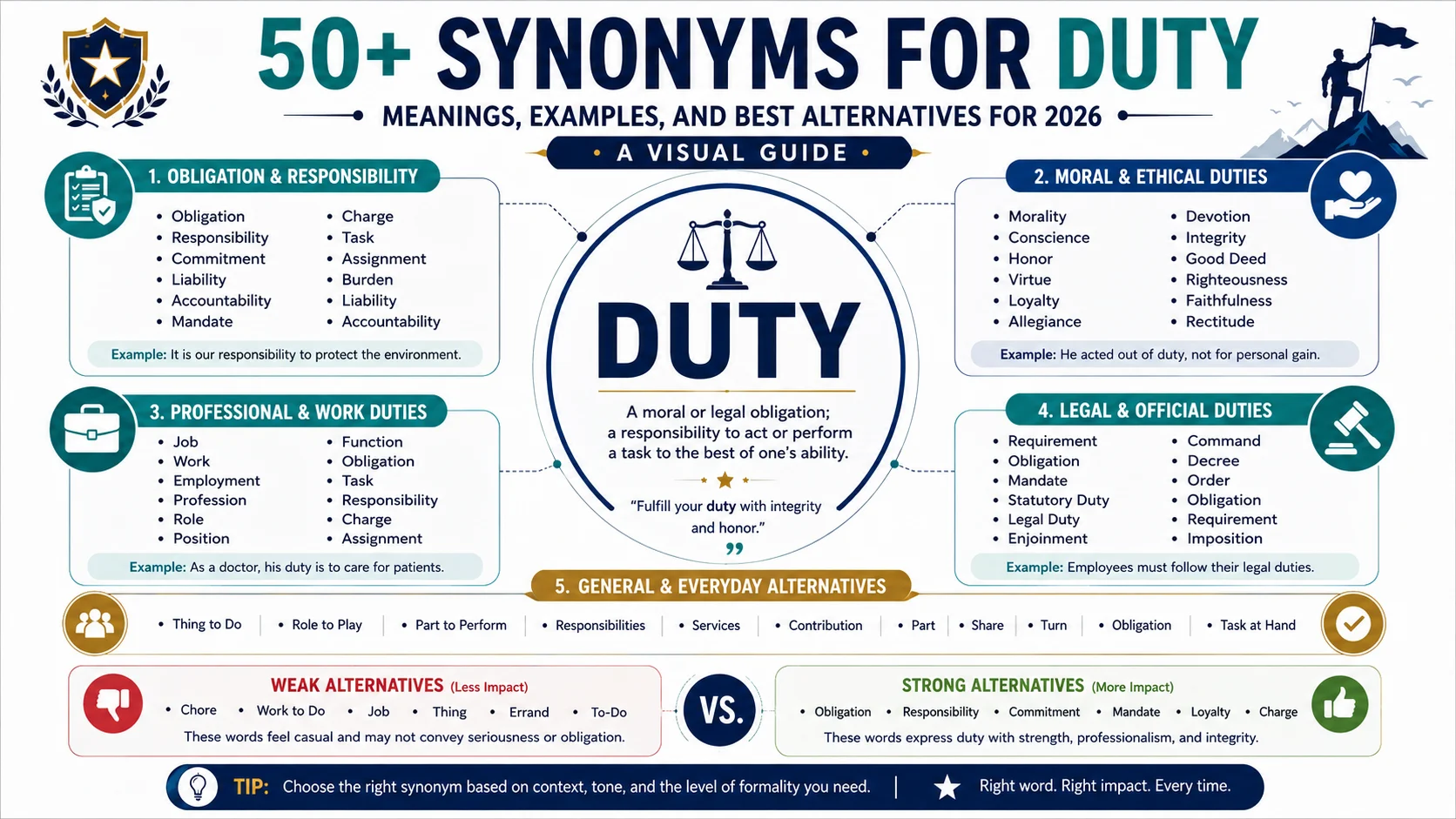
Duty is a noun that refers to a moral or legal obligation; a task or action one is required to perform. The best synonym depends on your context. For formal writing, use “obligation” or “responsibility.” For a casual setting, “job” or “task” are more appropriate.
Meaning, Tone and Context
Understanding the full meaning of “duty” is the first step to finding the perfect alternative.
- Simple definition: A duty is something you are expected to do because it is morally, legally, or professionally right.
- Part of speech: It is primarily used as a noun.
- Tone: The tone is generally neutral to serious. It conveys a sense of purpose and requirement .
- Formality level: It sits in the middle. It can be formal (e.g., “legal duty”) but is also common in everyday conversation.
- Common use cases: You will find it used when discussing work tasks, legal requirements, moral obligations, and taxes .
- Word forms: The adjective form is “dutiful.” An adverb is “dutifully,” which means performing a duty in a compliant manner .
When and How to Use “Duty”
“Duty” is the perfect choice when you want to emphasize a sense of obligation. Here are examples of when and how to use it effectively.
Professional (Job Description):
“Your primary duty will be to manage the company’s social media accounts.”
Personal (Moral Obligation):
“I feel it is my duty to help my neighbor in need.”
Academic (Civic Responsibility):
“Voting is an essential civic duty that should not be taken lightly.”
Legal (Contractual Obligation):
“The landlord has a legal duty to ensure the property is safe.”
Tax (Financial):
“The new government has imposed a duty on all imported electronics.”
Emotional (Sense of Obligation):
“She visited her parents every Sunday out of a sense of duty.”
Another Word for “Duty”
Selecting the best single word replacement for “duty” requires you to understand the nuance of the situation.
- Professional writing: responsibility
- Academic writing: obligation
- Casual conversation: job
- Emotional writing: calling
- Creative writing: mission
- Resume or workplace: role
- Social media captions: task
- Stronger meaning: imperative
- Softer meaning: function
When Not to Use “Duty”
There are times when “duty” is too vague, too formal, or too weak.
If you are describing a specific, short task, “duty” is too general. For instance, “My duty is to file these papers” sounds overly dramatic. It is better to say, “My task is to file these papers.”
Similarly, in a casual setting with friends, saying “It is my duty to bring snacks” can sound stiff and formal. You would sound more natural saying, “It’s my job to bring snacks.” Always choose the word that fits the tone of the conversation.
- Words Commonly Confused With “Duty”
Some words are often used in place of “duty,” but they have distinct meanings. Understanding the difference will improve your precision.
- Duty vs. Responsibility: “Responsibility” refers to being accountable for something, while “duty” often implies a specific action one is required to perform. You have a responsibility to your team, which comes with specific duties .
- Duty vs. Job: “Job” is a broad term for paid work. A “duty” is a specific task within that job. Your job is to be a teacher; a duty is to grade papers.
- Duty vs. Obligation: These are very close. “Obligation” is a more general term for a promise or law that compels you to act, whereas “duty” often implies a moral or ethical dimension .
- Duty vs. Task: A “task” is a specific piece of work. It is often routine and less emotionally weighted than a “duty” .
- Best Synonym by Context for “Duty
This table offers a quick reference for the best word to use in various settings.
- Which Synonym Should You Choose?
To choose the perfect synonym, you must consider four key factors: meaning, formality, emotional intensity, and context.
First, ask yourself if you mean a moral, legal, or simple task obligation. This will help you decide between “obligation” and “task.” Second, consider the formality of the setting. You would use “function” in a report but “job” in an email to a friend.
Next, decide on the emotional weight. If you want to sound passionate, “calling” is your word. If you want to sound neutral, “task” is a safe bet. Finally, always consider the sentence and what feels most natural.
- Real Life Examples of “Duty” in Sentences
Seeing “duty” and its synonyms in action will help you use them with confidence.
School: “Completing your homework is a student’s primary responsibility.” (Using responsibility)
Workplace: “One of my key functions is to manage the budget.” (Using functions)
Writing: “Her mission was to expose the truth, no matter the cost.” (Using mission)
Conversation: “Don’t worry, it’s not your job to fix everything.” (Using job)
Social Media: “My task for the weekend is to finally organize my closet.” (Using task)
Email: “As a director, it is my responsibility to approve these plans.” (Using responsibility)
Storytelling: “His charge was to deliver the message to the king.” (Using charge)
- 25 Synonyms for “Duty
Here are 25 powerful synonyms for “duty,” each with a unique definition and example.
Synonym Groups and Usage Differences
Grouping synonyms helps you understand their subtle differences and use them more effectively.
Professional vs. Personal Synonyms
Professional synonyms like “function” and “portfolio” are clear and formal. They are perfect for resumes and meetings. Personal synonyms like “calling” and “charge” are more emotional. They are better suited for personal essays or heartfelt conversations.
Formal vs. Conversational Synonyms
Formal synonyms such as “obligation” and “onus” should be used in reports, essays, and official speeches. Conversational alternatives like “job” and “task” are better for emails to colleagues, texts, and casual chats. Using “onus” with a friend will sound unnatural.
Academic Synonyms
In essays or research papers, precision is key. Words like “responsibility,” “obligation,” and “imperative” sound authoritative. They demonstrate a nuanced understanding of the topic. For example, a sociology paper might discuss “civic responsibility” instead of “civic chores.”
Professional and Business Synonyms
- In the workplace, you want to sound competent. Use “role” to describe your position. Use “function” to explain a department’s purpose. Use “portfolio” to discuss your range of work. These words show you are a professional who understands business language.
Creative or Literary Synonyms
Writers should use synonyms to paint a picture. “Calling” suggests passion. “Mission” implies a quest. “Charge” conveys a deep sense of trust. Using these words adds emotion and depth to your descriptions.
Slang or Modern Synonyms
For the word “duty,” there are no widely recognized modern slang synonyms. It is best to stick with the formal, professional, or casual alternatives provided in this guide to ensure you are understood and sound credible.
Strongest vs. Weaker Synonyms
An intensity scale shows how the emotional weight of a word changes.
Mildest: Task, job, assignment. These are neutral and routine.
Moderate: Responsibility, obligation, role. These have a strong sense of accountability.
Strongest: Calling, imperative, mission. These words suggest a deep, personal, or urgent purpose.
Emotional vs. Neutral Synonyms
If you want to add emotion, use “calling,” “charge,” or “mission.” These words suggest passion, purpose, and personal investment. If you want to stay factual and neutral, use “task,” “function,” or “assignment.” They simply describe the work to be done.
Antonyms of “Duty”
Understanding the opposites of “duty” helps to clarify its meaning. An antonym highlights the concept of freedom from obligation.
Comparison: Duty vs. Similar Words
Let’s compare “duty” with other common words to highlight the best use for each.
- Duty vs. Responsibility
- Main difference: “Duty” emphasizes the specific act required, while “responsibility” is about being accountable for a person or task.
- Which one is stronger: Responsibility is generally a stronger, more enduring concept.
- Which one is more formal: Both are formal, but “responsibility” is often preferred in corporate language.
- Example for Duty: “It is my duty to report this incident to the authorities.”
- Example for Responsibility: “The manager has overall responsibility for the project’s success.”
- Duty vs. Task
- Main difference: A “task” is a discrete piece of work, often practical. A “duty” carries a sense of moral or ethical obligation.
- Which one is stronger: Duty is the stronger word due to its emotional weight.
- Which one is more formal: Duty is more formal.
- Example for Duty: “It is the parent’s duty to care for a child.”
- Example for Task: “My task for today is to clean the garage.”
- Duty vs. Job
- Main difference: “Job” is often the work you do for pay, while “duty” is a specific obligation related to that work or a moral code.
- Which one is stronger: Duty is the more serious term.
- Which one is more formal: Duty is more formal.
- Example for Duty: “It is his duty as a police officer to protect the innocent.”
- Example for Job: “His job as a police officer is based in the city center.”
- Duty vs. Obligation
- Main difference: “Obligation” is an umbrella term for any commitment, legal or moral. “Duty” often implies a moral, ethical, or patriotic motive.
- Which one is stronger: They carry similar weight, but “duty” often feels more personal.
- Which one is more formal: Both are very formal.
- Example for Duty: “She felt it was her personal duty to defend her friend.”
- Example for Obligation: “He had a legal obligation to pay the fine.”
- Duty vs. Chore
- Main difference: A “chore” is an unpleasant, often routine task, while a “duty” is a more significant responsibility.
- Which one is stronger: Duty is much stronger and more important.
- Which one is more formal: Duty is formal; “chore” is informal.
- Example for Duty: “It is your duty to serve your country.”
- Example for Chore: “Cleaning the bathroom is a chore I hate.”
- Duty vs. Tariff
- Main difference: A “tariff” is specifically a tax on imported goods. “Duty” is a general term for tax, of which a tariff is a type .
- Which one is stronger: They are not comparable in this way.
- Which one is more formal: They are both formal financial terms.
- Example for Duty: “The government charges a duty on all wine.”
- Example for Tariff: “The new tariff on Chinese imports has raised prices.”
Common Phrases and Expressions with “Duty”
Learning common phrases will help you sound more like a native speaker.
1. Duty Calls
- Meaning: Used to say you must go and do your work or fulfill an obligation.
- Example sentence: “I would love to stay at the party, but duty calls. I have an early meeting.”
2. To Do Your Duty
- Meaning: To fulfill your responsibility or obligation.
- Example sentence: “He was merely doing his duty by reporting the incident.”
3. Beyond the Call of Duty
- Meaning: More than is required or expected in one’s job.
- Example sentence: “The firefighters went beyond the call of duty to save the family’s pets.”
4. A Sense of Duty
- Meaning: A strong inner feeling that you are obligated to do something.
- Example sentence: “She visited her grandmother every week out of a strong sense of duty.”
5. Bounden Duty
- Meaning: A responsibility or duty that one is bound to perform.
- Example sentence: “It is our bounden duty to protect our children.”
6. On Duty / Off Duty
- Meaning: Working or not working at a particular time.
- Example sentence: “The police officer was off duty when he saw the accident.”
7. Dereliction of Duty
- Meaning: Willful or negligent failure to perform one’s duty.
- Example sentence: “The soldier was court-martialed for dereliction of duty.”
8. Heavy Duty
- Meaning: Designed for hard work or very serious. (Note: This is a compound word often used as an adjective).
- Example sentence: “We need a heavy-duty machine to handle this workload.”
Common Mistakes to Avoid
Avoiding these common errors will make you a more effective and precise communicator.
1. Using “Duty” When a More Precise Word Is Better
Do not write, “My duty is to clean the bathroom.” This sounds overly formal.
Correct: “My task is to clean the bathroom.”
Correct: “Cleaning the bathroom is one of my chores.”
2. Confusing Duty with a Related Word
Do not use “duty” when you mean “tax” in a general sense. They are not interchangeable in every context.
Incorrect: “I paid my duty at the grocery store.” (Use “sales tax”).
Correct: “I paid import duty on the goods.”
3. Using a Casual Synonym in Formal Writing
Do not write, “It is the company’s job to protect data” in a legal document.
Correct: “It is the company’s legal obligation to protect data.”
4. Using an Overly Dramatic Synonym for a Simple Situation
Do not write, “It is my calling to take out the trash.” This is too serious for a mundane task.
Correct: “It is my job to take out the trash.”
5. Repeating the Same Word Too Often
Avoid repeating “duty” multiple times in a paragraph. Use synonyms to keep your writing engaging.
6. Choosing a Synonym with the Wrong Emotional Tone
Do not use “chore” to describe a prestigious role you are proud of. It downplays its importance.
7. Using Slang in Academic or Professional Writing
There is no slang alternative for this word. Always choose a professional alternative in a professional setting.
FAQs
1. What is the best synonym for duty?
The best synonym is “obligation,” as it perfectly captures the sense of moral or legal requirement in most formal contexts .
2. What is a formal synonym for duty?
“Obligation” and “responsibility” are the most professional and formal synonyms .
3. What is an informal synonym for duty?
“Job” and “task” are the best choices for casual conversations and everyday writing .
4. What is another word for duty in professional writing?
Use “function,” “role,” or “portfolio.” These words sound professional and specific to a workplace setting .
5. What is the difference between duty and responsibility?
Duty is the specific action you are required to do, while responsibility is the broader state of being accountable for someone or something .
6. What is the opposite of duty?
The most direct opposite is “freedom,” as duty is a form of obligation, and freedom is a state of being without obligation .
Conclusion
You should now have a clear understanding of the word “duty.” It has a core meaning of obligation, but its power lies in the nuance of its many synonyms. You can choose the perfect word for any situation by considering the context, your audience, and the emotional tone you want to convey. A practical tip is to keep a list of these synonyms nearby. When you write a draft, challenge yourself to replace “duty” with a more specific word like “function,” “calling,” or “assignment.” It is a small change that will significantly improve your vocabulary and communication skills.
