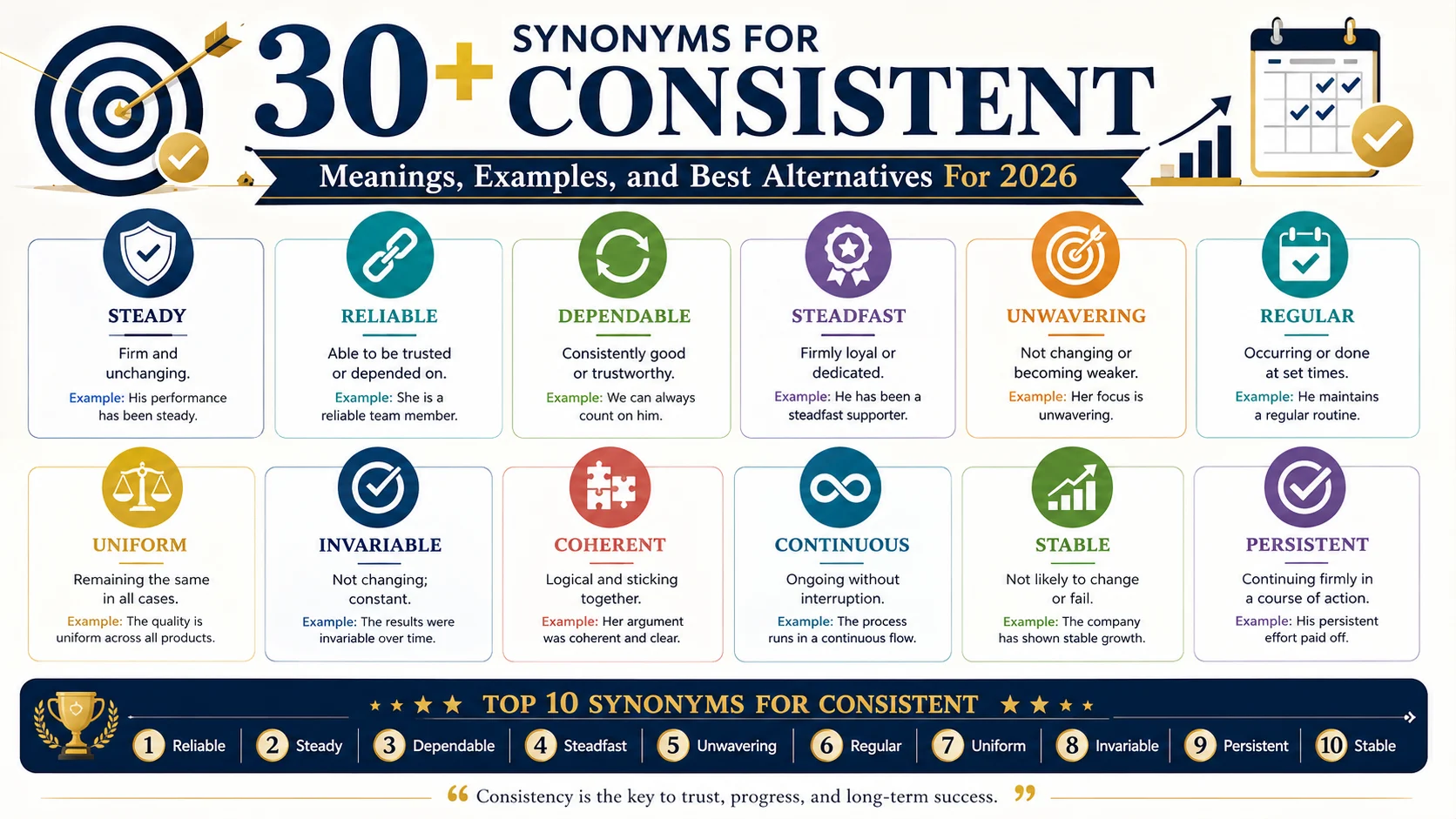
Consistent means acting or happening in the same way over time. It describes reliability, uniformity, and lack of contradiction. The best synonyms are steady for reliability, constant for uninterrupted action, uniform for sameness, and dependable for trustworthiness. Each synonym carries a slightly different meaning and works best in specific contexts.
Top 10 Synonyms for Consistent:
- Steady
- Constant
- Uniform
- Dependable
- Reliable
- Regular
- Stable
- Persistent
- Unwavering
- Predictable
Every synonym has a slightly different meaning, tone, or context. Choosing the right one makes your English sound more natural and precise.
Have you ever struggled to find the right word to describe someone who always performs well?
Or maybe you have tried to explain a process that produces the same results every time. The word “consistent” comes to mind, but using it repeatedly makes your writing feel repetitive and dull.
Learning synonyms for consistent helps you describe reliability, uniformity, and dependability with greater precision. Whether you are writing a performance review, describing a product’s quality, or complimenting a colleague’s work ethic, the right synonym makes all the difference.
This guide will teach you exactly how to choose the right synonym for consistent in any context. You will learn the subtle differences between steady, constant, uniform, reliable, and many other alternatives. By the end, you will express consistency with confidence and variety.
What Does “Consistent” Mean?
Definition
Consistent means acting or happening in the same way over a period of time. It describes something that does not change unexpectedly. When something is consistent, it follows a pattern, maintains a standard, or agrees with itself.
For example, a consistent employee shows up on time every day. Consistent quality means products meet the same standards repeatedly. Consistent arguments do not contradict each other. In every case, consistency means reliability, uniformity, and predictability.
The word carries a positive tone. It suggests trustworthiness and dependability. However, in some contexts, it can feel neutral or even negative when describing something boring or unchanging.
Pronunciation
| Feature | Information |
|---|---|
| US IPA | /kənˈsɪstənt/ |
| UK IPA | /kənˈsɪstənt/ |
| Syllables | 3 |
| Tip | Stress the second syllable: kuhn-SIS-tuhnt |
Grammar
| Grammar Feature | Information |
|---|---|
| Part of Speech | Adjective |
| Common Position | Before a noun or after a linking verb |
| Typical Pattern | Consistent + with + noun |
Example sentences:
“Her performance has been consistent throughout the year.”
“The data is consistent with our previous findings.”
“He is a consistent worker who never misses deadlines.”
Grammar note: When describing agreement or compatibility, use “consistent with.” For example, “This policy is consistent with company values.” Do not say “consistent to.”
Word Family
| Word | Part of Speech | Meaning |
|---|---|---|
| Consistent | Adjective | Acting or happening in the same way over time |
| Consistently | Adverb | In a consistent manner |
| Consistency | Noun | The quality of being consistent |
| Inconsistent | Adjective | Not consistent; changing unpredictably |
| Inconsistency | Noun | The quality of being inconsistent |
15 Synonyms of “Consistent”
1. Steady
Meaning: Firm, stable, and not changing or fluctuating. Reliable over time.
Best Used For: Describing performance, progress, relationships, and work habits.
Formality: Neutral
Tone: Positive, reassuring
Frequency: ⭐⭐⭐⭐⭐ Very Common
CEFR Level: B1
Example Sentence 1: “She has made steady progress in her language studies over the past six months.”
Example Sentence 2: “The company reported steady growth in sales for the third quarter.”
Usage Tip: Steady emphasizes stability and lack of fluctuation. Use it when you want to describe gradual, reliable progress. It works well in both professional and personal contexts. Avoid using steady when you mean exact uniformity, as it suggests consistent movement rather than identical results.
2. Constant
Meaning: Happening continuously or regularly over a long period. Never stopping.
Best Used For: Describing unchanging conditions, ongoing processes, and persistent behavior.
Formality: Neutral
Tone: Neutral to positive
Frequency: ⭐⭐⭐⭐⭐ Very Common
CEFR Level: B1
Example Sentence 1: “The machine requires constant maintenance to operate efficiently.”
Example Sentence 2: “She receives constant support from her family and friends.”
Usage Tip: Constant emphasizes unbroken continuity. Use it when you want to describe something that never stops or changes. It can sound intense because it suggests no breaks. Be careful using it for people, as “constant attention” might sound demanding. For work habits, “steady” or “consistent” often sounds more natural.
3. Uniform
Meaning: The same in all cases; not varying. Showing no differences.
Best Used For: Describing products, standards, procedures, and physical appearances.
Formality: Neutral to Formal
Tone: Professional, factual
Frequency: ⭐⭐⭐ Moderate
CEFR Level: B2
Example Sentence 1: “The factory produces uniform products that meet the same quality standards.”
Example Sentence 2: “All employees must follow uniform procedures for safety compliance.”
Usage Tip: Uniform emphasizes sameness and lack of variation. Use it when you want to describe identical results or standards. It works well in manufacturing, quality control, and procedural contexts. Avoid using uniform to describe people’s behavior in casual conversation, as it can sound too mechanical.
4. Dependable
Meaning: Trustworthy and reliable. Can be counted on to do what is expected.
Best Used For: Describing people, employees, systems, and services.
Formality: Neutral
Tone: Positive, trusting
Frequency: ⭐⭐⭐⭐ Common
CEFR Level: B1
Example Sentence 1: “He is the most dependable member of our team. You can always count on him.”
Example Sentence 2: “The old car is surprisingly dependable despite its age.”
Usage Tip: Dependable emphasizes trustworthiness and reliability. Use it when you want to express confidence in someone or something. It is more personal and warmer than consistent. Native speakers often use it to praise colleagues, employees, and friends. Avoid using it for abstract concepts or processes, where “consistent” sounds more appropriate.
5. Reliable
Meaning: Able to be trusted to do what is expected. Consistently good in quality or performance.
Best Used For: Describing people, products, information, and services.
Formality: Neutral
Tone: Positive, trustworthy
Frequency: ⭐⭐⭐⭐⭐ Very Common
CEFR Level: B1
Example Sentence 1: “The news source is reliable and provides accurate information.”
Example Sentence 2: “We need a reliable car for our long road trip this summer.”
Usage Tip: Reliable is very similar to dependable but is slightly more common in everyday speech. Use it when you want to describe something or someone that consistently delivers good results. It is versatile and works in almost all contexts. Avoid confusing it with “reliant,” which means dependent on something.
6. Regular
Meaning: Happening at fixed intervals. Following a predictable pattern.
Best Used For: Describing schedules, routines, habits, and recurring events.
Formality: Neutral
Tone: Positive, predictable
Frequency: ⭐⭐⭐⭐⭐ Very Common
CEFR Level: A2
Example Sentence 1: “She follows a regular exercise routine every morning before work.”
Example Sentence 2: “Regular maintenance checks prevent unexpected breakdowns.”
Usage Tip: Regular emphasizes frequency and predictable patterns. Use it when you want to describe habits, schedules, or intervals. It is one of the most common and accessible synonyms for consistent. Avoid using regular when you mean high quality or reliability, as it focuses on frequency rather than trustworthiness.
7. Stable
Meaning: Firmly fixed and not likely to change or fail. Balanced and steady.
Best Used For: Describing conditions, systems, relationships, and emotional states.
Formality: Neutral
Tone: Positive, secure
Frequency: ⭐⭐⭐⭐ Common
CEFR Level: B1
Example Sentence 1: “The country has enjoyed stable economic growth for five years.”
Example Sentence 2: “She provides a stable environment for her children to grow up in.”
Usage Tip: Stable emphasizes security and resistance to change. Use it when you want to describe something that is well-balanced and unlikely to fail. It works well in economic, emotional, and structural contexts. Avoid using stable when you mean consistent performance over time, as it focuses on security rather than uniformity.
8. Persistent
Meaning: Continuing firmly despite difficulties or opposition. Determined to continue.
Best Used For: Describing effort, behavior, and determination.
Formality: Neutral
Tone: Positive when describing effort, negative when describing problems
Frequency: ⭐⭐⭐⭐ Common
CEFR Level: B2
Example Sentence 1: “Her persistent efforts finally paid off with a promotion.”
Example Sentence 2: “Persistent problems with the software delayed the project.”
Usage Tip: Persistent emphasizes continuity despite challenges. Use it when you want to describe someone who does not give up or something that continues stubbornly. It can be positive when describing effort but negative when describing problems. Avoid using it to describe routine consistency, as it implies active effort rather than passive reliability.
9. Unwavering
Meaning: Not changing or hesitating. Firm and steady in purpose or direction.
Best Used For: Describing commitment, support, loyalty, and determination.
Formality: Formal to Literary
Tone: Positive, inspiring, strong
Frequency: ⭐⭐ Rare
CEFR Level: C1
Example Sentence 1: “She showed unwavering commitment to her goals throughout her career.
Example Sentence 2: “The community offered unwavering support to the affected families.”
Usage Tip: Unwavering emphasizes strength and lack of doubt. Use it when you want to describe strong commitment or loyalty. It has a formal and slightly dramatic tone. Avoid using it in everyday conversation, where “steady” or “consistent” sounds more natural. It works well in speeches, inspirational writing, and formal praise.
10. Predictable
Meaning: Behaving or happening in a way that you expect. Easy to anticipate.
Best Used For: Describing outcomes, behavior, and patterns.
Formality: Neutral
Tone: Can be positive or negative depending on context
Frequency: ⭐⭐⭐⭐ Common
CEFR Level: B1
Example Sentence 1: “The team’s predictable performance made them a favorite to win the championship.”
Example Sentence 2: “His predictable responses to questions became boring over time.”
Usage Tip: Predictable emphasizes the ability to anticipate what will happen. Use it when you want to describe something that follows a clear pattern. It can be positive when describing reliability but negative when describing boredom or lack of creativity. Avoid using it when you mean exact uniformity, as it focuses on expectation rather than sameness.
11. Unchanging
Meaning: Remaining the same over time. Not varying or fluctuating.
Best Used For: Describing conditions, standards, and principles.
Formality: Formal
Tone: Neutral to positive
Frequency: ⭐⭐⭐ Moderate
CEFR Level: B2
Example Sentence 1: “The company’s core values remain unchanging despite market fluctuations.”
Example Sentence 2: “She found comfort in the unchanging routines of her daily life.”
Usage Tip: Unchanging emphasizes the absence of change. Use it when you want to describe something that stays exactly the same. It can sound stiff in casual conversation. Avoid using it for people, as it can imply lack of growth. It works well in formal writing and when describing principles or standards.
12. Regular as Clockwork
Meaning: Happening with perfect regularity and predictability. Extremely consistent.
Best Used For: Informal conversation, emphasizing reliability, and colorful descriptions.
Formality: Informal
Tone: Positive, conversational
Frequency: ⭐⭐⭐ Moderate
CEFR Level: B2
Example Sentence 1: “Every morning at 6 AM, he arrives at the gym regular as clockwork.”
Example Sentence 2: “The mail carrier delivers our packages regular as clockwork.”
Usage Tip: This is an idiomatic expression that adds emphasis and color to your writing. Use it in casual conversation or descriptive writing when you want to emphasize extreme consistency. It sounds natural and friendly. Avoid using it in formal business writing, where “consistent” or “reliable” is more appropriate.
13. Even
Meaning: Level, smooth, or equal. Not varying in quality, quantity, or intensity.
Best Used For: Describing temperature, distribution, surfaces, and performance.
Formality: Neutral
Tone: Neutral, descriptive
Frequency: ⭐⭐⭐⭐ Common
CEFR Level: B1
Example Sentence 1: “The oven maintains an even temperature throughout the baking process.”
Example Sentence 2: “She has an even temperament that helps her handle stressful situations.”
Usage Tip: Even emphasizes smoothness and lack of variation. Use it when you want to describe something that is level or equal. It works well in technical and everyday contexts. Avoid using it when you mean reliability over time, as it focuses on sameness at a single moment rather than consistency over time.
14. Homogeneous
Meaning: Composed of parts that are all the same or similar. Uniform in nature.
Best Used For: Academic writing, scientific contexts, and describing groups or mixtures.
Formality: Formal
Tone: Academic, scientific
Frequency: ⭐ Rare
CEFR Level: C1
Example Sentence 1: “The study used a homogeneous sample of participants with similar backgrounds.”
Example Sentence 2: “The mixture must be homogeneous to achieve consistent results.”
Usage Tip: Homogeneous is a technical term that emphasizes sameness of composition. Use it in academic, scientific, or technical writing. It is rarely used in everyday conversation. Avoid using it when you mean reliable performance, as it focuses on composition rather than behavior.
15. Monotonous
Meaning: Lacking in variety and interest. Repeated too often without variation.
Best Used For: Describing routines, tasks, and patterns that become boring.
Formality: Neutral
Tone: Negative, critical
Frequency: ⭐⭐⭐ Moderate
CEFR Level: B2
Example Sentence 1: “The monotonous data entry work made her long for something more creative.”
Example Sentence 2: “His monotonous voice put half the audience to sleep.”
Usage Tip: Monotonous emphasizes boring repetition without variation. Use it when you want to criticize something as dull or unchanging. It is almost always negative. Avoid using it to describe reliable performance or positive consistency. It works well in creative writing and reviews.
Synonyms Comparison Table
| Synonym | Best Context | Formality | Tone | Frequency |
|---|---|---|---|---|
| Steady | Performance, progress | Neutral | Positive, reassuring | ⭐⭐⭐⭐⭐ |
| Constant | Ongoing processes | Neutral | Neutral to positive | ⭐⭐⭐⭐⭐ |
| Uniform | Products, standards | Neutral to Formal | Professional, factual | ⭐⭐⭐ |
| Dependable | People, systems | Neutral | Positive, trusting | ⭐⭐⭐⭐ |
| Reliable | Products, information | Neutral | Positive, trustworthy | ⭐⭐⭐⭐⭐ |
| Regular | Schedules, routines | Neutral | Positive, predictable | ⭐⭐⭐⭐⭐ |
| Stable | Conditions, systems | Neutral | Positive, secure | ⭐⭐⭐⭐ |
| Persistent | Effort, determination | Neutral | Variable | ⭐⭐⭐⭐ |
| Unwavering | Commitment, loyalty | Formal to Literary | Positive, inspiring | ⭐⭐ |
| Predictable | Outcomes, patterns | Neutral | Variable | ⭐⭐⭐⭐ |
| Unchanging | Conditions, principles | Formal | Neutral to positive | ⭐⭐⭐ |
| Regular as clockwork | Emphasizing reliability | Informal | Positive, conversational | ⭐⭐⭐ |
| Even | Distribution, surfaces | Neutral | Neutral, descriptive | ⭐⭐⭐⭐ |
| Homogeneous | Academic, scientific | Formal | Academic, scientific | ⭐ |
| Monotonous | Boring routines | Neutral | Negative, critical | ⭐⭐⭐ |
Best Synonyms by Situation
| Situation | Best Synonym | Why It Works |
|---|---|---|
| Daily Conversation | Reliable or Regular | Simple, natural, and easy to understand |
| Business Email | Consistent or Dependable | Professional and clear without being overly formal |
| Academic Writing | Uniform or Homogeneous | Precise and appropriate for scholarly contexts |
| School Assignment | Consistent or Steady | Clear and appropriate for student writing |
| Professional Meeting | Reliable or Steady | Project confidence and competence |
| Presentation | Consistent or Unwavering | Adds weight and credibility to your message |
| Creative Writing | Monotonous or Regular as Clockwork | Adds descriptive depth and character |
| Social Media | Reliable or Regular as Clockwork | Engaging and conversational |
| Performance Review | Dependable or Consistent | Shows appreciation for reliability |
| Product Description | Uniform or Reliable | Builds customer trust and confidence |
| Scientific Report | Homogeneous or Consistent | Demonstrates precision and accuracy |
Formal vs Informal Synonyms
Formal Alternatives
| Synonym | Best Used For |
|---|---|
| Uniform | Academic writing, quality control, professional standards |
| Homogeneous | Scientific writing, research, technical contexts |
| Unchanging | Formal writing, principles, core values |
| Unwavering | Formal praise, leadership, commitment |
Use formal synonyms in academic essays, scientific reports, business proposals, and official documents. They add precision and sophistication to your writing. However, avoid using them in everyday conversation, where they can sound stiff and unnatural.
Neutral Alternatives
| Synonym | Best Used For |
|---|---|
| Consistent | General use, all contexts |
| Steady | Describing progress, performance |
| Constant | Describing continuous processes |
| Reliable | Describing trustworthiness |
Neutral synonyms work in almost any situation. They are appropriate for both formal and informal contexts. Use them when you are unsure about the appropriate tone or when you want to sound natural without being too casual or too formal.
Informal Alternatives
| Synonym | Best Used For |
|---|---|
| Regular as clockwork | Emphasizing reliability in conversation |
| Regular | Describing routines and habits |
| Dependable | Praising people in casual contexts |
Use informal synonyms with friends, family, social media posts, and casual conversations. They sound natural and friendly. However, avoid them in academic essays, professional reports, and formal business communication, where they can seem unprofessional.
Strong vs Mild Synonyms
Mild Synonyms
These synonyms describe consistency gently. They suggest regularity and reliability without emphasizing intensity or strictness.
- Regular
- Steady
- Reliable
- Predictable
Use mild synonyms for everyday situations and when you want to sound balanced and reasonable.
Moderate Synonyms
These synonyms express solid consistency and dependability. They are the most common and work in almost all situations.
- Consistent
- Dependable
- Stable
- Constant
Use moderate synonyms in most writing and conversation. They are versatile and rarely sound inappropriate.
Strong Synonyms
These synonyms express intense consistency, absolute uniformity, or unshakable reliability. They should be used carefully.
- Unwavering
- Unchanging
- Homogeneous
- Monotonous (negative)
Use strong synonyms when you want to emphasize extreme consistency or complete uniformity. Be careful, as some can sound dramatic or negative depending on context.
Real-Life Examples
School Context
“Students who maintain a consistent study schedule perform better on exams. Regular practice helps reinforce learning. Those who are steady in their efforts usually achieve their academic goals.”
Office Context
“Our department relies on reliable team members who deliver consistent work. We appreciate employees who maintain steady performance throughout the year. Dependable people are the backbone of our success.”
Business Email Context
“Dear Team, I appreciate your consistent efforts on this project. Your reliable contributions have made a significant difference. Please continue your steady progress toward our upcoming deadline.”
Meeting Context
“We need to maintain consistent quality across all our product lines. Our customers expect reliable performance from every item we produce. A steady improvement plan will help us achieve this goal.”
Creative Writing Context
“The old clock ticked with predictable regularity, marking each passing second. Her days followed the same monotonous routine. Yet she found comfort in the unchanging rhythm of her simple life.”
Social Media Context
“This reliable cleaning hack has saved me hours of work. I have seen consistent results every time I use it. Try it yourself and enjoy steady progress toward a cleaner home.”
Performance Review Context
“Throughout the year, you have demonstrated consistent excellence in your work. Your reliable attendance and steady productivity have been invaluable. We appreciate your dependable contributions to the team.”
Academic Writing Context
“The study employed a homogeneous sample of participants to ensure uniform results. The data remained consistent with previous findings. This steady evidence supports our initial hypothesis.”
Common Collocations
| Common Phrase | Better Alternative |
|---|---|
| Consistent effort | Steady effort or Persistent effort |
| Consistent growth | Steady growth or Stable growth |
| Consistent quality | Uniform quality or Reliable quality |
| Consistent performance | Steady performance or Reliable performance |
| Consistent results | Reliable results or Uniform results |
| Consistent support | Steady support or Unwavering support |
| Consistent routine | Regular routine or Predictable routine |
Common Phrases
1. Consistent with
Meaning: In agreement with or matching something.
Example: “Her story is consistent with the evidence we collected.”
2. Consistent quality
Meaning: The same level of quality maintained over time.
Example: “The brand is known for its consistent quality across all products.”
3. Consistent performance
Meaning: Reliable performance that does not fluctuate.
Example: “His consistent performance earned him the employee of the month award.”
4. Consistent effort
Meaning: Regular and steady effort over time.
Example: “Consistent effort leads to better results than occasional bursts of hard work.”
5. Consistent basis
Meaning: On a regular and reliable schedule.
Example: “We meet on a consistent basis to review our progress.”
6. Stay consistent
Meaning: Maintain the same level of effort or performance.
Example: “Stay consistent with your practice schedule to see real improvement.”
7. Consistent approach
Meaning: The same method or strategy applied repeatedly.
Example: “A consistent approach to problem-solving helps teams work more efficiently.”
Context Guide
| Situation | Best Synonym | Reason |
|---|---|---|
| Academic Essay | Uniform or Homogeneous | Precise and appropriate for scholarly writing |
| Formal Speech | Unwavering or Consistent | Adds weight and credibility |
| Business Email | Reliable or Dependable | Professional and clear |
| Creative Writing | Monotonous or Regular as Clockwork | Adds descriptive richness |
| Professional Presentation | Steady or Consistent | Sounds confident and strategic |
| Casual Conversation | Regular or Reliable | Natural and easy to understand |
| Performance Review | Dependable or Consistent | Shows appreciation and professionalism |
| Product Description | Uniform or Reliable | Builds customer confidence |
Related Words
Near Synonyms
Near synonyms include steady, constant, and uniform. These words are closely related to consistent but emphasize slightly different aspects. Steady emphasizes stability, constant emphasizes continuous action, and uniform emphasizes sameness. All can replace consistent in many contexts, but each has a unique focus.
Antonyms
| Antonym | Meaning |
|---|---|
| Inconsistent | Not consistent; changing unpredictably |
| Erratic | Unpredictable and irregular |
| Unreliable | Cannot be trusted to do what is expected |
| Variable | Likely to change frequently |
| Fluctuating | Rising and falling unpredictably |
| Sporadic | Happening occasionally, not regularly |
Related Adjectives
Reliable describes someone or something that can be trusted. Dependable means trustworthy and consistent. Stable means firmly fixed and unchanging. Steady means regular and without fluctuation. Uniform means the same in all cases.
Related Nouns
Consistency means the quality of being consistent. Reliability means the ability to be trusted. Steadiness means the quality of being steady. Uniformity means the quality of being uniform. Stability means the state of being stable.
Related Verbs
Consist means to be composed of something. Stabilize means to make stable. Standardize means to make uniform. Regularize means to make regular. Maintain means to keep in the same condition.
Frequently Asked Questions
1. What is the best synonym for consistent in everyday conversation?
Reliable is the best synonym for everyday conversation. It is simple, natural, and easy to understand. Native speakers frequently use “reliable” to describe people, products, and information they trust.
2. Which synonym sounds the most professional in business writing?
Dependable sounds the most professional in business writing. It conveys trustworthiness and reliability clearly. It works well in emails, reports, performance reviews, and professional recommendations.
3. What is the strongest synonym for consistent?
Unwavering is the strongest synonym for consistent. It expresses absolute firmness and lack of doubt. Homogeneous is also strong in academic contexts. Both words should be used carefully because they carry intense meanings.
4. What is the difference between consistent and constant?
Consistent means acting or happening in the same way over time. Constant means happening continuously without stopping. You can have consistent results that happen occasionally but regularly, while constant implies no breaks. Both describe regularity, but constant suggests continuous action.
5. What is the opposite of consistent?
The opposite of consistent is inconsistent, erratic, or unreliable. These words describe things that change unpredictably and cannot be trusted. For example, “erratic performance” means performance that is not consistent.
6. Which synonym should I use in academic writing?
In academic writing, use uniform, homogeneous, or consistent. These synonyms sound precise and scholarly. For example, “The uniform results supported our hypothesis” sounds more academic than “The consistent results supported our hypothesis.”
7. What is the most common synonym for consistent in American English?
Reliable is the most common synonym for consistent in American English. It appears frequently in both spoken and written contexts. Steady and regular are also very common and widely understood in everyday communication.
8. What is the difference between steady and consistent?
Steady suggests gradual, reliable progress without fluctuation. Consistent suggests the same results or behavior repeated over time. You can have steady improvement (gradual progress) but consistent quality (same quality each time). Both describe reliability, but steady emphasizes the absence of ups and downs.
Conclusion
Consistent is a valuable word that describes reliability, uniformity, and dependability. However, using the same word repeatedly makes your writing and speaking sound repetitive and dull. The solution is simple: learn the right synonym for every situation.
For everyday conversation, choose reliable or regular. For professional writing, choose dependable or steady. For academic contexts, choose uniform or homogeneous. Each synonym carries a slightly different meaning and works best in specific contexts.
Remember to consider formality, tone, and emotional intensity when choosing a synonym. A word that sounds natural in a casual conversation might sound out of place in a formal report. Matching your word choice to the situation is the mark of a confident English speaker.
The next time you describe something that does not change or someone you can count on, pause for a moment. Consider whether steady, constant, uniform, reliable, or another synonym would serve you better. This simple habit will transform your vocabulary and make your communication clearer, more engaging, and more effective.
Start using these synonyms today. Your readers and listeners will notice the improvement.
