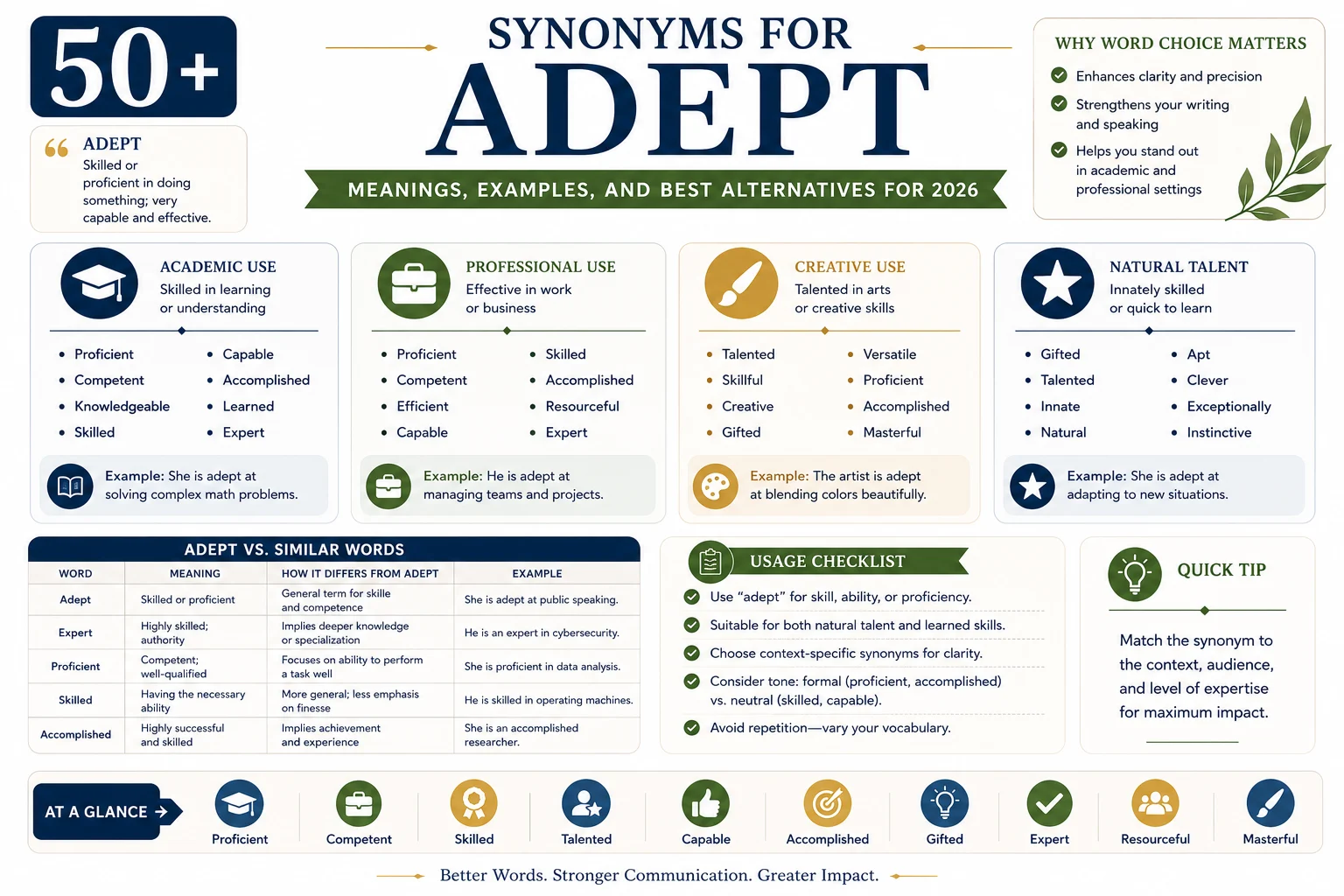
Adept means highly skilled or proficient at something through practice and experience. The best synonym depends on context: use skilled for general use, expert for professional mastery, proficient for workplace competence, masterful for artistic ability, and accomplished for achievements.
Have you ever described someone as “adept” and immediately wondered if there was a better word to capture their true level of ability?
You are not alone. Most writers, students, and professionals struggle to find the precise word that conveys just how capable someone really is.
Imagine you are writing a recommendation letter and you keep saying your colleague is “adept” at everything. Or you are crafting a resume and every bullet point uses the same tired phrase.
This is exactly the situation we will solve together.
A rich vocabulary transforms ordinary descriptions into powerful endorsements. When you master synonyms for adept, you gain the ability to express skill, expertise, and mastery with precision and impact.
This comprehensive guide will show you exactly how to choose the right synonym for adept in any situation. You will learn the subtle differences between skilled, proficient, expert, masterful, accomplished, and many other alternatives.
Meaning, Tone and Context
Simple Definition
To be adept means to be very skilled or proficient at a particular activity or task. It suggests natural ability combined with practiced expertise.
Part of Speech
Adept is primarily an adjective, though it can occasionally function as a noun referring to a skilled person. As an adjective, it is used with “at” or “in” to indicate the area of expertise.
Tone
Positive and complimentary. The tone expresses admiration and recognition of someone’s competence. It carries a sense of respect for developed ability.
Formality Level
Adept is moderately formal. It is appropriate for professional writing, academic contexts, and formal descriptions. It sounds more sophisticated than “good at” but less formal than “proficient” in some contexts.
Common Use Cases
- Describing workplace skills: “She is adept at managing teams.”
- Highlighting technical abilities: “He is adept with complex software systems.”
- Recognizing artistic talent: “The painter is adept in watercolor techniques.”
- Acknowledging problem-solving: “Our team is adept at finding creative solutions.”
- Showing adaptability: “She is adept at learning new technologies quickly.”
Important Word Forms
- Adjective: adept, more adept, most adept
- Noun: adept (a skilled person)
- Adverb: adeptly (in a skilled manner)
- Noun: adeptness (the quality of being skilled)
- Related adjective: adept at, adept in
When and How to Use “Adept”
Use adept when you want to express that someone possesses a high level of skill or proficiency developed through practice and experience. It works best when you need to compliment someone’s capabilities or highlight expertise.
Professional example:
“Our senior developer is adept at troubleshooting complex system issues and implementing effective solutions.”
Personal example:
“My grandmother is surprisingly adept at using social media to stay connected with her grandchildren.”
Academic example:
“Students who become adept at critical thinking perform better in research-based courses.”
Emotional example:
“She was adept at reading people’s emotions, making her an exceptional counselor.”
Creative example:
“The jazz musician was adept at weaving improvisation into every performance.”
Social media example:
“This creator is incredibly adept at making complex topics feel accessible and engaging.”
Resume example:
“Adept at leading cross-functional teams to deliver projects ahead of schedule.”
Casual example:
“Jake is pretty adept at fixing anything around the house.”
Another Word for “Adept”
The best single replacement depends entirely on your context and what you want to emphasize.
- Professional writing: Proficient
- Academic writing: Skilled, competent
- Casual conversation: Good at
- Emotional writing: Gifted
- Creative writing: Masterful
- Resume or workplace: Expert, accomplished
- Social media captions: Skilled, talented
- Stronger meaning: Expert, masterful
- Softer meaning: Competent, capable
When Not to Use “Adept”
Adept sounds too generic when you need to specify the exact nature of someone’s skill or the level of their expertise.
Too vague: “She is adept at her job.”
More precise: “She is adept at negotiating complex contracts and resolving client disputes.”
Too formal: “He is adept at cooking.”
More casual: “He is great at cooking.”
Too weak: “He is adept at public speaking.”
Stronger: “He is a masterful public speaker who captivates audiences.”
Too general: “The team is adept.”
More specific: “The team is adept at data analysis and strategic planning.”
Words Commonly Confused With “Adept”
Adept vs. Skilled
Skilled is broader and refers to having developed abilities through training or experience. Adept implies a higher level of proficiency and natural ease. You can be skilled at many things, but you are adept at those you excel in particularly.
Adept vs. Proficient
Proficient emphasizes competence and meeting standards. Adept suggests surpassing basic proficiency with natural flair. A proficient accountant can complete tax returns accurately, while an adept accountant finds creative solutions to complex financial problems.
Adept vs. Expert
Expert is the highest level of proficiency, implying extensive knowledge and authority. Adept is impressive but does not necessarily indicate the same depth of specialized knowledge. An expert has years of deep study, while an adept person performs with great skill.
Adept vs. Masterful
Masterful suggests commanding control and authority, often with artistic or creative connotations. Adept is more general. A masterful pianist performs with extraordinary control, while an adept pianist plays with great skill.
Adept vs. Accomplished
Accomplished emphasizes achievements and success. Adept focuses on skill and ability. An accomplished professional has a track record of success, while an adept professional demonstrates superior skill in their work.
Adept vs. Talented
Talented suggests natural ability or aptitude. Adept emphasizes developed skill through practice. A talented singer has a beautiful voice naturally, while an adept singer has honed their technique through years of practice.
Best Synonym by Context for “Adept”
| Context | Best Synonym | Why It Works | Example |
|---|---|---|---|
| Formal writing | Proficient | Standard professional terminology | The candidate is proficient in project management. |
| Academic writing | Skilled | Precise and widely understood | Skilled researchers produce reliable findings. |
| Professional use | Expert | Conveys authority and reliability | Our expert team delivers exceptional results. |
| Resume writing | Accomplished | Highlights achievements and success | Accomplished professional with ten years of experience. |
| Casual conversation | Great at | Natural and friendly | She is great at solving problems. |
| Creative writing | Masterful | Adds artistic depth and admiration | His masterful storytelling captivated the audience. |
| Emotional tone | Gifted | Expresses natural talent and appreciation | She is gifted in connecting with people. |
| Strong intensity | Expert | Shows highest level of competence | He is an expert negotiator. |
| Soft tone | Competent | Professional but modest | She is competent in all required areas. |
| Social media | Skilled | Modern and conversational | Skilled creator sharing valuable tips daily. |
| US usage | Skilled | Common in American professional contexts | Skilled workers are always in demand. |
| UK usage | Proficient | Equally common but slightly more formal | She is proficient in multiple programming languages. |
Which Synonym Should You Choose?
Choosing the right synonym for adept depends on four key factors.
First, consider the level of expertise. Are you describing basic competence, developed skill, or exceptional mastery? Competent works for basic ability, skilled and proficient for developed competence, and expert or masterful for the highest level.
Second, think about the context. Professional settings favor proficient and expert. Academic writing benefits from skilled and competent. Casual conversation welcomes great at and talented.
Third, evaluate whether the skill is natural or developed. Talented and gifted suggest innate ability, while proficient and accomplished emphasize practice and achievement.
Fourth, consider your audience. Hiring managers appreciate expert and accomplished. Friends and family understand great at and talented perfectly.
Remember the simple rule: when in doubt, skilled is the safest, most versatile choice for almost any context.
Real Life Examples of “Adept” in Sentences
School Context
“Students who become adept at time management complete assignments with less stress. Those adept at active learning retain more information and perform better on exams.”
Workplace Context
“Our marketing team is adept at identifying emerging trends before competitors notice them. We need professionals adept at adapting to rapid industry changes.”
Writing Context
“Effective writers are adept at choosing words that evoke specific emotions. Authors adept at building suspense keep readers engaged until the final page.”
Conversation Context
“My cousin is adept at fixing computers and always helps when mine crashes. You should see how adept she is at explaining technology to beginners.”
Social Media Context
“Content creators adept at storytelling build loyal followings quickly. This influencer is adept at turning everyday moments into engaging content.”
Email Context
“Our team is adept at handling high-volume customer inquiries. Please note that we are adept at customizing solutions for each client’s unique needs.”
Storytelling Context
“The old craftsman was adept at transforming rough wood into elegant furniture. His hands moved adeptly across the surface, revealing the beauty within.”
25 Synonyms for “Adept”
| Synonym | Simple Meaning | Best Used For | Example Sentence |
|---|---|---|---|
| Skilled | Having developed abilities | General use, all contexts | She is skilled in data analysis. |
| Proficient | Competent and capable | Professional, workplace | He is proficient in Spanish. |
| Expert | Highly knowledgeable | Professional, formal | Our expert team solved the crisis. |
| Masterful | Showing great control | Creative, artistic | Her masterful piano performance amazed everyone. |
| Accomplished | Highly successful and skilled | Achievements, resumes | An accomplished researcher published dozens of papers. |
| Competent | Capable and effective | Professional, modest | She is competent in all required tasks. |
| Talented | Having natural aptitude | Casual, personal | He is a talented graphic designer. |
| Gifted | Having exceptional natural ability | Emotional, appreciative | She is gifted in teaching children. |
| Qualified | Having necessary skills | Formal, professional | He is qualified for senior leadership. |
| Capable | Having the ability to do something | General, professional | Our team is capable of meeting deadlines. |
| Adroit | Quick and skillful | Formal, literary | He was adroit at handling difficult situations. |
| Dexterous | Showing mental or physical skill | Literary, descriptive | The artist’s dexterous hands created masterpieces. |
| Savvy | Practical knowledge and ability | Modern, professional | She is tech-savvy and adaptable. |
| Apt | Quick to learn or understand | Professional, academic | He is apt at learning new languages. |
| Clever | Skillful and intelligent | Casual, modern | She is clever at solving puzzles. |
| Resourceful | Good at finding solutions | Professional, practical | He is resourceful in challenging situations. |
| Seasoned | Experienced and skilled | Professional, workplace | A seasoned professional joined our team. |
| Veteran | Experienced and skilled | Professional, formal | Veteran teachers provide invaluable guidance. |
| Expertly | With great skill | Adverb form | She expertly handled the negotiation. |
| Handy | Skilled with hands | Casual, practical | My grandfather is handy with tools. |
| Nifty | Clever and skillful | Informal, playful | She is nifty at fixing broken gadgets. |
| Sharp | Quick-witted and skillful | Casual, modern | He is sharp in business negotiations. |
| Canny | Showing shrewd skill | Professional, strategic | Her canny approach saved the project. |
| Versatile | Good at many things | Professional, complimentary | She is a versatile and capable leader. |
| Polished | Refined and skilled | Professional, artistic | His polished presentation impressed everyone. |
Synonym Groups and Usage Differences
Professional vs. Personal Synonyms
Professional contexts favor proficient, expert, accomplished, and seasoned. These words convey competence and reliability in workplace settings. Personal contexts welcome talented, gifted, great at, and handy, which build warm, appreciative connections.
Formal vs. Conversational Synonyms
Formal writing uses proficient, expert, competent, and adroit. These words appear in reports, essays, references, and official documents. Conversational contexts use great at, good at, handy, and nifty for everyday speech.
Academic Synonyms
Academic writing benefits from skilled, competent, apt, and capable. These words show precise thinking and measured evaluation. They work well in research papers, recommendations, and scholarly articles.
Professional and Business Synonyms
Business communication favors proficient, expert, accomplished, seasoned, and resourceful. These words appear in resumes, emails, reviews, and presentations. They project confidence, competence, and strategic value.
Creative or Literary Synonyms
Creative writing uses masterful, adroit, dexterous, and gifted. These words add descriptive richness and emotional depth to narratives, poetry, and character descriptions.
Slang or Modern Synonyms
Savvy, nifty, handy, and sharp work in casual contexts and modern conversations. They are acceptable with friends and in informal writing. They are too casual for academic essays, formal reports, or professional documents.
Strongest vs. Weaker Synonyms
Mild: Capable, competent (showing basic ability)
Moderate: Skilled, proficient, talented (showing developed skill)
Strong: Expert, accomplished (showing exceptional achievement)
Intense: Masterful, adroit (showing extraordinary control and artistry)
Emotional vs. Neutral Synonyms
Emotional: Gifted, talented, masterful (express admiration, appreciation, and awe)
Neutral: Skilled, proficient, competent, capable (factual, professional, and measured)
Antonyms of “Adept”
| Antonym | Meaning | Example Sentence |
|---|---|---|
| Incompetent | Lacking necessary skills | The incompetent manager failed to lead the team. |
| Inept | Lacking skill or ability | His inept handling of the project caused delays. |
| Unskilled | Not having developed abilities | Unskilled workers need additional training. |
| Clumsy | Awkward in movement or action | Her clumsy approach frustrated her colleagues. |
| Awkward | Lacking grace or skill | He felt awkward during the presentation. |
| Inexperienced | Lacking practice or knowledge | The inexperienced intern needed guidance. |
| Unqualified | Not meeting requirements | She was unqualified for the senior role. |
| Incapable | Lacking the ability | He is incapable of managing the team. |
| Ineffective | Not producing desired results | The ineffective strategy wasted resources. |
| Amateurish | Lacking professional skill | The amateurish design hurt their brand. |
| Untrained | Not having received instruction | Untrained staff cannot operate the equipment. |
| Inadequate | Not sufficient in ability | Her inadequate preparation showed in the exam. |
| Bungling | Incompetent at tasks | His bungling efforts made things worse. |
| Unpracticed | Not having had practice | Her unpracticed performance disappointed everyone. |
| Maladroit | Clumsy or tactless | His maladroit comment offended the client. |
Comparison: Adept vs. Similar Words
Adept vs. Skilled
Main difference: Skilled is broader and refers to developed ability. Adept suggests natural ease and high proficiency.
Which is stronger: Adept is stronger and more specific.
Which is more formal: Adept is slightly more formal.
Example with adept: “She is adept at reading complex financial reports.”
Example with skilled: “He is a skilled carpenter who builds beautiful furniture.”
Adept vs. Proficient
Main difference: Proficient emphasizes competence and meeting standards. Adept suggests surpassing basic proficiency.
Which is stronger: Adept is stronger, implying excellence beyond mere competence.
Which is more formal: Proficient is commonly used in official contexts.
Example with adept: “The surgeon is adept at performing delicate procedures.”
Example with proficient: “The technician is proficient in all required software.”
Adept vs. Expert
Main difference: Expert represents the highest level of knowledge and authority. Adept is impressive but may not indicate the same depth.
Which is stronger: Expert is significantly stronger.
Which is more formal: Expert is more formal and authoritative.
Example with adept: “She is adept at graphic design.”
Example with expert: “He is an expert in international tax law.”
Adept vs. Masterful
Main difference: Masterful suggests commanding control and artistic mastery. Adept is more general and practical.
Which is stronger: Masterful is stronger and more artistic.
Which is more formal: Masterful is more literary and descriptive.
Example with adept: “She is adept at managing projects.”
Example with masterful: “His masterful direction brought the play to life.”
Adept vs. Accomplished
Main difference: Accomplished emphasizes achievements and success. Adept focuses on skill and ability.
Which is stronger: Accomplished is stronger in terms of proven results.
Which is more formal: Accomplished is more formal, often used in resumes.
Example with adept: “He is adept at problem-solving.”
Example with accomplished: “She is an accomplished leader with many awards.”
Adept vs. Talented
Main difference: Talented suggests natural ability or aptitude. Adept emphasizes developed skill through practice.
Which is stronger: Both are strong, but adept emphasizes honed skill.
Which is more formal: Adept is more formal and professional.
Example with adept: “She is adept at presenting complex ideas clearly.”
Example with talented: “He is a talented musician with perfect pitch.”
Common Phrases and Expressions with “Adept”
1. Adept at something
Meaning: Skilled in a particular activity.
Example: “She is remarkably adept at negotiating business deals.”
2. Adept in something
Meaning: Proficient in a field or area.
Example: “He is adept in multiple programming languages.”
3. Adept with something
Meaning: Skilled at using a tool or resource.
Example: “Our team is adept with the latest marketing analytics tools.”
4. Prove adept at
Meaning: Demonstrate skill in a situation.
Example: “The new manager proved adept at resolving employee conflicts.”
5. Become adept at
Meaning: Develop skill over time.
Example: “Through practice, she became adept at public speaking.”
6. Highly adept
Meaning: Extremely skilled.
Example: “The highly adept technician fixed the issue in minutes.”
Common Mistakes to Avoid
1. Using adept when a more precise synonym is better
Adept is often too general. Choose expert for exceptional knowledge, talented for natural ability, or accomplished for proven success.
Mistake: “She is adept at her job.”
Better: “She is an accomplished professional with excellent results.”
2. Confusing adept with adapt
Adept and adapt are commonly confused but have completely different meanings. Adept means skilled, while adapt means to adjust or change.
Mistake: “He is adapt at problem-solving.”
Better: “He is adept at problem-solving.”
3. Using adept without a preposition
Adept must be followed by at, in, or with to indicate the area of expertise.
Mistake: “She is adept coding.”
Better: “She is adept at coding.”
4. Overusing adept in resumes
Resumes that use adept repeatedly sound repetitive and lack variety. Use different synonyms for different skills.
Repetitive: “Adept at Excel. Adept at communication. Adept at leadership.”
Varied: “Proficient in Excel. Skilled communicator. Accomplished leader.”
5. Using adept when a simpler word works
In casual conversation, great at or good at often sound more natural than adept.
Mistake: “I am adept at cooking pasta.”
Better: “I am great at cooking pasta.”
6. Overstating ability
Using expert or masterful for moderate skills sounds boastful and inaccurate.
Mistake: “He is a masterful chef.”
Better: “He is an accomplished home cook.”
7. Using slang in professional documents
Handy, nifty, and sharp are too casual for resumes, cover letters, and formal emails.
Mistake: “I am handy with spreadsheets.”
Better: “I am proficient in spreadsheet analysis.”
FAQs
1. What is the best synonym for adept?
The best synonym for adept is skilled. It works in almost all contexts, from casual conversation to professional writing, and captures the essential meaning of having developed ability.
2. What is a formal synonym for adept?
A formal synonym for adept is proficient or competent. These words add professionalism and precision to academic essays, legal documents, and official correspondence.
3. What is an informal synonym for adept?
An informal synonym for adept is great at or talented. These words are natural in casual conversation, texts, and social media posts.
4. What is another word for adept in professional writing?
Another word for adept in professional writing is accomplished or expert. These words sound confident and strategic in business communications and resumes.
5. What is the difference between adept and proficient?
Adept suggests natural ease and high proficiency, while proficient emphasizes meeting standards and demonstrating competence. Adept is stronger and more complimentary.
6. What is the opposite of adept?
The opposite of adept is inept or incompetent. These words express lack of skill or ability.
Conclusion
Adept is a powerful adjective that expresses skill, proficiency, and natural ease. Its true value emerges when you choose the right synonym for your specific context.
Use skilled for general situations, proficient for professional settings, expert for exceptional knowledge, and talented for natural ability. Academic writing benefits from competent and capable, while creative expression welcomes masterful and adroit.
Understanding tone and context transforms your vocabulary from adequate to excellent. A precise synonym makes your writing clear, engaging, and impactful.
The next time you describe someone as adept, pause and consider which alternative serves your message best. You might choose expert for its authority, talented for its warmth, or accomplished for its achievements. This simple habit will elevate every recommendation, resume, and conversation you write.
Start applying these synonyms today. Your readers will appreciate the precision and confidence in your words.
