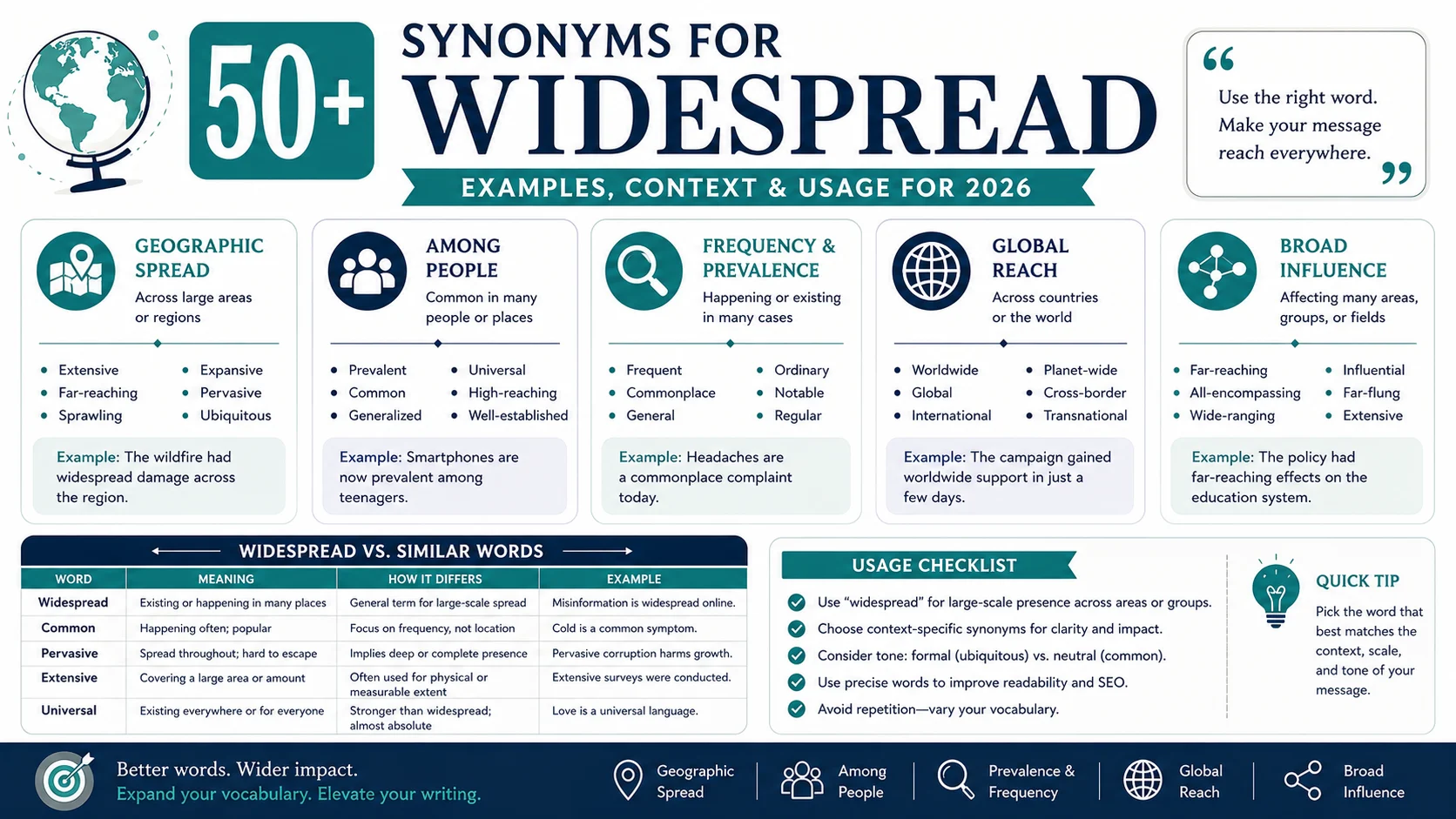
Widespread means something that exists or happens over a large area, among many people, or in many places. The best synonym depends on context: use prevalent for common occurrence, pervasive for negative spread, common for everyday use, and extensive for physical coverage.
Have you ever described something as “widespread” in a report, essay, or conversation and felt the word was too vague?
You are not alone. Writers, students, and professionals often reach for this useful adjective without realizing how many precise alternatives exist.
Imagine you are writing a public health report about a seasonal illness. You write, “The flu is widespread.” While technically correct, this statement lacks the precision that makes writing impactful.
Or picture yourself composing a business presentation about market trends. You say, “Remote work is widespread.” Your audience understands the idea, but they miss the nuance you could have conveyed with a more specific word.
This is exactly the vocabulary challenge we will solve together.
A rich vocabulary transforms ordinary descriptions into vivid, precise communication. When you master synonyms for widespread, you gain the ability to describe scope, prevalence, and distribution with clarity and impact.
This comprehensive guide will show you exactly how to choose the right synonym for widespread in any situation. You will learn the subtle differences between prevalent, pervasive, common, extensive, and many other powerful alternatives.
Meaning, Tone and Context
Simple Definition
Widespread describes something that is found or distributed over a large area, among a vast number of people, or in many places. It indicates broad reach and significant prevalence.
Part of Speech
Widespread is an adjective. It modifies nouns to indicate extensive distribution or occurrence.
Tone
- Neutral. The tone shifts based on what you are describing. It becomes negative when describing problems such as disease or poverty. It becomes positive when describing benefits such as education or opportunity. It remains neutral for factual descriptions such as weather patterns or technological adoption.
Formality Level
Widespread is standard English suitable for all contexts. It works in casual conversation, professional reports, academic papers, and journalistic writing.
Common Use Cases
- Describing disease or health conditions: “The illness was widespread.”
- Discussing social phenomena: “Social media usage is widespread.”
- Explaining environmental issues: “Deforestation is widespread in the region.”
- Describing technological adoption: “Smartphone use is widespread globally.”
- Talking about beliefs or opinions: “The sentiment is widespread among voters.”
- Describing natural phenomena: “The drought had widespread effects.”
Important Word Forms
- Adjective: widespread
- Adverb: widely (used to modify verbs and adjectives)
- Noun: spread (the extent or reach of something)
- Related forms: widespreadness (less common)
When and How to Use “Widespread”
Use widespread when you need to communicate that something covers a large physical area, affects many people, or exists in many different locations. It works best when emphasizing breadth and reach rather than intensity or specific concentration.
Professional example:
“The new policy received widespread support across all departments and regions.”
Personal example:
“The popularity of plant based diets has become widespread among my friends and coworkers.”
Academic example:
“There is widespread agreement among researchers about the primary causes of climate change.”
Emotional example:
“Widespread grief followed the announcement of the community leader’s passing.”
Creative example:
“News of the discovery spread with widespread urgency through the quiet town.”
Social media example:
“Widespread memes and trends dominate our feeds within hours of events.”
Resume example:
“Led a team that implemented widespread process improvements across eight international offices.”
Casual example:
“Once the video went viral, widespread interest in the product exploded overnight.”
Another Word for “Widespread”
The best single replacement depends entirely on your context and what aspect of spread you want to emphasize.
- Professional writing: Extensive, comprehensive
- Academic writing: Prevalent, pervasive
- Casual conversation: Common, everywhere
- Emotional writing: Far reaching, sweeping
- Creative writing: Expansive, panoramic
- Resume or workplace: Company wide, organization wide
- Social media captions: Viral, trending
- Stronger meaning: Pervasive, rampant
- Softer meaning: Common, usual
- Negative context: Rampant, endemic
- Positive context: Ubiquitous, universal
When Not to Use “Widespread”
Widespread sounds too general when you need to specify the exact nature, intensity, or concentration of the spread.
Too vague: “The problem is widespread.”
More precise: “The problem is pervasive throughout the organization’s culture.”
Too weak: “Interest in our product is widespread.”
Stronger: “Interest in our product is rampant across all demographic groups.”
Too casual: “The tradition is widespread in our community.”
More formal: “The tradition is prevalent among community members.”
Too general: “Technology use is widespread.”
More specific: “Technology adoption is ubiquitous among urban populations.”
Too neutral: “Changes were widespread.”
More descriptive: “Changes were sweeping across every department.”
Too abstract: “Her influence was widespread.”
More concrete: “Her influence extended across three continents.”
Words Commonly Confused With “Widespread”
Widespread vs. Prevalent
These are often used interchangeably, but there is a subtle difference. Prevalent emphasizes common occurrence and existence in a particular place or among a particular group. Widespread emphasizes physical or geographic distribution. A disease can be prevalent in a city but widespread across a country.
Widespread vs. Pervasive
Pervasive suggests an unpleasant or unwelcome presence that spreads throughout everything. It carries a negative connotation. Widespread is neutral. Bad odors are pervasive. Smartphones are widespread.
Widespread vs. Common
Common means found frequently or usual. It does not necessarily imply broad distribution. Widespread always implies extensive reach. Rain is common in spring, but a particular weather pattern is widespread across the region.
Widespread vs. Extensive
Extensive emphasizes large size, amount, or scope. Widespread emphasizes distribution across space or population. You can have extensive knowledge, but you have widespread influence.
Widespread vs. Ubiquitous
Ubiquitous means present everywhere at the same time. It suggests near universality. Widespread suggests large distribution but not necessarily everywhere. Smartphones are ubiquitous in modern cities. Smartphones are widespread in developing nations.
Widespread vs. Rampant
Rampant describes something negative that grows uncontrolled and unchecked. It carries a strong negative connotation. Widespread is neutral. Crime is rampant. Social media use is widespread.
Widespread vs. Endemic
Endemic describes something that is regularly found among a particular people or in a certain area. Widespread describes broad distribution. Malaria is endemic in tropical regions. The flu is widespread during winter months.
Best Synonym by Context for “Widespread”
| Context | Best Synonym | Why It Works | Example |
|---|---|---|---|
| Formal writing | Prevalent | Academic and professional tone | The condition is prevalent among older adults. |
| Academic writing | Ubiquitous | Shows sophisticated vocabulary | Smartphones are ubiquitous in modern society. |
| Professional use | Extensive | Emphasizes scope and reach | Extensive research supports our conclusions. |
| Resume writing | Company wide | Specific and measurable | Implemented company wide training initiatives. |
| Casual conversation | Everywhere | Natural and conversational | Her music is everywhere these days. |
| Creative writing | Sweeping | Adds visual and emotional impact | Sweeping changes transformed the landscape. |
| Emotional tone | Far reaching | Shows impact and significance | The tragedy had far reaching consequences. |
| Strong intensity | Rampant | Emphasizes uncontrolled spread | Corruption was rampant in the organization. |
| Soft tone | Common | Gentle and unassuming | This practice is common in many cultures. |
| Social media | Viral | Modern and engaging | The challenge went viral within hours. |
| Negative context | Pervasive | Highlights unwelcome presence | A pervasive sense of unease filled the room. |
| Positive context | Universal | Emphasizes widespread acceptance | Universal access to education is a goal. |
| US usage | Widespread | Common in American English | Widespread flooding affected the region. |
| UK usage | Prevalent | More common in British academic writing | The disease is prevalent in rural areas. |
Which Synonym Should You Choose?
Choosing the right synonym for widespread depends on four key factors.
First, consider your meaning. Are you describing physical distribution, common occurrence, or negative uncontrolled spread? Physical distribution calls for extensive or expansive. Common occurrence suggests prevalent or common. Negative spread demands pervasive or rampant.
Second, think about formality. Academic and professional writing requires prevalent, ubiquitous, or extensive. Casual communication welcomes everywhere or common.
Third, evaluate emotional tone. Do you need a word with negative weight such as rampant or pervasive? Or do you need something neutral such as prevalent or extensive?
Fourth, consider your audience. Business stakeholders appreciate extensive and organization wide. Friends and family understand everywhere and common perfectly.
Remember the simple rule: when in doubt, prevalent is the safest, most versatile choice for almost any context.
Real Life Examples of “Widespread” in Sentences
School Context
“Widespread student engagement in extracurricular activities contributes to a vibrant campus culture. Teachers note that widespread participation in study groups improves overall academic performance.”
Workplace Context
“The new software update received widespread adoption across all departments within two weeks. Management noted widespread enthusiasm for the flexible work policy.”
Writing Context
“Good descriptive writing relies on widespread sensory details to immerse readers in the scene. Authors achieve widespread appeal by connecting with universal human experiences.”
Conversation Context
“Widespread rumors about the merger caused anxiety among employees. The celebration of the holiday has become widespread in communities across the country.”
Social Media Context
“Widespread sharing of the campaign video led to record donations. The hashtag quickly gained widespread traction among users worldwide.”
Email Context
“We have seen widespread interest in the new product line. Please note that widespread participation in the survey will help us make better decisions.”
Storytelling Context
“The king’s widespread influence reached every corner of the kingdom. A widespread silence fell over the crowd as the announcement was made.”
- 25 Synonyms for “Widespread
| Synonym | Simple Meaning | Best Used For | Example Sentence |
|---|---|---|---|
| Prevalent | Common in a particular area or group | General use, all contexts | Diabetes is prevalent among older adults. |
| Pervasive | Spread throughout and perceived everywhere | Negative or neutral contexts | A pervasive smell of smoke filled the building. |
| Common | Found frequently or usual | Casual, everyday use | Snow is common in the northern states. |
| Extensive | Large in amount, size, or scope | Formal, professional contexts | Extensive damage was reported after the storm. |
| Ubiquitous | Present everywhere at the same time | Academic, sophisticated writing | Wireless internet is ubiquitous in cities. |
| Sweeping | Extending over a large area | Creative, dramatic contexts | Sweeping reforms changed the education system. |
| Far reaching | Having broad effects or implications | Emotional, significant situations | The decision had far reaching consequences. |
| Rampant | Uncontrolled and widespread | Negative contexts | Rampant inflation hurt the economy. |
| Universal | Present in all places or among all people | Positive, idealistic contexts | Universal healthcare remains a goal. |
| Epidemic | Widespread occurrence of a disease | Health, negative contexts | The flu reached epidemic proportions. |
| Endemic | Regularly found in a particular area | Health, regional contexts | Malaria is endemic in tropical regions. |
| General | Affecting the majority | Neutral, professional contexts | There is general agreement on the issue. |
| Popular | Liked by many people | Positive, casual contexts | The app is popular among teenagers. |
| Rife | Common and widespread, often negative | Formal, negative contexts | Corruption is rife in some industries. |
| Expansive | Covering a wide area | Geographic, descriptive contexts | Expansive views stretched across the valley. |
| Global | Worldwide in scope | International, business contexts | Climate change is a global concern. |
| Broad | Wide in extent | Professional, academic contexts | Broad consensus supports the policy. |
| Deep seated | Firmly established and widespread | Psychological, cultural contexts | Deep seated beliefs are hard to change. |
| Extensive | Large scale and far reaching | Professional, formal contexts | Extensive research confirmed the findings. |
| Widespreading | Spreading widely over an area | Geographic, scientific contexts | The wildfire was widespreading rapidly. |
| Perennial | Recurring and widespread | Seasonal, cyclical contexts | Perennial flooding affects the region. |
| Systemic | Relating to a whole system | Organizational, academic contexts | Systemic racism exists in many institutions. |
| Radical | Extreme and far reaching | Political, social contexts | Radical changes transformed the industry. |
| Penetrating | Spreading deeply into something | Intellectual, emotional contexts | Her penetrating insights changed my perspective. |
| Boundless | Having no limits | Creative, inspirational contexts | Boundless ambition drove his success. |
Synonym Groups and Usage Differences
Professional vs. Personal Synonyms
Professional contexts favor extensive, company wide, and prevalent. These words sound competent and strategic in workplace communications. Personal contexts welcome common, everywhere, and popular, which are natural and approachable in everyday conversation.
Formal vs. Conversational Synonyms
Formal writing uses prevalent, ubiquitous, extensive, and pervasive. These words appear in reports, essays, academic papers, and official documents. Conversational contexts use common, everywhere, and popular for texts, social media, and everyday speech.
Academic Synonyms
Academic writing benefits from ubiquitous, prevalent, and extensive. These words demonstrate sophisticated vocabulary and precise thinking. They work well in research papers, essays, and scholarly articles where accuracy and formal tone matter.
Professional and Business Synonyms
Business communication favors extensive, company wide, organization wide, and global. These words appear in emails, reports, presentations, and strategic documents. They project competence and strategic awareness.
Creative or Literary Synonyms
Creative writing uses sweeping, expansive, far reaching, and boundless. These words add imagery, drama, and descriptive richness to narratives, poetry, and storytelling. They bring scenes and concepts to life.
Slang or Modern Synonyms
Viral and trending work in casual contexts, social media captions, and modern conversations. They are acceptable on platforms where informal language fits the tone. They are too casual for academic essays, formal reports, or professional documents.
Strongest vs. Weaker Synonyms
Mild: Common, general, popular (gentle and simple)
Moderate: Widespread, prevalent, extensive (standard and reliable)
Strong: Pervasive, rampant, sweeping (forceful and impactful)
Intense: Ubiquitous, universal, boundless (extreme and absolute)
Emotional vs. Neutral Synonyms
Emotional: Far reaching, sweeping, pervasive (express impact, drama, and significant effect)
Neutral: Widespread, prevalent, extensive (factual, objective, and professional)
Negative vs. Positive Synonyms
Negative: Rampant, pervasive, rife, epidemic (describe harmful, destructive, or unwelcome spread)
Positive: Universal, popular, expansive (describe beneficial, welcome, or desirable spread)
Neutral: Widespread, prevalent, extensive (objective descriptions)
Antonyms of “Widespread”
| Antonym | Meaning | Example Sentence |
|---|---|---|
| Limited | Restricted in size, amount, or extent | The damage was limited to a small area. |
| Rare | Not occurring very often | This species is rare in the wild. |
| Uncommon | Not frequently found | Such behavior is uncommon in our culture. |
| Restricted | Kept within certain limits | Access to the facility is restricted. |
| Isolated | Far away from others | The village is isolated from major cities. |
| Local | Affecting only a particular area | The problem is local, not national. |
| Scarce | Insufficient in supply | Clean water is scarce in the region. |
| Sparse | Thinly scattered or distributed | Sparse population inhabits the desert. |
| Regional | Limited to one geographic area | The tradition is regional, not national. |
| Confined | Kept within boundaries | The disease remains confined to the hospital. |
| Narrow | Limited in extent or scope | His views are narrow compared to others. |
| Exceptional | Unusual and not typical | The weather is exceptional for this time of year. |
| Occasional | Happening from time to time | Occasional storms occur during summer. |
| Infrequent | Not occurring often | Infrequent visitors came to the remote island. |
| Sporadic | Occurring at irregular intervals | Sporadic power outages affected the region. |
Comparison: Widespread vs. Similar Words
Widespread vs. Prevalent
Main difference: Prevalent emphasizes common occurrence in a particular place or group. Widespread emphasizes broad geographic or population distribution.
Which is stronger: Widespread is stronger regarding geographic reach.
Which is more formal: Both are formal, but prevalent appears more frequently in academic writing.
Example with widespread: “The flu is widespread across the entire state.”
Example with prevalent: “The flu is prevalent among school age children.”
Widespread vs. Pervasive
Main difference: Pervasive suggests an unpleasant, unwelcome presence that spreads throughout everything. Widespread is neutral.
Which is stronger: Pervasive is stronger and more intense, especially with negative connotations.
Which is more formal: Both are formal, but pervasive is more literary.
Example with widespread: “Smartphones are widespread in modern society.”
Example with pervasive: “A pervasive sense of anxiety filled the workplace.”
Widespread vs. Common
Main difference: Common means frequent or usual and does not imply broad distribution. Widespread always implies extensive reach.
Which is stronger: Widespread is stronger regarding scope and extent.
Which is more formal: Widespread is more formal.
Example with widespread: “The trend is widespread across Europe.”
Example with common: “The trend is common among teenagers.”
Widespread vs. Extensive
Main difference: Extensive emphasizes large size, amount, or scope. Widespread emphasizes distribution across space or population.
Which is stronger: Extensive is stronger regarding amount and scale.
Which is more formal: Both are formal and professional.
Example with widespread: “The damage was widespread across the region.”
Example with extensive: “Extensive damage required months of repairs.”
Widespread vs. Ubiquitous
Main difference: Ubiquitous means present everywhere at the same time and suggests near universality. Widespread suggests large distribution but not necessarily everywhere.
Which is stronger: Ubiquitous is stronger because it implies complete presence.
Which is more formal: Ubiquitous is more sophisticated and formal.
Example with widespread: “Coffee shops are widespread in urban areas.”
Example with ubiquitous: “Coffee shops are ubiquitous in modern cities.”
Widespread vs. Rampant
Main difference: Rampant describes something negative that grows uncontrolled. Widespread is neutral and describes distribution.
Which is stronger: Rampant is stronger and carries strong negative connotations.
Which is more formal: Both are formal, but rampant is more intense.
Example with widespread: “Social media use is widespread among teens.”
Example with rampant: “Rampant misinformation spread across social media.”
Widespread vs. Endemic
Main difference: Endemic describes something regularly found in a particular area or among a particular group. Widespread describes broad distribution.
Which is stronger: Both are precise, but endemic is more specific.
Which is more formal: Endemic is more technical and academic.
Example with widespread: “The disease is widespread during winter months.”
Example with endemic: “The disease is endemic in tropical regions.”
Common Phrases and Expressions with “Widespread”
1. Widespread support
Meaning: Support that exists among many people or groups.
Example: “The new policy has widespread support among voters from both parties.”
2. Widespread use
Meaning: Usage that occurs in many places or among many people.
Example: “The widespread use of smartphones has transformed how we communicate.”
3. Widespread concern
Meaning: Worry or anxiety shared by many people.
Example: “Widespread concern about climate change has led to policy reforms.”
4. Widespread availability
Meaning: Something that can be found or accessed in many places.
Example: “The widespread availability of online education has made learning accessible.”
5. Widespread adoption
Meaning: Acceptance and use that extends across many people or organizations.
Example: “The widespread adoption of renewable energy sources is encouraging.”
6. Widespread acclaim
Meaning: Praise and approval from many sources.
Example: “The film received widespread acclaim from critics and audiences.”
7. Widespread panic
Meaning: Fear or anxiety affecting a large number of people.
Example: “Widespread panic followed the announcement of the emergency.”
8. Widespread destruction
Meaning: Damage that affects a large area or many structures.
Example: “Widespread destruction was reported after the hurricane made landfall.”
Common Mistakes to Avoid
1. Using widespread when a more precise synonym is better
Widespread is often too general. Choose prevalent for common occurrence, pervasive for negative spread, and ubiquitous for near universality.
Mistake: “The problem is widespread.”
Better: “The problem is pervasive throughout the organization.”
2. Confusing widespread with epidemic
Epidemic specifically refers to disease spread among a population. Widespread applies to any phenomenon.
Mistake: “There is an epidemic of smartphone use.”
Better: “Smartphone use is widespread.”
Correct: “There is an epidemic of the flu.”
3. Using casual synonyms in formal writing
Everywhere and viral are too casual for academic essays and professional reports.
Mistake: “The issue is everywhere in academia.”
Better: “The issue is prevalent in academia.”
4. Using negative synonyms for positive situations
Rampant and pervasive carry negative weight and should not describe positive developments.
Mistake: “Rampant enthusiasm greeted the announcement.”
Better: “Widespread enthusiasm greeted the announcement.”
5. Repeating widespread too often in writing
Overusing any word weakens your writing. Vary your vocabulary with appropriate synonyms.
Repetitive: “Widespread change, widespread support, widespread adoption.”
Varied: “Sweeping change, widespread support, and universal adoption.”
6. Choosing a synonym with the wrong geographic implication
Global and international imply world wide reach. Widespread can describe regional or national distribution.
Mistake: “The local tradition is global.”
Better: “The local tradition is widespread in the region.”
7. Using slang in academic or professional writing
Viral and trending are unacceptable in scholarly articles, formal proposals, and official correspondence.
Mistake: “The theory went viral in academic circles.”
Better: “The theory gained widespread acceptance in academic circles.”
FAQs
1. What is the best synonym for widespread?
The best synonym for widespread is prevalent. It works in almost all contexts, captures the same essential meaning of common occurrence, and maintains professional tone.
2. What is a formal synonym for widespread?
A formal synonym for widespread is prevalent, ubiquitous, or extensive. These words add precision and sophistication to academic writing, reports, and formal documents.
3. What is an informal synonym for widespread?
An informal synonym for widespread is everywhere, common, or popular. These words are natural in casual conversation, texts, and social media posts.
4. What is another word for widespread in professional writing?
Another word for widespread in professional writing is extensive, company wide, or organization wide. These words sound strategic and specific in business communications.
5. What is the difference between widespread and pervasive?
Widespread describes broad distribution across space or population. Pervasive describes an unpleasant presence that spreads throughout everything and usually carries negative connotations.
6. What is the opposite of widespread?
The opposite of widespread is limited, rare, uncommon, or isolated. These words express restriction, scarcity, or concentration in a small area.
Conclusion
Widespread is a versatile adjective that expresses broad distribution, extensive reach, and common occurrence. Its true power emerges when you choose the right synonym for your specific context.
Use prevalent for general common occurrence, pervasive for negative spread, common for everyday situations, and extensive for large scope. Academic writing demands ubiquitous and prevalent, while professional communication favors extensive and organization wide.
Understanding tone and context transforms your vocabulary from adequate to excellent. A precise synonym makes your writing clear, engaging, and impactful.
The next time you type “widespread,” pause and consider which alternative serves your message best. You might choose prevalent for its academic precision, pervasive for its emotional weight, or universal for its hopeful reach. This simple habit will elevate every report, essay, and conversation you write.
Start applying these synonyms today. Your readers will appreciate the clarity and nuance.
