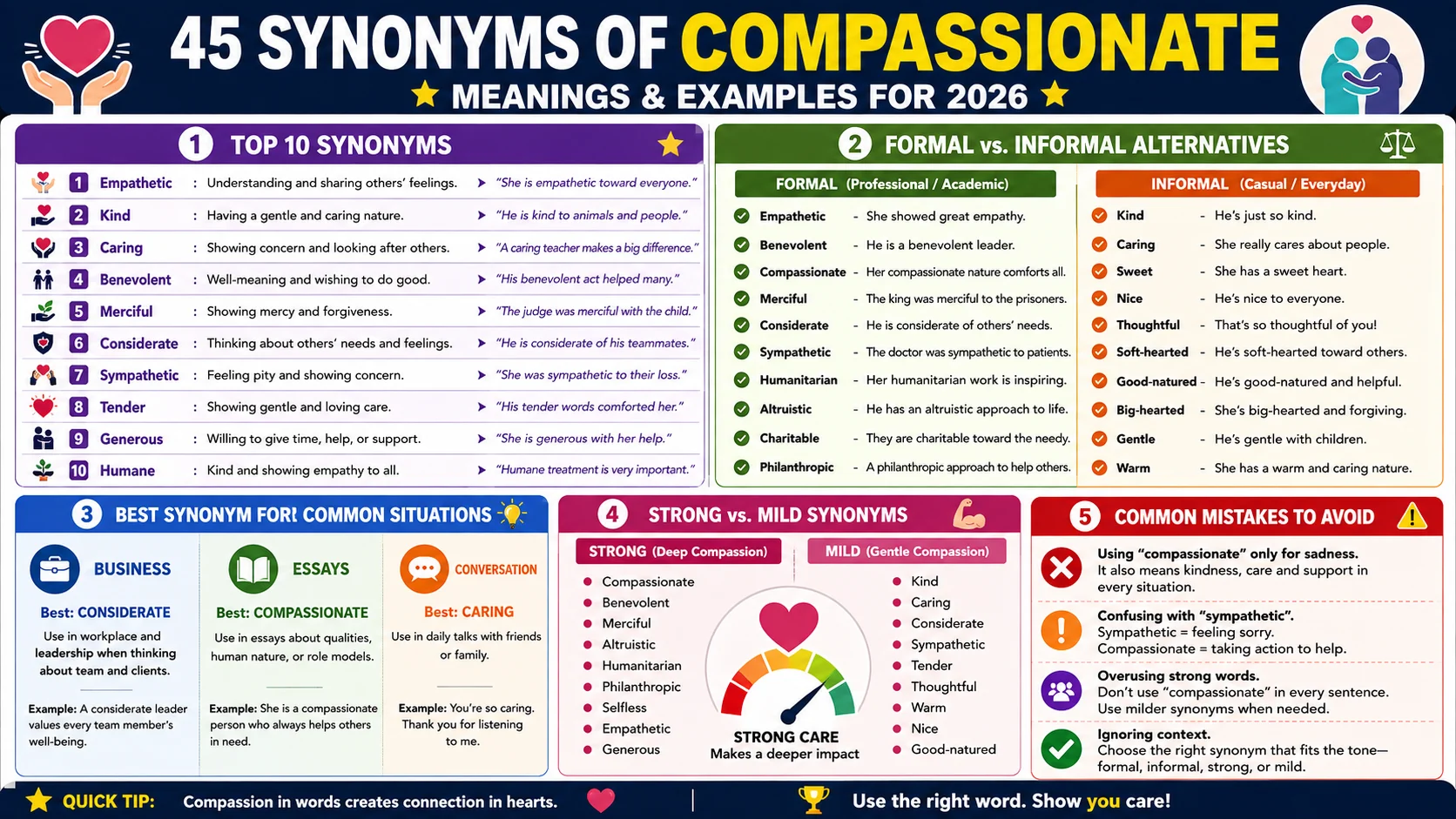
“Compassionate” means caring about others and wanting to help them when they suffer. The best synonyms are caring, kind, sympathetic, empathetic, and warm-hearted. “Caring” is the most common natural alternative. Each synonym has a slightly different meaning and context where it fits best.
Top 10 Synonyms
- Caring
- Kind
- Sympathetic
- Empathetic
- Warm-hearted
- Tender
- Understanding
- Benevolent
- Generous
- Humane
“Compassionate” is a beautiful word. It describes the best quality in human beings—the ability to feel for others and want to help. But using it too often can make your English feel repetitive.
Think about it. You can describe a compassionate doctor, a compassionate friend, a compassionate leader, or a compassionate society. Each situation might need a different word that captures the specific type of kindness.
In this guide, you’ll learn 35 powerful synonyms for “compassionate.” You’ll discover exactly when to use each one, how formal they are, and what common mistakes to avoid. Let’s begin!
What Does “Compassionate” Mean?
Definition
Compassionate” means feeling sympathy for others who are suffering and wanting to help them. It’s about understanding someone’s pain and being moved to do something about it. A compassionate person has a kind heart and shows care for others.
Pronunciation
| Feature | Value |
|---|---|
| US IPA | /kəmˈpæʃənət/ |
| UK IPA | /kəmˈpæʃənət/ |
| Syllables | 4 (com-pas-sion-ate) |
| Tip | Stress the second syllable: “kuhm-PASH-uh-nut” |
Grammar
| Grammar Feature | Information |
|---|---|
| Part of Speech | Adjective |
| Common Position | Before a noun or after a linking verb |
| Typical Pattern | Compassionate + noun / Subject + be + compassionate + toward |
Examples:
- “She is a compassionate nurse.” (before noun)
- people experiencing homelessness.(after verb)
- “The compassionate teacher helped the struggling student.” (before noun)
Grammar Note: “Compassionate” is often used with “toward” to show who receives the compassion.
Word Family
| Word | Part of Speech | Meaning |
|---|---|---|
| Compassion | Noun | Sympathy and concern for others |
| Compassionate | Adjective | Showing compassion |
| Compassionately | Adverb | In a compassionate way |
| Compass | Verb | To understand (related root) |
15 Synonyms of “Compassionate”
Caring
Meaning: Showing concern and kindness for others.
Best Used For: Everyday situations, people, relationships.
Formality: Neutral
Tone: Kind, Warm
Frequency: ⭐⭐⭐⭐⭐ (Very Common)
CEFR Level: A2
Example Sentence 1: “She is a caring mother who always puts her children first.
Example Sentence 2: “The nurses were caring and attentive.”
Usage Tip: “Caring” is the most direct and common synonym. Use it for anyone who shows kindness and concern.
Common Confusion: Caring vs Compassionate. “Caring” is broader. “Compassionate” specifically involves feeling for those who suffer.
Kind
Meaning: Friendly, generous, and considerate toward others.
Best Used For: People, actions, general goodness.
Formality: Neutral
Tone: Friendly, Nice
Frequency: ⭐⭐⭐⭐⭐ (Very Common)
CEFR Level: A2
Example Sentence 1: “He is a kind person who helps everyone.”
Example Sentence 2: “She gave me a kind smile.”
Usage Tip: “Kind” is simple and universal. Use it for anyone who is good to others.
Sympathetic
Meaning: Feeling pity and concern for someone’s problems.
Best Used For: Listening, understanding, comforting.
Formality: Neutral
Tone: Understanding, Supportive
Frequency: ⭐⭐⭐⭐ (Common)
CEFR Level: B2
Example Sentence 1: “She was sympathetic to his difficult situation.”
Example Sentence 2: “The doctor gave her a sympathetic ear.”
Usage Tip: “Sympathetic” emphasizes understanding and sharing someone’s feelings.
Empathetic
Meaning: Able to understand and share another person’s feelings.
Best Used For: Deep understanding, emotional connection.
Formality: Formal
Tone: Understanding, Connected
Frequency: ⭐⭐⭐⭐ (Common)
CEFR Level: B2
Example Sentence 1: “She is an empathetic listener who really understands.”
Example Sentence 2: “His empathetic nature makes him a great counselor.
Usage Tip: “Empathetic” is about truly feeling what others feel. It’s deeper than sympathy.
Warm-hearted
Meaning: Kind, friendly, and generous.
Best Used For: People, personalities, positive descriptions.
Formality: Neutral
Tone: Warm, Loving
Frequency: ⭐⭐⭐ (Moderate)
CEFR Level: B2
Example Sentence 1: “She is a warm-hearted woman who loves everyone.”
Example Sentence 2: “His warm-hearted smile made everyone feel welcome.”
Usage Tip: “Warm-hearted” suggests natural kindness and friendliness.
Tender
Meaning: Gentle, kind, and loving.
Best Used For: Romantic contexts, care, gentle actions.
Formality: Neutral
Tone: Gentle, Loving
Frequency: ⭐⭐⭐ (Moderate)
CEFR Level: B2
Example Sentence 1: “She gave her child a tender hug.”
Example Sentence 2: “His tender words comforted her.
Usage Tip: “Tender” suggests softness and gentle care. Use it for loving actions.
Understanding
Meaning: Showing sympathy and awareness of others’ feelings.
Best Used For: Listening, relationships, support.
Formality: Neutral
Tone: Supportive, Patient
Frequency: ⭐⭐⭐⭐⭐ (Very Common)
CEFR Level: B1
Example Sentence 1: “She is an understanding friend who never judges.”
Example Sentence 2: “The teacher was understanding about the late homework.”
Usage Tip: “Understanding” emphasizes patience and acceptance of others’ situations.
Benevolent
Meaning: Kind and generous; wanting to help others.
Best Used For: Formal contexts, organizations, leaders.
Formality: Formal
Tone: Generous, Charitable
Frequency: ⭐⭐⭐ (Moderate)
CEFR Level: C1
Example Sentence 1: synonym of compassionate
Example Sentence 2: “His benevolent leadership inspired everyone.”
Usage Tip: “Benevolent” is a formal word for kind and generous, often used for leaders and organizations.
Generous
Meaning: Willing to give money, time, or help to others.
Best Used For: Giving, helping, sharing.
Formality: Neutral
Tone: Giving, Kind
Frequency: ⭐⭐⭐⭐⭐ (Very Common)
CEFR Level: B1
Example Sentence 1: “She is generous with her time and money.”
Example Sentence 2: “He made a generous donation to charity.”
Usage Tip: “Generous” emphasizes giving and helping others.
Humane
Meaning: Showing kindness and compassion toward people and animals.
Best Used For: Treatment, policies, organizations.
Formality: Formal
Tone: Ethical, Kind
Frequency: ⭐⭐⭐ (Moderate)
CEFR Level: C1
Example Sentence 1: “The humane treatment of animals is important.”
Example Sentence 2: “They fought for humane working conditions.”
Usage Tip: “Humane” is used for kind treatment, especially of vulnerable beings.
Kind-hearted
Meaning: Having a kind and sympathetic nature.
Best Used For: People, personalities.
Formality: Neutral
Tone: Kind, Friendly
Frequency: ⭐⭐⭐ (Moderate)
CEFR Level: B2
Example Sentence 1: “She is a kind-hearted woman who loves animals.”
Example Sentence 2: “His kind-hearted nature makes him popular.”
Usage Tip: “Kind-hearted” is a warm, positive description of someone’s character.
Considerate
Meaning: Thoughtful of others’ feelings and needs.
Best Used For: Behavior, actions, relationships.
Formality: Neutral
Tone: Thoughtful, Polite
Frequency: ⭐⭐⭐⭐ (Common)
CEFR Level: B2
Example Sentence 1: “He is always considerate of other people’s feelings.”
Example Sentence 2: “She made a considerate gesture.”
Usage Tip: “Considerate” is about being thoughtful and not causing trouble for others.
Charitable
Meaning: Generous and kind, especially in helping the less fortunate.
Best Used For: Donations, organizations, giving.
Formality: Formal
Tone: Generous, Helping
Frequency: ⭐⭐⭐ (Moderate)
CEFR Level: B2
Example Sentence 1: “She is a charitable person who helps the needy.”
Example Sentence 2: “His charitable work is well-known.”
Usage Tip: “Charitable” often involves giving to those in need.
Merciful
Meaning: Showing forgiveness or compassion toward someone.
Best Used For: Justice, leadership, forgiveness.
Formality: Formal
Tone: Forgiving, Kind
Frequency: ⭐⭐ (Rare)
CEFR Level: C1
Example Sentence 1: “The judge was merciful in his decision.”
Example Sentence 2: “She showed a merciful heart.”
Usage Tip: “Merciful” emphasizes forgiveness and leniency, especially in positions of power.
Gentle
Meaning: Mild, kind, and not rough or harsh.
Best Used For: People, actions, behavior.
Formality: Neutral
Tone: Soft, Kind
Frequency: ⭐⭐⭐⭐ (Common)
CEFR Level: B1
Example Sentence 1: “She has a gentle way of speaking.”
Example Sentence 2: “His gentle touch comforted the child.
Usage Tip: “Gentle” suggests softness and kindness in action or manner.
Synonyms Comparison Table
| Synonym | Best Context | Formality | Tone | Frequency |
|---|---|---|---|---|
| Caring | General use | Neutral | Warm | ⭐⭐⭐⭐⭐ |
| Kind | Everyday | Neutral | Friendly | ⭐⭐⭐⭐⭐ |
| Understanding | Relationships | Neutral | Supportive | ⭐⭐⭐⭐⭐ |
| Generous | Giving | Neutral | Giving | ⭐⭐⭐⭐⭐ |
| Sympathetic | Listening | Neutral | Supportive | ⭐⭐⭐⭐ |
| Empathetic | Deep understanding | Formal | Connected | ⭐⭐⭐⭐ |
| Considerate | Thoughtfulness | Neutral | Polite | ⭐⭐⭐⭐ |
| Warm-hearted | People | Neutral | Warm | ⭐⭐⭐ |
| Benevolent | Organizations | Formal | Generous | ⭐⭐⭐ |
| Humane | Treatment | Formal | Ethical | ⭐⭐⭐ |
Best Synonyms by Situation
| Situation | Best Synonym | Why It Works |
|---|---|---|
| Daily Conversation | Caring | Natural and common |
| Business Email | Understanding | Professional and kind |
| Academic Writing | Empathetic | Formal and precise |
| School Assignment | Kind | Clear and simple |
| Professional Meeting | Considerate | Sounds thoughtful |
| Presentation | Compassionate | Strong and clear |
| Creative Writing | Tender | Adds emotional depth |
| Social Media | Kind-hearted | Warm and relatable |
| Healthcare Context | Compassionate | Professional and caring |
Formal vs Informal Synonyms
Formal Alternatives
| Synonym | Best Used For |
|---|---|
| Empathetic | Deep understanding |
| Benevolent | Organizations, leaders |
| Humane | Treatment, policies |
| Merciful | Forgiveness, justice |
| Charitable | Giving, helping |
Neutral Alternatives
| Synonym | Best Used For |
|---|---|
| Caring | Most situations |
| Kind | General kindness |
| Understanding | Acceptance |
| Considerate | Thoughtfulness |
Informal Alternatives
| Synonym | Best Used For |
|---|---|
| Warm-hearted | Friendly people |
| Kind-hearted | Nice people |
| Gentle | Soft, kind people |
Choosing the Right Level: Use “empathetic” and “benevolent” for formal writing. Use “caring” and “understanding” for most situations. Use “warm-hearted” and “kind-hearted” with friends.
Strong vs Mild Synonyms
Mild
Suitable for everyday situations with less intensity.
- Kind
- Gentle
- Considerate
Moderate
More caring or thoughtful alternatives.
- Caring
- Understanding
- Sympathetic
- Warm-hearted
Strong
High-intensity alternatives suggesting deep compassion.
- Empathetic (deep feeling)
- Benevolent (active kindness)
- Humane (ethical compassion)
- Merciful (forgiving compassion)
How Intensity Changes Meaning: “She is kind” is simple. “She is empathetic” suggests deep emotional understanding. Choose stronger words when you want to emphasize deep compassion.
Real-Life Examples
School: “The compassionate teacher helped the struggling student.”
Office: “She is an understanding manager who listens to her team.”
Business Email: “We need a humane approach to this situation.”
Meetings: “His considerate attitude made everyone feel valued.”
Presentations: “Compassionate leadership inspires loyalty.”
Daily Conversations: “She’s such a kind person.”
Social Media: “Let’s be more caring toward one another.”
Academic Writing: “Empathetic responses improve therapeutic outcomes.”
Common Collocations
| Common Phrase | Better Alternative |
|---|---|
| Compassionate person | Caring person |
| Compassionate care | Gentle care |
| Compassionate heart | Kind heart |
| Compassionate leader | Understanding leader |
| Compassionate society | Humane society |
Common Phrases
A kind soul: A kind person. (e.g., “She’s a kind soul.”)
Big heart: A generous, caring person. (e.g., “He has a big heart.”)
Soft spot: A special kindness for something. (e.g., “She has a soft spot for animals.”)
Warm heart: A kind, loving nature. (e.g., “Her warm heart touches everyone.”)
Heart of gold: A very kind person. (e.g., “He has a heart of gold.”)
Context Guide
| Situation | Best Synonym | Reason |
|---|---|---|
| Essay | Empathetic | Academic and formal |
| Speech | Compassionate | Inspiring and clear |
| Business Email | Understanding | Professional and kind |
| Novel | Tender | Adds emotional depth |
| Presentation | Compassionate | Strong and clear |
| Conversation | Caring | Natural and relatable |
| Academic Writing | Empathetic | Precise and formal |
| Marketing Copy | Kind-hearted | Warm and engaging |
Related Words
Near Synonyms
- Charitable: Generous in giving.
- Altruistic: Selflessly helping others.
- Magnanimous: Very generous.
- Beneficent: Doing good.
- Philanthropic: Helping others through giving.
Antonyms
- Cruel: Causing suffering.
- Heartless: Lacking compassion.
- Uncaring: Not caring.
- Cold: Lacking warmth.
- Indifferent: Not concerned.
Related Adjectives
- Compassionate: Feeling for others.
- Caring: Showing concern.
- Kind: Friendly and generous.
- Sympathetic: Understanding.
- Empathetic: Sharing feelings.
Related Nouns
- Compassion: Sympathy for others.
- Empathy: Sharing feelings.
- Kindness: The quality of being kind.
- Sympathy: Understanding others’ feelings.
- Care: Concern for others.
Related Verbs
- Care: To feel concern.
- Understand: To comprehend feelings.
- Support: To help.
- Help: To assist.
- Comfort: To soothe.
Frequently Asked Questions
What is another word for compassionate?
Common synonyms include caring, kind, sympathetic, empathetic, and warm-hearted. “Caring” is the most common and direct alternative.
Which synonym sounds the most professional?
Empathetic and benevolent sound very professional. “Understanding” is also excellent for workplace contexts.
What is the strongest synonym for compassionate?
Empathetic is one of the strongest synonyms. It suggests deep emotional understanding. “Humane” is also strong for ethical contexts.
Which synonym is best for essays?
Empathetic is the best choice for academic essays. It’s formal and precise.
What’s the difference between compassionate and empathetic?
“Compassionate” involves feeling for others and wanting to help. “Empathetic” is specifically about understanding and sharing others’ feelings.
Which synonym is most common in everyday English?
“Caring” and “kind” are the most common in everyday speech. “Understanding” is also frequently used.
What is the opposite of compassionate?
Common opposites are cruel, heartless, uncaring, and indifferent. These words describe a lack of kindness.
Conclusion
“Compassionate” is a beautiful word, but now you have 35 fantastic alternatives. Each synonym adds a different shade of meaning to your language.
Remember, the key is understanding the context. Use “caring” for everyday kindness. Use “empathetic” for deep understanding. Use “benevolent” for formal contexts. Use “kind” for simple, universal goodness.
The best way to improve is practice. Try using one or two new synonyms each day. Listen for these words in conversations and books. Your vocabulary will become richer and more expressive with time.
