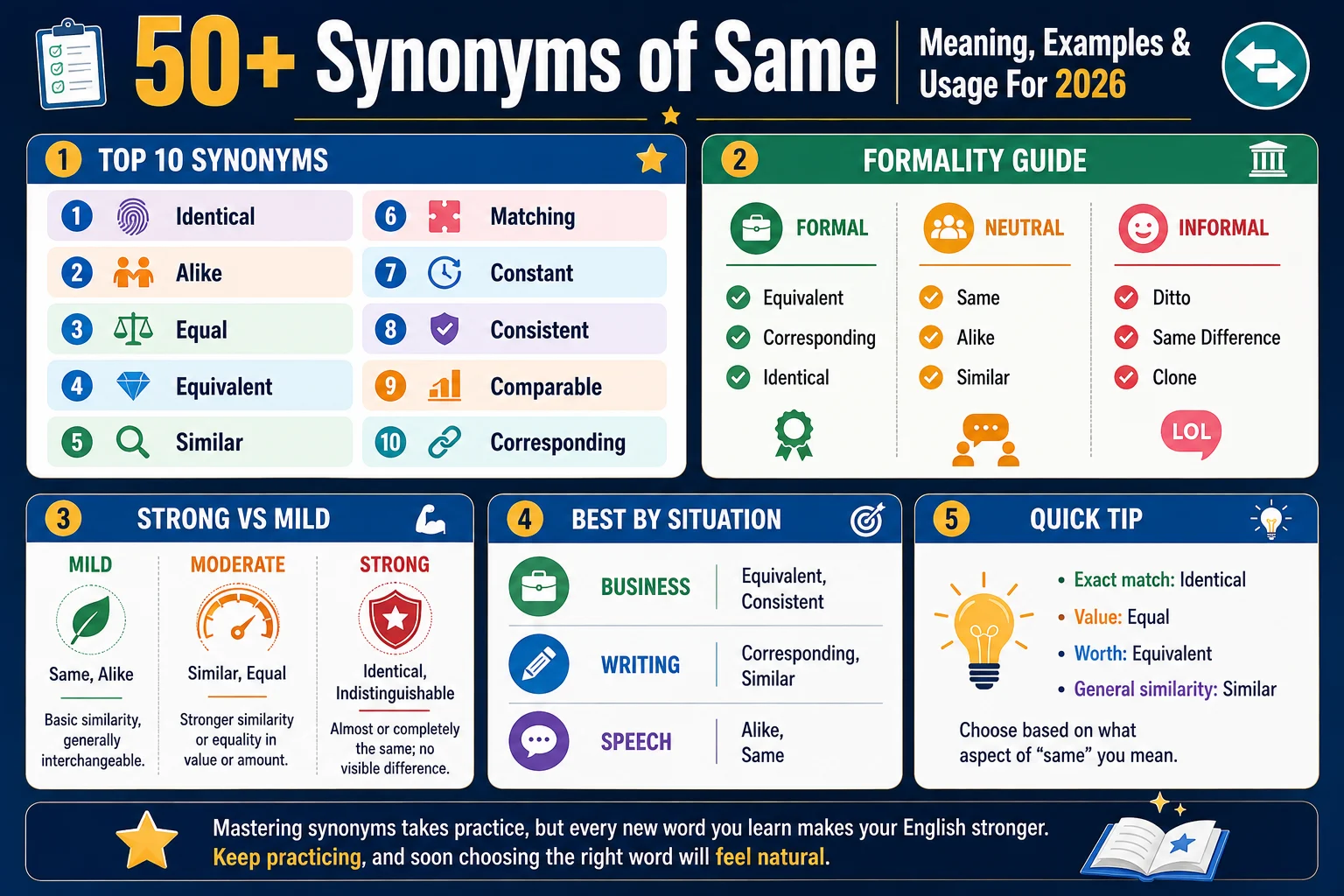
Same means identical, not different, or unchanged . The most common synonyms are identical, alike, equal, and equivalent . Choose identical when things match exactly , alike for similarities in appearance or nature , equal for the same quantity or value , and equivalent when two different things have the same worth or function. Every synonym has a slightly different meaning, tone, or context.
Have you ever felt stuck using the word “same” over and over again? Whether you’re writing an essay, sending a professional email, or just having a conversation, having a variety of synonyms at your fingertips makes your English sound more natural and polished.
In this guide, we’ll explore over 50 alternatives to the word “same.” You’ll learn the exact meaning of each synonym, when to use it, how formal or informal it is, and see real examples. By the end, you’ll confidently choose the perfect word for any situation.
What Does “Same” Mean?
Definition
Same means identical in every way, not different, or unchanged from before . If two things are the same, they match completely in quality, kind, or amount . When something stays the same, it has not changed over time .
Pronunciation
| Feature | Value |
|---|---|
| US IPA | /seɪm/ |
| UK IPA | /seɪm/ |
| Syllables | 1 |
| Tip | Rhymes with “name” and “game.” |
Grammar
| Grammar Feature | Information |
|---|---|
| Part of Speech | Adjective (most common), also used as a pronoun or adverb |
| Common Position | Before a noun (the same car) or after a linking verb (look the same) |
| Typical Pattern | The same + noun + as (the same color as mine) |
Examples:
- We ordered the same dish for dinner.
- Your bag looks the same as mine.
Word Family
| Word | Part of Speech | Meaning |
|---|---|---|
| Same | Adjective | Identical; not different |
| Sameness | Noun | The quality of being identical or unchanged |
| Selfsame | Adjective | Exactly the same; identical |
| Similarly | Adverb | In a like manner |
50+ Synonyms of “Same”
1. Identical
Meaning: Exactly alike in every single detail .
Best Used For: Formal writing, comparisons, emphasizing exact matches.
Formality: Neutral to Formal
Tone: Precise, factual
Frequency: ⭐⭐⭐⭐⭐ Very Common
CEFR Level: B1
Example Sentence 1: The two phones are identical, except for the color.
Example Sentence 2: The twins have identical handwriting.
Usage Tip: Use identical when you want to stress that two things are the same in every possible way. It’s stronger than “same.” Don’t use it for things that are just similar.
2. Alike
Meaning: Similar in appearance or nature; having shared qualities .
Best Used For: Describing people or things that look or act similarly.
Formality: Neutral
Tone: General, observational
Frequency: ⭐⭐⭐⭐⭐ Very Common
CEFR Level: A2
Example Sentence 1: The two sisters look very alike.
Example Sentence 2: The movies are alike in plot, but the endings differ.
Usage Tip: Use alike after a verb (look alike, think alike) . Don’t place it directly before a noun—we say “similar ideas,” not “alike ideas.”
3. Equal
Meaning: Having the same amount, value, or measure as something else .
Best Used For: Mathematics, numbers, measurements, fairness, rights.
Formality: Neutral to Formal
Tone: Objective, mathematical
Frequency: ⭐⭐⭐⭐⭐ Very Common
CEFR Level: A2
Example Sentence 1: Four quarters are equal to one dollar.
Example Sentence 2: All employees deserve equal treatment.
Usage Tip: Use equal primarily for quantities, values, and rights. For physical appearance, use “identical” or “alike” instead.
4. Equivalent
Meaning: Having the same value, purpose, or meaning, even if different in form .
Best Used For: Translations, currency exchange, comparisons of value.
Formality: Formal
Tone: Professional, academic
Frequency: ⭐⭐⭐⭐ Common
CEFR Level: B2
Example Sentence 1: One pound is roughly equivalent to 453 grams.
Example Sentence 2: His experience is equivalent to a college degree.
Usage Tip: Use equivalent when two different things have the same worth or function. Unlike “identical,” the items don’t need to look the same.
5. Selfsame
Meaning: Exactly the same; identical. Emphasizes that it is the very same thing, not just similar .
Best Used For: Literary writing, formal emphasis, stressing identity.
Formality: Formal to Literary
Tone: Dramatic, emphatic
Frequency: ⭐⭐ Rare
CEFR Level: C1
Example Sentence 1: He wore the selfsame suit to every wedding.
Example Sentence 2: The selfsame question came up again at the meeting.
Usage Tip: Selfsame is old-fashioned but useful for emphasis. It always refers to one thing, not two similar things.
6. Very
Meaning: The exact same; used to emphasize identity .
Best Used For: Emphasizing that something is precisely the same thing.
Formality: Neutral
Tone: Emphatic
Frequency: ⭐⭐⭐⭐ Common
CEFR Level: A2
Example Sentence 1: That is the very dress I wanted to buy.
Example Sentence 2: He used the very same words as before.
Usage Tip: In this sense, “very” is used with “same” to add emphasis. Don’t confuse it with “very” meaning “extremely.
7. Indistinguishable
Meaning: So similar that you cannot tell the difference between them .
Best Used For: Describing things that are so alike they seem identical.
Formality: Formal
Tone: Precise, descriptive
Frequency: ⭐⭐⭐ Moderate
CEFR Level: B2
Example Sentence 1: The fake painting was indistinguishable from the real one.
Example Sentence 2: The two versions are almost indistinguishable.
Usage Tip: Use this when the difference, if any, is impossible to detect. It is stronger than “similar” but less absolute than “identical.”
8. Matching
Meaning: Having the same color, design, or pattern .
Best Used For: Clothing, furniture, decor, describing coordinated items.
Formality: Neutral
Tone: Practical, everyday
Frequency: ⭐⭐⭐⭐ Common
CEFR Level: A2
Example Sentence 1: She bought a matching scarf and gloves.
Example Sentence 2: The restaurant had matching chairs and tables.
Usage Tip: Use matching for items that are part of a set or have the same design. It does not mean identical in all ways, just coordinated.
9. Similar
Meaning: Nearly the same; having some qualities in common .
Best Used For: General comparisons when things are alike but not exact.
Formality: Neutral
Tone: General, descriptive
Frequency: ⭐⭐⭐⭐⭐ Very Common
CEFR Level: A2
Example Sentence 1: The two recipes are similar but not identical.
Example Sentence 2: They have similar tastes in music.
Usage Tip: Use similar when things share qualities but are not exactly alike. It is a safe choice for most everyday situations .
10. Corresponding
Meaning: Matching or related to something else .
Best Used For: Lists, data, relationships, formal writing.
Formality: Formal
Tone: Analytical, structured
Frequency: ⭐⭐⭐⭐ Common
CEFR Level: B2
Example Sentence 1: Write the answer next to the corresponding question.
Example Sentence 2: The company increased salaries in corresponding departments.
Usage Tip: Use when items relate to each other in a matched or paired way.
11. Comparable
Meaning: Similar in quality, size, or value, so that a fair comparison is possible .
Best Used For: Product comparisons, performance evaluations, market analysis.
Formality: Formal to Neutral
Tone: Analytical, objective
Frequency: ⭐⭐⭐⭐ Common
CEFR Level: B2
Example Sentence 1: The two hotels are comparable in price.
Example Sentence 2: She has comparable experience to the other candidate.
Usage Tip: Use comparable when two things are similar enough to be reasonably compared.
12. Duplicate
Meaning: An exact copy of something .
Best Used For: Documents, keys, copies, formal contexts.
Formality: Formal
Tone: Technical, precise
Frequency: ⭐⭐⭐⭐ Common
CEFR Level: B1
Example Sentence 1: He made a duplicate copy of the report.
Example Sentence 2: She asked for a duplicate key.
Usage Tip: Use duplicate when referring to a deliberate copy of something.
13. Unchanged
Meaning: Not altered or modified; remaining the same .
Best Used For: Describing situations, rules, conditions that have not changed.
Formality: Neutral
Tone: Factual, observational
Frequency: ⭐⭐⭐⭐ Common
CEFR Level: B1
Example Sentence 1: The village has remained unchanged for decades.
Example Sentence 2: The policy remained unchanged after the review.
Usage Tip: Use unchanged to emphasize that something has stayed the same over time.
14. Constant
Meaning: Staying the same; not changing over time .
Best Used For: Describing stable conditions, habits, emotions.
Formality: Neutral
Tone: Stable, reliable
Frequency: ⭐⭐⭐⭐⭐ Very Common
CEFR Level: B1
Example Sentence 1: He checks his phone with constant regularity.
Example Sentence 2: The temperature needs to remain constant.
Usage Tip: Use constant when emphasizing the absence of variation over a period of time .
15. Consistent
Meaning: Always behaving or happening in the same way .
Best Used For: Work quality, behavior, performance, writing style.
Formality: Neutral
Tone: Reliable, dependable
Frequency: ⭐⭐⭐⭐⭐ Very Common
CEFR Level: B1
Example Sentence 1: She has shown consistent improvement in her grades.
Example Sentence 2: His story is consistent with the evidence.
Usage Tip: Use consistent when something stays the same in a dependable, positive way.
16. Uniform
Meaning: The same throughout; not varying .
Best Used For: Standards, policies, appearance.
Formality: Formal
Tone: Structured, standardized
Frequency: ⭐⭐⭐⭐ Common
CEFR Level: B2
Example Sentence 1: All schools should have a uniform dress code.
Example Sentence 2: The product has a uniform quality across batches.
Usage Tip: Use uniform when describing consistency across a group or across time.
17. Unvarying
Meaning: Not changing; always the same .
Best Used For: Describing routines, conditions, or patterns that never change.
Formality: Formal
Tone: Descriptive, precise
Frequency: ⭐⭐ Rare
CEFR Level: C1
Example Sentence 1: He maintained an unvarying daily routine.
Example Sentence 2: The robot produced unvarying results.
Usage Tip: This word is more formal and less common than “constant” or “consistent.”
18. Twin
Meaning: Exactly alike; paired .
Best Used For: Describing things that come in pairs or are very alike.
Formality: Neutral
Tone: Casual, descriptive
Frequency: ⭐⭐⭐⭐ Common
CEFR Level: A2
Example Sentence 1: The two buildings were twin towers.
Example Sentence 2: He bought a twin set of speakers.
Usage Tip: Use twin to describe two things that are paired and very similar.
19. Synonymous
Meaning: So similar in meaning that one can substitute for the other .
Best Used For: Vocabulary, language teaching, describing word relationships.
Formality: Formal
Tone: Academic, precise
Frequency: ⭐⭐⭐ Moderate
CEFR Level: B2
Example Sentence 1: In this context, “happy” is synonymous with “joyful.
Example Sentence 2: Their goals are practically synonymous.
Usage Tip: Perfect for language discussions. In broader use, it suggests two things mean the same thing.
20. Akin
Meaning: Similar or related in character .
Best Used For: Comparing concepts, ideas, or characteristics.
Formality: Formal to Literary
Tone: Descriptive, thoughtful
Frequency: ⭐⭐ Rare
CEFR Level: C1
Example Sentence 1: Running a marathon is akin to achieving a life goal.
Example Sentence 2: The two languages are closely akin.
Usage Tip: Akin is more literary and formal than “similar.” Use it for thoughtful comparisons.
21. Equal (repeat of #3)
22. Like
Meaning: Similar in some way .
Best Used For: Everyday speech, casual comparisons.
Formality: Neutral to Informal
Tone: Casual, conversational
Frequency: ⭐⭐⭐⭐⭐ Very Common
CEFR Level: A1
Example Sentence 1: They have like opinions on most topics.
Example Sentence 2: I’ve never seen anything like that before.
Usage Tip: Like is extremely common in informal English. In formal writing, prefer “similar to” or “such as.”
23. Comparable (repeat #11)
24. Correspondent (related to corresponding, less common)
Meaning: Similar or corresponding.
Best Used For: Formal comparisons.
Formality: Formal
Tone: Analytical
Frequency: ⭐⭐ Rare
CEFR Level: B2
Example Sentence 1: The results were correspondent with expectations.
Example Sentence 2: His actions were correspondent to his words.
Usage Tip: Less common than “corresponding.”
25. Clone
Meaning: An exact copy or duplicate .
Best Used For: Informal speech, technology, biology.
Formality: Informal
Tone: Casual, technical
Frequency: ⭐⭐⭐ Moderate
CEFR Level: B2
Example Sentence 1: This phone is a clone of the more expensive model.
Example Sentence 2: The two cars are practically clones.
Usage Tip: Use clone informally for things that are nearly identical copies.
26. Look-alike
Meaning: A person or thing that looks very similar to another .
Best Used For: Describing people or objects that appear similar.
Formality: Informal
Tone: Casual, descriptive
Frequency: ⭐⭐⭐ Moderate
CEFR Level: B1
Example Sentence 1: He has a look-alike in the movies.
Example Sentence 2: The building is a look-alike of the original.
Usage Tip: Use for appearance-based similarity, not for function or value.
27. Much of a muchness
Meaning: Very similar; having little difference .
Best Used For: Informal British English, casual comparisons.
Formality: Informal
Tone: Conversational, British
Frequency: ⭐⭐ Rare (mostly British)
CEFR Level: C1
Example Sentence 1: The two hotels are much of a muchness.
Example Sentence 2: All their policies are much of a muchness.
Usage Tip: This is a British idiom. Use in casual British English contexts only.
28. Tantamount
Meaning: Equivalent in value, significance, or effect .
Best Used For: Formal writing, legal contexts, emphasizing consequences.
Formality: Formal
Tone: Serious, emphatic
Frequency: ⭐⭐⭐ Moderate
CEFR Level: C1
Example Sentence 1: Not apologizing is tantamount to admitting guilt.
Example Sentence 2: Her refusal was tantamount to a resignation.
Usage Tip: Use tantamount when one action is effectively the same as another.
29. Ditto
Meaning: The same as said before; used to agree or repeat .
Best Used For: Informal conversation, quick agreement.
Formality: Informal
Tone: Casual, playful
Frequency: ⭐⭐⭐ Moderate
CEFR Level: B1
Example Sentence 1: She said she was hungry, and I said “ditto.”
Example Sentence 2: Ditto for the second batch.
Usage Tip: Use ditto in informal speech as a quick way to say “same here” or “same applies.”
30. Same difference
Meaning: No real difference; essentially the same (often used for minor differences) .
Best Used For: Informal conversation.
Formality: Informal
Tone: Casual, dismissive
Frequency: ⭐⭐⭐ Moderate
CEFR Level: B2
Example Sentence 1: “Is it 10 or 10:30?” “Same difference.”
Example Sentence 2: Whether we take the car or the train, it’s same difference.
Usage Tip: This phrase acknowledges a small difference while asserting no meaningful difference.
Synonyms Comparison Table
| Synonym | Best Context | Formality | Tone | Frequency |
|---|---|---|---|---|
| Identical | Exact matches | Neutral-Formal | Precise | ⭐⭐⭐⭐⭐ |
| Alike | Appearance, behavior | Neutral | General | ⭐⭐⭐⭐⭐ |
| Equal | Values, rights | Neutral-Formal | Objective | ⭐⭐⭐⭐⭐ |
| Equivalent | Worth, function | Formal | Professional | ⭐⭐⭐⭐ |
| Selfsame | Emphasis, identity | Formal-Literary | Dramatic | ⭐⭐ |
| Very | Emphasis | Neutral | Emphatic | ⭐⭐⭐⭐ |
| Indistinguishable | Undetectable differences | Formal | Precise | ⭐⭐⭐ |
| Matching | Coordinated sets | Neutral | Practical | ⭐⭐⭐⭐ |
| Similar | General comparisons | Neutral | General | ⭐⭐⭐⭐⭐ |
| Corresponding | Matched relationships | Formal | Analytical | ⭐⭐⭐⭐ |
| Comparable | Fair comparison | Formal-Neutral | Objective | ⭐⭐⭐⭐ |
| Duplicate | Exact copies | Formal | Technical | ⭐⭐⭐⭐ |
| Unchanged | No change over time | Neutral | Factual | ⭐⭐⭐⭐ |
| Constant | No variation | Neutral | Stable | ⭐⭐⭐⭐⭐ |
| Consistent | Dependable repetition | Neutral | Reliable | ⭐⭐⭐⭐⭐ |
| Uniform | Standardized | Formal | Structured | ⭐⭐⭐⭐ |
| Unvarying | Never changing | Formal | Precise | ⭐⭐ |
| Twin | Paired, alike | Neutral | Descriptive | ⭐⭐⭐⭐ |
| Synonymous | Same meaning | Formal | Academic | ⭐⭐⭐ |
| Akin | Related character | Formal-Literary | Thoughtful | ⭐⭐ |
Best Synonyms by Situation
| Situation | Best Synonym | Why It Works |
|---|---|---|
| Daily Conversation | Same, Alike, Like | Natural, easy, and common |
| Business Email | Identical, Equivalent, Consistent | Professional and clear |
| Academic Writing | Equivalent, Corresponding, Comparable | Precise and formal |
| School Assignment | Similar, Identical, Alike | Clear and appropriate |
| Professional Meeting | Uniform, Consistent, Comparable | Structured and clear |
| Presentation | Equal, Corresponding, Comparable | Professional and persuasive |
| Creative Writing | Selfsame, Akin, Synonymous | Literary and expressive |
| Social Media | Ditto, Same, Matching | Casual and relatable |
| Product Description | Matching, Equivalent, Similar | Clear and helpful |
| Legal Documents | Identical, Tantamount, Duplicate | Precise and accurate |
Formal vs Informal Synonyms
Formal Alternatives
| Synonym | Best Used For |
|---|---|
| Equivalent | Professional contexts, value comparisons |
| Corresponding | Data matching, lists |
| Comparable | Professional comparisons |
| Selfsame | Literary emphasis |
| Tantamount | Legal or serious contexts |
| Indistinguishable | Scientific or analytical contexts |
| Uniform | Standardized settings |
| Duplicate | Official copies, documents |
| Unvarying | Scientific or analytical contexts |
Neutral Alternatives
| Synonym | Best Used For |
|---|---|
| Same | Everyday neutral use |
| Identical | Precise comparisons |
| Alike | Appearance and behavior |
| Equal | Quantities and rights |
| Similar | General comparisons |
| Matching | Coordinated items |
| Constant | Stable conditions |
| Consistent | Reliable patterns |
| Unchanged | No change over time |
Informal Alternatives
| Synonym | Best Used For |
|---|---|
| Like | Casual conversation |
| Twin | Paired things |
| Ditto | Quick agreement |
| Clone | Exact copies in casual speech |
| Look-alike | Appearance |
| Same difference | Minor differences |
| Much of a muchness | British casual speech |
Strong vs Mild Synonyms
Mild
- Same (neutral)
- Alike (general)
- Like (casual)
- Matching (coordinated)
These are suitable for everyday situations and safe choices.
Moderate
- Similar (somewhat alike)
- Equal (same in value)
- Consistent (same over time)
- Comparable (similar enough to compare)
More expressive and descriptive than mild options.
Strong
- Identical (exact in every way)
- Indistinguishable (so similar no difference can be seen)
- Tantamount (equivalent in effect)
- Selfsame (dramatic emphasis)
- Synonymous (same meaning)
Use these when you need to emphasize absolute sameness or equivalence.
Real-Life Examples
In the Office
- “Our new office layout is very similar to the old one.”
- “The team produced consistent results throughout the project.”
In Business Emails
- “The prices are comparable to what our competitors offer.”
- “Please send a duplicate copy of the invoice.”
In Everyday Conversation
- “We have the same taste in music.”
- “These two restaurants are much of a muchness.”
In Academic Writing
- “Two groups of ten is equal to one group of twenty.”
- “The author’s argument is tantamount to a confession.”
Common Collocations
| Common Phrase | Better Alternative |
|---|---|
| Same opinion | Identical opinion, similar view |
| Same rules | Uniform rules, consistent rules |
| Same situation | Comparable situation, similar situation |
| Same size | Equal size, identical size |
| Same color | Matching color, identical color |
| Same price | Equal price, comparable price |
| Same time | Corresponding time, equivalent time |
Common Phrases
“The same old same old”
Meaning: The same routine or situation with no change.
Better alternative: Unchanging, constant.
“Just the same”
Meaning: Despite everything; nevertheless.
Better alternative: Nonetheless, even so.
“All the same”
Meaning: Despite what has been said.
Better alternative: Nevertheless, regardless.
“Same difference”
Meaning: No real difference.
Better alternative: Essentially the same, comparable.
“Same here”
Meaning: I agree; me too.
Better alternative: Likewise, ditto.
Context Guide
| Situation | Best Synonym | Reason |
|---|---|---|
| Essay | Equivalent, Corresponding | Formal and precise |
| Speech | Alike, Similar | Clear and understandable |
| Business Email | Identical, Consistent | Professional and clear |
| Novel | Selfsame, Akin | Literary and expressive |
| Presentation | Comparable, Uniform | Professional and structured |
| Conversation | Same, Like | Natural and common |
| Academic Writing | Equivalent, Synonymous | Accurate and formal |
| Marketing Copy | Matching, Similar | Clear and appealing |
Related Words
Near Synonyms
Same means identical or unchanged. Synonyms share this meaning but with different nuances: alike emphasizes resemblance, equal focuses on quantity or value, and equivalent stresses similar worth or function.
Antonyms
- Different
- Other
- Distinct
- Separate
- Unlike
- Diverse
Related Adjectives
- Similar – somewhat the same
- Comparable – similar enough for comparison
- Analogous – similar in function or structure
Related Nouns
- Sameness – the quality of being the same
- Equivalence – being equal in value
- Identity – being identical
Related Verbs
- Compare – to examine similarities and differences
- Match – to be the same as
- Correspond – to be similar or equivalent
Frequently Asked Questions
What is another word for “same”?
Common synonyms include identical, alike, equal, and equivalent . The best choice depends on your context. Use identical for exact matches, equal for values, alike for appearance, and equivalent for similar worth or function.
Which synonym of “same” sounds the most professional?
Equivalent, corresponding, consistent, and comparable sound professional in business contexts. In formal writing, identical and uniform also work well. Avoid informal options like “ditto” or “same difference.”
What’s the strongest synonym for “same”?
Identical and indistinguishable are the strongest synonyms. Identical means exactly the same in every detail, while indistinguishable means so alike you cannot tell them apart .
Which synonym is best for essays?
For essays, use equivalent, corresponding, comparable, similar, or identical. These are formal enough for academic writing while remaining clear. Avoid informal options like “same difference” or “ditto.”
What’s the difference between “same” and “similar”?
Same means identical in every way, while similar means having some qualities in common but not being identical . For example, two people can be similar in personality but not the same person .
Which synonym is most common in everyday English?
Same itself is the most common. Other frequently used everyday options include alike, similar, equal, and like. These are neutral and natural in most conversations .
What is the opposite of “same”?
The main opposites are different, other, distinct, and separate . Unlike and diverse are also common antonyms.
Can “same” be used formally?
Yes, “same” is neutral and works in both formal and informal contexts . For very formal writing, identical, equivalent, or corresponding may be more appropriate.
Conclusion
The word “same” is one of the most common words in English, but variety makes your language richer. Whether you choose identical for exact matches, alike for appearance, equal for values, or equivalent for comparable worth, every synonym adds a slightly different shade of meaning.
Remember, the best synonym depends on your context, audience, and message. Formal writing often calls for identical, corresponding, or equivalent, while everyday conversation naturally uses same, alike, or like.
The next time you need to say “same,” pause and consider which word fits best. Your vocabulary will grow, and your English will sound more natural and confident.
