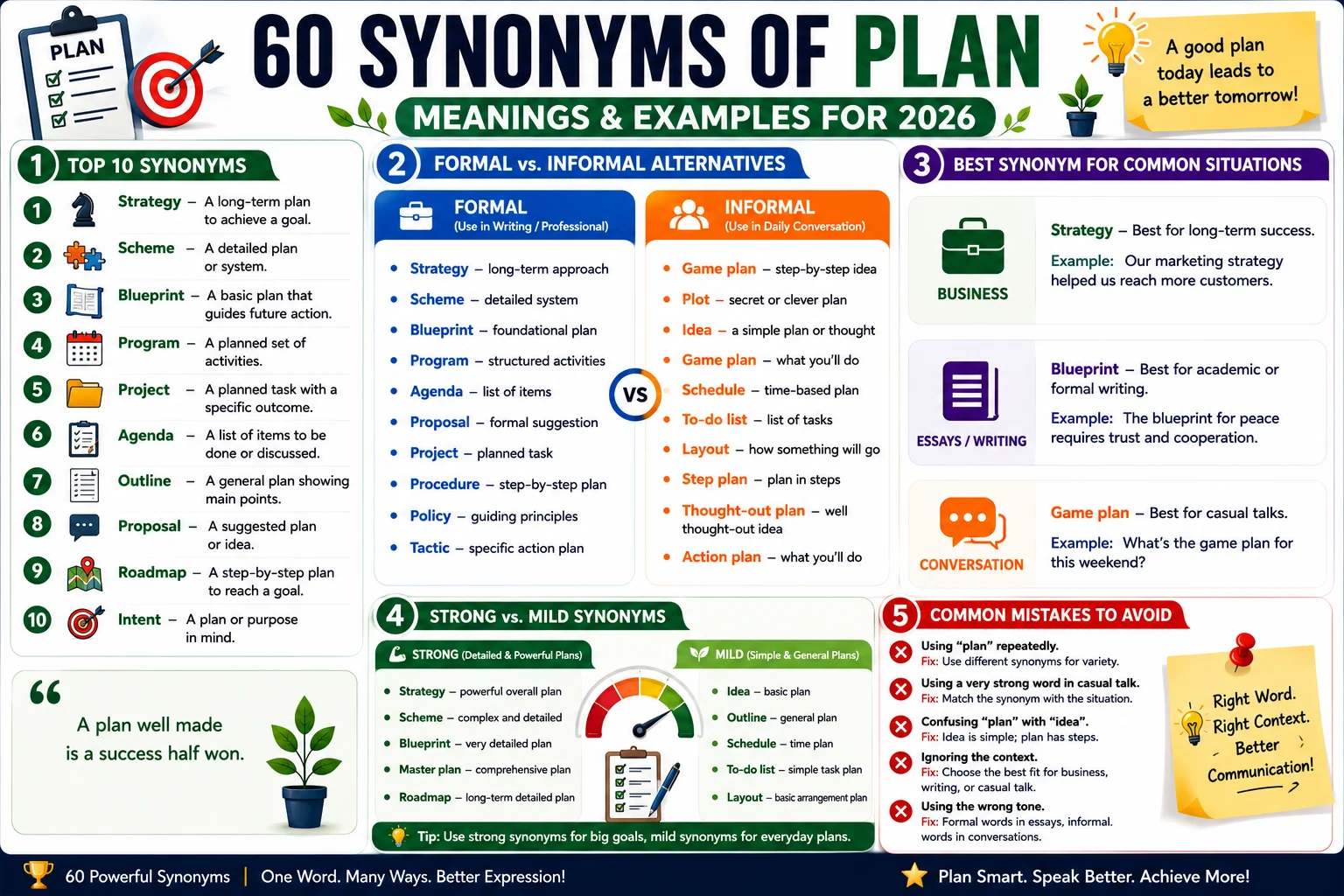
“Plan” means a detailed proposal for achieving something. The best synonyms are scheme, strategy, blueprint, design, and program. “Scheme” is a common alternative. Each synonym has a slightly different meaning and context where it fits best.
Top 10 Synonyms
- Scheme
- Strategy
- Blueprint
- Design
- Program
- Project
- Proposal
- System
- Arrangement
- Outline
“Plan” is one of those words we use every day. We make plans for work, school, travel, and life. But using the same word over and over can make your English feel repetitive and basic.
Think about it. You plan a project, plan a trip, plan a meal, and plan your career. Each situation might need a different word that captures the exact type of planning.
The good news is that English is full of wonderful alternatives. Some words suggest detailed preparation, while others suggest broad strategies. Some are formal, and some are very casual.
In this guide, you’ll learn 35 powerful synonyms for “plan.” You’ll discover exactly when to use each one, how formal they are, and what common mistakes to avoid. Let’s begin!
What Does “Plan” Mean?
Definition
Plan” means a detailed proposal, scheme, or method for doing or achieving something. It’s what you create when you think about the future and decide what you’re going to do. A plan can be simple, like a meal plan, or complex, like a business plan.
Pronunciation
| Feature | Value |
|---|---|
| US IPA | /plæn/ |
| UK IPA | /plæn/ |
| Syllables | 1 |
| Tip | Say it like “plan” with a short ‘a’ sound |
Grammar
| Grammar Feature | Information |
|---|---|
| Part of Speech | Noun and Verb |
| Common Position | Subject or object |
| Typical Pattern | Plan + for + something / Plan + to + verb |
Examples:
- “We made a plan for the weekend.” (noun)
- “She plans to travel next year.” (verb)
- “The plan worked perfectly.” (noun)
Grammar Note: “Plan” can be a noun (the document or idea) or a verb (the action of planning). As a noun, it’s countable—you can have one plan or many plans.
Word Family
| Word | Part of Speech | Meaning |
|---|---|---|
| Plan | Noun/Verb | A detailed proposal or to make such a proposal |
| Planner | Noun | A person who makes plans |
| Planning | Noun | The process of making plans |
| Planned | Adjective | Arranged in advance |
15 Synonyms of “Plan”
Scheme
Meaning: A carefully designed plan for achieving something, sometimes secret or dishonest.
Best Used For: Projects, strategies, sometimes negative contexts.
Formality: Neutral
Tone: Strategic, Sometimes Negative
Frequency: ⭐⭐⭐⭐ (Common)
CEFR Level: B1
Example Sentence 1: “They devised a scheme to increase sales.”
Example Sentence 2: “The government introduced a new housing scheme.”
Usage Tip: “Scheme” can be neutral or negative. In American English, it often suggests something slightly dishonest. In British English, it’s often neutral for a government program.
Common Confusion: Scheme vs Plan. “Scheme” often suggests cleverness or secrecy. “Plan” is more general and neutral.
Strategy
Meaning: A long-term plan for achieving a major goal.
Best Used For: Business, military, politics, sports.
Formality: Formal
Tone: Strategic, Professional
Frequency: ⭐⭐⭐⭐⭐ (Very Common)
CEFR Level: B2
Example Sentence 1: “The company needs a new marketing strategy.
Example Sentence 2: “He developed a winning strategy for the team.
Usage Tip: “Strategy” is for long-term, big-picture plans. Use it in professional and formal contexts.
Blueprint
Meaning: A detailed plan or outline for something, originally an architectural drawing.
Best Used For: Projects, buildings, business plans, complex systems.
Formality: Formal
Tone: Detailed, Professional
Frequency: ⭐⭐⭐ (Moderate)
CEFR Level: B2
Example Sentence 1: “The architect showed us the blueprint for the new building.”
Example Sentence 2: “We need a blueprint for the company’s future.”
Usage Tip: “Blueprint” suggests a very detailed, visual plan. It’s perfect for architectural and business contexts.
Design
Meaning: A plan or drawing that shows how something will look or work.
Best Used For: Products, buildings, systems, creative projects.
Formality: Neutral
Tone: Creative, Practical
Frequency: ⭐⭐⭐⭐⭐ (Very Common)
CEFR Level: A2
Example Sentence 1: “The design of the new website is beautiful.”
Example Sentence 2: “She drew the design for the new kitchen.”
Usage Tip: “Design” often focuses on appearance and function. Use it for creative and product planning.
Program
Meaning: A planned series of events or activities.
Best Used For: Events, education, government initiatives.
Formality: Neutral
Tone: Organized, Structured
Frequency: ⭐⭐⭐⭐⭐ (Very Common)
CEFR Level: B1
Example Sentence 1: “The school has an excellent sports program.
Example Sentence 2: “The government launched a new health program.”
Usage Tip: “Program” is great for planned series of activities or events, often over time.
Project
Meaning: A planned piece of work or activity with a specific purpose.
Best Used For: Work, school, construction, research.
Formality: Neutral
Tone: Purposeful, Organized
Frequency: ⭐⭐⭐⭐⭐ (Very Common)
CEFR Level: A2
Example Sentence 1: “We’re working on a new construction project.”
Example Sentence 2: “The science project took six months to complete.”
Usage Tip: “Project” is a specific piece of work with a clear goal. It’s widely used in school and business.
Proposal
Meaning: A suggested plan or idea for someone to consider.
Best Used For: Business, academic, formal suggestions.
Formality: Formal
Tone: Suggestive, Professional
Frequency: ⭐⭐⭐⭐ (Common)
CEFR Level: B2
Example Sentence 1: “She submitted a proposal for the new project.”
Example Sentence 2: “The proposal was accepted by the board.”
Usage Tip: “Proposal” is about suggesting a plan. It’s often written and submitted for approval.
System
Meaning: An organized set of ideas or methods for doing something.
Best Used For: Workflows, processes, methodologies.
Formality: Neutral
Tone: Organized, Methodical
Frequency: ⭐⭐⭐⭐⭐ (Very Common)
CEFR Level: B1
Example Sentence 1: “We need a better system for tracking orders.”
Example Sentence 2: “His system for organizing files is very effective.”
Usage Tip: “System” emphasizes method and organization. It’s about how things are done.
Arrangement
Meaning: A plan for how something will happen or be organized.
Best Used For: Events, meetings, travel, everyday planning.
Formality: Neutral
Tone: Organized, Practical
Frequency: ⭐⭐⭐⭐ (Common)
CEFR Level: B1
Example Sentence 1: “We made arrangements for the wedding.”
Example Sentence 2: “I need to make travel arrangements.”
Usage Tip: “Arrangement” is often used in the plural “arrangements” for practical planning.
Outline
Meaning: A general plan or summary of something.
Best Used For: Essays, speeches, projects, presentations.
Formality: Neutral
Tone: Clear, Structured
Frequency: ⭐⭐⭐⭐ (Common)
CEFR Level: B1
Example Sentence 1: “She prepared an outline for her speech.
Example Sentence 2: “The teacher gave us an outline of the course.”
Usage Tip: “Outline” is for a basic structure or summary, not a detailed plan.
Roadmap
Meaning: A detailed plan for how to achieve something, especially in business.
Best Used For: Business, projects, career planning.
Formality: Formal
Tone: Strategic, Forward-looking
Frequency: ⭐⭐⭐ (Moderate)
CEFR Level: B2
Example Sentence 1: “The company created a roadmap for growth.”
Example Sentence 2: “We need a roadmap to reach our goals.”
Usage Tip: “Roadmap” is a modern business term for a step-by-step plan to reach a goal.
Tactics
Meaning: Specific plans or actions for achieving a larger goal.
Best Used For: Military, sports, business strategy.
Formality: Formal
Tone: Strategic, Action-oriented
Frequency: ⭐⭐⭐ (Moderate)
CEFR Level: B2
Example Sentence 1: “The general’s tactics won the battle.”
Example Sentence 2: “We need new tactics to compete in the market.
Usage Tip: “Tactics” are the specific actions you take to achieve a larger strategy.
Plot
Meaning: The main events of a story, or a secret plan.
Best Used For: Stories, films, secretive plans.
Formality: Neutral
Tone: Narrative, Sometimes Negative
Frequency: ⭐⭐⭐⭐ (Common)
CEFR Level: B1
Example Sentence 1: “The plot of the movie was very exciting.”
Example Sentence 2: “They discovered a plot to steal the jewels.”
Usage Tip: “Plot” is used for stories and secretive plans. It can be neutral (story) or negative (conspiracy).
Framework
Meaning: A basic structure or plan that supports something.
Best Used For: Policies, systems, strategies.
Formality: Formal
Tone: Structural, Organized
Frequency: ⭐⭐⭐ (Moderate)
CEFR Level: C1
Example Sentence 1: “We need a framework for the new policy.”
Example Sentence 2: “The framework provides guidelines for decision-making.
Usage Tip: “Framework” is a broad structure that supports more detailed plans. It’s a formal, professional word.
Contingency plan
Meaning: A plan for dealing with problems if they happen.
Best Used For: Emergency planning, risk management.
Formality: Formal
Tone: Prepared, Cautious
Frequency: ⭐⭐⭐ (Moderate)
CEFR Level: B2
Example Sentence 1: “We have a contingency plan in case of bad weather.
Example Sentence 2: “Every business needs a contingency plan for emergencies.”
Usage Tip: “Contingency plan” is specifically for “Plan B”—what you’ll do if the original plan fails.
Synonyms Comparison Table
| Synonym | Best Context | Formality | Tone | Frequency |
|---|---|---|---|---|
| Scheme | Projects, programs | Neutral | Strategic | ⭐⭐⭐⭐ |
| Strategy | Long-term goals | Formal | Professional | ⭐⭐⭐⭐⭐ |
| Blueprint | Detailed plans | Formal | Detailed | ⭐⭐⭐ |
| Design | Creative projects | Neutral | Creative | ⭐⭐⭐⭐⭐ |
| Program | Series of events | Neutral | Organized | ⭐⭐⭐⭐⭐ |
| Project | Specific work | Neutral | Purposeful | ⭐⭐⭐⭐⭐ |
| Proposal | Suggestions | Formal | Suggestive | ⭐⭐⭐⭐ |
| System | Methods, processes | Neutral | Methodical | ⭐⭐⭐⭐⭐ |
| Arrangement | Practical planning | Neutral | Organized | ⭐⭐⭐⭐ |
| Outline | Summary, structure | Neutral | Clear | ⭐⭐⭐⭐ |
Best Synonyms by Situation
| Situation | Best Synonym | Why It Works |
|---|---|---|
| Daily Conversation | Plan / Arrangement | Natural and common |
| Business Email | Proposal / Strategy | Professional and formal |
| Academic Writing | Framework / Strategy | Formal and precise |
| School Assignment | Outline / Project | Clear and organized |
| Professional Meeting | Strategy / Blueprint | Sounds professional |
| Presentation | Strategy / Roadmap | Clear and forward-looking |
| Creative Writing | Plot / Design | Adds literary depth |
| Social Media | Plan / Program | Casual and relatable |
| Architecture | Blueprint / Design | Specific and professional |
Formal vs Informal Synonyms
Formal Alternatives
| Synonym | Best Used For |
|---|---|
| Strategy | Long-term business or political goals |
| Blueprint | Detailed technical plans |
| Proposal | Written suggestions for approval |
| Framework | Structural plans and policies |
| Contingency plan | Emergency preparation |
Neutral Alternatives
| Synonym | Best Used For |
|---|---|
| Plan | Most general situations |
| Design | Creative and product planning |
| Project | Specific pieces of work |
| System | Methods and processes |
| Arrangement | Practical logistics |
Informal Alternatives
| Synonym | Best Used For |
|---|---|
| Scheme | Projects (British) or secret plans |
| Plot | Storylines or secret plans |
| Outline | Quick summaries |
Choosing the Right Level: Use “strategy” and “blueprint” for professional contexts. Use “plan” and “arrangement” for most everyday situations. Use “scheme” carefully—it can have negative connotations in American English.
Strong vs Mild Synonyms
Mild
Suitable for everyday situations with less intensity.
- Plan
- Outline
- Arrangement
Moderate
More specific or professional alternatives.
- Scheme
- Project
- Design
- Program
Strong
High-intensity alternatives suggesting significant planning.
- Strategy (big-picture)
- Blueprint (detailed and comprehensive)
- Framework (structural)
- Contingency plan (prepared for emergencies)
How Intensity Changes Meaning: “I have a plan for the weekend” is simple. “I have a strategy for career growth” sounds much more serious. Choose stronger words when you want to emphasize the importance of the planning.
Real-Life Examples
School: “The teacher asked us to create an outline for our essays.”
Office: “We need a new marketing strategy for the coming year.”
Business Email: “Please review the proposal and send feedback.”
Meetings: “Let’s discuss the blueprint for the new project.”
Presentations: “Our strategy for growth is clear and achievable.”
Daily Conversations: “We’re making plans for the summer vacation.”
Social Media: “Here’s a roadmap for achieving your goals!”
Academic Writing: “The framework provides a foundation for future research.”
Common Collocations
| Common Phrase | Better Alternative |
|---|---|
| Make a plan | Develop a strategy |
| Simple plan | Basic outline |
| Business plan | Business proposal |
| Project plan | Project blueprint |
| Master plan | Comprehensive strategy |
| Backup plan | Contingency plan |
Common Phrases
Plan ahead: To make plans for the future. (e.g., “We should plan ahead for the holiday.”)
Best-laid plans: Plans that are carefully made but fail. (e.g., “The best-laid plans often go wrong.”)
On the drawing board: In the planning stage. (e.g., “The new product is still on the drawing board.”)
Game plan: A strategy or plan. (e.g., “What’s our game plan for today?”)
Master plan: A large, comprehensive plan. (e.g., “The city has a master plan for development.”)
Context Guide
| Situation | Best Synonym | Reason |
|---|---|---|
| Essay | Framework / Strategy | Academic and formal |
| Speech | Strategy / Roadmap | Inspiring and clear |
| Business Email | Proposal / Strategy | Professional and organized |
| Novel | Plot | Adds literary value |
| Presentation | Strategy / Blueprint | Professional and clear |
| Conversation | Plan / Arrangement | Natural and relatable |
| Academic Writing | Framework | Precise and structural |
| Marketing Copy | Strategy / Roadmap | Forward-looking and engaging |
Related Words
Near Synonyms
- Approach: A way of dealing with something.
- Method: A particular way of doing something.
- Procedure: An established way of doing things.
- Policy: A course of action adopted by a government or organization.
- Formula: A plan or method for achieving something.
Antonyms
- Improvisation: Acting without a plan.
- Spontaneity: Acting without planning.
- Disorganization: Lack of planning.
- Chaos: Complete lack of order.
- Randomness: Without plan or purpose.
Related Adjectives
- Planned: Arranged in advance.
- Strategic: Relating to long-term plans.
- Systematic: Done according to a system.
- Organized: Arranged in an orderly way.
- Methodical: Done in a careful, systematic way.
Related Nouns
- Planning: The act of making plans.
- Strategy: A long-term plan.
- Vision: An idea of what the future could be.
- Goal: What you want to achieve.
- Objective: A specific goal.
Related Verbs
- Plan: To make a plan.
- Organize: To arrange systematically.
- Design: To create a plan.
- Strategize: To make a strategy.
- Coordinate: To organize together.
Frequently Asked Questions
What is another word for plan?
Common synonyms include scheme, strategy, blueprint, design, program, project, proposal, system, arrangement, and outline. “Strategy” is the most professional alternative.
Which synonym sounds the most professional?
Strategy and blueprint sound the most professional. “Proposal” is excellent for business contexts.
What is the strongest synonym for plan?
Strategy is one of the strongest synonyms, suggesting long-term, big-picture thinking. “Blueprint” is also strong, suggesting highly detailed planning.
Which synonym is best for essays?
Framework and strategy are excellent for academic essays. “Outline” is perfect for organizing thoughts.
What’s the difference between plan and scheme?
“Plan” is neutral and general. “Scheme” can be neutral (especially in British English) or suggest secrecy or dishonesty. In American English, “scheme” often has negative connotations.
Which synonym is most common in everyday English?
“Plan” itself is most common, but “arrangement” and “project” are also very common in everyday speech.
What is the opposite of plan?
Common opposites include improvisation, spontaneity, and chaos. These words describe acting without planning.
Conclusion
“Plan” is a word we use constantly, but now you have 35 fantastic alternatives. Each synonym adds a different shade of meaning to your language.
Remember, the key is understanding the context. Use “strategy” for long-term professional goals. Use “blueprint” for detailed plans. Use “proposal” for suggestions. Use “outline” for quick summaries. Use “contingency plan” for backup options.
The best way to improve is practice. Try using one or two new synonyms each day. Listen for these words in conversations and books. Your vocabulary will become richer and more impressive with time.
