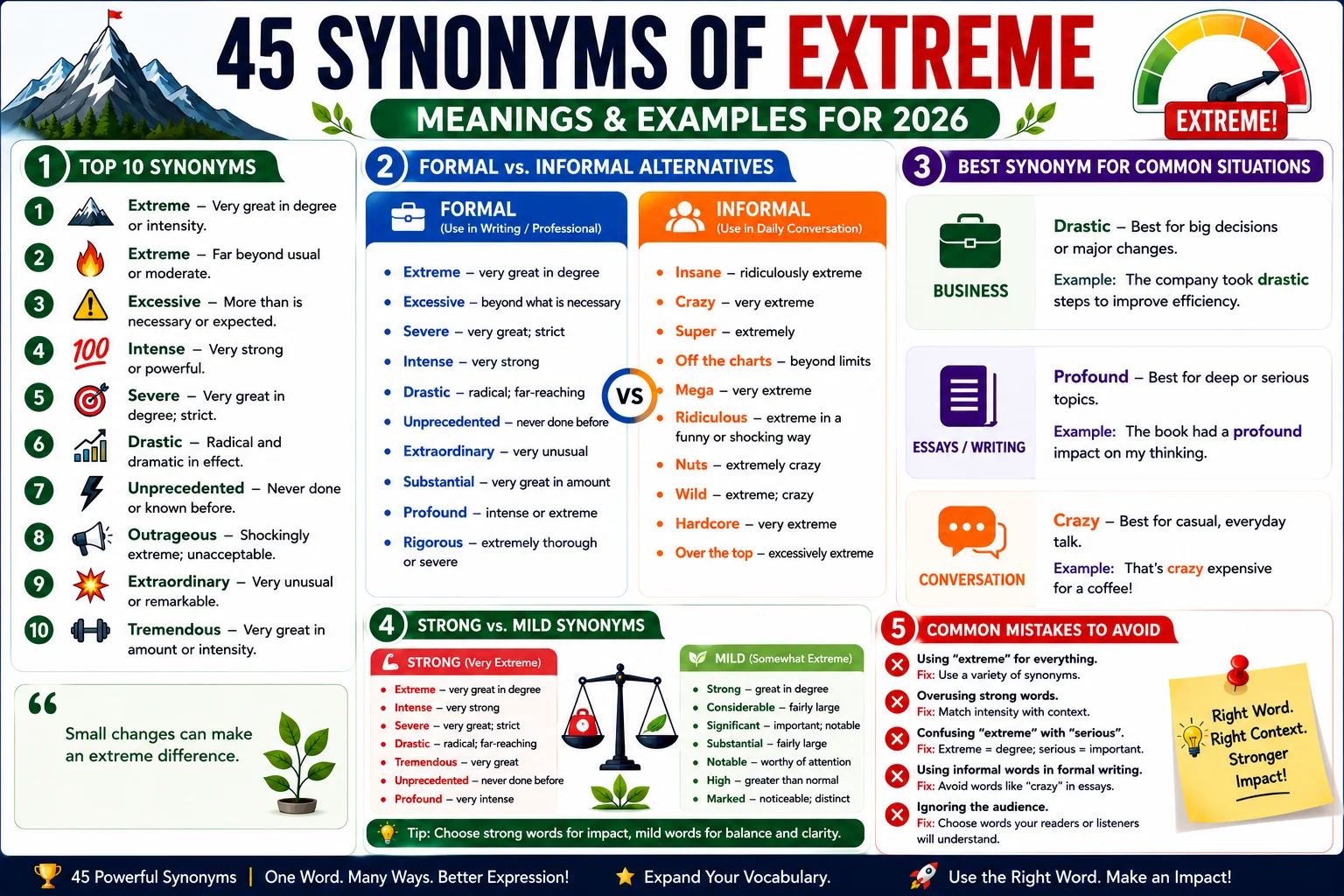
“Extreme” means very great, severe, or far beyond what is normal. The best synonyms are intense, severe, excessive, radical, and drastic. “Intense” is the most common natural alternative. Each synonym has a slightly different meaning and context where it fits best.
Top 10 Synonyms
- Intense
- Severe
- Excessive
- Radical
- Drastic
- Extreme
- Fierce
- Violent
- Profound
- Utmost
“Extreme” is a word we use all the time. Extreme weather, extreme sports, extreme opinions—it describes things that are far beyond normal. But using it too often can make your writing feel repetitive.
Think about it. You can have extreme heat, extreme poverty, extreme measures, or extreme happiness. Each situation might need a different word that captures the exact degree of intensity.
In this guide, you’ll learn 35 powerful synonyms for “extreme.” You’ll discover exactly when to use each one, how formal they are, and what common mistakes to avoid. Let’s begin!
What Does “Extreme” Mean?
Definition
Extreme” means reaching a very high degree or intensity. It describes something that is far beyond what is usual, normal, or moderate. It can describe physical conditions like heat or cold, emotional states like joy or anger, or actions and measures that are drastic.
Pronunciation
| Feature | Value |
|---|---|
| US IPA | /ɪkˈstrim/ |
| UK IPA | /ɪkˈstriːm/ |
| Syllables | 2 (ex-treme) |
| Tip | Stress the second syllable: “ik-STREEM” |
Grammar
| Grammar Feature | Information |
|---|---|
| Part of Speech | Adjective |
| Common Position | Before a noun or after a linking verb |
| Typical Pattern | Extreme + noun / Subject + be + extreme |
Examples:
- “We experienced extreme heat.” (before noun)
- “His reaction was extreme.” (after verb)
- “She lives in extreme poverty.” (before noun)
Grammar Note: “Extreme” can also be a noun (e.g., “go to extremes”). It is often used to emphasize the intensity of something.
Word Family
| Word | Part of Speech | Meaning |
|---|---|---|
| Extreme | Adjective | Very great or severe |
| Extremely | Adverb | To a very great degree |
| Extremism | Noun | Holding extreme political or religious views |
| Extremist | Noun | A person who holds extreme views |
15 Synonyms of “Extreme”
Intense
Meaning: Very strong or powerful; having great force or strength.
Best Used For: Emotions, feelings, colors, effort.
Formality: Neutral
Tone: Powerful, Strong
Frequency: ⭐⭐⭐⭐⭐ (Very Common)
CEFR Level: B1
Example Sentence 1: “The heat was so intense that we stayed inside.
Example Sentence 2: “She felt intense joy when she saw her family.
Usage Tip: “Intense” is a very common alternative. Use it for strong emotions, effort, or physical sensations.
Severe
Meaning: Very serious, harsh, or strict.
Best Used For: Weather, punishments, problems, diseases.
Formality: Formal
Tone: Serious, Harsh
Frequency: ⭐⭐⭐⭐⭐ (Very Common)
CEFR Level: B1
Example Sentence 1: “The storm caused severe damage to the town.”
Example Sentence 2: “He received a severe punishment for his crime.”
Usage Tip: “Severe” is often used for serious problems, harsh weather, and strict consequences.
Excessive
Meaning: More than is necessary, proper, or reasonable.
Best Used For: Amounts, spending, behavior.
Formality: Formal
Tone: Critical, Negative
Frequency: ⭐⭐⭐⭐ (Common)
CEFR Level: B2
Example Sentence 1: “His excessive spending led to financial problems.
Example Sentence 2: “Excessive noise can damage your hearing.”
Usage Tip: “Excessive” usually has a negative meaning—it suggests too much of something.
Radical
Meaning: Relating to big changes or new ideas that challenge the traditional way.
Best Used For: Political views, changes, ideas.
Formality: Formal
Tone: Revolutionary, Bold
Frequency: ⭐⭐⭐ (Moderate)
CEFR Level: B2
Example Sentence 1: “The company made radical changes to its structure.”
Example Sentence 2: “She holds radical views on education.”
Usage Tip: “Radical” means extreme in the sense of being very different or revolutionary.
Drastic
Meaning: Very strong and having a big effect.
Best Used For: Measures, actions, changes.
Formality: Formal
Tone: Serious, Decisive
Frequency: ⭐⭐⭐ (Moderate)
CEFR Level: B2
Example Sentence 1: “We need to take drastic action to solve this problem.
Example Sentence 2: “The new policy caused drastic changes in the company.
Usage Tip: “Drastic” suggests strong, decisive action that has significant effects.
Fierce
Meaning: Showing strong or intense feeling.
Best Used For: Competition, animals, emotions, weather.
Formality: Neutral
Tone: Strong, Aggressive
Frequency: ⭐⭐⭐⭐ (Common)
CEFR Level: B1
Example Sentence 1: “There is fierce competition for jobs.”
Example Sentence 2: “The fierce wind knocked down trees.”
Usage Tip: “Fierce” suggests intensity with an aggressive or powerful quality.
Violent
Meaning: Using physical force to hurt or damage; or very strong.
Best Used For: Crime, weather, reactions.
Formality: Neutral
Tone: Aggressive, Strong
Frequency: ⭐⭐⭐⭐ (Common)
CEFR Level: B1
Example Sentence 1: “The storm brought violent winds.”
Example Sentence 2: “He had a violent reaction to the news.”
Usage Tip: “Violent” often suggests physical force or extreme emotional reaction.
Profound
Meaning: Very deep, serious, or strong.
Best Used For: Feelings, knowledge, effects.
Formality: Formal
Tone: Deep, Intellectual
Frequency: ⭐⭐⭐ (Moderate)
CEFR Level: B2
Example Sentence 1: “She felt profound sadness after the loss.
Example Sentence 2: “His words had a profound effect on me.
Usage Tip: “Profound” suggests deep, intense feeling or serious intellectual depth.
Utmost
Meaning: Greatest or highest in degree.
Best Used For: Effort, importance, respect.
Formality: Formal
Tone: Serious, Respectful
Frequency: ⭐⭐⭐ (Moderate)
CEFR Level: B2
Example Sentence 1: “We must take the utmost care.”
Example Sentence 2: “She deserves the utmost respect.”
Usage Tip: “Utmost” means the greatest possible. It’s often used with nouns like “care” or “importance.”
Excessive
Meaning: More than is necessary or reasonable.
Best Used For: Behavior, spending, amounts.
Formality: Formal
Tone: Critical, Negative
Frequency: ⭐⭐⭐⭐ (Common)
CEFR Level: B2
Example Sentence 1: “Excessive salt in food is unhealthy.
Example Sentence 2: “His excessive pride was his downfall.
Usage Tip: “Excessive” suggests going beyond what is needed. It’s often used in a critical context.
Terrible
Meaning: Extremely bad or serious.
Best Used For: Events, weather, situations.
Formality: Neutral
Tone: Negative, Serious
Frequency: ⭐⭐⭐⭐⭐ (Very Common)
CEFR Level: A2
Example Sentence 1: “There was a terrible accident on the highway.”
Example Sentence 2: “The weather was terrible all week.
Usage Tip: “Terrible” is very common for describing bad or serious situations.
Tremendous
Meaning: Very great in amount, size, or intensity.
Best Used For: Success, effort, impact.
Formality: Neutral
Tone: Positive, Impressive
Frequency: ⭐⭐⭐⭐ (Common)
CEFR Level: B1
Example Sentence 1: “The team made tremendous progress.”
Example Sentence 2: “Her support has been tremendous.”
Usage Tip: “Tremendous” can mean very large or very good. It often has a positive tone.
Immense
Meaning: Extremely large or great.
Best Used For: Size, importance, amount.
Formality: Formal
Tone: Impressive, Grand
Frequency: ⭐⭐⭐ (Moderate)
CEFR Level: B2
Example Sentence 1: “The project required immense effort.”
Example Sentence 2: “He had immense wealth.”
Usage Tip: “Immense” suggests enormous size or degree, often with a grand or impressive feel.
Excessive
Meaning: More than is reasonable or necessary.
Best Used For: Spending, behavior, amounts.
Formality: Formal
Tone: Critical, Negative
Frequency: ⭐⭐⭐⭐ (Common)
CEFR Level: B2
Example Sentence 1: “Excessive heat can be dangerous.”
Example Sentence 2: “He was fired for excessive absenteeism.”
Usage Tip: “Excessive” is formal and suggests going too far.
Unprecedented
Meaning: Never done or known before.
Best Used For: Events, situations, changes.
Formality: Formal
Tone: Historical, Significant
Frequency: ⭐⭐⭐ (Moderate)
CEFR Level: C1
Example Sentence 1: “The pandemic created unprecedented challenges.”
Example Sentence 2: “The response was unprecedented in scale.”
Usage Tip: “Unprecedented” suggests something is extreme because it has never happened before.
Synonyms Comparison Table
| Synonym | Best Context | Formality | Tone | Frequency |
|---|---|---|---|---|
| Intense | Emotions, effort | Neutral | Powerful | ⭐⭐⭐⭐⭐ |
| Severe | Weather, problems | Formal | Serious | ⭐⭐⭐⭐⭐ |
| Excessive | Amounts, behavior | Formal | Negative | ⭐⭐⭐⭐ |
| Radical | Changes, ideas | Formal | Bold | ⭐⭐⭐ |
| Drastic | Actions, measures | Formal | Decisive | ⭐⭐⭐ |
| Fierce | Competition, weather | Neutral | Aggressive | ⭐⭐⭐⭐ |
| Profound | Feelings, knowledge | Formal | Deep | ⭐⭐⭐ |
| Utmost | Care, importance | Formal | Serious | ⭐⭐⭐ |
| Tremendous | Success, effort | Neutral | Positive | ⭐⭐⭐⭐ |
Best Synonyms by Situation
| Situation | Best Synonym | Why It Works |
|---|---|---|
| Daily Conversation | Intense | Natural and common |
| Business Email | Radical | Professional and bold |
| Academic Writing | Profound | Formal and intellectual |
| School Assignment | Severe | Clear and appropriate |
| Professional Meeting | Drastic | Shows decisive action |
| Presentation | Tremendous | Positive and impressive |
| Creative Writing | Fierce | Adds dramatic effect |
| Social Media | Intense | Casual and relatable |
| Legal Context | Severe | Formal and precise |
Formal vs Informal Synonyms
Formal Alternatives
| Synonym | Best Used For |
|---|---|
| Profound | Deep feelings, intellectual effects |
| Unprecedented | New, never-before-seen events |
| Utmost | Greatest possible effort or respect |
| Radical | Revolutionary changes |
| Excessive | Too much, going beyond limits |
Neutral Alternatives
| Synonym | Best Used For |
|---|---|
| Intense | Strong feelings and effort |
| Severe | Serious problems |
| Tremendous | Large positive effects |
| Terrible | Bad situations |
Informal Alternatives
| Synonym | Best Used For |
|---|---|
| unpredictable(slang) | Very intense |
| baffling (slang) | Very extreme |
| Over the top | Excessive |
Choosing the Right Level: In academic writing, use “profound” or “unprecedented.” In business, use “radical” or “drastic.” In casual conversation, “intense” or “severe” are safe choices.
Strong vs Mild Synonyms
Mild
Suitable for everyday situations with less intensity.
- Terrible
- Severe
- Excessive
Moderate
More powerful or serious alternatives.
- Intense
- Fierce
- Drastic
- Tremendous
Strong
High-intensity alternatives suggesting great power or importance.
- Profound (deep, intellectual intensity)
- Radical (revolutionary intensity)
- Unprecedented (intensity never seen before)
- Utmost (maximum intensity)
How Intensity Changes Meaning: “The heat was bad” is mild. “The heat was intense” is strong. “The heat was unprecedented” is much stronger. Choose words that match the level of intensity you want to convey.
Real-Life Examples
School: “The exam required intense concentration.”
Office: “We need to take drastic measures to meet the deadline.”
Business Email: “The new policy will have a profound impact.”
Meetings: “This decision requires the utmost care.”
Presentations: “We’ve seen tremendous growth this year.”
Daily Conversations: “The traffic was terrible today.”
Social Media: “The concert was absolutely intense!”
Academic Writing: “The Industrial Revolution brought radical changes.”
Common Collocations
| Common Phrase | Better Alternative |
|---|---|
| Extreme heat | Intense heat / Severe heat |
| Extreme poverty | Severe poverty |
| Extreme measures | Drastic measures |
| Extreme sports | Intense sports |
| Extreme weather | Severe weather |
| Extreme emotions | Intense emotions |
Common Phrases
Go to extremes: To do something beyond what is reasonable. (e.g., “He goes to extremes to get attention.”)
In the extreme: To a very great degree. (e.g., “His behavior was foolish in the extreme.”)
Extreme makeover: A complete transformation.
Push to the limit: To go to the extreme. (e.g., “She pushes herself to the limit.”)
Over the top: Excessive, extreme. (e.g., “His reaction was over the top.”)
Context Guide
| Situation | Best Synonym | Reason |
|---|---|---|
| Essay | Profound / Unprecedented | Academic and formal |
| Speech | Intense / Tremendous | Inspiring and clear |
| Business Email | Radical / Drastic | Professional and decisive |
| Novel | Fierce / Profound | Literary and vivid |
| Presentation | Tremendous | Positive and impressive |
| Conversation | Intense / Severe | Natural and direct |
| Academic Writing | Profound | Precise and intellectual |
| Marketing Copy | Tremendous | Engaging and positive |
Related Words
Near Synonyms
- Excessive: Going beyond what is reasonable.
- Exorbitant: Too high in price or amount.
- Inordinate: Too much; unreasonable.
- Exaggerated: Made to seem larger or worse.
- Hyperbolic: Exaggerated for effect.
Antonyms
- Mild: Gentle, moderate.
- Moderate: Average, not extreme.
- Temperate: Mild, moderate.
- Mild: Not severe.
- Measured: Careful, restrained.
Related Adjectives
- Intense: Very strong.
- Severe: Very serious.
- Radical: Very different.
- Profound: Very deep.
- Fierce: Strong, powerful.
Related Nouns
- Extremity: The state of being extreme.
- Excess: Too much of something.
- Intensity: Great strength.
- Severity: The state of being severe.
- Radicalism: Extreme views.
Related Verbs
- Exceed: To go beyond limits.
- Escalate: To increase rapidly.
- Intensify: To become more intense.
- Exaggerate: To make too great.
Frequently Asked Questions
What is another word for extreme?
Common synonyms include intense, severe, excessive, radical, and drastic. “Intense” is the most common and versatile alternative.
Which synonym sounds the most professional?
Radical and profound sound very professional. “Unprecedented” is also excellent for formal contexts.
What is the strongest synonym for extreme?
Profound is one of the strongest synonyms. It suggests deep, serious intensity. “Unprecedented” is also very strong.
Which synonym is best for essays?
Profound is the best choice for academic essays. It is formal, intellectual, and precise.
What’s the difference between extreme and intense?
Extreme” is broader and means far beyond normal. Intense” specifically means very strong or powerful. Intense heat is a type of extreme heat.
Which synonym is most common in everyday English?
“Intense” and “severe” are very common. “Terrible” is also frequently used in everyday conversation.
What is the opposite of extreme?
Common opposites are mild, moderate, and temperate. These words describe things that are average or gentle.
Conclusion
“Extreme” is a powerful word, but now you have 35 fantastic alternatives. Each synonym adds a different shade of meaning to your language.
Remember, the key is understanding the context. Use “intense” for strong feelings and effort. Use “severe” for serious problems. Use “radical” for revolutionary changes. Use “drastic” for decisive actions. Use “profound” for deep intellectual effects.
The best way to improve is practice. Try using one or two new synonyms each day. Listen for these words in conversations and books. Your vocabulary will become richer and more expressive with time.
