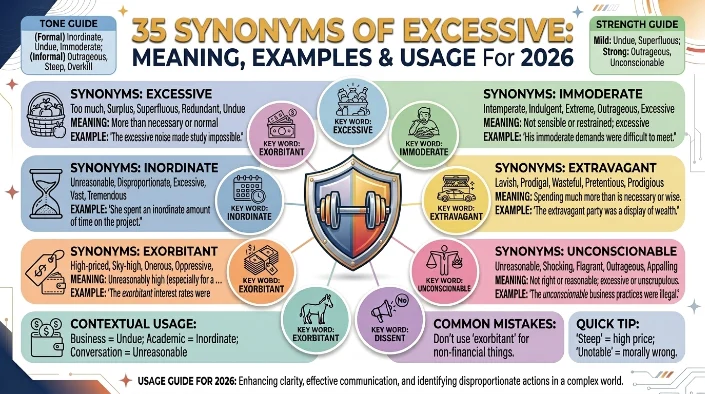
Excessive means too much or more than is needed, reasonable, or normal. The best synonyms include immoderate, inordinate, undue, extreme, unreasonable, extravagant, exorbitant, outrageous, steep, and unconscionable. But each word has its own context, formality, and tone.
Do you ever feel like the word “excessive” is, well, a little excessive? It’s a common adjective, but English has so many better options that can make your writing and speaking more precise.
Think about it. You might describe a price as excessive. But calling it “exorbitant” sounds stronger. Or you could call a boss’s demands “unreasonable” instead of excessive.
The word “excessive” itself is neutral. It simply describes something beyond normal limits. But depending on the situation, you may want a word that sounds more formal, more emotional, or more professional. That’s where this guide helps. By the end, you’ll know exactly which synonym fits your situation.
What Does “Excessive” Mean?
Definition
“Excessive” describes anything that goes beyond what is normal, necessary, or acceptable. Think of it as crossing a line. If you eat one cookie, that’s normal. If you eat the whole box, that’s excessive. The word implies “too much” and often carries a slightly negative tone, suggesting something is unreasonable or unjustified.
Pronunciation
| Feature | Value |
|---|---|
| US IPA | /ɪkˈsɛs.ɪv/ |
| UK IPA | /ɪkˈses.ɪv/ |
| Syllables | 3 |
| Tip | Stress the second syllable: ex-CESS-ive |
Grammar
| Grammar Feature | Information |
|---|---|
| Part of Speech | Adjective |
| Common Position | Before a noun or after a linking verb |
| Typical Pattern | Excessive + noun (e.g., excessive speed) |
| Verb “to be” + excessive (e.g., The price was excessive.) |
Examples:
- The police stopped him for excessive speed.
- Her reaction to the joke was excessive.
- The restaurant charges excessive fees for delivery.
Word Family
| Word | Part of Speech | Meaning |
|---|---|---|
| excess | Noun | An amount that is more than necessary |
| excessive | Adjective | Too much; beyond normal limits |
| excessively | Adverb | In a way that is too much |
| excessiveness | Noun | The state of being too much |
| exceed | Verb | To go beyond a limit |
30 Synonyms of “Excessive”
1. Immoderate
Meaning: Lacking moderation; going beyond reasonable limits.
Best Used For: Formal writing, describing behavior, habits, or opinions that lack self-control.
Formality: Formal
Tone: Negative, Critical
Frequency: ⭐⭐⭐ Moderate
CEFR Level: C1
Example Sentence 1: His immoderate drinking worried his family.
Example Sentence 2: The politician’s immoderate ambition cost him the election.
Usage Tip: Immoderate suggests a failure to control oneself. Use it when you want to criticize a lack of restraint. It sounds more academic than “excessive.”
2. Inordinate
Meaning: Much larger than what is reasonable or proper.
Best Used For: Formal writing, essays, and professional reports.
Formality: Formal
Tone: Neutral, Critical
Frequency: ⭐⭐⭐ Moderate
CEFR Level: C1
Example Sentence 1: She spends an inordinate amount of time on her phone.
Example Sentence 2: The project required an inordinate budget.
Usage Tip: Inordinate often describes amounts, time, or attention that are not justified. It sounds more sophisticated than “excessive.”
Common Confusion: Inordinate vs Excessive. Inordinate often implies something is unfair or undeserved. Excessive is broader.
3. Undue
Meaning: More than is appropriate or necessary, often suggesting something is unfair.
Best Used For: Business writing, legal contexts, formal English.
Formality: Formal
Tone: Neutral, Professional
Frequency: ⭐⭐⭐⭐ Common
CEFR Level: B2
Example Sentence 1: The police used undue force during the arrest.
Example Sentence 2: She faced undue pressure to make a decision.
Usage Tip: “Undue” is common in legal and business English. It often appears in phrases like “undue influence” or “undue hardship.” Use it when you want to sound professional.
4. Unreasonable
Meaning: Not based on good sense or fairness; too extreme.
Best Used For: Daily conversation, complaints, informal arguments.
Formality: Neutral
Tone: Critical, Frustrated
Frequency: ⭐⭐⭐⭐⭐ Very Common
CEFR Level: B1
Example Sentence 1: His demands are completely unreasonable.
Example Sentence 2: The hotel charges unreasonable prices for breakfast.
Usage Tip: This is the most everyday synonym for “excessive.” Native speakers use it all the time when complaining about prices, rules, or people.
5. Extravagant
Meaning: Spending or using too much money or resources; often wasteful.
Best Used For: Describing spending, gifts, lifestyles, or claims.
Formality: Neutral
Tone: Critical, Sometimes Admiring
Frequency: ⭐⭐⭐⭐ Common
CEFR Level: B2
Example Sentence 1: They had an extravagant wedding with over 500 guests.
Example Sentence 2: His extravagant claims about his achievements made everyone suspicious.
Usage Tip: Extravagant often relates to money but can also describe praise (“extravagant praise”) or promises. When used positively, it can mean “luxurious” or “impressive.”
6. Exorbitant
Meaning: Much higher than is fair or reasonable, especially about prices.
Best Used For: Prices, fees, costs, and financial contexts.
Formality: Formal
Tone: Strongly Critical
Frequency: ⭐⭐⭐ Moderate
CEFR Level: C1
Example Sentence 1: The doctors charged an exorbitant fee for the surgery.
Example Sentence 2: Rent in the city center is exorbitant.
Usage Tip: Save this for situations where something costs far too much. It’s stronger and more specific than “excessive.”
7. Outrageous
Meaning: Extremely shocking, unreasonable, or unacceptable.
Best Used For: Strong complaints, describing shocking behavior or unfair situations.
Formality: Informal
Tone: Strongly Negative, Emotional
Frequency: ⭐⭐⭐⭐ Common
CEFR Level: B2
Example Sentence 1: The price of that handbag is outrageous!
Example Sentence 2: His outrageous behavior at the party embarrassed everyone.
Usage Tip: Outrageous carries strong emotion. Use it when you want to express anger or disbelief. It’s more extreme than “excessive.”
8. Steep
Meaning: High or excessive (usually about prices or demands).
Best Used For: Daily conversation, complaining about costs.
Formality: Informal
Tone: Critical, Casual
Frequency: ⭐⭐⭐⭐ Common
CEFR Level: B1
Example Sentence 1: $10 for a coffee? That’s a bit steep.
Example Sentence 2: The club membership fees are too steep for me.
Usage Tip: “Steep” is a great informal synonym for “expensive.” Native speakers use it often. It’s also used for demands: “That’s a steep request.”
9. Unconscionable
Meaning: So unreasonable or unfair that it shocks the conscience.
Best Used For: Formal complaints, legal writing, strong moral criticism.
Formality: Very Formal
Tone: Very Strongly Negative, Moral
Frequency: ⭐ Rare
CEFR Level: C2
Example Sentence 1: The company’s unconscionable treatment of its workers caused a scandal.
Example Sentence 2: They charged an unconscionable interest rate.
Usage Tip: This is a powerful word. Reserve it for situations that are seriously wrong. It suggests moral outrage.
10. Extravagant
Meaning: Spending or using too much money or resources; often wasteful.
Best Used For: Describing spending, gifts, lifestyles, or claims.
Formality: Neutral
Tone: Critical, Sometimes Admiring
Frequency: ⭐⭐⭐⭐ Common
CEFR Level: B2
Example Sentence 1: They had an extravagant wedding with over 500 guests.
Example Sentence 2: His extravagant claims about his achievements made everyone suspicious.
Usage Tip: Extravagant often relates to money but can also describe praise (“extravagant praise”) or promises. When used positively, it can mean “luxurious” or “impressive.”
11. Overmuch
Meaning: Too much; more than is needed.
Best Used For: Literary writing, old-fashioned English.
Formality: Formal / Old-fashioned
Tone: Neutral
Frequency: ⭐ Very Rare
CEFR Level: B2
Example Sentence 1: He worried overmuch about his grades.
Example Sentence 2: She didn’t think overmuch about the consequences.
Usage Tip: “Overmuch” sounds old-fashioned. Most native speakers don’t use it in daily conversation. It’s fine for creative writing.
12. Disproportionate
Meaning: Too large or too small compared to something else; out of proper proportion.
Best Used For: Formal or academic writing, data analysis.
Formality: Formal
Tone: Neutral, Analytical
Frequency: ⭐⭐⭐ Moderate
CEFR Level: C1
Example Sentence 1: There was a disproportionate number of men in leadership roles.
Example Sentence 2: The punishment seemed disproportionate to the crime.
Usage Tip: “Disproportionate” suggests an imbalance. It’s useful when you compare two things and one is much larger than you expect.
13. Superfluous
Meaning: More than is needed or wanted; unnecessary.
Best Used For: Formal writing, academic contexts.
Formality: Formal
Tone: Neutral, Analytical
Frequency: ⭐⭐ Rare
CEFR Level: C1
Example Sentence 1: She deleted the superfluous details from her essay.
Example Sentence 2: In a minimalist home, any decoration is superfluous.
Usage Tip: “Superfluous” means “not needed” rather than “too much.” It’s a great word for editing or simplifying things.
14. Intemperate
Meaning: Lacking moderation; having extreme opinions or behaviors.
Best Used For: Describing strong emotions, criticism, or arguments.
Formality: Formal
Tone: Negative, Critical
Frequency: ⭐ Rare
CEFR Level: C1
Example Sentence 1: His intemperate remarks cost him his job.
Example Sentence 2: The newspaper printed intemperate criticism of the government.
Usage Tip: Intemperate often describes words, anger, or habits. It’s a formal way to say someone lacks self-control.
15. Overabundant
Meaning: Too much; an excessive amount of something.
Best Used For: Nature, resources, formal writing.
Formality: Formal / Neutral
Tone: Neutral
Frequency: ⭐⭐ Rare
CEFR Level: B2
Example Sentence 1: The garden has an overabundant supply of tomatoes.
Example Sentence 2: The report contained overabundant data.
Usage Tip: “Overabundant” is less common than “excessive.” Use it when you want to emphasize a large quantity.
16. Extortionate
Meaning: Charging a price that is much too high; using threats or unfair advantage.
Best Used For: Prices, fees, business practices.
Formality: Formal / Neutral
Tone: Strongly Negative
Frequency: ⭐⭐ Rare
CEFR Level: C1
Example Sentence 1: The taxi driver charged an extortionate fare.
Example Sentence 2: Extortionate interest rates hurt poor families.
Usage Tip: This word is similar to “exorbitant” but has a stronger sense of unfairness. It suggests someone is taking advantage.
17. Inordinate
Meaning: Much larger than what is reasonable or proper.
Best Used For: Formal writing, essays, and professional reports.
Formality: Formal
Tone: Neutral, Critical
Frequency: ⭐⭐⭐ Moderate
CEFR Level: C1
Example Sentence 1: She spends an inordinate amount of time on her phone.
Example Sentence 2: The project required an inordinate budget.
Usage Tip: Inordinate often describes amounts, time, or attention that are not justified. It sounds more sophisticated than “excessive.”
Common Confusion: Inordinate vs Excessive. Inordinate often implies something is unfair or undeserved. Excessive is broader.
18. Fulsome
Meaning: Excessive and insincere (usually of praise or flattery).
Best Used For: Describing praise, compliments, or apologies that seem fake.
Formality: Formal / Literary
Tone: Negative, Critical
Frequency: ⭐ Rare
CEFR Level: C1
Example Sentence 1: She received fulsome praise that felt empty.
Example Sentence 2: His fulsome apology did not sound genuine.
Usage Tip: “Fulsome” is tricky. Many people incorrectly use it to mean “abundant.” Actually, it means “sickeningly excessive.” Use it only when you want to criticize false praise.
19. Overkill
Meaning: Too much of something; an excessive amount that is unnecessary.
Best Used For: Informal conversation, describing plans, actions, or force.
Formality: Informal
Tone: Critical, Casual
Frequency: ⭐⭐⭐⭐ Common
CEFR Level: B2
Example Sentence 1: Using a bomb to destroy a mouse is overkill.
Example Sentence 2: Ten security guards for one celebrity is overkill.
Usage Tip: Overkill is a noun, not an adjective. Use it to describe an action that uses excessive force or resources.
20. Overwhelming
Meaning: Too large or strong to resist or deal with.
Best Used For: Emotions, tasks, experiences, quantities.
Formality: Neutral
Tone: Sometimes Positive, Sometimes Negative
Frequency: ⭐⭐⭐⭐⭐ Very Common
CEFR Level: B1
Example Sentence 1: She felt an overwhelming desire to cry.
Example Sentence 2: The response to the campaign was overwhelming.
Usage Tip: Overwhelming can be positive (“overwhelming support”) or negative (“overwhelming sadness”). It suggests something is so strong you can’t ignore or fight it.
21. Unwarranted
Meaning: Not justified or deserved; unnecessary.
Best Used For: Criticism, complaints, legal contexts.
Formality: Formal
Tone: Neutral, Professional
Frequency: ⭐⭐⭐ Moderate
CEFR Level: C1
Example Sentence 1: The accusations were completely unwarranted.
Example Sentence 2: She complained about unwarranted interference in her work.
Usage Tip: “Unwarranted” suggests there is no good reason for something. It is common in formal complaints and legal writing.
22. Uncalled-for
Meaning: Not necessary or appropriate; unwelcome.
Best Used For: Criticism, remarks, rude behavior.
Formality: Informal
Tone: Negative, Critical
Frequency: ⭐⭐⭐ Moderate
CEFR Level: B2
Example Sentence 1: That comment was completely uncalled-for.
Example Sentence 2: His angry response was uncalled-for.
Usage Tip: “Uncalled-for” is a common everyday phrase. Use it to describe rude or unnecessary behavior.
23. Supererogatory
Meaning: More than is required or expected; beyond duty.
Best Used For: Very formal writing, philosophy, theology.
Formality: Very Formal
Tone: Neutral
Frequency: ⭐ Very Rare
CEFR Level: C2
Example Sentence 1: Helping the neighbor was a supererogatory act of kindness.
Example Sentence 2: The employee’s supererogatory efforts earned him a promotion.
Usage Tip: This is a high-level word. Most people have never heard it. Reserve it for academic or formal contexts.
24. Unrestrained
Meaning: Not controlled or limited.
Best Used For: Emotions, behavior, growth.
Formality: Formal / Neutral
Tone: Neutral, Analytical
Frequency: ⭐⭐⭐ Moderate
CEFR Level: B2
Example Sentence 1: His unrestrained anger scared everyone.
Example Sentence 2: The company faced unrestrained competition.
Usage Tip: “Unrestrained” suggests a lack of control, but not always negative. It can describe positive things like “unrestrained laughter.”
25. Overabundant
Meaning: Too much; an excessive amount of something.
Best Used For: Nature, resources, formal writing.
Formality: Formal / Neutral
Tone: Neutral
Frequency: ⭐⭐ Rare
CEFR Level: B2
Example Sentence 1: The garden has an overabundant supply of tomatoes.
Example Sentence 2: The report contained overabundant data.
Usage Tip: “Overabundant” is less common than “excessive.” Use it when you want to emphasize a large quantity.
26. Wanton
Meaning: Deliberately causing harm or damage; excessive and lacking restraint.
Best Used For: Violence, destruction, behavior.
Formality: Formal / Literary
Tone: Strongly Negative
Frequency: ⭐⭐ Rare
CEFR Level: C1
Example Sentence 1: The soldiers committed wanton destruction of property.
Example Sentence 2: Wanton cruelty has no excuse.
Usage Tip: “Wanton” is a strong word. It suggests deliberate and unnecessary harm. Use it carefully.
27. Excessive
Meaning: Too much; beyond normal limits.
Best Used For: General use, any situation.
Formality: Neutral
Tone: Neutral
Frequency: ⭐⭐⭐⭐⭐ Very Common
CEFR Level: B1
Example Sentence 1: The cost of the car was excessive.
Example Sentence 2: Excessive noise disturbs the neighbors.
Usage Tip: This is the base word. Use it when you don’t need a special meaning. It’s the safest choice.
28. Extreme
Meaning: Far beyond what is normal, desirable, or acceptable.
Best Used For: Criticism, descriptions of weather, diets, opinions.
Formality: Neutral
Tone: Neutral, Sometimes Negative
Frequency: ⭐⭐⭐⭐⭐ Very Common
CEFR Level: B1
Example Sentence 1: Her political views are quite extreme.
Example Sentence 2: The desert has extreme temperatures.
Usage Tip: “Extreme” is a strong word. It can be neutral (extreme sports) or negative (extreme measures). It often suggests going to a dangerous edge.
29. Prodigal
Meaning: Wastefully extravagant; spending money freely.
Best Used For: Spending, wealth, lifestyle.
Formality: Formal / Literary
Tone: Critical, Sometimes Admiring
Frequency: ⭐ Rare
CEFR Level: C1
Example Sentence 1: The prodigal son wasted his inheritance.
Example Sentence 2: Her prodigal spending exhausted her savings.
Usage Tip: “Prodigal” is famous from the Bible story of the Prodigal Son. It usually describes reckless spending.
30. Gluttonous
Meaning: Excessively greedy, especially for food.
Best Used For: Food consumption, desire for more.
Formality: Neutral
Tone: Critical
Frequency: ⭐ Moderate
CEFR Level: B2
Example Sentence 1: His gluttonous appetite embarrassed him.
Example Sentence 2: The gluttonous feast left everyone full.
Usage Tip: “Gluttonous” specifically refers to eating too much. It can also be used metaphorically for greed.
Synonyms Comparison Table
| Synonym | Best Context | Formality | Tone | Frequency |
|---|---|---|---|---|
| Unreasonable | Everyday complaints | Neutral | Critical | ⭐⭐⭐⭐⭐ |
| Extreme | Strong opinions, weather | Neutral | Neutral | ⭐⭐⭐⭐⭐ |
| Undue | Legal, professional | Formal | Professional | ⭐⭐⭐⭐ |
| Extravagant | Spending, praise | Neutral | Critical | ⭐⭐⭐⭐ |
| Outrageous | Complaints, behavior | Informal | Emotional | ⭐⭐⭐⭐ |
| Steep | Prices | Informal | Critical | ⭐⭐⭐⭐ |
| Inordinate | Formal writing | Formal | Neutral | ⭐⭐⭐ |
| Exorbitant | Prices, fees | Formal | Strongly Negative | ⭐⭐⭐ |
| Immoderate | Formal criticism | Formal | Negative | ⭐⭐⭐ |
| Disproportionate | Statistics, data | Formal | Analytical | ⭐⭐⭐ |
| Unconscionable | Moral outrage | Very Formal | Very Negative | ⭐ |
| Superfluous | Unnecessary things | Formal | Analytical | ⭐⭐ |
| Intemperate | Emotions, anger | Formal | Negative | ⭐ |
| Unwarranted | Accusations | Formal | Professional | ⭐⭐⭐ |
Best Synonyms by Situation
| Situation | Best Synonym | Why It Works |
|---|---|---|
| Daily Conversation | Unreasonable or Steep | Sounds natural, easy to understand |
| Business Email | Undue or Unwarranted | Professional, appropriate for complaints |
| Academic Writing | Inordinate or Disproportionate | Formal and precise |
| School Assignment | Immoderate or Intemperate | Demonstrates advanced vocabulary |
| Professional Meeting | Extreme or Unconscionable | Commanding, direct |
| Presentation | Excessive or Overabundant | Clear and effective |
| Creative Writing | Extravagant or Prodigal | Adds emotional color |
| Social Media | Outrageous or Overkill | Attention-grabbing |
| Movie Review | Overwhelming | Describes emotional impact |
| Book Review | Superfluous | Describes unnecessary details |
Formal vs Informal Synonyms
Formal Alternatives
| Synonym | Best Used For |
|---|---|
| Inordinate | Emphasizing unfair amounts |
| Undue | Legal and official contexts |
| Immoderate | Lack of restraint |
| Intemperate | Extreme opinions |
| Disproportionate | Imbalanced ratios |
| Superfluous | Unnecessary elements |
| Unconscionable | Strong moral criticism |
Neutral Alternatives
| Synonym | Best Used For |
|---|---|
| Excessive | General use |
| Extreme | Intense situations |
| Overwhelming | Strong emotions or effects |
| Unreasonable | Everyday criticism |
Informal Alternatives
| Synonym | Best Used For |
|---|---|
| Outrageous | Complaining, expressing shock |
| Steep | High prices |
| Overkill | Overreactions |
| Uncalled-for | Rude comments |
| Overabundant | Too much of something |
Strong vs Mild Synonyms
Mild
These words are the gentlest alternatives to “excessive.”
- Undue (suggests slight overstepping)
- Unreasonable (suggests poor judgment)
- Superfluous (suggests something not needed)
Moderate
These words are more expressive than “excessive.”
- Inordinate (suggests unjustified quantity)
- Extravagant (suggests waste or luxury)
- Immoderate (suggests lack of control)
- Extreme (suggests going to the edge)
Strong
These words are intense and should be used carefully.
- Outrageous (suggests shock)
- Unconscionable (suggests deep moral wrongness)
- Exorbitant (suggests unfair costs)
- Intemperate (suggests dangerous lack of control)
Real-Life Examples
School:
- The teacher said I had an excessive number of spelling mistakes.
- My advisor called my course load inordinate.
Office:
- The manager complained about excessive overtime.
- My boss said my demands were unreasonable.
Business emails:
- “We believe the charges are undue.”
- “Please explain this extravagant budget.”
Meetings:
- “That deadline seems extreme.”
- “The proposal includes exorbitant fees.”
Movies / Books:
- The film’s running time was excessive.
- The story used superfluous description.
Daily conversations:
- “$8 for a burger? That’s steep!”
- “His reaction was completely uncalled-for.”
Common Collocations
| Common Phrase | Better Alternative |
|---|---|
| excessive speed | extreme speed, undue speed |
| excessive force | undue force, immoderate force |
| excessive drinking | immoderate drinking, intemperate drinking |
| excessive price | exorbitant price, steep price |
| excessive praise | extravagant praise, fulsome praise |
| excessive demand | unreasonable demand, inordinate demand |
| excessive spending | extravagant spending, prodigal spending |
| excessive amount | inordinate amount, overabundant amount |
Common Phrases
Too much of a good thing
- Meaning: Having too much of something that is generally good.
- Better: “overabundance” or “excess”
Over the top
- Meaning: Excessive or extreme.
- Better: “outrageous” or “extreme”
Push the envelope
- Meaning: Go beyond normal limits.
- Better: “extreme” or “immoderate”
Pour it on thick
- Meaning: Be excessive in praise or flattery.
- Better: “fulsome” or “extravagant”
Go overboard
- Meaning: Do too much.
- Better: “overkill” or “excessive”
Context Guide
| Situation | Best Synonym | Reason |
|---|---|---|
| Essay | Inordinate, Disproportionate | Sounds academic |
| Speech | Extreme, Outrageous | Grabs attention |
| Business Email | Undue, Unwarranted | Professional |
| Novel | Extravagant, Prodigal | Adds literary flair |
| Presentation | Excessive, Overwhelming | Clear and understood |
| Conversation | Unreasonable, Steep | Natural and easy to understand |
| Academic Writing | Immoderate, Superfluous | Demonstrates vocabulary range |
| Marketing Copy | Extreme, Overabundant | Persuasive and impactful |
Related Words
Near Synonyms
- Overboard: Doing too much (informal)
- Over the top: Excessive in a showy way
- Bountiful: Abundant (usually positive)
Antonyms
- Moderate: Keeping within reasonable limits
- Reasonable: Fair and sensible
- Modest: Not excessive
- Limited: Controlled in amount
- Minimal: Very small in amount
- Restrained: Showing self-control
- Sensible: Practical and reasonable
Related Adjectives
- Abundant: Existing in large quantities (neutral)
- Profuse: Plentiful (often positive)
- Superabundant: Extremely plentiful (near-synonym)
Related Nouns
- Excess: The state of being too much
- Extravagance: Spending too much money
- Lavishness: Using more than needed
Related Verbs
- Exceed: To go beyond a limit
- Overdo: To do too much
- Exaggerate: To make something seem larger than it is
Frequently Asked Questions
What is another word for excessive?
The most common synonyms are “immoderate,” “inordinate,” “undue,” “extreme,” and “unreasonable.” The best choice depends on the context. For everyday conversation, “unreasonable” or “extreme” work well. For formal writing, use “inordinate” or “immoderate.”
Which synonym sounds the most professional?
For professional contexts, “undue,” “unwarranted,” and “inordinate” sound the most professional. They appear often in legal, business, and academic writing. Use “undue” for complaints about unfair treatment and “inordinate” to describe excessive amounts.
What is the strongest synonym for excessive?
Unconscionable” is the strongest synonym. It implies moral outrage. “Outrageous” is also strong but less formal. “Exorbitant” is the strongest for prices. “Wanton” is the strongest for deliberate harm or destruction.
Which synonym is best for essays?
For essays, “immoderate,” “inordinate,” “disproportionate,” and “superfluous” are excellent choices. They sound academic and precise. “Undue” is also a good option for formal arguments. Avoid “steep” or “outrageous” in formal essays.
What’s the difference between excessive and exorbitant?
“Excessive” is a general word meaning “too much.” “Exorbitant” is much more specific and means “too expensive.” Use “excessive” for amounts, force, speed, or behavior. Use “exorbitant” only for prices, fees, or costs.
Which synonym is most common in everyday English?
Unreasonable” and “extreme” are the most common synonyms in everyday speech. Native speakers use them constantly to complain about prices, demands, or behavior. “Steep” is also very common for expensive items.
What is the opposite of excessive?
The opposites of “excessive” include “moderate,” “reasonable,” “modest,” “limited,” “minimal,” and “restrained.” Use “moderate” for balanced amounts, “reasonable” for fair demands, and “minimal” for very small amounts.
Conclusion
“Excessive” is a useful word, but English has many better alternatives. Each synonym carries a slightly different meaning, formality, and emotion.
For everyday conversation, “unreasonable,” “extreme,” and “steep” are the most natural choices. For formal writing, choose “inordinate,” “undue,” or “immoderate.” When you want to express strong anger, use “outrageous,” “unconscionable,” or “exorbitant.”
The key is to choose the word that fits your context, tone, and audience. Are you writing a business email? Use “undue” or “unwarranted.” Complaining about a price? “Exorbitant” or “steep” will sound more natural. Describing a friend’s behavior? “Overkill” or “over-the-top” work well.
Avoid using “excessive” every time. Your vocabulary will improve, your writing will become more precise, and native speakers will notice the difference.
