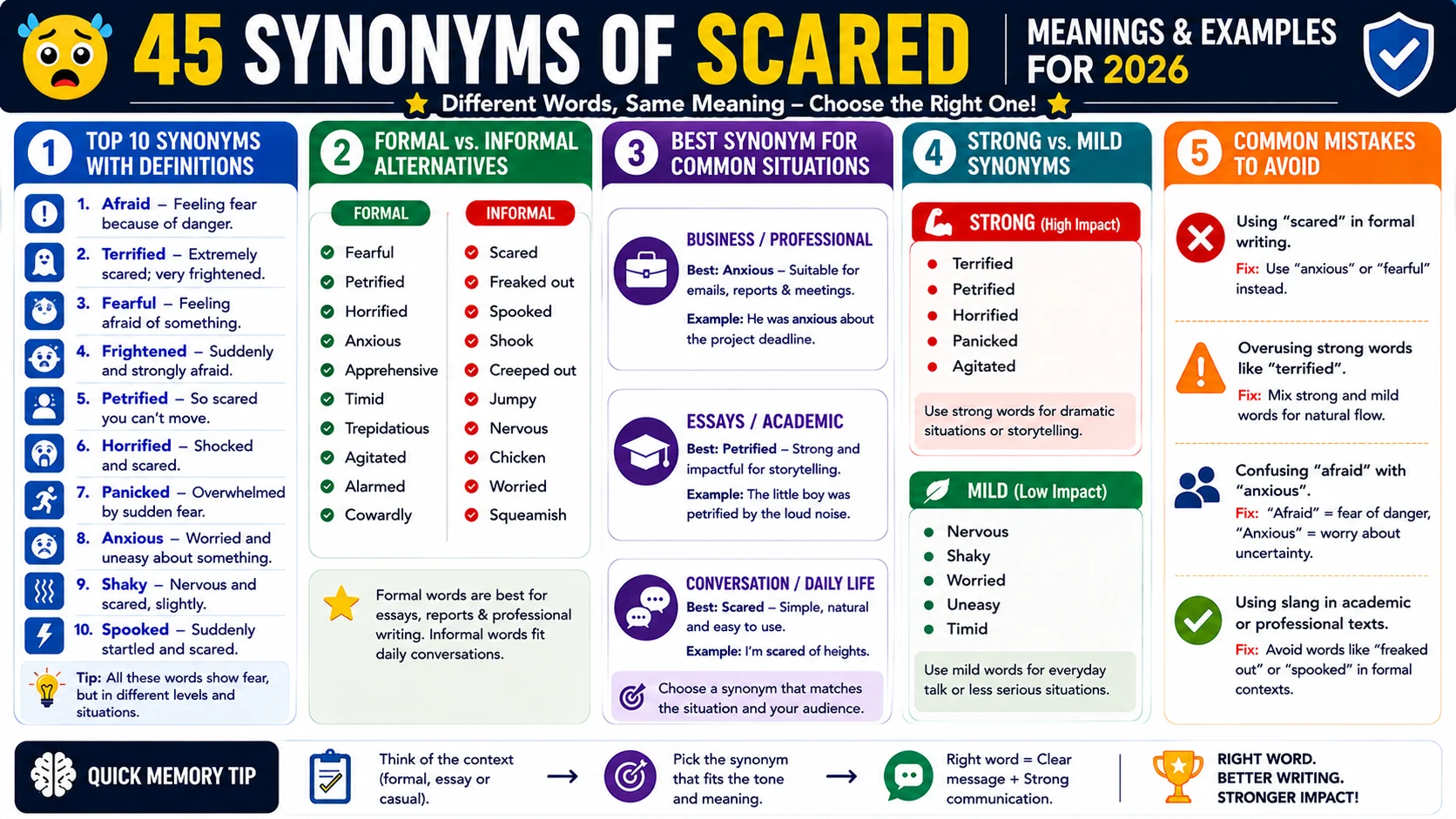
Scared” means feeling afraid or frightened. The best synonyms are afraid, frightened, terrified, horrified, and petrified. “Afraid” is the most common natural alternative. Each synonym has a slightly different meaning and context where it fits best.
Top 10 Synonyms
- Afraid
- Frightened
- Terrified
- Horrified
- Petrified
- Alarmed
- Panicked
- Nervous
- Anxious
- Spooked
“Scared” is a word we use all the time. We feel scared in scary movies, scared during exams, scared of the dark, and scared for our safety. But using it too often can make your English feel repetitive.
Think about it. You can be scared of heights, scared of spiders, scared of failure, or scared of the unknown. Each situation might need a different word that captures the specific type of fear.
In this guide, you’ll learn 35 powerful synonyms for “scared.” You’ll discover exactly when to use each one, how formal they are, and what common mistakes to avoid. Let’s begin!
What Does “Scared” Mean?
Definition
Scared” means feeling afraid or frightened. It’s the emotion you feel when you think something dangerous might happen. It can be a small fear, like being scared of a spider, or a big fear, like being scared for your life.
Pronunciation
| Feature | Value |
|---|---|
| US IPA | /skɛrd/ |
| UK IPA | /skeəd/ |
| Syllables | 1 |
| Tip | Rhymes with “shared” and “cared” |
Grammar
| Grammar Feature | Information |
|---|---|
| Part of Speech | Adjective |
| Common Position | After a linking verb or before a noun |
| Typical Pattern | Subject + be + scared + of/about |
Examples:
- “I am scared of spiders.” (after verb)
- “The scared child cried.” (before noun)
- “She was scared of the dark.” (after verb)
Grammar Note: “Scared” is often used with “of” to show what you’re afraid of.
Word Family
| Word | Part of Speech | Meaning |
|---|---|---|
| Scared | Adjective | Feeling afraid |
| Scare | Verb/Noun | To frighten or the feeling of fright |
| Scary | Adjective | Causing fear |
| Scaring | Gerund | The act of frightening |
| Scaredy | Noun | A scared person (informal) |
15 Synonyms of “Scared”
Afraid
Meaning: Feeling fear or worry.
Best Used For: Almost any situation where you feel fear.
Formality: Neutral
Tone: Worried, Fearful
Frequency: ⭐⭐⭐⭐⭐ (Very Common)
CEFR Level: A2
Example Sentence 1: “I’m afraid of heights.”
Example Sentence 2: “She was afraid to speak in public.”
Usage Tip: “Afraid” is the most common synonym. Use it in almost any situation where you feel fear or worry.
Common Confusion: Afraid vs Scared. They are very similar. “Afraid” can also mean “sorry” in some contexts (e.g., “I’m afraid we’re late”).
Frightened
Meaning: Feeling sudden fear or shock.
Best Used For: Sudden surprises, shock, frightening experiences.
Formality: Neutral
Tone: Shocked, Alarmed
Frequency: ⭐⭐⭐⭐⭐ (Very Common)
CEFR Level: A2
Example Sentence 1: “The loud noise made her frightened.”
Example Sentence 2: “He looked frightened by the sudden appearance.”
Usage Tip: “Frightened” often suggests a sudden, immediate fear. Use it for sudden scares.
Terrified
Meaning: Extremely scared.
Best Used For: Very intense fear, life-threatening situations.
Formality: Neutral
Tone: Extreme, Intense
Frequency: ⭐⭐⭐⭐ (Common)
CEFR Level: B2
Example Sentence 1: “She was terrified of the dark.”
Example Sentence 2: “He was terrified by the horror movie.”
Usage Tip: “Terrified” is much stronger than “scared.” Use it for extreme fear.
Horrified
Meaning: Shocked and scared, often by something terrible.
Best Used For: Shock, disgust, terrible events.
Formality: Neutral
Tone: Shocked, Disgusted
Frequency: ⭐⭐⭐ (Moderate)
CEFR Level: B2
Example Sentence 1: “She was horrified by the news.”
Example Sentence 2: “He looked horrified at the scene.”
Usage Tip: “Horrified” combines fear with shock and often disgust.
Petrified
Meaning: So scared that you can’t move.
Best Used For: Extreme, paralyzing fear.
Formality: Neutral
Tone: Paralyzed, Frozen
Frequency: ⭐⭐⭐ (Moderate)
CEFR Level: B2
Example Sentence 1: “She was petrified with fear.”
Example Sentence 2: “He stood petrified, unable to move.”
Usage Tip: “Petrified” suggests being frozen with fear. It’s a strong, vivid word.
Alarmed
Meaning: Suddenly scared or worried about danger.
Best Used For: Sudden warnings, unexpected danger.
Formality: Neutral
Tone: Worried, Concerned
Frequency: ⭐⭐⭐ (Moderate)
CEFR Level: B2
Example Sentence 1: “She was alarmed by the sound of glass breaking.”
Example Sentence 2: “The police were alarmed by the situation.”
Usage Tip: “Alarmed” suggests sudden concern or worry. Use it for unexpected dangers.
Panicked
Meaning: In a state of sudden, uncontrollable fear.
Best Used For: Emergencies, chaos, overwhelming situations.
Formality: Neutral
Tone: Chaotic, Overwhelmed
Frequency: ⭐⭐⭐ (Moderate)
CEFR Level: B2
Example Sentence 1: “The crowd panicked when the fire started.”
Example Sentence 2: “She was panicked and couldn’t think clearly.
Usage Tip: “Panicked” suggests losing control due to fear. Use it for chaotic situations.
Nervous
Meaning: Worried and uneasy about something.
Best Used For: Before exams, interviews, new situations.
Formality: Neutral
Tone: Worried, Uneasy
Frequency: ⭐⭐⭐⭐⭐ (Very Common)
CEFR Level: B1
Example Sentence 1: “She felt nervous before the interview.”
Example Sentence 2: “He was nervous about the exam.”
Usage Tip: “Nervous” is about worry and unease, often before an event. It’s milder than “scared.”
Anxious
Meaning: Worried and uneasy, often without a clear reason.
Best Used For: Ongoing worry, general anxiety.
Formality: Neutral
Tone: Worried, Uneasy
Frequency: ⭐⭐⭐⭐ (Common)
CEFR Level: B2
Example Sentence 1: “She felt anxious about the future.”
Example Sentence 2: “He became anxious when she didn’t call.”
Usage Tip: “Anxious” suggests longer-lasting worry. It’s often used for mental health contexts.
Spooked
Meaning: Suddenly scared or startled.
Best Used For: Informal contexts, sudden scares.
Formality: Informal
Tone: Startled, Surprised
Frequency: ⭐⭐⭐ (Moderate)
CEFR Level: B2
Example Sentence 1: “The loud noise spooked the horse.”
Example Sentence 2: “He looked spooked by the strange noise.”
Usage Tip: “Spooked” is informal. Use it for sudden, unexpected scares.
Startled
Meaning: Suddenly surprised and slightly scared.
Best Used For: Surprises, sudden noises.
Formality: Neutral
Tone: Surprised, Shocked
Frequency: ⭐⭐⭐ (Moderate)
CEFR Level: B2
Example Sentence 1: “The sudden bang startled her.”
Example Sentence 2: “He looked startled by the question.”
Usage Tip: “Startled” is about sudden surprise, often with mild fear.
Frightened
Meaning: Feeling sudden fear.
Best Used For: Surprises, sudden shocks.
Formality: Neutral
Tone: Shocked, Alarmed
Frequency: ⭐⭐⭐⭐⭐ (Very Common)
CEFR Level: A2
Example Sentence 1: “The child was frightened by the loud thunder.”
Example Sentence 2: “She felt frightened when the lights went out.”
Usage Tip: “Frightened” is a common word for sudden, immediate fear.
Dread
Meaning: To fear something that is coming.
Best Used For: Anticipated fear, future events.
Formality: Neutral
Tone: Fearful, Apprehensive
Frequency: ⭐⭐⭐ (Moderate)
CEFR Level: B2
Example Sentence 1: “She dreaded going to the dentist.”
Example Sentence 2: “He felt a sense of dread.”
Usage Tip: “Dread” is about fearing something in the future. It’s often a strong, deep fear.
Intimidated
Meaning: Feeling scared because someone or something is powerful.
Best Used For: Powerful people, authority figures.
Formality: Neutral
Tone: Overwhelmed, Outmatched
Frequency: ⭐⭐⭐ (Moderate)
CEFR Level: B2
Example Sentence 1: “She felt intimidated by the interview panel.”
Example Sentence 2: “He was intimidated by his boss.”
Usage Tip: “Intimidated” suggests feeling inferior or overwhelmed by someone’s power.
Fearful
Meaning: Feeling or showing fear.
Best Used For: Formal contexts, general fear.
Formality: Formal
Tone: Afraid, Worried
Frequency: ⭐⭐⭐ (Moderate)
CEFR Level: B2
Example Sentence 1: “She was fearful of the consequences.”
Example Sentence 2: “He gave a fearful glance.”
Usage Tip: “Fearful” is a more formal word for feeling fear.
Synonyms Comparison Table
| Synonym | Best Context | Formality | Tone | Frequency |
|---|---|---|---|---|
| Afraid | General fear | Neutral | Fearful | ⭐⭐⭐⭐⭐ |
| Frightened | Sudden fear | Neutral | Shocked | ⭐⭐⭐⭐⭐ |
| Nervous | Worry before events | Neutral | Uneasy | ⭐⭐⭐⭐⭐ |
| Anxious | Ongoing worry | Neutral | Worried | ⭐⭐⭐⭐ |
| Terrified | Extreme fear | Neutral | Intense | ⭐⭐⭐⭐ |
| Petrified | Paralyzing fear | Neutral | Frozen | ⭐⭐⭐ |
| Horrified | Shock and disgust | Neutral | Shocked | ⭐⭐⭐ |
| Alarmed | Sudden warning | Neutral | Concerned | ⭐⭐⭐ |
| Panicked | Losing control | Neutral | Chaotic | ⭐⭐⭐ |
| Spooked | Informal scares | Informal | Startled | ⭐⭐⭐ |
Best Synonyms by Situation
| Situation | Best Synonym | Why It Works |
|---|---|---|
| Daily Conversation | Afraid | Natural and common |
| Business Email | Concerned (not scared) | Professional alternative |
| Academic Writing | Fearful | Formal and precise |
| School Assignment | Afraid | Clear and simple |
| Professional Meeting | Concerned | Professional tone |
| Presentation | Nervous | Relatable and honest |
| Creative Writing | Petrified | Adds literary depth |
| Social Media | Scared | Casual and relatable |
| Horror Movie | Terrified | Intense and strong |
Formal vs Informal Synonyms
Formal Alternatives
| Synonym | Best Used For |
|---|---|
| Fearful | Formal writing |
| Apprehensive | Worrying about something |
| Intimidated | Power dynamics |
| Dreadful | Extreme fear of the future |
| Trembling | Physical fear |
Neutral Alternatives
| Synonym | Best Used For |
|---|---|
| Afraid | Most general situations |
| Frightened | Sudden fear |
| Nervous | Before events |
| Anxious | Ongoing worry |
| Scared | General fear |
Informal Alternatives
| Synonym | Best Used For |
|---|---|
| Spooked | Sudden scares |
| Freaked out | Very scared (informal) |
| Creeped out | Uncomfortably scared |
| Jumpy | Easily scared |
Choosing the Right Level: Use “fearful” and “apprehensive” for formal writing. Use “afraid” and “scared” for most situations. Use “spooked” and “freaked out” with friends.
Strong vs Mild Synonyms
Mild
Suitable for everyday situations with less intensity.
- Nervous
- Anxious
- Worried
Moderate
More fearful or serious alternatives.
- Afraid
- Scared (itself)
- Frightened
- Alarmed
Strong
High-intensity alternatives suggesting extreme fear.
- Terrified (extreme fear)
- Horrified (shock and fear)
- Petrified (frozen with fear)
- Panicked (losing control)
How Intensity Changes Meaning: “I’m nervous” is mild. “I’m terrified” is extreme. Choose stronger words when you want to emphasize the intensity of the fear.
Real-Life Examples
School: “The students were scared of the difficult exam.”
Office: “She was nervous about her presentation.”
Business Email: “We are concerned about the potential risks.”
Meetings: “He looked intimidated by the senior managers.”
Presentations: “I was terrified to speak in front of so many people.”
Daily Conversations: “I’m afraid of spiders.”
Social Media: “This movie had me terrified!”
Academic Writing: “The subjects were fearful of the consequences.”
Common Collocations
| Common Phrase | Better Alternative |
|---|---|
| Scared of | Afraid of |
| Really scared | Terrified |
| A little scared | Nervous |
| Scared to death | Petrified |
| Scared about | Worried about |
Common Phrases
Scared to death: Extremely scared. (e.g., “He was scared to death.”)
Scared out of one’s wits: Extremely scared. (e.g., “The ghost scared me out of my wits.”)
Shake like a leaf: To tremble with fear. (e.g., “He was shaking like a leaf.”)
Have one’s heart in one’s throat: To be very scared. (e.g., “I had my heart in my throat.”)
Jump out of one’s skin: To be extremely startled. (e.g., “The noise made me jump out of my skin.”)
Context Guide
| Situation | Best Synonym | Reason |
|---|---|---|
| Essay | Fearful | Academic and formal |
| Speech | Nervous | Relatable and honest |
| Business Email | Concerned | Professional and clear |
| Novel | Petrified | Adds literary depth |
| Presentation | Nervous | Relatable and honest |
| Conversation | Afraid | Natural and relatable |
| Academic Writing | Fearful | Precise and formal |
| Marketing Copy | Avoid (too negative) | Not appropriate |
Related Words
Near Synonyms
- Apprehensive: Worried about the future.
- Agitated: Feeling nervous and upset.
- Uneasy: Feeling uncomfortable and worried.
- Jittery: Nervous and shaky.
- Trembling: Shaking with fear.
Antonyms
- Brave: Not afraid.
- Fearless: Without fear.
- Confident: Self-assured.
- Bold: Daring.
- Courageous: Brave.
Related Adjectives
- Afraid: Feeling fear.
- Frightened: Suddenly scared.
- Terrified: Extremely scared.
- Nervous: Worried and uneasy.
- Anxious: Worried about the future.
Related Nouns
- Fear: The feeling of being scared.
- Terror: Extreme fear.
- Panic: Sudden, uncontrollable fear.
- Anxiety: Long-lasting worry.
- Dread: Fear of the future.
Related Verbs
- Scare: To make someone afraid.
- Frighten: To make someone suddenly afraid.
- Terrify: To make someone extremely afraid.
- Startle: To surprise and scare.
- Intimidate: To make someone feel scared and inferior.
Frequently Asked Questions
What is another word for scared?
Common synonyms include afraid, frightened, terrified, horrified, and petrified. “Afraid” is the most common and direct alternative.
Which synonym sounds the most professional?
“Fearful” and “apprehensive” sound professional. In business contexts, “concerned” is often used instead of “scared.”
What is the strongest synonym for scared?
Terrified” and “petrified” are among the strongest synonyms. They suggest extreme, paralyzing fear.
Which synonym is best for essays?
“Fearful” is the best choice for academic essays. It’s formal and precise.
What’s the difference between scared and frightened?
They are very similar. “Frightened” often suggests a sudden, immediate fear. “Scared” is broader.
Which synonym is most common in everyday English?
“Afraid” and “scared” are the most common in everyday speech. “Nervous” is also frequently used.
What is the opposite of scared?
Common opposites are brave, fearless, confident, and bold. These words describe not being afraid.
Conclusion
“Scared” is a useful word, but now you have 35 fantastic alternatives. Each synonym adds a different shade of meaning to your language.
Remember, the key is understanding the context. Use “afraid” for general fear. Use “terrified” for extreme fear. Use “nervous” for worry before events. Use “petrified” for paralyzing fear.
The best way to improve is practice. Try using one or two new synonyms each day. Listen for these words in conversations and books. Your vocabulary will become richer and more impressive with time.
