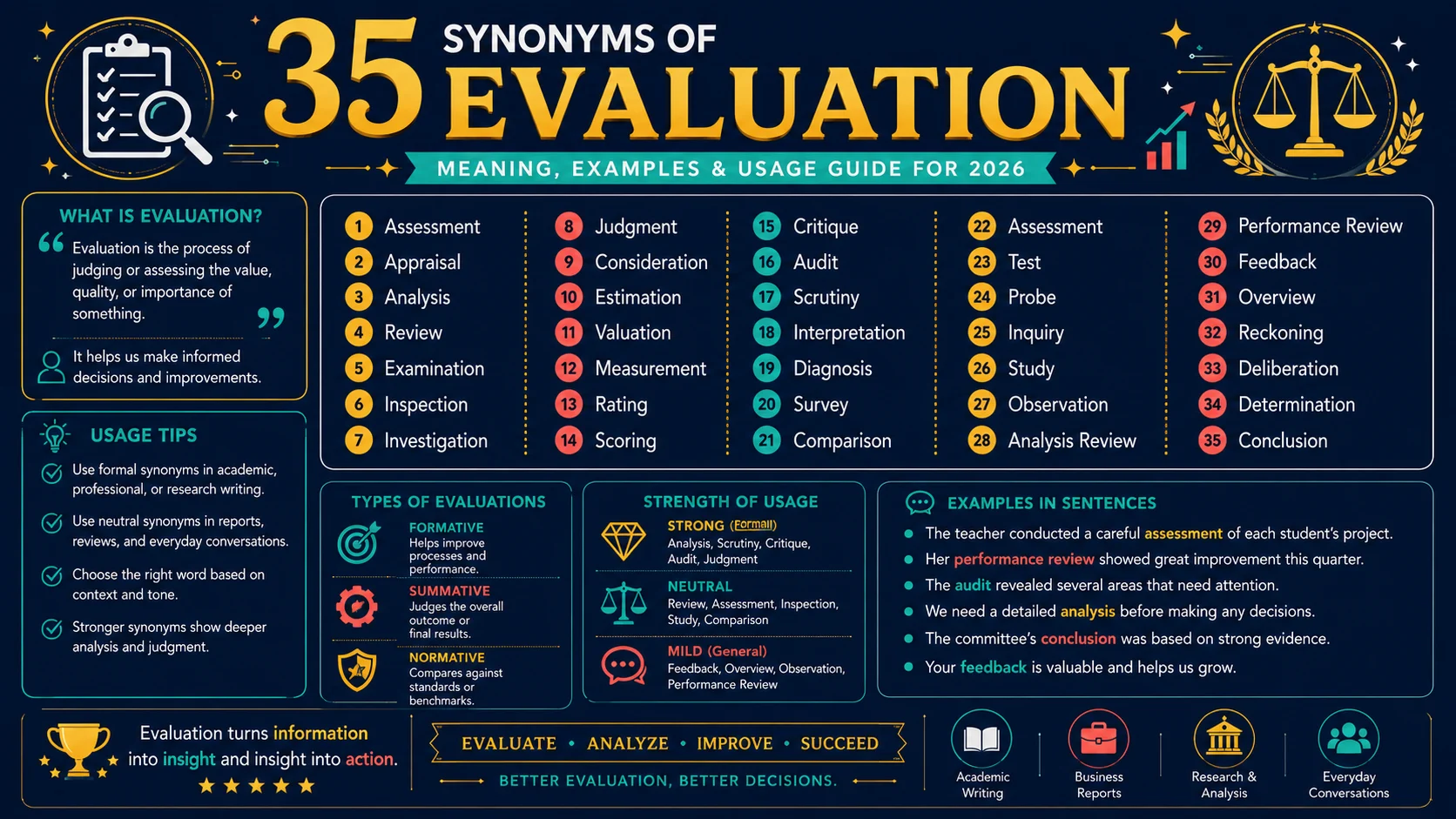
Evaluation means carefully judging or examining something to decide its value, quality, or importance. The best synonyms include assessment, appraisal, review, analysis, appreciation, estimation, examination, and judgment. The most common everyday synonym is review, while assessment works best in professional contexts. Each synonym has a slightly different tone and fits different situations perfectly.
Top 10 Synonyms
- Assessment
- Appraisal
- Review
- Analysis
- Appreciation
- Estimation
- Examination
- Judgment
- Valuation
- Critique
Every synonym has a slightly different meaning, tone, or context, so choose carefully based on your situation.
Do you keep using “evaluation” in your writing and speaking? It’s a useful word, but overusing it makes your English sound repetitive and formal.
Learning synonyms for “evaluation” helps you express yourself more naturally and precisely. Whether you’re writing a performance review, analyzing data, or simply giving your opinion on something, having the right word makes your message clearer and more professional.
In this guide, you’ll discover 35 powerful alternatives to “evaluation.” You’ll learn their meanings, when to use them, and which ones native speakers prefer in different situations. Let’s dive in!
What Does “Evaluation” Mean?
Definition
Evaluation means the process of carefully judging or examining something to understand its worth, importance, or quality. It’s about looking at all the evidence and making a thoughtful decision or judgment.
In everyday terms, think of it like this: when a teacher grades your work, they’re doing an evaluation. When a manager reviews your performance at work, that’s also an evaluation. It’s the process of stepping back, looking at something carefully, and deciding what it’s really worth.
Evaluation can describe:
- Judging quality (“The evaluation of the product was positive”)
- Analyzing performance (“The annual evaluation showed great progress”)
- Determining value (“The evaluation of the property was fair”)
Pronunciation
| Feature | Value |
|---|---|
| US IPA | /ɪˌvæl.juˈeɪ.ʃən/ |
| UK IPA | /ɪˌvæl.juˈeɪ.ʃən/ |
| Syllables | 5 (e-val-u-a-tion) |
| Tip | Stress the fourth syllable: e-val-u-A-tion |
Grammar
| Grammar Feature | Information |
|---|---|
| Part of Speech | Noun |
| Common Position | Subject or object of a sentence |
| Typical Pattern | evaluation + of + something |
Example Sentences:
- “The evaluation of the new system took three months.”
- “Her evaluation of the situation was accurate.”
- “We need an evaluation before making a decision.”
Grammar Note: “Evaluation” is a noun. The verb form is “evaluate,” and the adjective is “evaluative.”
Word Family
| Word | Part of Speech | Meaning |
|---|---|---|
| Evaluate | Verb | To judge or determine the value of something |
| Evaluation | Noun | The act of evaluating |
| Evaluative | Adjective | Relating to evaluation or judgment |
| Evaluator | Noun | A person who evaluates |
| Re-evaluate | Verb | To evaluate again |
| Misevaluate | Verb | To evaluate incorrectly |
| Overevaluate | Verb | To evaluate too highly |
35 Synonyms of “Evaluation”
1. Assessment
Meaning: The process of judging or deciding the quality, importance, or value of something.
Best Used For: Education, professional contexts, medical situations, general use.
Formality: Neutral to Formal
Tone: Professional, Objective
Frequency: ⭐⭐⭐⭐⭐ Very Common
CEFR Level: B1
Example Sentence 1: “The teacher’s assessment of the students’ progress was thorough.”
Example Sentence 2: “We conducted a risk assessment before starting the project.”
Usage Tip: “Assessment” is the closest and most common alternative to “evaluation.” It works in almost any context. Use it when you want to sound professional but not overly formal.
Common Confusion: Assessment vs Evaluation – These are often used interchangeably. “Assessment” often implies measuring against a standard, while “evaluation” can be more about determining overall value.
2. Appraisal
Meaning: A careful examination and judgment of something’s value, quality, or performance.
Best Used For: Performance reviews, property values, art, business.
Formality: Formal
Tone: Professional, Analytical
Frequency: ⭐⭐⭐⭐ Common
CEFR Level: B2
Example Sentence 1: “She received an excellent performance appraisal from her manager.
Example Sentence 2: “The art dealer gave a high appraisal of the painting.”
Usage Tip: “Appraisal” is often used for professional performance reviews and determining monetary value. It’s more formal than “assessment” and suggests a systematic, often documented, process.
3. Review
Meaning: An examination of something to decide if changes are needed or to give an opinion.
Best Used For: Products, books, movies, performance, daily conversation.
Formality: Neutral
Tone: Practical, Accessible
Frequency: ⭐⭐⭐⭐⭐ Very Common
CEFR Level: A2
Example Sentence 1: “Let’s do a review of the project before the client presentation.”
Example Sentence 2: “The restaurant received positive reviews online.”
Usage Tip: “Review” is the most natural and common alternative in everyday English. It’s perfect for describing the process of looking at something carefully and forming an opinion.
4. Analysis
Meaning: A detailed examination of something to understand its parts and how they work together.
Best Used For: Research, business data, scientific contexts, problem-solving.
Formality: Formal
Tone: Analytical, Technical
Frequency: ⭐⭐⭐⭐⭐ Very Common
CEFR Level: B2
Example Sentence 1: “The data analysis revealed important trends.
Example Sentence 2: “We conducted a thorough analysis of the market.
Usage Tip: “Analysis” focuses on breaking things down to understand them, rather than just judging their value. It’s more technical and detailed than “evaluation.”
5. Appreciation
Meaning: Understanding the true value or quality of something; a positive evaluation.
Best Used For: Art, music, literature, culture, positive assessments.
Formality: Neutral to Formal
Tone: Positive, Reflective
Frequency: ⭐⭐⭐⭐ Common
CEFR Level: B2
Example Sentence 1: “Her appreciation of poetry deepened after the course.”
Example Sentence 2: “He showed a real appreciation for fine architecture.”
Usage Tip: “Appreciation” often implies a positive evaluation. It’s about recognizing quality and value. Use it when you want to emphasize understanding and positive judgment.
6. Estimation
Meaning: A rough judgment or calculation of value, number, or importance.
Best Used For: Approximate values, business, construction, general prediction.
Formality: Neutral
Tone: Practical, Tentative
Frequency: ⭐⭐⭐⭐ Common
CEFR Level: B2
Example Sentence 1: “My estimation is that we’ll finish in two weeks.”
Example Sentence 2: “The contractor gave us an estimation of the repair costs.”
Usage Tip: “Estimation” often suggests something that isn’t exact. It’s about making a careful guess based on available information, not a precise measurement.
7. Examination
Meaning: A careful look at something to understand it or check for problems.
Best Used For: Medical checks, inspections, academic tests, detailed investigation.
Formality: Neutral to Formal
Tone: Thorough, Serious
Frequency: ⭐⭐⭐⭐ Common
CEFR Level: B1
Example Sentence 1: “The doctor performed a thorough examination.”
Example Sentence 2: “The document examination revealed several errors.”
Usage Tip: “Examination” suggests a careful, often physical, inspection. It’s about looking closely for problems or information. It can also mean a formal test.
8. Judgment
Meaning: The ability to make good decisions based on careful thought; or the decision itself.
Best Used For: Legal contexts, personal decisions, professional opinions.
Formality: Neutral
Tone: Authoritative, Decisive
Frequency: ⭐⭐⭐⭐⭐ Very Common
CEFR Level: B1
Example Sentence 1: “His judgment about the investment was correct.”
Example Sentence 2: “The judge’s judgment was fair and well-reasoned.”
Usage Tip: “Judgment” (also spelled “judgement” in the UK) suggests reaching a conclusion after careful thought. It often implies authority or the ability to make sound decisions.
9. Valuation
Meaning: Determining how much something is worth, especially financially.
Best Used For: Finance, real estate, business, insurance.
Formality: Formal
Tone: Financial, Precise
Frequency: ⭐⭐⭐ Moderate
CEFR Level: B2
Example Sentence 1: “The valuation of the property increased significantly.”
Example Sentence 2: “We need a valuation of the company before the merger.”
Usage Tip: “Valuation” is specific to determining financial value. Use it in business and financial contexts. It’s more precise than “evaluation” when talking about money.
10. Critique
Meaning: A careful, often detailed, assessment of something, especially artistic or creative work.
Best Used For: Art, literature, film, academic writing, constructive feedback.
Formality: Neutral to Formal
Tone: Analytical, Constructive
Frequency: ⭐⭐⭐⭐ Common
CEFR Level: B2
Example Sentence 1: “The film received mixed critiques from the reviewers.
Example Sentence 2: “She offered a constructive critique of my presentation.”
Usage Tip: “Critique” is often used for creative works and suggests thoughtful, detailed feedback. It can be positive or negative but should always be helpful.
11. Inspection
Meaning: A careful look at something to make sure it’s working properly or to find problems.
Best Used For: Safety checks, quality control, property inspection.
Formality: Formal
Tone: Thorough, Compliance-focused
Frequency: ⭐⭐⭐⭐ Common
CEFR Level: B2
Example Sentence 1: “The building passed the safety inspection.”
Example Sentence 2: “We conducted a final inspection before moving in.”
Usage Tip: “Inspection” suggests checking for compliance or problems. It’s often used for safety, quality control, and official checks.
12. Audit
Meaning: A systematic, independent examination of finances, records, or processes.
Best Used For: Finance, accounting, compliance, organizational review.
Formality: Formal
Tone: Official, Regulatory
Frequency: ⭐⭐⭐⭐ Common
CEFR Level: B2
Example Sentence 1: “The company is undergoing a financial audit.”
Example Sentence 2: “The internal audit found no major problems.”
Usage Tip: “Audit” is specific to financial or compliance checks. It implies an official, systematic examination, often by someone outside the organization.
13. Survey
Meaning: A general look at something; or a collection of information from many people.
Best Used For: Research, customer feedback, general overview.
Formality: Neutral
Tone: Informative, Data-driven
Frequency: ⭐⭐⭐⭐⭐ Very Common
CEFR Level: B1
Example Sentence 1: “We conducted a survey to understand customer satisfaction.
Example Sentence 2: “The survey of the situation revealed several key issues.”
Usage Tip: “Survey” can mean collecting information from people OR a general examination. It’s common in research and business contexts.
14. Analysis
Meaning: A detailed examination of the parts of something to understand the whole.
Best Used For: Technical contexts, research, problem-solving.
Formality: Formal
Tone: Technical, Academic
Frequency: ⭐⭐⭐⭐⭐ Very Common
CEFR Level: B2
Example Sentence 1: “The analysis of the experiment results took days.”
Example Sentence 2: “His analysis of the problem was brilliant.”
Usage Tip: “Analysis” emphasizes breaking something down into parts. It’s more technical than “evaluation” and suggests deep understanding.
15. Assessment
Meaning: The process of judging the value, importance, or quality of something.
Best Used For: Education, professional contexts, general use.
Formality: Neutral to Formal
Tone: Professional, Objective
Frequency: ⭐⭐⭐⭐⭐ Very Common
CEFR Level: B1
Example Sentence 1: “The assessment confirmed our initial findings.”
Example Sentence 2: “She made a careful assessment of the risks involved.”
Usage Tip: This is one of the most versatile synonyms. It works well in almost any context where you need to say “evaluation.”
16. Assessment
Meaning: The process of judging the value, importance, or quality of something.
Best Used For: Education, professional contexts, general use.
Formality: Neutral to Formal
Tone: Professional, Objective
Frequency: ⭐⭐⭐⭐⭐ Very Common
CEFR Level: B1
Example Sentence 1: “The assessment confirmed our initial findings.”
Example Sentence 2: “She made a careful assessment of the risks involved.”
Usage Tip: This is one of the most versatile synonyms. It works well in almost any context where you need to say “evaluation.”
17. Rating
Meaning: A score or grade that shows quality, performance, or value.
Best Used For: Products, services, movies, restaurants, online reviews.
Formality: Neutral
Tone: Accessible, Consumer-focused
Frequency: ⭐⭐⭐⭐⭐ Very Common
CEFR Level: A2
Example Sentence 1: “The restaurant has a five-star rating.”
Example Sentence 2: “We gave the new product a high rating.”
Usage Tip: “Rating” is about assigning a score or level. It’s concrete and easy to understand. Use it for reviews of products, services, or performances.
18. Analysis
Meaning: A detailed examination and understanding of something complex.
Best Used For: Research, business data, scientific contexts.
Formality: Formal
Tone: Analytical, Precise
Frequency: ⭐⭐⭐⭐⭐ Very Common
CEFR Level: B2
Example Sentence 1: “The data analysis showed a clear pattern.”
Example Sentence 2: “We need a detailed analysis of the costs involved.”
Usage Tip: “Analysis” is about understanding how something works. It’s deeper and more focused on understanding than simple evaluation.
19. Appraisal
Meaning: A professional opinion on value or quality.
Best Used For: Professional reviews, art, property.
Formality: Formal
Tone: Professional, Expert
Frequency: ⭐⭐⭐⭐ Common
CEFR Level: B2
Example Sentence 1: “The appraisal of the vintage car was high.”
Example Sentence 2: “She provided an honest appraisal of my work.”
Usage Tip: “Appraisal” often implies expertise. Use it when you want to suggest a professional or expert opinion.
20. Diagnosis
Meaning: Identifying the nature of a problem by careful examination.
Best Used For: Medical contexts, problems, troubleshooting.
Formality: Formal
Tone: Clinical, Analytical
Frequency: ⭐⭐⭐⭐ Common
CEFR Level: B2
Example Sentence 1: “The doctor’s diagnosis was accurate.”
Example Sentence 2: “We need a diagnosis of the technical problem.”
Usage Tip: “Diagnosis” is specific to identifying problems or illnesses. Use it in medical or troubleshooting contexts.
21. Interpretation
meaning: Explaining or understanding the meaning of something.
Best Used For: Art, literature, data analysis, communication.
Formality: Neutral
Tone: Analytical, Insightful
Frequency: ⭐⭐⭐⭐ Common
CEFR Level: B2
Example Sentence 1: “His interpretation of the data was interesting.
Example Sentence 2: “The poem is open to many interpretations.”
Usage Tip: “Interpretation” focuses on meaning. It’s about understanding what something means, not just judging its value.
22. Consideration
Meaning: Careful thought about something before making a decision.
Best Used For: Decision-making, planning, evaluation of options.
Formality: Neutral
Tone: Thoughtful, Careful
Frequency: ⭐⭐⭐⭐⭐ Very Common
CEFR Level: B1
Example Sentence 1: “After careful consideration, we chose the new supplier.”
Example Sentence 2: “The matter deserves serious consideration.”
Usage Tip: “Consideration” is about thinking carefully. It’s a gentler word than “evaluation,” suggesting thoughtfulness rather than judgment.
23. Examination
Meaning: A close and careful look at something.
Best Used For: Any thorough check, research, or investigation.
Formality: Neutral to Formal
Tone: Thorough, Detailed
Frequency: ⭐⭐⭐⭐ Common
CEFR Level: B1
Example Sentence 1: “The examination of the evidence took weeks.”
Example Sentence 2: “We gave the contract a thorough examination.”
Usage Tip: “Examination” is versatile and suggests a detailed, careful look. It works in many contexts.
24. Judgment
Meaning: A decision or opinion based on careful thought.
Best Used For: Legal contexts, personal opinions, professional decisions.
Formality: Neutral
Tone: Authoritative, Decisive
Frequency: ⭐⭐⭐⭐⭐ Very Common
CEFR Level: B1
Example Sentence 1: “I respect her professional judgment.”
Example Sentence 2: “The judgment of the court was appealed.”
Usage Tip: “Judgment” often implies finality. It’s about reaching a conclusion after evaluation.
25. Review
Meaning: An assessment that looks back at something.
Best Used For: Performance, products, overall assessment.
Formality: Neutral
Tone: Practical, Thorough
Frequency: ⭐⭐⭐⭐⭐ Very Common
CEFR Level: A2
Example Sentence 1: “Let’s have a review of the current situation.”
Example Sentence 2: “The project is due for a quarterly review.”
Usage Tip: “Review” often suggests looking at something again. It’s practical and widely used.
26. Observation
Meaning: Watching or noticing something carefully.
Best Used For: Scientific contexts, patient monitoring, behavior study.
Formality: Neutral
Tone: Watchful, Scientific
Frequency: ⭐⭐⭐⭐ Common
CEFR Level: B1
Example Sentence 1: “The observation of the animals took six months.”
Example Sentence 2: “His observation of the problem was insightful.”
Usage Tip: “Observation” is more about watching than judging. It’s a form of evaluation that emphasizes data collection through watching.
27. Inspection
Meaning: A formal examination to check standards or safety.
Best Used For: Safety, quality control, official checks.
Formality: Formal
Tone: Official, Regulatory
Frequency: ⭐⭐⭐⭐ Common
CEFR Level: B2
Example Sentence 1: “The factory passed a surprise inspection.
Example Sentence 2: “We conducted a safety inspection of the building.”
Usage Tip: “Inspection” is formal and often implies official approval or compliance.
28. Review
Meaning: A systematic examination of something.
Best Used For: Performance, documents, general assessment.
Formality: Neutral
Tone: Practical, Thorough
Frequency: ⭐⭐⭐⭐⭐ Very Common
CEFR Level: A2
Example Sentence 1: “We’ll review the proposal tomorrow.”
Example Sentence 2: “A quick review of the report showed no errors.”
Usage Tip: “Review” is often used for documents, proposals, and performance.
29. Assessment
Meaning: A careful judgment of someone or something.
Best Used For: Education, professional contexts, any evaluation.
Formality: Neutral to Formal
Tone: Professional, Objective
Frequency: ⭐⭐⭐⭐⭐ Very Common
CEFR Level: B1
Example Sentence 1: “The assessment showed significant improvement.”
Example Sentence 2: “We need a risk assessment for this project.”
Usage Tip: “Assessment” is the all-purpose synonym for “evaluation.” It works everywhere.
30. Analysis
Meaning: Breaking something down to understand it thoroughly.
Best Used For: Research, business, technical contexts.
Formality: Formal
Tone: Technical, Detailed
Frequency: ⭐⭐⭐⭐⭐ Very Common
CEFR Level: B2
Example Sentence 1: “The financial analysis was comprehensive.”
Example Sentence 2: “Her analysis of the data was groundbreaking.”
Usage Tip: “Analysis” goes deeper than evaluation. It’s about understanding the components of something.
31. Audit
Meaning: An official examination of financial or business records.
Best Used For: Financial contexts, compliance, accountability.
Formality: Formal
Tone: Official, Scrutinizing
Frequency: ⭐⭐⭐⭐ Common
CEFR Level: B2
Example Sentence 1: “The tax audit revealed no problems.”
Example Sentence 2: “We’re preparing for the annual audit.”
Usage Tip: “Audit” is specific to financial and compliance examinations. It implies an official review.
32. Valuation
Meaning: A determination of financial worth.
Best Used For: Business, real estate, finance.
Formality: Formal
Tone: Financial, Professional
Frequency: ⭐⭐⭐ Moderate
CEFR Level: B2
Example Sentence 1: “The valuation of the company was $10 million.”
Example Sentence 2: “We need a property valuation before the purchase.”
Usage Tip: “Valuation” is specifically about financial worth. Use it in business and real estate contexts.
33. Review
Meaning: A comprehensive look at something.
Best Used For: Books, products, performance, general evaluation.
Formality: Neutral
Tone: Balanced, Practical
Frequency: ⭐⭐⭐⭐⭐ Very Common
CEFR Level: A2
Example Sentence 1: “The book review was in the Sunday paper.”
Example Sentence 2: “Let’s do a review of the sales figures.”
Usage Tip: “Review” is the natural choice for most everyday situations.
34. Critique
Meaning: A detailed, often written, assessment of work.
Best Used For: Academic, creative, professional feedback.
Formality: Neutral to Formal
Tone: Analytical, Constructive
Frequency: ⭐⭐⭐⭐ Common
CEFR Level: B2
Example Sentence 1: “She wrote a brilliant critique of the film.”
Example Sentence 2: “He gave a constructive critique of my project.”
Usage Tip: “Critique” is about providing helpful feedback, often in writing.
35. Review
Meaning: The process of carefully examining something.
Best Used For: All contexts, from casual to professional.
Formality: Neutral
Tone: Practical, Balanced
Frequency: ⭐⭐⭐⭐⭐ Very Common
CEFR Level: A2
Example Sentence 1: “We need a review of the current policy.”
Example Sentence 2: “Her review of the situation was accurate.”
Usage Tip: “Review” is the most versatile and commonly used synonym for “evaluation.
Synonyms Comparison Table
| Synonym | Best Context | Formality | Tone | Frequency |
|---|---|---|---|---|
| Assessment | Education, professional | Neutral | Professional | ⭐⭐⭐⭐⭐ |
| Appraisal | Performance, value | Formal | Analytical | ⭐⭐⭐⭐ |
| Review | Products, performance | Neutral | Practical | ⭐⭐⭐⭐⭐ |
| Analysis | Research, data | Formal | Technical | ⭐⭐⭐⭐⭐ |
| Appreciation | Art, culture | Neutral | Positive | ⭐⭐⭐⭐ |
| Estimation | Approximate value | Neutral | Tentative | ⭐⭐⭐⭐ |
| Examination | Medical, inspection | Neutral | Thorough | ⭐⭐⭐⭐ |
| Judgment | Legal, decisions | Neutral | Decisive | ⭐⭐⭐⭐⭐ |
| Valuation | Finance, real estate | Formal | Financial | ⭐⭐⭐ |
| Critique | Art, feedback | Neutral | Constructive | ⭐⭐⭐⭐ |
Best Synonyms by Situation
| Situation | Best Synonym | Why It Works |
|---|---|---|
| Performance Review | Appraisal, Assessment | Professional and thorough |
| Academic Research | Analysis, Examination | Sounds academic and precise |
| Product Review | Review, Rating, Critique | Easy for consumers to understand |
| Business Meeting | Assessment, Review | Practical and professional |
| Medical Context | Examination, Diagnosis | Accurate and appropriate |
| Financial Context | Valuation, Audit | Precise and professional |
| Art/Literature | Critique, Appreciation | Shows understanding and sensitivity |
| Daily Conversation | Review, Judgment | Natural and accessible |
| Scientific Context | Analysis, Observation | Technical and accurate |
| Legal Context | Judgment, Examination | Authoritative and appropriate |
Formal vs Informal Synonyms
Formal Alternatives
| Synonym | Best Used For |
|---|---|
| Appraisal | Performance, value assessment |
| Analysis | Research, data examination |
| Audit | Financial and compliance checks |
| Valuation | Financial worth determination |
| Diagnosis | Problem identification |
| Inspection | Official checks and safety |
Neutral Alternatives
| Synonym | Best Used For |
|---|---|
| Assessment | Most professional contexts |
| Review | General use |
| Examination | Any thorough check |
| Judgment | Decisions and opinions |
| Survey | Information gathering |
Informal Alternatives
| Synonym | Best Used For |
|---|---|
| Rating | Simple scores and stars |
| Review | Products, services |
| Take | Opinion or viewpoint |
| Look | Quick assessment |
When to choose each level: Use formal synonyms for academic papers, business reports, and official documents. Use neutral synonyms for everyday professional contexts. Use informal synonyms in conversation and casual writing.
Strong vs Mild Synonyms
Mild (Everyday Situations)
- Review
- Assessment
- Survey
- Look
- Observation
Moderate (More Expressive)
- Analysis
- Examination
- Appraisal
- Judgment
- Critique
Strong (High-Intensity)
- Audit
- Scrutiny
- Diagnosis
- Valuation
- Appraisal
Remember: Stronger doesn’t always mean better. Choose the intensity that fits your situation. In a formal report, “appraisal” works perfectly. In a casual conversation, “review” is more natural.
Real-Life Examples
In the Office
“The manager’s assessment of the project was thorough and fair.”
In a Business Email
“Please complete the performance appraisal form by Friday.”
Academic Context
“The research involved a detailed analysis of historical data.”
In the Medical Field
“The doctor’s diagnosis came after a careful examination.”
Financial Context
“The company’s valuation increased after the successful merger.”
Daily Conversation
“I need to do a quick review of my notes before the meeting.”
On Social Media
“What’s your review of the new restaurant downtown?”
Legal Context
“The judge’s judgment was based on all available evidence.”
Common Collocations
| Common Phrase | Better Alternative |
|---|---|
| Needs evaluation | Needs assessment, Needs review |
| Complete an evaluation | Complete an appraisal |
| Conduct an evaluation | Conduct an analysis |
| Performance evaluation | Performance appraisal |
| Risk evaluation | Risk assessment |
| Product evaluation | Product review |
| Annual evaluation | Annual review |
Common Phrases
- “Take stock of” – Meaning: Make a careful assessment of a situation. Instead of “do an evaluation,” say “take stock of the situation.”
- “Size up” – Meaning: Make a quick evaluation or judgment. Instead of “evaluate quickly,” say “size up.”
- “Weigh up” – Meaning: Consider carefully before deciding. Instead of “evaluate options,” say “weigh up the options.”
- “Run the numbers” – Meaning: Evaluate financial data. Instead of “evaluate costs,” say “run the numbers.”
Context Guide
| Situation | Best Synonym | Reason |
|---|---|---|
| Essay | Analysis, Examination | Academic and thorough |
| Speech | Assessment, Judgment | Clear and impactful |
| Business Email | Appraisal, Review | Professional and clear |
| Novel | Critique, Appreciation | Literary and nuanced |
| Presentation | Analysis, Assessment | Professional and informative |
| Conversation | Review, Opinion | Natural and accessible |
| Academic Writing | Analysis, Examination | Precise and scholarly |
| Marketing Copy | Review, Assessment | Clear and customer-focused |
Related Words
Near Synonyms
- Assessment: Careful judgment of quality or value.
- Appraisal: Professional opinion on worth.
- Review: A look back to form an opinion.
- Analysis: Breaking something down to understand it.
Antonyms
- Neglect: Ignoring or not paying attention.
- Dismissal: Rejecting without proper consideration.
- Ignorance: Lack of knowledge or consideration.
- Disregard: Ignoring something important.
- Related Adjectives
- Evaluative: Relating to judgment or assessment.
- Analytical: Skilled at breaking down information.
- Subjective: Based on personal opinions.
- Objective: Based on facts, not feelings.
- Related Nouns
- Analyst: A person who analyzes.
- Critic: A person who gives evaluations, especially of creative work.
- Assessor: A person who evaluates.
- Examiner: A person who inspects or tests.
- Related Verbs
- Analyze: To examine in detail.
- Assess: To judge carefully.
- Review: To look at again and evaluate.
- Critique: To give a detailed assessment.
Frequently Asked Questions
What is another word for evaluation?
The best alternatives are assessment, appraisal, review, analysis, appreciation, estimation, examination, and judgment. The most common and natural alternative is review, which works in almost any context. For professional situations, assessment and appraisal are excellent choices.
Which synonym sounds the most professional?
Appraisal, analysis, and audit sound the most professional. These words appear frequently in business reports, academic papers, and official documents. Appraisal suggests expert judgment, while analysis suggests deep understanding.
What is the strongest synonym for evaluation?
Audit, scrutiny, and diagnosis are among the strongest alternatives. Audit suggests an official, systematic examination. Diagnosis suggests identifying the core problem. Use them when you want to emphasize thoroughness.
Which synonym is best for essays?
Analysis, examination, and assessment work best in academic essays. They’re formal enough for academic writing while remaining clear and accessible. Analysis is particularly useful for research-based writing.
What’s the difference between evaluation and assessment?
These are often used interchangeably. However, assessment often implies measuring against a standard, while evaluation can be more about determining overall value or quality. In practice, they mean essentially the same thing.
Which synonym is most common in everyday English?
Review and assessment are the most common everyday alternatives. Native speakers use these words frequently in conversation, business, and online reviews. They’re natural, clear, and work in almost any context.
What is the opposite of evaluation?
Common opposites include neglect, disregard, ignorance, and dismissal. These words describe failing to give proper attention or consideration to something important.
Is “appraisal” only used for financial value?
No, appraisal can be used for performance reviews, art, and many other contexts. However, it’s most commonly associated with financial value (property appraisals) and professional performance (performance appraisals).
Can “critique” be positive?
Yes, a critique can be positive, negative, or balanced. It simply means a detailed assessment. The word “criticism” is usually negative, but “critique” is neutral and often constructive.
What’s the best synonym for a performance review?
Performance appraisal and performance assessment are the best choices. These are the standard terms used in human resources and management contexts. Review also works well in more casual settings.
Conclusion
Finding the right alternative to “evaluation” makes your English more precise and natural. The word you choose depends on your context, audience, and what you want to emphasize.
For everyday situations, review and assessment are your safest choices. They’re natural, clear, and work in almost any context. For professional writing, appraisal, analysis, and assessment will help you sound competent and credible.
Remember these key principles:
- Formal situations need formal words like audit, appraisal, or valuation
- Neutral situations work well with review, assessment, or examination
- Academic contexts favor analysis and examination
- Creative contexts use critique and appreciation
Choose the word that fits your situation, and your writing will sound more natural and professional. The more you practice using these alternatives, the more confident you’ll become.
