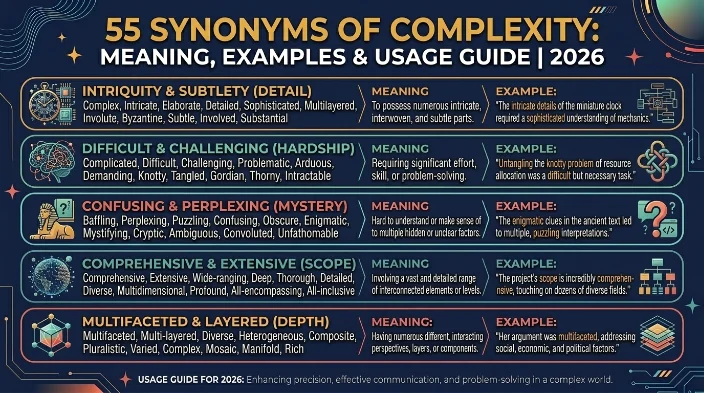
Complexity means the state of being complicated or having many interconnected parts. The best synonyms include complication, intricacy, difficulty, sophistication, elaborateness, convolutedness, entanglement, and knotty nature. The most common everyday synonym is complication, while intricacy works best for describing detailed systems. Each synonym has a slightly different meaning, tone, or context, so choose carefully based on your situation.
Top 10 Synonyms
- Complication
- Intricacy
- Difficulty
- Sophistication
- Elaborateness
- Convolutedness
- Entanglement
- Kink
- Snag
- Challenge
Every synonym has a slightly different meaning, tone, or context, so choose carefully based on your situation.
Do you find yourself using “complexity” too often in your writing? You’re not alone. It’s a useful word, but overusing it makes your writing sound repetitive and less engaging.
Learning synonyms for “complexity” helps you express your ideas more precisely. Whether you’re describing a difficult situation, a detailed system, or a challenging problem, having the right word makes all the difference.
In this guide, you’ll discover 35 powerful alternatives to “complexity.” You’ll learn their meanings, when to use them, and which ones native speakers prefer in different situations. Let’s begin!
What Does “Complexity” Mean?
Definition
Complexity means the state of being complex, complicated, or having many interconnected parts. It describes situations, systems, or problems that are not simple and require careful thought to understand.
In everyday terms, think of complexity like a puzzle with many pieces. Each piece connects to others, and understanding the whole picture takes time and effort. Something complex is not just difficult it has many layers and relationships.
Complexity can describe:
- Systems (“The complexity of the human brain is amazing”)
- Situations (“The complexity of the problem surprised us”)
- Relationships (“The complexity of their family dynamics”)
Pronunciation
| Feature | Value |
|---|---|
| US IPA | /kəmˈplek.sə.t̬i/ |
| UK IPA | /kəmˈplek.sə.ti/ |
| Syllables | 4 (com-plex-i-ty) |
| Tip | Stress the second syllable: com-PLEX-i-ty |
Grammar
| Grammar Feature | Information |
|---|---|
| Part of Speech | Noun (uncountable and countable) |
| Common Position | Subject or object |
| Typical Pattern | complexity + of + noun |
Example Sentences:
- “The complexity of the problem made it hard to solve.”
- “We underestimated the complexity of the project.”
- “The system’s complexity surprised everyone.”
Grammar Notes: “Complexity” can be uncountable (“the complexity of life”) or countable (“the complexities of modern society”). The plural is “complexities.”
Word Family
| Word | Part of Speech | Meaning |
|---|---|---|
| Complexity | Noun | The state of being complicated |
| Complex | Adjective | Difficult to understand |
| Complexify | Verb | To make something more complex |
| Complexification | Noun | The process of becoming more complex |
| Complicated | Adjective | Difficult to understand or deal with |
| Complication | Noun | A difficulty or problem |
55 Synonyms of “Complexity”
1. Complication
Meaning: A difficulty or problem that makes something harder.
Best Used For: Daily conversation, describing problems, medical contexts.
Formality: Neutral
Tone: Practical, Clear
Frequency: ⭐⭐⭐⭐⭐ Very Common
CEFR Level: B1
Example Sentence 1: “The complication with the plan was the budget.”
Example Sentence 2: “Medical complications delayed his recovery.”
Usage Tip: “Complication” is the most common everyday synonym. Use it when something makes a situation harder than expected.
2. Intricacy
Meaning: Having many small, connected parts that make it hard to understand.
Best Used For: Detailed systems, designs, academic writing.
Formality: Formal
Tone: Detailed, Precise
Frequency: ⭐⭐⭐ Moderate
CEFR Level: B2
Example Sentence 1: “The intricacy of the machine amazed the engineers.”
Example Sentence 2: “She appreciated the intricacy of the handmade lace.”
Usage Tip: “Intricacy” emphasizes fine detail and interconnected parts. Use it for systems, designs, and artwork.
3. Difficulty
Meaning: The state of being hard to do or understand.
Best Used For: General use, describing challenges.
Formality: Neutral
Tone: Practical, Honest
Frequency: ⭐⭐⭐⭐⭐ Very Common
CEFR Level: A2
Example Sentence 1: “The difficulty of the task was underestimated.”
Example Sentence 2: “We faced many difficulties during the project.”
Usage Tip: “Difficulty” is simple and direct. Use it when you want to emphasize that something is hard.
4. Sophistication
Meaning: Having advanced complexity or refinement.
Best Used For: Technology, design, culture.
Formality: Formal
Tone: Positive, Advanced
Frequency: ⭐⭐⭐⭐ Common
CEFR Level: B2
Example Sentence 1: “The sophistication of modern smartphones is impressive.”
Example Sentence 2: “His writing shows great sophistication.”
Usage Tip: “Sophistication” suggests complexity that is impressive or advanced. Use it for positive complexity.
5. Elaborateness
Meaning: Having many carefully planned details.
Best Used For: Designs, plans, decorations.
Formality: Formal
Tone: Detailed, Decorative
Frequency: ⭐⭐⭐ Moderate
CEFR Level: B2
Example Sentence 1: “The elaborateness of the building’s architecture is stunning.”
Example Sentence 2: “The elaborateness of her wedding plan impressed everyone.”
Usage Tip: “Elaborateness” suggests careful planning and many details. Use it for designs and decorations.
6. Convolutedness
Meaning: Extremely complex and hard to follow.
Best Used For: Arguments, explanations, instructions.
Formality: Formal
Tone: Negative, Confusing
Frequency: ⭐⭐ Rare
CEFR Level: C1
Example Sentence 1: “The convolutedness of his explanation confused everyone.
Example Sentence 2: “The convolutedness of the legal system frustrates many people.”
Usage Tip: “Convolutedness” has a negative meaning. Use it when something is unnecessarily complex.
7. Entanglement
Meaning: A complicated or difficult situation.
Best Used For: Relationships, legal situations, politics.
Formality: Neutral to Formal
Tone: Emotional, Difficult
Frequency: ⭐⭐⭐ Moderate
CEFR Level: B2
Example Sentence 1: “The entanglement of business and politics created problems.”
Example Sentence 2: “Their emotional entanglement made the breakup difficult.”
Usage Tip: “Entanglement” suggests being caught in a complex situation. Use it for relationships and difficult situations.
8. Kink
Meaning: A difficulty or problem in a plan.
Best Used For: Plans, processes, informal contexts.
Formality: Informal
Tone: Casual, Practical
Frequency: ⭐⭐⭐ Moderate
CEFR Level: B2
Example Sentence 1: “We need to work out the kinks in the plan.”
Example Sentence 2: “There’s still a kink in the new software.”
Usage Tip: “Kink” is casual and practical. Use it for small problems in plans or processes.
9. Snag
Meaning: A small problem that delays things.
Best Used For: Plans, projects, everyday problems.
Formality: Informal
Tone: Practical, Casual
Frequency: ⭐⭐⭐⭐ Common
CEFR Level: B2
Example Sentence 1: “We hit a snag with the delivery.”
Example Sentence 2: “The only snag was finding a venue.”
Usage Tip: “Snag” suggests a small, unexpected problem. Use it in casual conversations about plans.
10. Challenge
Meaning: Something difficult that tests your abilities.
Best Used For: Positive contexts, motivation, personal growth.
Formality: Neutral
Tone: Positive, Inspiring
Frequency: ⭐⭐⭐⭐⭐ Very Common
CEFR Level: A2
Example Sentence 1: “The challenge of the project motivated the team.”
Example Sentence 2: “She enjoys the challenge of learning new skills.”
Usage Tip: “Challenge” has a positive meaning. Use it when complexity is seen as an opportunity.
11. Dilemma
Meaning: A difficult choice between two options.
Best Used For: Decisions, ethics, personal situations.
Formality: Neutral
Tone: Serious, Difficult
Frequency: ⭐⭐⭐⭐ Common
CEFR Level: B2
Example Sentence 1: “She faced a dilemma between career and family.
Example Sentence 2: “The dilemma of choosing a college stressed him out.”
Usage Tip: “Dilemma” is about making difficult choices. Use it for decision-making situations.
12. Predicament
Meaning: A difficult or unpleasant situation.
Best Used For: Serious problems, difficult situations.
Formality: Formal
Tone: Serious, Difficult
Frequency: ⭐⭐⭐⭐ Common
CEFR Level: B2
Example Sentence 1: “The company’s financial predicament worried investors.”
Example Sentence 2: “He found himself in a predicament without a solution.”
Usage Tip: “Predicament” suggests a serious, difficult situation. Use it for problems with no easy solution.
13. Quandary
Meaning: A state of uncertainty about what to do.
Best Used For: Decisions, moral questions, uncertainty.
Formality: Formal
Tone: Confused, Unsure
Frequency: ⭐⭐⭐ Moderate
CEFR Level: B2
Example Sentence 1: “She was in a quandary about accepting the job.”
Example Sentence 2: “The ethical quandary divided the team.
Usage Tip: “Quandary” is about not knowing what to do. Use it for decisions and moral questions.
14. Obstacle
Meaning: Something that blocks progress.
Best Used For: Goals, challenges, barriers.
Formality: Neutral
Tone: Practical, Determined
Frequency: ⭐⭐⭐⭐⭐ Very Common
CEFR Level: B1
Example Sentence 1: “The obstacle of limited funding held us back.”
Example Sentence 2: “She overcame every obstacle in her path.”
Usage Tip: “Obstacle” suggests something in your way. Use it for barriers to progress.
15. Hurdle
Meaning: A difficulty that must be overcome.
Best Used For: Challenges, progress, goals.
Formality: Neutral
Tone: Achievable, Motivating
Frequency: ⭐⭐⭐⭐ Common
CEFR Level: B2
Example Sentence 1: “The biggest hurdle was getting approval.”
Example Sentence 2: “She cleared every hurdle to success.”
Usage Tip: “Hurdle” suggests a challenge you can overcome. Use it for motivating situations.
16. Obstruction
Meaning: Something that blocks or delays.
Best Used For: Physical barriers, process delays.
Formality: Formal
Tone: Negative, Blocking
Frequency: ⭐⭐⭐ Moderate
CEFR Level: B2
Example Sentence 1: “The obstruction of the road caused delays.”
Example Sentence 2: “The obstruction of justice was a serious crime.
Usage Tip: “Obstruction” suggests blocking. Use it for physical or legal barriers.
17. Impediment
Meaning: A barrier to progress.
Best Used For: Formal contexts, legal, speech.
Formality: Formal
Tone: Serious, Blocking
Frequency: ⭐⭐⭐ Moderate
CEFR Level: B2
Example Sentence 1: “Her speech impediment didn’t stop her from succeeding.”
Example Sentence 2: “The impediment to progress was lack of funding.”
Usage Tip: “Impediment” is formal for “obstacle.” Use it in professional contexts.
18. Complication (Medical)
Meaning: An unexpected problem in medical treatment.
Best Used For: Healthcare, medical contexts.
Formality: Formal
Tone: Serious, Professional
Frequency: ⭐⭐⭐⭐⭐ Very Common
CEFR Level: B2
Example Sentence 1: “The surgery had no complications.”
Example Sentence 2: “Medical complications extended his hospital stay.
Usage Tip: “Complication” is the standard medical term. Use it for medical problems.
19. Involvement
Meaning: Being connected or part of something complex.
Best Used For: Relationships, situations, processes.
Formality: Neutral
Tone: Connected, Engaged
Frequency: ⭐⭐⭐⭐⭐ Very Common
CEFR Level: B1
Example Sentence 1: “His involvement in the scandal was unexpected.”
Example Sentence 2: “The involvement of many factors made it complex.”
Usage Tip: “Involvement” suggests connection. Use it when many things are connected.
20. Implication
meaning: A hidden or indirect meaning.
Best Used For: Meanings, consequences, suggestions.
Formality: Formal
Tone: Subtle, Important
Frequency: ⭐⭐⭐⭐ Common
CEFR Level: B2
Example Sentence 1: “The implications of the policy were serious.”
Example Sentence 2: “She understood the implications of her decision.”
Usage Tip: “Implication” is about what something suggests. Use it for hidden meanings and consequences.
21. Nuance
Meaning: A subtle difference or detail.
Best Used For: Language, art, subtle meanings.
Formality: Formal
Tone: Subtle, Detailed
Frequency: ⭐⭐⭐⭐ Common
CEFR Level: B2
Example Sentence 1: “The nuance of the painting was hard to see.”
Example Sentence 2: “His argument lacked subtle nuance.”
Usage Tip: “Nuance” is about subtle details. Use it for fine distinctions.
22. Subtlety
Meaning: The quality of being subtle or indirect.
Best Used For: Language, humor, art.
Formality: Formal
Tone: Subtle, Clever
Frequency: ⭐⭐⭐⭐ Common
CEFR Level: B2
Example Sentence 1: “The subtlety of the joke was lost on her.”
Example Sentence 2: “His writing is known for its subtlety.”
Usage Tip: “Subtlety” is about indirectness. Use it for clever, hidden meanings.
23. Deepness
Meaning: Being deep or complex.
Best Used For: Thinking, feelings, ideas.
Formality: Neutral
Tone: Deep, Serious
Frequency: ⭐⭐⭐ Moderate
CEFR Level: B2
Example Sentence 1: “The deepness of his thoughts impressed everyone.”
Example Sentence 2: “The deepness of the problem surprised us.
Usage Tip: “Deepness” suggests intellectual or emotional depth. Use it for serious topics.
24. Profundity
Meaning: Great depth or insight.
Best Used For: Thoughts, ideas, wisdom.
Formality: Formal
Tone: Intellectual, Wise
Frequency: ⭐⭐ Rare
CEFR Level: C1
Example Sentence 1: “The profundity of his speech moved the audience.”
Example Sentence 2: “Her writing shows great profundity.”
Usage Tip: “Profundity” is a sophisticated word for deep thinking. Use it in formal contexts.
25. Tangledness
Meaning: The state of being twisted or confused.
Best Used For: Situations, relationships, explanations.
Formality: Informal
Tone: Confused, Messy
Frequency: ⭐⭐ Rare
CEFR Level: C1
Example Sentence 1: “The tangledness of the story confused everyone.”
Example Sentence 2: “The tangledness of their relationship made it hard to follow.”
Usage Tip: “Tangledness” suggests confusion. Use it for messy situations.
26. Muddle
Meaning: A confused or messy situation.
Best Used For: Confusion, disorganization.
Formality: Informal
Tone: Confused, Messy
Frequency: ⭐⭐⭐ Moderate
CEFR Level: B2
Example Sentence 1: “The muddle of paperwork delayed the project.”
Example Sentence 2: “His explanation was a complete muddle.
Usage Tip: “Muddle” suggests disorganization. Use it for confused situations.
27. Knot
Meaning: A complicated problem.
Best Used For: Problems, relationships, situations.
Formality: Informal
Tone: Difficult, Tangled
Frequency: ⭐⭐⭐ Moderate
CEFR Level: B2
Example Sentence 1: “The knot of the problem took hours to unravel.”
Example Sentence 2: “Their relationship became a psychological knot.”
Usage Tip: “Knot” suggests something tangled. Use it for complicated problems.
28. Gordian knot
Meaning: An extremely difficult problem.
Best Used For: Formal writing, metaphorical problems.
Formality: Formal to Literary
Tone: Dramatic, Difficult
Frequency: ⭐⭐ Rare
CEFR Level: C1
Example Sentence 1: “The budget crisis was a Gordian knot.”
Example Sentence 2: “He tried to cut the Gordian knot with a bold decision.”
Usage Tip: This is a literary metaphor. Use it for very difficult problems.
29. Labyrinth
Meaning: A confusing maze-like situation.
Best Used For: Descriptions, metaphors, formal writing.
Formality: Formal to Literary
Tone: Confusing, Complex
Frequency: ⭐⭐⭐ Moderate
CEFR Level: B2
Example Sentence 1: “The labyrinth of regulations confused everyone.”
Example Sentence 2: “He navigated the labyrinth of university bureaucracy.”
Usage Tip: “Labyrinth” is a metaphor for confusion. Use it for complex systems.
30. Maze
Meaning: A confusing network of paths.
Best Used For: Descriptions, systems, situations.
Formality: Neutral
Tone: Confusing, Complex
Frequency: ⭐⭐⭐⭐ Common
CEFR Level: B2
Example Sentence 1: “The maze of corridors confused the visitors.”
Example Sentence 2: “The maze of tax laws frustrated him.”
Usage Tip: “Maze” is simpler than “labyrinth.” Use it for confusing systems.
31. Web
Meaning: A complex network.
Best Used For: Networks, relationships, systems.
Formality: Neutral
Tone: Connected, Complex
Frequency: ⭐⭐⭐⭐⭐ Very Common
CEFR Level: B1
Example Sentence 1: “The web of connections surprised everyone.”
Example Sentence 2: “He was caught in a web of lies.”
Usage Tip: “Web” suggests many connections. Use it for networks and relationships.
32. Network
Meaning: Many connected parts.
Best Used For: Technology, relationships, systems.
Formality: Neutral
Tone: Connected, Organized
Frequency: ⭐⭐⭐⭐⭐ Very Common
CEFR Level: B1
Example Sentence 1: “The network of streets confused tourists.”
Example Sentence 2: “She built a network of professional contacts.”
Usage Tip: “Network” suggests organized connections. Use it for professional contexts.
33. Skein
Meaning: A tangled complex situation.
Best Used For: Literary writing, metaphors.
Formality: Literary
Tone: Tangled, Complex
Frequency: ⭐ Very Rare
CEFR Level: C1
Example Sentence 1: “The skein of events was hard to follow.”
Example Sentence 2: “He tried to unravel the skein of the mystery.”
Usage Tip: “Skein” is a literary word. Use it in creative writing.
34. Byzantine
Meaning: Extremely complex and bureaucratic.
Best Used For: Systems, bureaucracy, politics.
Formality: Formal
Tone: Negative, Bureaucratic
Frequency: ⭐⭐⭐ Moderate
CEFR Level: C1
Example Sentence 1: “The Byzantine rules confused everyone.”
Example Sentence 2: “The Byzantine bureaucracy delayed the project.”
Usage Tip: “Byzantine” is used for overly complex systems. Use it for bureaucracy.
35. Overcomplication
Meaning: Excessive complexity.
Best Used For: Negative contexts, unnecessary complexity.
Formality: Neutral
Tone: Negative, Unnecessary
Frequency: ⭐⭐⭐ Moderate
CEFR Level: B2
Example Sentence 1: “The overcomplication of the process wasted time.”
Example Sentence 2: “He criticized the overcomplication of the rules.”
Usage Tip: “Overcomplication” suggests too much complexity. Use it when things are unnecessarily complex.
Synonyms Comparison Table
| Synonym | Best Context | Formality | Tone | Frequency |
|---|---|---|---|---|
| Complication | General problems | Neutral | Practical | ⭐⭐⭐⭐⭐ |
| Intricacy | Detailed systems | Formal | Detailed | ⭐⭐⭐ |
| Difficulty | Simple challenges | Neutral | Honest | ⭐⭐⭐⭐⭐ |
| Sophistication | Advanced systems | Formal | Positive | ⭐⭐⭐⭐ |
| Convolutedness | Confusing systems | Formal | Negative | ⭐⭐ |
| Challenge | Positive problems | Neutral | Inspiring | ⭐⭐⭐⭐⭐ |
| Snag | Small problems | Informal | Casual | ⭐⭐⭐⭐ |
| Dilemma | Decision-making | Neutral | Serious | ⭐⭐⭐⭐ |
| Predicament | Serious problems | Formal | Serious | ⭐⭐⭐⭐ |
| Web | Networks | Neutral | Connected | ⭐⭐⭐⭐⭐ |
Best Synonyms by Situation
| Situation | Best Synonym | Why It Works |
|---|---|---|
| Business | Complexity, Sophistication | Professional and precise |
| Daily Conversation | Complication, Snag | Natural and easy |
| Academic Writing | Intricacy, Nuance | Formal and scholarly |
| Technology | Sophistication, Network | Impressive and accurate |
| Relationships | Entanglement, Web | Captures connection |
| Problem-solving | Challenge, Hurdle | Positive and motivating |
| Formal Writing | Profundity, Convolutedness | Sophisticated vocabulary |
| Creative Writing | Labyrinth, Maze | Vivid imagery |
Formal vs Informal Synonyms
Formal Alternatives
| Synonym | Best Used For |
|---|---|
| Intricacy | Detailed systems |
| Sophistication | Advanced technology |
| Convolutedness | Confusing systems |
| Profundity | Deep thinking |
| Byzantine | Bureaucratic complexity |
| Impediment | Barriers |
Neutral Alternatives
| Synonym | Best Used For |
|---|---|
| Complication | General problems |
| Difficulty | Challenges |
| Challenge | Motivating problems |
| Web | Networks |
| Network | Connections |
Informal Alternatives
| Synonym | Best Used For |
|---|---|
| Snag | Small problems |
| Kink | Plan problems |
| Knot | Tangled situations |
| Muddle | Confusion |
When to choose each level: Use formal synonyms for academic papers and professional reports. Use neutral synonyms for everyday writing. Use informal synonyms in casual conversation.
Strong vs Mild Synonyms
Mild (Everyday Situations)
- Complication
- Difficulty
- Snag
- Kink
- Challenge
Moderate (More Expressive)
- Intricacy
- Sophistication
- Dilemma
- Predicament
- Web
Strong (High-Intensity)
- Convolutedness
- Entanglement
- Labyrinth
- Byzantine
- Gordian knot
Remember: Stronger doesn’t always mean better. “Gordian knot” sounds dramatic but might be too strong for a small problem. Choose the intensity that matches your situation.
Real-Life Examples
In Business
“The sophistication of the new software impressed the investors.”
Academic Writing
“The intricacy of the theory required years to understand.”
Daily Conversation
“We hit a snag with the travel arrangements.”
In Relationships
“The entanglement of their personal and professional lives caused problems.”
In Technology
“The network of connections made the system hard to manage.”
Formal Writing
“The Byzantine regulations frustrated everyone involved.”
Common Collocations
| Common Phrase | Better Alternative |
|---|---|
| High complexity | High sophistication |
| Complexity of life | Intricacy of life |
| Political complexity | Political entanglement |
| System complexity | System intricacy |
| Problem complexity | Problem difficulty |
| Unnecessary complexity | Overcomplication |
Common Phrases
- “Kink in the plan” – Meaning: A small problem. Instead of “complexity,” say “snag” or “kink.”
- “Caught in a web” – Meaning: In a complex situation. Instead of “complexity,” say “web” or “entanglement.”
- “Cut the Gordian knot” – Meaning: Solve a difficult problem. Use this for very difficult problems.
- “Navigate the maze” – Meaning: Deal with complexity. Instead of “complexity,” say “maze” or “labyrinth.”
Context Guide
| Situation | Best Synonym | Reason |
|---|---|---|
| Essay | Intricacy, Profundity | Formal and scholarly |
| Speech | Challenge, Sophistication | Inspiring and engaging |
| Business Email | Complication, Issue | Professional and clear |
| Novel | Labyrinth, Entanglement | Vivid and descriptive |
| Presentation | Complexity, Sophistication | Professional and impressive |
| Conversation | Snag, Kink | Natural and easy |
| Academic Writing | Nuance, Implication | Precise and scholarly |
| Marketing Copy | Sophistication, Advanced | Persuasive and modern |
Related Words
Near Synonyms
- Complication: A difficulty
- Intricacy: Fine details
- Sophistication: Advanced complexity
- Difficulty: Being hard
Antonyms
- Simplicity: Easy to understand
- Clarity: Easy to see or understand
- Straightforwardness: Clear and simple
- Ease: Not difficult
Related Adjectives
- Complex: Difficult to understand
- Complicated: Having many parts
- Intricate: Having fine details
- Sophisticated: Advanced and refined
Related Nouns
- Complication: A difficulty
- Intricacy: Fine details
- Sophistication: Advanced quality
- Difficulty: Being hard
Related Verbs
- Complicate: Make more difficult
- Intricate: Add fine details
- Entangle: Catch in a complex situation
Frequently Asked Questions
What is another word for complexity?
The best alternatives are complication, intricacy, difficulty, sophistication, convolutedness, and entanglement. The most common everyday synonym is complication, while intricacy is perfect for formal contexts.
Which synonym sounds the most professional?
Intricacy, sophistication, and profundity sound the most professional. These words appear in academic and formal writing. Intricacy is particularly good for describing detailed systems.
What is the strongest synonym for complexity?
Convolutedness, Gordian knot, Byzantine, and labyrinth are among the strongest alternatives. They suggest extreme, often negative complexity. Use them carefully as they carry strong connotations.
Which synonym is best for essays?
Intricacy, profundity, nuance, and implication work best in academic essays. They’re formal enough for academic writing while remaining clear. Avoid casual alternatives like snag or kink in formal essays.
What’s the difference between complexity and complication?
Complexity is the overall state of being complex. Complication is a specific problem that makes something harder. Complexity is the big picture; a complication is one difficulty within it.
Which synonym is most common in everyday English?
Complication and difficulty are the most common everyday synonyms. Native speakers use these frequently in conversation. Challenge is also very common and has a positive tone.
What is the opposite of complexity?
The most common opposites are simplicity, clarity, straightforwardness, and ease. These words describe things that are easy to understand or do.
Is “sophistication” positive or negative?
Sophistication is generally positive. It suggests advanced development and refinement. However, it can be neutral or negative in some contexts (like “over-sophistication”).
Conclusion
Learning alternatives to “complexity” helps you express your ideas more precisely and naturally. The right word depends on your context, audience, and what you want to emphasize.
For everyday situations, complication and difficulty are your safest choices. For professional writing, intricacy and sophistication will help you sound more impressive. For creative work, labyrinth and web add vivid imagery.
Remember these key principles:
- Formal situations need formal words like intricacy, profundity, or convolutedness
- Neutral situations work well with complication, difficulty, or challenge
- Informal situations let you use snag, kink, or muddle
