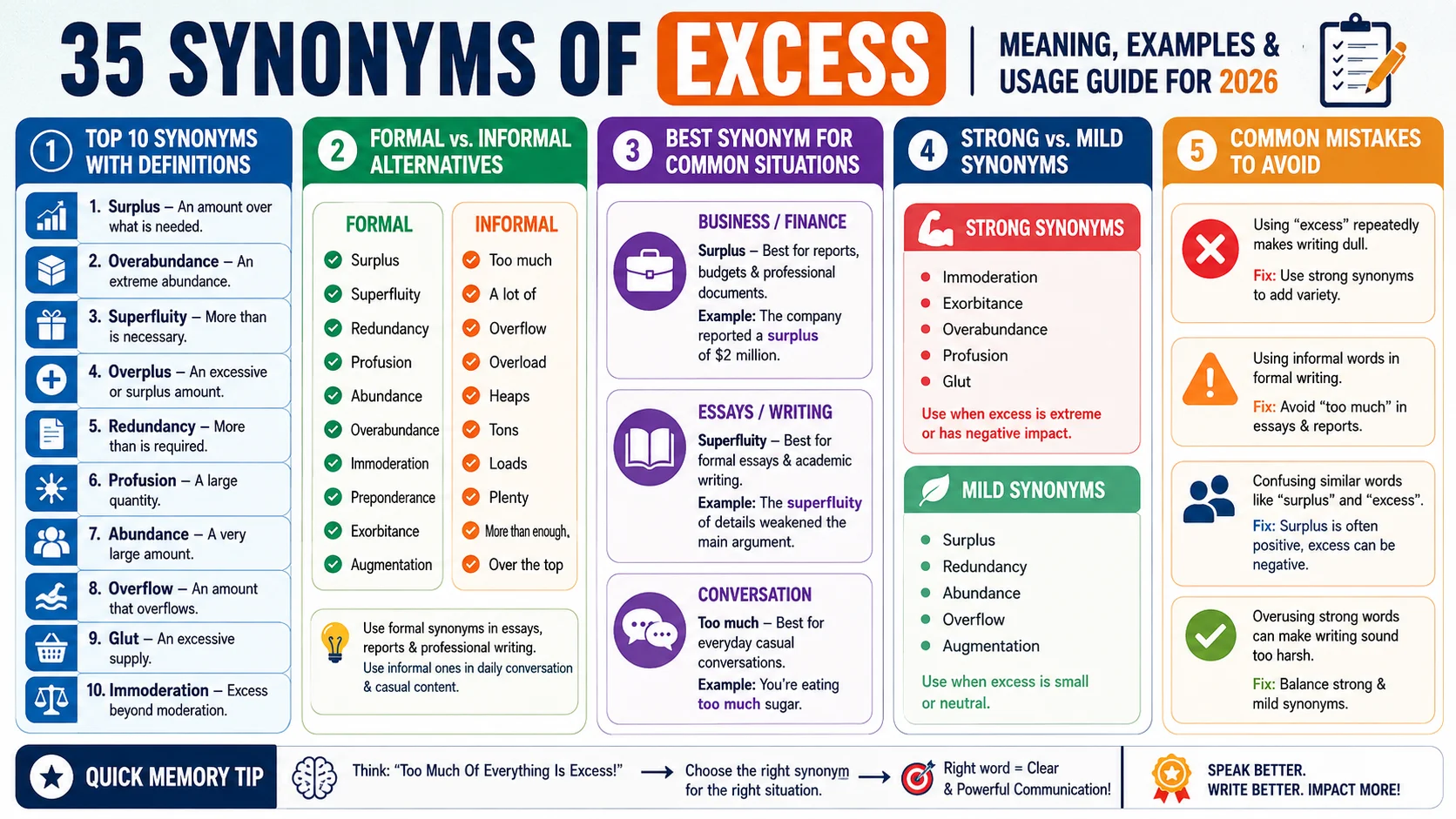
Excess means having more than is needed, wanted, or allowed. The best synonyms include surplus, overflow, overabundance, glut, plethora, redundancy, extravagance, and surfeit. The most common everyday synonym is surplus, while overabundance works perfectly for describing too much of something. Each synonym carries a slightly different tone and fits different situations.
Top 10 Synonyms
- Surplus
- Overabundance
- Glut
- Plethora
- Redundancy
- Extravagance
- Surfeit
- Overflow
- Profusion
- Overkill
Every synonym has a slightly different meaning, tone, or context, so choose carefully based on your situation.
Do you ever feel like you keep using the same word when describing “too much” of something? Whether you’re writing about economics, describing a feast, or talking about wasteful spending, having varied vocabulary makes your English more precise and interesting.
Learning synonyms for “excess” helps you express yourself more clearly. Instead of simply saying “too much,” you can choose exactly the right word for your situation. Is it a surplus of food? An extravagance of spending? A glut of products?
In this guide, you’ll discover 35 powerful alternatives to “excess.” You’ll learn their meanings, when to use them, and which ones native speakers prefer in different situations. Let’s dive in!
What Does “Excess” Mean?
Definition
Excess means an amount that is more than what is necessary, proper, or desirable. It describes having too much of something—beyond what’s reasonable or needed.
In everyday terms, think of it like this: if you need five apples for a recipe and you buy fifteen, you have an excess of apples. The extra ten are beyond what you need. Similarly, if someone spends way more money than they should on a handbag, that’s excess.
Excess can describe:
- Physical quantities (“There’s an excess of food at the party”)
- Behavior (“He drinks to excess”)
- Spending (“The government reduced excess spending”)
- Feelings (“She showed excess emotion”)
Pronunciation
| Feature | Value |
|---|---|
| US IPA | /ˈɛk.ses/ |
| UK IPA | /ˈɛk.ses/ |
| Syllables | 2 (ex-cess) |
| Tip | Stress the first syllable: EX-cess |
Grammar
| Grammar Feature | Information |
|---|---|
| Part of Speech | Noun (also used as an adjective) |
| Common Position | After a determiner (an excess of) |
| Typical Pattern | excess + of + noun |
Example Sentences:
- “There was an excess of food at the wedding.”
- “The company cut excess spending to save money.”
- “He drank to excess and felt terrible the next day.”
Grammar Note: “Excess” can also be used as an adjective before a noun (e.g., “excess baggage”). When used this way, it means “extra” or “additional.
Word Family
| Word | Part of Speech | Meaning |
|---|---|---|
| Excess | Noun / Adjective | More than is needed |
| Excessive | Adjective | Too much; extreme |
| Excessively | Adverb | To an extreme degree |
| Excessiveness | Noun | The quality of being excessive |
| Exceed | Verb | To go beyond a limit |
| Exceedingly | Adverb | Very; extremely |
35 Synonyms of “Excess”
1. Surplus
Meaning: An amount that is more than what is needed or used.
Best Used For: Economics, budgeting, inventory, describing extra resources.
Formality: Neutral to Formal
Tone: Practical, Neutral
Frequency: ⭐⭐⭐⭐⭐ Very Common
CEFR Level: B2
Example Sentence 1: “The store had a surplus of winter coats and put them on sale.”
Example Sentence 2: “The country’s surplus of oil helped stabilize its economy.”
Usage Tip: “Surplus” is the most neutral and common synonym for excess. Use it when you mean “extra” without implying waste. It’s safe for almost any context.
2. Overabundance
Meaning: An extremely large amount that is more than needed.
Best Used For: Describing nature, resources, or situations with plenty.
Formality: Neutral
Tone: Descriptive, Neutral
Frequency: ⭐⭐⭐⭐ Common
CEFR Level: B2
Example Sentence 1: “There was an overabundance of flowers in the garden this spring.”
Example Sentence 2: “The city has an overabundance of restaurants but few parks.”
Usage Tip: “Overabundance” emphasizes that there is much more than necessary. It’s slightly more formal than “surplus” and very descriptive.
3. Glut
Meaning: An excessive supply of something that causes problems.
Best Used For: Economics, markets, describing oversupply.
Formality: Neutral
Tone: Neutral to Negative
Frequency: ⭐⭐⭐ Moderate
CEFR Level: B2
Example Sentence 1: “The glut of cheap imports hurt local businesses.
Example Sentence 2: “There’s a glut of graduates but not enough jobs.”
Usage Tip: “Glut” often carries a negative connotation. Use it when having too much causes problems or lowers value. It’s common in economic discussions.
4. Plethora
Meaning: A very large amount that seems almost too much.
Best Used For: Academic writing, formal contexts, describing variety.
Formality: Formal
Tone: Academic, Neutral
Frequency: ⭐⭐⭐ Moderate
CEFR Level: B2
Example Sentence 1: “The library has a plethora of resources for researchers.”
Example Sentence 2: “Students had a plethora of options for extracurricular activities.”
Usage Tip: “Plethora” is a sophisticated word that suggests abundance. It’s slightly formal but very impressive. Use it when you want to sound educated and precise.
5. Redundancy
Meaning: Something that is unnecessary because it repeats or overlaps with something else.
Best Used For: Business, writing, technology, describing duplication.
Formality: Formal
Tone: Neutral to Negative
Frequency: ⭐⭐⭐⭐ Common
CEFR Level: B2
Example Sentence 1: “The report contained a lot of redundancy with unnecessary repetition.”
Example Sentence 2: “The company eliminated redundancy in their operations.”
Usage Tip: “Redundancy” specifically refers to unnecessary repetition or duplication. It’s common in writing, business, and technology. It can also mean losing a job (being made redundant).
6. Extravagance
Meaning: Spending or using too much, especially in a wasteful way.
Best Used For: Describing spending, lifestyle, or luxury.
Formality: Neutral to Formal
Tone: Negative (often), Critical
Frequency: ⭐⭐⭐⭐ Common
CEFR Level: B2
Example Sentence 1: “His extravagance with money made him go into debt.”
Example Sentence 2: “The wedding was marked by unnecessary extravagance.”
Usage Tip: “Extravagance” has a negative tone. It suggests wastefulness and poor judgment. Use it when you want to criticize overspending or overconsumption.
7. Surfeit
Meaning: An excessive amount that causes discomfort or problems.
Best Used For: Food, consumption, formal writing.
Formality: Formal
Tone: Negative, Critical
Frequency: ⭐⭐ Rare
CEFR Level: C1
Example Sentence 1: “A surfeit of rich food made him feel sick.”
Example Sentence 2: “The country suffered from a surfeit of bad policies.
Usage Tip: “Surfeit” suggests that having too much is actually harmful. It’s quite formal and literary. Use it when you want to describe a harmful excess, especially of food or consumption.
8. Overflow
Meaning: Something that extends beyond limits; extra that can’t be contained.
Best Used For: Water, crowds, storage, general situations.
Formality: Neutral
Tone: Neutral to Negative
Frequency: ⭐⭐⭐⭐ Common
CEFR Level: B1
Example Sentence 1: “The overflow of water flooded the basement.”
Example Sentence 2: “There was an overflow of guests at the party.”
Usage Tip: “Overflow” suggests something that can’t be contained or accommodated. Use it when the extra amount is more than the space or system can handle.
9. Profusion
Meaning: A large amount of something; abundance.
Best Used For: Creative writing, describing nature, artistic contexts.
Formality: Formal
Tone: Positive, Beautiful
Frequency: ⭐⭐⭐ Moderate
CEFR Level: B2
Example Sentence 1: “The garden displayed a profusion of colorful flowers.”
Example Sentence 2: “Her essay included a profusion of creative ideas.”
Usage Tip: “Profusion” has a positive, almost poetic tone. Use it to describe beautiful abundance. It’s more artistic than “surplus” or “excess.”
10. Overkill
Meaning: Using too much of something; unnecessary force or quantity.
Best Used For: Casual conversation, describing excessive effort.
Formality: Informal
Tone: Negative, Critical
Frequency: ⭐⭐⭐⭐ Common
CEFR Level: B2
Example Sentence 1: “Adding ten eggs to the recipe was complete overkill.”
Example Sentence 2: “Calling the police for a noise complaint seemed like overkill.”
Usage Tip: “Overkill” is a casual, modern word. Use it when someone or something goes way beyond what’s necessary. It often suggests waste of effort or resources.
11. Surplusage
Meaning: Excess; more than is needed (legal term).
Best Used For: Legal writing, formal contexts.
Formality: Formal
Tone: Neutral, Legal
Frequency: ⭐ Rare
CEFR Level: C1
Example Sentence 1: “The contract contained surplusage that could be removed.”
Example Sentence 2: “Legal documents often include surplusage due to caution.”
Usage Tip: “Surplusage” is a legal term for unnecessary words in a document. Use it only in legal or highly formal contexts.
12. Overdose
Meaning: An excessive amount of something, especially drugs.
Best Used For: Medicine, drugs, metaphorical use.
Formality: Neutral
Tone: Negative, Serious
Frequency: ⭐⭐⭐⭐ Common
CEFR Level: B1
Example Sentence 1: “He accidentally took an overdose of medication.”
Example Sentence 2: “A sugar overdose can make you feel terrible.”
Usage Tip: “Overdose” is primarily medical. Use it metaphorically for dramatic effect (“an overdose of excitement”), but be careful not to trivialize serious medical situations.
13. Embarrassment of riches
Meaning: Having so much that it creates problems or difficulty choosing.
Best Used For: Formal writing, literature, describing luxury.
Formality: Formal
Tone: Positive, Ironic
Frequency: ⭐⭐⭐ Moderate
CEFR Level: C1
Example Sentence 1: “The team had an embarrassment of riches with so many talented players.”
Example Sentence 2: “We faced an embarrassment of riches when choosing a vacation spot.”
Usage Tip: This phrase is an idiom. It’s a clever way to say having too much of a good thing is actually a problem. Use it for sophisticated writing.
14. Superfluity
Meaning: An unnecessary amount; more than needed.
Best Used For: Formal writing, academic contexts.
Formality: Formal
Tone: Neutral, Academic
Frequency: ⭐⭐ Rare
CEFR Level: C1
Example Sentence 1: “The article contained a superfluity of unnecessary details.”
Example Sentence 2: “We eliminated superfluity from the budget.”
Usage Tip: “Superfluity” is formal and emphasizes unnecessary abundance. Use it in academic or professional writing. It’s more precise than “excess.”
15. Nimiety
Meaning: An excessive amount; overabundance.
Best Used For: Very formal writing, unusual contexts.
Formality: Formal
Tone: Neutral, Academic
Frequency: ⭐ Very Rare
CEFR Level: C2
Example Sentence 1: “The room had a nimiety of furniture and no space to walk.”
Example Sentence 2: “His writing suffered from a nimiety of adjectives.”
Usage Tip: “Nimiety” is extremely rare and academic. Most native speakers don’t know this word. Use it only if you want to sound very educated or playful with language.
16. Extravaganza
Meaning: A spectacular and excessive display or event.
Best Used For: Events, performances, shows.
Formality: Neutral
Tone: Positive, Exciting
Frequency: ⭐⭐⭐ Moderate
CEFR Level: B2
Example Sentence 1: “The concert was a three-hour musical extravaganza.”
Example Sentence 2: “They planned a birthday extravaganza with fireworks.”
Usage Tip: “Extravaganza” is about spectacle and showiness. It’s positive and exciting, not negative. Use it for grand events or displays.
17. Deluge
Meaning: A sudden and overwhelming amount of something.
Best Used For: Rain, water, information, requests.
Formality: Neutral to Formal
Tone: Overwhelming, Intense
Frequency: ⭐⭐⭐ Moderate
CEFR Level: B2
Example Sentence 1: “The company received a deluge of complaints.”
Example Sentence 2: “A deluge of rain flooded the streets.”
Usage Tip: “Deluge” originally refers to a flood. Use it metaphorically to describe an overwhelming amount of anything that arrives suddenly.
18. Flood
Meaning: A very large amount that arrives suddenly.
Best Used For: Water, information, requests, emotions.
Formality: Neutral
Tone: Overwhelming, Intense
Frequency: ⭐⭐⭐⭐⭐ Very Common
CEFR Level: B1
Example Sentence 1: “The school received a flood of applications.”
Example Sentence 2: “She felt a flood of emotion when she heard the news.”
Usage Tip: “Flood” is simple and common. Use it when a large amount comes suddenly and is hard to handle. It’s more accessible than “deluge.”
19. Avalanche
Meaning: A sudden and overwhelming amount.
Best Used For: Information, work, snow, problems.
Formality: Neutral
Tone: Overwhelming, Intense
Frequency: ⭐⭐⭐⭐ Common
CEFR Level: B2
Example Sentence 1: “We received an avalanche of emails after the announcement.”
Example Sentence 2: “The project faced an avalanche of unexpected challenges.”
Usage Tip: “Avalanche” suggests being buried by too much. Use it for overwhelming amounts of work, information, or problems.
20. Torrent
Meaning: A sudden and violent flow of something.
Best Used For: Water, words, emotions.
Formality: Neutral to Formal
Tone: Intense, Dramatic
Frequency: ⭐⭐⭐ Moderate
CEFR Level: B2
Example Sentence 1: “He faced a torrent of criticism after his speech.”
Example Sentence 2: “Rain came down in torrents all night.”
Usage Tip: “Torrent” is intense and dramatic. Use it for strong emotions, harsh criticism, or heavy rain.
21. Overplus
Meaning: An excessive amount; surplus.
Best Used For: Formal writing, literary contexts.
Formality: Formal
Tone: Neutral, Literary
Frequency: ⭐ Very Rare
CEFR Level: C1
Example Sentence 1: “The overplus of goods was donated to charity.”
Example Sentence 2: “The harvest produced an overplus of grain.”
Usage Tip: “Overplus” is old-fashioned and rarely used. It’s similar to “surplus” but sounds poetic. Use it in literary writing only.
22. Waste
Meaning: Unused or unnecessary resources.
Best Used For: Resources, time, effort, money.
Formality: Neutral
Tone: Negative
Frequency: ⭐⭐⭐⭐⭐ Very Common
CEFR Level: A2
Example Sentence 1: “The company cut waste from their processes.”
Example Sentence 2: “Waiting for three hours was a waste of time.”
Usage Tip: “Waste” emphasizes the negative aspect of excess—that something valuable is being lost. Use it when focusing on the downside.
23. Abundance
Meaning: A very large quantity; plenty.
Best Used For: Positive descriptions, nature, resources.
Formality: Neutral
Tone: Positive
Frequency: ⭐⭐⭐⭐⭐ Very Common
CEFR Level: B1
Example Sentence 1: “There was an abundance of fresh fruit at the market.”
Example Sentence 2: “The area is known for its abundance of wildlife.”
Usage Tip: “Abundance” has a positive tone. It suggests plenty without waste. Use it when describing good things. It’s more positive than “excess.”
24. Excessiveness
Meaning: The quality of being too much; extreme amount.
Best Used For: Formal writing, describing extreme behavior.
Formality: Formal
Tone: Neutral to Negative
Frequency: ⭐⭐⭐ Moderate
CEFR Level: B2
Example Sentence 1: “The excessiveness of the celebrations was criticized.”
Example Sentence 2: “The excessiveness of the regulations frustrated business owners.”
Usage Tip: “Excessiveness” is the noun form of “excessive.” Use it when describing the quality of being too much. It’s a formal alternative to “excess.”
25. Overproduction
Meaning: Producing more than is needed.
Best Used For: Economics, manufacturing, agriculture.
Formality: Neutral to Formal
Tone: Neutral to Negative
Frequency: ⭐⭐⭐⭐ Common
CEFR Level: B2
Example Sentence 1: “Overproduction of cars led to falling prices.”
Example Sentence 2: “The farm’s overproduction caused storage problems.”
Usage Tip: “Overproduction” is specific to manufacturing and farming. Use it when discussing supply and demand issues.
26. Oversupply
Meaning: Too much supply; more than demand.
Best Used For: Economics, markets, inventory.
Formality: Neutral to Formal
Tone: Neutral to Negative
Frequency: ⭐⭐⭐⭐ Common
CEFR Level: B2
Example Sentence 1: “An oversupply of oil caused prices to drop.”
Example Sentence 2: “The housing market experienced an oversupply of new homes.”
Usage Tip: “Oversupply” is an economic term. It specifically refers to market situations where supply exceeds demand. Use it for business and economics contexts.
27. Overconsumption
Meaning: Using or eating too much.
Best Used For: Health, environment, resources.
Formality: Formal
Tone: Negative, Critical
Frequency: ⭐⭐⭐⭐ Common
CEFR Level: B2
Example Sentence 1: “Overconsumption of sugar leads to health problems.”
Example Sentence 2: “Overconsumption of resources is harming the planet.”
Usage Tip: “Overconsumption” specifically describes using too much. It’s common in health and environmental discussions. It has a negative connotation.
28. Abundancy
Meaning: Large quantity; plenty.
Best Used For: General use, positive descriptions.
Formality: Neutral
Tone: Positive
Frequency: ⭐⭐⭐ Moderate
CEFR Level: B2
Example Sentence 1: “The abundancy of food ensured no one went hungry.”
Example Sentence 2: “There was an abundancy of talent in the competition.”
Usage Tip: “Abundancy” is similar to “abundance.” It’s slightly less common but still useful. Use it for positive descriptions of plenty.
29. Copiousness
Meaning: Abundant supply; large quantity.
Best Used For: Formal writing, describing large amounts.
Formality: Formal
Tone: Neutral to Positive
Frequency: ⭐⭐ Rare
CEFR Level: C1
Example Sentence 1: “The copiousness of the harvest was remarkable.”
Example Sentence 2: “The copiousness of details made the report difficult to read.”
Usage Tip: “Copiousness” is formal and academic. It describes large quantities. Use it for sophisticated writing.
30. Prodigality
Meaning: Wasteful or excessive spending.
Best Used For: Formal writing, describing waste.
Formality: Formal
Tone: Negative, Critical
Frequency: ⭐⭐ Rare
CEFR Level: C1
Example Sentence 1: “His prodigality with money shocked his family.”
Example Sentence 2: “The government’s prodigality led to budget deficits.”
Usage Tip: “Prodigality” suggests reckless wastefulness. It’s more formal than “extravagance.” Use it to criticize spending.
31. Profligacy
Meaning: Reckless and wasteful behavior.
Best Used For: Formal writing, describing moral excess.
Formality: Formal
Tone: Strongly Negative
Frequency: ⭐⭐ Rare
CEFR Level: C1
Example Sentence 1: “His profligacy with company funds cost him his job.
Example Sentence 2: “The nation’s profligacy with resources is unsustainable.”
Usage Tip: “Profligacy” is a strong word for reckless wastefulness. It suggests moral failure. Use it for serious criticism.
32. Extravagancy
Meaning: The quality of being extravagant; excess.
Best Used For: Formal writing, describing excess.
Formality: Formal
Tone: Negative, Critical
Frequency: ⭐⭐ Rare
CEFR Level: B2
Example Sentence 1: “The extravagancy of the event surprised everyone.
Example Sentence 2: “His extravagancy led to financial ruin.”
Usage Tip: “Extravagancy” is a noun form of “extravagant.” Use it for formal writing. It’s less common than “extravagance.”
33. Overdoing
Meaning: Doing too much of something.
Best Used For: Daily conversation, describing effort.
Formality: Informal
Tone: Casual, Critical
Frequency: ⭐⭐⭐⭐ Common
CEFR Level: B1
Example Sentence 1: “You’re overdoing it with the salt.”
Example Sentence 2: “She’s overdoing her workout routine.”
Usage Tip: “Overdoing” is the gerund form. It describes the action of doing too much. Use it in casual conversation.
34. Superabundance
Meaning: Extremely large amount; more than sufficient.
Best Used For: Formal writing, emphasizing largeness.
Formality: Formal
Tone: Neutral to Positive
Frequency: ⭐⭐ Rare
CEFR Level: C1
Example Sentence 1: “There was a superabundance of volunteers for the event.”
Example Sentence 2: “The superabundance of options made choosing difficult.”
Usage Tip: “Superabundance” emphasizes extreme abundance. It’s more intense than “abundance.” Use it for formal contexts.
35. Profuseness
Meaning: Large quantity; abundance.
Best Used For: Formal writing, poetic contexts.
Formality: Formal
Tone: Neutral to Positive
Frequency: ⭐⭐ Rare
CEFR Level: C1
Example Sentence 1: “The profuseness of the garden was breathtaking.”
Example Sentence 2: “His profuseness with compliments was flattering.”
Usage Tip: “Profuseness” is related to “profuse.” It describes abundant quantity. It has a slightly poetic tone.
Synonyms Comparison Table
| Synonym | Best Context | Formality | Tone | Frequency |
|---|---|---|---|---|
| Surplus | Economics, resources | Neutral | Practical | ⭐⭐⭐⭐⭐ |
| Overabundance | General, nature | Neutral | Neutral | ⭐⭐⭐⭐ |
| Glut | Markets, economics | Neutral | Negative | ⭐⭐⭐ |
| Plethora | Academic, formal | Formal | Neutral | ⭐⭐⭐ |
| Redundancy | Business, writing | Formal | Negative | ⭐⭐⭐⭐ |
| Extravagance | Spending, luxury | Neutral | Negative | ⭐⭐⭐⭐ |
| Surfeit | Food, consumption | Formal | Negative | ⭐⭐ |
| Overflow | General, crowds | Neutral | Neutral | ⭐⭐⭐⭐ |
| Profusion | Creative, nature | Formal | Positive | ⭐⭐⭐ |
| Overkill | Casual, effort | Informal | Negative | ⭐⭐⭐⭐ |
| Deluge | Information, problems | Neutral | Overwhelming | ⭐⭐⭐ |
| Flood | General, sudden | Neutral | Overwhelming | ⭐⭐⭐⭐⭐ |
| Avalanche | Work, problems | Neutral | Overwhelming | ⭐⭐⭐⭐ |
| Waste | Resources, time | Neutral | Negative | ⭐⭐⭐⭐⭐ |
| Abundance | Positive, resources | Neutral | Positive | ⭐⭐⭐⭐⭐ |
Best Synonyms by Situation
| Situation | Best Synonym | Why It Works |
|---|---|---|
| Daily Conversation | Surplus, Overflow | Natural and clear |
| Business Email | Overabundance, Surplus | Professional and precise |
| Academic Writing | Plethora, Superfluity | Formal and educated |
| Economics | Glut, Oversupply | Technical and accurate |
| Describing Spending | Extravagance, Prodigality | Shows waste |
| Environmental Issues | Overconsumption | Specific and relevant |
| Creative Writing | Profusion, Deluge | Descriptive and vivid |
| Legal Writing | Surplusage | Technical and correct |
| Health Context | Overconsumption, Surfeit | Accurate and serious |
| Casual Conversation | Overkill, Overdoing | Natural and modern |
Formal vs Informal Synonyms
Formal Alternatives
| Synonym | Best Used For |
|---|---|
| Plethora | Academic writing, formal speeches |
| Surfeit | Literary works, formal discussions |
| Superfluity | Academic papers, professional reports |
| Prodigality | Criticizing waste in formal contexts |
| Surplusage | Legal documents, contracts |
| Profusion | Literary descriptions, poetry |
Neutral Alternatives
| Synonym | Best Used For |
|---|---|
| Surplus | Most professional situations |
| Overabundance | General descriptions |
| Overflow | Everyday writing |
| Abundance | Positive descriptions |
| Waste | Practical discussions |
| Oversupply | Business and economics |
Informal Alternatives
| Synonym | Best Used For |
|---|---|
| Overkill | Casual conversations |
| Overdoing | Everyday situations |
| Flood | Conversational use |
| Avalanche | Modern, casual contexts |
When to choose each level: Use formal synonyms for academic papers, business reports, and official documents. Use neutral synonyms for everyday writing and most professional contexts. Use informal synonyms with friends and in casual conversation.
Strong vs Mild Synonyms
Mild (Everyday Situations)
- Surplus
- Overflow
- Abundance
- Waste
- Flood
Moderate (More Expressive)
- Overabundance
- Glut
- Plethora
- Extravagance
- Deluge
Strong (High-Intensity)
- Surfeit
- Superfluity
- Prodigality
- Profligacy
- Embarrassment of riches
Remember: Stronger doesn’t always mean better. Choose the intensity that fits your situation. In a casual conversation, “overkill” works perfectly. In a formal report, “plethora” is more appropriate.
Real-Life Examples
In the Office
“There was a surplus of office supplies, so we donated the extras.”
In a Business Email
“We need to address the overabundance of costs in the marketing budget.”
Academic Context
“The researcher found a plethora of evidence supporting the theory.”
Daily Conversation
“Adding five more people to the team seems like overkill for this small project.”
Environmental Discussion
“Overconsumption of plastic is harming marine life.”
Creative Writing
“The garden exploded with a profusion of colors and scents.”
In Government
“The government reduced wasteful spending in the national budget.”
Common Collocations
| Common Phrase | Better Alternative |
|---|---|
| Too much money | Extravagance, Surplus |
| Too many people | Overabundance, Overflow |
| Too much food | Surfeit, Glut |
| Too much work | Overload, Avalanche |
| Too much information | Plethora, Deluge |
| Too much spending | Waste, Prodigality |
| Too many choices | Embarrassment of riches |
| Too much production | Oversupply, Glut |
Common Phrases
- “In excess of” – Meaning: More than a certain amount. Instead of “more than,” say “in excess of” for formal contexts.
- “To excess” – Meaning: To an extreme degree. Instead of “too much,” say “to excess” for formal contexts.
- “Excess baggage” – Meaning: Extra weight (literal) or unnecessary problems (figurative). Use “surplus” or “overload” as alternatives.
- “Embarrassment of riches” – Meaning: Having too much of a good thing. A clever, sophisticated idiom.
Context Guide
| Situation | Best Synonym | Reason |
|---|---|---|
| Essay | Plethora, Superfluity | Formal and academic |
| Speech | Overabundance, Surfeit | Strong and clear |
| Business Email | Surplus, Redundancy | Professional and precise |
| Novel | Profusion, Deluge | Descriptive and vivid |
| Presentation | Surplus, Overabundance | Clear and professional |
| Conversation | Overkill, Flood | Natural and modern |
| Academic Writing | Superfluity, Plethora | Precise and scholarly |
| Marketing Copy | Abundance, Overflow | Positive and persuasive |
Related Words
Near Synonyms
- Surplus: Extra amount beyond needs.
- Overabundance: Much more than necessary.
- Glut: Oversupply causing problems.
- Plethora: Large abundance, often positive.
Antonyms
- Scarcity: Not enough; shortage.
- Deficit: Lacking; less than needed.
- Shortage: Insufficient amount.
- Dearth: Lack or scarcity.
- Related Adjectives
- Excessive: Too much; extreme.
- Superfluous: Unnecessary; extra.
- Abundant: Plenty; large amount.
- Profuse: Abundant; generous.
- Related Nouns
- Abundance: Large quantity.
- Overload: Too much to handle.
- Extravagance: Wasteful spending.
- Waste: Unused or unnecessary resources.
- Related Verbs
- Exceed: To go beyond a limit.
- Overdo: To do too much.
- Overproduce: To produce more than needed.
- Overconsume: To use too much.
Frequently Asked Questions
What is another word for excess?
The best alternatives are surplus, overabundance, glut, plethora, redundancy, extravagance, and surfeit. The most common and natural alternative is surplus, which works in almost any context. For positive descriptions, use abundance. For negative situations, use glut or extravagance.
Which synonym sounds the most professional?
Surplus, overabundance, and plethora sound the most professional. Surplus is safe for business and economics contexts. Plethora works well in academic and formal writing. Avoid casual alternatives like “overkill” in professional settings.
What is the strongest synonym for excess?
Prodigality, profligacy, and surfeit are among the strongest alternatives. These words suggest harmful, wasteful, or morally questionable excess. Use them carefully in serious contexts. Surfeit suggests excess that causes discomfort or problems.
Which synonym is best for essays?
Plethora, superfluity, and surfeit work best for academic essays. These words sound educated and precise. Plethora is particularly useful for describing abundance in academic contexts. Avoid casual alternatives like “overkill” in essays.
What’s the difference between excess and surplus?
Surplus specifically means an amount beyond what is needed, often with a neutral or practical tone. Excess is broader and can describe any amount that is too much, including behavior and spending. Surplus is often used in economics and inventory management.
Which synonym is most common in everyday English?
Surplus and flood are the most common everyday alternatives. Native speakers use these words frequently. Surplus is safe for most situations. Flood works for sudden, overwhelming amounts.
What is the opposite of excess?
The direct opposites are scarcity, shortage, deficit, and dearth. These words describe not having enough of something. Scarcity is the most common opposite and is used in economics and everyday conversation.
Is “plethora” positive or negative?
Plethora is generally neutral or slightly positive. It simply means a very large amount. Unlike glut or surfeit, it doesn’t suggest that the large amount causes problems. However, in some contexts, it can imply “almost too much.”
Conclusion
Learning alternatives to “excess” makes your English more precise and powerful. The right word depends on your context, audience, and what you want to emphasize.
For everyday situations, surplus is your safest and most 35 Synonyms of Excess| Meaning, Examples & Usage Guide For 2026choice. It works in almost any context and is easy to understand. For professional writing, surplus, overabundance, and plethora will help you sound more educated and precise. For criticizing waste, extravagance, prodigality, or profligacy convey strong negative judgment.
Remember these key principles:
- Formal situations need formal words like plethora, superfluity, or surfeit
- Neutral situations work well with surplus, overabundance, or overflow
- Informal situations let you use overkill, overdoing, or flood
- Positive descriptions call for abundance or profusion
- Negative descriptions call for glut, waste, or extravagance
Choose the word that fits your situation, and your writing will sound more natural and professional. The more you practice using these alternatives, the more natural they’ll become.
