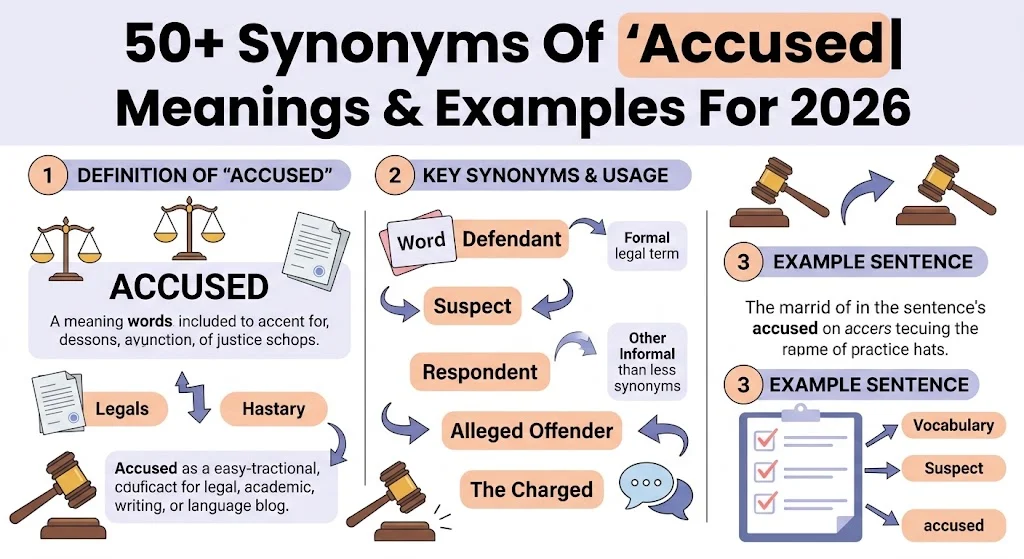
“Accused” means a person or group charged with a crime or wrongdoing. The best synonyms depend on context. For formal legal writing, use defendant or the charged. For academic writing, use alleged offender. For casual conversation, use suspect or blamed.
Meaning, Tone and Context
- The word “accused” is a serious term with specific legal and social implications. Its core function is to identify someone who has been formally or informally charged with a wrongdoing. The tone is generally neutral but can become negative depending on the context.
1. Simple Definition: The accused is a person or group of people who have been charged with a crime or blamed for something wrong.
- 2. Part of Speech: Accused is primarily a noun (used with “the”). It is also the past tense and past participle of the verb “accuse.”
- Noun: “The accused pleaded not guilty.”
- Verb: “She accused him of stealing her idea.”
- 3. Tone: The tone is usually neutral and factual. However, it can become negative when the accusation is serious or when the person is presumed guilty by the public.
4. Formality: “Accused” is a formal word, most commonly used in legal, journalistic, and academic contexts. For casual conversation, “blamed” or “suspect” is more natural.
5. Common Use Cases: You will encounter “accused” in many situations.
- Legal Context: “The accused was brought before the judge.”
- News Reporting: “The accused denied all charges.”
- Academic Writing: “The rights of the accused must be protected.”
- Casual Conversation: “He is the accused in the office theft case.”
6. Important Word Forms:
- Verb: to accuse. “They accused him of lying.”
- Noun: accusation. “The accusation was proven false.”
- Noun: accuser. “The accuser testified in court.”
- Adjective: accusing. “She gave him an accusing look.”
When and How to Use “Accused”
Knowing when to use “accused” is about understanding its legal and social weight. It is a serious word that should be used with care. Here are several scenarios where it is the perfect choice.
- Legal Context: To refer to a person formally charged with a crime.
Example: “The accused sat quietly as the prosecutor presented the evidence.”- News Reporting: To report on a criminal case without presuming guilt.
Example: “The accused has denied all allegations against him.”- Academic Context: To discuss legal rights and procedures.
Example: “The study examines how the accused are treated in different legal systems.”- Professional Context: To discuss a workplace investigation.
Example: “The accused employee was placed on leave pending an investigation.”- Casual Conversation: To talk about someone blamed for something.
Example: “Everyone knows he is the accused, but no one has proof.”- Emotional Context: To express sympathy or concern for someone facing accusations.
Example: “She felt sorry for the accused, even though the charges were serious.”- Creative Writing: To create tension in a crime story.
Example: “The accused looked around the courtroom, searching for a friendly face.”- Email Context: To discuss a formal complaint or investigation.
Example: “The accused party has been notified of the proceedings.”
Another Word for “Accused”
Choosing the best replacement for “accused” depends entirely on the context. Here are the most effective alternatives categorized by use.
- Professional Writing: “Defendant” or “Respondent.” “The defendant entered a plea of not guilty.”
- Academic Writing: “Alleged offender” or “Suspect.” “The rights of the alleged offender must be respected.”
- Casual Conversation: “Blamed” or “Suspect.” “He is the prime suspect in the case.”
- Emotional Writing: “The charged” or “The indicted.” “The indicted man maintained his innocence.”
- Creative Writing: “The culprit” or “The perpetrator.” “The culprit was finally caught.”
- Resume or Workplace: “Subject of the investigation” or “Respondent.” “The respondent was asked to provide a written statement.”
- Social Media Captions: “The person charged” or “Suspect.” “The person charged has not yet entered a plea.”
- Stronger Meaning: “Perpetrator” or “Offender.” “The perpetrator of the crime was sentenced to ten years.”
- Softer Meaning: “Alleged” or “Accused person.” “The alleged wrongdoer has not been proven guilty.”
When Not to Use “Accused”
While “accused” is a powerful word, it can be too strong, too formal, or too vague in certain situations. Using a more precise synonym can improve clarity and fairness.
- When You Need to Be Fair: “Accused” can sound like a judgment. If you want to be neutral, use “alleged” or “suspect.” “The accused man” sounds more judgmental than “the alleged offender.”
- When Discussing Civil Cases: “Accused” is typically used in criminal cases. In civil cases, “defendant” is the correct term. “The accused in the lawsuit” is incorrect. “The defendant in the lawsuit” is correct.
- When Criticizing Directly: Using “accused” can sound neutral when you want to be critical. Instead of “The accused was clearly guilty,” try “The evidence strongly suggested the defendant’s guilt.”
Example of Precision: Compare these two sentences.
- Vague: “The accused was in the room.”
- Precise: “The defendant was in the room during the hearing.”
The second sentence is more specific and uses the correct legal term.
Words Commonly Confused With “Accused”
Understanding the differences between these related words will significantly refine your English, especially in legal and academic contexts.
- Accused vs. Suspect: A “suspect” is a person believed to have committed a crime, but not yet formally charged. The “accused” is a person who has been formally charged. A suspect becomes the accused after charges are filed.
- Accused vs. Defendant: A “defendant” is the person against whom a legal case is brought in court. The “accused” is a broader term that can refer to someone before or during a trial. In a courtroom, “defendant” is the correct term.
- Accused vs. Convict: A “convict” is a person who has been found guilty of a crime. The “accused” has only been charged, not proven guilty. A convict is guilty; the accused is presumed innocent.
- Accused vs. Plaintiff: A “plaintiff” is the person who brings a case against another in a civil court. The “accused” is the person being charged. They are on opposite sides of a legal dispute.
- Accused vs. Perpetrator: A “perpetrator” is a person who actually committed a crime. The “accused” may or may not be the perpetrator. Only after conviction can the accused be called the perpetrator.
- Accused vs. Alleged: “Alleged” is an adjective that means something is claimed but not proven. “Accused” can be a noun or a verb. You can be an accused person or an alleged offender. The words are often used together: “the alleged accused.”
Best Synonym by Context for “Accused”
| Context | Best Synonym | Why It Works | Example |
|---|---|---|---|
| Formal Writing | Defendant | It is the precise legal term for a person in court. | “The defendant pleaded not guilty to all charges.” |
| Academic Writing | Alleged offender | It is neutral and emphasizes the presumption of innocence. | “The study focused on the rights of the alleged offender.” |
| Professional/Business | Respondent | It is the correct term for civil and workplace investigations. | “The respondent was asked to provide a statement.” |
| Resume | Subject of the investigation | It is neutral and avoids judgment. | “I was the subject of an investigation that cleared my name.” |
| Casual Conversation | Suspect | It is simple and widely understood. | “The police have a new suspect in the case.” |
| Creative Writing | The culprit | It adds a sense of mystery and narrative. | “The culprit was finally revealed in the final chapter.” |
| Emotional Tone | The charged | It conveys the weight of the accusation. | “The charged man looked exhausted and defeated.” |
| Strong Intensity | Perpetrator | It implies actual guilt, so use with caution. | “The perpetrator of the fraud was sentenced to five years.” |
| Soft/Moderate Tone | Alleged wrongdoer | It is cautious and neutral. | “The alleged wrongdoer has not yet been questioned.” |
| Social Media Captions | The person charged | It is clear and neutral. | “The person charged has denied all allegations.” |
| US/UK Usage | Defendant (US) / Accused (UK) | Both are common, but usage varies by region. | US: “The defendant took the stand.” UK: “The accused took the stand.” |
Which Synonym Should You Choose?
Choosing the right word can seem difficult, but this simple guide will help you decide. It is all about matching the word to your goal, audience, and the message you want to send.
- Is your goal to be legally precise? Use “defendant” or “respondent.” These are the correct terms in a court of law.
- Is your goal to be neutral and fair? Use “alleged offender” or “suspect.” These words emphasize that guilt has not been proven.
- Is your goal to be formal and professional? Use “the charged” or “the indicted.” These are appropriate for formal reports and journalism.
- Is your goal to be casual and conversational? Use “suspect” or “blamed.” These are natural in everyday speech.
- Are you writing a story or narrative? Use “culprit” or “perpetrator.” These words add drama and clarity to a narrative.
- Do you want to emphasize the seriousness of the charge? Use “perpetrator” or “offender.” Be careful with these, as they imply guilt.
Real Life Examples of “Accused” in Sentences
Here are examples of how “accused” and its stronger synonyms can be used in different real world scenarios.
- School: “The accused student was given a chance to explain his side of the story.” Stronger: “The alleged offender was given a chance to explain his side of the story.”
- Workplace: “The accused employee was suspended pending the investigation.” Stronger: “The respondent was suspended pending the investigation.”
- Writing: “The article referred to the accused by name, which raised ethical concerns.” Stronger: “The article referred to the defendant by name, which raised ethical concerns.”
- Conversation: “Everyone thinks he is the accused, but nothing has been proven.” Stronger: “Everyone thinks he is the suspect, but nothing has been proven.”
- Social Media: “The accused in the viral video has spoken out.” Stronger: “The person charged in the viral video has spoken out.”
- Resume: “I was never the accused in any workplace dispute.” Stronger: “I was never the respondent in any workplace dispute.”
- Email: “Please be aware that the accused has the right to legal representation.” Stronger: “Please be aware that the defendant has the right to legal representation.”
- Storytelling: “The accused sat in the corner, avoiding eye contact with everyone.” Stronger: “The defendant sat in the corner, avoiding eye contact with everyone.”
50 Synonyms for “Accused”
The following table lists 25 accurate and practical synonyms for “accused.
Synonym Simple Meaning Best Used For Example Sentence Defendant A person against whom a legal case is brought. Legal, formal. “The defendant entered a plea of not guilty.” Suspect A person believed to have committed a crime. Police, news. “The suspect was taken in for questioning.” The charged A person formally accused of a crime. Formal, legal. “The charged man was released on bail.” Alleged offender A person claimed to have done wrong. Academic, neutral. “The alleged offender has not yet been tried.” Respondent A person who responds to a legal petition. Civil law, formal. “The respondent filed a counterclaim.” The indicted A person formally charged with a serious crime. Legal, formal. “The indicted official resigned from his post.” Culprit A person responsible for a crime or misdeed. Creative, casual. “The culprit was finally caught by police.” Perpetrator A person who commits a crime. Legal, serious. “The perpetrator of the robbery was sentenced.” Offender A person who breaks the law. Legal, formal. “The offender was given a suspended sentence.” Wrongdoer A person who does something wrong. General, neutral. “The wrongdoer was asked to apologize.” Blamed A person held responsible for something. Casual, general. “He was blamed for the team’s loss.” Accused person A person who has been accused. General, neutral. “The accused person has the right to remain silent.” The prisoner A person held in custody. Legal, prison. “The prisoner awaited his trial date.” The guilty party The person responsible for a wrongdoing. General, formal. “The guilty party was ordered to pay damages.” The at fault A person responsible for an error. Casual, general. “The at fault driver was given a ticket.” The one responsible The person who caused something. General, neutral. “The one responsible for the mess must clean it up.” The perpetrator A person who carries out a harmful act. Formal, serious. “The perpetrator of the fraud was never found.” The criminal A person who has committed a crime. General, serious. “The criminal was known to police.” The lawbreaker A person who violates the law. Formal, legal. “The lawbreaker was fined for his actions.” The offender A person who commits an offense. Legal, formal. “The offender was ordered to attend counseling.” The suspect A person thought to be guilty. Police, news. “The suspect was released without charge.” The accused party A group or person accused in a dispute. Formal, legal. “The accused party denied all claims.” The charged individual A single person formally accused. Formal, journalistic. “The charged individual has not yet entered a plea.” The alleged perpetrator A person claimed to have committed a crime. Academic, neutral. “The alleged perpetrator was identified by witnesses.” The person of interest Someone police want to question. Police, media. “The person of interest is not a suspect at this time.”
Synonym Groups and Usage Differences
Professional vs. Personal Synonyms
In a professional setting, like a legal brief or a news report, choose “defendant,” “respondent,” or “the charged.” These words sound precise and appropriate. In a personal setting, “suspect” or “blamed” are more natural and casual. For example, you would tell a colleague “The defendant has entered a plea,” but a friend “He is the main suspect.”
Formal vs. Conversational Synonyms
Formal Synonyms: “Defendant,” “respondent,” and “the indicted” are perfect for legal documents, academic papers, and formal journalism.
Conversational Synonyms: “Suspect,” “blamed,” and “culprit” are the best choices for everyday conversations and casual writing.
Academic Synonyms
- In essays and research papers, “alleged offender” is a powerful and neutral term. “The accused” is also common in legal scholarship. “Perpetrator” is used when discussing criminology and the actual commission of a crime.
Professional and Business Synonyms
“Respondent” is a safe and professional choice for civil cases and workplace investigations. “Defendant” is correct for criminal proceedings. “The accused party” is useful in formal dispute resolution.
Creative or Literary Synonyms
These words add a layer of drama and narrative to your descriptions.
- Culprit: Suggests a mystery or a puzzle to be solved.
- Perpetrator: Conveys a sense of seriousness and finality.
- The guilty party: Adds a tone of moral judgment.
Slang or Modern Synonyms
- The bad guy” is a very casual and informal synonym. It is acceptable in casual conversation and some forms of entertainment, but should be avoided in formal or professional writing. “Perp” is a slang term used in police work, but it is too informal for academic or professional writing.
Strongest vs. Weaker Synonyms
Here is an intensity scale from mild to strongest:
- Blamed: Very mild, casual responsibility.
- Suspect, Person of interest: Mild, not yet charged.
- Accused, Alleged offender: Moderate, formally charged but presumed innocent.
- Defendant, Respondent: Strong, formal legal terms.
- Perpetrator, Offender, Convict: Strongest, implies actual guilt or conviction.
Emotional vs. Neutral Synonyms
Emotional Synonyms: “Culprit,” “wrongdoer,” and “the guilty party” can carry emotional weight, suggesting moral judgment or blame.
Neutral Synonyms: “Defendant,” “respondent,” “suspect,” and “alleged offender” are factual and free of emotional charge.
Antonyms of “Accused”
Here are 15 clear antonyms for “accused,” which are words that mean the opposite: a person who is innocent, a victim, or a person who brings a charge.
| Antonym | Meaning | Example Sentence |
|---|---|---|
| Victim | A person harmed by a crime or action. | “The victim testified against the accused.” |
| Plaintiff | A person who brings a case in civil court. | “The plaintiff sued the company for damages.” |
| Accuser | A person who makes an accusation. | “The accuser presented evidence to the court.” |
| Innocent | A person who has not done wrong. | “The innocent man was finally released.” |
| Witness | A person who sees an event. | “The witness provided a detailed account.” |
| Complainant | A person who makes a formal complaint. | “The complainant filed a report with the police.” |
| Prosecutor | A lawyer who conducts a case against the accused. | “The prosecutor presented a strong case.” |
| Petitioner | A person who presents a formal request to a court. | “The petitioner asked for a review of the case.” |
| The wronged | A person who has been treated unfairly. | “The wronged party deserved justice.” |
| The harmed | A person who has suffered harm. | “The harmed individual sought compensation.” |
| The offended | A person who has been hurt or insulted. | “The offended party demanded an apology.” |
| The injured | A person who has been hurt. | “The injured party filed a lawsuit.” |
| The aggrieved | A person who feels they have been treated unfairly. | “The aggrieved employee filed a grievance.” |
| The slandered | A person whose reputation has been damaged. | “The slandered businessman sued for defamation.” |
| The exonerated | A person cleared of blame. | “The exonerated man walked free after ten years.” |
Comparison: “Accused” vs. Similar Words
Accused vs. Suspect
- Main Difference: A “suspect” is believed to have committed a crime but has not been formally charged. The “accused” has been formally charged.
- Which One Is Stronger: “Accused” is stronger because it implies a formal legal step has been taken.
Which One Is More Formal: “Accused” is more formal and legal.
Example Sentence with Accused: “The accused pleaded not guilty.”
Example Sentence with Suspect: “The police have a suspect in custody.”
Accused vs. Defendant
Main Difference: A “defendant” is the person against whom a legal case is brought in court. The “accused” is a broader term that can refer to someone before or during a trial.
Which One Is Stronger: Both are strong, but “defendant” is the precise legal term.
Which One Is More Formal: “Defendant” is more formal and specific to courtroom proceedings.
Example Sentence with Accused: “The accused was brought before the judge.”
Example Sentence with Defendant: “The defendant took the stand to testify.”
Accused vs. Convict
Main Difference: A “convict” is a person who has been found guilty. The “accused” has only been charged and is presumed innocent.
Which One Is Stronger: “Convict” is much stronger and implies final judgment.
Which One Is More Formal: Both are formal, but “convict” is used after a trial.
Example Sentence with Accused: “The accused maintained his innocence.”
Example Sentence with Convict: “The convict was sentenced to ten years.”
Accused vs. Plaintiff
Main Difference: A “plaintiff” is the person who brings a case in a civil court. The “accused” is the person being charged.
Which One Is Stronger: They are on opposite sides of a legal dispute.
Which One Is More Formal: Both are formal legal terms.
Example Sentence with Accused: “The accused in the civil case denied the claims.”
Example Sentence with Plaintiff: “The plaintiff sought damages for the injury.”
Accused vs. Perpetrator
Main Difference: A “perpetrator” is a person who actually committed a crime. The “accused” may or may not be the perpetrator.
Which One Is Stronger: “Perpetrator” is stronger because it assumes guilt.
- Which One Is More Formal: Both are formal, but “perpetrator” is used in a more definitive sense.
- Example Sentence with Accused: “The accused has not yet been tried.”
- Example Sentence with Perpetrator: “The perpetrator of the crime was caught on camera.”
Accused vs. Alleged
Main Difference: “Alleged” is an adjective that means something is claimed but not proven. “Accused” can be a noun or a verb.
Which One Is Stronger: “Accused” is stronger because it implies a formal charge.
Which One Is More Formal: Both are formal, but “alleged” is often used to be cautious and neutral.
Example Sentence with Accused: “The accused man was released on bail.”
Example Sentence with Alleged: “The alleged offender has not been questioned.”
Common Phrases and Expressions with “Accused”
1. The accused
Meaning: The person or people charged with a crime.
Example Sentence: “The accused was led into the courtroom.”2. Stand accused
Meaning: To be in the position of being accused.
Example Sentence: “He stood accused of a crime he did not commit.”3. Accused of
Meaning: Charged with a specific wrongdoing.
Example Sentence: “She was accused of stealing company funds.”4. Falsely accused
Meaning: Accused of something you did not do.
Example Sentence: “He was falsely accused and later exonerated.”5. Face the accused
Meaning: To confront the person who accused you.
Example Sentence: “The victim had to face the accused in court.”6. Rights of the accused
Meaning: The legal protections guaranteed to a person charged with a crime.
Example Sentence: “The rights of the accused must be respected.”7. Accusing look
Meaning: A look that suggests you blame someone.
Example Sentence: “She gave him an accusing look when the vase broke.”8. Point the finger at the accused
Meaning: To blame the person who has been charged.
Example Sentence: “The prosecutor pointed the finger at the accused.”
Common Mistakes to Avoid
1. Using “Accused” When a More Precise Synonym Is Better
Mistake: “The accused in the civil case was ordered to pay.”
Better: “The defendant in the civil case was ordered to pay.” “Defendant” is the correct term for civil cases.2. Confusing “Accused” with “Suspect”
Mistake: “The suspect was formally charged and will stand trial.”
Better: “The accused was formally charged and will stand trial.” A suspect becomes the accused after charges are filed.3. Using a Casual Synonym in Formal Writing
Mistake: “The culprit was sentenced to five years.”
Better: “The defendant was sentenced to five years.” “Culprit” is too casual for formal legal writing.4. Using an Overly Dramatic Synonym for a Simple Situation
Mistake: “The perpetrator of the office prank was caught.”
Better: “The person responsible for the office prank was caught.” “Perpetrator” is too strong for a harmless prank.5. Repeating the Same Word Too Often
Mistake: “The accused entered the room. The accused sat down. The accused looked nervous.”
Better: “The accused entered the room. The defendant sat down. The charged individual looked nervous.” This variation makes the writing more engaging.6. Choosing a Synonym with the Wrong Emotional Tone
Mistake: “I felt sorry for the perpetrator who was wrongly charged.”
Better: “I felt sorry for the accused who was wrongly charged.” “Perpetrator” implies guilt, while “accused” is neutral.7. Using Slang in Academic or Professional Writing
Mistake: “The bad guy was caught by police.”
Better: “The suspect was apprehended by police.” “Bad guy” is too informal for professional writing.
FAQs
1. What is the best synonym for accused?
- The best synonym depends on your context. For legal writing, “defendant” is a safe choice. For news, “suspect” is common. For academic work, use “alleged offender.”
2. What is a formal synonym for accused?
A formal synonym for accused is “defendant” or “respondent.” Both are appropriate for legal and professional communication.
3. What is an informal synonym for accused?
- An informal synonym for accused is “blamed” or “suspect.” “Culprit” is also a good casual choice. These words are perfect for everyday conversation.
4. What is another word for accused in professional writing?
In professional writing, “defendant” is an excellent choice. “Respondent” is also effective for civil cases. “The charged” is useful for formal journalism.
5. What is the difference between accused and suspect?
- A “suspect” is believed to have committed a crime but has not been formally charged. The “accused” has been formally charged with a crime.
6. What is the opposite of accused?
- The opposite of accused is “victim,” “plaintiff,” or “innocent.” These words describe a person who has been harmed or who has not done wrong.
Conclusion
- The word “accused” is a serious and important term in legal, academic, and journalistic writing. It identifies a person who has been charged with a wrongdoing. However, choosing the right synonym depends entirely on your context, audience, and the tone you wish to convey.
For a legal setting, “defendant” or “respondent” work well. For a neutral and fair academic context, “alleged offender” is an excellent choice. In casual conversation, “suspect” or “blamed” are natural and friendly. For creative writing, “culprit” adds a narrative touch.
- The best advice is to think about your purpose and your audience before you choose a word. Do you want to be legally precise, neutral, formal, or casual? Matching your word to your intention will make your communication more effective and your English more precise.
- A practical vocabulary tip: Try replacing “accused” with a more specific synonym in your writing this week. If you are writing a legal brief, use “defendant.” If you are writing a news report, use “suspect.” This small change will significantly improve the clarity and sophistication of your English.
