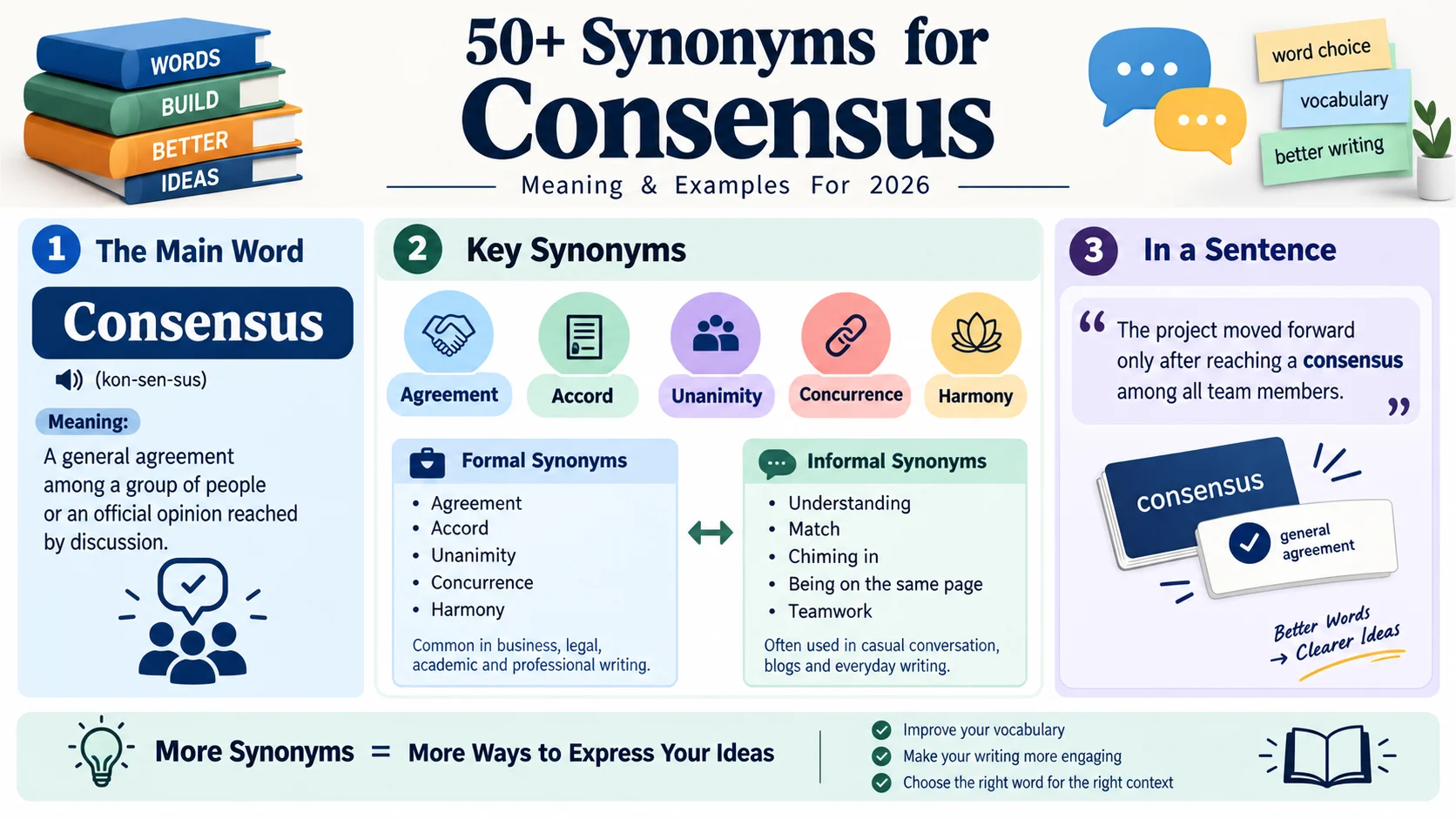
Consensus means general agreement among a group of people. It is the collective opinion or shared decision reached by everyone involved. The best synonyms depend on context: for formal writing, use “accord” or “concurrence.” For casual conversation, try “agreement” or “harmony.” For professional settings, “unanimity” or “collective agreement” work well.
Meaning, Tone and Context
The word “consensus” is a noun that describes a state of general agreement. It implies that a group has discussed a matter and reached a decision that most or all members support. The tone is neutral and professional, making it suitable for many situations.
1. Simple Definition: Consensus is a general agreement or collective opinion reached by a group.
2. Part of Speech: Consensus is a noun. It is an uncountable noun, so you would say “a consensus” or “the consensus” but not “consensuses.”
3. Tone: The tone is neutral to positive. It suggests cooperation, unity, and shared purpose. It is rarely used in a negative context.
4. Formality: Consensus is a formal word. It is common in business, politics, academia, and law. For casual conversation, “agreement” is more natural.
5. Common Use Cases: You will encounter “consensus” in many professional and academic settings.
- Business Meetings: “The team reached a consensus on the new marketing strategy.”
- Academic Writing: “There is a growing consensus among researchers about climate change.”
- Political Contexts: “The senators struggled to find a consensus on the bill.”
- Legal Settings: “The jury arrived at a consensus after hours of deliberation.”
6. Important Word Forms:
- Noun: consensus. “The consensus was clear.”
- Adjective: consensual. “They reached a consensual decision.” Note: “Consensual” often refers to mutual consent in personal contexts.
- Verb: consent. “Everyone consented to the plan.” Note: “Consent” means to give permission, which is slightly different from reaching a consensus.
- Related Form: consentient. This is a rare adjective meaning “agreeing.” It is not commonly used in modern English.
When and How to Use “Consensus”
The word “consensus” is best used when you want to describe a group decision that everyone supports. It implies a process of discussion and compromise. Here are several realistic examples.
- Professional Context: To describe a team decision.
Example: “After a lengthy discussion, the board reached a consensus on the budget for the next fiscal year.” - Academic Context: To describe agreement among scholars.
Example: “There is a broad consensus in the scientific community that the climate is changing.” - Political Context: To describe agreement among lawmakers.
Example: “The committee worked tirelessly to build a consensus on the healthcare reform bill.” - Personal Context: To describe agreement among friends or family.
Example: “We reached a consensus on where to go for our summer vacation.” - Email Communication: To inform colleagues about a decision.
Example: “Following our meeting, the consensus is to move forward with the new software.” - Resume or Cover Letter: To demonstrate your ability to work with others.
Example: “I facilitated a consensus among department heads to streamline our workflow.” - Social Media Caption: To share a group opinion.
Example: “The consensus is in: this is the best pizza place in town.”
Another Word for “Consensus”
Choosing the best replacement for “consensus” depends on the context and the tone you want to set. Here are the most effective single word alternatives for different situations.
- Professional Writing: “Accord” or “Concurrence.” “The two parties reached an accord on the terms of the contract.”
- Academic Writing: “Unanimity” or “Convergence.” “The study found a surprising unanimity among the participants.”
- Casual Conversation: “Agreement” or “Harmony.” “We finally came to an agreement about the movie.”
- Emotional Writing: “Unity” or “Solidarity.” “The community showed remarkable unity in the face of adversity.”
- Creative Writing: “Concord” or “Chorus.” “A chorus of voices rose in support of the proposal.”
- Resume or Workplace: “Collective Agreement” or “Team Decision.” “We achieved a collective agreement on the project timeline.”
- Social Media Captions: “The Verdict” or “The Word.” “The verdict is in: everyone loves this new cafe.”
- Stronger Meaning: “Unanimity.” This word implies complete, one hundred percent agreement.
- Softer Meaning: “General Agreement.” This phrase suggests that most people agree, but not necessarily everyone.
When Not to Use “Consensus”
While “consensus” is a valuable word, it is not always the right choice. Using it in the wrong context can make your writing sound awkward or imprecise.
- When You Mean “Compromise”: Consensus is not the same as compromise. A compromise involves everyone giving up something. A consensus is a shared agreement. “We reached a compromise” is different from “We reached a consensus.”
- When You Mean “Majority Vote”: Consensus implies general agreement, not just a simple majority. If fifty one percent of people agree, that is a majority, not a consensus.
- In Casual Conversation: “Consensus” can sound too formal for everyday chat. “We agreed on a movie” sounds more natural than “We reached a consensus on a movie.”
- When Describing a Personal Decision: You cannot have a consensus by yourself. Consensus requires a group. “My consensus is to go to bed” is incorrect. You would say “My decision is to go to bed.”
Example of Precision: Compare these two sentences.
- Incorrect: “The consensus of one person was to leave.”
- Correct: “The decision was to leave.”
Words Commonly Confused With “Consensus”
Understanding the differences between these related words will help you use “consensus” correctly.
- Consensus vs. Unanimity: “Unanimity” means complete agreement from everyone. “Consensus” means general agreement, which may still include a few dissenters. Unanimity is a stronger, more absolute term.
- Consensus vs. Majority: A “majority” is more than half of a group. A “consensus” is a general agreement that may include almost everyone. Majority is a numerical concept; consensus is a relational one.
- Consensus vs. Compromise: A “compromise” is a settlement where each side gives up something. A “consensus” is a shared decision that everyone supports. A compromise can lead to a consensus, but they are not the same thing.
- Consensus vs. Concurrence: “Concurrence” means agreement or cooperation. It is very similar to consensus but is often used in legal or formal contexts to describe agreeing opinions.
- Consensus vs. Accord: “Accord” is a formal agreement, often between nations or organizations. It is more specific than consensus, which is a general agreement among people.
- Consensus vs. Harmony: “Harmony” is a state of peaceful agreement and cooperation. It focuses on the quality of the relationship, while consensus focuses on the decision itself.
Best Synonym by Context for “Consensus”
| Context | Best Synonym | Why It Works | Example |
|---|---|---|---|
| Formal Writing | Accord | It sounds sophisticated and official. | “The nations signed an accord to reduce emissions.” |
| Academic Writing | Unanimity | It suggests complete agreement among experts. | “The study revealed a surprising unanimity of opinion.” |
| Professional/Business | Concurrence | It is precise and commonly used in business. | “We have received the concurrence of all department heads.” |
| Resume | Collective Agreement | It highlights teamwork and collaboration. | “I helped broker a collective agreement on the new policy.” |
| Casual Conversation | Agreement | It is simple and easily understood. | “We finally came to an agreement.” |
| Creative Writing | Concord | It adds a poetic, harmonious tone. | “They lived in concord with their neighbors.” |
| Emotional Tone | Unity | It emphasizes togetherness and shared feeling. | “The event showcased the unity of the community.” |
| Strong Intensity | Unanimity | It implies one hundred percent agreement. | “The decision was met with unanimity.” |
| Soft/Moderate Tone | General Agreement | It suggests that most people agree. | “There is a general agreement on this issue.” |
| Social Media Captions | The Verdict | It is catchy and engaging. | “The verdict is in: this is the best movie of the year.” |
| US/UK Usage | Consensus | The word is used identically in both regions. | “The consensus in the US and UK is the same.” |
Which Synonym Should You Choose?
Choosing the right synonym for “consensus” is about matching the word to your audience and purpose.
- For a professional report or email: Use “concurrence” or “accord.” These words sound formal and authoritative.
- For an academic paper: Use “unanimity” or “convergence.” These words are precise and suitable for research contexts.
- For a casual conversation: Use “agreement” or “harmony.” These words are friendly and easy to understand.
- For a speech or presentation: Use “unity” or “solidarity.” These words inspire and motivate an audience.
- For a creative piece: Use “concord” or “chorus.” These words add imagery and depth.
- For a resume: Use “collective agreement” or “team decision.” These phrases highlight your collaborative skills.
Real Life Examples of “Consensus” in Sentences
Here are examples of how “consensus” and its synonyms can be used in various real world scenarios.
- School: “The student council reached a consensus on the theme for the school dance.”
- Workplace: “After a long debate, the team achieved unanimity on the project’s direction.”
- Writing: “The author argued that there is a growing consensus on the need for renewable energy.”
- Conversation: “We finally came to an agreement about where to eat dinner.”
- Social Media: “The verdict is in: everyone loves the new update.”
- Resume: “I facilitated a collective agreement among stakeholders to launch the new product on time.”
- Email: “The consensus from our meeting is to proceed with the original plan.”
- Storytelling: “In a rare moment of concord, the two rivals shook hands and agreed to work together.”
25 Synonyms for “Consensus”
The following table lists 25 accurate and practical synonyms for “consensus.”
| Synonym | Simple Meaning | Best Used For | Example Sentence |
|---|---|---|---|
| Agreement | A shared opinion or decision. | General use, casual. | “The two sides finally reached an agreement.” |
| Accord | A formal agreement or harmony. | Formal writing, diplomacy. | “The countries signed a peace accord.” |
| Concurrence | Agreement or cooperation. | Professional, legal. | “We need the concurrence of all parties involved.” |
| Unanimity | Complete agreement by everyone. | Academic, formal. | “The jury reached a verdict of unanimity.” |
| Harmony | Peaceful agreement and cooperation. | Personal, emotional. | “The team worked in perfect harmony.” |
| Unity | Togetherness and oneness of purpose. | Speeches, emotional. | “The crisis brought a sense of unity to the nation.” |
| Solidarity | Mutual support within a group. | Political, emotional. | “The workers showed solidarity with their striking colleagues.” |
| Concord | Agreement and peaceful relations. | Literary, formal. | “They lived in concord for many years.” |
| Consent | Permission or agreement. | Legal, formal. | “She gave her consent for the procedure.” |
| Assent | Expression of approval or agreement. | Formal, official. | “The king gave his assent to the new law.” |
| Acquiescence | Passive acceptance or agreement. | Formal, nuanced. | “His silence was taken as acquiescence.” |
| Convergence | Coming together of different views. | Academic, analytical. | “There is a convergence of opinion on this issue.” |
| General Agreement | Agreement by most people. | Neutral, soft. | “There is a general agreement that the policy needs review.” |
| Collective Agreement | Agreement by a group as a whole. | Business, workplace. | “The union negotiated a collective agreement.” |
| Team Decision | A decision made by a team. | Workplace, informal. | “It was a team decision to move forward.” |
| Common Ground | Shared beliefs or interests. | Negotiation, discussion. | “We need to find common ground on this issue.” |
| Meeting of Minds | A shared understanding. | Formal, intellectual. | “After hours of discussion, we had a meeting of minds.” |
| Chorus | A simultaneous expression of opinion. | Creative, literary. | “A chorus of approval greeted the announcement.” |
| The Verdict | A final decision or opinion. | Casual, social media. | “The verdict is in: the new restaurant is a hit.” |
| The Word | The general opinion. | Slang, casual. | “The word on the street is that the movie is great.” |
| Consensus Omnium | Agreement of all. | Academic, Latin phrase. | “The principle was accepted as a consensus omnium.” |
| Concert | Agreement in action or feeling. | Formal, literary. | “They acted in concert to solve the problem.” |
| Sympathy | Agreement in feeling or opinion. | Emotional, personal. | “There was a clear sympathy of views between them.” |
| Unison | Simultaneous action or agreement. | Formal, expressive. | “The group acted in unison to achieve their goal.” |
| Rapport | A close and harmonious relationship. | Personal, professional. | “The two leaders quickly established a rapport.” |
Synonym Groups and Usage Differences
Professional vs. Personal Synonyms
In a professional setting, like a board meeting or a formal report, use “concurrence,” “accord,” or “collective agreement.” These words sound polished and authoritative. In a personal setting, “agreement” or “harmony” are more natural. For example, you would tell your boss “We have concurrence on the budget,” but you would tell your friend “We finally came to an agreement on the movie.”
Formal vs. Conversational Synonyms
Formal Synonyms: “Unanimity,” “accord,” and “concurrence” are perfect for academic papers, legal documents, or formal speeches.
Conversational Synonyms: “Agreement,” “harmony,” and “common ground” are the best choices for everyday conversations and emails to friends.
Academic Synonyms
In essays and research papers, “unanimity” and “convergence” are powerful words. They allow you to discuss the state of agreement among scholars or data points. “Consensus” itself is also common in academic writing.
Professional and Business Synonyms
“Concurrence” is a safe and professional choice for almost any workplace communication. “Accord” is excellent for formal agreements. “Collective agreement” is useful in human resources and team management contexts.
Creative or Literary Synonyms
These words add a layer of artistry to your descriptions.
- Concord: Suggests a state of peaceful harmony.
- Chorus: Suggests a unified voice or opinion.
- Unison: Suggests simultaneous action and agreement.
Slang or Modern Synonyms
“The verdict” and “the word” are modern, casual ways to express a general opinion. They are acceptable in casual writing, social media, and marketing, but should be avoided in formal academic or professional writing.
Strongest vs. Weaker Synonyms
Here is an intensity scale from mild to strongest:
- General Agreement: Mild, suggests most people agree.
- Agreement, Harmony: Moderate, suggests a peaceful state.
- Consensus, Concurrence: Moderate to strong, suggests a formal decision.
- Accord, Unity: Strong, suggests a formal, binding agreement.
- Unanimity: Strongest, suggests complete, one hundred percent agreement.
Emotional vs. Neutral Synonyms
Emotional Synonyms: “Unity,” “solidarity,” and “harmony” carry strong emotional weight. They suggest a deep, positive connection among people.
Neutral Synonyms: “Agreement,” “concurrence,” and “accord” are factual and free of emotional charge.
Antonyms of “Consensus”
Here are 15 clear antonyms for “consensus,” which are words that mean the opposite: disagreement, division, and a lack of unity.
| Antonym | Meaning | Example Sentence |
|---|---|---|
| Disagreement | A lack of consensus or approval. | “There was widespread disagreement about the new policy.” |
| Discord | Lack of agreement or harmony. | “The meeting ended in discord.” |
| Dissent | The expression of a minority opinion. | “There was some dissent among the committee members.” |
| Division | A state of separation or disagreement. | “The issue caused a deep division in the community.” |
| Conflict | A serious disagreement or argument. | “The conflict between the two departments continued.” |
| Dispute | A disagreement or argument. | “The dispute over the contract lasted for months.” |
| Contention | Heated disagreement. | “The proposal was a source of contention.” |
| Opposition | Resistance or disagreement. | “The plan faced strong opposition from the public.” |
| Dissonance | A lack of harmony or agreement. | “There was cognitive dissonance among the team.” |
| Schism | A split or division between strongly opposed groups. | “The debate caused a schism in the organization.” |
| Faction | A small organized dissenting group. | “A faction within the party opposed the leader.” |
| Dissension | Disagreement that leads to discord. | “The decision caused dissension among the ranks.” |
| Disunity | Lack of unity or agreement. | “The disunity of the group made progress difficult.” |
| Disaccord | Lack of agreement or harmony. | “There was complete disaccord between the two sides.” |
| Variation | A change or difference in condition. | “There was a wide variation of opinion on the matter.” |
Comparison: “Consensus” vs. Similar Words
Consensus vs. Unanimity
Main Difference: Consensus means general agreement, which may include some dissent. Unanimity means complete, one hundred percent agreement. Unanimity is a stronger, more absolute term.
Which One Is Stronger: Unanimity is stronger.
Which One Is More Formal: Both are formal, but unanimity is more precise in its meaning.
Example Sentence with Consensus: “The group reached a consensus after a long discussion.”
Example Sentence with Unanimity: “The decision was made with unanimity.”
Consensus vs. Majority
Main Difference: A majority is more than half of a group. A consensus is a general agreement that may include almost everyone. Majority is a numerical concept; consensus is a relational one.
Which One Is Stronger: Consensus implies broader agreement than a simple majority.
Which One Is More Formal: Both are formal, but they are used in different contexts.
Example Sentence with Consensus: “The consensus was to move forward with the plan.”
Example Sentence with Majority: “The majority voted in favor of the proposal.”
Consensus vs. Compromise
Main Difference: A compromise is a settlement where each side gives up something. A consensus is a shared decision that everyone supports. A compromise can lead to a consensus, but they are not the same thing.
Which One Is Stronger: Consensus is a more positive and unified outcome.
Which One Is More Formal: Both are formal, but they describe different processes.
Example Sentence with Consensus: “We reached a consensus on the best way forward.”
Example Sentence with Compromise: “After much negotiation, we reached a compromise.”
Consensus vs. Concurrence
Main Difference: Concurrence means agreement or cooperation. It is very similar to consensus but is often used in legal or formal contexts to describe agreeing opinions.
Which One Is Stronger: They are similar in strength.
Which One Is More Formal: Concurrence is slightly more formal and legalistic.
Example Sentence with Consensus: “There is a consensus among experts.”
Example Sentence with Concurrence: “We have the concurrence of the legal team.”
Consensus vs. Accord
Main Difference: An accord is a formal agreement, often between nations or organizations. It is more specific than consensus, which is a general agreement among people.
Which One Is Stronger: An accord is a formal, binding agreement.
Which One Is More Formal: Accord is more formal.
Example Sentence with Consensus: “The group reached a consensus on the issue.”
Example Sentence with Accord: “The two nations signed a peace accord.”
Consensus vs. Harmony
Main Difference: Harmony is a state of peaceful agreement and cooperation. It focuses on the quality of the relationship, while consensus focuses on the decision itself.
Which One Is Stronger: Harmony is a broader, more emotional term.
Which One Is More Formal: Consensus is more formal and decision oriented.
Example Sentence with Consensus: “The consensus was to hire the new candidate.”
Example Sentence with Harmony: “The team worked together in perfect harmony.”
Common Phrases and Expressions with “Consensus”
1. Reach a Consensus
Meaning: To come to a general agreement.
Example Sentence: “After hours of debate, the committee finally reached a consensus.”
2. Build a Consensus
Meaning: To work toward creating a general agreement.
Example Sentence: “The leader worked hard to build a consensus around the new policy.”
3. General Consensus
Meaning: The overall opinion of a group.
Example Sentence: “The general consensus is that the project was a success.”
4. Consensus Building
Meaning: The process of creating agreement within a group.
Example Sentence: “Consensus building is an important skill for any manager.”
5. Break the Consensus
Meaning: To disagree with the general agreement.
Example Sentence: “One member decided to break the consensus and vote against the plan.”
6. Consensus View
Meaning: The generally accepted opinion.
Example Sentence: “The consensus view among scientists is that action is needed.”
7. Emerging Consensus
Meaning: A general agreement that is starting to form.
Example Sentence: “There is an emerging consensus that the policy needs to change.”
8. Consensus Decision Making
Meaning: A process where decisions are made by general agreement.
Example Sentence: “The organization uses consensus decision making for all major choices.”
Common Mistakes to Avoid
1. Using “Consensus” When a More Precise Synonym Is Better
Mistake: “We reached a consensus to order pizza.”
Better: “We agreed to order pizza.” For simple, casual decisions, “agreed” is more natural.
2. Confusing “Consensus” with “Compromise”
Mistake: “After a compromise, we reached a consensus.” This is redundant and confusing.
Correction: A compromise can lead to a consensus, but they are different things. Choose one word based on what you mean.
3. Using a Casual Synonym in Formal Writing
Mistake: “The verdict of the board was to approve the budget.”
Better: “The consensus of the board was to approve the budget.” “The verdict” is too casual for a formal business report.
4. Using an Overly Dramatic Synonym for a Simple Situation
Mistake: “The family achieved unanimity on what to watch on TV.”
Better: “The family agreed on what to watch on TV.” “Unanimity” is too formal for a casual family decision.
5. Repeating the Same Word Too Often
Mistake: “The consensus was clear. The consensus was strong. The consensus was final.”
Better: “The consensus was clear and strong. It was a final decision.” This variation makes the writing more engaging.
6. Choosing a Synonym with the Wrong Emotional Tone
Mistake: “The discord among the team was a sign of their consensus.”
Better: “The harmony among the team was a sign of their consensus.” “Discord” is the opposite of consensus.
7. Using Slang in Academic or Professional Writing
Mistake: “The word on the street is that the policy is bad.”
Better: “The general consensus is that the policy is ineffective.” “The word on the street” is too casual for professional writing.
FAQs
1. What is the best synonym for consensus?
- The best synonym depends on your context. For general use, “agreement” is a safe choice. For formal writing, “accord” or “concurrence” work well. For complete agreement, use “unanimity.”
2. What is a formal synonym for consensus?
A formal synonym for consensus is “accord.” Another good option is “concurrence.” Both are appropriate for formal writing and professional communication.
3. What is an informal synonym for consensus?
An informal synonym for consensus is “agreement.” “Common ground” is also a good casual choice. These words are perfect for everyday conversation.
4. What is another word for consensus in professional writing?
In professional writing, “concurrence” is an excellent choice. “Accord” is also effective for formal agreements. “Collective agreement” is useful for team decisions.
5. What is the difference between consensus and unanimity?
Consensus means general agreement, which may include some dissent. Unanimity means complete, one hundred percent agreement. Unanimity is a stronger, more absolute term.
6. What is the opposite of consensus?
The opposite of consensus is “disagreement,” “discord,” or “dissent.” These words describe a lack of agreement or unity among a group.
Conclusion
The word “consensus” is a powerful tool for describing group agreement and shared decision making. It is a formal, neutral word that is perfect for business, academic, and political contexts.
Choosing the best synonym depends entirely on your audience and purpose. For a professional report, “concurrence” or “accord” are excellent choices. For an academic paper, “unanimity” or “convergence” sound precise. In casual conversation, “agreement” or “harmony” are natural and friendly. For a speech, “unity” or “solidarity” inspire and motivate.
The best advice is to think about your purpose and your audience before you choose a word. Do you want to be formal, casual, emotional, or precise? Matching your word to your intention will make your communication more effective and your English more sophisticated.
A practical vocabulary tip: The next time you are in a meeting, listen for the word “consensus.” Then try to think of another word that could replace it. This simple exercise will help you build your vocabulary and become a more versatile communicator.
