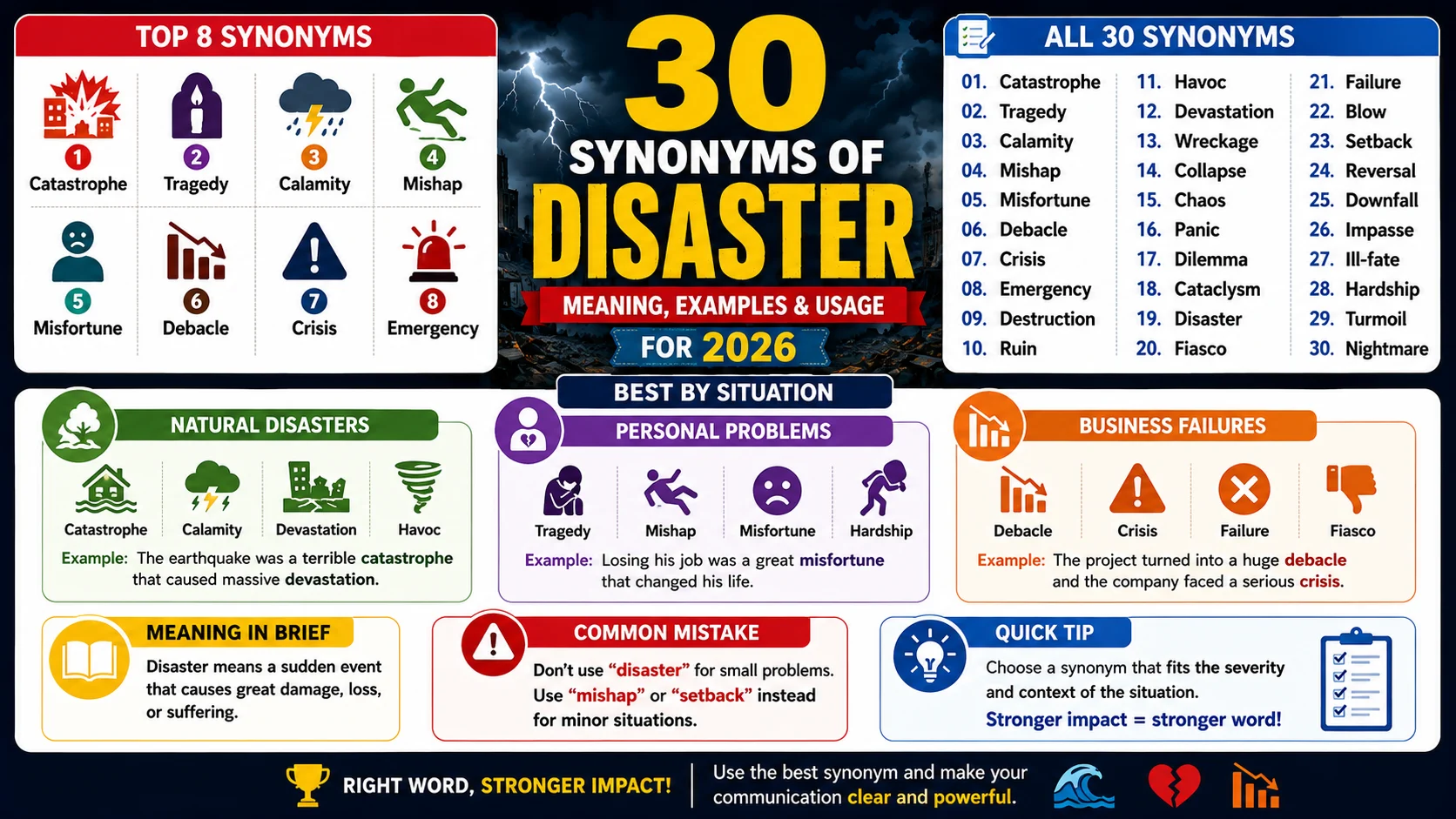
Disaster means a sudden event that causes great damage, loss, or suffering. The best synonyms include catastrophe, tragedy, calamity, mishap, misfortune, cataclysm, and debacle. The most common everyday synonym is mishap for small problems, and tragedy for serious events. Each synonym has a slightly different meaning, tone, and context.
We all face difficult situations. Sometimes a small mistake ruins our day. Other times, a major event changes everything. The word “disaster” covers both, but it doesn’t always fit every situation.
That’s why learning synonyms for disaster is so valuable. Whether you’re writing a news report, describing a personal setback, or telling a story, having the right word makes all the difference. In this guide, I’ll walk you through 30 powerful alternatives, complete with real examples and practical usage tips. By the time you finish, you’ll know exactly which word to use whether you’re talking about a burnt dinner or a national emergency.
What Does “Disaster” Mean?
Definition
In simple terms, a disaster is a sudden, unexpected event that causes serious harm, destruction, or suffering. It can be a natural event like an earthquake, a artificial event like a plane crash, or even a personal event like losing your job. The key idea is that something bad happens quickly and causes significant damage or loss.
Pronunciation
| Feature | Information |
|---|---|
| US IPA | /dɪˈzæs.tɚ/ |
| UK IPA | /dɪˈzɑː.stə/ |
| Syllables | 3 (di-zas-ter) |
| Tip | Stress the second syllable: di-ZAS-ter |
Grammar
| Feature | Information |
|---|---|
| Part of Speech | Noun |
| Common Position | Subject or object of a sentence |
| Typical Pattern | “disaster for [someone/something]” or “disaster strikes” |
Example Sentences:
- The earthquake was the worst disaster the country had ever experienced.
- Forgetting your passport is a disaster when you’re traveling.
- The project turned out to be a complete disaster.
Grammar Note: “Disaster” is usually a countable noun. You can have one disaster, two disasters, or many disasters.
Word Family
| Word | Part of Speech | Meaning |
|---|---|---|
| Disastrous | Adjective | Causing great damage or suffering |
| Disastrously | Adverb | In a way that causes great damage |
| Disaster | Noun | A sudden event causing great harm |
30 Synonyms of Disaster
1. Catastrophe
Meaning: A sudden, terrible event that causes extreme suffering or destruction.
Best Used For: News reporting, formal writing, describing major events.
Formality: Formal
Tone: Serious, Dramatic
Frequency: ⭐⭐⭐⭐ Common
CEFR Level: B2
Example Sentence 1: The oil spill was an environmental catastrophe that destroyed marine life.
Example Sentence 2: The earthquake was the worst catastrophe the region had faced in a century.
Usage Tip: Use “catastrophe” for truly massive, devastating events. It’s stronger than “disaster” and suggests long-lasting consequences.
2. Tragedy
Meaning: A terrible event that causes great sadness, often involving death or suffering.
Best Used For: News reporting, storytelling, personal discussions.
Formality: Neutral
Tone: Emotional, Sad
Frequency: ⭐⭐⭐⭐⭐ Very Common
CEFR Level: B1
Example Sentence 1: The plane crash was a tragedy that affected families around the world.
Example Sentence 2: His sudden death was a personal tragedy for everyone who knew him.
Usage Tip: “Tragedy” focuses on the emotional impact and human suffering. It’s often used for events that cause loss of life.
3. Calamity
Meaning: A terrible event that causes great suffering and loss.
Best Used For: Formal writing, news, literature.
Formality: Formal
Tone: Serious, Literary
Frequency: ⭐⭐⭐ Moderate
CEFR Level: B2
Example Sentence 1: The famine was a calamity that affected millions of people.
Example Sentence 2: The economic collapse brought calamity to the entire nation.
Usage Tip: “Calamity” has a somewhat old-fashioned, literary feel. It works well in formal writing but may sound dramatic in everyday conversation.
4. Mishap
Meaning: A small, unlucky event that causes minor problems or damage.
Best Used For: Daily conversation, describing everyday problems.
Formality: Informal
Tone: Neutral, Slightly Humorous
Frequency: ⭐⭐⭐⭐ Common
CEFR Level: B1
Example Sentence 1: The cooking mishap left us ordering takeout instead.
Example Sentence 2: I had a small mishap with my car this morning, but no one was hurt.
Usage Tip: “Mishap” is perfect for minor problems. Don’t use it for serious events it sounds disrespectful and inappropriate.
5. Misfortune
Meaning: Bad luck or an unlucky event that causes problems.
Best Used For: Personal conversations, storytelling, everyday speech.
Formality: Neutral
Tone: Neutral, Sympathetic
Frequency: ⭐⭐⭐⭐ Common
CEFR Level: B2
Example Sentence 1: Through no fault of his own, he suffered a series of misfortunes.
Example Sentence 2: The family faced great misfortune when they lost their home in the flood.
Usage Tip: “Misfortune” suggests bad luck rather than anyone’s fault. It’s a gentler, more sympathetic word than “disaster.”
6. Cataclysm
Meaning: A violent, sudden change or disaster that causes major destruction.
Best Used For: Formal writing, geology, dramatic storytelling.
Formality: Formal
Tone: Dramatic, Serious
Frequency: ⭐⭐ Rare
CEFR Level: C1
Example Sentence 1: The volcanic eruption was a cataclysm that changed the landscape forever.
Example Sentence 2: The war was a cataclysm that reshaped the entire region.
Usage Tip: “Cataclysm” is very dramatic and somewhat technical. Use it for events that cause massive, permanent changes.
7. Debacle
Meaning: A sudden, complete failure or collapse.
Best Used For: Business, politics, sports, describing failures.
Formality: Neutral
Tone: Negative, Critical
Frequency: ⭐⭐⭐ Moderate
CEFR Level: B2
Example Sentence 1: The product launch was a complete debacle for the company.
Example Sentence 2: Their playoff performance turned into a humiliating debacle.
Usage Tip: “Debacle” is perfect for failures caused by poor planning or mistakes. It’s common in business and sports contexts.
8. Accident
Meaning: An unexpected, harmful event that happens without intention.
Best Used For: Daily conversation, insurance, safety discussions.
Formality: Neutral
Tone: Neutral
Frequency: ⭐⭐⭐⭐⭐ Very Common
CEFR Level: A2
Example Sentence 1: The car accident blocked traffic for hours.
Example Sentence 2: Spilling coffee on your laptop is a common office accident.
Usage Tip: “Accident” is the most common word for unexpected harmful events. It doesn’t usually suggest blame or intention.
9. Emergency
Meaning: A serious, urgent situation that requires immediate action.
Best Used For: Medical situations, safety, crisis management.
Formality: Neutral
Tone: Urgent, Serious
Frequency: ⭐⭐⭐⭐⭐ Very Common
CEFR Level: A2
Example Sentence 1: The hospital staff prepared for the emergency after the factory explosion.
Example Sentence 2: Call 911 in any medical emergency.
Usage Tip: “Emergency” focuses on the need for immediate response, not just the event itself.
10. Crisis
Meaning: A time of intense difficulty, danger, or uncertainty.
Best Used For: Business, politics, healthcare, personal situations.
Formality: Neutral
Tone: Serious, Urgent
Frequency: ⭐⭐⭐⭐⭐ Very Common
CEFR Level: B1
Example Sentence 1: The company faced a financial crisis after losing its biggest client.
Example Sentence 2: The country is in the middle of a housing crisis.
Usage Tip: “Crisis” often suggests a turning point or a period of intense difficulty. It’s less dramatic than “catastrophe” but more serious than “mishap.”
11. Catastrophe
Meaning: A sudden, terrible event causing extreme suffering.
Best Used For: Formal writing, news, environmental discussions.
Formality: Formal
Tone: Serious, Dramatic
Frequency: ⭐⭐⭐⭐ Common
CEFR Level: B2
Example Sentence 1: The nuclear meltdown was an unimaginable catastrophe.
Example Sentence 2: The hurricane was a catastrophe for the coastal communities.
Usage Tip: “Catastrophe” is one of the strongest synonyms. Use it only for events with devastating consequences.
12. Adversity
Meaning: A state of difficulty or hardship, often continuing over time.
Best Used For: Personal development, motivational writing, storytelling.
Formality: Formal
Tone: Serious, Inspirational
Frequency: ⭐⭐⭐ Moderate
CEFR Level: B2
Example Sentence 1: She faced incredible adversity but never gave up.
Example Sentence 2: Growing up in poverty was an adversity that made him stronger.
Usage Tip: “Adversity” focuses on ongoing hardship rather than a single event.
13. Tribulation
Meaning: A difficult or painful experience that tests your strength.
Best Used For: Literature, religious texts, dramatic writing.
Formality: Formal
Tone: Emotional, Literary
Frequency: ⭐⭐ Rare
CEFR Level: C1
Example Sentence 1: The family endured many tribulations during the war.
Example Sentence 2: His faith helped him through every tribulation.
Usage Tip: “Tribulation” has a religious or literary feel. It’s rarely used in everyday conversation.
14. Tragedy
Meaning: A very sad event that causes suffering.
Best Used For: News, personal stories, emotional discussions.
Formality: Neutral
Tone: Emotional, Sad
Frequency: ⭐⭐⭐⭐⭐ Very Common
CEFR Level: B1
Example Sentence 1: The shooting was a tragedy that shocked the nation.
Example Sentence 2: Her story is a personal tragedy that touched many hearts.
Usage Tip: “Tragedy” emphasizes human suffering and loss. It’s one of the most common alternatives to “disaster.”
15. Setback
Meaning: A problem that delays progress or causes difficulty.
Best Used For: Business, sports, personal development.
Formality: Neutral
Tone: Neutral, Practical
Frequency: ⭐⭐⭐⭐ Common
CEFR Level: B2
Example Sentence 1: The team faced a major setback when their star player got injured.
Example Sentence 2: Losing funding was a setback, but we continued the project.
Usage Tip: “Setback” suggests temporary difficulty rather than complete failure.
16. Calamity
Meaning: A terrible event causing great suffering.
Best Used For: Formal writing, news, historical accounts.
Formality: Formal
Tone: Serious, Literary
Frequency: ⭐⭐⭐ Moderate
CEFR Level: B2
Example Sentence 1: The country had suffered many calamities over the centuries.
Example Sentence 2: The drought was a calamity for local farmers.
Usage Tip: “Calamity” sounds more dramatic than “disaster” and has a slightly old-fashioned quality.
17. Affliction
Meaning: Something that causes pain or suffering, especially a physical condition.
Best Used For: Medical contexts, emotional discussions, formal writing.
Formality: Formal
Tone: Serious, Sympathetic
Frequency: ⭐⭐⭐ Moderate
CEFR Level: B2
Example Sentence 1: The disease is a terrible affliction affecting millions.
Example Sentence 2: Poverty is an affliction that damages entire communities.
Usage Tip: “Affliction” often refers to long-term suffering, especially physical or mental conditions.
18. Blow
Meaning: A sudden event that causes shock or disappointment.
Best Used For: Daily conversation, storytelling, emotional situations.
Formality: Informal
Tone: Emotional, Casual
Frequency: ⭐⭐⭐⭐ Common
CEFR Level: B1
Example Sentence 1: Losing his job was a terrible blow to his confidence.
Example Sentence 2: Her retirement was a blow to the entire team.
Usage Tip: “Blow” is often used metaphorically to describe sudden disappointment. It’s informal and common in speech.
19. Difficulty
Meaning: A problem or challenge that requires effort to overcome.
Best Used For: Everyday conversation, professional contexts, education.
Formality: Neutral
Tone: Neutral
Frequency: ⭐⭐⭐⭐⭐ Very Common
CEFR Level: A2
Example Sentence 1: The project ran into serious difficulties after the funding was cut.
Example Sentence 2: Financial difficulties forced them to sell their home.
Usage Tip: “Difficulty” is much milder than “disaster.” Use it for challenges and problems that aren’t catastrophic.
20. Failure
Meaning: An event that doesn’t succeed or achieve its goal.
Best Used For: Business, education, personal development.
Formality: Neutral
Tone: Negative
Frequency: ⭐⭐⭐⭐⭐ Very Common
CEFR Level: A2
Example Sentence 1: The product launch was a failure despite months of preparation.
Example Sentence 2: She viewed her mistakes not as failures but as learning opportunities.
Usage Tip: “Failure” focuses on not achieving success, not necessarily on causing harm or damage.
21. Fall
Meaning: A loss of power, success, or importance.
Best Used For: Politics, business, history.
Formality: Neutral
Tone: Dramatic
Frequency: ⭐⭐⭐⭐ Common
CEFR Level: B1
Example Sentence 1: The emperor’s fall from power was a major event.
Example Sentence 2: The company’s sudden fall surprised everyone in the industry.
Usage Tip: “Fall” often describes a decline or loss of position, not a sudden event.
22. Collapse
Meaning: A sudden failure or breakdown of a system or structure.
Best Used For: Business, economics, politics, engineering.
Formality: Neutral
Tone: Serious
Frequency: ⭐⭐⭐⭐ Common
CEFR Level: B2
Example Sentence 1: The collapse of the stock market affected investors worldwide.
Example Sentence 2: The building’s collapse was caused by structural failure.
Usage Tip: “Collapse” suggests something breaking down suddenly and completely.
23. Catastrophe
Meaning: A sudden, terrible event that causes widespread destruction.
Best Used For: News, environmental discussions, formal writing.
Formality: Formal
Tone: Serious, Dramatic
Frequency: ⭐⭐⭐⭐ Common
CEFR Level: B2
Example Sentence 1: The flood was a catastrophe that displaced thousands of people.
Example Sentence 2: Climate change could lead to global catastrophe.
Usage Tip: “Catastrophe” is one of the strongest synonyms for “disaster.”
24. Misfortune
Meaning: Bad luck that leads to an unpleasant event.
Best Used For: Personal conversations, storytelling, everyday speech.
Formality: Neutral
Tone: Sympathetic
Frequency: ⭐⭐⭐⭐ Common
CEFR Level: B2
Example Sentence 1: It was his misfortune to be born into a family facing financial problems.
Example Sentence 2: The family experienced great misfortune when their home was destroyed by fire.
Usage Tip: “Misfortune” emphasizes the role of luck rather than anyone’s fault.
25. Hardship
Meaning: A difficult situation that causes suffering or inconvenience.
Best Used For: Personal development, social issues, storytelling.
Formality: Neutral
Tone: Serious, Sympathetic
Frequency: ⭐⭐⭐⭐ Common
CEFR Level: B2
Example Sentence 1: The immigrants faced many hardships in their new country.
Example Sentence 2: She endured great hardship but never lost hope.
Usage Tip: “Hardship” often describes long-term difficulty, not a single sudden event.
26. Plight
Meaning: A dangerous, difficult, or unfortunate situation.
Best Used For: News reporting, social issues, formal writing.
Formality: Formal
Tone: Serious, Sympathetic
Frequency: ⭐⭐⭐ Moderate
CEFR Level: B2
Example Sentence 1: The plight of the refugees touched hearts around the world.
Example Sentence 2: We must do something about the plight of homeless people.
Usage Tip: “Plight” focuses on the suffering of people in a difficult situation.
27. Calamity
Meaning: An event that causes serious damage and suffering.
Best Used For: Formal writing, literature, news.
Formality: Formal
Tone: Serious, Literary
Frequency: ⭐⭐⭐ Moderate
CEFR Level: B2
Example Sentence 1: The earthquake was a calamity for the entire region.
Example Sentence 2: The attack on the village was an unimaginable calamity.
Usage Tip: “Calamity” has a dramatic, serious tone and is often used in historical or formal contexts.
28. Accident
Meaning: An unexpected event that causes harm or damage.
Best Used For: Daily conversation, safety, insurance.
Formality: Neutral
Tone: Neutral
Frequency: ⭐⭐⭐⭐⭐ Very Common
CEFR Level: A2
Example Sentence 1: He was injured in a terrible accident on the highway.
Example Sentence 2: Hiring him was an accident waiting to happen.
Usage Tip: “Accident” often suggests no one is to blame the event happened by chance.
29. Emergency
Meaning: A sudden situation requiring immediate attention.
Best Used For: Healthcare, safety, crisis response.
Formality: Neutral
Tone: Urgent
Frequency: ⭐⭐⭐⭐⭐ Very Common
CEFR Level: A2
Example Sentence 1: The emergency at the chemical plant required evacuation.
Example Sentence 2: In a medical emergency, every second counts.
Usage Tip: “Emergency” focuses on the need for quick action, not just the event itself.
30. Crisis
Meaning: A critical time of difficulty or danger.
Best Used For: Business, politics, personal situations.
Formality: Neutral
Tone: Serious
Frequency: ⭐⭐⭐⭐⭐ Very Common
CEFR Level: B1
Example Sentence 1: The country faced an economic crisis that lasted for years.
Example Sentence 2: He was going through a personal crisis after his divorce.
Usage Tip: “Crisis” implies a turning point or a time when important decisions must be made.
Synonyms Comparison Table
| Synonym | Best Context | Formality | Tone | Frequency |
|---|---|---|---|---|
| Catastrophe | Major disasters | Formal | Dramatic | ⭐⭐⭐⭐ |
| Tragedy | Events with loss of life | Neutral | Emotional | ⭐⭐⭐⭐⭐ |
| Calamity | Formal, literary | Formal | Serious | ⭐⭐⭐ |
| Mishap | Everyday problems | Informal | Casual | ⭐⭐⭐⭐ |
| Misfortune | Bad luck | Neutral | Sympathetic | ⭐⭐⭐⭐ |
| Debacle | Failures, collapses | Neutral | Critical | ⭐⭐⭐ |
| Accident | Unexpected events | Neutral | Neutral | ⭐⭐⭐⭐⭐ |
| Emergency | Urgent situations | Neutral | Urgent | ⭐⭐⭐⭐⭐ |
| Crisis | Difficult periods | Neutral | Serious | ⭐⭐⭐⭐⭐ |
| Setback | Temporary difficulties | Neutral | Practical | ⭐⭐⭐⭐ |
Best Synonyms by Situation
| Situation | Best Synonym | Why It Works |
|---|---|---|
| Daily Conversation | Mishap | Simple and appropriate for small problems |
| Business Email | Setback | Professional and constructive |
| Academic Writing | Catastrophe | Formal and precise |
| School Assignment | Tragedy | Clear and widely understood |
| Professional Meeting | Crisis | Urgent and appropriate |
| Presentation | Debacle | Impactful and memorable |
| Creative Writing | Cataclysm | Dramatic and vivid |
| Social Media | Disaster | Short and commonly used |
| Movie Review | Tragedy | Emotional and engaging |
| Book Review | Calamity | Literary and sophisticated |
Formal vs Informal Synonyms
Formal Alternatives
| Synonym | Best Used For |
|---|---|
| Catastrophe | News reporting, formal essays |
| Calamity | Academic writing, historical accounts |
| Cataclysm | Scientific writing, dramatic descriptions |
| Tribulation | Literature, religious contexts |
| Affliction | Medical writing, formal discussions |
Neutral Alternatives
| Synonym | Best Used For |
|---|---|
| Tragedy | General use, news |
| Misfortune | Everyday situations |
| Crisis | Professional contexts |
| Setback | Business, personal |
| Failure | General use |
Informal Alternatives
| Synonym | Best Used For |
|---|---|
| Mishap | Casual conversation |
| Blow | Personal stories |
| Mess | Very casual conversation |
Choosing the Right Level: Use formal synonyms for professional writing and serious contexts. Choose neutral alternatives for most everyday situations. Save informal synonyms for conversations with friends.
Strong vs Mild Synonyms
Mild
- Mishap – minor problems
- Setback – temporary difficulties
- Difficulty – challenges
- Hardship – difficult conditions
Moderate
- Disaster – the original word
- Crisis – serious but manageable
- Tragedy – very sad events
- Misfortune – unlucky events
Strong
- Catastrophe – devastating events
- Cataclysm – world-changing events
- Catastrophe – maximum level of damage
- Affliction – severe suffering
Intensity Matters: Choosing a strong synonym dramatically changes your message. “The dinner was a mishap” is very different from “The dinner was a catastrophe.” Match the intensity to the actual situation.
Real-Life Examples
Office:
“The server crash was a setback, but the IT team had it fixed within an hour.”
Business Email:
“We are writing to address the recent crisis in our supply chain and the steps we are taking to resolve it.”
News Report:
“The earthquake was the worst catastrophe the country has experienced in decades.”
Everyday Conversation:
“I had a small mishap with my phone dropped it in a puddle, but it still works.”
Creative Writing:
“The shipwreck was a personal tragedy that would haunt him for the rest of his days.”
Common Collocations
| Common Phrase | Better Alternative |
|---|---|
| Natural disaster | Natural catastrophe, Natural calamity |
| Financial disaster | Financial crisis, Economic catastrophe |
| Personal disaster | Personal tragedy, Personal misfortune |
| Complete disaster | Utter catastrophe, Total debacle |
| Disaster area | Crisis zone, Catastrophe zone |
Common Phrases
| Phrase | Meaning | Better Alternative |
|---|---|---|
| Disaster waiting to happen | Something likely to fail | Accident waiting to happen |
| Recipe for disaster | A situation likely to cause problems | Recipe for catastrophe |
| Disaster relief | Help after a disaster | Emergency response, Crisis support |
Context Guide
| Situation | Best Synonym | Reason |
|---|---|---|
| Essay | Catastrophe | Formal and academic |
| Speech | Tragedy | Emotional and engaging |
| Business Email | Setback | Professional and constructive |
| Novel | Calamity | Literary and dramatic |
| Presentation | Crisis | Clear and urgent |
| Conversation | Mishap | Natural and everyday |
| Academic Writing | Cataclysm | Precise and technical |
| Marketing Copy | Challenge | Positive and encouraging |
Related Words
Near Synonyms
- Disaster and catastrophe are often used interchangeably, but catastrophe suggests more severe consequences. Mishap is much smaller in scale.
Antonyms
- Success – achieving goals
- Miracle – wonderful event
- Blessing – positive event
- Advantage – beneficial situation
Related Adjectives
- Disastrous – causing great damage
- Catastrophic – extremely destructive
- Tragic – causing great sadness
Related Nouns
- Crisis – critical situation
- Emergency – urgent situation
- Tragedy – sad event
Related Verbs
- Fail – to not succeed
- Collapse – to fall down
- Disaster strikes – a disaster happens
Frequently Asked Questions
What is another word for disaster?
The most common synonyms for disaster are catastrophe, tragedy, calamity, mishap, and misfortune. Each one has a different level of severity and appropriate context.
Which synonym sounds the most professional?
Catastrophe and calamity sound most professional in formal contexts. Setback and crisis are also professional but less dramatic.
Which synonym is best for everyday conversation?
Mishap is the most natural choice for everyday conversation, especially for small problems. Accident is also very common and widely understood.
What is the strongest synonym for disaster?
Cataclysm and catastrophe are among the strongest synonyms. They suggest massive destruction and permanent change.
What’s the difference between catastrophe and tragedy?
Catastrophe focuses on the scale of destruction, while tragedy focuses on human suffering and sadness. A catastrophe can be a tragedy, but not every tragedy is a catastrophe.
Which synonym is most common in everyday English?
Accident, crisis, and emergency are the most common synonyms in everyday English. You’ll hear them frequently in daily life.
What is the opposite of disaster?
Success, miracle, blessing, and benefit are opposites of disaster. They describe positive events and good outcomes.
Is “disaster” a formal or informal word?
Disaster is neutral it works well in both formal writing and everyday conversation. That’s part of why it’s so widely used.
Conclusion
We’ve covered a lot of ground, so let’s bring it all together. Disaster is a powerful word, but it’s not always the right choice. Sometimes you need something milder, like mishap or setback. Other times, you need something stronger, like catastrophe or cataclysm.
The key is matching the word to the situation. Think about the severity, the formality, and the emotional impact you want to create. Use catastrophe for major events, tragedy for sad losses, mishap for everyday problems, and crisis for urgent situations.
Remember, native speakers choose their words carefully. A “small disaster” sounds like an exaggeration, while a “mishap” sounds honest and natural. Practice using these synonyms in your daily conversations and writing. Before long, you’ll choose the perfect word without even thinking about it.
Your vocabulary is one of your most powerful tools. Use it wisely, and you’ll communicate more clearly and confidently than ever before.
