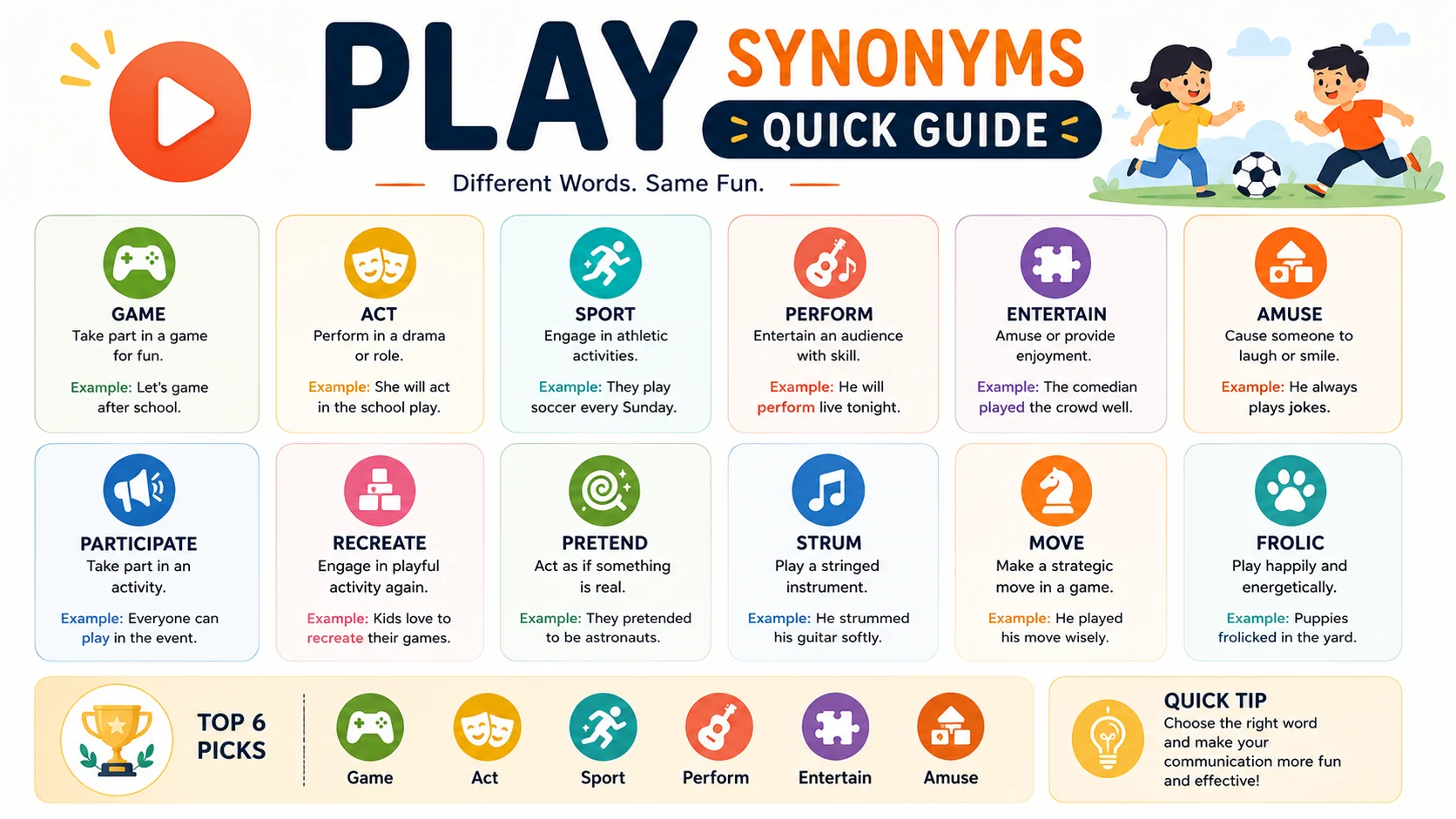
Play has multiple meanings including to engage in fun activities, to perform music, to participate in a sport, or to portray a character. The best synonym depends on context. Use perform for music, act for theater, compete for sports, and enjoy for fun. Each synonym carries a slightly different meaning and works best in specific contexts.
Top 10 Synonyms for Play:
- Perform
- Act
- Compete
- Enjoy
- Participate
- Engage
- Portray
- Exercise
- Frolic
- Recreate
Every synonym has a slightly different meaning, tone, or context. Choosing the right one makes your English sound more natural and precise.
Have you ever struggled to find the right word to describe someone playing music, acting in a play, or participating in a sport?
The word “play” is incredibly versatile. You can play a sport, play music, play a role, or play with friends. But using the same word for all these activities makes your writing and speaking feel repetitive and unclear.
Learning synonyms for play helps you express yourself with greater precision. Whether you are describing a musician’s performance, an actor’s role, or children having fun, the right synonym makes all the difference.
This guide will teach you exactly how to choose the right synonym for play in any context. You will learn the subtle differences between perform, act, compete, enjoy, and many other alternatives. By the end, you will express play with confidence and variety.
What Does “Play” Mean?
Definition
Play is a versatile word with several related meanings. It can mean to engage in fun activities for enjoyment, especially children’s games. It can mean to perform on a musical instrument. It can mean to participate in a sport. It can also mean to portray a character in a performance.
For example, children play in the park. Musicians play their instruments. Athletes play in a game. Actors play a role in a movie. In every case, play involves active participation and engagement.
The word carries a generally positive tone when describing fun and creativity. It becomes neutral when describing performances and sports. The tone depends entirely on the context.
Pronunciation
| Feature | Information |
|---|---|
| US IPA | /pleɪ/ |
| UK IPA | /pleɪ/ |
| Syllables | 1 |
| Tip | Pronounce it like the word “pay” with an “l” sound |
Grammar
| Grammar Feature | Information |
|---|---|
| Part of Speech | Verb and Noun |
| Common Position | Usually followed by a direct object or preposition |
| Typical Pattern | Play + instrument/sport/role/with + noun |
Example sentences:
“She plays the piano beautifully.”
“He plays soccer every weekend.”
“The actress plays a detective in the new movie.”
Grammar note: When playing an instrument, use “play the.” For example, “play the guitar.” When playing a sport, do not use an article. For example, “play tennis” not “play the tennis.” When playing a role, use “play a” or “play the.”
Word Family
| Word | Part of Speech | Meaning |
|---|---|---|
| Play | Verb/Noun | To engage in activity for enjoyment or performance |
| Player | Noun | Someone who plays |
| Playful | Adjective | Full of fun and energy |
| Playfully | Adverb | In a playful manner |
| Playfulness | Noun | The quality of being playful |
| Played | Verb (past) | Performed or engaged in play |
15 Synonyms of “Play”
1. Perform
Meaning: To present or act out something for an audience. To execute a musical piece or dramatic role.
Best Used For: Music, theater, dance, and entertainment contexts.
Formality: Neutral
Tone: Professional, artistic
Frequency: ⭐⭐⭐⭐⭐ Very Common
CEFR Level: B1
Example Sentence 1: “The orchestra will perform Beethoven’s Fifth Symphony tonight.”
Example Sentence 2: “She performed her original composition at the talent show.”
Usage Tip: Perform is more formal than play and emphasizes the presentation aspect. Use it when you want to highlight professionalism or artistry. It works well for music, theater, and dance. Avoid using perform for casual fun or sports, where “play” or “compete” sounds more natural.
2. Act
Meaning: To portray a character in a performance. To behave or pretend in a certain way.
Best Used For: Theater, film, television, and role-playing contexts.
Formality: Neutral
Tone: Professional, artistic
Frequency: ⭐⭐⭐⭐⭐ Very Common
CEFR Level: B1
Example Sentence 1: “She will act as the lead character in the school play.”
Example Sentence 2: “Children often act out their favorite stories at home.”
Usage Tip: Act is specifically used for theater and film performances. It can also describe pretending or behaving a certain way. Use it when you want to emphasize the dramatic or role-playing aspect. Avoid using act for music or sports, where “perform” or “compete” sounds more natural.
3. Compete
Meaning: To take part in a contest or game with the goal of winning.
Best Used For: Sports, games, and competitive activities.
Formality: Neutral
Tone: Professional, competitive
Frequency: ⭐⭐⭐⭐ Common
CEFR Level: B1
Example Sentence 1: “She will compete in the national swimming championship.”
Example Sentence 2: “Teams from around the world compete in the Olympic Games.”
Usage Tip: Compete emphasizes winning and competition. Use it when you want to highlight the competitive aspect of playing a sport or game. It sounds more serious than “play.” Avoid using compete for casual fun, performances, or music, where “play” or “perform” sounds more natural.
4. Enjoy
Meaning: To take pleasure in an activity or experience.
Best Used For: Casual fun, leisure activities, and hobbies.
Formality: Neutral
Tone: Positive, relaxed
Frequency: ⭐⭐⭐⭐⭐ Very Common
CEFR Level: A2
Example Sentence 1: “The children enjoyed themselves at the playground.”
Example Sentence 2: “We enjoy spending time together as a family.”
Usage Tip: Enjoy emphasizes pleasure and satisfaction. Use it when you want to describe the fun aspect of playing. It is softer and more general than “play.” Avoid using enjoy when you mean performing or competing, as it lacks the active engagement aspect.
5. Participate
Meaning: To take part in an activity or event.
Best Used For: Sports, games, events, and organized activities.
Formality: Formal
Tone: Professional, inclusive
Frequency: ⭐⭐⭐⭐ Common
CEFR Level: B1
Example Sentence 1: “Over one hundred students will participate in the science fair.”
Example Sentence 2: “She participates in several extracurricular activities at school.”
Usage Tip: Participate is more formal than “play” and emphasizes being involved in an activity. Use it in formal writing or when describing organized events. It sounds more professional than “play.” Avoid using participate for casual fun or performances, where “play” or “perform” sounds more natural.
6. Engage
Meaning: To take part in an activity, especially one that requires attention and interest.
Best Used For: Educational activities, hobbies, and intentional involvement.
Formality: Formal
Tone: Professional, intellectual
Frequency: ⭐⭐⭐ Moderate
CEFR Level: B2
Example Sentence 1: “Students engage in various learning activities throughout the day.”
Example Sentence 2: “She engages in creative hobbies like painting and writing.”
Usage Tip: Engage emphasizes active involvement and attention. Use it in formal or educational contexts. It sounds sophisticated and professional. Avoid using engage for casual play or performances, where simpler words sound more natural.
7. Portray
Meaning: To depict or represent someone or something, especially in art or performance.
Best Used For: Acting, roles, and artistic representation.
Formality: Formal
Tone: Professional, artistic
Frequency: ⭐⭐⭐ Moderate
CEFR Level: B2
Example Sentence 1: “The actor portrayed the historical figure with incredible accuracy.”
Example Sentence 2: “The film portrays the struggles of immigrant families.”
Usage Tip: Portray is more formal and artistic than “play” when describing a role. Use it in academic writing, film reviews, and artistic criticism. It adds sophistication to your writing. Avoid using portray in casual conversation, where “play” or “act” sounds more natural.
8. Frolic
Meaning: To play and move around in a lively, happy, and energetic way.
Best Used For: Children, animals, and playful descriptions.
Formality: Informal to Literary
Tone: Positive, joyful, lighthearted
Frequency: ⭐⭐ Rare
CEFR Level: B2
Example Sentence 1: “The children frolicked in the park on the sunny afternoon.”
Example Sentence 2: “Lambs were frolicking in the green meadow.”
Usage Tip: Frolic is a colorful, descriptive word that adds imagery to your writing. Use it in creative writing, storytelling, or descriptive passages. It has a joyful, lighthearted tone. Avoid using frolic in business writing or formal contexts, as it sounds too casual and poetic.
9. Recreate
Meaning: To engage in relaxing or fun activities for enjoyment, typically during leisure time.
Best Used For: Hobbies, leisure activities, and relaxation.
Formality: Formal
Tone: Positive, relaxed
Frequency: ⭐⭐⭐ Moderate
CEFR Level: B2
Example Sentence 1: “She recreates by hiking in the mountains every weekend.”
Example Sentence 2: “Many people recreate through sports and outdoor activities.”
Usage Tip: Recreate emphasizes relaxation and refreshment. Use it in formal writing when describing leisure activities. It is less common than “play” in everyday conversation. Avoid using recreate for performances or sports competitions, where more specific words sound better.
10. Exercise
Meaning: To engage in physical activity to stay healthy and fit.
Best Used For: Sports, fitness, and physical activities.
Formality: Neutral
Tone: Positive, health-focused
Frequency: ⭐⭐⭐⭐⭐ Very Common
CEFR Level: A2
Example Sentence 1: “She exercises at the gym three times a week.”
Example Sentence 2: “Regular exercise helps maintain a healthy weight.”
Usage Tip: Exercise emphasizes physical activity and health. Use it when you want to highlight fitness or well-being. It is a great alternative to “play” for describing sports and physical activities. Avoid using exercise for fun or performance contexts, where “play” or “perform” sounds more natural.
11. Sport
Meaning: To participate in a sport or outdoor activity. Also used to describe wearing something.
Best Used For: Sports, games, and athletic activities.
Formality: Neutral
Tone: Positive, active
Frequency: ⭐⭐⭐⭐ Common
CEFR Level: B1
Example Sentence 1: “He sports a new hairstyle every few months.”
Example Sentence 2: “We enjoy sporting activities like cycling and swimming.”
Usage Tip: As a verb, sport can mean to wear or display something, or to participate in sports. It is more specific than “play” for athletic activities. Use it when you want variety in your sports writing. Avoid using sport as a verb for music or performances.
12. Gamble
Meaning: To play games of chance for money. To take risky action in hope of a reward.
Best Used For: Casinos, betting, and high-risk situations.
Formality: Neutral
Tone: Negative or neutral depending on context
Frequency: ⭐⭐⭐ Moderate
CEFR Level: B2
Example Sentence 1: “Some people gamble at casinos without understanding the risks.”
Example Sentence 2: “She gambled her savings on a risky investment.”
Usage Tip: Gamble is specific to games of chance and risk-taking. Use it when you want to describe betting or taking chances. It has a serious tone and often carries negative connotations. Avoid using gamble for general games or fun activities, where “play” sounds more appropriate.
13. Dramatize
Meaning: To adapt something into a play or dramatic performance. To make something seem more dramatic.
Best Used For: Theatre, film, and exaggerated storytelling.
Formality: Formal
Tone: Professional, artistic
Frequency: ⭐⭐ Rare
CEFR Level: C1
Example Sentence 1: “The playwright dramatized the historical events for the stage.”
Example Sentence 2: “Please do not dramatize the situation. It is not that serious.”
Usage Tip: Dramatize emphasizes turning something into a dramatic performance. Use it in theatrical or artistic contexts. It has both a literal meaning (adapting for stage) and a figurative meaning (exaggerating). Avoid using dramatize for casual play, where simpler words sound more natural.
14. Joke
Meaning: To say something amusing or humorous. To playfully tease someone.
Best Used For: Humor, teasing, and friendly banter.
Formality: Informal
Tone: Positive, humorous
Frequency: ⭐⭐⭐⭐ Common
CEFR Level: A2
Example Sentence 1: “He always jokes about his cooking skills, but the food is actually delicious.”
Example Sentence 2: “She joked with her colleagues during the lunch break.”
Usage Tip: Joke is specific to humor and amusement. Use it when you want to describe playful teasing or making people laugh. It is informal and friendly. Avoid using joke for serious contexts or when describing games and performances.
15. Amuse
Meaning: To entertain or make someone laugh or smile.
Best Used For: Entertainment, fun, and pleasant experiences.
Formality: Neutral
Tone: Positive, pleasant
Frequency: ⭐⭐⭐⭐ Common
CEFR Level: B1
Example Sentence 1: “The children amused themselves with puzzles and games.”
Example Sentence 2: “His funny stories amused the entire audience.”
Usage Tip: Amuse emphasizes entertaining and making people happy. Use it when you want to describe fun or pleasant experiences. It is gentler than “play” and focuses on enjoyment. Avoid using amuse for competitive sports or performances, where more specific words work better.
Synonyms Comparison Table
| Synonym | Best Context | Formality | Tone | Frequency |
|---|---|---|---|---|
| Perform | Music, theater, dance | Neutral | Professional, artistic | ⭐⭐⭐⭐⭐ |
| Act | Theater, film, roles | Neutral | Professional, artistic | ⭐⭐⭐⭐⭐ |
| Compete | Sports, games | Neutral | Professional, competitive | ⭐⭐⭐⭐ |
| Enjoy | Casual fun, leisure | Neutral | Positive, relaxed | ⭐⭐⭐⭐⭐ |
| Participate | Organized events | Formal | Professional, inclusive | ⭐⭐⭐⭐ |
| Engage | Educational activities | Formal | Professional, intellectual | ⭐⭐⭐ |
| Portray | Acting, artistic roles | Formal | Professional, artistic | ⭐⭐⭐ |
| Frolic | Children, animals | Informal to Literary | Positive, joyful | ⭐⭐ |
| Recreate | Hobbies, leisure | Formal | Positive, relaxed | ⭐⭐⭐ |
| Exercise | Physical fitness | Neutral | Positive, health-focused | ⭐⭐⭐⭐⭐ |
| Sport | Athletic activities | Neutral | Positive, active | ⭐⭐⭐⭐ |
| Gamble | Betting, risk-taking | Neutral | Neutral to negative | ⭐⭐⭐ |
| Dramatize | Theatre, exaggeration | Formal | Professional, artistic | ⭐⭐ |
| Joke | Humor, teasing | Informal | Positive, humorous | ⭐⭐⭐⭐ |
| Amuse | Entertainment, fun | Neutral | Positive, pleasant | ⭐⭐⭐⭐ |
Best Synonyms by Situation
| Situation | Best Synonym | Why It Works |
|---|---|---|
| Daily Conversation | Enjoy or Play | Simple, natural, and easy to understand |
| Business Email | Participate or Engage | Professional and clear |
| Academic Writing | Portray or Dramatize | Precise and appropriate for scholarly contexts |
| School Assignment | Participate or Perform | Clear and appropriate for student writing |
| Professional Meeting | Compete or Engage | Professional and strategic |
| Presentation | Perform or Present | Adds weight and credibility |
| Creative Writing | Frolic or Dramatize | Adds descriptive depth and imagery |
| Social Media | Play or Enjoy | Engaging and conversational |
| Sports Report | Compete or Sport | Precise and appropriate for athletics |
| Music Context | Perform or Play | Professional and artistic |
| Theater Review | Act or Portray | Shows appreciation for performance |
Formal vs Informal Synonyms
Formal Alternatives
| Synonym | Best Used For |
|---|---|
| Participate | Business writing, academic writing, professional communication |
| Engage | Educational contexts, professional communication |
| Portray | Academic writing, artistic criticism, film reviews |
| Recreate | Formal writing about leisure activities |
| Dramatize | Theatre criticism, artistic contexts |
Use formal synonyms in academic essays, business proposals, legal documents, professional reports, and official correspondence. They add sophistication and precision to your writing. However, avoid using them in everyday conversation, where they can sound stiff and unnatural.
Neutral Alternatives
| Synonym | Best Used For |
|---|---|
| Perform | Music, theater, dance |
| Act | Theater, film, roles |
| Compete | Sports, games, competitions |
| Enjoy | Casual fun, leisure |
| Exercise | Physical fitness, health |
| Sport | Athletic activities |
Neutral synonyms work in almost any situation. They are appropriate for both formal and informal contexts. Use them when you are unsure about the appropriate tone or when you want to sound natural without being too casual or too formal.
Informal Alternatives
| Synonym | Best Used For |
|---|---|
| Frolic | Creative writing, playful descriptions |
| Joke | Humor, teasing, friendly conversation |
| Amuse | Entertainment, fun experiences |
Use informal synonyms with friends, family, social media posts, and casual conversations. They sound natural and friendly. However, avoid them in academic essays, professional reports, and formal business communication, where they can seem unprofessional.
Strong vs Mild Synonyms
Mild Synonyms
These synonyms describe play gently. They emphasize enjoyment, relaxation, and pleasant experiences.
- Enjoy
- Amuse
- Exercise
- Recreate
Use mild synonyms for everyday situations and when you want to sound relaxed and pleasant.
Moderate Synonyms
These synonyms express standard involvement and participation. They are the most common and work in almost all situations.
- Play
- Participate
- Perform
- Act
- Compete
Use moderate synonyms in most writing and conversation. They are versatile and rarely sound inappropriate.
Strong Synonyms
These synonyms express intense involvement, competitiveness, or dramatic expression. They should be used carefully.
- Compete (competitive intensity)
- Dramatize (dramatic intensity)
- Gamble (risk intensity)
- Portray (artistic intensity)
Use strong synonyms when you want to emphasize the intensity of the activity. Be careful, as some can sound dramatic or negative depending on context.
Real-Life Examples
School Context
“Students participate in various activities throughout the school year. They perform in the school band and act in the annual play. During recess, children enjoy playing on the playground equipment.”
Office Context
“We encourage employees to participate in team-building activities. Many of our staff perform in the company talent show. Some colleagues compete in the annual charity sports event.”
Business Email Context
“Dear Team, I am writing to invite you to participate in our upcoming team-building retreat. Please let me know if you plan to attend and engage in the activities we have planned.”
Meeting Context
“Our company will compete in the industry sports tournament next month. We encourage everyone to participate, whether as players or supporters. We also enjoy team bonding activities throughout the year.”
Creative Writing Context
“The children frolicked in the meadow, their laughter echoing through the valley. The puppies played chase around the old oak tree. It was a scene of pure joy and freedom.”
Social Media Context
“Looking for a fun way to exercise and enjoy the outdoors? Join our community sports group! We play every Saturday morning and welcome players of all skill levels.”
Sports Context
“The team will compete against their biggest rivals this weekend. All players must participate in the warm-up session. We expect an exciting game that will showcase their talent.”
Theater Context
“The talented actress will portray the lead character in the Broadway production. She performed the role with incredible emotion and depth. Critics are already praising her performance.”
Common Collocations
| Common Phrase | Better Alternative |
|---|---|
| Play a game | Participate in a game or Compete in a game |
| Play music | Perform music or Play an instrument |
| Play a role | Act a role or Portray a character |
| Play sports | Compete in sports or Exercise |
| Play with friends | Enjoy time with friends or Frolic with friends |
| Play the piano | Perform on the piano or Play piano |
| Play outside | Frolic outside or Enjoy the outdoors |
| Play a character | Act a character or Portray a character |
Common Phrases
1. Play a role
Meaning: To have an effect or part in something.
Example: “Education plays a significant role in career success.”
2. Play along
Meaning: To pretend to agree or participate.
Example: “He decided to play along with the joke, even though he did not find it funny.”
3. Play by the rules
Meaning: To follow the rules or behave fairly.
Example: “Successful businesses play by the rules and maintain ethical standards.
4. Play it safe
Meaning: To avoid risks and choose the safest option.
Example: “She decided to play it safe and save money instead of investing in the risky stock.”
5. Play for keeps
Meaning: To act seriously with long-term consequences.
Example: “This is not a game. We are playing for keeps.”
6. Play hard to get
Meaning: To pretend to be uninterested to increase appeal.
Example: “He played hard to get, but she saw through the act.”
7. Play with fire
Meaning: To take unnecessary risks.
Example: “Ignoring safety protocols is like playing with fire.”
8. Play on words
Meaning: A pun or clever use of language.
Example: “The comedian loves to play on words in his routines.”
Context Guide
| Situation | Best Synonym | Reason |
|---|---|---|
| Academic Essay | Portray or Dramatize | Precise and appropriate for scholarly writing |
| Formal Speech | Participate or Engage | Professional and respectful |
| Business Email | Participate or Engage | Professional and clear |
| Creative Writing | Frolic or Dramatize | Adds descriptive richness |
| Professional Presentation | Perform or Compete | Sounds confident and strategic |
| Casual Conversation | Enjoy or Play | Natural and easy to understand |
| Sports Commentary | Compete or Sport | Precise and descriptive |
| Music Review | Perform or Play | Professional and artistic |
| Theater Review | Act or Portray | Shows appreciation for the art form |
| Social Media Post | Enjoy or Play | Engaging and conversational |
Related Words
Near Synonyms
Near synonyms include perform, act, compete, and frolic. These words are closely related to play but emphasize different aspects. Perform highlights artistic execution, act highlights role portrayal, compete highlights competition, and frolic highlights joyful movement. All can replace play in many contexts, but each has a unique focus.
Antonyms
| Antonym | Meaning |
|---|---|
| Work | Engage in labor or effort |
| Labor | Perform physical or mental work |
| Toil | Work laboriously |
| Drudge | Do tedious work |
| Idle | Do nothing or be inactive |
| Rest | Cease activity to relax |
Related Adjectives
Playful means full of fun and energy. Active means engaged in physical activity. Competitive means wanting to win. Amusing means entertaining. Joyful means full of happiness.
Related Nouns
Play means activity for enjoyment. Performance means an act or presentation. Game means a structured form of play. Sport means a competitive physical activity. Recreation means leisure activities.
Related Verbs
Perform means to present before an audience. Act means to portray a character. Compete means to strive for victory. Frolic means to play energetically. Gamble means to take risky chances.
Frequently Asked Questions
1. What is the best synonym for play in everyday conversation?
Enjoy is the best synonym for everyday conversation. It is simple, natural, and easy to understand. Native speakers frequently use “enjoy” to describe fun activities and leisure time.
2. Which synonym sounds the most professional in business writing?
Participate or engage sounds the most professional in business writing. They convey active involvement clearly. These words work well in emails, reports, and formal communications.
3. What is the strongest synonym for play?
Compete is the strongest synonym for play when you want to emphasize competition. Dramatize is strong when emphasizing dramatic expression. Both words should be used carefully because they carry intense meanings.
4. What is the difference between perform and act?
Perform emphasizes presenting something before an audience, such as music or dance. Act emphasizes portraying a character or pretending. You perform a song but act a role. Both are related but focus on different aspects of playing.
5. What is the opposite of play?
The opposite of play is work, labor, or idle. These words describe activities that are not playful or recreational. For example, “work” emphasizes effort and productivity, while “play” emphasizes enjoyment and leisure.
6. Which synonym should I use for playing a sport?
Compete is a great synonym for playing a sport when you want to emphasize the competitive aspect. Participate works for describing involvement without focusing on winning. Both are appropriate and professional.
7. What is the most common synonym for play in American English?
Enjoy is the most common synonym for play in American English when describing fun activities. Perform is most common for music and entertainment contexts. Both are widely understood and natural in everyday communication.
8. What is the difference between frolic and play?
Frolic emphasizes energetic, joyful, and playful movement, often associated with children or animals. Play is broader and includes games, music, sports, and activities. Frolic is more colorful and descriptive, while play is more general and versatile.
Conclusion
Play is a wonderfully versatile word with many meanings and uses. However, using the same word for every activity makes your writing and speaking repetitive and unclear. The solution is simple: learn the right synonym for every context.
For fun and leisure, choose enjoy or frolic. For music and performances, choose perform or act. For sports and competitions, choose compete or participate. For professional contexts, choose engage or participate. Each synonym carries a slightly different meaning and works best in specific contexts.
Remember to consider formality, tone, and specific activity when choosing a synonym. A word that sounds natural in a casual conversation might sound out of place in a formal report. Matching your word choice to the situation is the mark of a confident English speaker.
The next time you describe someone playing, pause for a moment. Consider whether performing, acting, competing, enjoying, or another synonym would serve you better. This simple habit will transform your vocabulary and make your communication clearer, more engaging, and more effective.
Start using these synonyms today. Your readers and listeners will notice the improvement.
