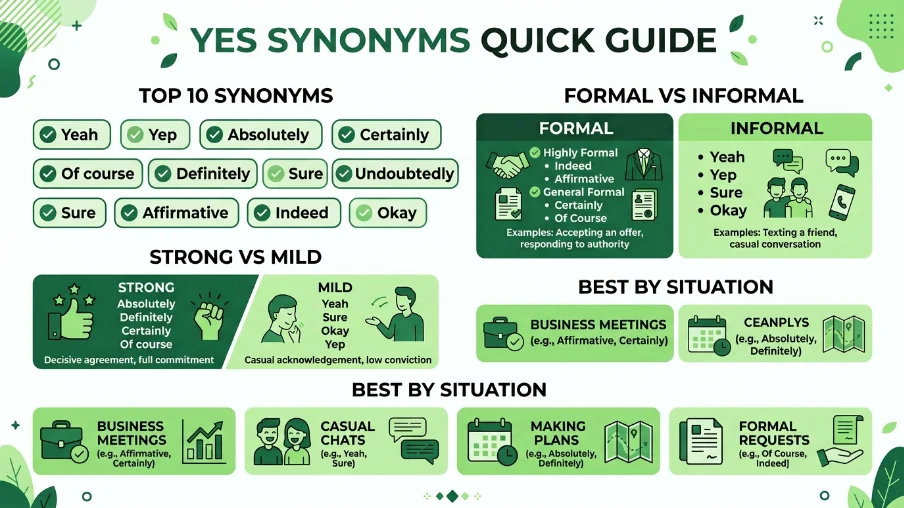
Yes is an affirmative word used to show agreement, acceptance, or consent. The best synonyms include yeah (informal), certainly (formal), absolutely (strong agreement), yep (casual), and of course (natural). Each synonym has a slightly different tone, formality, or context, so choosing the right one depends on who you’re talking to and the situation.
Top 10 Synonyms:
- Yeah
- Yep
- Absolutely
- Certainly
- Of course
- Definitely
- Sure
- Affirmative
- Indeed
- Okay
The word “yes” is one of the first words we learn in English. It’s short, simple, and gets the job done. But if you use “yes” all the time, your English can start to sound repetitive and boring. Think about it how many times do you say “yes” in a single day? Probably more than you realize!
Learning different ways to say “yes” will make you sound more natural, more professional, and more expressive. In this article, I’ll teach you 30 synonyms of “yes,” explain exactly when to use each one, and show you real examples so you can start using them right away. By the end, you’ll never feel stuck saying “yes” again.
What Does “Yes” Mean?
Definition
Yes is an adverb that expresses affirmation, agreement, or consent. In simple terms, it’s the word you use when you want to say “that’s right,” “I agree,” or “I will.” It’s the opposite of “no.”
For example, if someone asks, “Do you want coffee?” and you say “Yes,” you’re showing that you accept the offer. If someone says, “The meeting is at 3 PM,” and you say “Yes,” you’re confirming that you understand and agree.
Pronunciation
| Feature | Value |
|---|---|
| US IPA | /jɛs/ |
| UK IPA | /jes/ |
| Syllables | 1 |
| Tip | The ‘e’ sounds like the ‘e’ in “bed.” Keep it short and crisp. |
Grammar
| Grammar Feature | Information |
|---|---|
| Part of Speech | Adverb (also used as a noun and interjection) |
| Common Position | At the beginning of a sentence or as a one-word response |
| Typical Pattern | Yes + [subject] + [verb] or standalone response |
Examples:
- “Yes, I will help you with that.”
- “Yes, that’s exactly what I meant.”
- “Would you like more tea?” “Yes, please!”
Grammar Note: “Yes” can also be used as a noun, as in “The yeses outnumbered the noes”, or as a verb, as in “He yessed the proposal”.
Word Family
30 Synonyms of “Yes”
1. Yeah
Meaning: An informal way to say yes, very common in everyday conversation.
Best Used For: Daily conversation with friends, family, and people you know well.
Formality: Informal
Tone: Casual, relaxed
Frequency: ⭐⭐⭐⭐⭐ Very Common
CEFR Level: A1
Example Sentence 1: “Are you coming to the party?” “Yeah, I’ll be there.”
Example Sentence 2: “Yeah, I think that’s a great idea.”
Usage Tip: “Yeah” is the most common casual alternative to “yes.” Use it with friends and family, but avoid it in formal writing or job interviews. It can also be used sarcastically, as in “Yeah, right!” to mean “I don’t believe you.
2. Yep
Meaning: A very casual and short way to say yes.
Best Used For: Quick, informal responses with friends or in text messages.
Formality: Informal
Tone: Casual, quick
Frequency: ⭐⭐⭐⭐⭐ Very Common
CEFR Level: A2
Example Sentence 1: “Did you finish your homework?” “Yep.”
Example Sentence 2: “Want to grab lunch?” “Yep, let’s go.”
Usage Tip: “Yep” is even more casual than “yeah.” It’s perfect for quick answers but can sound too short or dismissive in formal situations. Native speakers often use it in texts and with close friends.
3. Yup
Meaning: Another casual variant of yes, very similar to “yep”.
Best Used For: Informal responses, text messages, casual conversation.
Formality: Informal
Tone: Casual, friendly
Frequency: ⭐⭐⭐⭐⭐ Very Common
CEFR Level: A2
Example Sentence 1: “Are you ready to go?” “Yup!”
Example Sentence 2: “Yup, that’s exactly what happened.”
Usage Tip: “Yup” and “yep” are almost identical. Some native speakers use “yup” to sound slightly more playful. Both are fine for casual use, but neither belongs in formal writing.
4. Absolutely
Meaning: A strong and enthusiastic way to say yes, showing complete agreement.
Best Used For: Expressing strong agreement or enthusiasm in both formal and informal settings.
Formality: Neutral (can be formal or informal)
Tone: Enthusiastic, strong
Frequency: ⭐⭐⭐⭐⭐ Very Common
CEFR Level: B1
Example Sentence 1: “Do you agree with the new plan?” “Absolutely!
Example Sentence 2: “Would you recommend this restaurant?” “Absolutely, the food is amazing.”
Usage Tip: “Absolutely” shows you’re not just agreeing you’re fully committed. It’s great for showing enthusiasm. Just don’t overuse it, or it might lose its impact.
5. Certainly
Meaning: A polite and formal way to say yes, often used in professional settings.
Best Used For: Business emails, professional communication, formal responses.
Formality: Formal
Tone: Polite, professional
Frequency: ⭐⭐⭐⭐ Common
CEFR Level: B1
Example Sentence 1: “Can you send me the report by Friday?” “Certainly, I’ll have it ready.
Example Sentence 2: “Would you like more coffee?” “Certainly, thank you.”
Usage Tip: “Certainly” is a safe choice for professional emails and formal conversations. It sounds polished and respectful. However, it can feel too formal for casual chats with friends.
6. Of course
Meaning: A natural way to say yes, implying that the answer is obvious or expected.
Best Used For: Everyday conversation, polite responses, confirming obvious facts.
Formality: Neutral
Tone: Natural, polite
Frequency: ⭐⭐⭐⭐⭐ Very Common
CEFR Level: A2
Example Sentence 1: “Can you help me with this?” “Of course!”
Example Sentence 2: “Do you like pizza?” “Of course, who doesn’t?”
Usage Tip: “Of course” is very common and natural. It can mean “yes, obviously” or “yes, willingly.” Be careful: if you say “of course” too often, it might sound like you think the question was unnecessary.
7. Definitely
Meaning: A strong yes that shows you have no doubt.
Best Used For: Confirming plans, expressing certainty, showing enthusiasm.
Formality: Neutral
Tone: Confident, certain
Frequency: ⭐⭐⭐⭐⭐ Very Common
CEFR Level: B1
Example Sentence 1: “Are you coming to the meeting?” “Definitely.”
Example Sentence 2: “This is the best movie I’ve seen all year, definitely.”
Usage Tip: Use “definitely” when you want to remove all doubt. It’s stronger than a simple “yes” but not as intense as “absolutely.” It works in both formal and informal settings.
8. Sure
Meaning: A relaxed way to say yes, showing willingness.
Best Used For: Casual conversation, agreeing to requests, everyday situations.
Formality: Informal
Tone: Relaxed, willing
Frequency: ⭐⭐⭐⭐⭐ Very Common
CEFR Level: A2
Example Sentence 1: “Can you pass me the salt?” “Sure, here you go.”
Example Sentence 2: “Would you like to go out tonight?” “Sure, why not?”
Usage Tip: “Sure” is friendly and easygoing. It’s perfect for casual situations but can sound a little too relaxed for formal business writing. In some contexts, “sure” can sound like reluctant agreement, so pay attention to your tone.
9. Affirmative
Meaning: A formal or military-style word for yes, often used in radio communication.
Best Used For: Military communication, aviation, formal reports, official responses.
Formality: Formal
Tone: Official, precise
Frequency: ⭐⭐⭐ Moderate
CEFR Level: B2
Example Sentence 1: “Do you copy my last message?” “Affirmative.”
Example Sentence 2: “Is the mission approved?” “Affirmative, proceed as planned.”
Usage Tip: “Affirmative” sounds very official. Use it in professional contexts like the military, aviation, or formal reports. It would sound strange in casual conversation.
10. Indeed
Meaning: A formal way to say yes, often used to emphasize that something is true.
Best Used For: Formal writing, academic contexts, emphasizing agreement.
Formality: Formal
Tone: Emphatic, scholarly
Frequency: ⭐⭐⭐⭐ Common
CEFR Level: B1
Example Sentence 1: “The results are impressive.” “Indeed, they exceeded our expectations.
Example Sentence 2: “It’s a beautiful day.” “Indeed it is.”
Usage Tip: “Indeed” is more formal than “yes” and adds emphasis. It’s great for academic writing and formal speeches. In casual conversation, it can sound a bit old-fashioned, but it’s still used.
11. Okay / OK
Meaning: A neutral way to say yes, indicating agreement or acceptance.
Best Used For: Everyday conversation, text messages, agreeing to plans.
Formality: Neutral
Tone: Neutral, accepting
Frequency: ⭐⭐⭐⭐⭐ Very Common
CEFR Level: A1
Example Sentence 1: “Let’s meet at 5 PM.” “Okay, see you then.”
Example Sentence 2: “Can I borrow your pen?” “OK, sure.”
Usage Tip: “Okay” is one of the most versatile words in English. It can mean “yes,” “I agree,” or “that’s fine”. However, it can sometimes sound like reluctant agreement rather than enthusiastic consent.
12. By all means
Meaning: A polite and formal way to give permission or express strong agreement.
Best Used For: Formal permission, professional settings, polite responses.
Formality: Formal
Tone: Polite, gracious
Frequency: ⭐⭐⭐ Moderate
CEFR Level: B2
Example Sentence 1: “May I use your phone?” “By all means, go ahead.”
Example Sentence 2: “Can I ask you a question?” “By all means.”
Usage Tip: “By all means” is a very polite way to say “yes, please go ahead.” It’s perfect for formal situations but might sound too formal for casual conversation.
13. Undoubtedly
Meaning: A strong, formal way to say yes, meaning “without any doubt”.
Best Used For: Formal writing, academic essays, emphasizing certainty.
Formality: Formal
Tone: Certain, emphatic
Frequency: ⭐⭐⭐ Moderate
CEFR Level: B2
Example Sentence 1: “She is the best candidate for the job, undoubtedly.”
Example Sentence 2: “Undoubtedly, this is the most important decision we’ll make.”
Usage Tip: “Undoubtedly” is a powerful word. Use it when you want to express absolute certainty. It’s more common in writing than in speech.
14. Precisely
Meaning: A formal way to say yes, meaning “exactly” or “that’s correct”.
Best Used For: Formal discussions, academic settings, confirming exact details.
Formality: Formal
Tone: Exact, precise
Frequency: ⭐⭐⭐ Moderate
CEFR Level: B2
Example Sentence 1: “So the meeting is at 3 PM?” “Precisely.”
Example Sentence 2: “That’s precisely what I meant.”
Usage Tip: Use “precisely” when you want to confirm that something is exactly right. It’s more formal than “exactly” and works well in professional and academic contexts.
15. You bet
Meaning: An informal and confident way to say yes, showing enthusiasm.
Best Used For: Casual conversation, showing confidence, friendly agreement.
Formality: Informal
Tone: Confident, friendly
Frequency: ⭐⭐⭐⭐ Common
CEFR Level: B1
Example Sentence 1: “Are you coming to the game?” “You bet I am!”
Example Sentence 2: “Can you help me move this?” “You bet!”
Usage Tip: “You bet” is a friendly, confident way to say yes. It’s common in American English and works well with friends and colleagues you know well. Avoid it in formal writing.
16. I will
Meaning: A future-focused way to say yes, confirming that you will do something.
Best Used For: Making promises, confirming future actions, professional settings.
Formality: Neutral
Tone: Committed, reliable
Frequency: ⭐⭐⭐⭐ Common
CEFR Level: A2
Example Sentence 1: “Can you finish this by tomorrow?” “I will.”
Example Sentence 2: “Will you be there?” “I will, I promise.”
Usage Tip: “I will” is a strong way to say yes because it commits you to a future action. It sounds reliable and trustworthy, making it great for professional settings.
17. Gladly
Meaning: A polite way to say yes, showing that you’re happy to do something.
Best Used For: Polite responses, accepting offers, showing willingness.
Formality: Formal
Tone: Happy, willing
Frequency: ⭐⭐⭐ Moderate
CEFR Level: B1
Example Sentence 1: “Could you help me with this?” “Gladly.”
Example Sentence 2: “Would you like to join us for dinner?” “Gladly, thank you.”
Usage Tip: “Gladly” shows that you’re not just agreeing but that you’re happy about it. It’s a polite and warm way to say yes, especially in formal situations.
18. For sure
Meaning: An informal way to say yes, meaning “certainly” or “definitely”.
Best Used For: Casual conversation, confirming plans, friendly agreement.
Formality: Informal
Tone: Casual, certain
Frequency: ⭐⭐⭐⭐ Common
CEFR Level: B1
Example Sentence 1: “Are you coming to the party?” “For sure!”
Example Sentence 2: “That was a great movie.” “For sure, I loved it.”
Usage Tip: “For sure” is common in casual American English. It’s friendly and shows certainty. Avoid it in formal writing.
19. Totally
Meaning: An informal way to say yes, showing complete agreement.
Best Used For: Casual conversation, showing enthusiasm, agreeing with friends.
Formality: Informal
Tone: Enthusiastic, casual
Frequency: ⭐⭐⭐⭐ Common
CEFR Level: B1
Example Sentence 1: “That outfit looks amazing on you.” “Totally!”
Example Sentence 2: “I think we should go to the beach.” “Totally, let’s do it.
Usage Tip: “Totally” is a popular word among younger speakers. It shows strong agreement in a casual way. It’s not suitable for formal or professional writing.
20. Aye
Meaning: An archaic or dialectal way to say yes, still used in Scotland and in voting.
Best Used For: Scottish English, formal voting (“aye” vs “nay”), nautical contexts.
Formality: Neutral (formal in voting, informal in Scotland)
Tone: Traditional, regional
Frequency: ⭐⭐⭐ Moderate (regional)
CEFR Level: B1
Example Sentence 1: “Are you coming to the pub?” “Aye, I’ll be there.”
Example Sentence 2: “All in favor say aye.”
Usage Tip: “Aye” is the standard way to say yes in Scotland and parts of northern England. It’s also used in formal votes. Outside these contexts, it can sound old-fashioned.
21. Roger that / Copy that
Meaning: A way to say yes in radio communication, meaning “I understand and agree”.
Best Used For: Radio communication, military, aviation, informal acknowledgment.
Formality: Neutral (formal in radio, casual elsewhere)
Tone: Acknowledging, precise
Frequency: ⭐⭐⭐ Moderate
CEFR Level: B1
Example Sentence 1: “We’re landing in 10 minutes.” “Roger that.”
Example Sentence 2: “Can you pick up the supplies?” “Copy that, I’m on it.”
Usage Tip: “Roger that” and “copy that” come from radio communication. They mean “I understood your message and agree.” They can be used casually too, but they sound a bit technical.
22. Uh-huh
Meaning: A very casual, almost lazy way to say yes, often used in listening.
Best Used For: Casual conversation, showing you’re listening, quick agreements.
Formality: Informal
Tone: Casual, relaxed
Frequency: ⭐⭐⭐⭐ Common
CEFR Level: A2
Example Sentence 1: “Are you listening to me?” “Uh-huh.”
Example Sentence 2: “So you agree?” “Uh-huh.”
Usage Tip: “Uh-huh” is the sound you make when you’re listening and agreeing. It’s very casual and can sound disinterested if overused. Never use it in formal writing.
23. Very well
Meaning: A formal and slightly old-fashioned way to say yes, showing acceptance.
Best Used For: Formal acceptance, polite agreement, old-fashioned English.
Formality: Formal
Tone: Polite, traditional
Frequency: ⭐⭐ Rare
CEFR Level: B2
Example Sentence 1: “You must finish this by noon.” “Very well, I will.”
Example Sentence 2: “Very well, let’s proceed with the plan.”
Usage Tip: “Very well” sounds formal and a bit old-fashioned. It’s often used by people in authority or in historical dramas. You probably won’t need it in everyday conversation.
24. I do
Meaning: A strong and personal way to say yes, famously used in wedding vows.
Best Used For: Weddings, making promises, strong personal commitments.
Formality: Formal
Tone: Committed, personal
Frequency: ⭐⭐ Rare (outside weddings)
CEFR Level: A2
Example Sentence 1: “Do you take this woman to be your wife?” “I do.”
Example Sentence 2: “Do you promise to tell the truth?” “I do.”
Usage Tip: “I do” is most famous from wedding ceremonies. It’s a very strong, personal way to say yes to a commitment. Use it only in serious situations.
25. Sounds good
Meaning: A casual way to say yes to a plan or suggestion.
Best Used For: Agreeing to plans, casual conversation, text messages.
Formality: Informal
Tone: Agreeable, casual
Frequency: ⭐⭐⭐⭐ Common
CEFR Level: B1
Example Sentence 1: “Let’s meet at 7 PM.” “Sounds good.”
Example Sentence 2: “How about pizza for dinner?” “Sounds good to me.”
Usage Tip: “Sounds good” is a very common and natural way to agree to a plan. It’s friendly and easygoing, perfect for casual situations.
26. Right on
Meaning: An informal, enthusiastic way to say yes, often used in American English.
Best Used For: Showing enthusiastic agreement, casual conversation.
Formality: Informal
Tone: Enthusiastic, cool
Frequency: ⭐⭐ Moderate
CEFR Level: B2
Example Sentence 1: “We’re going to win this game!” “Right on!”
Example Sentence 2: “That’s exactly what I was thinking.” “Right on, man.”
Usage Tip: “Right on” was popular in the 1960s and 1970s but is still used today. It shows enthusiastic agreement and has a cool, relaxed vibe.
27. No doubt
Meaning: A way to say yes that emphasizes certainty, meaning “without any question”.
Best Used For: Expressing certainty, casual and formal contexts.
Formality: Neutral
Tone: Certain, confident
Frequency: ⭐⭐⭐ Moderate
CEFR Level: B1
Example Sentence 1: “She’s the best candidate.” “No doubt.”
Example Sentence 2: “No doubt, this is the right decision.”
Usage Tip: “No doubt” is a confident way to agree. It works in both casual and formal settings, though it’s slightly more common in speech than in writing.
28. Good
Meaning: A short, neutral way to say yes, meaning “acceptable” or “agreeable”.
Best Used For: Quick agreements, acknowledging information, casual responses.
Formality: Neutral
Tone: Neutral, accepting
Frequency: ⭐⭐⭐⭐ Common
CEFR Level: A2
Example Sentence 1: “I’ll send you the email by noon.” “Good.”
Example Sentence 2: “Dinner at 8?” “Good.”
Usage Tip: “Good” is a short and simple way to say yes. It can sound a bit dismissive if overused, so use it sparingly in conversation.
29. I’m in
Meaning: A casual way to say yes to an invitation or plan, meaning “count me in”.
Best Used For: Accepting invitations, agreeing to join activities, casual conversation.
Formality: Informal
Tone: Enthusiastic, inclusive
Frequency: ⭐⭐⭐ Moderate
CEFR Level: B1
Example Sentence 1: “We’re going hiking this weekend.” “I’m in!”
Example Sentence 2: “Who wants to join the game?” “I’m in.”
Usage Tip: “I’m in” is a great way to show enthusiasm for an activity. It’s casual and friendly, perfect for social situations.
30. I concur
Meaning: A formal way to say “I agree”.
Best Used For: Formal meetings, academic discussions, professional settings.
Formality: Formal
Tone: Professional, academic
Frequency: ⭐⭐ Moderate
CEFR Level: B2
Example Sentence 1: “The data supports this conclusion.” “I concur.”
Example Sentence 2: “We should proceed with the plan.” “I concur, let’s move forward.”
Usage Tip: “I concur” is a formal way to say “I agree.” It’s common in meetings and academic writing. In casual conversation, it would sound out of place.
Synonyms Comparison Table
| Synonym | Best Context | Formality | Tone | Frequency |
|---|---|---|---|---|
| Yeah | Daily conversation | Informal | Casual | ⭐⭐⭐⭐⭐ |
| Yep | Quick, casual replies | Informal | Casual | ⭐⭐⭐⭐⭐ |
| Absolutely | Enthusiastic agreement | Neutral | Enthusiastic | ⭐⭐⭐⭐⭐ |
| Certainly | Professional settings | Formal | Polite | ⭐⭐⭐⭐ |
| Of course | Natural, polite responses | Neutral | Natural | ⭐⭐⭐⭐⭐ |
| Definitely | Confirming with certainty | Neutral | Confident | ⭐⭐⭐⭐⭐ |
| Sure | Casual agreement | Informal | Relaxed | ⭐⭐⭐⭐⭐ |
| Affirmative | Official, military | Formal | Official | ⭐⭐⭐ |
| Indeed | Formal emphasis | Formal | Emphatic | ⭐⭐⭐⭐ |
| Okay | Neutral agreement | Neutral | Neutral | ⭐⭐⭐⭐⭐ |
| By all means | Polite permission | Formal | Gracious | ⭐⭐⭐ |
| Undoubtedly | Strong certainty | Formal | Emphatic | ⭐⭐⭐ |
| Precisely | Confirming exactness | Formal | Precise | ⭐⭐⭐ |
| You bet | Confident agreement | Informal | Confident | ⭐⭐⭐⭐ |
| Gladly | Happy willingness | Formal | Happy | ⭐⭐⭐ |
| For sure | Casual certainty | Informal | Casual | ⭐⭐⭐⭐ |
| Totally | Enthusiastic agreement | Informal | Enthusiastic | ⭐⭐⭐⭐ |
| Aye | Scottish / Voting | Neutral | Traditional | ⭐⭐⭐ |
| Roger that | Radio / Acknowledgment | Neutral | Precise | ⭐⭐⭐ |
| Uh-huh | Listening / Quick agree | Informal | Casual | ⭐⭐⭐⭐ |
| Sounds good | Agreeing to plans | Informal | Agreeable | ⭐⭐⭐⭐ |
| I’m in | Joining activities | Informal | Enthusiastic | ⭐⭐⭐ |
Best Synonyms by Situation
| Situation | Best Synonym | Why It Works |
|---|---|---|
| Daily Conversation | Yeah / Sure | Natural, friendly, and easy to use with friends and family. |
| Business Email | Certainly / Absolutely | Professional and respectful without being too stiff. |
| Academic Writing | Indeed / Undoubtedly | Adds emphasis and formality appropriate for essays and papers. |
| School Assignment | Precisely / I concur | Shows you understand and agree with academic concepts. |
| Professional Meeting | Affirmative / I concur | Sounds official and confident in a business setting. |
| Presentation | Absolutely / Definitely | Shows strong support and enthusiasm for ideas. |
| Creative Writing | Aye / Indeed | Adds character, period flavor, or literary depth. |
| Social Media | Totally / For sure | Casual and engaging, perfect for posts and comments. |
| Text Messaging | Yep / K / Sounds good | Short, quick, and easy to type. |
| Job Interview | Certainly / Of course | Polite and professional, shows you’re a good candidate. |
Formal vs Informal Synonyms
Formal Alternatives
Neutral Alternatives
| Synonym | Best Used For |
|---|---|
| Absolutely | Most situations where you want to show strong agreement |
| Definitely | Confirming plans, showing certainty |
| Of course | Natural, polite responses in most settings |
| Okay | Everyday agreement, accepting plans |
| No doubt | Expressing certainty in various contexts |
Informal Alternatives
When to choose each level of formality: Use formal synonyms in professional emails, job interviews, academic writing, and official communications. Use neutral synonyms in most everyday situations where you’re not sure about the formality level. Use informal synonyms with friends, family, and in casual settings.
Strong vs Mild Synonyms
Mild
- Okay – Simple acceptance, nothing special.
- Sure – Relaxed agreement, easygoing.
- Yeah – Casual, everyday yes.
- Yep / Yup – Quick, casual confirmation.
- Uh-huh – Very casual, almost lazy agreement.
These are suitable for everyday situations where you don’t need to show strong emotion.
Moderate
- Of course – Natural, polite agreement.
- Definitely – Shows certainty without being over-the-top.
- Certainly – Polite and professional.
- Indeed – Adds emphasis in a formal way.
- For sure – Casual but certain.
These are more expressive than the mild options but not as intense as the strong ones.
Strong
- Absolutely – Very strong, enthusiastic agreement.
- Undoubtedly – No doubt at all, very certain.
- By all means – Strong, gracious permission.
- You bet – Confident, enthusiastic agreement.
- Totally – Complete, enthusiastic agreement.
How intensity changes meaning: Using a strong synonym shows that you’re not just agreeing you’re excited, certain, or fully committed. Mild synonyms are fine for everyday use, but strong synonyms can make your agreement more memorable and impactful. However, using strong synonyms too often can make you sound insincere or overly eager.
Real-Life Examples
At Work:
- “Can you have the presentation ready by 3 PM?” “Certainly, I’ll finish it by then.”
- “Do we have the budget for this project?” “Affirmative, the funds have been approved.”
In Business Emails:
- “Could you please review the attached document?” “Absolutely, I’ll take a look right away.”
- “Are we still on for the meeting tomorrow?” “Definitely, I’ll be there.”
In Daily Conversation:
- “Want to grab coffee?” “Yeah, let’s go!”
- “Did you see the game last night?” “Yep, it was incredible.”
With Friends:
- “We’re going to the beach this weekend.” “I’m in! I’ll bring snacks.”
- “That movie was so good.” “Totally! I want to watch it again.”
In Academic Writing:
- “The evidence supports this conclusion.” “Indeed, the data is very clear.”
- “This theory is widely accepted.” “Undoubtedly, it has been proven many times.”
In Presentations:
- “So we all agree on this approach?” “Absolutely, it’s the best solution.”
- “This will increase our sales by 20%.” “Precisely, that’s the goal.”
Common Collocations
| Common Phrase | Better Alternative |
|---|---|
| Say yes | Give the go-ahead, approve |
| Answer yes | Respond affirmatively |
| Nod yes | Nod in agreement |
| Yes, sir | Certainly, sir / Absolutely, sir |
| Yes, please | Certainly, thank you / Gladly |
| Yes, I will | I certainly will / I definitely will |
| Yes, that’s right | Precisely / Exactly |
Common Phrases
- “Yes, sir” – A respectful way to say yes to someone in authority. Alternative: “Certainly, sir.”
- “Yes, please” – A polite way to accept an offer. Alternative: “Gladly, thank you.”
- “Yes, indeed” – A way to strongly agree. Alternative: “Absolutely” or “Without a doubt.”
- “Yes, and” – A phrase used in improvisation to accept and build on an idea. Alternative: “Absolutely, and”
- “Yes, but” – A way to agree while introducing a condition or reservation. Alternative: “I agree, however”
Context Guide
| Situation | Best Synonym | Reason |
|---|---|---|
| Essay | Indeed / Undoubtedly | Adds formality and emphasis appropriate for academic writing. |
| Speech | Absolutely / Certainly | Shows confidence and engages the audience. |
| Business Email | Certainly / Of course | Professional and polite without being too stiff. |
| Novel | Aye / Indeed | Adds character and period flavor to dialogue. |
| Presentation | Absolutely / Definitely | Shows strong support and enthusiasm. |
| Conversation | Yeah / Sure | Natural and easy for everyday talk. |
| Academic Writing | Precisely / I concur | Shows understanding and agreement with scholarly ideas. |
| Marketing Copy | Absolutely / Definitely | Builds confidence and persuades readers. |
Related Words
Near Synonyms
- Agreed – A way to say you share the same opinion.
- Accepted – Acknowledging that something is true or approved.
- Confirmed – Saying yes after verification.
- Approved – Giving official permission.
Antonyms
- No – The direct opposite of yes.
- Nay – A formal or archaic no, used in voting.
- Nope – An informal no.
- Negative – A formal no, often used in radio communication.
Related Adjectives
- Affirmative – Expressing agreement or consent.
- Positive – Showing agreement or approval.
- Favorable – Showing approval or support.
Related Nouns
- Affirmation – The act of saying yes or showing agreement.
- Consent – Permission or agreement to do something.
- Approval – The feeling that something is good or acceptable.
- Assent – Formal agreement or approval.
Related Verbs
- Agree – To have the same opinion as someone else.
- Consent – To give permission for something to happen.
- Approve – To officially agree to or accept something.
- Confirm – To state or show that something is true or correct.
Frequently Asked Questions
What is another word for yes?
Another word for yes depends on the context. Common alternatives include yeah (informal), certainly (formal), absolutely (strong agreement), and yep (casual). Choose based on who you’re talking to and the situation.
Which synonym sounds the most professional?
Certainly, affirmative, and indeed sound the most professional. Use these in business emails, job interviews, and formal presentations to sound polished and respectful.
What is the strongest synonym for yes?
Absolutely and undoubtedly are among the strongest synonyms. They show complete agreement with no doubt or hesitation. Use them when you want to emphasize your full support or enthusiasm.
Which synonym is best for essays?
Indeed and undoubtedly are excellent choices for essays. They add formality and emphasis, making your writing sound more academic and polished.
What’s the difference between “yeah” and “yep”?
“Yeah” and “yep” both mean yes, but “yep” is slightly more casual and shorter. “Yeah” is more common in everyday conversation, while “yep” is often used for quick, brief responses. Both are informal.
Which synonym is most common in everyday English?
Yeah is the most common casual alternative to yes in everyday English. It’s used constantly in conversation with friends, family, and colleagues in informal settings.
What is the opposite of yes?
The opposite of yes is no. Other antonyms include nay (formal or archaic), nope (informal), and negative (formal, often used in radio communication).
Can “okay” be used as a synonym for yes?
Yes, “okay” can be used as a synonym for yes, especially when indicating agreement or consent. However, it can sometimes sound like reluctant agreement rather than enthusiastic consent, so pay attention to your tone.
Conclusion
“Yes” is a small word with a big job. It’s how we agree, accept, and confirm. But using the same word over and over can make your English sound repetitive and boring. That’s why learning synonyms of yes is so valuable.
In this article, we’ve explored 30 different ways to say yes, from the casual “yeah” and “yep” to the formal “certainly” and “indeed.” We’ve looked at strong options like “absolutely” and “undoubtedly,” and we’ve seen how context, tone, and formality affect which synonym is best.
The key takeaway is this: choose your synonym based on who you’re talking to and what you want to express. Use “yeah” with friends, “certainly” in business emails, and “absolutely” when you’re really excited. The more you practice, the more natural these alternatives will feel.
So next time someone asks you a question, don’t just say “yes.” Choose a synonym that fits the moment and watch your English come alive!
