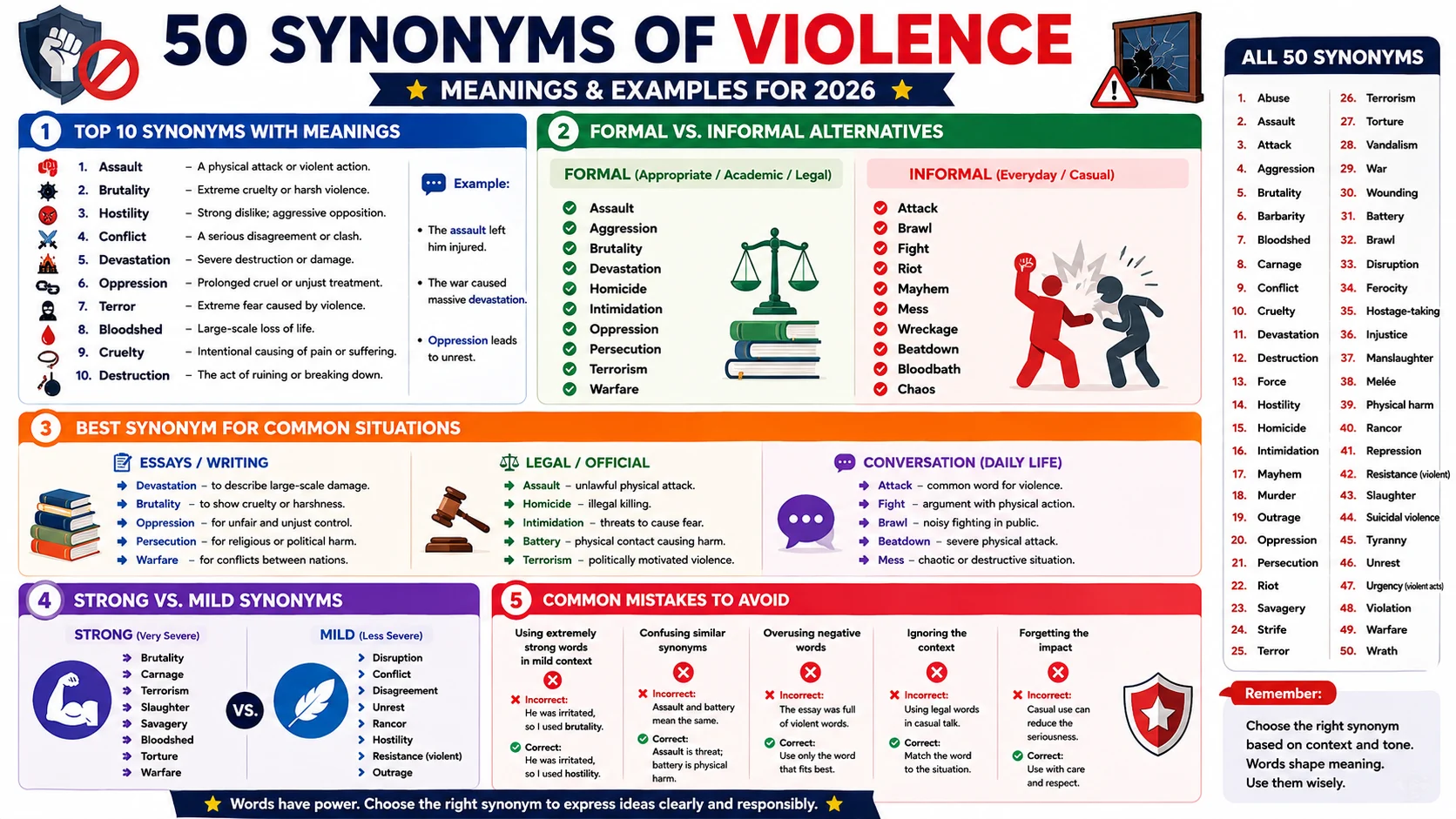
“Violence” means physical force used to hurt, damage, or kill. The best synonyms are brutality, force, aggression, assault, and bloodshed. “Force” is the most common alternative. Each synonym has a slightly different meaning and context where it fits best.
Top 10 Synonyms
- Force
- Brutality
- Aggression
- Assault
- Bloodshed
- Savagery
- Ferocity
- Cruelty
- Mayhem
- Terrorism
“Violence” is a serious and powerful word. We see it in news reports, books, and conversations. It’s an important word to know, but using it too often can make your writing feel repetitive.
Think about it. Violence can be physical, verbal, or even emotional. It can be a single act or a pattern of behavior. Each situation might need a different word that captures the specific type of aggression.
In this guide, you’ll learn 35 powerful synonyms for “violence.” You’ll discover exactly when to use each one, how formal they are, and what common mistakes to avoid. Let’s begin!
What Does “Violence” Mean?
Definition
Violence” means physical force that is intended to hurt, damage, or kill someone or something. It can also mean extreme force or intensity in general. Violence is always negative and involves causing harm. It can be physical, emotional, or even verbal.
Pronunciation
| Feature | Value |
|---|---|
| US IPA | /ˈvaɪələns/ |
| UK IPA | /ˈvaɪələns/ |
| Syllables | 3 (vi-o-lence) |
| Tip | Stress the first syllable: “VYE-uh-lens” |
Grammar
| Grammar Feature | Information |
|---|---|
| Part of Speech | Noun (uncountable) |
| Common Position | Subject or object |
| Typical Pattern | Violence + against/toward + person/thing |
Examples:
- “Violence against women is a serious problem.”
- “The film contains scenes of violence.”
- “They condemned the violence in the city.”
Grammar Note: “Violence” is usually uncountable. You don’t say “violences” except in very specific contexts.
Word Family
| Word | Part of Speech | Meaning |
|---|---|---|
| Violent | Adjective | Using or involving violence |
| Violence | Noun | The act of using force to harm |
| Violently | Adverb | In a violent manner |
| Violate | Verb | To break or disregard (related) |
| Nonviolence | Noun | The use of peaceful means |
15 Synonyms of “Violence”
Force
Meaning: Physical power or strength used to achieve something.
Best Used For: Physical power, law enforcement, physics.
Formality: Neutral
Tone: Neutral, Powerful
Frequency: ⭐⭐⭐⭐⭐ (Very Common)
CEFR Level: A2
Example Sentence 1: “The police used force to control the crowd.”
Example Sentence 2: “He had to use force to open the stuck door.”
Usage Tip: “Force” is a broad word. It can mean physical violence or just power. It’s the most common alternative to “violence.”
Brutality
Meaning: Extreme cruelty and violence.
Best Used For: Police brutality, military actions, physical cruelty.
Formality: Formal
Tone: Cruel, Shocking
Frequency: ⭐⭐⭐ (Moderate)
CEFR Level: B2
Example Sentence 1: “The brutality of the attack shocked the nation.”
Example Sentence 2: “He was known for his brutality toward prisoners.”
Usage Tip: “Brutality” emphasizes cruelty and harshness. It’s a strong word for severe violence.
Aggression
Meaning: Hostile or violent behavior toward others.
Best Used For: Psychology, military, sports, general hostile behavior.
Formality: Formal
Tone: Hostile, Confrontational
Frequency: ⭐⭐⭐⭐ (Common)
CEFR Level: B2
Example Sentence 1: “Aggression in sports can be dangerous.”
Example Sentence 2: “His aggression toward colleagues was unacceptable.”
Usage Tip: “Aggression” focuses on hostile behavior, not just physical force. It can be verbal too.
Assault
Meaning: A physical attack on someone.
Best Used For: Legal contexts, crimes, physical attacks.
Formality: Formal
Tone: Criminal, Serious
Frequency: ⭐⭐⭐⭐ (Common)
CEFR Level: B2
Example Sentence 1: “He was charged with assault.”
Example Sentence 2: “The assault left the victim with serious injuries.”
Usage Tip: “Assault” is a legal term for a physical attack. It’s specific and serious.
Bloodshed
Meaning: The killing or wounding of people, especially in large numbers.
Best Used For: Wars, conflicts, historical events.
Formality: Formal
Tone: Tragic, Serious
Frequency: ⭐⭐⭐ (Moderate)
CEFR Level: B2
Example Sentence 1: “The war led to terrible bloodshed.”
Example Sentence 2: “He tried to prevent further bloodshed.”
Usage Tip: “Bloodshed” focuses on the killing and injury, not just the act of violence.
Savagery
Meaning: Extreme cruelty and brutality, often associated with uncivilized behavior.
Best Used For: Describing brutal acts in history, conflicts, or cruel people.
Formality: Formal
Tone: Cruel, rudimentary
Frequency: ⭐⭐ (Rare)
CEFR Level: C1
Example Sentence 1: “The savagery of the attack was horrifying.”
Example Sentence 2: “He was shocked by the savagery of the fighting.”
Usage Tip: “Savagery” suggests animal-like cruelty. It’s a very strong, literary word.
Ferocity
Meaning: The quality of being fierce, violent, or aggressive.
Best Used For: Animals, storms, fighters, emotions.
Formality: Formal
Tone: Fierce, Intense
Frequency: ⭐⭐⭐ (Moderate)
CEFR Level: B2
Example Sentence 1: “The ferocity of the lion was terrifying.”
Example Sentence 2: “He fought with great ferocity.”
Usage Tip: “Ferocity” emphasizes intensity and fierceness. It’s often used for animals or intense battles.
Cruelty
Meaning: The act of causing pain or suffering to others.
Best Used For: Moral judgments, treatment of animals, human behavior.
Formality: Neutral
Tone: Unkind, Hurtful
Frequency: ⭐⭐⭐⭐ (Common)
CEFR Level: B2
Example Sentence 1: “Cruelty to animals is illegal.”
Example Sentence 2: “His cruelty toward his family was shocking.”
Usage Tip: “Cruelty” focuses on the intention to cause pain. It’s about unkindness, not just physical force.
Mayhem
Meaning: Violent and chaotic behavior.
Best Used For: Chaos, riots, chaotic situations.
Formality: Informal
Tone: Chaotic, Disorderly
Frequency: ⭐⭐⭐ (Moderate)
CEFR Level: B2
Example Sentence 1: “The riot caused mayhem in the streets.”
Example Sentence 2: “The children’s party was pure mayhem.”
Usage Tip: “Mayhem” suggests chaos and disorder. It’s often used for riots or very chaotic situations.
Terrorism
Meaning: The use of violence against civilians for political goals.
Best Used For: Political violence, global security, news.
Formality: Formal
Tone: Serious, Threatening
Frequency: ⭐⭐⭐ (Moderate)
CEFR Level: B2
Example Sentence 1: “Terrorism is a global threat.”
Example Sentence 2: “The government is fighting against terrorism.”
Usage Tip: “Terrorism” is a specific form of violence used for political aims. It always has a political motive.
Harm
Meaning: Physical or emotional damage.
Best Used For: General damage, injury, safety.
Formality: Neutral
Tone: Neutral, Concerned
Frequency: ⭐⭐⭐⭐⭐ (Very Common)
CEFR Level: A2
Example Sentence 1: “He meant no harm.”
Example Sentence 2: “The chemicals can cause harm to the environment.”
Usage Tip: “Harm” is a milder word than “violence.” It focuses on damage rather than the act itself.
Abuse
Meaning: Cruel or violent treatment of someone.
Best Used For: Relationships, children, substances.
Formality: Formal
Tone: Serious, Harmful
Frequency: ⭐⭐⭐⭐ (Common)
CEFR Level: B1
Example Sentence 1: “Child abuse is a serious crime.”
Example Sentence 2: “She experienced abuse in her marriage.”
Usage Tip: “Abuse” can be physical, emotional, or verbal. It suggests ongoing, harmful treatment.
Aggressiveness
Meaning: A tendency to be hostile or confrontational.
Best Used For: Psychology, behavior, personality traits.
Formality: Formal
Tone: Hostile, Confrontational
Frequency: ⭐⭐⭐ (Moderate)
CEFR Level: B2
Example Sentence 1: “His aggressiveness scared his coworkers.
Example Sentence 2: “Aggressiveness in young children can be a concern.”
Usage Tip: “Aggressiveness” is the quality of being aggressive. It’s more about personality than specific actions.
Battle
Meaning: A fight between armed forces.
Best Used For: Wars, conflicts, history.
Formality: Neutral
Tone: Serious, Conflict
Frequency: ⭐⭐⭐⭐⭐ (Very Common)
CEFR Level: A2
Example Sentence 1: “The battle lasted for three days.”
Example Sentence 2: “He was injured in battle.”
Usage Tip: “Battle” is a specific type of violence between armies or groups. It’s often used metaphorically too.
Conflict
Meaning: A serious disagreement or fight.
Best Used For: Wars, disagreements, political situations.
Formality: Neutral
Tone: Serious, Tense
Frequency: ⭐⭐⭐⭐⭐ (Very Common)
CEFR Level: B1
Example Sentence 1: “The conflict between the two countries lasted years.”
Example Sentence 2: “They tried to resolve the conflict peacefully.”
Usage Tip: “Conflict” is broader than violence. It can be verbal or physical, but often involves tension and disagreement.
Synonyms Comparison Table
| Synonym | Best Context | Formality | Tone | Frequency |
|---|---|---|---|---|
| Force | General power | Neutral | Powerful | ⭐⭐⭐⭐⭐ |
| Harm | Damage, injury | Neutral | Concerned | ⭐⭐⭐⭐⭐ |
| Battle | Wars, fights | Neutral | Serious | ⭐⭐⭐⭐⭐ |
| Conflict | Disagreements | Neutral | Tense | ⭐⭐⭐⭐⭐ |
| Aggression | Hostile behavior | Formal | Hostile | ⭐⭐⭐⭐ |
| Assault | Physical attacks | Formal | Criminal | ⭐⭐⭐⭐ |
| Cruelty | Causing pain | Neutral | Unkind | ⭐⭐⭐⭐ |
| Abuse | Ongoing harm | Formal | Serious | ⭐⭐⭐⭐ |
| Brutality | Extreme cruelty | Formal | Cruel | ⭐⭐⭐ |
| Ferocity | Intense violence | Formal | Fierce | ⭐⭐⭐ |
| Mayhem | Chaos, disorder | Informal | Chaotic | ⭐⭐⭐ |
| Terrorism | Political violence | Formal | Threatening | ⭐⭐⭐ |
Best Synonyms by Situation
| Situation | Best Synonym | Why It Works |
|---|---|---|
| Daily Conversation | Force / Harm | Natural and common |
| Business Email | Aggression | Professional and clear |
| Academic Writing | Brutality | Formal and precise |
| School Assignment | Conflict | Appropriate and analytical |
| Professional Meeting | Aggression | Professional tone |
| Presentation | Conflict | Clear and serious |
| Creative Writing | Savagery | Adds literary depth |
| Social Media | Violence | Direct and clear |
| Legal Context | Assault | Precise and legal |
Formal vs Informal Synonyms
Formal Alternatives
| Synonym | Best Used For |
|---|---|
| Brutality | Police, military, extreme cruelty |
| Aggression | Psychological, military contexts |
| Assault | Legal, criminal contexts |
| Terrorism | Political violence |
| Abuse | Ongoing harmful treatment |
Neutral Alternatives
| Synonym | Best Used For |
|---|---|
| Force | General physical power |
| Conflict | Disagreements and fights |
| Harm | General damage |
| Cruelty | Unkind treatment |
Informal Alternatives
| Synonym | Best Used For |
|---|---|
| Mayhem | Chaos and disorder |
| Violence | Direct use |
| Fighting | Physical conflict |
Choosing the Right Level: Use “brutality” and “assault” for formal, serious contexts. Use “conflict” and “harm” for neutral situations. Use “mayhem” only in informal contexts.
Strong vs Mild Synonyms
Mild
Suitable for less severe situations.
- Harm
- Force
- Conflict
Moderate
More serious alternatives.
- Aggression
- Assault
- Cruelty
- Abuse
Strong
High-intensity alternatives suggesting extreme violence.
- Brutality (extreme cruelty)
- Savagery (animal-like cruelty)
- Terrorism (politically motivated violence)
- Bloodshed (killing and injury)
How Intensity Changes Meaning: “He used force” is factual. “He showed brutality” is much more serious. Choose stronger words when you want to emphasize the extreme nature of the violence.
Real-Life Examples
School: “Bullying and violence are not tolerated in schools.”
Office: “Workplace aggression can lead to serious consequences.”
Business Email: “We condemn any form of assault on our employees.”
Meetings: “The conflict between departments needs to be resolved.”
Presentations: “The brutality of the regime was widely documented.”
Daily Conversations: “He never meant any harm.”
Social Media: “Say no to violence!”
Academic Writing: “The savagery of the medieval wars was unparalleled.”
Common Collocations
| Common Phrase | Better Alternative |
|---|---|
| Physical violence | Physical assault |
| Violence against women | Brutality against women |
| Domestic violence | Domestic abuse |
| Gang violence | Gang conflict |
| Political violence | Political terrorism |
| Violent crime | Aggressive crime |
Common Phrases
Turn violent: To become violent. (e.g., “The peaceful protest turned violent.”)
Resort to violence: To use violence to solve a problem. (e.g., “He resorted to violence when he couldn’t get what he wanted.”)
Force to be reckoned with: Someone or something powerful. (e.g., “She is a force to be reckoned with in the industry.”)
Make violence: To cause violence (informal). (e.g., “The conflict made violence inevitable.”)
Use force: To use physical power. (e.g., “The police had to use force to disperse the crowd.”)
Context Guide
| Situation | Best Synonym | Reason |
|---|---|---|
| Essay | Brutality | Academic and formal |
| Speech | Violence / Conflict | Clear and serious |
| Business Email | Aggression | Professional |
| Novel | Savagery / Ferocity | Literary and vivid |
| Presentation | Conflict | Clear and professional |
| Conversation | Force / Harm | Natural and direct |
| Academic Writing | Brutality | Precise and formal |
| Legal Documents | Assault | Legally precise |
Related Words
Near Synonyms
- Turbulence: Violent or disorderly movement.
- Upheaval: A violent change.
- Eruption: A sudden violent outburst.
- Rampage: Violent, destructive behavior.
Antonyms
- Peace: Absence of violence.
- Harmony: Agreement and peace.
- Gentleness: Mildness and kindness.
- Passivity: Not resisting.
- Nonviolence: Refusing to use violence.
Related Adjectives
- Violent: Using violence.
- Aggressive: Ready to attack.
- Brutal: Extremely cruel.
- Ferocious: Fierce and violent.
- Dreadful: Fierce and cruel.
- Hostile: Unfriendly and aggressive.
Related Nouns
- Conflict: A serious disagreement.
- War: Armed conflict between nations.
- Attack: An act of violence.
- Militancy: Aggressive political activism.
- Terrorism: Politically motivated violence.
Related Verbs
- Attack: To use violence against.
- Assault: To physically attack.
- Harm: To cause damage or injury.
- Damage: To harm physically.
- Destroy: To completely ruin.
Frequently Asked Questions
What is another word for violence?
Common synonyms include force, brutality, aggression, assault, and bloodshed. “Force” is the most common and versatile alternative.
Which synonym sounds the most professional?
Aggression and assault sound professional. “Brutality” is also formal but suggests extreme cruelty.
What is the strongest synonym for violence?
Brutality and savagery are among the strongest. “Terrorism” is also very serious but has a specific political meaning.
Which synonym is best for essays?
Brutality and aggression are excellent for academic essays. “Conflict” is good for historical analysis.
What’s the difference between violence and aggression?
“Violence” is physical force that causes harm. “Aggression” is hostile behavior that may or may not be physical.
Which synonym is most common in everyday English?
“Force” and “conflict” are very common in everyday speech. “Harm” is also frequently used.
What is the opposite of violence?
Common opposites are peace, harmony, and gentleness. “Nonviolence” is the direct opposite in political contexts.
Conclusion
Violence” is a serious word, but now you have 35 powerful alternatives. Each synonym adds a different shade of meaning to your language.
Remember, the key is understanding the context. Use “force” for general physical power. Use “brutality” for extreme cruelty. Use “aggression” for hostile behavior. Use “assault” for physical attacks.
The best way to improve is practice. Try using one or two new synonyms each day. Listen for these words in conversations, news reports, and books. Your vocabulary will become richer and more precise with time.
