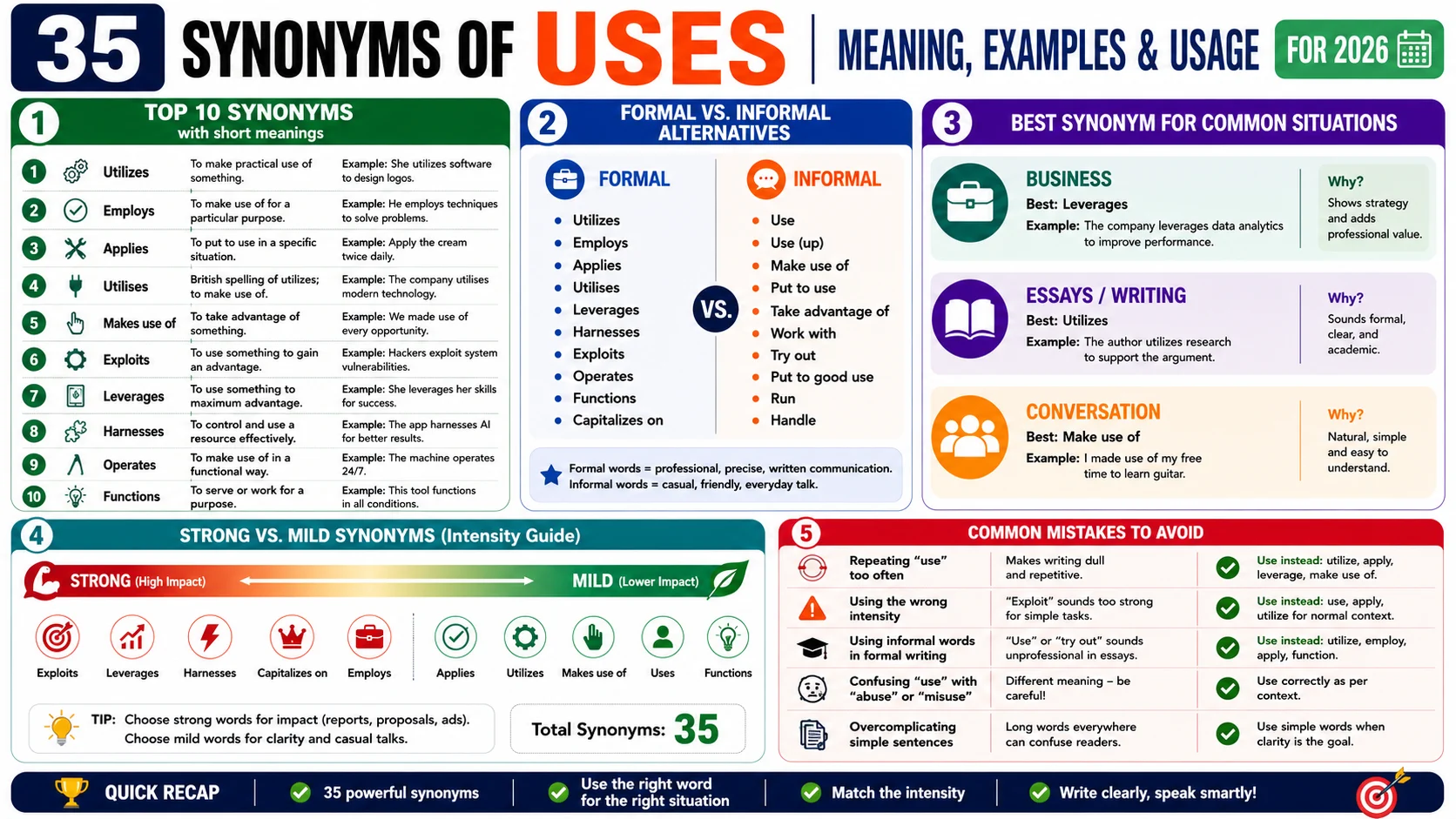
“Uses” means the ways something is employed or the purposes it serves. The best synonyms are applications, functions, purposes, employments, and utilizations. “Applications” is the most common alternative. Each synonym works best in specific contexts and tones.
Top 10 Synonyms
- Applications
- Functions
- Purposes
- Employments
- Utilizations
- Roles
- Advantages
- Benefits
- Services
- Operations
Do you find yourself repeating the word “uses” too often? Many English learners do. It’s a simple, useful word, but using it repeatedly can make your writing sound dull and repetitive.
The good news is that English has many wonderful alternatives. Some words focus on the purpose of something, while others describe how it works or what it does. Some are formal, and others are more casual.
In this guide, you’ll learn 35 powerful synonyms for “uses.” You’ll discover exactly when to use each one, how formal they are, and what common mistakes to avoid. Let’s begin!
What Does “Uses” Mean?
Definition
“Uses” is the plural of “use.” It refers to the ways something is employed, the purposes it serves, or the benefits it provides. For example, a smartphone has many uses. It can make calls, send messages, take photos, and browse the internet. Each of these is a use.
Pronunciation
| Feature | Value |
|---|---|
| US IPA | /ˈjuːzɪz/ |
| UK IPA | /ˈjuːzɪz/ |
| Syllables | 2 (us-es) |
| Tip | The “s” is pronounced like a “z” sound |
Grammar
| Grammar Feature | Information |
|---|---|
| Part of Speech | Noun (plural) |
| Common Position | Subject or object |
| Typical Pattern | Uses + of + something / something + has + uses |
Examples:
- “The uses of this tool are endless.”
- “This machine has many uses in the kitchen.”
- “We discovered new uses for old technology.”
Grammar Note: “Use” can be both a noun and a verb. As a noun, it’s often used in the plural form “uses” when talking about multiple purposes or applications.
Word Family
| Word | Part of Speech | Meaning |
|---|---|---|
| Use | Verb | To employ something for a purpose |
| Use | Noun | The act of using something |
| Uses | Noun (plural) | Multiple purposes or applications |
| Useful | Adjective | Having many good uses |
| Useless | Adjective | Having no good uses |
| User | Noun | A person who uses something |
15 Synonyms of “Uses”
Applications
Meaning: The specific ways something can be used, often practical or technical.
Best Used For: Technology, scientific writing, describing practical purposes.
Formality: Formal
Tone: Professional, Practical
Frequency: ⭐⭐⭐⭐⭐ (Very Common)
CEFR Level: B2
Example Sentence 1: “The applications of artificial intelligence in medicine are growing.”
Example Sentence 2: “This software has many useful applications for businesses.”
Usage Tip: “Applications” is the most common and professional synonym for “uses.” It works well in both formal and neutral contexts.
Functions
Meaning: The specific jobs or tasks something is designed to do.
Best Used For: Technology, equipment, describing how things work.
Formality: Neutral
Tone: Technical, Practical
Frequency: ⭐⭐⭐⭐⭐ (Very Common)
CEFR Level: B1
Example Sentence 1: “The phone has many functions beyond making calls.”
Example Sentence 2: “The new camera has advanced functions for professional photographers.”
Usage Tip: “Functions” focuses on what something does. It’s very common in technical and everyday contexts.
Purposes
Meaning: The reasons why something is used or done.
Best Used For: Explaining reasons, describing goals or objectives.
Formality: Neutral
Tone: Explanatory, Clear
Frequency: ⭐⭐⭐⭐⭐ (Very Common)
CEFR Level: B1
Example Sentence 1: “This tool serves many purposes around the house.”
Example Sentence 2: “The training program has several purposes.”
Usage Tip: “Purposes” is about the reasons or goals behind using something. It’s a very natural alternative to “uses.”
Employments
Meaning: The ways something is used or the uses it is put to.
Best Used For: Formal writing, professional contexts.
Formality: Formal
Tone: Professional, Scholarly
Frequency: ⭐⭐ (Rare)
CEFR Level: C1
Example Sentence 1: “The employments of this technology in modern medicine are diverse.”
Example Sentence 2: “Different employments of the method have been explored.”
Usage Tip: “Employments” is quite formal and rare in everyday speech. Use it in academic or professional writing.
Utilizations
Meaning: The act of making practical use of something.
Best Used For: Formal writing, technical contexts.
Formality: Formal
Tone: Technical, Professional
Frequency: ⭐⭐ (Rare)
CEFR Level: C1
Example Sentence 1: “The utilization of renewable energy has increased significantly.”
Example Sentence 2: “Optimizing the utilization of resources is important.”
Usage Tip: “Utilization” is a formal alternative. It’s common in business and technical writing but rare in conversation.
Roles
Meaning: The parts or jobs something plays in a situation.
Best Used For: Describing contributions, parts in a system.
Formality: Neutral
Tone: Descriptive, Analytical
Frequency: ⭐⭐⭐⭐ (Common)
CEFR Level: B2
Example Sentence 1: “Social media now plays multiple roles in our lives.
Example Sentence 2: “The roles of different nutrients in our diet are well understood.”
Usage Tip: “Roles” emphasizes the part something plays. It’s perfect when describing contributions within a system.
Advantages
Meaning: The benefits or positive features of using something.
Best Used For: Marketing, persuasive writing, describing benefits.
Formality: Neutral
Tone: Positive, Persuasive
Frequency: ⭐⭐⭐⭐⭐ (Very Common)
CEFR Level: B1
Example Sentence 1: “The advantages of electric cars are becoming clearer.
Example Sentence 2: “This method has many advantages over the traditional approach.”
Usage Tip: “Advantages” focuses on the positive aspects and benefits. Use it when you want to persuade or highlight benefits.
Benefits
Meaning: The good results or helpful effects of using something.
Best Used For: Health, wellness, marketing, describing positive outcomes.
Formality: Neutral
Tone: Positive, Encouraging
Frequency: ⭐⭐⭐⭐⭐ (Very Common)
CEFR Level: B1
Example Sentence 1: “The benefits of regular exercise are well documented.”
Example Sentence 2: “This product offers numerous benefits to customers.”
Usage Tip: “Benefits” is very similar to “advantages” but often focuses on well-being or personal gains.
Services
Meaning: The work or help something provides.
Best Used For: Business, describing what something offers.
Formality: Neutral
Tone: Professional, Practical
Frequency: ⭐⭐⭐⭐ (Common)
CEFR Level: B1
Example Sentence 1: “The app offers many services for its users.”
Example Sentence 2: “The library provides services to the community.”
Usage Tip: “Services” works well when describing what a business, organization, or tool provides.
Operations
Meaning: The ways something works or functions.
Best Used For: Technical writing, describing machinery or systems.
Formality: Formal
Tone: Technical, Detailed
Frequency: ⭐⭐⭐ (Moderate)
CEFR Level: B2
Example Sentence 1: “Understanding the operations of this engine is essential.”
Example Sentence 2: “The operations of the new system are more efficient.”
Usage Tip: “Operations” is technical and focuses on how things work. Use it in technical or scientific contexts.
Capabilities
Meaning: The things something is able to do.
Best Used For: Technology, describing features and abilities.
Formality: Neutral
Tone: Positive, Impressive
Frequency: ⭐⭐⭐⭐ (Common)
CEFR Level: B2
Example Sentence 1: “The software’s capabilities are truly impressive.”
Example Sentence 2: “The new phone has capabilities that older models don’t have.”
Usage Tip: “Capabilities” emphasizes what something can do. It has a positive tone and is common in technology contexts.
Features
Meaning: Important or interesting parts of something.
Best Used For: Marketing, describing products or services.
Formality: Neutral
Tone: Promotional, Descriptive
Frequency: ⭐⭐⭐⭐⭐ (Very Common)
CEFR Level: B1
Example Sentence 1: “The new laptop has some impressive features.”
Example Sentence 2: “One of the best features of this tool is its simplicity.”
Usage Tip: “Features” focuses on the parts or characteristics of a product. It’s very common in marketing contexts.
Possibilities
Meaning: The potential uses or applications.
Best Used For: Creative contexts, describing potential.
Formality: Neutral
Tone: Creative, Optimistic
Frequency: ⭐⭐⭐⭐ (Common)
CEFR Level: B1
Example Sentence 1: “The possibilities of this technology are endless.”
Example Sentence 2: “We’re still discovering new possibilities for this material.”
Usage Tip: “Possibilities” has a positive, optimistic tone. It’s about potential and what could be done.
Necessities
Meaning: The essential uses or reasons something is needed.
Best Used For: Survival, basic needs, describing importance.
Formality: Neutral
Tone: Essential, Important
Frequency: ⭐⭐⭐ (Moderate)
CEFR Level: B2
Example Sentence 1: “Water has many necessities in our daily lives.”
Example Sentence 2: “The necessities of daily life include food and shelter.
Usage Tip: “Necessities” emphasizes essential uses. It’s about what is needed for survival or basic functioning.
Purposes
Meaning: The reasons or goals for using something.
Best Used For: Explaining reasons, describing objectives.
Formality: Neutral
Tone: Explanatory, Clear
Frequency: ⭐⭐⭐⭐⭐ (Very Common)
CEFR Level: B1
Example Sentence 1: “This tool serves multiple purposes in the workshop.”
Example Sentence 2: “The meeting had several purposes, including planning and evaluation.”
Usage Tip: “Purposes” focuses on the reasons or goals for use. It’s a very natural and common alternative.
Synonyms Comparison Table
| Synonym | Best Context | Formality | Tone | Frequency |
|---|---|---|---|---|
| Applications | Technology, science | Formal | Professional | ⭐⭐⭐⭐⭐ |
| Functions | Equipment, systems | Neutral | Technical | ⭐⭐⭐⭐⭐ |
| Purposes | Explanations | Neutral | Clear | ⭐⭐⭐⭐⭐ |
| Advantages | Persuasive writing | Neutral | Positive | ⭐⭐⭐⭐⭐ |
| Benefits | Health, marketing | Neutral | Positive | ⭐⭐⭐⭐⭐ |
| Features | Products, marketing | Neutral | Promotional | ⭐⭐⭐⭐⭐ |
| Roles | Systems, analysis | Neutral | Descriptive | ⭐⭐⭐⭐ |
| Services | Business, organizations | Neutral | Professional | ⭐⭐⭐⭐ |
| Employments | Academic, formal | Formal | Scholarly | ⭐⭐ |
| Utilizations | Technical, formal | Formal | Technical | ⭐⭐ |
Best Synonyms by Situation
| Situation | Best Synonym | Why It Works |
|---|---|---|
| Daily Conversation | Purposes | Simple and natural |
| Business Email | Applications | Professional and clear |
| Academic Writing | Utilizations | Formal and precise |
| School Assignment | Functions | Easy to understand |
| Professional Meeting | Applications | Sounds knowledgeable |
| Presentation | Features | Engaging and clear |
| Creative Writing | Possibilities | Adds imagination |
| Social Media | Benefits | Positive and shareable |
Formal vs Informal Synonyms
Formal Alternatives
| Synonym | Best Used For |
|---|---|
| Applications | Technology, scientific contexts |
| Utilizations | Technical, professional writing |
| Employments | Academic, professional contexts |
| Operations | Technical, scientific contexts |
Neutral Alternatives
| Synonym | Best Used For |
|---|---|
| Functions | Explaining how things work |
| Purposes | Describing reasons |
| Roles | Describing parts in a system |
| Features | Describing products |
Informal Alternatives
| Synonym | Best Used For |
|---|---|
| Uses | Everyday conversation |
| Advantages | Describing benefits casually |
| Possibilities | Creative, optimistic contexts |
Choosing the Right Level: For formal writing, choose “applications,” “utilizations,” or “employments.” For most everyday situations, “functions,” “purposes,” and “features” are excellent. For casual conversation, keep it simple.
Strong vs Mild Synonyms
Mild
Suitable for everyday situations.
- Uses
- Functions
- Purposes
Moderate
More specific and detailed alternatives.
- Applications
- Features
- Roles
- Services
Strong
High-intensity alternatives with special nuance.
- Utilizations (formal and precise)
- Employments (scholarly)
- Operations (technical)
- Capabilities (impressive)
How Intensity Changes Meaning: “The uses of this software” is simple. “The applications of this software” sounds more professional. “The capabilities of this software” sounds more impressive. Choose based on your audience and context.
Real-Life Examples
School: “The functions of the microscope were explained in class.”
Office: “This software has many applications for our daily tasks.”
Business Email: “We should explore the benefits of this new approach.”
Meetings: “Let’s discuss the roles of each department.”
Presentations: “The features of this product are truly innovative.”
Daily Conversations: “I learned about the purposes of this tool.”
Social Media: “Discover the amazing benefits of this new product!”
Academic Writing: “The research explores various employments of this method.”
Common Collocations
| Common Phrase | Better Alternative |
|---|---|
| Uses of technology | Applications of technology |
| Uses of the tool | Functions of the tool |
| Uses of the product | Features of the product |
| Uses of the method | Applications of the method |
| Main uses | Main purposes / Primary functions |
Common Phrases
Put to use: To start using something. (e.g., “We need to put these skills to use.”)
Make use of: To use something. (e.g., “Make use of all the resources available.”)
Out of use: No longer used. (e.g., “This machine is out of use.”)
In use: Currently being used. (e.g., “The conference room is in use.”)
Use for: The purpose of something. (e.g., “What’s the use for this gadget?”)
Come into use: To start being used. (e.g., “This method came into use recently.”)
Context Guide
| Situation | Best Synonym | Reason |
|---|---|---|
| Essay | Applications / Utilizations | Academic and formal |
| Speech | Advantages / Benefits | Positive and persuasive |
| Business Email | Applications / Services | Professional and practical |
| Novel | Possibilities / Roles | Adds variety and interest |
| Presentation | Features / Benefits | Clear and engaging |
| Conversation | Purposes / Functions | Natural and common |
| Academic Writing | Utilizations / Operations | Precise and analytical |
| Marketing Copy | Benefits / Advantages | Persuasive and positive |
Related Words
Near Synonyms
- Purposes: The reasons something is done.
- Employments: Formal term for uses.
- Utilizations: The act of using.
- Operations: How something works.
Antonyms
- Disuse: The state of not being used.
- Inaction: Lack of use or activity.
- Neglect: Failing to use properly.
- Abandonment: Giving up on using.
Related Adjectives
- Useful: Having many uses.
- Useless: Having no use.
- Applicable: Able to be used.
- Functional: Working and useful.
- Versatile: Having many uses.
Related Nouns
- Usage: The way something is used.
- User: A person who uses something.
- Application: A practical use.
- Function: A specific use or role.
Related Verbs
- Use: To employ.
- Employ: To make use of.
- Utilize: To use effectively.
- Apply: To put to use.
- Exploit: To use fully.
Frequently Asked Questions
What is another word for uses?
Common synonyms for uses include applications, functions, purposes, employments, and utilizations. “Applications” is the most common professional choice.
Which synonym sounds the most professional?
Applications and utilizations sound the most professional. “Employments” is also formal but less common in everyday contexts.
What is the strongest synonym for uses?
Utilizations and employments are the strongest synonyms. They suggest careful, thorough, and professional use of something.
Which synonym is best for essays?
Applications is excellent for essays. “Employments” and “utilizations” are also good choices for academic writing.
What’s the difference between uses and applications?
“Uses” is more general. “Applications” often suggests practical, specific, and professional uses. You might talk about the uses of a knife, but the applications of technology.
Which synonym is most common in everyday English?
“Purposes” and “functions” are very common in everyday speech. “Uses” itself is still the most common word.
What is the opposite of uses?
Common opposites include disuse, neglect, and abandonment. These words describe the lack of use.
Conclusion
Uses” is a simple and useful word, but now you have 35 powerful alternatives. Each one adds precision and variety to your language.
The key is understanding the context. Use “applications” and “functions” for technical or professional contexts. Use “purposes” for everyday explanations. Use “benefits” and “advantages” when you want to be persuasive. Use “roles” when describing parts in a system.
The best way to improve is practice. Try using one or two new synonyms each day. Listen for these words in conversations and books. Your vocabulary will grow richer and more natural over time.
