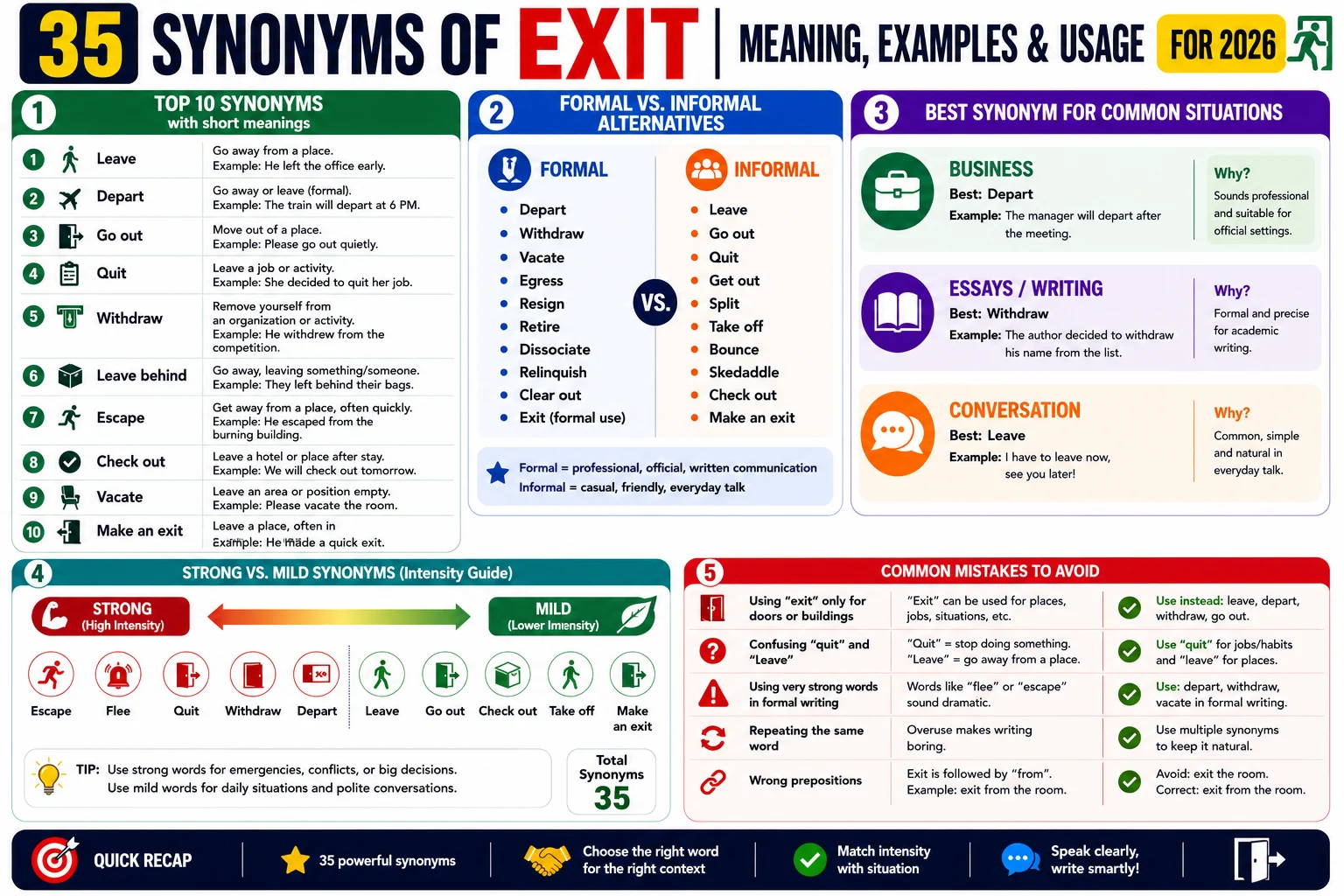
“Exit” means to leave a place, situation, or to go out. The best synonyms are leave, depart, withdraw, retreat, and go out. “Leave” is the most common alternative. Each synonym has a different tone, from formal to casual.
Top 10 Synonyms
- Leave
- Depart
- Withdraw
- Retreat
- Go out
- Step out
- Escape
- Quit
- Vacate
- Evacuate
Do you ever feel like you’re always saying “exit” when you talk about leaving? It’s a useful word, but it can sound a bit stiff and formal. There are so many other ways to say it, each with its own special feeling.
Some synonyms sound professional, like “withdraw” or “depart.” Others are more casual, like “head out” or “step out.” Some even describe a dramatic escape or a quiet retreat.
In this guide, you’ll discover 35 powerful ways to say “exit.” You’ll learn exactly when to use each one, how formal they are, and what common mistakes to avoid. Your English will sound much more natural and varied.
What Does “Exit” Mean?
Definition
Exit” means to go out of or leave a place, situation, or position. It can be a physical action, like walking out of a room. It can also be more abstract, like leaving a job or ending a relationship. The word comes from Latin and has a slightly formal feel.
Pronunciation
| Feature | Value |
|---|---|
| US IPA | /ˈɛɡzɪt/ |
| UK IPA | /ˈɛɡzɪt/ |
| Syllables | 2 (ex-it) |
| Tip | Stress the first syllable: “EGG-zit” |
Grammar
| Grammar Feature | Information |
|---|---|
| Part of Speech | Verb and Noun |
| Common Position | After subject (verb) or as object (noun) |
| Typical Pattern | Subject + exit + place |
Examples:
- “Please exit the building through the rear door.” (verb)
- “We made a quick exit before anyone noticed.” (noun)
Grammar Note: “Exit” works as both a verb and a noun. As a verb, it’s usually followed by a place. As a noun, it’s often used with prepositions like “from” or “through.”
Word Family
| Word | Part of Speech | Meaning |
|---|---|---|
| Exit | Verb / Noun | To leave or go out |
| Exiting | Gerund | The act of leaving |
| Exited | Verb (past) | Left in the past |
| Exodus | Noun | A mass departure of people |
15 Synonyms of “Exit”
Leave
Meaning: To go away from a place or person.
Best Used For: Daily conversation, any situation where you’re going away.
Formality: Neutral
Tone: Casual, Direct
Frequency: ⭐⭐⭐⭐⭐ (Very Common)
CEFR Level: A1
Example Sentence 1: “I need to leave work early today.
Example Sentence 2: “She left the party at midnight.”
Usage Tip: “Leave” is the most common and natural alternative. Use it in almost any situation. It’s simple, clear, and always appropriate.
Depart
Meaning: To leave, especially on a journey or for a specific destination.
Best Used For: Formal contexts, travel announcements, professional settings.
Formality: Formal
Tone: Official, Serious
Frequency: ⭐⭐⭐⭐ (Common)
CEFR Level: B1
Example Sentence 1: “The train will depart from platform three at six.”
Example Sentence 2: “He departed for London this morning.”
Usage Tip: “Depart” is more formal and often used for travel. It’s perfect for flight announcements, formal emails, and official contexts.
Withdraw
Meaning: To leave a place, position, or situation, often quietly or strategically.
Best Used For: Professional contexts, formal situations, military or political language.
Formality: Formal
Tone: Strategic, Reserved
Frequency: ⭐⭐⭐⭐ (Common)
CEFR Level: B2
Example Sentence 1: “She decided to withdraw from the competition.”
Example Sentence 2: “The troops withdrew from the region.”
Usage Tip: “Withdraw” implies a deliberate, often strategic departure. It’s a great word for professional and formal contexts.
Retreat
Meaning: To move back or leave a dangerous or unpleasant situation.
Best Used For: Military, describing a tactical move, avoiding conflict.
Formality: Formal
Tone: Tactical, Protective
Frequency: ⭐⭐⭐ (Moderate)
CEFR Level: B2
Example Sentence 1: “The army was forced to retreat.”
Example Sentence 2: “She retreated to her room to think.”
Usage Tip: “Retreat” suggests leaving to protect yourself or because you’re in a weaker position. It’s also used for quiet, peaceful escapes.
Go out
Meaning: To leave a building or place, often for social reasons.
Best Used For: Daily conversation, social activities, casual settings.
Formality: Informal
Tone: Casual, Social
Frequency: ⭐⭐⭐⭐⭐ (Very Common)
CEFR Level: A1
Example Sentence 1: “Do you want to go out for dinner tonight?”
Example Sentence 2: “I’m going out with my friends this weekend.”
Usage Tip: “Go out” is very common and informal. It often has a social meaning, like going to a restaurant or party.
Step out
Meaning: To leave a place for a short time.
Best Used For: Informal conversation, work breaks, quick departures.
Formality: Informal
Tone: Casual, Brief
Frequency: ⭐⭐⭐⭐ (Common)
CEFR Level: B1
Example Sentence 1: “I need to step out for a moment to take this call.”
Example Sentence 2: “She stepped out of the meeting to answer her phone.”
Usage Tip: “Step out” implies a short, temporary leave. It’s perfect for work breaks or quick errands.
Escape
Meaning: To get away from a dangerous or unpleasant situation.
Best Used For: Dramatic situations, describing freedom, avoiding something.
Formality: Neutral
Tone: Dramatic, Urgent
Frequency: ⭐⭐⭐⭐ (Common)
CEFR Level: B1
Example Sentence 1: “The prisoner escaped from the jail.”
Example Sentence 2: “I needed to escape the noise and find some peace.”
Usage Tip: “Escape” implies leaving a situation that’s trapping you. It’s more dramatic than a simple exit.
Quit
Meaning: To leave a job, school, or position permanently.
Best Used For: Work, education, describing giving up.
Formality: Informal
Tone: Decisive, Often Emotional
Frequency: ⭐⭐⭐⭐⭐ (Very Common)
CEFR Level: A2
Example Sentence 1: “She quit her job after ten years.”
Example Sentence 2: “He quit school to start his own business.”
Usage Tip: “Quit” is very common for leaving jobs or school. It’s informal and can sometimes have a negative feeling.
Vacate
Meaning: To leave a place, room, or building so someone else can use it.
Best Used For: Official contexts, housing, hotels, announcements.
Formality: Formal
Tone: Official, Clear
Frequency: ⭐⭐⭐ (Moderate)
CEFR Level: B2
Example Sentence 1: “Please vacate your room by eleven a.m.”
Example Sentence 2: “The residents were asked to vacate the building.”
Usage Tip: “Vacate” is very official and usually involves leaving a place so it becomes empty or available for others.
Evacuate
Meaning: To leave a dangerous place in an emergency.
Best Used For: Emergencies, natural disasters, official safety warnings.
Formality: Formal
Tone: Urgent, Serious
Frequency: ⭐⭐⭐ (Moderate)
CEFR Level: B2
Example Sentence 1: “The building was evacuated due to a fire.”
Example Sentence 2: “Residents were evacuated from the flood zone.”
Usage Tip: “Evacuate” is used for safety emergencies. It’s serious and always about leaving a dangerous place.
Head out
Meaning: To leave a place, often to go somewhere specific.
Best Used For: Daily conversation, informal settings, starting a journey.
Formality: Informal
Tone: Casual, Direct
Frequency: ⭐⭐⭐⭐⭐ (Very Common)
CEFR Level: A2
Example Sentence 1: “I’ll head out to the store in a few minutes.”
Example Sentence 2: “We’re heading out for vacation tomorrow.”
Usage Tip: “Head out” is a very casual, natural phrasal verb. It’s perfect for everyday conversation.
Pull out
Meaning: To leave a place or withdraw from a situation.
Best Used For: Military, business deals, competitive situations.
Formality: Neutral
Tone: Strategic, Decisive
Frequency: ⭐⭐⭐ (Moderate)
CEFR Level: B2
Example Sentence 1: “The company pulled out of the deal.”
Example Sentence 2: “The team pulled out of the competition.”
Usage Tip: “Pull out” is great when you’re withdrawing from an agreement, competition, or complex situation.
Abandon
Meaning: To leave a place, person, or thing permanently.
Best Used For: Dramatic situations, describing desertion.
Formality: Formal
Tone: Dramatic, Often Negative
Frequency: ⭐⭐⭐ (Moderate)
CEFR Level: B2
Example Sentence 1: “They were forced to abandon their home.”
Example Sentence 2: “She abandoned her plan and started over.
Usage Tip: “Abandon” suggests leaving forever and can have a negative meaning. Use it carefully.
Adjourn
Meaning: To end a meeting or session and leave, to be continued later.
Best Used For: Meetings, legal proceedings, official gatherings.
Formality: Formal
Tone: Official, Procedural
Frequency: ⭐⭐ (Rare)
CEFR Level: C1
Example Sentence 1: “The judge adjourned the court for lunch.”
Example Sentence 2: “We’ll adjourn the meeting until tomorrow.”
Usage Tip: “Adjourn” is a very specific formal word. It’s used for ending meetings and official sessions.
Decamp
Meaning: To leave a place suddenly and quickly.
Best Used For: Literary writing, describing a quick departure.
Formality: Informal/Literary
Tone: Dramatic, Sudden
Frequency: ⭐ (Very Rare)
CEFR Level: C1
Example Sentence 1: “The guests decamped before the police arrived.”
Example Sentence 2: “We decamped to the beach for the weekend.”
Usage Tip: “Decamp” is quite literary and uncommon. It’s great for creative writing but rare in everyday speech.
Synonyms Comparison Table
| Synonym | Best Context | Formality | Tone | Frequency |
|---|---|---|---|---|
| Leave | General use | Neutral | Casual | ⭐⭐⭐⭐⭐ |
| Depart | Travel, formal | Formal | Official | ⭐⭐⭐⭐ |
| Withdraw | Professional | Formal | Strategic | ⭐⭐⭐⭐ |
| Go out | Social activities | Informal | Casual | ⭐⭐⭐⭐⭐ |
| Step out | Short breaks | Informal | Brief | ⭐⭐⭐⭐ |
| Escape | Dramatic | Neutral | Urgent | ⭐⭐⭐⭐ |
| Quit | Jobs, school | Informal | Decisive | ⭐⭐⭐⭐⭐ |
| Vacate | Official | Formal | Clear | ⭐⭐⭐ |
| Evacuate | Emergencies | Formal | Serious | ⭐⭐⭐ |
Best Synonyms by Situation
| Situation | Best Synonym | Why It Works |
|---|---|---|
| Daily Conversation | Leave / Go out | Natural and casual |
| Business Email | Withdraw / Depart | Professional and clear |
| Academic Writing | Withdraw | Formal and precise |
| School Assignment | Leave | Simple and appropriate |
| Professional Meeting | Adjourn | Perfect for ending meetings |
| Presentation | Conclude | Signals the end |
| Creative Writing | Escape / Decamp | Adds literary flair |
| Social Media | Head out | Casual and engaging |
Formal vs Informal Synonyms
Formal Alternatives
| Synonym | Best Used For |
|---|---|
| Depart | Travel announcements, official events |
| Withdraw | Formal situations, strategic moves |
| Vacate | Official announcements, housing |
| Evacuate | Emergency situations |
| Adjourn | Meetings, legal proceedings |
Neutral Alternatives
| Synonym | Best Used For |
|---|---|
| Leave | Most everyday situations |
| Escape | Dramatic or urgent situations |
| Quit | Leaving a job or position |
Informal Alternatives
| Synonym | Best Used For |
|---|---|
| Go out | Social activities |
| Step out | Short, quick leave |
| Head out | Starting a journey or errand |
| Take off | Leaving quickly |
Choosing the Right Level: In a business email, use “withdraw” or “depart.” In an emergency, use “evacuate.” With friends, use “go out” or “head out.” The context decides the best word.
Strong vs Mild Synonyms
Mild
Suitable for everyday, simple exits.
- Leave
- Go out
- Step out
- Head out
Moderate
More purposeful or formal.
- Depart
- Withdraw
- Vacate
- Quit
Strong
Dramatic, urgent, or serious.
- Escape (urgent, dramatic)
- Evacuate (urgent, safety)
- Abandon (permanent, negative)
- Retreat (strategic)
How Intensity Changes Meaning: “I left the party” is simple. “I escaped the party” sounds dramatic, as if something was wrong. Choose words that match the intensity of the situation.
Real-Life Examples
School: “The students were asked to exit the building calmly.”
Office: “We need to vacate the conference room by three.”
Business Email: “I need to withdraw from the project for personal reasons.”
Meetings: “Let’s adjourn the meeting and continue tomorrow.”
Presentations: “I’ll conclude with a brief summary.”
Daily Conversations: “I’m going to head out now. See you tomorrow!”
Social Media: “Time to escape the city for the weekend!”
Academic Writing: “The troops were forced to retreat after the defeat.”
Common Collocations
| Common Phrase | Better Alternative |
|---|---|
| Exit the room | Leave the room |
| Exit the building | Vacate the building |
| Exit the highway | Take the exit |
| Exit a company | Leave a company / Resign |
| Exit a conversation | End a conversation |
Common Phrases
Make a quick exit: To leave quickly. (e.g., “He made a quick exit from the party.”)
Exit strategy: A plan for leaving a situation. (e.g., “We need an exit strategy for the investment.”)
Emergency exit: A special door for leaving in an emergency. (e.g., “Find the nearest emergency exit.”)
Ticket to exit: A way to leave a situation. (e.g., “This job is my ticket to exit from poverty.”)
Context Guide
| Situation | Best Synonym | Reason |
|---|---|---|
| Essay | Withdraw / Depart | Formal and academic |
| Speech | Conclude | Signals the end clearly |
| Business Email | Withdraw | Professional and clear |
| Novel | Escape / Decamp | Adds literary variety |
| Presentation | Conclude | Clear and professional |
| Conversation | Leave / Head out | Natural and casual |
| Academic Writing | Withdraw / Retreat | Formal and precise |
| Marketing Copy | Escape / Go out | Engaging and relatable |
Related Words
Near Synonyms
- Bolt: To leave suddenly and quickly. (e.g., “She bolted out the door.”)
- Dash: To run or leave quickly. (e.g., “He dashed out to catch the bus.”)
- Take off: To leave quickly. (e.g., “We took off as soon as the meeting ended.”)
- Skedaddle: A fun, informal word for leaving quickly.
Antonyms
- Enter: To go into a place.
- Arrive: To reach a destination.
- Stay: To remain in a place.
- Remain: To stay in the same place.
- Return: To come back to a place.
Related Adjectives
- Exiting: Leaving or going out.
- Exitless: Having no exit or way out.
- Evacuated: Emptied of people.
Related Nouns
- Departure: The act of leaving.
- Withdrawal: The act of taking back or leaving.
- Retreat: A quiet place to leave to.
- Evacuation: The act of leaving for safety.
- Exodus: A mass departure.
Related Verbs
- Depart: To leave, especially on a journey.
- Withdraw: To leave a position or situation.
- Retreat: To move back or leave for safety.
- Flee: To leave quickly, often from danger.
Frequently Asked Questions
What is another word for exit?
Common synonyms include leave, depart, withdraw, retreat, and go out. “Leave” is the most common and natural alternative.
Which synonym sounds the most professional?
Withdraw and depart sound the most professional. “Vacate” is also excellent for official contexts.
What is the strongest synonym for exit?
Escape is one of the strongest. It implies urgency and danger. “Evacuate” is also very strong, used for safety emergencies.
Which synonym is best for essays?
Withdraw and depart are excellent choices. “Retreat” can also work in academic contexts, especially for historical or military writing.
What’s the difference between exit and leave?
“Exit” is more formal and often refers to leaving a building or stage. “Leave” is more general and casual. You exit a room but leave a job.
Which synonym is most common in everyday English?
Leave” is the most common synonym in everyday speech. “Go out” and “head out” are also very common in casual conversation.
What is the opposite of exit?
The opposite is enter, arrive, or stay. These words describe coming into a place or remaining there.
Conclusion
You now have 35 powerful ways to say “exit.” Each synonym brings its own special flavor to your English. Some are perfect for formal situations, others for casual chats with friends.
The most important thing is to think about the context. Use “depart” for travel and formal occasions. Use “withdraw” for professional and strategic situations. Use “go out” and “head out” for social and casual settings. Use “evacuate” and “escape” for emergencies and dramatic moments.
The best way to build your vocabulary is to practice. Try using one or two new synonyms each day. Listen for these words in movies, podcasts, and conversations. Your English will become more natural, colorful, and precise
This response is AI-generated, for reference only.
