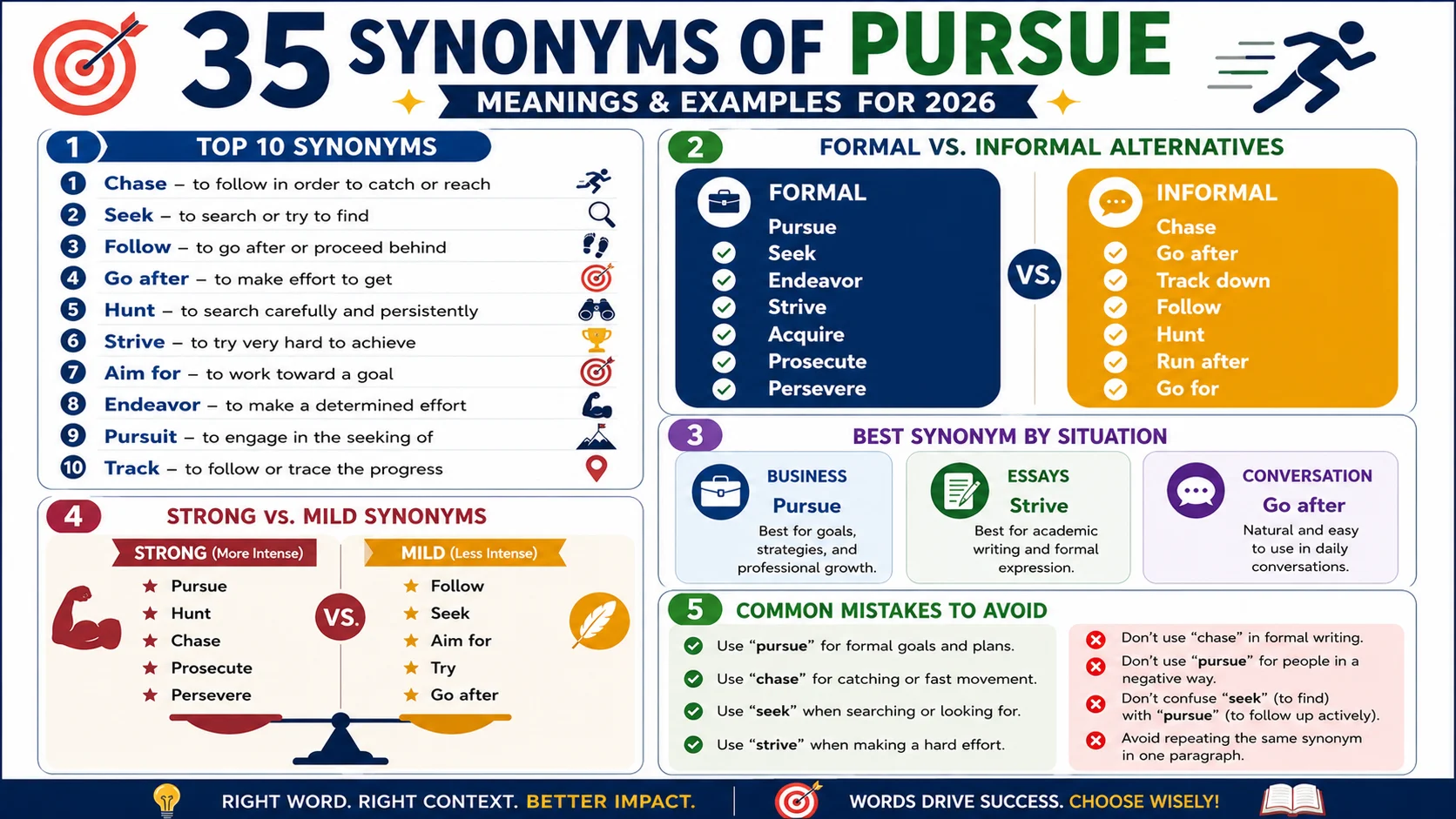
“Pursue” means to follow, chase, or seek something with determination. The best synonyms are chase, follow, seek, strive for, and aspire to. “Chase” is the most direct alternative. Each synonym has a different tone and works best in specific contexts.
Top 10 Synonyms
- Chase
- Follow
- Seek
- Strive for
- Aspire to
- Hunt
- Track
- Trail
- Persue
- Aim for
“Pursue” is a powerful word. It means going after something with purpose and determination. But using it too often can make your English sound repetitive.
Think about it. You pursue a dream, pursue a career, pursue a goal, or even pursue someone in a race. Each situation might need a different word that captures the exact meaning more clearly.
The good news is that English is full of fantastic alternatives. Some words suggest physical chasing. Others are about chasing dreams or goals. Some are formal, and some are very casual.
In this guide, you’ll learn 35 powerful synonyms for “pursue.” You’ll discover exactly when to use each one, how formal they are, and what common mistakes to avoid. Let’s get started!
What Does “Pursue” Mean?
Definition
Pursue” means to follow or chase someone or something. It can mean physically chasing a person or animal. It can also mean working toward a goal, dream, or career. When you pursue something, you are actively trying to achieve it or catch it.
Pronunciation
| Feature | Value |
|---|---|
| US IPA | /pərˈsu/ |
| UK IPA | /pəˈsjuː/ |
| Syllables | 2 (pur-sue) |
| Tip | Stress the second syllable: “per-SOO” |
Grammar
| Grammar Feature | Information |
|---|---|
| Part of Speech | Verb (transitive) |
| Common Position | After the subject |
| Typical Pattern | Subject + pursue + object |
Examples:
- “She pursues her dreams with passion.” (goal)
- “The police pursued the suspect.” (physical)
- “He pursued a career in medicine.” (career)
Grammar Note: “Pursue” is a transitive verb, so it always needs an object. You can’t just say “I pursue.” You must say what you pursue.
Word Family
| Word | Part of Speech | Meaning |
|---|---|---|
| Pursue | Verb | To follow, chase, or seek |
| Pursuit | Noun | The act of pursuing |
| Pursuer | Noun | A person who pursues |
| Pursuant | Adjective | In accordance with (formal) |
15 Synonyms of “Pursue”
Chase
Meaning: To run after someone or something to catch them.
Best Used For: Physical chasing, competitive contexts.
Formality: Informal
Tone: Active, Physical
Frequency: ⭐⭐⭐⭐⭐ (Very Common)
CEFR Level: A2
Example Sentence 1: “The dog chased the cat across the garden.”
Example Sentence 2: “Police chased the thief through the streets.”
Usage Tip: “Chase” is the most direct synonym for physical pursuit. It’s informal and very common in everyday speech.
Common Confusion: Chase vs Pursue. “Chase” is usually physical and fast. “Pursue” is broader and can be about goals or dreams.
Follow
Meaning: To come after someone or something, or to move in the same direction.
Best Used For: Physical following, instructions, trends.
Formality: Neutral
Tone: Direct, Practical
Frequency: ⭐⭐⭐⭐⭐ (Very Common)
CEFR Level: A2
Example Sentence 1: “Follow me, and I’ll show you the way.”
Example Sentence 2: “She followed the instructions carefully.”
Usage Tip: “Follow” is very common and neutral. Use it when you’re going after someone or something in a less aggressive way than “chase.”
Seek
Meaning: To try to find or get something.
Best Used For: Goals, opportunities, advice, knowledge.
Formality: Formal
Tone: Purposeful, Intentional
Frequency: ⭐⭐⭐⭐ (Common)
CEFR Level: B1
Example Sentence 1: “You should seek professional advice.”
Example Sentence 2: “They are seeking new opportunities abroad.”
Usage Tip: “Seek” is a formal word that means to look for or try to get something. Use it for goals, advice, and opportunities.
Strive for
Meaning: To make a great effort to achieve something.
Best Used For: Goals, excellence, self-improvement.
Formality: Formal
Tone: Determined, Ambitious
Frequency: ⭐⭐⭐⭐ (Common)
CEFR Level: B2
Example Sentence 1: “We should always strive for excellence.
Example Sentence 2: “She strives for perfection in everything she does.”
Usage Tip: “Strive for” emphasizes effort and determination. It’s excellent for motivational and inspirational contexts.
Aspire to
Meaning: To have a strong desire to achieve something great.
Best Used For: Dreams, careers, personal goals.
Formality: Formal
Tone: Inspirational, Ambitious
Frequency: ⭐⭐⭐ (Moderate)
CEFR Level: B2
Example Sentence 1: “He aspires to become a doctor.”
Example Sentence 2: “Many young people aspire to success.”
Usage Tip: “Aspire to” is about wanting to achieve something great. It has a positive, ambitious tone.
Hunt
Meaning: To chase and try to catch animals, or to search for something.
Best Used For: Animals, literal hunting, metaphorical searching.
Formality: Neutral
Tone: Active, Determined
Frequency: ⭐⭐⭐ (Moderate)
CEFR Level: B1
Example Sentence 1: “The hunter hunted deer in the forest.”
Example Sentence 2: “She’s hunting for a new apartment.”
Usage Tip: “Hunt” works for literal animal hunting and for searching for something. It’s more intense than “look for.”
Track
Meaning: To follow the path or progress of someone or something.
Best Used For: Animals, people, progress, data.
Formality: Neutral
Tone: Careful, Observant
Frequency: ⭐⭐⭐⭐ (Common)
CEFR Level: B1
Example Sentence 1: “The tracker followed the animal’s tracks.”
Example Sentence 2: “We need to track our progress on the project.”
Usage Tip: “Track” emphasizes careful following, often using signs or data. It’s perfect for progress and monitoring.
Trail
Meaning: To follow the scent or tracks of someone or something.
Best Used For: Animals, searching, detective work.
Formality: Neutral
Tone: Suspenseful, Careful
Frequency: ⭐⭐⭐ (Moderate)
CEFR Level: B1
Example Sentence 1: “The detective trailed the suspect for days.”
Example Sentence 2: “The hunters trailed the deer through the woods.”
Usage Tip: “Trail” suggests following behind at a distance, often carefully or secretly.
Aim for
Meaning: To point toward a goal or target.
Best Used For: Goals, targets, objectives.
Formality: Neutral
Tone: Ambitious, Focused
Frequency: ⭐⭐⭐⭐ (Common)
CEFR Level: B1
Example Sentence 1: “We should aim for success.”
Example Sentence 2: “Aim for the center of the target.”
Usage Tip: “Aim for” is about directing your efforts toward a specific goal. It’s a common and natural phrase.
Go after
Meaning: To pursue or chase someone or something.
Best Used For: Casual conversation, goals, physical pursuit.
Formality: Informal
Tone: Casual, Determined
Frequency: ⭐⭐⭐⭐ (Common)
CEFR Level: B1
Example Sentence 1: “You should go after your dreams.”
Example Sentence 2: “The police went after the criminals.”
Usage Tip: “Go after” is a great phrasal verb for everyday speech. It works for both goals and physical pursuit.
Seek out
Meaning: To actively search for something and find it.
Best Used For: Opportunities, experiences, people.
Formality: Formal
Tone: Intentional, Proactive
Frequency: ⭐⭐⭐ (Moderate)
CEFR Level: B2
Example Sentence 1: “You should seek out new experiences.”
Example Sentence 2: “She sought out the best restaurant in town.”
Usage Tip: “Seek out” is formal and emphasizes actively looking for and finding something.
Work toward
Meaning: To make efforts to achieve something over time.
Best Used For: Long-term goals, careers, personal development.
Formality: Neutral
Tone: Persistent, Dedicated
Frequency: ⭐⭐⭐⭐ (Common)
CEFR Level: B1
Example Sentence 1: “We’re working toward a common goal.”
Example Sentence 2: “She’s working toward her degree.”
Usage Tip: “Work toward” emphasizes gradual progress over time. It’s great for long-term goals.
Dog
Meaning: To follow someone persistently.
Best Used For: Following closely, being persistent.
Formality: Informal
Tone: Persistent, Annoying
Frequency: ⭐⭐ (Rare)
CEFR Level: B2
Example Sentence 1: “Reporters dogged him wherever he went.”
Example Sentence 2: “The problems dogged her for years.”
Usage Tip: “Dog” as a verb means to follow persistently and often annoyingly. It’s quite informal.
Shad
Meaning: To follow or trail someone secretly.
Best Used For: Surveillance, detective work, spying.
Formality: Informal
Tone: Secretive, Suspicious
Frequency: ⭐ (Very Rare)
CEFR Level: C1
Example Sentence 1: “The agent shadowed the suspect for days.”
Example Sentence 2: “She shadowed her boss to learn the job.”
Usage Tip: “Shadow” suggests following secretly or closely, often to learn or observe.
Run after
Meaning: To chase someone or something.
Best Used For: Physical chasing, casual contexts.
Formality: Informal
Tone: Active, Urgent
Frequency: ⭐⭐⭐ (Moderate)
CEFR Level: A2
Example Sentence 1: “The children ran after the ice cream truck.”
Example Sentence 2: “He ran after his dream of becoming a musician.”
Usage Tip: “Run after” is very casual. It’s great for physical chasing and metaphorical goal-chasing.
Synonyms Comparison Table
| Synonym | Best Context | Formality | Tone | Frequency |
|---|---|---|---|---|
| Chase | Physical pursuit | Informal | Active | ⭐⭐⭐⭐⭐ |
| Follow | Going after someone | Neutral | Direct | ⭐⭐⭐⭐⭐ |
| Seek | Goals, advice | Formal | Purposeful | ⭐⭐⭐⭐ |
| Strive for | Excellence, goals | Formal | Determined | ⭐⭐⭐⭐ |
| Aspire to | Dreams, careers | Formal | Inspirational | ⭐⭐⭐ |
| Hunt | Animals, searching | Neutral | Active | ⭐⭐⭐ |
| Track | Data, progress | Neutral | Observant | ⭐⭐⭐⭐ |
| Aim for | Targets, goals | Neutral | Focused | ⭐⭐⭐⭐ |
| Go after | Goals, suspects | Informal | Casual | ⭐⭐⭐⭐ |
Best Synonyms by Situation
| Situation | Best Synonym | Why It Works |
|---|---|---|
| Daily Conversation | Chase / Go after | Natural and casual |
| Business Email | Seek / Strive for | Professional and ambitious |
| Academic Writing | Aspire to / Seek out | Formal and purposeful |
| School Assignment | Work toward / Aim for | Shows clear effort |
| Professional Meeting | Work toward / Strive for | Sound committed and focused |
| Presentation | Aspire to / Aim for | Inspirational and clear |
| Creative Writing | Seek / Chase | Adds energy to writing |
| Social Media | Go after / Chase | Casual and engaging |
| Sports | Chase / Run after | Active and physical |
Formal vs Informal Synonyms
Formal Alternatives
| Synonym | Best Used For |
|---|---|
| Seek | Opportunities, advice, knowledge |
| Aspire to | Dreams, career goals |
| Strive for | Excellence, achievements |
| Work toward | Long-term goals, degrees |
Neutral Alternatives
| Synonym | Best Used For |
|---|---|
| Follow | Directions, people |
| Track | Progress, data |
| Aim for | Targets, objectives |
Informal Alternatives
| Synonym | Best Used For |
|---|---|
| Chase | Physical pursuit |
| Go after | Goals, people |
| Run after | Chasing, casual contexts |
| Hunt | Searching, finding |
Choosing the Right Level: In formal writing, use “aspire to” or “strive for.” In professional contexts, “seek” and “work toward” are excellent. With friends, “chase” and “go after” sound much more natural.
Strong vs Mild Synonyms
Mild
Suitable for everyday situations with less intensity.
- Follow
- Aim for
- Go after
Moderate
More determined or effort-focused alternatives.
- Seek
- Work toward
- Strive for
- Seek out
Strong
High-intensity alternatives suggesting significant effort.
- Chase (intense physical pursuit)
- Hunt (active, determined search)
- Aspire to (high ambition)
- Strive for (great effort)
How Intensity Changes Meaning: “I aim for success” is focused. “I strive for excellence” sounds much more determined. Choose stronger words when you want to emphasize effort and ambition.
Real-Life Examples
School: “Students should work toward their academic goals.”
Office: “We strive for excellence in everything we do.”
Business Email: “We are seeking new opportunities in the market.”
Meetings: “We need to work toward our quarterly targets.”
Presentations: “We should aim for sustainable growth.”
Daily Conversations: “I’m going to go after that promotion.”
Social Media: “Always chase your dreams!”
Academic Writing: “Many scholars aspire to make a meaningful contribution.”
Common Collocations
| Common Phrase | Better Alternative |
|---|---|
| Pursue a career | Build a career |
| Pursue a dream | Chase a dream |
| Pursue a goal | Work toward a goal |
| Pursue an opportunity | Seek an opportunity |
| Pursue a degree | Work toward a degree |
Common Phrases
Chase after: To run or pursue after. (e.g., “The children chased after the ball.”)
Go after: To pursue with determination. (e.g., “Don’t be afraid to go after what you want.”)
Follow up: To pursue further action. (e.g., “We need to follow up on the email.”)
Hunt down: To find and catch. (e.g., “They hunted down the missing documents.”)
Track down: To find after a search. (e.g., “I finally tracked down the person I was looking for.”)
Context Guide
| Situation | Best Synonym | Reason |
|---|---|---|
| Essay | Aspire to / Seek out | Academic and formal |
| Speech | Strive for / Aim for | Inspirational and clear |
| Business Email | Seek / Work toward | Professional and goal-oriented |
| Novel | Chase / Hunt | Adds drama and action |
| Presentation | Aim for / Strive for | Clear and motivating |
| Conversation | Go after / Chase | Natural and casual |
| Academic Writing | Aspire to / Seek out | Formal and purposeful |
| Marketing Copy | Chase / Go after | Energetic and engaging |
Related Words
Near Synonyms
- Pursuit: The act of pursuing. (e.g., “The pursuit of happiness”)
- Quarry: The thing being hunted or pursued. (e.g., “The dogs caught their quarry”)
- Prey: An animal that is hunted.
- Target: The goal of pursuit.
Antonyms
- Avoid: To stay away from.
- Ignore: To pay no attention to.
- Abandon: To give up on.
- Give up: To stop trying.
- Flee: To run away from.
Related Adjectives
- Persistent: Continuing firmly despite difficulty.
- Determined: Having a strong desire to succeed.
- Relentless: Never stopping.
- Tenacious: Holding on firmly.
Related Nouns
- Pursuit: The act of pursuing.
- Ambition: Strong desire to achieve something.
- Determination: Firmness of purpose.
- Perseverance: Continued effort despite difficulty.
Related Verbs
- Follow: To come after.
- Track: To follow the progress of.
- Trail: To follow behind.
- Shadow: To follow secretly.
- Stalk: To pursue stealthily.
Frequently Asked Questions
What is another word for pursue?
Common synonyms are chase, follow, seek, strive for, and aspire to. The best choice depends on whether you are talking about a goal, a person, or an opportunity.
Which synonym sounds the most professional?
“Seek” and “strive for” sound very professional. “Work toward” is also excellent for business contexts.
What is the strongest synonym for pursue?
“Strive for” and “aspire to” are among the strongest. They suggest high ambition and great effort. “Hunt” is also strong for determined pursuit.
Which synonym is best for essays?
“Seek out” and “aspire to” are excellent for academic essays. “Strive for” is also a strong choice.
What’s the difference between pursue and chase?
“Chase” usually means physical pursuit, like running after someone. “Pursue” is broader and includes goals, careers, and dreams.
Which synonym is most common in everyday English?
“Follow” and “go after” are very common in everyday speech. “Chase” is also frequently used.
What is the opposite of pursue?
Common opposites are avoid, ignore, and abandon. These mean to stay away or give up.
Conclusion
“Pursue” is a powerful and versatile word, but now you have 35 fantastic alternatives. Each synonym adds its own special meaning and tone to your language.
Remember, the key is understanding the context. Use “chase” and “go after” for physical pursuit and casual conversation. Use “seek” and “strive for” for professional and formal contexts. Use ” aspire” for dreams and big ambitions.
The best way to improve is practice. Try using one or two new synonyms each day. Listen for these words in conversations, movies, and books. Your vocabulary will become richer and more impressive with time.
