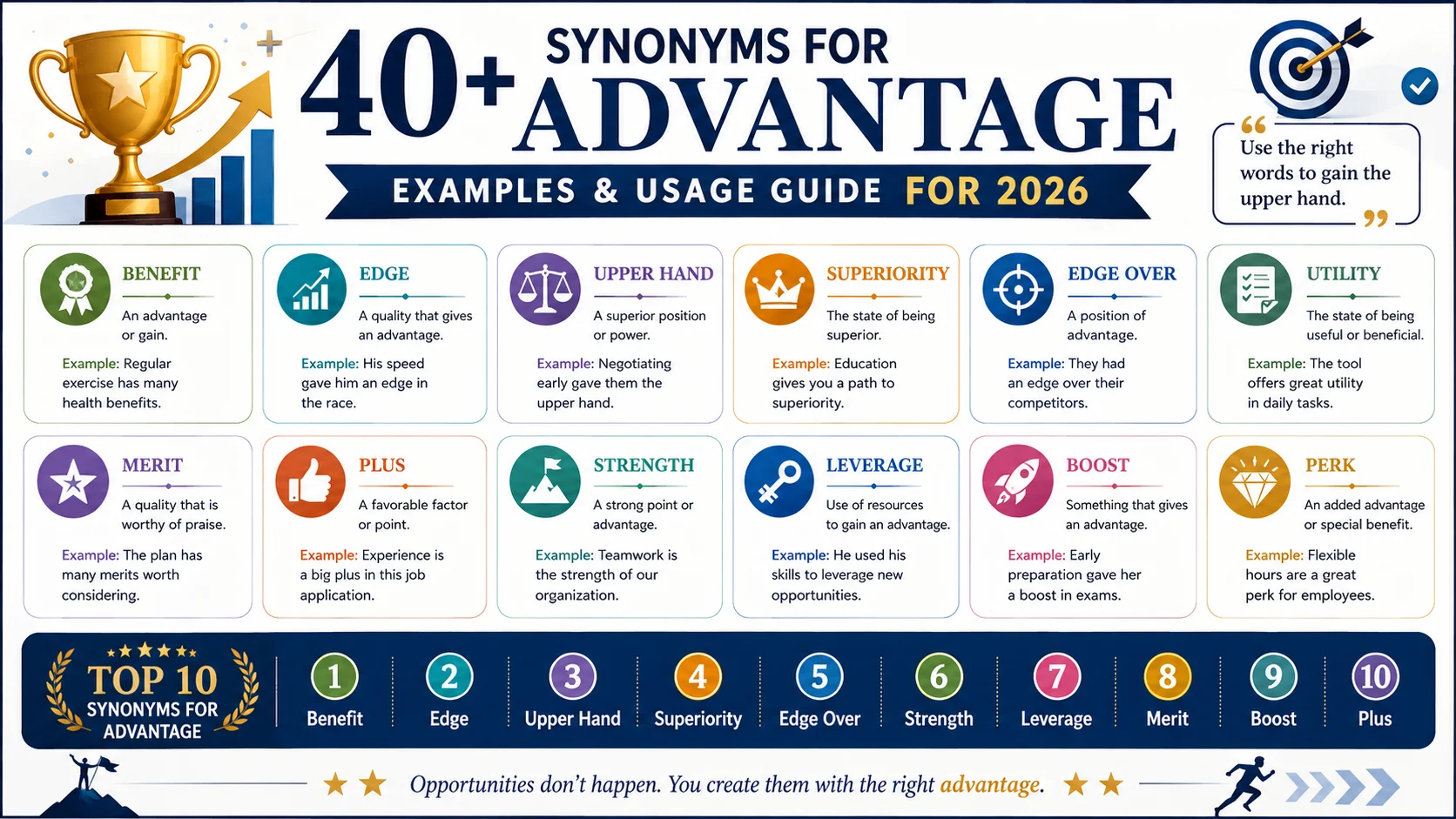
Advantage means a condition or circumstance that puts you in a favorable or superior position. It refers to something that helps you succeed or makes things easier. The best synonyms are benefit for general use, edge for competitive situations, upper hand for strategic contexts, and asset for valuable qualities. Each synonym has a slightly different meaning and works best in specific contexts.
- Benefit
- Edge
- Upper hand
- Asset
- Gain
- Profit
- Boon
- Plus
- Perk
- Privilege
Every synonym has a slightly different meaning, tone, or context. Choosing the right one makes your English sound more natural and precise.
Have you ever struggled to describe a situation where you have an advantage without repeating the same word?
Maybe you are writing a business proposal and want to explain why your company has an edge over competitors. Or perhaps you are describing a skill that gives you an advantage in your career. Using the same word repeatedly makes your writing feel repetitive and dull.
Learning synonyms for advantage helps you express favorable conditions, benefits, and superior positions with greater precision. Whether you are writing a cover letter, negotiating a deal, or describing a competitive situation, the right synonym makes all the difference.
This guide will teach you exactly how to choose the right synonym for advantage in any context. You will learn the subtle differences between benefit, edge, upper hand, asset, and many other alternatives. By the end, you will express advantages with confidence and variety.
What Does “Advantage” Mean?
Definition
Advantage means a condition or circumstance that gives you a better chance of success or makes things easier for you. It is a favorable position that helps you achieve your goals or outperform others. When you have an advantage, you are in a stronger position than someone else.
For example, having a college degree gives you an advantage in the job market. Speaking multiple languages is an advantage when traveling. Knowing the local market gives businesses an advantage over newcomers. In every case, an advantage is something that helps you succeed.
The word carries a positive tone. It suggests opportunity, benefit, and superiority. However, it can also imply unfairness in some contexts, such as when someone has an unfair advantage.
Pronunciation
| Feature | Information |
|---|---|
| US IPA | /ədˈvæntɪdʒ/ |
| UK IPA | /ədˈvɑːntɪdʒ/ |
| Syllables | 3 |
| Tip | Stress the second syllable: uhd-VAN-tij |
Grammar
| Grammar Feature | Information |
|---|---|
| Part of Speech | Noun |
| Common Position | Subject, object, or after prepositions |
| Typical Pattern | Advantage + over + noun |
Example sentences:
“Her experience gives her an advantage over other applicants.”
“There are several advantages to living in a small town.”
“Being bilingual is a clear advantage in international business.”
Grammar note: When comparing, use “advantage over.” For example, “We have an advantage over our competitors.” Use “advantage to” when discussing benefits. For example, “There are many advantages to studying abroad.”
Word Family
| Word | Part of Speech | Meaning |
|---|---|---|
| Advantage | Noun | A favorable condition or position |
| Advantageous | Adjective | Giving an advantage or benefit |
| Advantageously | Adverb | In a way that gives an advantage |
| Disadvantage | Noun | An unfavorable condition |
| Disadvantageous | Adjective | Not giving an advantage |
15 Synonyms of “Advantage”
1. Benefit
Meaning: Something that helps or improves your situation. A positive result or advantage.
Best Used For: General use, professional writing, personal situations, and describing positive outcomes.
Formality: Neutral
Tone: Positive, helpful
Frequency: ⭐⭐⭐⭐⭐ Very Common
CEFR Level: A2
Example Sentence 1: “One major benefit of remote work is the flexibility it offers employees.”
Example Sentence 2: “Regular exercise has numerous health benefits that improve quality of life.”
Usage Tip: Benefit is the most direct and versatile synonym for advantage. Use it when you want to describe something positive or helpful. It works in almost all contexts, from casual conversation to formal writing. Native speakers often use it when discussing positive outcomes. Avoid using benefit when you mean a competitive position, where “edge” or “upper hand” sounds more appropriate.
2. Edge
Meaning: A slight advantage over others. Something that gives you a competitive position.
Best Used For: Competitive situations, business writing, sports, and describing superiority.
Formality: Neutral to Informal
Tone: Competitive, strategic
Frequency: ⭐⭐⭐⭐ Common
CEFR Level: B1
Example Sentence 1: “Her technical skills give her an edge over other candidates for the position.”
Example Sentence 2: “The team’s home crowd gave them a decisive edge in the championship match.”
Usage Tip: Edge implies a competitive advantage, often a slight one that makes a difference. Use it when you want to describe superiority in a competition. It sounds natural in business and sports contexts. Avoid using edge when you mean a general benefit, as it focuses on competition rather than positive outcomes.
3. Upper Hand
Meaning: A position of control or advantage over someone else. Being in a stronger position.
Best Used For: Strategic contexts, negotiations, power dynamics, and competitive situations.
Formality: Informal to Neutral
Tone: Strategic, powerful
Frequency: ⭐⭐⭐ Moderate
CEFR Level: B2
Example Sentence 1: “Knowing the market trends gave our company the upper hand in negotiations.”
Example Sentence 2: “She gained the upper hand in the debate with her well-researched arguments.”
Usage Tip: Upper hand emphasizes control and dominance. Use it when you want to describe being in a position of power over others. It is common in strategic and competitive contexts. Avoid using upper hand in formal academic writing, where “advantage” sounds more appropriate. It can sound too competitive in personal situations.
4. Asset
Meaning: A valuable or useful quality, skill, or resource. Something that gives you an advantage.
Best Used For: Professional writing, personal descriptions, business contexts, and resumes.
Formality: Neutral to Formal
Tone: Positive, valuable
Frequency: ⭐⭐⭐⭐ Common
CEFR Level: B1
Example Sentence 1: “Her ability to speak three languages is a valuable asset in our global team.”
Example Sentence 2: “Good communication skills are an asset in any profession.”
Usage Tip: Asset emphasizes value and usefulness. Use it when you want to describe something that makes you more valuable or effective. It is common in professional and business contexts. Avoid using asset when you mean a temporary advantage, as it implies lasting value.
5. Gain
Meaning: An increase or improvement in something. Something beneficial that you achieve.
Best Used For: Describing progress, achievements, and improvements.
Formality: Neutral
Tone: Positive, progressive
Frequency: ⭐⭐⭐⭐ Common
CEFR Level: B1
Example Sentence 1: “Regular practice resulted in significant gains in her language skills.”
Example Sentence 2: “The company reported substantial gains in market share this quarter.”
Usage Tip: Gain emphasizes improvement and progress. Use it when you want to describe something you have achieved or acquired. It works well in professional and personal contexts. Avoid using gain when you mean a competitive position, where “edge” sounds more appropriate.
6. Profit
Meaning: A benefit or advantage gained from something. Often used in financial contexts.
Best Used For: Business writing, financial contexts, and describing returns.
Formality: Neutral
Tone: Positive, practical
Frequency: ⭐⭐⭐⭐ Common
CEFR Level: B1
Example Sentence 1: “There is little profit in arguing with someone who refuses to listen.”
Example Sentence 2: “The new strategy brought significant profit to the organization.”
Usage Tip: Profit emphasizes what you gain or receive from something. Use it when you want to describe returns, whether financial or practical. Avoid using profit when you mean a non-financial advantage, as it primarily implies monetary gain.
7. Boon
Meaning: Something that is very helpful or beneficial. A great advantage.
Best Used For: Formal writing, descriptive contexts, and emphasizing significant benefits.
Formality: Formal
Tone: Positive, strong
Frequency: ⭐⭐ Rare
CEFR Level: C1
Example Sentence 1: “The new public transportation system has been a boon for commuters.”
Example Sentence 2: “Modern technology is a boon to small business owners worldwide.”
Usage Tip: Boon is a more formal and literary word that emphasizes significant benefits. Use it when you want to sound sophisticated or when describing major advantages. It is less common in everyday conversation. Avoid using boon in casual contexts, where “benefit” sounds more natural.
8. Plus
Meaning: An additional advantage or benefit. A positive extra.
Best Used For: Informal conversation, social media, and casual writing.
Formality: Informal
Tone: Positive, conversational
Frequency: ⭐⭐⭐⭐ Common
CEFR Level: B1
Example Sentence 1: “Living near the beach is a big plus during the summer months.”
Example Sentence 2: “Having flexible work hours is a definite plus for this position.”
Usage Tip: Plus is informal and conversational. Use it when you want to describe an additional benefit in a casual way. It sounds natural among friends and in casual writing. Avoid using plus in formal business writing or academic essays, where “benefit” or “advantage” sounds more professional.
9. Perk
Meaning: An extra benefit or advantage, especially related to a job or situation.
Best Used For: Describing job benefits, casual conversation, and informal writing.
Formality: Informal
Tone: Positive, casual
Frequency: ⭐⭐⭐ Moderate
CEFR Level: B2
Example Sentence 1: “Free lunch and flexible hours are just two perks of working at this company.”
Example Sentence 2: “One of the perks of living in a big city is having access to great restaurants.”
Usage Tip: Perk refers to an extra benefit, often something beyond the basic expectations. Use it when describing job benefits or additional advantages. It is informal and conversational. Avoid using perk in formal writing, where “benefit” sounds more appropriate.
10. Privilege
Meaning: A special advantage or benefit that not everyone has.
Best Used For: Formal writing, describing special opportunities, and social contexts.
Formality: Formal
Tone: Positive, special
Frequency: ⭐⭐⭐⭐ Common
CEFR Level: B1
Example Sentence 1: “Having access to quality education is a privilege many people take for granted.”
Example Sentence 2: “It was a privilege to work with such talented colleagues.”
Usage Tip: Privilege implies a special advantage that not everyone enjoys. Use it when describing opportunities, access, or exclusive benefits. It has a formal tone and often carries social or ethical implications. Avoid using privilege for everyday advantages where “benefit” sounds more appropriate.
11. Favor
Meaning: An advantage or benefit that is given or received.
Best Used For: Describing favorable conditions, and informal contexts.
Formality: Neutral to Informal
Tone: Positive, helpful
Frequency: ⭐⭐⭐⭐ Common
CEFR Level: B1
Example Sentence 1: “The weather was in our favor during the outdoor event.”
Example Sentence 2: “Her connections worked in her favor when applying for the position.”
Usage Tip: Favor often implies conditions or circumstances that are advantageous. Use it when describing situations that work to your benefit. It sounds natural in both casual and professional contexts. Avoid using favor when you mean a competitive advantage, where “edge” sounds more appropriate.
12. Superiority
Meaning: The state of being better or more powerful than others.
Best Used For: Formal writing, competitive analysis, and describing dominance.
Formality: Formal
Tone: Competitive, strong
Frequency: ⭐⭐⭐ Moderate
CEFR Level: B2
Example Sentence 1: “The company’s technological superiority gave it an advantage over competitors.”
Example Sentence 2: “Military superiority is often a decisive factor in geopolitical conflicts.”
Usage Tip: Superiority emphasizes being better than others. Use it in formal and competitive contexts. It has a strong tone and can sound arrogant if used carelessly. Avoid using superiority in personal conversations, where it sounds too competitive.
13. Head Start
Meaning: An early start that gives you an advantage over others.
Best Used For: Describing early advantages, education, and competitive situations.
Formality: Informal
Tone: Positive, opportunistic
Frequency: ⭐⭐⭐ Moderate
CEFR Level: B2
Example Sentence 1: “Children who learn to read early get a head start in school.”
Example Sentence 2: “Our early research gave us a head start in the market.”
Usage Tip: Head start emphasizes having an early advantage. Use it when describing how starting earlier or preparing in advance gives you an advantage. It is conversational and works well in educational and professional contexts. Avoid using head start in formal writing, where “early advantage” sounds more appropriate.
14. Clout
Meaning: Influence or power that gives you an advantage in situations.
Best Used For: Describing influence, political contexts, and professional networks.
Formality: Informal to Neutral
Tone: Powerful, strategic
Frequency: ⭐⭐⭐ Moderate
CEFR Level: B2
Example Sentence 1: “Her industry connections give her significant clout in business negotiations.”
Example Sentence 2: “Having political clout can help you influence important decisions.”
Usage Tip: Clout emphasizes influence and power. Use it when describing how connections or reputation give you an advantage. It is common in professional and political contexts. Avoid using clout in casual conversation, where “influence” sounds more natural.
15. Inside Track
Meaning: A special position of advantage because of access to information or connections.
Best Used For: Informal contexts, describing privileged access, and networking situations.
Formality: Informal
Tone: Strategic, exclusive
Frequency: ⭐⭐ Rare
CEFR Level: B2
Example Sentence 1: “His connections in the industry gave him the inside track on the new project.”
Example Sentence 2: “Being a former employee gave her the inside track for the position.”
Usage Tip: Inside track is an idiom that means having special access or information that gives you an advantage. Use it in informal contexts when describing privileged positions. Avoid using it in formal writing, where “advantage” or “edge” is more appropriate.
Synonyms Comparison Table
| Synonym | Best Context | Formality | Tone | Frequency |
|---|---|---|---|---|
| Benefit | General use, positive outcomes | Neutral | Positive, helpful | ⭐⭐⭐⭐⭐ |
| Edge | Competitive situations | Neutral to Informal | Competitive, strategic | ⭐⭐⭐⭐ |
| Upper hand | Power dynamics, negotiations | Informal to Neutral | Strategic, powerful | ⭐⭐⭐ |
| Asset | Professional, value descriptions | Neutral to Formal | Positive, valuable | ⭐⭐⭐⭐ |
| Gain | Progress, achievements | Neutral | Positive, progressive | ⭐⭐⭐⭐ |
| Profit | Business, financial contexts | Neutral | Positive, practical | ⭐⭐⭐⭐ |
| Boon | Formal, significant benefits | Formal | Positive, strong | ⭐⭐ |
| Plus | Informal, additional benefits | Informal | Positive, conversational | ⭐⭐⭐⭐ |
| Perk | Job benefits, extras | Informal | Positive, casual | ⭐⭐⭐ |
| Privilege | Special opportunities, formal | Formal | Positive, special | ⭐⭐⭐⭐ |
| Favor | Favorable conditions | Neutral to Informal | Positive, helpful | ⭐⭐⭐⭐ |
| Superiority | Competitive dominance | Formal | Competitive, strong | ⭐⭐⭐ |
| Head start | Early advantages | Informal | Positive, opportunistic | ⭐⭐⭐ |
| Clout | Influence, power | Informal to Neutral | Powerful, strategic | ⭐⭐⭐ |
| Inside track | Special access | Informal | Strategic, exclusive | ⭐⭐ |
Best Synonyms by Situation
| Situation | Best Synonym | Why It Works |
|---|---|---|
| Daily Conversation | Benefit or Plus | Simple, natural, and easy to understand |
| Business Email | Advantage or Benefit | Professional and clear |
| Academic Writing | Advantage or Asset | Precise and appropriate for scholarly contexts |
| School Assignment | Benefit or Gain | Clear and appropriate for student writing |
| Professional Meeting | Edge or Advantage | Sounds strategic and confident |
| Presentation | Advantage or Superiority | Adds weight and credibility |
| Creative Writing | Boon or Benefit | Adds descriptive depth |
| Social Media | Plus or Perk | Engaging and conversational |
| Job Interview | Asset or Advantage | Shows value and strategic thinking |
| Negotiation | Upper hand or Edge | Emphasizes strategic position |
| Resume | Asset or Benefit | Demonstrates value to employers |
Formal vs Informal Synonyms
Formal Alternatives
| Synonym | Best Used For |
|---|---|
| Boon | Formal writing, significant benefits |
| Superiority | Competitive analysis, formal contexts |
| Privilege | Special opportunities, formal writing |
| Advantageous (adjective) | Formal descriptions |
Use formal synonyms in academic essays, business proposals, legal documents, and professional reports. They add sophistication and precision to your writing. However, avoid using them in everyday conversation, where they can sound stiff and unnatural.
Neutral Alternatives
| Synonym | Best Used For |
|---|---|
| Benefit | General use, all contexts |
| Asset | Professional, value descriptions |
| Gain | Progress, achievements |
| Edge | Competitive situations |
Neutral synonyms work in almost any situation. They are appropriate for both formal and informal contexts. Use them when you are unsure about the appropriate tone or when you want to sound natural without being too casual or too formal.
Informal Alternatives
| Synonym | Best Used For |
|---|---|
| Plus | Informal conversation, additional benefits |
| Perk | Job benefits, casual contexts |
| Head start | Early advantages, casual |
| Upper hand | Strategic contexts, informal |
Use informal synonyms with friends, family, social media posts, and casual conversations. They sound natural and friendly. However, avoid them in academic essays, professional reports, and formal business communication, where they can seem unprofessional.
Strong vs Mild Synonyms
Mild Synonyms
These synonyms express advantage gently. They describe benefits without emphasizing competition or power.
- Benefit
- Plus
- Perk
- Favor
Use mild synonyms for everyday situations and when you want to sound balanced and positive.
Moderate Synonyms
These synonyms express clear advantage and value. They are the most common and work in almost all situations.
- Advantage
- Asset
- Gain
- Edge
Use moderate synonyms in most writing and conversation. They are versatile and rarely sound inappropriate.
Strong Synonyms
These synonyms express significant advantage, dominance, or power. They should be used carefully.
- Upper hand
- Superiority
- Clout
- Boon
Use strong synonyms when you want to emphasize significant advantage or power. Be careful, as they can sound arrogant or aggressive in some contexts.
Real-Life Examples
School Context
“The early study group gave her a head start on the exam material. Her ability to take clear notes was a significant asset. Regular attendance is a benefit that many students overlook.”
Office Context
“Having a diverse team gives us an edge in understanding different markets. Strong communication skills are an asset in any workplace. The new software has been a real boon for productivity.”
Business Email Context
“Dear Team, We have a clear advantage over our competitors in customer service. Our response time is a major benefit that clients appreciate. Let’s leverage this edge in our upcoming campaign.”
Negotiation Context
“We gained the upper hand in negotiations by preparing thoroughly. Our market research gave us a significant advantage. The data supported our position and strengthened our case.”
Creative Writing Context
“The old library was a boon to the small community. Its collection was a privilege that few towns enjoyed. The quiet reading rooms offered a peaceful advantage over the noisy city streets.”
Social Media Context
“The biggest perk of this job is the flexible schedule. Working from home has been a major plus this year. What benefits do you value most in your career?”
Job Application Context
“Bilingual ability is a valuable asset in our global economy. My international experience gives me an edge over other candidates. I believe this skillset is a benefit to any organization.”
Academic Writing Context
“The study’s methodology provided a clear advantage in data collection. The longitudinal approach was particularly beneficial. This advantage allowed researchers to draw more reliable conclusions.”
Common Collocations
| Common Phrase | Better Alternative |
|---|---|
| Have an advantage | Enjoy an advantage or Possess an advantage |
| Give an advantage | Provide an advantage or Offer an advantage |
| Competitive advantage | Strategic edge or Market advantage |
| Clear advantage | Decisive edge or Obvious benefit |
| Major advantage | Significant benefit or Substantial edge |
| Take advantage of | Benefit from or Leverage |
| Unfair advantage | Excessive benefit or Undue edge |
Common Phrases
1. Have the advantage of
Meaning: To possess something beneficial.
Example: “She has the advantage of years of experience in the field.”
2. Gain an advantage
Meaning: To obtain a favorable position.
Example: “The team gained an advantage through strategic planning.”
3. Take advantage of
Meaning: To use an opportunity or situation to your benefit.
Example: “Take advantage of the early bird discount before it expires.”
4. Competitive advantage
Meaning: Something that makes your business better than competitors.
Example: “Our customer service is our main competitive advantage.”
5. Advantage over
Meaning: Superiority compared to someone or something.
Example: “Her technical skills give her an advantage over other applicants.”
6. Have the upper hand
Meaning: To be in a position of control or advantage.
Example: “After the successful product launch, we had the upper hand in the market.”
7. Home advantage
Meaning: The benefit of being in a familiar environment.
Example: “The local team enjoyed home advantage during the tournament.”
Context Guide
| Situation | Best Synonym | Reason |
|---|---|---|
| Academic Essay | Advantageous or Asset | Precise and appropriate for scholarly writing |
| Formal Speech | Boon or Privilege | Adds weight and sophistication |
| Business Email | Benefit or Advantage | Professional and clear |
| Creative Writing | Boon or Favor | Adds descriptive richness |
| Professional Presentation | Edge or Advantage | Sounds strategic and confident |
| Casual Conversation | Plus or Perk | Natural and easy to understand |
| Job Interview | Asset or Advantage | Shows value and strategic thinking |
| Marketing Copy | Benefit or Edge | Persuasive and engaging |
Related Words
Near Synonyms
Near synonyms include benefit, asset, and gain. These words are closely related to advantage but emphasize slightly different aspects. Benefit focuses on positive outcomes, asset focuses on value, and gain focuses on achievement. All can replace advantage in many contexts, but each has a unique focus.
Antonyms
| Antonym | Meaning |
|---|---|
| Disadvantage | An unfavorable condition |
| Drawback | A negative aspect or problem |
| Disability | A limitation or obstacle |
| Liability | Something that is a disadvantage |
| Weakness | A lack of strength or advantage |
| Obstacle | Something that blocks progress |
Related Adjectives
Advantageous means giving an advantage. Beneficial means having a positive effect. Favorable means helpful or advantageous. Superior means better than others. Valuable means worth a lot or very useful.
Related Nouns
Benefit means a positive result. Edge means a slight advantage. Asset means something valuable. Gain means an increase or improvement. Profit means a financial or practical benefit.
Related Verbs
Benefit means to gain from something. Leverage means to use something to your advantage. Exploit means to use a situation for benefit (can be negative). Capitalize means to take advantage of an opportunity.
Frequently Asked Questions
1. What is the best synonym for advantage in everyday conversation?
Benefit is the best synonym for everyday conversation. It is simple, natural, and easy to understand. Native speakers frequently use “benefit” when discussing positive outcomes and advantages in daily life.
2. Which synonym sounds the most professional in business writing?
Advantage or benefit sound most professional in business writing. They are clear, direct, and appropriate for emails, reports, and presentations. They balance professionalism with clarity, making them safe choices for almost all business contexts.
3. What is the strongest synonym for advantage?
Upper hand and superiority are the strongest synonyms. They express significant advantage and dominance. Both words should be used carefully because they carry strong competitive meanings and can sound aggressive in some contexts.
4. What is the difference between advantage and benefit?
Advantage often implies a competitive or comparative position. Benefit implies a positive outcome regardless of comparison. You have an advantage over others, but you receive a benefit from something. Both are positive, but advantage suggests being in a better position.
5. What is the opposite of advantage?
The opposite of advantage is disadvantage, drawback, or liability. These words describe unfavorable conditions or negative aspects. For example, “The high cost is a major disadvantage of living in the city.”
6. Which synonym should I use in academic writing?
In academic writing, use advantageous, benefit, or asset. These synonyms sound precise and scholarly. For example, “The methodology provided an advantageous framework for data analysis” sounds more academic than “The methodology gave an advantage.”
7. What is the most common synonym for advantage in American English?
Benefit is the most common synonym for advantage in American English. It appears frequently in both spoken and written contexts. Edge is also very common in competitive situations. Both are widely understood and natural in everyday communication.
8. What is the difference between edge and advantage?
Edge is a specific type of advantage. It implies a slight but decisive advantage in competitive situations. Advantage is broader and includes all favorable conditions. You have an edge over competitors, but you have an advantage in life. Edge is more strategic and competitive.
Conclusion
Advantage is a useful word that describes favorable conditions, benefits, and superior positions. However, using the same word repeatedly makes your writing and speaking sound repetitive and dull. The solution is simple: learn the right synonym for every situation.
For everyday conversation, choose benefit or plus. For professional writing, choose advantage or asset. For competitive contexts, choose edge or upper hand. For academic contexts, choose advantage or beneficial. Each synonym carries a slightly different meaning and works best in specific contexts.
Remember to consider formality, tone, and emotional intensity when choosing a synonym. A word that sounds natural in a casual conversation might sound out of place in a formal report. Matching your word choice to the situation is the mark of a confident English speaker.
The next time you describe something that helps you succeed or gives you a better position, pause for a moment. Consider whether benefit, edge, asset, upper hand, or another synonym would serve you better. This simple habit will transform your vocabulary and make your communication clearer, more engaging, and more effective.
Start using these synonyms today. Your readers and listeners will notice the improvement.
