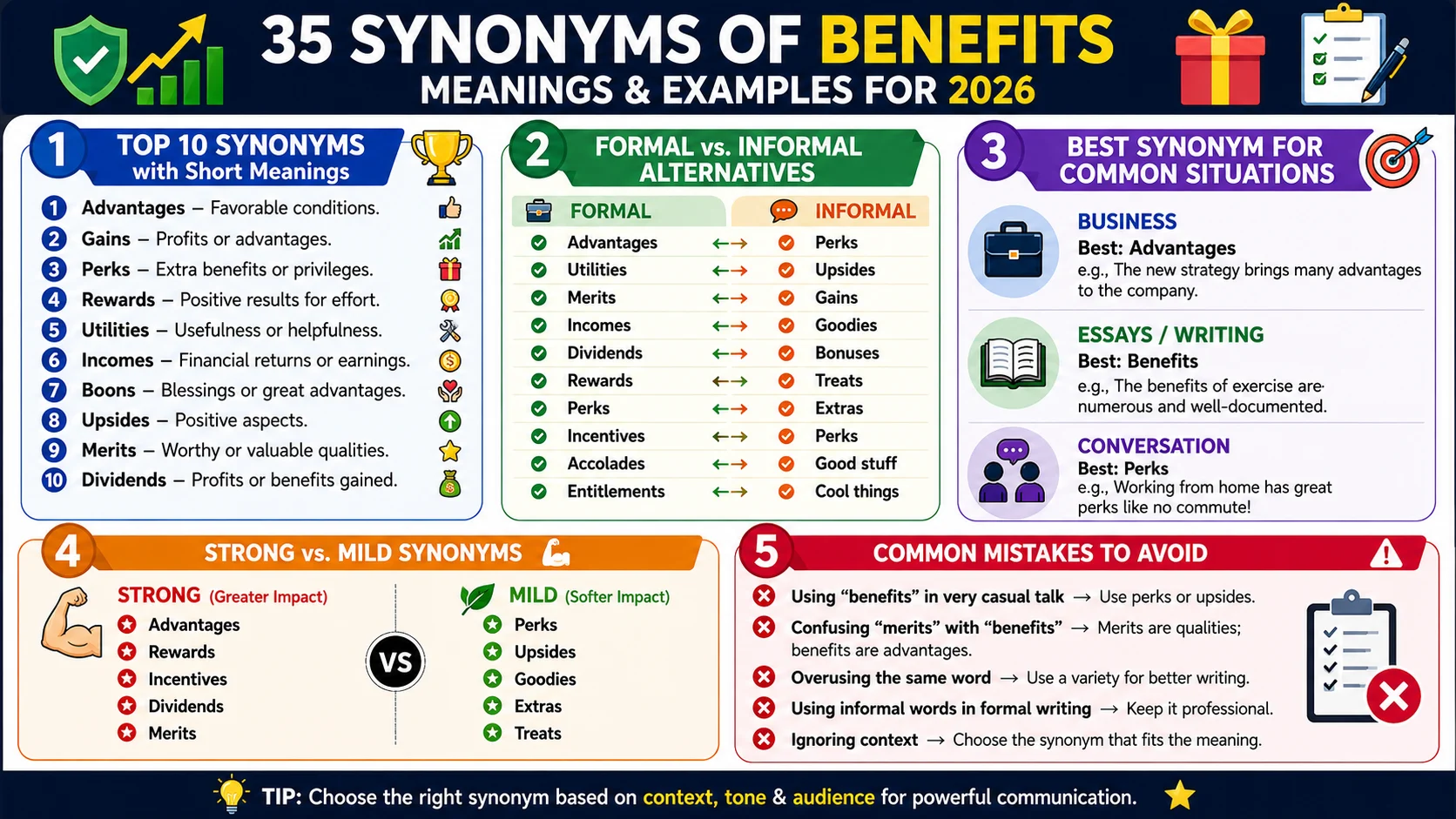
“Benefits” means the good things you get from something, like advantages or rewards. The best synonyms are advantages, perks, rewards, gains, and privileges. “Advantages” is the most common natural alternative. Each synonym has a slightly different meaning and context where it fits best.
Top 10 Synonyms
- Advantages
- Perks
- Rewards
- Gains
- Privileges
- Profits
- Returns
- Upsides
- Boons
- Assets
“Benefits” is a word we use all the time. We talk about job benefits, health benefits, and the benefits of exercise. It’s useful, but using it too often can make your English feel repetitive and basic.
Think about it. You can talk about the benefits of a product, the benefits of a job, the benefits of studying, or the benefits of a new policy. Each situation might need a different word that captures the specific type of advantage.
In this guide, you’ll learn 35 powerful synonyms for “benefits.” You’ll discover exactly when to use each one, how formal they are, and what common mistakes to avoid. Let’s begin!
What Does “Benefits” Mean?
Definition
Benefits” means good things, advantages, or rewards that come from something. It can be money, health, happiness, or any positive result. When you get a benefit, you gain something helpful or valuable. Benefits can be from work, from a decision, from exercise, or from any situation.
Pronunciation
| Feature | Value |
|---|---|
| US IPA | /ˈbɛnəfɪts/ |
| UK IPA | /ˈbɛnəfɪts/ |
| Syllables | 3 (ben-e-fits) |
| Tip | Stress the first syllable: “BEN-uh-fits” |
Grammar
| Grammar Feature | Information |
|---|---|
| Part of Speech | Noun (plural) |
| Common Position | Subject or object |
| Typical Pattern | Benefits + of + something / Benefits + to + someone |
Examples:
- “The benefits of exercise are well-known.”
- “There are many benefits to learning a new language.”
- “Employees receive health benefits.”
Grammar Note: “Benefits” is usually plural. The singular “benefit” is also used, but “benefits” is more common when talking about multiple advantages.
Word Family
| Word | Part of Speech | Meaning |
|---|---|---|
| Benefit | Noun/Verb | An advantage or good thing |
| Benefits | Noun (plural) | Multiple advantages |
| Beneficial | Adjective | Helpful or good |
| Beneficiary | Noun | Someone who receives benefits |
| Beneficially | Adverb | In a helpful way |
15 Synonyms of “Benefits”
Advantages
Meaning: Things that help you or give you a better chance of success.
Best Used For: General contexts, professional situations.
Formality: Neutral
Tone: Positive, Helpful
Frequency: ⭐⭐⭐⭐⭐ (Very Common)
CEFR Level: B1
Example Sentence 1: “Living in a big city has many advantages.”
Example Sentence 2: “The advantages of using this software are clear.
Usage Tip: “Advantages” is the most direct synonym. Use it for any situation where something gives you an edge.
Common Confusion: Advantages vs Benefits. “Advantages” often suggests a competitive edge. “Benefits” is broader and includes personal rewards.
Perks
Meaning: Extra benefits or special advantages, especially from a job.
Best Used For: Job benefits, informal contexts, lifestyle advantages.
Formality: Informal
Tone: Positive, Casual
Frequency: ⭐⭐⭐⭐ (Common)
CEFR Level: B2
Example Sentence 1: “The job includes great perks like a company car.”
Example Sentence 2: “Free coffee is one of the perks of working here.”
Usage Tip: “Perks” are extra bonuses, especially in jobs. It’s an informal, friendly word.
Rewards
Meaning: Good things you get because of your work, effort, or good behavior.
Best Used For: Work, parenting, personal achievement.
Formality: Neutral
Tone: Positive, Earned
Frequency: ⭐⭐⭐⭐ (Common)
CEFR Level: B1
Example Sentence 1: “The rewards of hard work are worth it.”
Example Sentence 2: “The job offers financial rewards.”
Usage Tip: “Rewards” suggests you earned or deserved the benefit. It’s often used for effort-based situations.
Gains
Meaning: Increases in money, knowledge, or something valuable.
Best Used For: Finance, business, personal growth.
Formality: Neutral
Tone: Positive, Practical
Frequency: ⭐⭐⭐⭐ (Common)
CEFR Level: B2
Example Sentence 1: “The gains from the investment were significant.”
Example Sentence 2: “Health gains come from regular exercise.”
Usage Tip: “Gains” often suggests measurable increases. Use it for statistics and improvements.
Privileges
Meaning: Special rights, advantages, or opportunities that not everyone has.
Best Used For: Jobs, social contexts, legal rights.
Formality: Formal
Tone: Exclusive, Special
Frequency: ⭐⭐⭐ (Moderate)
CEFR Level: B2
Example Sentence 1: “Employees enjoy many privileges at the company.”
Example Sentence 2: “Travel is one of the privileges of being a consultant.”
Usage Tip: “Privileges” suggests special access or rights. It’s a formal word.
Profits
Meaning: Financial gains or money made from business.
Best Used For: Business, finance, commercial contexts.
Formality: Formal
Tone: Financial, Commercial
Frequency: ⭐⭐⭐⭐ (Common)
CEFR Level: B2
Example Sentence 1: “The company’s profits increased this year.”
Example Sentence 2: “The profits from the sale were reinvested.”
Usage Tip: “Profits” is specific to money and business. Use it for financial situations.
Returns
Meaning: The money, results, or benefits you get from an investment.
Best Used For: Finance, business, effort-based situations.
Formality: Formal
Tone: Financial, Practical
Frequency: ⭐⭐⭐ (Moderate)
CEFR Level: B2
Example Sentence 1: “The returns on investment were excellent.”
Example Sentence 2: “The returns from your hard work will come.”
Usage Tip: “Returns” often refers to financial investments or the results of effort.
Upsides
Meaning: The positive or good aspects of a situation.
Best Used For: Casual conversation, describing pros and cons.
Formality: Informal
Tone: Positive, Casual
Frequency: ⭐⭐⭐ (Moderate)
CEFR Level: B2
Example Sentence 1: “The upside of the job is the flexible schedule.”
Example Sentence 2: “There are many upsides to living in a small town.”
Usage Tip: “Upside” is often used with “downside” to compare positives and negatives.
Boons
Meaning: Something very helpful or beneficial.
Best Used For: Formal writing, positive situations.
Formality: Formal
Tone: Helpful, Positive
Frequency: ⭐⭐ (Rare)
CEFR Level: C1
Example Sentence 1: “The new technology was a great boon to the industry.”
Example Sentence 2: “The rain was a boon for the farmers.”
Usage Tip: “Boon” is a formal, somewhat old-fashioned word. Use it for something that brings great help.
Assets
Meaning: Valuable things or qualities that are helpful.
Best Used For: Business, personal qualities, financial contexts.
Formality: Formal
Tone: Valuable, Practical
Frequency: ⭐⭐⭐⭐ (Common)
CEFR Level: B2
Example Sentence 1: “Her language skills are a great asset.
Example Sentence 2: “The company’s assets include property and equipment.”
Usage Tip: “Assets” can be financial or personal. It suggests something valuable.
Dividends
Meaning: Benefits or rewards from previous efforts.
Best Used For: Business, effort-based situations.
Formality: Formal
Tone: Rewarding, Practical
Frequency: ⭐⭐ (Rare)
CEFR Level: C1
Example Sentence 1: “The investment paid dividends over time.”
Example Sentence 2: “Hard work pays dividends.”
Usage Tip: “Dividends” is often used metaphorically for benefits from effort or investment.
Fruits
Meaning: The positive results or benefits of work.
Best Used For: Metaphorical, literary writing.
Formality: Formal/Literary
Tone: Poetic, Rewarding
Frequency: ⭐⭐ (Rare)
CEFR Level: C1
Example Sentence 1: “He is finally enjoying the fruits of his labor.”
Example Sentence 2: “The fruits of the peace treaty were seen for years.”
Usage Tip: “Fruits” is a metaphorical, literary word. Use it for poetic or formal writing.
Rewards
Meaning: Good things you receive as a result of effort.
Best Used For: Work, personal achievement, behavior.
Formality: Neutral
Tone: Earned, Positive
Frequency: ⭐⭐⭐⭐ (Common)
CEFR Level: B1
Example Sentence 1: “The rewards of teaching are immense.
Example Sentence 2: “You’ll receive rewards for your loyalty.”
Usage Tip: “Rewards” often suggests something earned through effort or good behavior.
Benefits (singular use)
Meaning: One specific advantage or good thing.
Best Used For: General contexts.
Formality: Neutral
Tone: Positive
Frequency: ⭐⭐⭐⭐⭐ (Very Common)
CEFR Level: A2
Example Sentence 1: “The main benefit is the cost savings.
Example Sentence 2: “One benefit of the new policy is flexibility.
Usage Tip: While we often use “benefits” in plural, the singular “benefit” works well when focusing on one thing.
Advantages (as a collective)
Meaning: The positive qualities or opportunities of something.
Best Used For: General contexts.
Formality: Neutral
Tone: Positive
Frequency: ⭐⭐⭐⭐⭐ (Very Common)
CEFR Level: B1
Example Sentence 1: “The advantages outweigh the disadvantages.”
Example Sentence 2: “There are many advantages to this approach.”
Usage Tip: “Advantages” is often used in comparisons to weigh positives against negatives.
Synonyms Comparison Table
| Synonym | Best Context | Formality | Tone | Frequency |
|---|---|---|---|---|
| Advantages | General use | Neutral | Positive | ⭐⭐⭐⭐⭐ |
| Rewards | Effort-based | Neutral | Earned | ⭐⭐⭐⭐⭐ |
| Perks | Jobs, informal | Informal | Casual | ⭐⭐⭐⭐ |
| Profits | Business, money | Formal | Financial | ⭐⭐⭐⭐ |
| Gains | Improvements | Neutral | Practical | ⭐⭐⭐⭐ |
| Assets | Valuable qualities | Formal | Valuable | ⭐⭐⭐⭐ |
| Privileges | Special rights | Formal | Exclusive | ⭐⭐⭐ |
| Upsides | Casual comparison | Informal | Casual | ⭐⭐⭐ |
| Returns | Investment | Formal | Financial | ⭐⭐⭐ |
| Boons | Helpful things | Formal | Helpful | ⭐⭐ |
Best Synonyms by Situation
| Situation | Best Synonym | Why It Works |
|---|---|---|
| Daily Conversation | Advantages | Natural and clear |
| Business Email | Advantages/Returns | Professional and direct |
| Academic Writing | Advantages | Formal and precise |
| School Assignment | Gains | Shows progress |
| Professional Meeting | Perks | Friendly and professional |
| Presentation | Advantages | Clear and effective |
| Creative Writing | Fruits | Adds literary depth |
| Social Media | Perks | Casual and relatable |
| Job Interview | Perks | Shows enthusiasm |
Formal vs Informal Synonyms
Formal Alternatives
| Synonym | Best Used For |
|---|---|
| Advantages | Most formal contexts |
| Privileges | Special rights or access |
| Profits | Financial business contexts |
| Returns | Investment results |
| Assets | Valuable qualities or property |
Neutral Alternatives
| Synonym | Best Used For |
|---|---|
| Rewards | Effort-based situations |
| Gains | Improvements and increases |
| Benefits | General use |
| Advantages | General comparisons |
Informal Alternatives
| Synonym | Best Used For |
|---|---|
| Perks | Jobs, lifestyle benefits |
| Upsides | Casual comparisons |
| Pros | Short for “advantages” |
Choosing the Right Level: Use “advantages” and “privileges” for formal writing. Use “perks” for friendly, informal contexts. Use “rewards” and “gains” for effort-based situations.
Strong vs Mild Synonyms
Mild
Suitable for everyday situations with less intensity.
- Benefits (itself)
- Rewards
- Gains
Moderate
More specific or noticeable alternatives.
- Advantages
- Perks
- Returns
- Assets
Strong
High-intensity alternatives suggesting significant value.
- Profits (financial)
- Privileges (special access)
- Boons (great help)
- Fruits (metaphorical)
How Intensity Changes Meaning: “There are benefits” is general. “There are significant advantages” is stronger. Choose stronger words when you want to emphasize importance.
Real-Life Examples
School: “Studying regularly has many benefits for students.”
Office: “The job offers great perks like flexible hours.”
Business Email: “Please consider the advantages of this proposal.”
Meetings: “The gains from this investment will be substantial.”
Presentations: “The advantages of our product are clear.”
Daily Conversations: “Living near work has its perks.”
Social Media: “Here are the perks of this new gadget!”
Academic Writing: “The advantages of this method are well-documented.”
Common Collocations
| Common Phrase | Better Alternative |
|---|---|
| Health benefits | Health advantages |
| Job benefits | Job perks |
| Financial benefits | Financial gains |
| Long-term benefits | Long-term advantages |
| Key benefits | Key advantages |
Common Phrases
Pros and cons: Advantages and disadvantages. (e.g., “Let’s weigh the pros and cons.”)
Pay off: To bring benefits. (e.g., “Your hard work will pay off.”)
Reap the rewards: To enjoy the benefits. (e.g., “You’ll reap the rewards of your effort.”)
Fruits of labor: The benefits of hard work. (e.g., “She’s enjoying the fruits of her labor.”)
Silver lining: A positive aspect of a bad situation. (e.g., “Every cloud has a silver lining.”)
Context Guide
| Situation | Best Synonym | Reason |
|---|---|---|
| Essay | Advantages | Academic and formal |
| Speech | Rewards | Inspiring and positive |
| Business Email | Advantages | Professional and clear |
| Novel | Fruits | Literary and poetic |
| Presentation | Advantages | Clear and effective |
| Conversation | Perks | Natural and relatable |
| Academic Writing | Advantages | Precise and formal |
| Marketing Copy | Perks | Engaging and attractive |
Related Words
Near Synonyms
- Bonus: Extra benefit. (e.g., “The bonus is a free meal.”)
- Fringe benefits: Extra benefits from a job. (e.g., “The job offers fringe benefits.”)
- Windfall: Unexpected financial benefit.
- Convenience: Ease and benefit.
Antonyms
- Drawbacks: Disadvantages.
- Disadvantages: Negative aspects.
- Cons: Negative sides.
- Downsides: Negative aspects.
- Detriments: Harmful things.
Related Adjectives
- Beneficial: Helpful and good.
- Advantageous: Giving an advantage.
- Lucrative: Profitable.
- Rewarding: Giving satisfaction.
- Favorable: Positive and helpful.
Related Nouns
- Advantage: A positive quality.
- Reward: Something given in return.
- Gain: An increase or improvement.
- Profit: Financial benefit.
- Asset: Something valuable.
Related Verbs
- Benefit: To help or be helped.
- Profit: To gain financially.
- Gain: To get or increase.
- Reap: To harvest benefits.
- Enjoy: To experience benefits.
Frequently Asked Questions
What is another word for benefits?
Common synonyms include advantages, perks, rewards, gains, and privileges. “Advantages” is the most common and versatile alternative.
Which synonym sounds the most professional?
Advantages and privileges sound very professional. “Returns” is excellent for financial contexts.
What is the strongest synonym for benefits?
Profits is one of the strongest for financial benefits. “Privileges” is strong for special advantages. “Boons” is strong but formal.
Which synonym is best for essays?
Advantages is the best choice for academic essays. It’s formal, clear, and widely used.
What’s the difference between benefits and perks?
“Benefits” is broader and can include anything positive. “Perks” are extra bonuses, especially from a job, and are more informal.
Which synonym is most common in everyday English?
“Advantages” and “rewards” are very common in everyday speech. “Perks” is also frequently used in casual conversation.
What is the opposite of benefits?
Common opposites are drawbacks, disadvantages, cons, and downsides. These words describe negative aspects.
Conclusion
“Benefits” is a useful word, but now you have 35 fantastic alternatives. Each synonym adds a different shade of meaning to your language.
Remember, the key is understanding the context. Use “advantages” for most situations. Use “perks” for job bonuses and lifestyle benefits. Use “rewards” for effort-based situations. Use “profits” and “returns” for financial contexts.
The best way to improve is practice. Try using one or two new synonyms each day. Listen for these words in conversations and books. Your vocabulary will become richer and more impressive with time.
