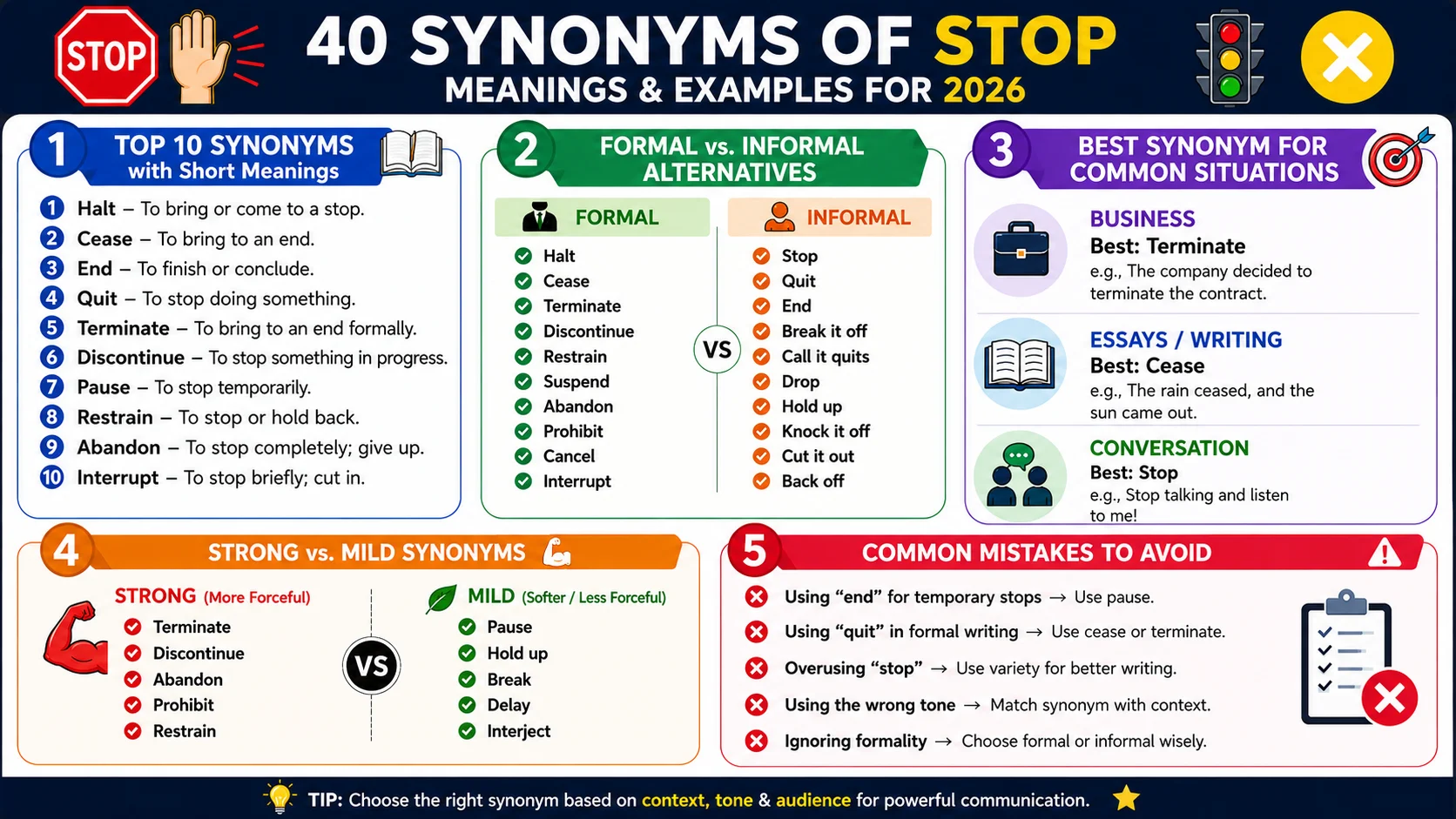
“Stop” means to bring something to an end or to pause movement. The best synonyms are halt, cease, quit, discontinue, and pause. “Halt” is the most direct alternative. Each synonym has a slightly different meaning and context where it fits best.
Top 10 Synonyms
- Halt
- Cease
- Quit
- Discontinue
- Pause
- End
- Finish
- Terminate
- Suspend
- Interrupt
Stop is one of the most common words in English. You use it to tell someone to pause, end an action, or prevent something from continuing. But repeating the same word can make your writing sound basic.
That’s why learning the right stop synonym matters. Depending on the situation, you might halt an action, cease a process, quit a habit, or discontinue a service. Each word carries a slightly different meaning and level of formality.
If you’re looking for a stopped synonym, the best choice depends on what actually ended. Words such as halted, ended, ceased, and concluded can work, but they aren’t always interchangeable. The same applies when you need another word for stopped, another word for stop, or another word for stopping.
In this guide, you’ll explore 35 carefully explained stopping synonyms, stopped synonyms, and alternatives to stop. You’ll learn their meanings, usage, tone, and common mistakes so you can choose the right word with confidence.
What Does “Stop” Mean?
Definition
“Stop” means to bring something to an end, to pause, or to prevent movement. It can be physical, like stopping a car. It can also be abstract, like stopping a bad habit or stopping a process. When you stop, you put an end to an action, movement, or event.
Pronunciation
| Feature | Value |
|---|---|
| US IPA | /stɑp/ |
| UK IPA | /stɒp/ |
| Syllables | 1 |
| Tip | Short and sharp. Say it like “stahp” in US English. |
Grammar
| Grammar Feature | Information |
|---|---|
| Part of Speech | Verb (transitive and intransitive) |
| Common Position | After the subject |
| Typical Pattern | Subject + stop + object / Subject + stop + -ing |
Examples:
- “Please stop the car.” (transitive)
- “The rain has stopped.” (intransitive)
- “She stopped smoking.” (with -ing)
Grammar Note: “Stop” can be used with or without an object. When followed by -ing, it means to end an activity. When followed by an infinitive, it means to pause in order to do something.
Word Family
| Word | Part of Speech | Meaning |
|---|---|---|
| Stop | Verb/Noun | To bring to an end |
| Stopped | Verb (past) | Past tense of stop |
| Stopping | Gerund | The act of stopping |
| Stoppage | Noun | An interruption or halt |
15 Synonyms of “Stop”
Halt
Meaning: To bring something to a stop suddenly and completely.
Best Used For: Formal contexts, business, official situations.
Formality: Formal
Tone: Abrupt, Complete
Frequency: ⭐⭐⭐⭐ (Common)
CEFR Level: B2
Example Sentence 1: “The project was halted due to budget problems.”
Example Sentence 2: “The guards halted the procession at the gate.”
Usage Tip: “Halt” is a formal synonym. It suggests a complete, often sudden stop. Use it in professional and official contexts.
Common Confusion: Halt vs Stop. “Halt” is more formal and often suggests an abrupt stop. “Stop” is more general and common.
Cease
Meaning: To come to an end or to stop something permanently.
Best Used For: Legal contexts, formal writing, official documents.
Formality: Very Formal
Tone: Official, Final
Frequency: ⭐⭐⭐ (Moderate)
CEFR Level: B2
Example Sentence 1: “The company ceased operations last year.”
Example Sentence 2: “The noise finally ceased after midnight.”
Usage Tip: “Cease” is a very formal word. It suggests a permanent or official end. Use it in legal or official writing.
Quit
Meaning: To stop doing something, especially a habit or a job.
Best Used For: Informal contexts, habits, jobs.
Formality: Informal
Tone: Abrupt, Personal
Frequency: ⭐⭐⭐⭐⭐ (Very Common)
CEFR Level: A2
Example Sentence 1: “She decided to quit her job.”
Example Sentence 2: “He quit smoking last year.”
Usage Tip: “Quit” is very common in informal speech. Use it for habits, jobs, and personal decisions. It suggests a deliberate choice.
Discontinue
Meaning: To stop making, providing, or doing something.
Best Used For: Business, product lines, services.
Formality: Formal
Tone: Official, Business-like
Frequency: ⭐⭐⭐ (Moderate)
CEFR Level: B2
Example Sentence 1: “The company discontinued this product.”
Example Sentence 2: “The service will be discontinued next month.”
Usage Tip: “Discontinue” is a formal business word. Use it for products, services, and official processes.
Pause
Meaning: To stop briefly or temporarily.
Best Used For: Everyday contexts, technology, conversations.
Formality: Neutral
Tone: Temporary, Brief
Frequency: ⭐⭐⭐⭐⭐ (Very Common)
CEFR Level: A2
Example Sentence 1: “Please pause the movie while I get a drink.”
Example Sentence 2: “She paused before answering the question.”
Usage Tip: “Pause” is for temporary stops. Use it when something will start again soon.
End
Meaning: To bring something to a finish or conclusion.
Best Used For: Stories, events, periods of time.
Formality: Neutral
Tone: Final, Complete
Frequency: ⭐⭐⭐⭐⭐ (Very Common)
CEFR Level: A2
Example Sentence 1: “The war ended in 1945.”
Example Sentence 2: “Let’s end the meeting here.”
Usage Tip: “End” is a very common, versatile word. Use it for events, stories, and anything that has a natural finish.
Finish
Meaning: To complete something or bring it to an end.
Best Used For: Tasks, projects, work.
Formality: Neutral
Tone: Complete, Accomplished
Frequency: ⭐⭐⭐⭐⭐ (Very Common)
CEFR Level: A2
Example Sentence 1: “I finished my homework early.”
Example Sentence 2: “The movie finishes at nine.”
Usage Tip: “Finish” suggests completion. Use it when you’ve done everything needed.
Terminate
Meaning: To bring something to an end, often officially or forcefully.
Best Used For: Legal contexts, contracts, employment.
Formality: Very Formal
Tone: Official, Final
Frequency: ⭐⭐⭐ (Moderate)
CEFR Level: B2
Example Sentence 1: “His employment was terminated.”
Example Sentence 2: “The contract was terminated early.”
Usage Tip: “Terminate” is a very formal word. Use it for contracts, employment, and legal situations.
Suspend
Meaning: To stop something temporarily.
Best Used For: Rules, services, employment.
Formality: Formal
Tone: Temporary, Official
Frequency: ⭐⭐⭐ (Moderate)
CEFR Level: B2
Example Sentence 1: “Classes were suspended because of the storm.”
Example Sentence 2: “She was suspended from work for three days.”
Usage Tip: “Suspend” suggests a temporary stop that might resume later. It’s often used for official situations.
Interrupt
Meaning: To stop something temporarily by breaking in.
Best Used For: Conversations, processes, activities.
Formality: Neutral
Tone: Disruptive, Sudden
Frequency: ⭐⭐⭐⭐ (Common)
CEFR Level: B1
Example Sentence 1: “Don’t interrupt me when I’m speaking.”
Example Sentence 2: “The meeting was interrupted by a phone call.”
Usage Tip: “Interrupt” suggests stopping something temporarily by cutting in. Use it for conversations and activities.
Abort
Meaning: To stop something before it’s complete, often because of problems.
Best Used For: Technology, missions, plans.
Formality: Formal
Tone: Abrupt, Problematic
Frequency: ⭐⭐⭐ (Moderate)
CEFR Level: B2
Example Sentence 1: “The mission was aborted due to bad weather.”
Example Sentence 2: “The pilot aborted the takeoff.”
Usage Tip: “Abort” suggests stopping something because of an emergency or problem. Use it for technical and planned situations.
Withdraw
Meaning: To take back or remove something, stopping it from continuing.
Best Used For: Offers, applications, money.
Formality: Formal
Tone: Official, Removed
Frequency: ⭐⭐⭐ (Moderate)
CEFR Level: B2
Example Sentence 1: “She withdrew her application.”
Example Sentence 2: “He withdrew money from the bank.”
Usage Tip: “Withdraw” suggests pulling something back. Use it for applications, offers, and official removals.
Desist
Meaning: To stop doing something, often used in legal contexts.
Best Used For: Legal notices, formal warnings.
Formality: Very Formal
Tone: Official, Warning
Frequency: ⭐ (Very Rare)
CEFR Level: C1
Example Sentence 1: “They were ordered to desist immediately.”
Example Sentence 2: “Please desist from calling me.”
Usage Tip: “Desist” is a very formal, legal word. Use it in official warnings and legal contexts.
Check
Meaning: To stop or slow down movement or progress.
Best Used For: Sports, physical movement, processes.
Formality: Neutral
Tone: Practical, Controlled
Frequency: ⭐⭐⭐ (Moderate)
CEFR Level: B1
Example Sentence 1: “The goalie checked the puck.”
Example Sentence 2: “We need to check the spread of the disease.
Usage Tip: “Check” suggests stopping or slowing something, often with control. Use it for sports and controlling processes.
Stem
Meaning: To stop the flow or spread of something.
Best Used For: Blood, water, problems.
Formality: Formal
Tone: Stopping, Controlling
Frequency: ⭐⭐ (Rare)
CEFR Level: B2
Example Sentence 1: “We need to stem the flow of refugees.”
Example Sentence 2: “They stemmed the blood with a bandage.”
Usage Tip: “Stem” is about stopping a flow. Use it for liquids, problems, and spreading situations.
Synonyms Comparison Table
| Synonym | Best Context | Formality | Tone | Frequency |
|---|---|---|---|---|
| Halt | Formal situations | Formal | Abrupt | ⭐⭐⭐⭐ |
| Cease | Legal, official | Very Formal | Official | ⭐⭐⭐ |
| Quit | Habits, jobs | Informal | Personal | ⭐⭐⭐⭐⭐ |
| Pause | Temporary stops | Neutral | Brief | ⭐⭐⭐⭐⭐ |
| End | Natural conclusions | Neutral | Final | ⭐⭐⭐⭐⭐ |
| Finish | Completion | Neutral | Complete | ⭐⭐⭐⭐⭐ |
| Terminate | Legal, contracts | Very Formal | Official | ⭐⭐⭐ |
| Suspend | Temporary official | Formal | Temporary | ⭐⭐⭐ |
| Interrupt | Conversations | Neutral | Disruptive | ⭐⭐⭐⭐ |
| Abort | Technology, missions | Formal | Problematic | ⭐⭐⭐ |
Best Synonyms by Situation
| Situation | Best Synonym | Why It Works |
|---|---|---|
| Daily Conversation | Stop / Quit | Natural and common |
| Business Email | Discontinue / Halt | Professional and clear |
| Academic Writing | Cease / Terminate | Formal and precise |
| School Assignment | End / Finish | Clear and simple |
| Professional Meeting | Suspend / Halt | Professional and official |
| Presentation | Stop / Halt | Clear and direct |
| Creative Writing | Cease / Abort | Adds literary depth |
| Social Media | Stop / Quit | Casual and relatable |
| Legal Context | Cease / Terminate | Accurate and official |
Formal vs Informal Synonyms
Formal Alternatives
| Synonym | Best Used For |
|---|---|
| Cease | Legal, official contexts |
| Terminate | Contracts, employment |
| Discontinue | Products, services |
| Suspend | Temporary official stops |
| Desist | Legal warnings |
| Halt | Official situations |
Neutral Alternatives
| Synonym | Best Used For |
|---|---|
| End | Natural conclusions |
| Finish | Completion of tasks |
| Pause | Temporary stops |
| Interrupt | Cutting in |
| Check | Controlling |
Informal Alternatives
| Synonym | Best Used For |
|---|---|
| Quit | Habits, jobs |
| Stop | General use |
| Cut out | Informal habits |
Choosing the Right Level: Use “cease” and “terminate” for formal writing. Use “halt” and “discontinue” for business contexts. Use “quit” and “pause” for casual conversation.
Strong vs Mild Synonyms
Mild
Suitable for everyday situations with less intensity.
- Pause
- Stop
- Check
Moderate
More definitive or official alternatives.
- End
- Finish
- Halt
- Interrupt
Strong
High-intensity alternatives suggesting finality or force.
- Cease (permanent end)
- Terminate (official, final)
- Abort (emergency stop)
- Desist (legal, forceful)
How Intensity Changes Meaning: “I paused the music” is mild. “I terminated the contract” is strong. Choose stronger words when you want to emphasize finality or official action.
Real-Life Examples
School: “The teacher stopped the class to explain a concept.”
Office: “The project was halted due to budget issues.”
Business Email: “We have decided to discontinue this service.”
Meetings: “Let’s pause the discussion and come back to it.”
Presentations: “The demonstration was aborted due to technical difficulties.”
Daily Conversations: “I quit smoking last year.”
Social Media: “Stop scrolling and read this!”
Academic Writing: “The study was terminated early due to safety concerns.”
Common Collocations
| Common Phrase | Better Alternative |
|---|---|
| Stop a car | Halt a car |
| Stop a service | Discontinue a service |
| Stop a habit | Quit a habit |
| Stop a meeting | End a meeting |
| Stop talking | Cease talking |
| Stop a project | Suspend a project |
Common Phrases
Bring to a halt: To stop something. (e.g., “The roadworks brought traffic to a halt.”)
Come to an end: To stop naturally. (e.g., “The summer came to an end.”)
Call it quits: To stop an effort. (e.g., “Let’s call it quits for today.”)
Put a stop to: To prevent something. (e.g., “We need to put a stop to this behavior.”)
Hit the brakes: To stop quickly. (e.g., “We hit the brakes on the project.”)
Context Guide
| Situation | Best Synonym | Reason |
|---|---|---|
| Essay | Cease | Formal and academic |
| Speech | Halt | Strong and clear |
| Business Email | Discontinue | Professional and official |
| Novel | Cease | Adds literary depth |
| Presentation | Halt | Strong and professional |
| Conversation | Quit | Natural and relatable |
| Academic Writing | Terminate | Precise and formal |
| Legal Documents | Cease | Accurate and official |
Related Words
Near Synonyms
- Stall: To stop suddenly. (e.g., “The car stalled on the hill.”)
- Freeze: To stop completely. (e.g., “She froze in fear.”)
- Curb: To limit or stop. (e.g., “We need to curb spending.”)
- Cessation: The act of stopping. (e.g., “A cessation of hostilities.”)
Antonyms
- Start: To begin.
- Begin: To start.
- Continue: To keep going.
- Proceed: To go forward.
- Resume: To start again.
Related Adjectives
- Stopped: Brought to an end.
- Completed: Finished.
- Suspended: Temporarily stopped.
- Intermittent: Starting and stopping.
Related Nouns
- Stop: The end or halt.
- Halt: A complete stop.
- Cessation: The act of stopping.
- Break: A pause or interruption.
- Interruption: A temporary stop.
Related Verbs
- Halt: To stop suddenly.
- Cease: To come to an end.
- Quit: To stop a habit.
- End: To bring to a close.
- Finish: To complete.
Frequently Asked Questions
What is another word for stop?
Common synonyms include halt, cease, quit, discontinue, pause, end, finish, and terminate. “Halt” is the most direct formal alternative.
Which synonym sounds the most professional?
Cease and terminate sound very professional. “Discontinue” is excellent for business contexts.
What is the strongest synonym for stop?
Cease and terminate are among the strongest. “Cease” suggests a permanent end. “Terminate” suggests a forceful, official end.
Which synonym is best for essays?
Cease is the best choice for academic essays. It’s formal and precise.
What’s the difference between stop and quit?
“Stop” is more general. “Quit” is more personal and often used for habits or jobs.
Which synonym is most common in everyday English?
“Stop” itself is most common. “Quit” and “pause” are also very common in everyday speech.
What is the opposite of stop?
Common opposites are start, begin, continue, proceed, and resume. These words describe beginning or continuing.
Conclusion
“Stop” is a common and useful word, but now you have 35 fantastic alternatives. Each synonym adds a different shade of meaning to your language.
Remember, the key is understanding the context. Use “halt” for official stops. Use “cease” for permanent endings. Use “quit” for habits and jobs. Use “pause” for temporary stops. Use “discontinue” for business contexts.
The best way to improve is practice. Try using one or two new synonyms each day. Listen for these words in conversations and books. Your vocabulary will become richer and more impressive with time.
